An extremal theorem for positive curvature of graphs
Pith reviewed 2026-07-03 10:24 UTC · model grok-4.3
The pith
Every graph on n≥8 vertices exceeding T(n) edges has positive Ollivier/Lin-Lu-Yau curvature.
A machine-rendered reading of the paper's core claim, the machinery that carries it, and where it could break.
Core claim
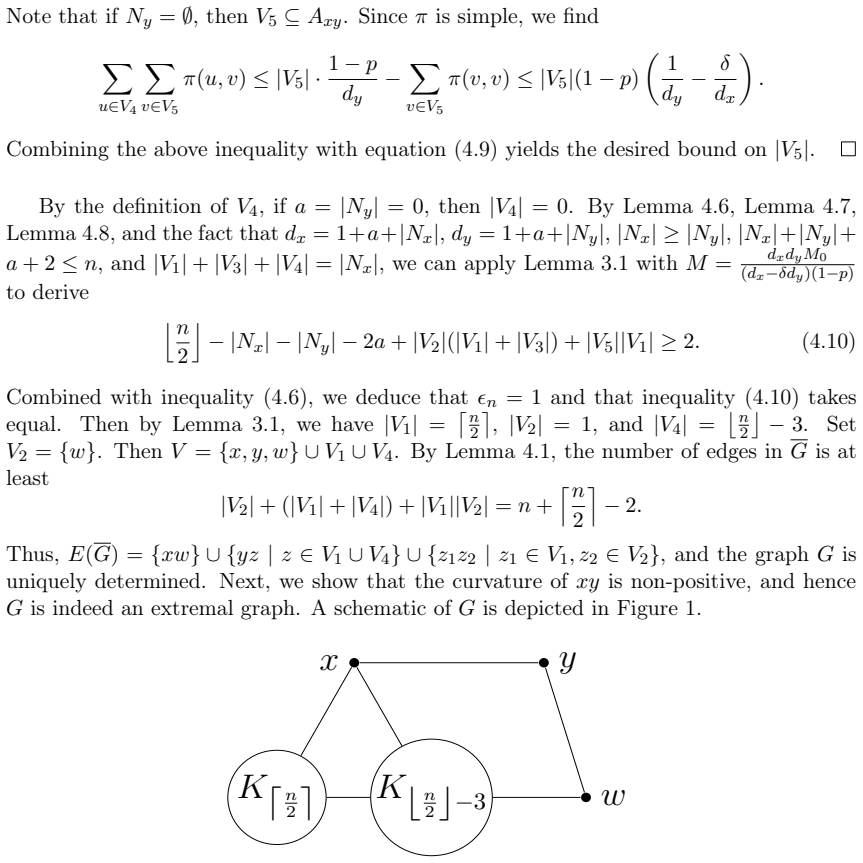
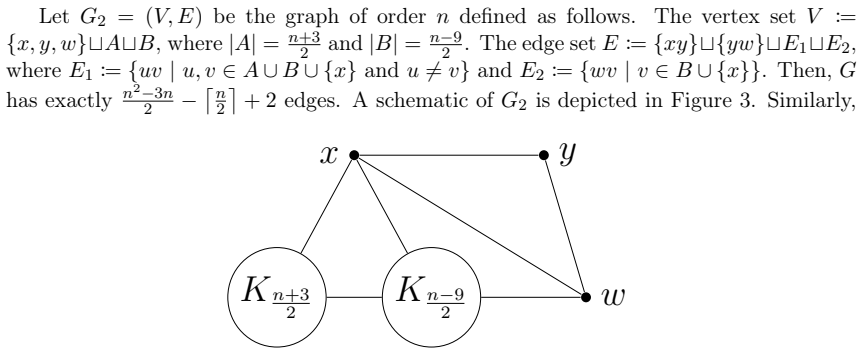
We prove an extremal theorem for positive Ollivier/Lin--Lu--Yau curvature: every graph of order n≥8 with more than T(n)=(n²-3n)/2 - ceil(n/2) +2 edges has positive Ollivier/Lin--Lu--Yau curvature, and this threshold is optimal. Moreover, for even n≥12, there exists a unique graph with T(n) edges that has an edge with non-positive curvature. For n=8,10 and odd n≥9, the extremal graphs are not unique.
What carries the argument
The extremal edge count T(n) that separates graphs guaranteed to have all positive Ollivier/Lin-Lu-Yau curvature edges from those permitted to contain a non-positive curvature edge.
If this is right
- Any graph with more than T(n) edges has positive curvature on every edge.
- The bound T(n) is achieved by graphs containing at least one non-positive curvature edge.
- For even n at least 12 the graph achieving T(n) edges while having a non-positive curvature edge is unique.
- Multiple distinct graphs achieve T(n) edges with a non-positive curvature edge when n equals 8 or 10 or is odd and at least 9.
Where Pith is reading between the lines
- The suggestion of a new class of curvature-defined extremal problems implies that analogous sharp thresholds may exist when Ollivier curvature is replaced by other discrete curvature notions.
- The explicit form of T(n) may allow rephrasing the curvature condition as the avoidance of certain local edge configurations, potentially linking the result to classical extremal graph theory.
Load-bearing premise
Optimality requires that there exist graphs with exactly T(n) edges containing at least one edge of non-positive curvature whose curvature values have been correctly computed.
What would settle it
A single graph on n vertices with more than T(n) edges that still contains an edge of non-positive Ollivier/Lin-Lu-Yau curvature would disprove the theorem.
Figures



read the original abstract
We prove an extremal theorem for positive Ollivier/Lin--Lu--Yau curvature: every graph of order \(n\geq 8\) with more than \[ T(n)=\frac{n^2-3n}{2}-\left\lceil\frac{n}{2}\right\rceil+2 \] edges has positive Ollivier/Lin--Lu--Yau curvature, and this threshold is optimal. Moreover, for even $n\geq 12$, there exists a unique graph with $T(n)$ edges that has an edge with non-positive curvature. For $n=8,10$ and odd $n\geq 9$, the extremal graphs are not unique. This suggests a new class of extremal graph-theoretic problems arising from discrete curvature notions.
Editorial analysis
A structured set of objections, weighed in public.
Referee Report
Summary. The manuscript proves that every graph on n≥8 vertices with more than T(n)=(n²-3n)/2 - ⌈n/2⌉ +2 edges has positive Ollivier/Lin-Lu-Yau curvature on every edge, and that the threshold T(n) is optimal because there exist graphs with exactly T(n) edges containing at least one edge of non-positive curvature. For even n≥12 the extremal graph is claimed to be unique; for n=8,10 and odd n≥9 the extremal graphs are not unique.
Significance. If correct, the result supplies the first sharp extremal threshold for the property that all edges have positive Ollivier/Lin-Lu-Yau curvature. It therefore initiates a new family of curvature-driven extremal problems in graph theory and supplies concrete, computable bounds that can be tested against known curvature formulas.
major comments (1)
- The optimality statement (that T(n) is sharp) rests on explicit constructions of graphs with exactly T(n) edges together with a verification that at least one edge has non-positive curvature. Because this verification is load-bearing for the sharpness claim and no machine-checked enumeration or independent curvature computation is supplied, the manuscript must include a self-contained calculation of the curvature values on the claimed extremal graphs (particularly the unique graph asserted for even n≥12).
Simulated Author's Rebuttal
We thank the referee for the careful reading and the constructive comment on strengthening the optimality claim. We respond point-by-point below.
read point-by-point responses
-
Referee: The optimality statement (that T(n) is sharp) rests on explicit constructions of graphs with exactly T(n) edges together with a verification that at least one edge has non-positive curvature. Because this verification is load-bearing for the sharpness claim and no machine-checked enumeration or independent curvature computation is supplied, the manuscript must include a self-contained calculation of the curvature values on the claimed extremal graphs (particularly the unique graph asserted for even n≥12).
Authors: We agree that the sharpness of T(n) requires explicit, self-contained verification of non-positive curvature on at least one edge of each extremal construction. In the revised manuscript we will add a dedicated subsection containing the full curvature computations (using the standard Ollivier/Lin-Lu-Yau formula) for the unique extremal graph when n is even and ≥12, as well as for the representative constructions in the remaining cases. These calculations will be presented step-by-step so that they can be checked directly from the text. revision: yes
Circularity Check
No significant circularity; direct proof with explicit extremal examples
full rationale
The derivation consists of a direct proof that graphs exceeding the explicit combinatorial threshold T(n) must have positive Ollivier/Lin-Lu-Yau curvature on all edges, together with separate verification of optimality by constructing specific graphs attaining T(n) edges and computing their curvature signs. No step reduces a claimed prediction to a fitted input by construction, no self-citation is invoked as a load-bearing uniqueness theorem, and the formula for T(n) is stated independently of the curvature sign. The explicit construction for optimality is a standard non-circular verification step rather than a re-derivation.
Axiom & Free-Parameter Ledger
axioms (1)
- domain assumption Ollivier/Lin-Lu-Yau curvature is defined on graphs via the standard formula involving Wasserstein distance between neighbor measures.
Reference graph
Works this paper leans on
-
[1]
Ollivier Ricci curvature on graphs obtained by removing edges from complete graphs
Y. Asai and T. Yamada, Ollivier Ricci curvature on graphs obtained by removing edges from complete graphs, arXiv preprint arXiv:2605.30830 (2026)
work page internal anchor Pith review Pith/arXiv arXiv 2026
-
[2]
Bakry and M
D. Bakry and M. Émery, Diffusions hypercontractives, Séminaire de probabilités, XIX, 1983/84, 177–206, Lecture Notes in Math. 1123, Springer, Berlin, 1985
1983
-
[3]
Bollobás,Extremal graph theory, reprint of the 1978 original, Dover, Mineola, NY, 2004
B. Bollobás,Extremal graph theory, reprint of the 1978 original, Dover, Mineola, NY, 2004
1978
-
[4]
D. P. Bourne, D. Cushing, S. Liu, F. Münch and N. Peyerimhoff, Ollivier-Ricci idleness functions of graphs, SIAM J. Discrete Math. 32(2) (2018) 1408-1424
2018
-
[5]
K. Chen, S. Liu, Z. You, Connectivity versus Lin–Lu–Yau curvature, Int. Math. Res. Not., 19 (2025), rnaf303
2025
-
[6]
K. Chen, S. Liu, Z. You, Criteria on forbidden subgraphs in the complements for positive Lin–Lu–Yau curvature, arXiv preprint arXiv: 2605.03470 (2026)
work page internal anchor Pith review Pith/arXiv arXiv 2026
-
[7]
Cushing, S
D. Cushing, S. Kamtue, J. H. Koolen, S. Liu, F. Münch, N. Peyerimhoff, Rigidity of the Bonnet-Myers inequality for graphs with respect to Ollivier Ricci curvature, Adv. Math. 369 (2020), 107188
2020
-
[8]
Cushing, R
D. Cushing, R. Kangaslampi, V. Lipiäinen, S. Liu and G. W. Stagg, The graph cur- vature calculator and the curvatures of cubic graphs, Exp. Math. 31 (2022), no. 2, 583-595
2022
-
[9]
K.Devriendt, R.Lambiotte, Discretecurvatureongraphsfromtheeffectiveresistance, J. Phys. Complex. 3 (2) (2022) 025008
2022
-
[10]
Füredi and M
Z. Füredi and M. Simonovits, The history of degenerate (bipartite) extremal graph problems, inErdös centennial, 169–264, Bolyai Soc. Math. Stud., 25, János Bolyai Math. Soc., Budapest
-
[11]
1, Paper No
M.Hehl, RegulargraphswithpositiveOllivier-Riccicurvature, Math.Ann.394(2026), no. 1, Paper No. 24, 28 pp
2026
-
[12]
Y. Li, W. J. Liu and L. H. Feng, A survey on spectral conditions for some extremal graph problems, Adv. Math. (China)51(2022), no. 2, 193–258
2022
-
[13]
Y. Lin, L. Lu and S.-T. Yau, Ricci curvature of graphs, Tohoku Math. J. 63 (2011), no. 4, 605-627
2011
-
[14]
Lin and S.-T
Y. Lin and S.-T. Yau, Ricci curvature and eigenvalue estimate on locally finite graphs, Math. Res. Lett. 17 (2010), no. 2, 343-356. 18
2010
-
[15]
Münch and R
F. Münch and R. Wojciechowski, Ollivier Ricci curvature for general graph Laplacians: heatequation, Laplaciancomparison, non-explosionanddiameterbounds, Adv.Math. 356 (2019), 106759, 45 pp
2019
-
[16]
Najman and P
L. Najman and P. Romon (Eds), Modern approaches to discrete curvature, Lecture Notes in Math., 2184, Springer, Cham, 2017
2017
-
[17]
Nikiforov, Some new results in extremal graph theory, inSurveys in combinatorics 2011, 141–181, London Math
V. Nikiforov, Some new results in extremal graph theory, inSurveys in combinatorics 2011, 141–181, London Math. Soc. Lecture Note Ser., 392, Cambridge Univ. Press, Cambridge
2011
-
[18]
Ollivier, Ricci curvature of Markov chains on metric spaces, J
Y. Ollivier, Ricci curvature of Markov chains on metric spaces, J. Funct. Anal. 256 (2009), no. 3, 810-864. 19
2009
discussion (0)
Sign in with ORCID, Apple, or X to comment. Anyone can read and Pith papers without signing in.