A PDE-Based Framework for Generative Modeling Beyond Classical Score-Based Diffusion
Pith reviewed 2026-07-03 07:29 UTC · model grok-4.3
The pith
A nonlinear modification of Ornstein-Uhlenbeck dynamics yields a stabilized reverse-time PDE that reconstructs initial distributions from asymptotic condensed states.
A machine-rendered reading of the paper's core claim, the machinery that carries it, and where it could break.
Core claim
By introducing a nonlinear modification of the classical Ornstein-Uhlenbeck dynamics that admits both a particle-system and a mean-field nonlinear Fokker-Planck description with superlinear drift, the forward process reaches an asymptotic state from which a stabilized reverse-time partial differential equation reconstructs the initial distribution, thereby extending the generative paradigm beyond the classical score-based framework.
What carries the argument
The stabilized reverse-time partial differential equation obtained by reversing the nonlinear Fokker-Planck equation with superlinear drift term.
If this is right
- For suitable parameters and sufficiently large initial mass the forward dynamics loses L2 regularity in finite time through condensation.
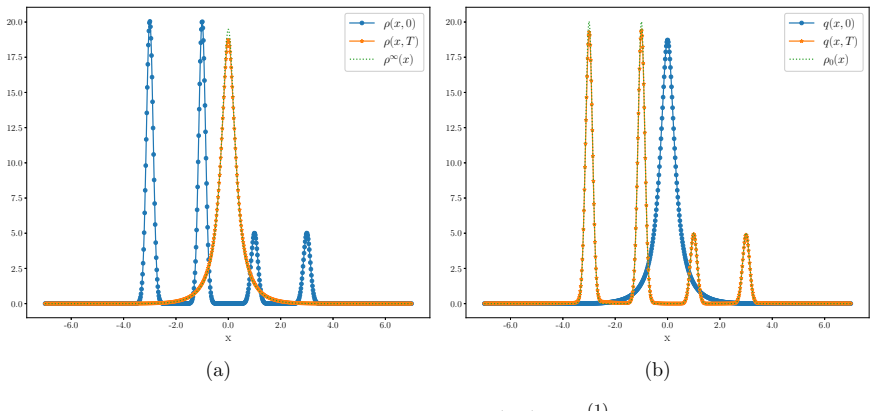
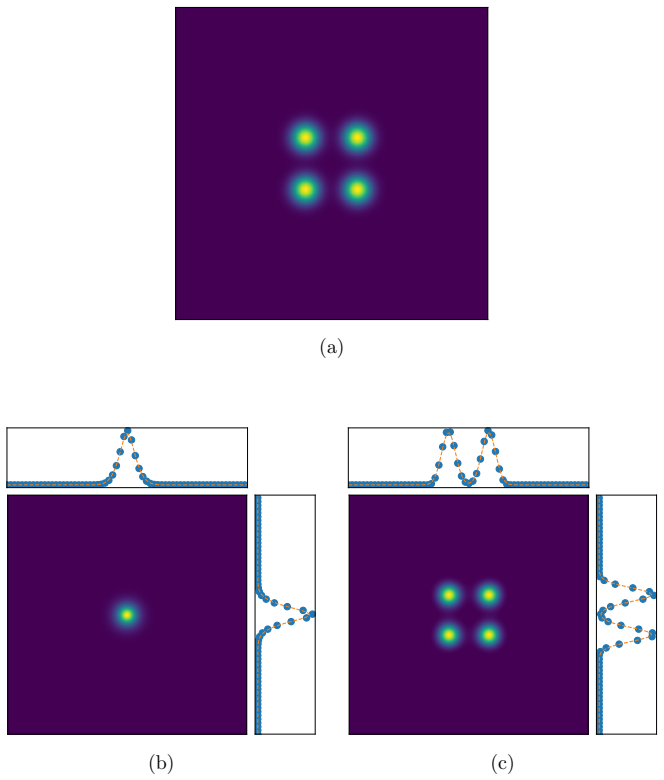
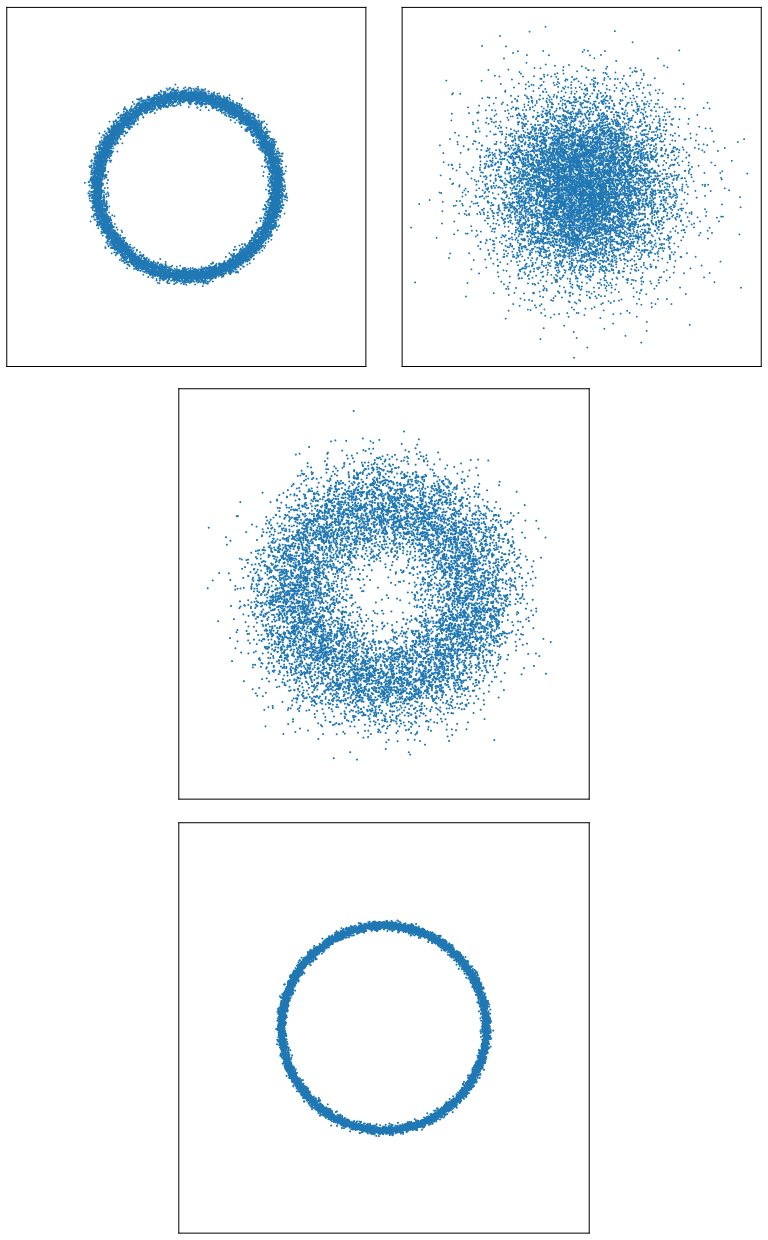
- Numerical discretizations of the forward and reverse processes accurately reproduce the continuous model's asymptotic behavior and recover the initial distribution.
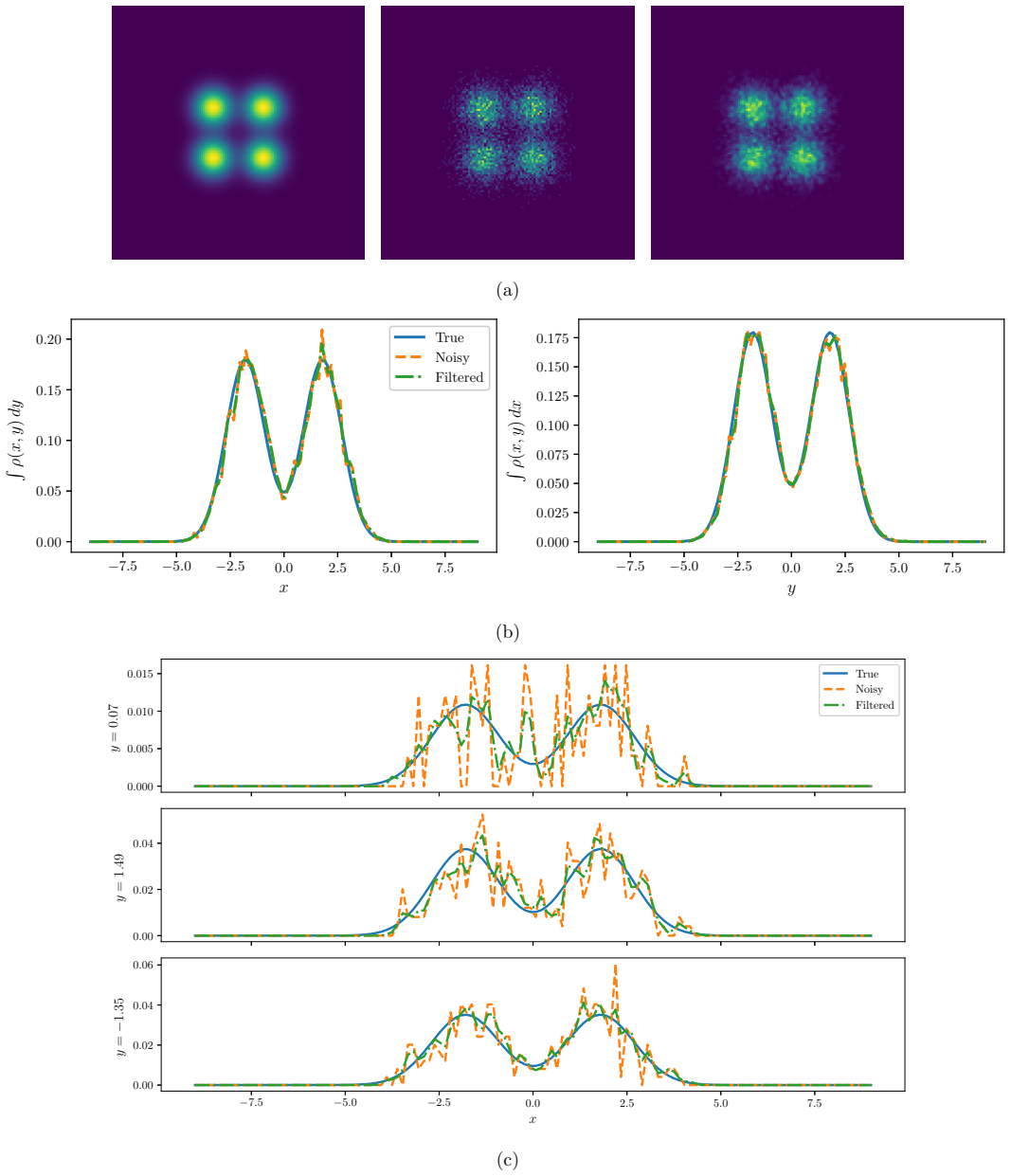
- Iterated application of the generative process performs density filtering.
- The method is demonstrated by experiments in one and two spatial dimensions.
Where Pith is reading between the lines
- The condensation mechanism may offer an alternative route to stable high-dimensional sampling that avoids explicit score estimation.
- Similar nonlinear drifts could be substituted to produce different condensation rates or target measures while preserving the reverse reconstruction property.
- The framework invites comparison with other mean-field limits of interacting particles to identify which nonlinearities permit reliable reverse-time recovery.
Load-bearing premise
The interacting particle system admits a mean-field limit given exactly by the nonlinear Fokker-Planck equation with superlinear drift term.
What would settle it
A concrete counterexample in which the proposed reverse-time PDE produces a density that differs substantially from the known initial distribution when the forward process is run to its asymptotic state.
Figures



read the original abstract
We introduce an alternative generative framework based on a nonlinear modification of the classical Ornstein--Uhlenbeck dynamics. The proposed dynamics admits both a microscopic description through an interacting particle system and, in the mean-field limit, a macroscopic formulation given by a nonlinear Fokker--Planck equation with a superlinear drift term. We show that, for suitable choices of the model parameters and sufficiently large initial mass, the forward dynamics exhibits condensation phenomena by proving the loss of $L^2$ regularity of the solution in finite time. Building upon this formulation, we derive a stabilized reverse-time partial differential equation that reconstructs the initial distribution from the asymptotic state of the forward dynamics, thereby extending the generative paradigm beyond the classical score-based framework. Furthermore, we introduce numerical discretizations of both the forward and reverse processes that accurately capture the asymptotic behavior of the continuous model while successfully reconstructing the initial distribution. Numerical experiments in one and two spatial dimensions validate the proposed methodology and illustrate its application to density filtering through successive iterations of the generative process.
Editorial analysis
A structured set of objections, weighed in public.
Referee Report
Summary. The paper introduces a nonlinear modification of the Ornstein-Uhlenbeck process for generative modeling. It connects an interacting particle system to a macroscopic nonlinear Fokker-Planck equation with superlinear drift in the mean-field limit, proves finite-time loss of L² regularity (condensation) for large initial mass, derives a stabilized reverse-time PDE that reconstructs the initial distribution from the asymptotic condensed state, and presents numerical discretizations validated in 1D and 2D experiments for density reconstruction and filtering.
Significance. If the mean-field limit and reverse PDE derivation hold rigorously, the framework provides a non-score-based generative paradigm grounded in condensation phenomena, with potential for new reconstruction methods; the numerical validation and explicit connection between microscopic and macroscopic descriptions are strengths.
major comments (1)
- [Abstract and mean-field limit derivation] The central reconstruction claim relies on using the nonlinear Fokker-Planck equation (with superlinear drift) as the macroscopic description for deriving the stabilized reverse-time PDE. However, the mean-field limit from the interacting particle system is invoked without justification under the condensation regime: the paper proves loss of L² regularity in finite time for large initial mass, but standard mean-field arguments (propagation of chaos, tightness) require uniform integrability or moment bounds that fail precisely when L² regularity collapses. No alternative verification (e.g., relative entropy or coupling) is indicated.
minor comments (2)
- [Model parameters section] Clarify the precise parameter regime (nonlinearity strength, drift coefficient, initial mass threshold) under which both condensation and the mean-field limit are claimed to hold simultaneously.
- [Numerical experiments] The numerical experiments section should include quantitative error metrics (e.g., Wasserstein distance or L² reconstruction error) comparing the reverse process output to the true initial distribution across multiple runs.
Simulated Author's Rebuttal
We thank the referee for the thorough review and constructive criticism. The main concern is the justification of the mean-field limit under the condensation regime where L² regularity is lost. We address this point below and indicate the revisions we will make to clarify the scope of the mean-field derivation while preserving the core contribution of the stabilized reverse PDE at the macroscopic level.
read point-by-point responses
-
Referee: [Abstract and mean-field limit derivation] The central reconstruction claim relies on using the nonlinear Fokker-Planck equation (with superlinear drift) as the macroscopic description for deriving the stabilized reverse-time PDE. However, the mean-field limit from the interacting particle system is invoked without justification under the condensation regime: the paper proves loss of L² regularity in finite time for large initial mass, but standard mean-field arguments (propagation of chaos, tightness) require uniform integrability or moment bounds that fail precisely when L² regularity collapses. No alternative verification (e.g., relative entropy or coupling) is indicated.
Authors: We agree that the mean-field limit requires careful justification precisely when condensation occurs. In the manuscript the interacting-particle to nonlinear Fokker-Planck convergence is established in the pre-condensation regime where the requisite moment and integrability bounds hold; the subsequent loss of L² regularity is proved directly for the macroscopic PDE. The stabilized reverse-time PDE is then derived entirely at the level of this nonlinear Fokker-Planck equation, independent of the particle system. The particle description is used to motivate the model and to furnish the numerical scheme. We will revise the text to (i) explicitly separate the pre-condensation mean-field result from the post-condensation PDE analysis, (ii) state that the mean-field limit in the condensed regime is formal, and (iii) note that alternative justifications (relative-entropy or coupling methods) remain open questions for future work. These clarifications will be added to the introduction, the mean-field section, and the derivation of the reverse PDE. revision: partial
Circularity Check
No significant circularity; derivation proceeds from forward nonlinear FP to reverse PDE without definitional reduction
full rationale
The paper introduces a nonlinear OU modification, invokes the mean-field limit to obtain the nonlinear Fokker-Planck equation, proves finite-time L2 loss (condensation), and derives a stabilized reverse-time PDE from that forward equation to reconstruct the initial distribution. No quoted step shows a fitted parameter renamed as prediction, a self-definitional loop, or a load-bearing self-citation chain that reduces the central claim to its own inputs by construction. The mean-field limit is stated as an assumption connecting microscopic to macroscopic descriptions, but the reverse-PDE derivation itself is presented as proceeding from the macroscopic equation without circular equivalence. This is the normal non-circular outcome for a derivation that remains independent of its fitted or assumed inputs.
Axiom & Free-Parameter Ledger
free parameters (1)
- model parameters controlling nonlinearity and drift strength
axioms (1)
- domain assumption The interacting particle system converges to the nonlinear Fokker-Planck equation in the mean-field limit
Reference graph
Works this paper leans on
-
[1]
Anderson, Reverse-time diffusion equation models, Stochastic Processes and their Applications, Volume 12, Issue 3, 1982, Pages 313-326, ISSN 0304-4149
B.D.O. Anderson, Reverse-time diffusion equation models, Stochastic Processes and their Applications, Volume 12, Issue 3, 1982, Pages 313-326, ISSN 0304-4149
1982
-
[2]
B. W. Silverman. Density estimation for statistics and data analysis. Routledge, 2018
2018
-
[3]
Bakry, I
D. Bakry, I. Gentil, M. Ledoux, et al. Analysis and geometry of Markov diffusion operators, volume 103. Springer, 2014
2014
-
[4]
Baranchuk, A
D. Baranchuk, A. Voynov, I. Rubachev, V. Khrulkov, and A. Babenko. Label-efficient semantic segmentation with diffusion models. In International Conference on Learning Representations, 2022
2022
-
[5]
J. A. Carrillo, K. Hopf, and J. L. Rodrigo. On the singularity formation and relaxation to equilibrium in 1D Fokker-Planck model with superlinear drift. Advances in Mathematics , 360:106883, 66, 2020
2020
-
[6]
H. Chen, H. Lee, J. Lu. Improved analysis of scorebased generative modeling: User-friendly bounds under minimal smoothness assumptions. In International Conference on Machine Learning, pages, 4735-4763. PMLR, 2023
2023
-
[7]
Calzola, G
E. Calzola, G. Dimarco, G. Toscani, and M. Zanella. Emergence of condensation patterns in kinetic equations for opinion dynamics. Physica D: Nonlinear Phenomena , 470:134356, 2024
2024
-
[8]
J. A. Carrillo, M. Fornasier, J. Rosado, and G. Toscani. Asymptotic flocking dynamics for the kinetic Cucker- Smale model. SIAM J. Math. Anal. , 42(1):218–236, 2010
2010
-
[9]
J. A. Carrillo, M. Fornasier, G. Toscani, and F. Vecil. Particle, kinetic, and hydrodynamic models of swarming. mathematical modeling of collective behavior in socio-economic and life sciences 297336. Model. Simul. Sci. Eng. Technol., Birkhuser Boston, Inc., Boston, MA , 2010
2010
- [10]
-
[11]
S. Chen, S. Chewi, J. Li, Y. Li, A. Salim, A. Zhang. Sampling is as easy as learning the score: theory for diffusion models with minimal data assumptions. In The Eleventh International Conference on Learning Representations, 2023
2023
-
[12]
Dieleman
S. Dieleman. Perspectives on diffusion. https://sander.ai/2023/07/20/perspectives.html, 2023
2023
-
[13]
Degond and S
P. Degond and S. Mas-Gallic. The weighted particle method for convection-diffusion equations. i. the case of an isotropic viscosity. Mathematics of computation , 53(188):485-507, 1989. 20
1989
-
[14]
Dhariwal, A
P. Dhariwal, A. Nichol. Diffusion models beat gans on image synthesis. Advances in neural information processing systems, 34:878-8794, 2021. 8794, 2021
2021
-
[15]
Durkan, S
C. Durkan, S. Ermon, I. Murray, and Y. Song. Maximum likelihood training of score-based diffusion models. Advances in neural information processing systems , 34:1415-1428, 2021
2021
-
[16]
Doucet, V
A. Doucet, V. De Bortoli, J. Heng, and J. Thornton. Diffusion schrödinger bridge with applications to score- based generative modeling. Advances in Neural Information Processing Systems , 34:17695-17709, 2021
2021
-
[17]
Franceschi, L
J. Franceschi, L. Pareschi, and M. Zanella. Superlinear drift in consensus-based optimization with condensa- tion phenomena. ESAIM: Control, Optimisation and Calculus of Variations , forthcoming, 2026
2026
-
[18]
C. Fiedler, M. Herty, M. Rom, C. Segala, S. Trimpe. Reproducing kernel Hilbert spaces in the mean field limit. Kinetic and Related Models , 2023, 16(6): 850-870. doi: 10.3934/krm.2023010
-
[19]
F. Golse. The mean-field limit for the dynamics of large particle systems. In Journées Équations aux Dérivées Partielles, pages Exp. No. IX, 47. Univ. Nantes, Nantes, 2003
2003
-
[20]
S. Gong, M. Li, J. Feng, Z. Wu, L.P. Kong. Diffuseq: Sequence to sequence text generation with diffusion models. arXiv preprint arXiv:2210.08933 , 2022
work page internal anchor Pith review Pith/arXiv arXiv 2022
-
[21]
J. Ho, A. N. Jain, and P. Abbeel. Denoising Diffusion Probabilistic Models. Advances in Neural Information Processing Systems, 33 (NeurIPS 2020), 2020
2020
-
[22]
J. Ho, T. Salimans, A. Gritsenko, W. Chan, M. Norouzi, and D. J. Fleet. Video diffusion models. Advances in Neural Information Processing Systems , 35:8633-8646, 2022
2022
-
[23]
Kaniadakis, P
G. Kaniadakis, P. Quarati. Classical model of bosons and fermions. Phys. Rev. E , 49, 5103–5110 (1994)
1994
- [24]
-
[25]
Karras, M
T. Karras, M. Aittala, T. Aila, and S. Laine. Elucidating the design space of diffusion-based generative models. Advances in neural information processing systems , 35:26565-26577, 2022
2022
-
[26]
Z. Kong, W. Ping, J. Huang, K. Zhao, and B. Catanzaro. Diffwave: A versatile diffusion model for audio synthesis. In International Conference on Learning Representations , 2021
2021
-
[27]
A PDE Perspective on Generative Diffusion Models
K. Liu, and E. Zuazua. A PDE Perspective on Generative Diffusion Models (2025). ArXiv, abs/2511.05940
work page internal anchor Pith review Pith/arXiv arXiv 2025
-
[28]
X. Li, J. Thickstun, I. Gulrajani, P. S. Liang, and T. B. Hashimoto. Diffusion-lm improves controllable text generation. Advances in Neural Information Processing Systems , 35:4328–4343, 2022
2022
-
[29]
A. Q. Nichol and P. Dhariwal. Improved denoising diffusion probabilistic models. In International conference on machine learning , pages 8162–8171. PMLR, 2021
2021
-
[30]
Poole, A
B. Poole, A. Jain, J. T. Barron, and B. Mildenhall. Dreamfusion: Text-to-3d using 2d diffusion. In The Eleventh International Conference on Learning Representations , 2023
2023
-
[31]
Popov, I
V. Popov, I. Vovk, V. Gogoryan, T. Sadekova, and M. Kudinov. Grad-tts: A diffusion probabilistic model for text-tospeech. In Marina Meila and Tong Zhang, editors, Proceedings of the 38th International Conference on Machine Learning, volume 139 of Proceedings of Machine Learning Research, pages 8599–8608. PMLR, 18–24 Jul 2021
2021
-
[32]
Y. Song, S. Ermon. Generative modeling by estimating gradients of the data distribution. Advances in neural information processing systems , 32, 2019
2019
-
[33]
Y. Song, S. Ermon. Improved techniques for training scorebased generative models. Advances in neural in- formation processing systems , 33:12438–12448, 2020. 21
2020
-
[34]
Shawe-Taylor, N
J. Shawe-Taylor, N. Cristianini, et al., Kernel methods for pattern analysis , Cambridge university press, 2004
2004
-
[35]
Sohl-Dickstein, E
J. Sohl-Dickstein, E. Weiss, N. Maheswaranathan, and S. Ganguli. Deep unsupervised learning using nonequi- librium thermodynamics. In International conference on machine learning , pages 2256–2265. PMLR, 2015
2015
-
[36]
Y. Song, J. Sohl-Dickstein, D. P. Kingma, A. Kumar, S. Ermon, and B. Poole. Score-based generative modeling through stochastic differential equations. arXiv preprint arXiv:2011.13456 , 2020
work page internal anchor Pith review Pith/arXiv arXiv 2011
-
[37]
Saharia, W
C. Saharia, W. Chan, H. Chang, C. Lee, J. Ho, T. Salimans, D. Fleet, and M. Norouzi. Palette: Image-toimage diffusion models. In ACM SIGGRAPH 2022 conference proceedings , pages 1–10, 2022
2022
-
[38]
A. Thiery. Denoising diffusion probabilistic models. https://alexxthiery.github.io/notes/DDPM/DDPM.html, 2023
2023
-
[39]
Toscani, Kinetic models of opinion formation, Commun
G. Toscani, Kinetic models of opinion formation, Commun. Math. Sci., 4 (2006), pp. 481–496
2006
-
[40]
Toscani, M
G. Toscani, M. Zanella. Supercritical Fokker-Planck equations for consensus dynamics: large-time behaviour and weighted Nash-type inequalities. Ricerche mat 75, 405-429 (2026)
2026
-
[41]
L. Weng. What are diffusion models? https://lilianweng.github. io/posts/2021-07-11-diffusion-models/, Jul 2021. 22
2021
discussion (0)
Sign in with ORCID, Apple, or X to comment. Anyone can read and Pith papers without signing in.