Measurement-Driven Learning-Based Beam Selection for Hybrid Beamforming at 26.5 GHz
Pith reviewed 2026-06-30 04:09 UTC · model grok-4.3
The pith
Channel measurements at 26.5 GHz train models that predict the SNR-optimal beam for hybrid beamforming without exhaustive search.
A machine-rendered reading of the paper's core claim, the machinery that carries it, and where it could break.
Core claim
Trained on real 26.5 GHz measurements, the learning models approximate the SNR-optimal transmit beam obtained by exhaustive sweeping, delivering high prediction accuracy while cutting beam-search overhead in an indoor hybrid-beamforming system.
What carries the argument
Supervised learning formulation that maps either spatial geometry or limited pilot measurements to the optimal beam index.
If this is right
- Beam search overhead drops substantially relative to exhaustive sweeping while maintaining high SNR.
- The pilots-only method removes the need for positional information during inference.
- The approach applies directly to hybrid beamforming architectures with joint transmission.
- Measurement-driven training replaces analytical channel models for beam selection.
Where Pith is reading between the lines
- If the models generalize, similar measurement campaigns could reduce training cost for other mmWave frequencies or array sizes.
- Real-time deployment would require periodic re-measurement to track environmental changes.
- Combining the geometry-driven and pilots-only predictors might further improve robustness without extra pilots.
Load-bearing premise
The channel data gathered in one office corridor environment is representative enough for the trained models to work in other indoor settings.
What would settle it
Retraining and testing the same models on measurements from a different indoor layout or larger room and observing prediction accuracy drop below the level reported for the corridor.
Figures


read the original abstract
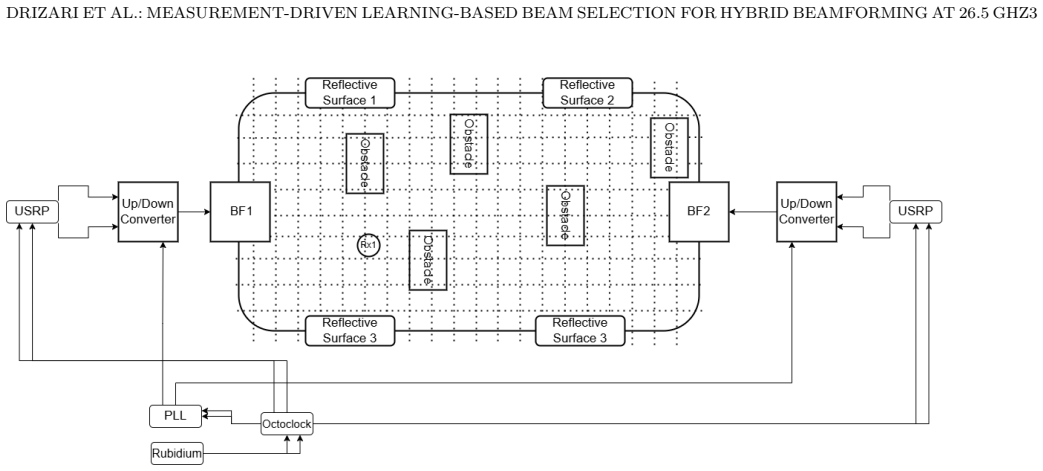
This paper investigates learning-assisted transmit beam selection for indoor millimeter-wave (mmWave) systems operating with hybrid beamforming and joint transmission. A synchronized SDR-based testbed at 26.5 GHz band is deployed to collect wideband channel measurements in a realistic office corridor environment. Using the measurement dataset, beam selection is formulated as a supervised learning problem aiming to approximate the SNR-optimal beam obtained through exhaustive sweeping. Two complementary approaches are examined: a geometry-driven Deep Neural Network (DNN) that predicts the optimal beam from spatial features, and a pilots-only method that infers suitable beams using a limited number of sounded pilot beams without positional information. Experimental results demonstrate high prediction accuracy and significant reduction in beam search overhead compared to exhaustive sweeping, highlighting the effectiveness of measurement-driven learning for practical indoor mmWave beam management.
Editorial analysis
A structured set of objections, weighed in public.
Referee Report
Summary. The paper claims that supervised learning can approximate SNR-optimal beam selection for hybrid beamforming in indoor mmWave systems. Using real wideband channel measurements collected at 26.5 GHz with a synchronized SDR testbed in one office corridor, it trains a geometry-driven DNN on spatial features and a pilots-only inference method on limited sounded beams. Experimental results are reported to show high prediction accuracy and substantial reduction in beam search overhead relative to exhaustive sweeping, supporting the utility of measurement-driven learning for practical indoor mmWave beam management.
Significance. If the reported accuracies and overhead reductions hold under the stated conditions, the work supplies concrete empirical evidence that data-driven beam selection can reduce the cost of exhaustive search in a realistic indoor mmWave setting. The use of synchronized hardware measurements rather than ray-tracing or stochastic models is a clear strength, as is the joint consideration of hybrid beamforming and the two complementary learning formulations (spatial-feature DNN and pilots-only).
major comments (2)
- [Abstract and experimental-results section] Abstract and experimental-results section: the framing that the results demonstrate 'effectiveness ... for practical indoor mmWave beam management' is load-bearing for the paper's contribution claim, yet all measurements come from a single office-corridor deployment. No cross-environment validation, no sensitivity analysis to changes in geometry or scattering, and no additional indoor layouts are provided, so the reported metrics remain tied to the propagation conditions of that specific corridor.
- [Experimental-results section] Experimental-results section: the manuscript supplies no dataset size, no description of train/validation/test splits, no error bars or confidence intervals on the accuracy figures, and no model hyperparameters or training details. These omissions prevent assessment of whether the claimed high prediction accuracy is statistically supported or reproducible.
minor comments (1)
- [Methods section] Notation for the two learning formulations (DNN vs. pilots-only) should be introduced with explicit equations or pseudocode early in the methods section to improve readability.
Simulated Author's Rebuttal
We thank the referee for the constructive feedback on our manuscript. We address the major comments point-by-point below, proposing revisions to improve clarity and completeness.
read point-by-point responses
-
Referee: [Abstract and experimental-results section] Abstract and experimental-results section: the framing that the results demonstrate 'effectiveness ... for practical indoor mmWave beam management' is load-bearing for the paper's contribution claim, yet all measurements come from a single office-corridor deployment. No cross-environment validation, no sensitivity analysis to changes in geometry or scattering, and no additional indoor layouts are provided, so the reported metrics remain tied to the propagation conditions of that specific corridor.
Authors: We agree that the experimental results are specific to the single office corridor environment in which the measurements were collected. To address this concern, we will revise the abstract and the relevant sections to qualify our claims, emphasizing that the demonstrated effectiveness applies to the measured indoor corridor setting. We will also add a discussion noting the limitations regarding generalizability and suggesting multi-environment validation as future work. This revision will better align the framing with the scope of the presented experiments. revision: partial
-
Referee: [Experimental-results section] Experimental-results section: the manuscript supplies no dataset size, no description of train/validation/test splits, no error bars or confidence intervals on the accuracy figures, and no model hyperparameters or training details. These omissions prevent assessment of whether the claimed high prediction accuracy is statistically supported or reproducible.
Authors: We acknowledge these omissions in the current manuscript. In the revised version, we will add the necessary details: the total number of channel measurements in the dataset, the train/validation/test split ratios and methodology, error bars or confidence intervals for the accuracy results, and a description of the DNN hyperparameters along with the training procedure. These additions will be included in the experimental results section or a dedicated appendix to ensure reproducibility. revision: yes
Circularity Check
No significant circularity; purely empirical measurement-driven approach
full rationale
The manuscript describes collection of channel measurements in a single office corridor environment at 26.5 GHz, followed by formulation of beam selection as a supervised learning task (DNN from spatial features or pilots-only inference) trained on that dataset. No derivation chain, equations, or fitted parameters are presented that reduce by construction to the inputs; results are reported accuracy and overhead metrics obtained directly from the empirical data. No self-citations are invoked as load-bearing uniqueness theorems or ansatzes. This is a standard measurement-driven ML setup whose central claims rest on the collected data rather than any self-referential reduction, so the derivation (such as it is) is self-contained.
Axiom & Free-Parameter Ledger
Reference graph
Works this paper leans on
-
[1]
Overview of millimeter wave communications for fifth-generation (5g) wireless networks—with a focus on propagation models,
T. S. Rappaport, Y. Xing, G. R. MacCartney, A. F. Molisch, E. Mellios, and J. Zhang, “Overview of millimeter wave communications for fifth-generation (5g) wireless networks—with a focus on propagation models,” IEEE Transactions on Antennas and Propagation, vol. 65, no. 12, pp. 6213–6230, 2017
2017
-
[2]
Millimeter-wave cellular wireless networks: Potentials and challenges,
S. Rangan, T. S. Rappaport, and E. Erkip, “Millimeter-wave cellular wireless networks: Potentials and challenges,” Proceedings of the IEEE, vol. 102, no. 3, pp. 366–385, 2014
2014
-
[3]
An introduction to millimeter-wave mobile broadband systems,
Z. Pi and F. Khan, “An introduction to millimeter-wave mobile broadband systems,” IEEE Communications Magazine, vol. 49, no. 6, pp. 101–107, 2011
2011
-
[4]
Comprehensive analysis of maximum power associ- ation policy for cellular networks using distance and angular coordinates,
H. K. Armeniakos, A. G. Kanatas, and H. S. Dhillon, “Comprehensive analysis of maximum power associ- ation policy for cellular networks using distance and angular coordinates,” IEEE Transactions on Wireless Communications, vol. 23, no. 9, pp. 12 189–12 205, 2024
2024
-
[5]
Indoor office wideband millimeter-wave propagation measurements and channel models at 28 and 73 ghz for ultra-dense 5g wireless networks,
G. R. Maccartney, T. S. Rappaport, S. Sun, and S. Deng, “Indoor office wideband millimeter-wave propagation measurements and channel models at 28 and 73 ghz for ultra-dense 5g wireless networks,” IEEE Access, vol. 3, pp. 2388–2424, 2015
2015
-
[6]
Millimeter wave mobile communications for 5g cellular: It will work!
T. S. Rappaport, S. Sun, R. Mayzus, H. Zhao, Y. Azar, K. Wang, G. N. Wong, J. K. Schulz, M. Samimi, and F. Gutierrez, “Millimeter wave mobile communications for 5g cellular: It will work!” IEEE Access, vol. 1, pp. 335–349, 2013
2013
-
[8]
Hybrid precoding for millimeter wave cellular systems with partial channel knowledge,
A. Alkhateeb, O. El Ayach, G. Leus, and R. W. Heath, “Hybrid precoding for millimeter wave cellular systems with partial channel knowledge,” in 2013 Information Theory and Applications Workshop (ITA), 2013, pp. 1–5
2013
-
[9]
An overview of signal processing techniques for millimeter wave mimo systems,
R. W. Heath, N. González-Prelcic, S. Rangan, W. Roh, and A. M. Sayeed, “An overview of signal processing techniques for millimeter wave mimo systems,” IEEE Journal of Selected Topics in Signal Processing, vol. 10, no. 3, pp. 436–453, 2016
2016
-
[10]
Hybrid beamforming for massive mimo: A survey,
A. F. Molisch, V. V. Ratnam, S. Han, Z. Li, S. L. H. Nguyen, L. Li, and K. Haneda, “Hybrid beamforming for massive mimo: A survey,” IEEE Communications Magazine, vol. 55, no. 9, pp. 134–141, 2017
2017
-
[11]
Hybrid analog and digital beamforming for mmwave ofdm large-scale antenna arrays,
F. Sohrabi and W. Yu, “Hybrid analog and digital beamforming for mmwave ofdm large-scale antenna arrays,” IEEE Journal on Selected Areas in Communications, vol. 35, no. 7, pp. 1432–1443, 2017
2017
-
[12]
Mixed near- and far-field communications for extremely large-scale array: An interference perspective,
Y. Zhang, C. You, L. Chen, and B. Zheng, “Mixed near- and far-field communications for extremely large-scale array: An interference perspective,” IEEE Communications Letters, vol. 27, no. 9, pp. 2496–2500, 2023
2023
-
[13]
Angular distance-based performance analysis of mmwave cellular networks,
C. K. Armeniakos and A. G. Kanatas, “Angular distance-based performance analysis of mmwave cellular networks,” in GLOBECOM 2022 - 2022 IEEE Global Communications Conference, 2022, pp. 5432–5437
2022
-
[14]
Beam codebook based beamforming protocol for multi-gbps millimeter-wave wpan systems,
J. Wang, Z. Lan, C. woo Pyo, T. Baykas, C. sean Sum, M. Rahman, J. Gao, R. Funada, F. Kojima, H. Harada, and S. Kato, “Beam codebook based beamforming protocol for multi-gbps millimeter-wave wpan systems,” IEEE Journal on Selected Areas in Communications, vol. 27, no. 8, pp. 1390–1399, 2009
2009
-
[15]
Millimeter wave beamforming for wireless backhaul and access in small cell networks,
S. Hur, T. Kim, D. J. Love, J. V. Krogmeier, T. A. Thomas, and A. Ghosh, “Millimeter wave beamforming for wireless backhaul and access in small cell networks,” IEEE Transactions on Communications, vol. 61, no. 10, pp. 4391–4403, 2013
2013
-
[16]
Machine learning for reliable mmwave systems: Blockage prediction and proactive handoff,
A. Alkhateeb, “Machine learning for reliable mmwave systems: Blockage prediction and proactive handoff,” in Proceedings of IEEE GLOBECOM, 07 2018. DRIZARI ET AL.: MEASUREMENT-DRIVEN LEARNING-BASED BEAM SELECTION FOR HYBRID BEAMFORMING AT 26.5 GHZ25
2018
-
[17]
Reconfigurable intelligent surfaces for energy efficiency in wireless communication,
C. Huang, A. Zappone, G. C. Alexandropoulos, M. Debbah, and C. Yuen, “Reconfigurable intelligent surfaces for energy efficiency in wireless communication,” IEEE Transactions on Wireless Communications, vol. 18, no. 8, pp. 4157–4170, 2019
2019
-
[18]
Deep learning of near field beam focusing in terahertz wideband massive mimo systems,
Y. Zhang and A. Alkhateeb, “Deep learning of near field beam focusing in terahertz wideband massive mimo systems,” IEEE Wireless Communications Letters, vol. 12, no. 3, pp. 535–539, 2023
2023
-
[19]
Deep learning based beam training for extremely large-scale massive mimo in near-field domain,
W. Liu, H. Ren, C. Pan, and J. Wang, “Deep learning based beam training for extremely large-scale massive mimo in near-field domain,” IEEE Communications Letters, vol. 27, no. 1, pp. 170–174, 2023
2023
-
[20]
Usrp x310 software defined radio platform,
Ettus Research, “Usrp x310 software defined radio platform,” https://www.ettus.com/all-products/x310-kit, 2025, accessed: Jun. 2026
2025
-
[21]
Ubx-160 daughterboard,
——, “Ubx-160 daughterboard,” https://www.ettus.com/all-products/ubx160, Ettus Research, National Instru- ments, 2025, accessed: Jun. 2026
2025
-
[22]
Ud box 5g up/down converter,
TMYTEK, “Ud box 5g up/down converter,” https://tmytek.com/products/frequency-converters/udbox5g, 2025, accessed: Jun. 2026
2025
-
[23]
Bbox one 5g beamformer,
——, “Bbox one 5g beamformer,” https://tmytek.com/products/beamformers/bbox, 2025, accessed: Jun. 2026
2025
-
[24]
Octoclock cda-2990 clock distribution accessory,
Ettus Research, “Octoclock cda-2990 clock distribution accessory,” https://www.ettus.com/all-products/ octoclock-g/, 2025, accessed: Jun. 2026
2025
-
[25]
A novel approach to mimo transmission using a single rf front end,
A. Kalis, A. G. Kanatas, and C. B. Papadias, “A novel approach to mimo transmission using a single rf front end,” IEEE Journal on Selected Areas in Communications, vol. 26, no. 6, pp. 972–980, 2008
2008
-
[26]
Pattern reconfig- urable espar antenna for vehicle-to-vehicle communications,
L. Marantis, D. Rongas, A. Paraskevopoulos, C. Oikonomopoulos-Zachos, and A. Kanatas, “Pattern reconfig- urable espar antenna for vehicle-to-vehicle communications,” IET Microwaves, Antennas & Propagation, vol. 12, no. 3, pp. 280–286, 2018
2018
-
[27]
Machine learning-based methods for mcs prediction in 5g networks,
L. Tsipi, M. Karavolos, G. Papaioannou, M. Volakaki, and D. Vouyioukas, “Machine learning-based methods for mcs prediction in 5g networks,” Telecommunication Systems, vol. 86, no. 4, pp. 705–728, 2024
2024
-
[28]
Ml-inspired multiple relay selection in uav-enabled untrusted networks,
L. Tsipi, E. T. Michailidis, K. Maliatsos, and D. Vouyioukas, “Ml-inspired multiple relay selection in uav-enabled untrusted networks,” in 2025 IEEE Wireless Communications and Networking Conference (WCNC), 2025, pp. 1–6
2025
discussion (0)
Sign in with ORCID, Apple, or X to comment. Anyone can read and Pith papers without signing in.