The competition between low-temperature kinks and magnons at the vicinity of the deconfinement transition point in 1D easy-axis XXZ ferromagnet
Pith reviewed 2026-07-01 01:21 UTC · model grok-4.3
The pith
In the 1D easy-axis XXZ ferromagnet near deconfinement, magnons govern the ordered phases while kinks govern the quantum supercritical regime.
A machine-rendered reading of the paper's core claim, the machinery that carries it, and where it could break.
Core claim
Near the deconfinement transition point, the two ordered phases of the 1D easy-axis XXZ ferromagnet are governed by magnons as the dominant lowest-energy excitations, while the quantum supercritical low-temperature regime is governed by kinks. The Ising model receives a detailed treatment inside this interpretation.
What carries the argument
Dominant lowest-energy excitations (magnons in ordered phases, kinks in the supercritical regime) that set the governing physics of each regime.
If this is right
- Thermodynamic quantities in the ordered phases follow from the statistics of magnon excitations.
- In the supercritical regime the same quantities are controlled by kink statistics.
- The boundary between regimes occurs where the lowest excitation energy switches from magnon to kink.
- The Ising model inherits the same magnon-versus-kink classification at its corresponding point.
Where Pith is reading between the lines
- The same dominance criterion could classify low-temperature regimes in other one-dimensional quantum spin models near deconfinement points.
- Neutron-scattering intensities sensitive to magnon or kink dispersion could directly test which excitation is active in each regime.
- The picture suggests that competition between two excitation branches may organize phase diagrams in additional easy-axis chains.
Load-bearing premise
The character of each regime is fixed by whichever excitation type has the lowest energy.
What would settle it
A calculation or measurement of low-temperature specific heat or correlation length in an ordered phase that matches kink rather than magnon statistics would contradict the assignment.
Figures
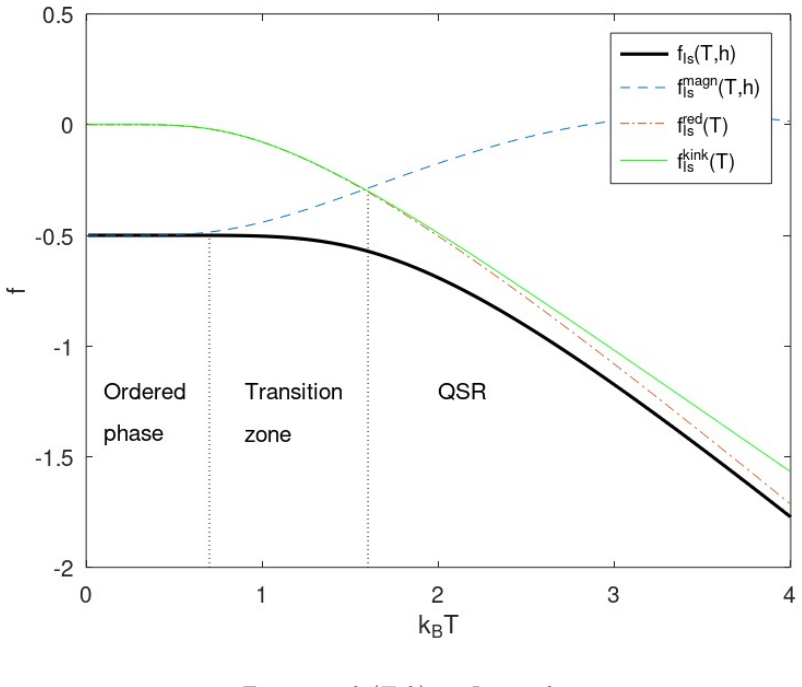
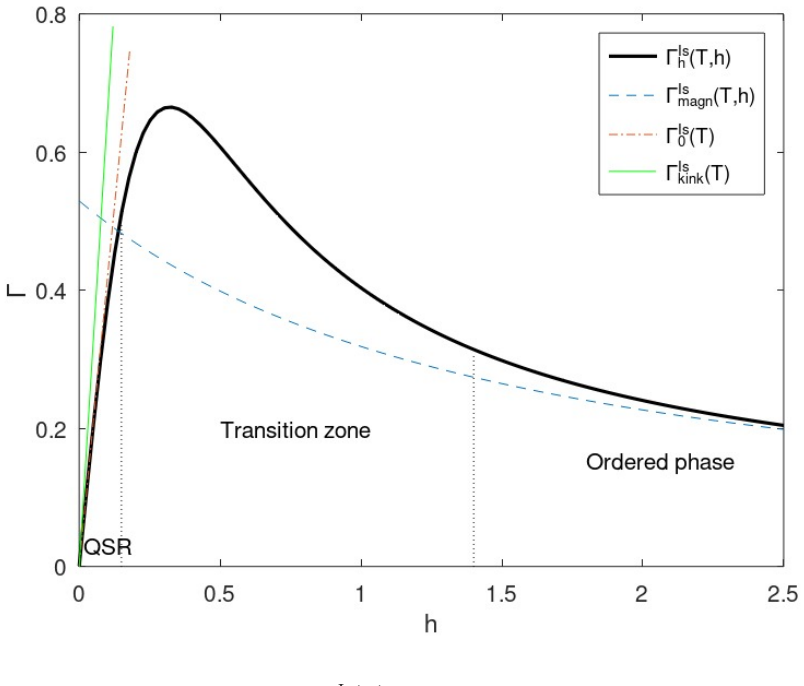

read the original abstract
Studying the ordered phases and quantum supercritical low-temperature regime at the vicinity of the deconfinement transition point in 1D easy-axis XXZ ferromagnet, we suggest their interpretations according to the corresponding dominant lowest-energy excitations. We show, that the two ordered phases are governed by magnons, while the quantum supercritical regime is governed by kinks. Within this framework the Ising model is treated in detail.
Editorial analysis
A structured set of objections, weighed in public.
Referee Report
Summary. The manuscript examines the low-temperature ordered phases and quantum supercritical regime of the 1D easy-axis XXZ ferromagnet near the deconfinement transition. It interprets the ordered phases as governed by magnons and the supercritical regime as governed by kinks on the basis of which excitation has the lowest energy gap, with a detailed analysis provided for the Ising limit.
Significance. If the mapping from lowest-energy excitation to regime character can be substantiated, the work supplies a compact interpretive framework for the XXZ chain near deconfinement that may generalize to other easy-axis models. The explicit Ising treatment is a concrete strength, but the absence of thermodynamic or correlation-function control calculations limits the immediate impact.
major comments (2)
- [Introduction and Ising-model treatment] The central interpretive step—that possession of the lowest excitation energy implies the regime is 'governed by' that excitation—requires explicit demonstration that magnons (resp. kinks) dominate the free energy, specific heat, or correlation lengths. The manuscript equates the two without showing that multi-particle continua or interaction effects remain sub-dominant near the transition.
- [Discussion of XXZ generalization] The detailed Ising analysis is presented, yet the extension to the full XXZ family (finite anisotropy) is asserted without corresponding gap or thermodynamic calculations that would confirm the same dominance pattern holds away from the Ising point.
minor comments (1)
- Notation for the kink and magnon gaps should be unified across figures and text to avoid ambiguity when comparing energies.
Simulated Author's Rebuttal
We thank the referee for the careful reading of our manuscript and the constructive comments. We respond to each major comment below, indicating where revisions will be incorporated.
read point-by-point responses
-
Referee: [Introduction and Ising-model treatment] The central interpretive step—that possession of the lowest excitation energy implies the regime is 'governed by' that excitation—requires explicit demonstration that magnons (resp. kinks) dominate the free energy, specific heat, or correlation lengths. The manuscript equates the two without showing that multi-particle continua or interaction effects remain sub-dominant near the transition.
Authors: We agree that the link between the lowest gap and thermodynamic dominance is interpretive and would benefit from further support. In the low-temperature regime the free energy receives its leading contribution from the smallest gap, with higher gaps suppressed exponentially; our Ising analysis identifies this gap structure explicitly. Nevertheless, we acknowledge that demonstrating the sub-dominance of multi-particle continua near the transition point would require additional control calculations that are absent from the present work. We will revise the manuscript to state this limitation explicitly and to frame the interpretation as suggestive rather than exhaustive. revision: partial
-
Referee: [Discussion of XXZ generalization] The detailed Ising analysis is presented, yet the extension to the full XXZ family (finite anisotropy) is asserted without corresponding gap or thermodynamic calculations that would confirm the same dominance pattern holds away from the Ising point.
Authors: The abstract and text state that the Ising limit receives the detailed treatment, while the generalization to finite anisotropy is proposed on the basis of continuity of the lowest-excitation gaps from the Ising point. No explicit gap or thermodynamic calculations are performed for Δ > 1. We will revise the manuscript to clarify that this extension is conjectural and to indicate that verification for the full XXZ family lies beyond the scope of the current study. revision: yes
Circularity Check
Central interpretive claim equates 'governed by' with lowest-energy excitation dominance by definitional framework
specific steps
-
self definitional
[Abstract]
"Studying the ordered phases and quantum supercritical low-temperature regime at the vicinity of the deconfinement transition point in 1D easy-axis XXZ ferromagnet, we suggest their interpretations according to the corresponding dominant lowest-energy excitations. We show, that the two ordered phases are governed by magnons, while the quantum supercritical regime is governed by kinks. Within this framework the Ising model is treated in detail."
The paper explicitly defines the interpretive framework as 'according to the corresponding dominant lowest-energy excitations' and then asserts that phases 'are governed by' those excitations. The assertion therefore reduces to the definitional premise rather than an independent demonstration that magnons or kinks control thermodynamics or correlations.
full rationale
The paper's strongest claim rests on an interpretive mapping introduced in the abstract: regimes are interpreted 'according to the corresponding dominant lowest-energy excitations' and then declared 'governed by' those excitations. This mapping is presented as the framework itself rather than derived from thermodynamic quantities (free energy, specific heat, or correlation functions) shown to be controlled by the identified modes. The detailed Ising treatment occurs inside this framework, so the mapping does not reduce to a fitted parameter or self-citation but is load-bearing by construction of the suggested interpretation. No equations or external benchmarks are visible in the provided text to falsify the assumption independently. This warrants a moderate circularity score but does not reach 6+ because the paper does not claim a first-principles derivation outside the stated framework.
Axiom & Free-Parameter Ledger
Reference graph
Works this paper leans on
-
[1]
Senthil, A
T. Senthil, A. Vishwanath, L. Balents, S. Sachdev, M. P. A. Fisher, ’Deconfined’ quantum critical points, Science,303, 1490-1493 (2004)
2004
-
[2]
Sentil, Deconfined quantum critical points: a review, 50 years of the renormaliza- tion group, 169-195 (2024)
T. Sentil, Deconfined quantum critical points: a review, 50 years of the renormaliza- tion group, 169-195 (2024)
2024
-
[3]
Yi. Cui, R. Yu, W. Yu, Deconfined quantum critical point: a review of progress, Chinese Phys. Lett.,42047503 (2025) 11
2025
-
[4]
S. B. Rutkevich, Spinon confinement in the gapped antiferromagnetic XXZ spin-1/2 chain, Phys. Rev. B106, 134405 (2022)
2022
-
[5]
P. N. Bibikov, Zero-temperature magnetic-field-induced phase transition between two ordered gapped phases in spin ladders with ferromagnetic legs, Phys. Rev. B73, 132402 (2006)
2006
-
[6]
E. Lv, N. Xi, Y. Jin, W. Li, Quantum supercritical regime with universal magne- tocaloric scaling in Ising magnets, Nature Communications,16, 10646, (2025)
2025
-
[7]
J. Wang, E. Lv, X. Li, Y. Jin, W. Li, Quantum supercritical crossover with dynamical singularity, Phys. Rev. B112, 195120 (2025)
2025
-
[8]
Takahashi, Thermodymamical Bethe Ansatz and condensed matter, Lect
M. Takahashi, Thermodymamical Bethe Ansatz and condensed matter, Lect. Notes in Physics,498, 204-250 (1997)
1997
-
[9]
F. C. Alcaraz, S. R. Salinas, W. F. Wreszinski, Anisotropic ferromagnetic quantum domains, Phys. Rev. Lett.,75, 930-933 (1995)
1995
-
[10]
Troyer, H
M. Troyer, H. Tsunetsugu, D. W¨ urtz, Thermodynamics and spin gap of the Heisen- berg ladder calculated by the look-ahead Lanczos algorithm, Phys. Rev. B5013515- 13527 (1994)
1994
-
[11]
P. N. Bibikov, Second cluster integral from the spectrum of an infinite XXZ spin chain, Ann. Phys.354, 705-714 (2015)
2015
-
[12]
Huang,Statistical Mechanics, second ed
K. Huang,Statistical Mechanics, second ed. John Wiley and Sons, New York, 1987
1987
-
[13]
J. D. Johnson, J. C. Bonner, Excitation spectrum and low-temperature thermody- namics of the Ising-Heisenberg linear ferromagnet, Phys. Rev. B22, 251-265 (1980)
1980
-
[14]
R. J. BaxterExactly Solved Models in Statistical Mechanics, Academic Press, London (1982)
1982
-
[15]
Garst, A
M. Garst, A. Rosch, Sign change of the Gr¨ uneisen parameter and magnetocaloric effect near quantum critical points, Phys. Rev. B72, 205129 (2005)
2005
-
[16]
M. Lang, B. Wolf, A. Honecker, L. Balents, U. Tutsch, P. T. Cong, G. Hofmann, N. Kr¨ uger, F. Ritter, W. Assmus, A. Prokofiev, Field-induced quantum criticality - application to magnetic cooling, Phys. Stat. Solidi,250, 457-463 (2013) 12
2013
-
[17]
J. Wang, H. Li, N. Xi, Y. Gao, Q.-B. Yan, W. Li, G. Su, Plaquette singlet transition, magnetic barocaloric effect, and spin supersolidity in the Shastry-Sutherland model, Phys. Rev. Lett.131, 116702 (2023)
2023
-
[18]
Trippe, A
C. Trippe, A. Honecker, A. Kl¨ umper, V. Ohanyan, Exact calculation of the magne- tocaloric effect in the spin-1/2 XXZ chain, Phys. Rev. B81, 054402 (2010)
2010
-
[19]
A. A. Zvyagin, V. V. Slavin, Giant caloric effects in spin chain materials, Phys. Rev. B109, 214438 (2024) A Direct evaluation of the low-temperature asymp- totic for the free energy density Representing (31) in the form fIs(T, h) =− |h| 2 − 1 β log 1 + e−β|h| 2 + 1−e −β|h| 2 s 1 + 4e−β(Jz+|h|) (1−e −β|h|)2 ,(A.1) and accounting for (25), one readily gets...
2024
discussion (0)
Sign in with ORCID, Apple, or X to comment. Anyone can read and Pith papers without signing in.