Breathing mode inducing dynamical pairing in Kagome materials
Pith reviewed 2026-07-02 04:15 UTC · model grok-4.3
The pith
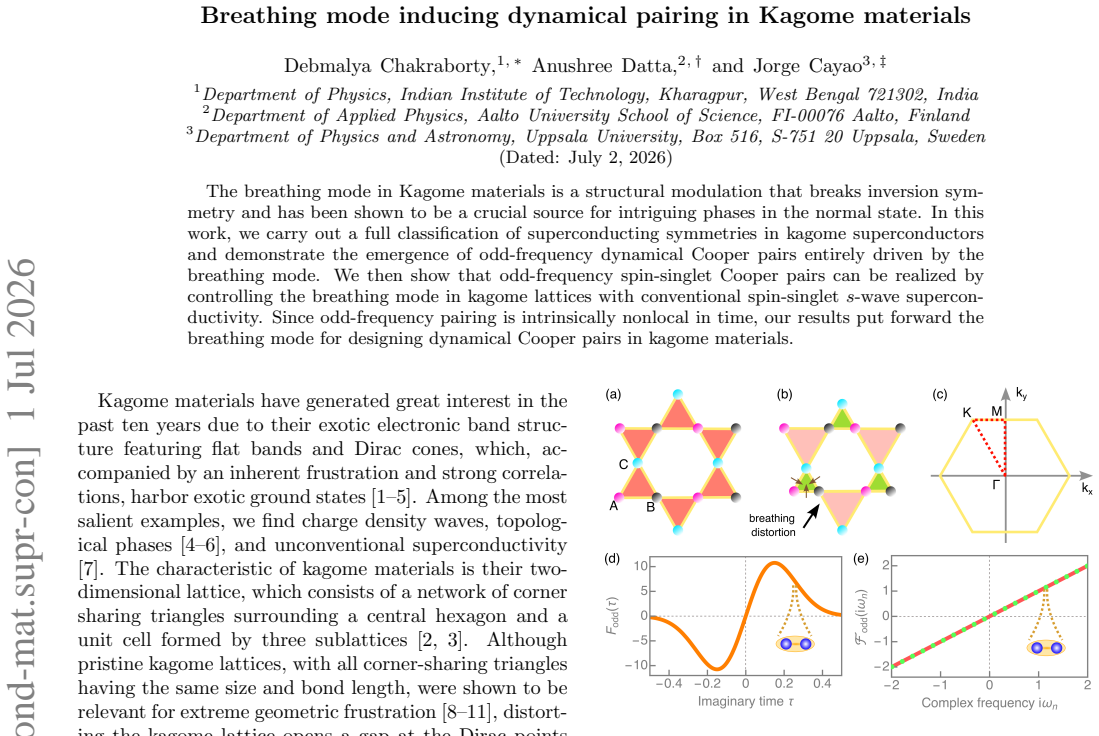
Breathing mode in Kagome lattices converts conventional s-wave superconductivity into odd-frequency dynamical Cooper pairs.
A machine-rendered reading of the paper's core claim, the machinery that carries it, and where it could break.
Core claim
The breathing mode breaks inversion symmetry and serves as the sole driver that converts conventional spin-singlet s-wave pairing into odd-frequency dynamical Cooper pairs. Controlling the amplitude of this mode in a Kagome lattice therefore realizes odd-frequency spin-singlet pairs on top of an otherwise standard s-wave superconductor.
What carries the argument
The breathing mode, a structural modulation that breaks inversion symmetry and supplies the sole source of odd-frequency dynamical pairing.
If this is right
- Odd-frequency spin-singlet Cooper pairs appear in any Kagome superconductor once the breathing mode is present, even if the microscopic interaction remains s-wave.
- Tuning the breathing-mode amplitude provides a direct experimental knob for switching the dynamical pairing component on and off.
- The full symmetry classification shows that the breathing mode mixes conventional even-frequency channels into odd-frequency channels without additional interactions.
- Dynamical pairing emerges entirely from the normal-state structural modulation rather than from any change in the pairing glue.
Where Pith is reading between the lines
- The same breathing-mode mechanism could be tested in other inversion-breaking distortions of Kagome lattices to map the range of accessible dynamical orders.
- Material-specific calculations of breathing-mode strength versus temperature or doping would give concrete targets for observing the predicted pairs.
- The nonlocal-in-time character implies that time-resolved probes sensitive to pairing dynamics should show signatures unique to the breathing-mode case.
Load-bearing premise
The breathing mode alone, through inversion-symmetry breaking, converts ordinary s-wave pairing into odd-frequency dynamical pairs with no other mechanism required.
What would settle it
Spectroscopic or tunneling measurements that detect odd-frequency components in the pairing function when the breathing mode is active but their complete absence when the mode is suppressed by pressure or strain.
Figures


read the original abstract
The breathing mode in Kagome materials is a structural modulation that breaks inversion symmetry and has been shown to be a crucial source for intriguing phases in the normal state. In this work, we carry out a full classification of superconducting symmetries in kagome superconductors and demonstrate the emergence of odd-frequency dynamical Cooper pairs entirely driven by the breathing mode. We then show that odd-frequency spin-singlet Cooper pairs can be realized by controlling the breathing mode in kagome lattices with conventional spin-singlet $s$-wave superconductivity. Since odd-frequency pairing is intrinsically nonlocal in time, our results put forward the breathing mode for designing dynamical Cooper pairs in kagome materials.
Editorial analysis
A structured set of objections, weighed in public.
Referee Report
Summary. The paper performs a symmetry classification of superconducting states in kagome lattices and claims that the breathing mode, by breaking inversion symmetry, induces odd-frequency dynamical Cooper pairs from an underlying conventional spin-singlet s-wave pairing. It further asserts that odd-frequency spin-singlet pairs can be realized by tuning the breathing-mode amplitude.
Significance. If the central derivation is correct, the result supplies a concrete, tunable mechanism for generating time-nonlocal pairing in a material class already known for breathing-mode physics in the normal state. Explicit verification that the odd-frequency channel vanishes identically at zero breathing amplitude would strengthen the claim of an 'entirely driven' effect and could guide experimental searches for dynamical pairing.
major comments (2)
- [Symmetry classification / pairing decomposition] The symmetry classification (presumably the section presenting the irreducible representations or the pairing-function decomposition) must explicitly demonstrate that the odd-frequency spin-singlet component is identically zero when the breathing-mode amplitude is set to zero while the even-frequency s-wave component remains finite. Without this control limit, the statement that the odd-frequency pairs are 'entirely driven' by the breathing mode remains an assumption rather than a derived result.
- [Hamiltonian and pairing kernel] If the lattice Hamiltonian is written with a breathing-mode term (e.g., a modulation of nearest-neighbor hoppings that breaks inversion), the subsequent derivation of the anomalous Green's function or the pairing kernel should include the explicit zero-amplitude limit to confirm the odd-frequency component vanishes. This check is load-bearing for the exclusivity claim in the abstract.
minor comments (2)
- Notation for the breathing-mode amplitude and its coupling to the pairing channel should be introduced once and used consistently; multiple symbols for the same quantity reduce clarity.
- The abstract states that odd-frequency pairs are 'realized by controlling the breathing mode'; a brief remark on the expected experimental signature (e.g., frequency-dependent response or nonlocal tunneling) would help readers assess testability.
Axiom & Free-Parameter Ledger
Reference graph
Works this paper leans on
-
[1]
J.-X. Yin, B. Lian, and M. Z. Hasan, Topological kagome magnets and superconductors, Nature612, 647 (2022)
2022
-
[2]
Y. Wang, H. Wu, G. T. McCandless, J. Y. Chan, and M. N. Ali, Quantum states and intertwining phases in kagome materials, Nat. Rev. Phys.5, 635 (2023)
2023
-
[3]
Di Sante, T
D. Di Sante, T. Neupert, G. Sangiovanni, R. Thomale, R. Comin, J. G. Checkelsky, I. Zeljkovic, and S. D. Wil- son, Kagome metals, Rev. Mod. Phys.98, 015002 (2026)
2026
-
[4]
Q. Wang, H. Lei, Y. Qi, and C. Felser, Topological quan- tum materials with kagome lattice, Acc. Mater. Res.5, 786 (2024)
2024
-
[5]
Q. Wang, H. Lei, Y. Qi, and C. Felser, Intriguing kagome topological materials, npj Quantum Mater.10, 72 (2025)
2025
-
[6]
J.-X. Yin, S. S. Zhang, G. Chang, Q. Wang, S. S. Tsirkin, Z. Guguchia, B. Lian, H. Zhou, K. Jiang, I. Belopol- ski,et al., Negative flat band magnetism in a spin–orbit- coupled correlated kagome magnet, Nat. Phys.15, 443 (2019)
2019
-
[7]
M. S. Hossain, Q. Zhang, E. S. Choi, D. Ratkovski, B. L¨ uscher, Y. Li, Y.-X. Jiang, M. Litskevich, Z.-J. Cheng, J.-X. Yin,et al., Unconventional gapping be- haviour in a kagome superconductor, Nat. Phys.21, 556 (2025)
2025
-
[8]
T. Imai, E. A. Nytko, B. M. Bartlett, M. P. Shores, and D. G. Nocera, 63Cu, 35Cl, and 1H nmr in thes= 1 2 kagome lattice zncu 3(OH)6cl2, Phys. Rev. Lett.100, 077203 (2008)
2008
-
[9]
J. S. Helton, K. Matan, M. P. Shores, E. A. Nytko, B. M. Bartlett, Y. Qiu, D. G. Nocera, and Y. S. Lee, Dynamic scaling in the susceptibility of the spin- 1 2 kagome lattice antiferromagnet herbertsmithite, Phys. Rev. Lett.104, 147201 (2010)
2010
-
[10]
G.-B. Jo, J. Guzman, C. K. Thomas, P. Hosur, A. Vish- wanath, and D. M. Stamper-Kurn, Ultracold atoms in a tunable optical kagome lattice, Phys. Rev. Lett.108, 045305 (2012)
2012
-
[11]
J. Wang, M. Spitaler, Y.-S. Su, K. M. Zoch, C. Krellner, P. Puphal, S. E. Brown, and A. Pustogow, Controlled frustration release on the kagome lattice by uniaxial- strain tuning, Phys. Rev. Lett.131, 256501 (2023)
2023
-
[12]
Yin, Y.-X
J.-X. Yin, Y.-X. Jiang, X. Teng, M. S. Hossain, S. Mar- danya, T.-R. Chang, Z. Ye, G. Xu, M. M. Denner, T. Neupert, B. Lienhard, H.-B. Deng, C. Setty, Q. Si, G. Chang, Z. Guguchia, B. Gao, N. Shumiya, Q. Zhang, T. A. Cochran, D. Multer, M. Yi, P. Dai, and M. Z. Hasan, Discovery of charge order and corresponding edge state in kagome magnet fege, Phys. Rev....
2022
-
[13]
R. Peng, Y. Ma, X. Xu, Z. He, B. Huang, and Y. Dai, In- trinsic anomalous valley hall effect in single-layer Nb 3i8, Phys. Rev. B102, 035412 (2020)
2020
-
[14]
Y. Li, C. Liu, G.-D. Zhao, T. Hu, and W. Ren, Two- dimensional multiferroics in a breathing kagome lattice, Phys. Rev. B104, L060405 (2021)
2021
-
[15]
D. Hu, H. Ye, N. Ding, K. Xu, S.-S. Wang, S. Dong, and X. Yao, Two-dimensional 5dmultiferroic w 3cl8: Breath- ing kagome lattice and tunable magneto-optical kerr ef- fect, Phys. Rev. B109, 014433 (2024)
2024
-
[16]
J. Zhao, Y. Feng, Y. Dai, B. Huang, and Y. Ma, Fer- roelectrovalley in two-dimensional multiferroic lattices, Nano Lett.24, 10490 (2024)
2024
-
[17]
S. Xing, B. Wang, T. Zhao, J. Zhou, and Z. Sun, Inde- pendent electrical control of spin and valley degrees in 2d breathing kagome Ta3I8 with intrinsic triferroicity, J. Phys. Chem. Lett.15, 6489 (2024)
2024
-
[18]
Regmi, T
S. Regmi, T. Fernando, Y. Zhao, A. P. Sakhya, G. Dhakal, I. Bin Elius, H. Vazquez, J. D. Denlinger, J. Yang, J.-H. Chu,et al., Spectroscopic evidence of flat bands in breathing kagome semiconductor Nb3I8, Com- mun. Mater.3, 100 (2022)
2022
-
[19]
Aretz, S
J. Aretz, S. Grytsiuk, X. Liu, G. Feraco, C. Knekna, M. Waseem, Z. Dan, M. Bianchi, P. Hofmann, M. N. Ali, M. I. Katsnelson, A. Grubiˇ si´ c-ˇCabo, H. U. R. Strand, E. G. C. P. van Loon, and M. R¨ osner, From strong to weak correlations in breathing-mode kagome van der waals materials: nb 3(F,Cl,Br,I) 8 as a robust and versa- tile platform for many-body e...
2025
-
[20]
Jung and Y.-H
J. Jung and Y.-H. Kim, Hidden breathing kagome topol- ogy in hexagonal transition metal dichalcogenides, Phys. Rev. B105, 085138 (2022)
2022
-
[21]
Y. Li, J. He, Y. Xie, C. Li, X. Shen, D. Wang, and J. Zhang, Role of breathing mode in band topology and multiferroics in two-dimensional kagome magnets, Phys. Rev. B112, 184410 (2025)
2025
-
[22]
M. A. J. Herrera, S. N. Kempkes, M. B. de Paz, A. Garc´ ıa-Etxarri, I. Swart, C. M. Smith, and D. Bercioux, Corner modes of the breathing kagome lat- 6 tice: Origin and robustness, Phys. Rev. B105, 085411 (2022)
2022
- [23]
-
[24]
Y. Xie, K. Ji, J. He, X. Shen, D. Wang, and J. Zhang, Manipulation of topology by electric field in breathing kagome lattice, Phys. Rev. Lett.135, 056701 (2025)
2025
-
[25]
Meena, M
P. Meena, M. Mandal, P. Manna, S. Srivastava, S. Sharma, P. Mishra, and R. Singh, Superconductivity in breathing kagome-structured C 14 laves phase XOs 2 (x= zr, hf), Supercond. Sci. Technol.37, 075004 (2024)
2024
-
[26]
H. Liu, J. Yao, J. Shi, Z. Yang, D. Yan, Y. Li, D. Chen, H. L. Feng, S. Li, Z. Wang, and Y. Shi, Vanadium-based superconductivity in the breathing kagome compound Ta2V3.1Si0.9, Phys. Rev. B108, 104504 (2023)
2023
-
[27]
J. N. Graham, H. Liu, V. Sazgari, C. Mielke III, M. Medarde, H. Luetkens, R. Khasanov, Y. Shi, and Z. Guguchia, Microscopic probing of the superconduct- ing and normal state properties of ta2v3.1si0.9 by muon spin rotation, Commun. Mater.5, 225 (2024)
2024
-
[28]
J. Lu, Y. Chen, X. Zhang, Z. Zhu, F. Zheng, L. Cai, W. Jiang, and Q. Sun, Tunable electronic honeycomb and (breathing) kagome lattices through molecular orbital de- sign in 2d metal-organic frameworks, Angew. Chem. Int. Ed.65, e4470567 (2026)
2026
-
[29]
L. Yang, J. Dong, Z. Wang, D. Li, C. Chen, B. Huang, D. Liu, and B. Cui, Breathing-controlled pure orbital and nonlinear hall effects in 2d organic kagome frameworks, Nano Lett. (2026)
2026
-
[30]
Zagoskin,Quantum Theory of Many-Body Systems: Techniques and Applications(Springer, 2014)
A. Zagoskin,Quantum Theory of Many-Body Systems: Techniques and Applications(Springer, 2014)
2014
-
[31]
G. D. Mahan,Many-particle physics(Springer Science & Business Media, 2013)
2013
-
[32]
Tanaka, M
Y. Tanaka, M. Sato, and N. Nagaosa, Symmetry and topology in superconductors–odd-frequency pairing and edge states–, J. Phys. Soc. Jpn.81, 011013 (2011)
2011
-
[33]
Cayao, C
J. Cayao, C. Triola, and A. M. Black-Schaffer, Odd- frequency superconducting pairing in one-dimensional systems, Eur. Phys. J.: Spec. Top.229, 545 (2020)
2020
-
[34]
Triola, J
C. Triola, J. Cayao, and A. M. Black-Schaffer, The role of odd-frequency pairing in multiband superconductors, Ann. Phys.532, 1900298 (2020)
2020
-
[35]
F. S. Bergeret, A. F. Volkov, and K. B. Efetov, Odd triplet superconductivity and related phenomena in superconductor-ferromagnet structures, Rev. Mod. Phys. 77, 1321 (2005)
2005
-
[36]
Linder and A
J. Linder and A. V. Balatsky, Odd-frequency supercon- ductivity, Rev. Mod. Phys.91, 045005 (2019)
2019
-
[37]
Tanaka, S
Y. Tanaka, S. Tamura, and J. Cayao, Theory of Ma- jorana zero modes in unconventional superconductors, Prog. Theor. Exp. Phys.2024, 08C105 (2024)
2024
-
[38]
Fukaya, B
Y. Fukaya, B. Lu, K. Yada, Y. Tanaka, and J. Cayao, Superconducting phenomena in systems with unconven- tional magnets, J. Phys.: Condens. Matter37, 313003 (2025)
2025
-
[39]
S. C. Holbæk, M. H. Christensen, A. Kreisel, and B. M. Andersen, Unconventional superconductivity protected from disorder on the kagome lattice, Phys. Rev. B108, 144508 (2023)
2023
-
[40]
Jalali-mola, T
Z. Jalali-mola, T. Grass, V. Kasper, M. Lewenstein, and U. Bhattacharya, Topological bogoliubov quasiparticles from bose-einstein condensate in a flat band system, Phys. Rev. Lett.131, 226601 (2023)
2023
-
[41]
A. T. Rømer, S. Bhattacharyya, R. Valent´ ı, M. H. Chris- tensen, and B. M. Andersen, Superconductivity from re- pulsive interactions on the kagome lattice, Phys. Rev. B 106, 174514 (2022)
2022
-
[42]
Furthermore, we also obtain finite inter-sublattice pair amplitudes, which develop OSEO and ESEE classes but also OSOE symmetry, all consistent with that allowed pair symmetries in kagome superconductors given in Ta- ble I
-
[43]
Kashiwaya and Y
S. Kashiwaya and Y. Tanaka, Tunnelling effects on sur- face bound states in unconventional superconductors, Rep. Prog. Phys.63, 1641 (2000)
2000
-
[44]
J. C. Cuevas, A. Mart´ ın-Rodero, and A. L. Yeyati, Hamil- tonian approach to the transport properties of supercon- ducting quantum point contacts, Phys. Rev. B54, 7366 (1996)
1996
-
[45]
Y. Gao, W. Song, Y. Wang, Z. Geng, Z. Cao, Z. Yu, S. Yang, J. Xu, F. Chen, Z. Li, R. Li, L. Yang, Z. Wang, S. Zhang, X. Feng, T. Wang, Y. Zang, L. Li, D. E. Liu, R. Shang, Q.-K. Xue, K. He, and H. Zhang, Quantized andreev conductance in semiconductor nanowires, Phys. Rev. Appl.23, L061004 (2025)
2025
-
[46]
Asano,Andreev Reflection in Superconducting Junc- tions(Springer Nature, 2021)
Y. Asano,Andreev Reflection in Superconducting Junc- tions(Springer Nature, 2021)
2021
-
[47]
Tanaka, Y
Y. Tanaka, Y. Tanuma, K. Kuroki, and S. Kashiwaya, Theory of magnetotunneling spectroscopy in spin triplet p-wave superconductors, J. Phys. Soc. Jpn.71, 2102 (2002)
2002
-
[48]
Tanuma, K
Y. Tanuma, K. Kuroki, Y. Tanaka, R. Arita, S. Kashi- waya, and H. Aoki, Determination of pairing symmetry from magnetotunneling spectroscopy: A case study for quasi-one-dimensional organic superconductors, Phys. Rev. B66, 094507 (2002)
2002
-
[49]
Tanuma, Y
Y. Tanuma, Y. Tanaka, K. Kuroki, and S. Kashiwaya, Magnetotunneling spectroscopy as a probe for pair- ing symmetry determination in quasi-two-dimensional anisotropic superconductors, Phys. Rev. B66, 174502 (2002)
2002
-
[50]
Tanaka, K
Y. Tanaka, K. Kuroki, Y. Tanuma, and S. Kashiwaya, Possible anomalous doppler shift effect in superconductor Sr2RuO4, J. Phys. Soc. Jpn.72, 2157 (2003)
2003
-
[51]
Damascelli, Z
A. Damascelli, Z. Hussain, and Z.-X. Shen, Angle- resolved photoemission studies of the cuprate supercon- ductors, Rev. Mod. Phys.75, 473 (2003)
2003
-
[52]
J. A. Sobota, Y. He, and Z.-X. Shen, Angle-resolved photoemission studies of quantum materials, Rev. Mod. Phys.93, 025006 (2021)
2021
-
[53]
Zhang, T
H. Zhang, T. Pincelli, C. Jozwiak, T. Kondo, R. Ernstor- fer, T. Sato, and S. Zhou, Angle-resolved photoemission spectroscopy, Nat. Rev. Methods Primers2, 54 (2022)
2022
-
[54]
Boschini, M
F. Boschini, M. Zonno, and A. Damascelli, Time-resolved ARPES studies of quantum materials, Rev. Mod. Phys. 96, 015003 (2024)
2024
-
[55]
Kornich, F
V. Kornich, F. Schlawin, M. A. Sentef, and B. Trauzettel, Direct detection of odd-frequency superconductivity via time- and angle-resolved photoelectron fluctuation spec- troscopy, Phys. Rev. Res.3, L042034 (2021)
2021
-
[56]
J. A. Krieger, A. Pertsova, S. R. Giblin, M. D¨ obeli, T. Prokscha, C. W. Schneider, A. Suter, T. Hesjedal, A. V. Balatsky, and Z. Salman, Proximity-induced odd- frequency superconductivity in a topological insulator, Phys. Rev. Lett.125, 026802 (2020)
2020
-
[57]
Di Bernardo, Z
A. Di Bernardo, Z. Salman, X. L. Wang, M. Amado, M. Egilmez, M. G. Flokstra, A. Suter, S. L. Lee, J. H. 7 Zhao, T. Prokscha, E. Morenzoni, M. G. Blamire, J. Lin- der, and J. W. A. Robinson, Intrinsic paramagnetic meissner effect due tos-wave odd-frequency supercon- ductivity, Phys. Rev. X5, 041021 (2015)
2015
-
[58]
Schmidt, F
J. Schmidt, F. Parhizgar, and A. M. Black-Schaffer, Odd- frequency superconductivity and meissner effect in the doped topological insulator bi 2se3, Phys. Rev. B101, 180512(R) (2020)
2020
-
[59]
M. P. Allan, A. W. Rost, A. Mackenzie, Y. Xie, J. Davis, K. Kihou, C.-H. Lee, A. Iyo, H. Eisaki, and T.-M. Chuang, Anisotropic energy gaps of iron-based super- conductivity from intraband quasiparticle interference in LiFeAs, Science336, 563 (2012)
2012
-
[60]
M. P. Allan, F. Massee, D. Morr, J. Van Dyke, A. W. Rost, A. Mackenzie, C. Petrovic, and J. C. Davis, Imag- ing cooper pairing of heavy fermions in CeCoIn 5, Nat. Phys.9, 468 (2013)
2013
-
[61]
Marques, M
C. Marques, M. Bahramy, C. Trainer, I. Markovi´ c, M. D. Watson, F. Mazzola, A. Rajan, T. D. Raub, P. King, and P. Wahl, Tomographic mapping of the hidden dimension in quasi-particle interference, Nat. Commun.12, 6739 (2021)
2021
-
[62]
S. Wang, K. Zhussupbekov, J. P. Carroll, B. Hu, X. Liu, E. Pangburn, A. Crepieux, C. Pepin, C. Broyles, S. Ran, et al., Odd-parity quasiparticle interference in the super- conductive surface state of UTe 2, Nat. Phys.21, 1555 (2025)
2025
-
[63]
Perrin, F
V. Perrin, F. L. N. Santos, G. C. M´ enard, C. Brun, T. Cren, M. Civelli, and P. Simon, Unveiling odd- frequency pairing around a magnetic impurity in a su- perconductor, Phys. Rev. Lett.125, 117003 (2020)
2020
-
[64]
Chakraborty and A
D. Chakraborty and A. M. Black-Schaffer, Quasiparticle interference as a direct experimental probe of bulk odd- frequency superconducting pairing, Phys. Rev. Lett.129, 247001 (2022)
2022
-
[65]
Hanaguri, Y
T. Hanaguri, Y. Kohsaka, M. Ono, M. Maltseva, P. Cole- man, I. Yamada, M. Azuma, M. Takano, K. Ohishi, and H. Takagi, Coherence factors in a high-tc cuprate probed by quasi-particle scattering off vortices, Science323, 923 (2009)
2009
-
[66]
C. Liu, Z. Wang, Y. Gao, X. Liu, Y. Liu, Q.-H. Wang, and J. Wang, Spectroscopic imaging of quasiparticle bound states induced by strong nonmagnetic scatterings in one- unit-cell FeSe/SrTiO 3, Phys. Rev. Lett.123, 036801 (2019)
2019
-
[67]
S. C. Cheung, J. Y. Shin, Y. Lau, Z. Chen, J. Sun, Y. Zhang, M. A. M¨ uller, I. M. Eremin, J. N. Wright, and A. N. Pasupathy, Dictionary learning in fourier- transform scanning tunneling spectroscopy, Nat. Com- mun.11, 1081 (2020)
2020
-
[68]
B¨ oker, M
J. B¨ oker, M. A. Sulangi, A. Akbari, J. C. S. Davis, P. J. Hirschfeld, and I. M. Eremin, Phase-sensitive determina- tion of nodald-wave order parameter in single-band and multiband superconductors, Phys. Rev. B101, 214505 (2020)
2020
-
[69]
J. E. Hoffman, K. McElroy, D.-H. Lee, K. M. Lang, H. Eisaki, S. Uchida, and J. C. Davis, Imaging quasi- particle interference in Bi 2Sr2CaCu2O8+x, Science297, 1148 (2002)
2002
-
[70]
Wang and D.-H
Q.-H. Wang and D.-H. Lee, Quasiparticle scattering in- terference in high-temperature superconductors, Phys. Rev. B67, 020511 (2003)
2003
-
[71]
McElroy, R
K. McElroy, R. W. Simmonds, J. E. Hoffman, D.-H. Lee, J. Orenstein, H. Eisaki, S. Uchida, and J. C. Davis, Relat- ing atomic-scale electronic phenomena to wave-like quasi- particle states in superconducting Bi 2Sr2CaCu2O8+δ, Nature422, 592 (2003)
2003
-
[72]
Sharma, A
R. Sharma, A. Kreisel, M. A. Sulangi, J. B¨ oker, A. Kostin, M. P. Allan, H. Eisaki, A. E. B¨ ohmer, P. C. Canfield, I. Eremin, J. C. S´ eamus Davis, P. J. Hirschfeld, and P. O. Sprau, Multi-atom quasiparticle scattering in- terference for superconductor energy-gap symmetry de- termination, npj Quantum Mater.6, 7 (2021)
2021
-
[73]
Liu and T
J. Liu and T. Zhou, Probing the pairing symmetry in kagome superconductors based on the single-particle spectrum, Phys. Rev. B109, 054504 (2024)
2024
-
[74]
P. J. Hirschfeld, D. Altenfeld, I. Eremin, and I. I. Mazin, Robust determination of the superconducting gap sign structure via quasiparticle interference, Phys. Rev. B92, 184513 (2015)
2015
-
[75]
Altenfeld, P
D. Altenfeld, P. J. Hirschfeld, I. I. Mazin, and I. Eremin, Detecting sign-changing superconducting gap in lifeas us- ing quasiparticle interference, Phys. Rev. B97, 054519 (2018)
2018
-
[76]
G. D. Mahan,Many-Particle Physics(Springer, 2000)
2000
-
[77]
X. Wu, T. Schwemmer, T. M¨ uller, A. Consiglio, G. San- giovanni, D. Di Sante, Y. Iqbal, W. Hanke, A. P. Schny- der, M. M. Denner, M. H. Fischer, T. Neupert, and R. Thomale, Nature of unconventional pairing in the kagome superconductors AB 3Sb5 (a= K,Rb,Cs), Phys. Rev. Lett.127, 177001 (2021)
2021
-
[78]
X. Wu, D. Chakraborty, A. P. Schnyder, and A. Greco, Crossover between electron-electron and electron-phonon mediated pairing on the kagome lattice, Phys. Rev. B 109, 014517 (2024)
2024
-
[79]
Chakraborty and A
D. Chakraborty and A. M. Black-Schaffer, Interplay of finite-energy and finite-momentum superconducting pair- ing, Phys. Rev. B106, 024511 (2022)
2022
-
[80]
Chakraborty and A
D. Chakraborty and A. M. Black-Schaffer, Odd- frequency pair density wave correlations in underdoped cuprates, New Journal of Physics23, 033001 (2021)
2021
discussion (0)
Sign in with ORCID, Apple, or X to comment. Anyone can read and Pith papers without signing in.