Ultrasound Evidence for a Low-Temperature Anomaly Inside the Superconducting State of 4Hb-TaS₂
Pith reviewed 2026-06-30 03:04 UTC · model grok-4.3
The pith
Ultrasound measurements on 4Hb-TaS2 detect an anomaly at about 1 K deep inside the superconducting state below 2.9 K.
A machine-rendered reading of the paper's core claim, the machinery that carries it, and where it could break.
Core claim
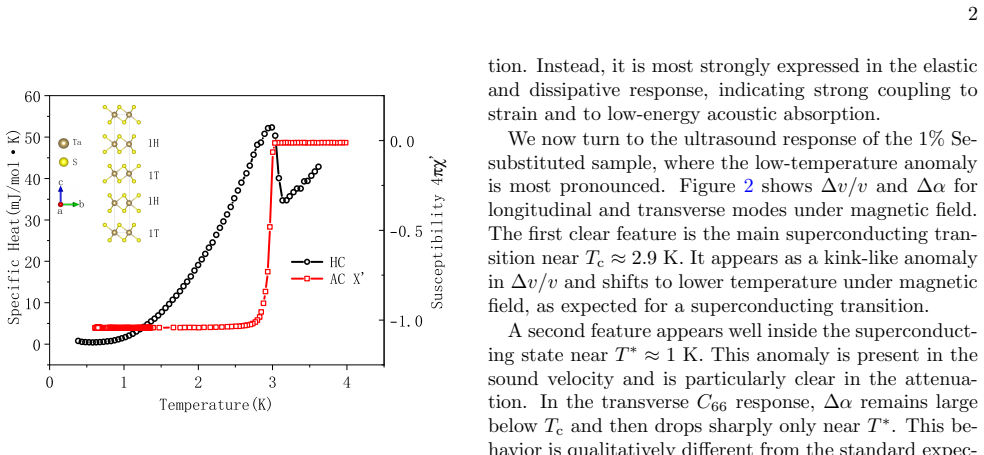
Ultrasound measurements on single crystals of 4Hb-TaS2 reveal an additional anomaly deep inside the superconducting state near T* approximately 1 K. Instead of being rapidly suppressed at Tc of 2.9 K, the relative ultrasonic attenuation change Delta alpha remains large throughout the intermediate superconducting regime and drops strongly only near T*. This loss of acoustic dissipation is accompanied by a pronounced anomaly in the relative sound velocity change Delta v/v, indicating strong coupling to the lattice. The low-temperature anomaly is rapidly suppressed by magnetic field and by Se substitution, suggesting a possible superconducting origin possibly related to induced superconductivit
What carries the argument
The relative ultrasonic attenuation change Delta alpha, which stays large below Tc and drops only near T* approximately 1 K, together with the accompanying anomaly in relative sound velocity change Delta v/v that signals lattice coupling.
If this is right
- The superconducting state contains at least two distinct temperature scales rather than a single transition at Tc.
- Acoustic dissipation remains high through most of the superconducting regime and collapses only at the lower temperature.
- The lattice is strongly coupled to the electronic degrees of freedom responsible for the anomaly.
- Chemical substitution or magnetic field can be used to tune or eliminate the lower-temperature feature.
Where Pith is reading between the lines
- If the anomaly reflects induced superconductivity in the 1T layers, then ultrasound could serve as a probe for proximity-induced order in other van der Waals heterostructures.
- Similar low-temperature acoustic features might appear in related layered chalcogenides when measured with comparable resolution.
- The strong lattice coupling implies that any microscopic model must include electron-phonon interactions at the lower temperature scale.
Load-bearing premise
The low-temperature anomaly is caused by superconductivity rather than another electronic or structural effect.
What would settle it
If the anomaly at 1 K persists unchanged when a magnetic field is applied up to the upper critical field or when the sample is substituted with selenium, that would show the feature is not of superconducting origin.
Figures


read the original abstract
We report low-temperature ultrasound measurements on single crystals of the layered van der Waals superconductor 4Hb-TaS$_2$. Specific heat and ac magnetic susceptibility show a sharp bulk superconducting transition at $T_{\rm c}\approx 2.9$~K. Ultrasound measurements reveal an additional anomaly deep inside the superconducting state near $T^{*}\approx 1$~K. The most direct signature is observed in the relative ultrasonic attenuation change $\Delta\alpha$: instead of being rapidly suppressed at $T_{\rm c}$, $\Delta\alpha$ remains large throughout the intermediate superconducting regime and drops strongly only near $T^{*}$. This loss of acoustic dissipation is accompanied by a pronounced anomaly in the relative sound velocity change $\Delta v/v$, indicating strong coupling to the lattice. The low-temperature anomaly is rapidly suppressed by magnetic field and by Se substitution, suggesting a possible superconducting origin of the anomaly. We speculate that this feature may be related to induced superconductivity in the 1T layers.
Editorial analysis
A structured set of objections, weighed in public.
Referee Report
Summary. The manuscript reports low-temperature ultrasound measurements on single crystals of the layered van der Waals superconductor 4Hb-TaS₂. Specific heat and ac susceptibility establish a bulk superconducting transition at Tc ≈ 2.9 K. The ultrasound data reveal an additional anomaly at T* ≈ 1 K deep inside the superconducting state, most prominently as a strong drop in the relative attenuation change Δα (which remains large between Tc and T* rather than being suppressed at Tc) accompanied by a feature in the relative sound velocity change Δv/v. Both signatures are rapidly suppressed by applied magnetic field and by Se substitution, leading to the inference of a possible superconducting origin, with speculation that the feature may reflect induced superconductivity in the 1T layers.
Significance. If the central observational claim holds, the work provides direct evidence via a lattice-sensitive probe for an additional low-temperature feature inside the superconducting dome of 4Hb-TaS₂. The combination of temperature, field, and substitution dependence offers a concrete experimental signature that could motivate targeted studies of multi-layer or induced superconductivity in related van der Waals systems. The manuscript supplies the raw Δα and Δv/v traces, their field and Se dependence, and the contrast with bulk Tc, which are the load-bearing elements of the report.
major comments (2)
- [Ultrasound results (description of Δα and Δv/v)] The ultrasound results section presents Δα and Δv/v traces but supplies no error bars, no quantitative description of background subtraction, and no assessment of sample-to-sample reproducibility. These omissions directly affect the ability to judge whether the drop near T* is statistically distinct from the behavior between Tc and T* and therefore weaken the central observational claim.
- [Discussion of possible superconducting origin] The discussion of the anomaly's origin relies on its suppression by field and Se substitution, yet no quantitative comparison is given between the field scale that suppresses the T* feature and the upper critical field of the bulk Tc transition. This comparison is load-bearing for the inference that the anomaly is superconductivity-related rather than an unrelated electronic or structural effect.
minor comments (2)
- [Abstract] The abstract states T* ≈ 1 K without indicating how the value was extracted from the data or what uncertainty is associated with it.
- [Figure captions] Figure captions and axis labels for the ultrasound data should explicitly state the units and normalization conventions used for Δα and Δv/v to improve clarity for readers.
Simulated Author's Rebuttal
We thank the referee for their positive evaluation and constructive comments, which will help strengthen the presentation of our results. We address each major comment below.
read point-by-point responses
-
Referee: [Ultrasound results (description of Δα and Δv/v)] The ultrasound results section presents Δα and Δv/v traces but supplies no error bars, no quantitative description of background subtraction, and no assessment of sample-to-sample reproducibility. These omissions directly affect the ability to judge whether the drop near T* is statistically distinct from the behavior between Tc and T* and therefore weaken the central observational claim.
Authors: We agree that these details are important for rigorously establishing the anomaly. In the revised manuscript we will add error bars derived from repeated temperature sweeps on the same crystal, provide a quantitative description of the polynomial background subtraction applied to obtain Δα and Δv/v, and include a brief statement confirming that the T* feature is reproducible across three independently measured crystals. These additions will make clear that the drop at T* stands out from the plateau between Tc and T*. revision: yes
-
Referee: [Discussion of possible superconducting origin] The discussion of the anomaly's origin relies on its suppression by field and Se substitution, yet no quantitative comparison is given between the field scale that suppresses the T* feature and the upper critical field of the bulk Tc transition. This comparison is load-bearing for the inference that the anomaly is superconductivity-related rather than an unrelated electronic or structural effect.
Authors: We concur that an explicit comparison strengthens the case. Using the field-dependent data already shown in the manuscript, we will add a quantitative statement in the discussion: the T* anomaly is fully suppressed by ~0.4 T, whereas the bulk upper critical field (extracted from specific-heat and susceptibility measurements) exceeds 1.5 T at the same base temperature. This disparity will be highlighted to support the inference of a distinct, likely superconductivity-related origin. revision: yes
Circularity Check
No significant circularity; purely experimental report
full rationale
This manuscript is an observational experimental study reporting ultrasound attenuation and velocity anomalies in 4Hb-TaS₂, with supporting specific-heat and susceptibility data. No derivations, equations, fitted parameters, or model-based predictions are present; all central claims rest directly on measured temperature, field, and substitution dependences without reduction to self-defined inputs or self-citation chains. The cautious speculation on 1T-layer induction is explicitly labeled as such and does not carry the headline result. The paper is therefore self-contained against external benchmarks with no load-bearing circular steps.
Axiom & Free-Parameter Ledger
axioms (1)
- domain assumption Changes in ultrasonic attenuation and sound velocity directly reflect lattice coupling and dissipation mechanisms in the material.
Reference graph
Works this paper leans on
-
[1]
Manzeli, D
S. Manzeli, D. Ovchinnikov, D. Pasquier, O. V. Yazyev, and A. Kis, 2d transition metal dichalcogenides, Nat Rev Mater2, 17033 (2017)
2017
-
[2]
Di Salvo, B
F. Di Salvo, B. Bagley, J. Voorhoeve, and J. Waszczak, Preparation and properties of a new polytype of tantalum disulfide (4Hb-TaS2), Journal of Physics and Chemistry of Solids34, 1357 (1973)
1973
-
[3]
Ribak, R
A. Ribak, R. M. Skiff, M. Mograbi, P. K. Rout, M. H. Fis- cher, J. Ruhman, K. Chashka, Y. Dagan, and A. Kanigel, Chiral superconductivity in the alternate stacking com- pound 4Hb-TaS2, Science Advances6, eaax9480 (2020)
2020
-
[4]
K. T. Law and P. A. Lee, 1T-TaS 2 as a quantum spin liquid, Proceedings of the Na- tional Academy of Sciences114, 6996 (2017), https://www.pnas.org/doi/pdf/10.1073/pnas.1706769114
-
[5]
Ribak, I
A. Ribak, I. Silber, C. Baines, K. Chashka, Z. Salman, Y. Dagan, and A. Kanigel, Gapless excitations in the ground state of 1T−T aS 2, Phys. Rev. B96, 195131 (2017)
2017
-
[6]
Murayama, Y
H. Murayama, Y. Sato, T. Taniguchi, R. Kurihara, X. Z. Xing, W. Huang, S. Kasahara, Y. Kasahara, I. Kim- chi, M. Yoshida, Y. Iwasa, Y. Mizukami, T. Shibauchi, M. Konczykowski, and Y. Matsuda, Effect of quenched disorder on the quantum spin liquid state of the triangular-lattice antiferromagnet 1T−T aS 2, Phys. Rev. Res.2, 013099 (2020)
2020
-
[7]
Almoalem, I
A. Almoalem, I. Feldman, I. Mangel, M. Shlafman, Y. E. Yaish, M. H. Fischer, M. Moshe, J. Ruhman, and A. Kanigel, The observation ofπ-shifts in the little-parks effect in 4Hb-TaS2, Nat Commun15, 4623 (2024)
2024
-
[8]
Silber, S
I. Silber, S. Mathimalar, I. Mangel, A. K. Nayak, O. Green, N. Avraham, H. Beidenkopf, I. Feldman, A. Kanigel, A. Klein, M. Goldstein, A. Banerjee, E. Sela, and Y. Dagan, Two-component nematic superconductiv- ity in 4Hb-TaS2, Nat Commun15, 824 (2024)
2024
-
[9]
A. K. Nayak, A. Steinbok, Y. Roet, J. Koo, G. Mar- galit, I. Feldman, A. Almoalem, A. Kanigel, G. A. Fiete, B. Yan, Y. Oreg, N. Avraham, and H. Beidenkopf, Ev- idence of topological boundary modes with topological nodal-point superconductivity, Nature Physics17, 1413 (2021), arXiv:2112.10240
-
[10]
Batlogg, D
B. Batlogg, D. J. Bishop, E. Bucher, C. M. Varma, Z. Fisk, and J. L. Smith, Anisotropic (triplet) supercon- ductivity in UPt 3 (invited), Journal of Applied Physics 57, 3060 (1985)
1985
-
[11]
Benhabib, C
S. Benhabib, C. Lupien, I. Paul, L. Berges, M. Dion, M. Nardone, R. Zitko, C. Proust, and L. Taillefer, Ul- trasound evidence for a two-component superconduct- ing order parameter in Sr2RuO4, Nature Physics17, 194 (2021)
2021
-
[12]
Ghosh, A
S. Ghosh, A. Shekhter, F. Jerzembeck, N. Kikugawa, D. A. Sokolov, M. Brando, A. P. Mackenzie, C. W. Hicks, and R. B. J., Thermodynamic evidence for a two-component superconducting order parameter in Sr2RuO4, Nature Physics17, 199 (2021)
2021
-
[13]
Halcrow, I
C. Halcrow, I. Shipulin, F. Caglieris, Y. Li, J. Wos- nitza, H.-H. Klauss, S. Zherlitsyn, V. Grinenko, and E. Babaev, Ultrasound evidence for multicomponent su- perconducting order parameter in Ba 1−xKxFe2As2 with electron quadrupling phase, npj Quantum Materials10, 107 (2025)
2025
-
[14]
R. Kurihara, K. Mitsumoto, M. Akatsu, Y. Nemoto, T. Goto, Y. Kobayashi, and M. Sato, Critical slow- ing down of quadrupole and hexadecapole order- ings in iron pnictide superconductor, Journal of the Physical Society of Japan86, 064706 (2017), https://doi.org/10.7566/JPSJ.86.064706. 6
-
[15]
Almoalem, R
A. Almoalem, R. Gofman, Y. Nitzav, I. Mangel, I. Feldman, J. Koo, F. Mazzola, J. Fujii, I. Vobornik, J. S´ anchez-Barriga, O. J. Clark, N. C. Plumb, M. Shi, B. Yann, and A. Kanigel, Charge transfer and spin- valley locking in 4Hb-TaS 2, npj Quantum Materials9, 36 (2024)
2024
discussion (0)
Sign in with ORCID, Apple, or X to comment. Anyone can read and Pith papers without signing in.