Quantum Tunneling-induced Hybridization and Coherent Dynamics of Jackiw-Rebbi Zero Modes in a Modified Su-Schrieffer-Heeger Chain
Pith reviewed 2026-07-03 18:40 UTC · model grok-4.3
The pith
Quantum tunneling between two Jackiw-Rebbi zero modes in a modified SSH chain lifts their degeneracy and produces coherent oscillations of occupation probability.
A machine-rendered reading of the paper's core claim, the machinery that carries it, and where it could break.
Core claim
In the modified SSH model the Dirac-type gap closing at k=±π/4a permits an effective mass that reverses sign at two interfaces under a kink, binding a pair of JR zero modes. Their finite overlap lifts the degeneracy through tunneling, yielding symmetric-antisymmetric hybridized states. The resulting two-level dynamics produces coherent oscillations of the mode occupation probability together with periodic transfer of sublattice polarization between the (A,C) and (B,D) sectors, with the oscillation period fixed by the hybridization gap.
What carries the argument
Jackiw-Rebbi zero modes localized at the two kink interfaces, hybridized by quantum tunneling into an effective two-level system that governs coherent oscillations.
If this is right
- The hybridization gap sets the oscillation period of the coherent dynamics between the two JR modes.
- Sublattice polarization transfers back and forth between the (A,C) and (B,D) sectors on the same timescale.
- The oscillation frequency can be tuned by adjusting the spatial separation of the interfaces.
- The framework connects JR zero modes, tunneling, and coherent control within modified SSH lattices.
Where Pith is reading between the lines
- The same tunneling-hybridization picture could apply to other one-dimensional topological models that host multiple zero modes at engineered interfaces.
- Cold-atom or photonic-lattice realizations could directly measure the predicted polarization transfer during the oscillations.
- Extending the two-mode description to chains with three or more JR modes might enable multi-state quantum-state transfer protocols.
Load-bearing premise
The low-energy Dirac theory around the Dirac gap closing points correctly predicts that the effective mass reverses sign at the two spatially separated interfaces of the kink profile.
What would settle it
Absence of any energy splitting between the zero modes or absence of coherent oscillations in the occupation probability when the two interfaces are brought within tunneling range.
Figures


read the original abstract
We investigate analytically and numerically the tunneling-induced hybridization and coherent dynamics of Jackiw-Rebbi (JR) zero modes in a modified Su-Schrieffer-Heeger (SSH) model. Unlike the conventional SSH model, this modified system possess two bulk gap closing points, namely, the quadratic-type gap closing point at $k=0$ and the Dirac-type gap closing point at $k=\pm\pi/4a$. While the quadratic point does not support a topological domain wall due to the absence of mass inversion, the low-energy Dirac theory around $k=\pm\pi/4a$ predicts an effective mass that changes sign at two spatially separated interfaces under a kink profile, generating a pair of JR bound states localized at those interfaces. We show that finite overlap between the JR zero modes lifts the zero-energy degeneracy through quantum tunneling, producing symmetric-antisymmetric hybridized states analogous to a quantum mechanical double-well system. An effective two-level description reveals coherent oscillations of the occupation probability between the two JR modes, accompanied by periodic transfer of sublattice polarization between the (A,C) and (B,D) sectors. The oscillation period is governed by the hybridization gap, providing a tunable route for controlling topological bound states. Our results establish a unified framework connecting JR zero modes, quantum tunneling, and coherent dynamics in modified SSH systems, offering a promising platform for controllable topological quantum-state transfer in engineered lattice structures.
Editorial analysis
A structured set of objections, weighed in public.
Referee Report
Summary. The manuscript investigates analytically and numerically the tunneling-induced hybridization of Jackiw-Rebbi zero modes in a modified Su-Schrieffer-Heeger chain that features both a quadratic gap closing at k=0 and Dirac-type closings at k=±π/4a. It argues that a kink profile induces mass sign changes only at the Dirac points, localizing a pair of JR bound states whose finite overlap lifts the zero-energy degeneracy, producing symmetric-antisymmetric hybridized states. An effective two-level model is derived to describe coherent oscillations of occupation probability between the modes together with periodic sublattice polarization transfer between (A,C) and (B,D) sectors, with the oscillation period set by the hybridization gap.
Significance. If the derivations hold, the work supplies a concrete lattice realization connecting JR zero modes, quantum tunneling, and coherent dynamics, with an explicit tunable handle (the hybridization gap) for topological state transfer. The separation of quadratic versus Dirac gap-closing physics and the mapping onto a double-well analogy are potentially useful for engineered topological platforms.
minor comments (3)
- [Abstract] Abstract and §2: the lattice constant a appears in the wave-vector locations k=±π/4a without an explicit statement of its value or normalization; adding a sentence defining the unit cell length would improve readability.
- [§3] §3 (effective two-level model): the hybridization matrix element is stated to be obtained from overlap integrals, but the explicit functional dependence on the kink width or separation is not summarized in the main text; a compact expression or scaling relation would strengthen the claim of tunability.
- [Figures] Figure captions: several panels show time-dependent polarization without indicating the numerical time-step or convergence criterion used in the exact diagonalization; adding this information would aid reproducibility.
Simulated Author's Rebuttal
We thank the referee for the positive summary and recommendation of minor revision. No specific major comments were raised in the report.
Circularity Check
No significant circularity in derivation chain
full rationale
The paper's central derivation proceeds from the standard low-energy Dirac Hamiltonian around the Dirac points k=±π/4a, where a kink-induced sign change in the effective mass produces JR zero modes by the usual Jackiw-Rebbi mechanism; the quadratic gap closing at k=0 is explicitly shown to lack mass inversion and thus no topological interface states. Finite overlap between the resulting localized modes is then treated with ordinary degenerate perturbation theory to obtain the hybridization gap and the effective two-level coherent dynamics. No fitted parameters are relabeled as predictions, no load-bearing uniqueness theorem is imported via self-citation, and the analytic steps remain independent of the numerical checks. The derivation is therefore self-contained against external benchmarks.
Axiom & Free-Parameter Ledger
Reference graph
Works this paper leans on
-
[1]
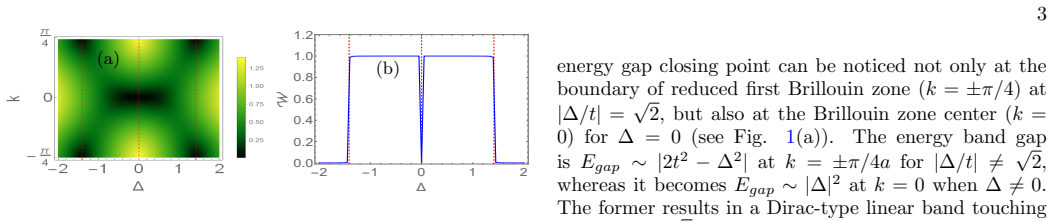
for ∆ = 0 (see Fig. 1(a)). The energy band gap isE gap ∼ |2t 2 −∆ 2|atk=±π/4afor|∆/t| ̸= √ 2, whereas it becomesE gap ∼ |∆| 2 atk= 0 when ∆̸= 0. The former results in a Dirac-type linear band touching at|∆/t|= √ 2 under both PBC and OBC, while the latter gives rise to a quadratic type gap closing exactly at ∆ = 0 for the model under both PBC and OBC. It i...
-
[2]
0 T andu BD =C 0 1 0 (1 + √ 2) T withC= [1 + (1 +√ 2)2]−1/2 is the normalization factor. Importantly, at the Dirac-type critical pointsk c =±π/4a, the zero- energy eigenspace is twofold degenerate and naturally decompose into two orthonormal sectorsu AC andu BD, which have support exclusively on the (A,C) and (B,D) sublattices, respectively. Projecting th...
-
[3]
Fig. 2(b) depicts no sign inversion, while Fig. 2(c) il- lustrates that the mass curve touches zero asymptotically. In contrast, Fig. 2(d) shows the appearance of two inter- faces exactly atx L andx R. Importantly, the existence of two interfaces is analogous to the double-well potential in quantum mechanics[57]. Moreover, the barrier in the finite positi...
work page 2022
-
[4]
Analytical Jackiw-Rebbi Method: Continuum limit of Momentum-space Hamiltonian In the seminal work by JR[1], one-dimensional Dirac fermions are coupled with a solitonic field. The solitonic field was introduced in the low-energy effective Dirac Hamiltonian as a position-dependent mass term, the spe- cific structure of which determines the topology of the s...
-
[5]
Real-space Analysis: Numerical Lattice Study To simulate the JR mode numerically, we need to con- struct the hopping position dependent such that they flip their relative magnitudes across the center of DW. Following[29, 30], we begin by introducing a single do- main wall for our model in real-space, with the modula- tion in hopping strength now taking th...
-
[6]
(2) Now, the Bloch Hamiltonian Eq
Block off-diagonal from of Eq. (2) Now, the Bloch Hamiltonian Eq. (2) can be changed to be block off-diagonal form as it has the chiral symmetry[29]. We first apply the unitary transformation with the unitary matrix U= 1 0 0 0 0 0 1 0 0 1 0 0 0 0 0 1 (A3) makes the HamiltonianH(k) in Eq. (2) into the block off- diagonal formH(k)→UH(k)U −1 = 0V V...
-
[7]
Asymptotic form ofTand∆E As we know,T∝e − αD2 s 4 and ∆E∝2e − αD2 s 4 . Although the overlap formula originally looked Gaussian inD s, we 12 0 20 40 60 80 100 1200.0 0.2 0.4 0.6 0.8 1.0 1.2 Site index (x) 0 20 40 60 80 100 120 0.0 0.2 0.4 0.6 0.8 1.0 Site index (x) xL xR (a) (b) FIG. 10.Winding numberfor (a) ∆ 0 < √ 2tand (b) ∆ 0 <√ 2t. Here, we setL= 1...
-
[8]
Bulk Winding Number Calculation For the domain-wall configuration, the local (as trans- lational invariance is broken, so the winding number is not globally defined) winding number can be calculated byW(x) = 1 2π R BZ dk∂k arg(hx(k, x) +ih y(k, x)) with hx(k, x) =t 2−∆2(x)−t2 cos 4kandh y(k, x) =−t 2 sin 4k. Then, one can attain W(x) = ( 1,0<|∆(x)|< √ 2t ...
-
[9]
The nature of the tunneling period withD s andξis plotted in Fig
Graph For Tunneling Time and Probability Density As we knowT osc = π T = 2π ∆E , therefore, from Appendix B 1, we attainT osc = π ∆E0 ecξ andT osc = π ∆E0 eκDs. The nature of the tunneling period withD s andξis plotted in Fig. 11, which shows the exponential growth ofT osc withD s andξ. 0 10 20 30 40 100 104 106 108 Ds Tosc 10 20 30 40 10 50 100 500 ξ Tos...
-
[10]
R. Jackiw and C. Rebbi, Solitons with Fermion number 1 2, Phys. Rev. D 13, 3398 (1976)
work page 1976
-
[11]
R. Jackiw, Fractional and Majorana fermions: the physics of zero-energy modes, Physica Scripta2012, 014005 (2012)
work page 2012
-
[12]
R. Jackiw and J. Schrieffer, Solitons with fermion num- ber 1 2 in condensed matter and relativistic field theories, Nucl. Phys. B190, 253 (1981)
work page 1981
-
[13]
J. Goldstone and F. Wilczek, Fractional quantum num- bers on solitons, Phys. Rev. Lett.47, 986 (1981)
work page 1981
- [14]
-
[15]
C. Nayak, S. H. Simon, A. Stern, M. Freedman, and S. 13 (a) (b) (c) (d) FIG. 12.Probability densityρ(x, t)illustrating coherent tunneling between two JR modes localized at the interfacesx L andx R for varyingξand fixed∆ 0 = 8.5.The vertical dashed lines indicates the interface positionsx L and xR. Other parameters are: (a)L= 30,ξ/a= 60, (b)L= 20,ξ/a= 12, ...
work page 2008
-
[16]
A. J. Heeger, Nobel Lecture: Semiconducting and metallic polymers: The fourth generation of polymeric materials, Rev. Mod. Phys.73, 681 (2001)
work page 2001
-
[17]
A. J. Heeger, S. Kivelson, J. R. Schrieffer, and W. P. Su, Solitons in conducting polymers, Rev. Mod. Phys. 60, 781 (1988)
work page 1988
-
[18]
M. Z. Hasan and C. L. Kane, Colloquium: Topological insulators, Rev. Mod. Phys.82, 3045 (2010)
work page 2010
-
[19]
X.-L. Qi and S.-C. Zhang, Topological insulators and superconductors, Rev. Mod. Phys.83, 1057 (2011)
work page 2011
-
[20]
L. Lu, J. D. Joannopoulos, and M. Soljaˇ ci´ c, Topological photonics, Nature Photon8, 821–829 (2014)
work page 2014
- [21]
-
[22]
J. W. You, Q. Ma, Z. Lan, Q. Xiao, N. C. Panoiu, and T. J. Cui, Reprogrammable plasmonic topological in- sulators with ultrafast control, Nat. Commun. 12, 5468 (2021)
work page 2021
-
[23]
Z. Xu, X. Kong, J. Chang, D. F. Sievenpiper, and T. J. Cui, Topological Flat Bands in Self-Complementary Plasmonic Metasurfaces, Phys. Rev. Lett. 129, 253001 (2022)
work page 2022
- [24]
-
[25]
W. Zhu et. al., Topological phononic metamaterials, Rep. Prog. Phys.86106501 (2023)
work page 2023
-
[26]
S. Jana, A. Saha, and S. Das, Jackiw-Rebbi zero modes in non-uniform topological insulator nanowire, Phys. Rev. B100, 085428 (2019)
work page 2019
-
[27]
W. P. Su, J. R. Schrieffer, and A. J. Heeger, Solitons in Polyacetylene, Phys. Rev. Lett.42, 1698 (1979)
work page 1979
-
[28]
W. P. Su, J. R. Schrieffer, and A. J. Heeger, Soliton exci- tations in polyacetylene, Phys. Rev. B22, 2099 (1980)
work page 2099
-
[29]
A Short Course on Topological Insulators
J. K. Asb´ oth, L. Oroszl´ any, and A. P´ alyi, “A Short Course on Topological Insulators”, Springer Interna- tional Publishing, (2016)
work page 2016
- [30]
-
[31]
A. Y. Kitaev, Unpaired Majorana fermions in quantum wires, Phys.-Usp.44131 (2001)
work page 2001
-
[32]
D. X. Horv´ ath, S. Fraenkel, S. Scopa, and C. Rylands, Charge resolved entanglement in the presence of topo- logical defects, Phys. Rev. B108, 165406 (2023)
work page 2023
-
[33]
F. M. D’Angelis, F. A. Pinheiro, D. Guery-Odelin, S. Longhi, and F. Impens, Fast and robust quantum state transfer in a topological Su-Schrieffer-Heeger chain with next-to-nearest-neighbor interactions, Phys. Rev. Res. 2, 033475 (2020)
work page 2020
- [34]
-
[35]
Longhi, Topological pumping of edge states via adi- abatic passage, Phys
S. Longhi, Topological pumping of edge states via adi- abatic passage, Phys. Rev. B99, 155150 (2019)
work page 2019
-
[36]
L. Qi, Y. Yan, Y. Xing, X. D. Zhao, S. Liu, W. X. Cui, X. Han, S. Zhang, and H. F. Wang, Topolog- ical router induced via long-range hopping in a Su- Schrieffer-Heeger chain, Phys. Rev. Res.3, 023037 (2021)
work page 2021
-
[37]
C.L. Kane, Chapter 1-Topological Band Theory and theZ 2 Invariant, Contemporary Concepts of Condensed Matter Science, Elsevier, Volume6, Pages 3-34 (2013)
work page 2013
- [38]
-
[39]
M. Scollon and M. P. Kennett, Persistence of chirality in the Su-Schrieffer-Heeger model in the presence of on- site disorder, Phys. Rev. B101, 144204 (2020)
work page 2020
- [40]
-
[41]
S. Weimann, Topologically protected bound states in photonic parity–time-symmetric crystals, Nature Mate- rials16, 433–438 (2017)
work page 2017
- [42]
-
[43]
C. L. Kane and T. C. Lubensky, Topological boundary modes in isostatic lattices, Nature Physics10, 39–45 (2014)
work page 2014
-
[44]
Alicea, New directions in the pursuit of Majorana fermions in solid state systems, Rep
J. Alicea, New directions in the pursuit of Majorana fermions in solid state systems, Rep. Prog. Phys.75 076501 (2012)
work page 2012
-
[45]
C. W. J. Beenakker, Search for Majorana Fermions in Superconductors, Annual Review Condensed Matter Physics. 4:113-136 (2013)
work page 2013
-
[46]
S. R. Elliott and M. Franz, Colloquium: Majorana fermions in nuclear, particle, and solid-state physics, Rev. Mod. Phys.87, 137 (2015)
work page 2015
-
[47]
Y. E. Kraus, Y. Lahini, Z. Ringel, M. Verbin, and O. Zilberberg, Topological States and Adiabatic Pumping in Quasicrystals, Phys. Rev. Lett.109, 106402 (2012)
work page 2012
- [48]
-
[49]
L. D. Landau and E. M. Lifshitz, Quantum Mechan- ics: Non-Relativistic Theory, 3rd ed. Pergamon Press, Oxford, 1977
work page 1977
-
[50]
C. Cohen-Tannoudji, B. Diu, and F. Lalo¨ e, Quantum Mechanics, John Wiley & Sons, New York, 1977
work page 1977
-
[51]
D. J. Griffiths and D. F. Schroeter, Introduction to Quantum Mechanics, 3rd ed. Chap. 8, Cambridge Uni- versity Press, Cambridge, 2018
work page 2018
-
[52]
Shankar, Principles of Quantum Mechanics, 2nd ed
R. Shankar, Principles of Quantum Mechanics, 2nd ed. New York: Springer, 1994
work page 1994
-
[53]
A. J. Leggett, S. Chakravarty, A. T. Dorsey, M. P. A. Fisher, A. Garg, and W. Zwerger, Dynamics of the dis- sipative two-state system, Reviews of Modern Physics 59, 1 (1987)
work page 1987
-
[54]
M. Grifoni, Dynamics of the dissipative two-state sys- tem under ac modulation of bias and coupling energy, Physical Review E54, R3086 (1996)
work page 1996
-
[55]
S. M. H. Halataei and A. J. Leggett, Tunnel splitting in asymmetric double well potentials: An improved wkb calculation (2017), arXiv:1703.05758 [quant-ph]
work page internal anchor Pith review Pith/arXiv arXiv 2017
-
[56]
J. D. Swalen and J. A. Ibers, Potential Function for the Inversion of Ammonia Available to Purchase, The Journal of Chemical Physics36, 1914 (1962)
work page 1914
-
[57]
G. Burkard, D. Loss, and D. P. DiVincenzo, Coupled quantum dots as quantum gates, Physical Review B59, 2070 (1999)
work page 2070
- [58]
-
[59]
Y. Shin, G.-B. Jo, M. Saba, T. A. Pasquini, W. Ketterle, and D. E. Pritchard, Optical Weak Link between Two Spatially Separated Bose-Einstein Condensates, Physi- cal Review Letters 95, 170402 (2005)
work page 2005
- [60]
-
[61]
B. V. Hall, S. Whitlock, R. Anderson, P. Hannaford, and A. I. Sidorov, Condensate Splitting in an Asymmet- ric Double Well for Atom Chip Based Sensors, Physical Review Letters98, 030402 (2007)
work page 2007
-
[62]
M. H. Devoret, J. M. Martinis, and J. Clarke, Mea- surements of Macroscopic Quantum Tunneling out of the Zero-Voltage State of a Current-Biased Josephson Junction, Physical Review Letters55, 1908 (1985)
work page 1908
-
[63]
Y. Makhlin, G. Sch¨ on, and A. Shnirman, Quantum- State Engineering with Josephson-Junction Devices, Reviews of Modern Physics73, 357 (2001)
work page 2001
-
[64]
S. Levy, E. Lahoud, I. Shomroni, and J. Steinhauer, The a.c. and d.c. Josephson effects in a Bose–Einstein condensate, Nature449, 579 (2007)
work page 2007
-
[65]
J. Clarke and F. K. Wilhelm, Superconducting quantum bits, Nature453, 1031 (2008)
work page 2008
- [66]
-
[67]
R. Christie and J. Eastman, Quantum tunnelling and thermally driven transitions in a double-well potential at finite temperature, J. Phys. A: Math. Theor.57 235005 (2024)
work page 2024
-
[68]
G. Grosso and G. Pastori Parravicini, Solid State Physics, Ch. 11 molecular bonding and double-well tun- neling, 2nd ed. Academic Press, 2014
work page 2014
-
[69]
S.Mandal, and S.Kar, Topology and PT Symmetry in a Non-Hermitian Su-Schrieffer-Heeger Chain with Peri- odic Hopping Modulation, J. Phys.: Condens. Matter 37, 095602 (2025)
work page 2025
-
[70]
Kar, Edge state behavior in a Su–Schrieffer–Heeger like model with periodically modulated hopping, J
S. Kar, Edge state behavior in a Su–Schrieffer–Heeger like model with periodically modulated hopping, J. Phys.: Condens. Matter36, 065301 (9pp) (2024)
work page 2024
-
[71]
C.-K. Chiu, J. C. Y. Teo, A. P. Schnyder, and S. Ryu, Classification of topological quantum matter with sym- metries, Rev. Mod. Phys.88, 035005 (2016)
work page 2016
-
[72]
A. Altland and M. R. Zirnbauer, Novel symmetry classes in mesoscopic normal-superconducting hybrid structures, Phys.Rev.B55, 1142 (1997)
work page 1997
-
[73]
V.Gurarie, Single particle Green’s functions and inter- 15 acting topological insulators, Phys. Rev. B83, 085426 (2011)
work page 2011
-
[74]
Z.Wang and S.C.Zhang, Topological Invariants and Ground-State Wave functions of Topological Insulators on a Torus, Phys. Rev. X4011006 (2014)
work page 2014
-
[75]
Y. He and C.-C. Chien, Non-Hermitian generalizations of extended Su–Schrieffer–Heeger models, J. Phys.: Condens. Matter33085501 (2021)
work page 2021
-
[76]
M. McIntyre and G. Cairns, A new formula for wind- ing number, In: Geometriae Dedicata 46.2, pp. 149–159 (1993)
work page 1993
-
[77]
J. C. Y. Teo and C. L. Kane, Topological defects and gapless modes in insulators and superconductors, Phys. Rev. B82, 115120 (2010)
work page 2010
- [78]
-
[79]
The oscillation of⟨x(t ′)⟩does not mean that a JR mode physically moves from one interface to the other. In- stead, it means that the occupation probability tunnels back and forth between two fixed JR modes
-
[80]
A. H. Castro Neto, F. Guinea, N. M. R. Peres, K. S. Novoselov, and A. K. Geim, The electronic properties of graphene, Rev. Mod. Phys.81, 109–162 (2009)
work page 2009
discussion (0)
Sign in with ORCID, Apple, or X to comment. Anyone can read and Pith papers without signing in.