Resilient j=3/2 superconductivity in topological semimetal YPtBi
Pith reviewed 2026-07-02 04:09 UTC · model grok-4.3
The pith
The critical temperature of superconductivity in YPtBi shows little variation despite large changes in disorder and carrier density.
A machine-rendered reading of the paper's core claim, the machinery that carries it, and where it could break.
Core claim
Cooper pairing in YPtBi occurs among j=3/2 quasiparticle states. By varying magnetic and nonmagnetic disorder by nearly two orders of magnitude and carrier densities by three orders, the superconducting critical temperature exhibits remarkable robustness with little variation. The results suggest that superconductivity resides in a regime where phase stiffness, rather than pair formation, governs the transition temperature. The insensitivity of Cooper pairing to dramatic changes in the quasiparticle environment highlights a new form of protection in topological high-spin superconductors.
What carries the argument
The j=3/2 quasiparticle manifold at the Gamma point, which supports resilient superconducting pairing insensitive to variations in the quasiparticle environment.
If this is right
- Superconductivity in YPtBi is protected against substantial changes in disorder and carrier concentration.
- The transition temperature is likely limited by phase stiffness rather than the strength of the pairing interaction.
- This resilience represents a distinct protection mechanism for topological high-spin superconductors.
- Pairing in such systems can persist even as the electronic environment near the Fermi level is strongly modified.
Where Pith is reading between the lines
- Similar robustness could be tested in other topological semimetals with inverted bands and high-spin states.
- If phase stiffness dominates, then Tc might be increased by improving superfluid density without needing stronger pairing.
- Device applications of such superconductors could tolerate variations in material quality better than conventional ones.
Load-bearing premise
The changes in disorder and carrier density accurately and independently control the quasiparticle environment near the Fermi level without introducing confounding factors such as sample inhomogeneity.
What would settle it
Observing a significant dependence of the critical temperature on disorder or carrier density in high-quality samples where other variables are held constant would contradict the claimed robustness.
Figures


read the original abstract
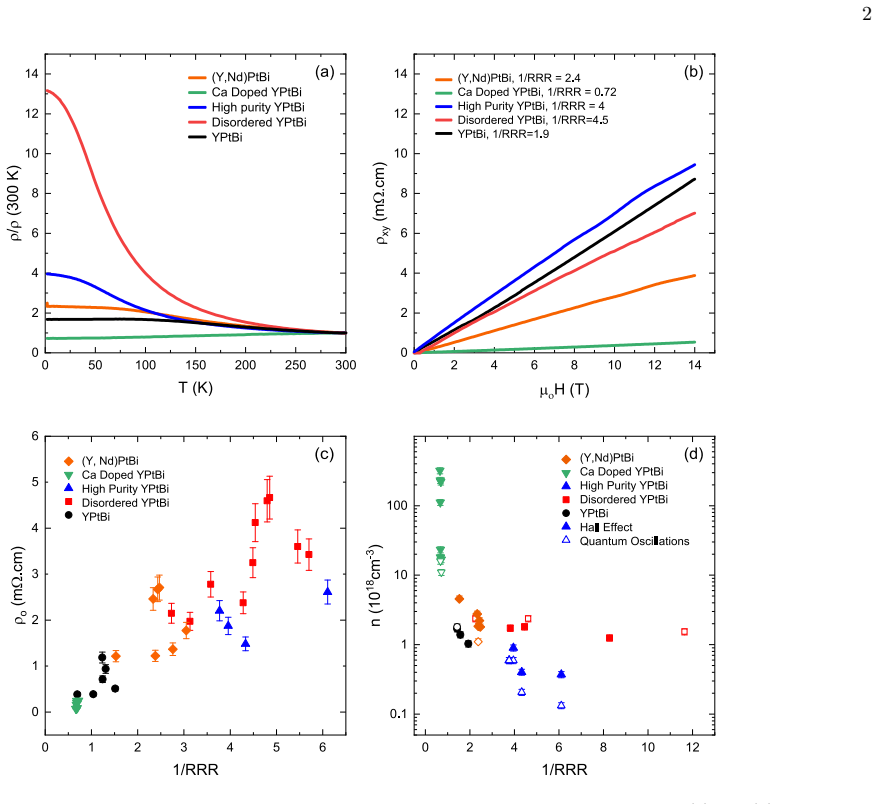
Cooper pairing in most of the known fermionic superfluids occurs via spin-1/2 quasiparticle interactions that lead to spin-singlet or spin-triplet pairing. In the topological semimetal YPtBi, strong spin-orbit coupling results in a band inversion between highly symmetric $s$- and $p$-like electronic bands and a degeneracy at the $\Gamma$ point that ensures the manifold of $j$=3/2 quasiparticle states thrive near the Fermi level, where superconducting pairing occurs. Here we study the effects of magnetic and nonmagnetic disorder and carrier density on this exotic superconducting pairing state. By varying levels of disorder and carrier densities by nearly two and three orders of magnitude, respectively, we show that the superconducting critical temperature of YPtBi has a remarkable robustness, with little variation across this span. Our results suggest that superconductivity in YPtBi may reside in a regime where phase stiffness, rather than pair formation, governs the transition temperature. The insensitivity of Cooper pairing to dramatic changes in quasiparticle environment in a $j$=3/2 superconductor highlights a new form of protection realized in topological high-spin superconductors.
Editorial analysis
A structured set of objections, weighed in public.
Axiom & Free-Parameter Ledger
Reference graph
Works this paper leans on
-
[1]
pairing states, which can exhibit complex gap struc- tures and in some cases robustness to certain types of disorder [24, 30]. The lack of sensitivity to carrier density is a more pro- found observation, challenging the applicability of a con- ventional electron-phonon mediated pairing mechanism which typically exhibits a strong dependence on the den- sit...
-
[2]
To systemat- ically study the angular dependence, the magnetic field was rotated in discrete 10 ◦ increments
axis for the Nd substituted samples. To systemat- ically study the angular dependence, the magnetic field was rotated in discrete 10 ◦ increments. Throughout the rotation, the magnetic field was kept perpendicular to the current. ACKNOWLEDGMENTS Research at the University of Maryland was sup- ported by the Gordon and Betty Moore Foundation’s EPiQS Initiat...
-
[3]
Chadov, X
S. Chadov, X. Qi, J. K¨ ubler, G. H. Fecher, C. Felser, and S. C. Zhang, Tunable multifunctional topological insu- lators in ternary heusler compounds, Nat Mater9, 541 (2010)
2010
-
[4]
H. Lin, L. A. Wray, Y. Xia, S. Xu, S. Jia, R. J. Cava, A. Bansil, and M. Z. Hasan, Half-heusler ternary com- pounds as new multifunctional experimental platforms for topological quantum phenomena, Nature Materials 9, 546 (2010)
2010
-
[5]
D. Xiao, Y. Yao, W. Feng, J. Wen, W. Zhu, X.-Q. Chen, G. M. Stocks, and Z. Zhang, Half-heusler compounds as a new class of three-dimensional topological insulators, Phys. Rev. Lett.105, 096404 (2010)
2010
-
[6]
N. P. Butch, P. Syers, K. Kirshenbaum, A. P. Hope, and J. Paglione, Superconductivity in the topological semimetal YPtBi, Phys. Rev. B84, 220504 (2011)
2011
-
[7]
H. Kim, K. Wang, Y. Nakajima, R. Hu, S. Ziemak, P. Syers, L. Wang, H. Hodovanets, J. D. Denlinger, P. M. R. Brydon, D. F. Agterberg, M. A. Tanatar, R. Prozorov, and J. Paglione, Beyond triplet: Uncon- ventional superconductivity in a spin-3/2 topological semimetal, Science Advances4, 10.1126/sciadv.aao4513 (2018)
-
[8]
H. Kim, J. Lee, H. Hodovanets, K. Wang, J. D. Sau, and J. Paglione, Quantum oscillations of thej= 3/2 fermi surface in the topological semimetal YPtBi, Phys. Rev. Res.4, 033169 (2022)
2022
-
[9]
Meinert, Unconventional superconductivity in YPtBi and related topological semimetals, Phys
M. Meinert, Unconventional superconductivity in YPtBi and related topological semimetals, Phys. Rev. Lett.116, 137001 (2016)
2016
-
[10]
X. Lin, Z. Zhu, B. Fauqu´ e, and K. Behnia, Fermi sur- face of the most dilute superconductor, Phys. Rev. X3, 021002 (2013)
2013
-
[11]
P. M. R. Brydon, L. Wang, M. Weinert, and D. F. Agter- berg, Pairing ofj= 3/2 fermions in half-heusler super- conductors, Phys. Rev. Lett.116, 177001 (2016)
2016
-
[12]
Yu and C.-X
J. Yu and C.-X. Liu, Singlet-quintet mixing in spin-orbit coupled superconductors withj= 3 2 fermions, Phys. Rev. B98, 104514 (2018)
2018
-
[13]
Savary, J
L. Savary, J. Ruhman, J. W. F. Venderbos, L. Fu, and P. A. Lee, Superconductivity in three-dimensional spin-orbit coupled semimetals, Phys. Rev. B96, 214514 (2017)
2017
-
[14]
H. Kim, M. A. Tanatar, H. Hodovanets, K. Wang, J. Paglione, and R. Prozorov, Campbell penetration depth in low carrier density superconductor YPtBi, Phys. Rev. B104, 014510 (2021)
2021
-
[16]
J. W. F. Venderbos, L. Savary, J. Ruhman, P. A. Lee, and L. Fu, Pairing states of spin- 3 2 fermions: Symmetry- enforced topological gap functions, Phys. Rev. X8, 011029 (2018)
2018
-
[17]
W. Yang, T. Xiang, and C. Wu, Majorana surface modes of nodal topological pairings in spin- 3 2 semimetals, Phys. Rev. B96, 144514 (2017)
2017
-
[18]
C. Timm, A. P. Schnyder, D. F. Agterberg, and P. M. R. Brydon, Inflated nodes and surface states in supercon- ducting half-heusler compounds, Phys. Rev. B96, 094526 (2017)
2017
-
[19]
G. Sim, A. Mishra, M. J. Park, Y. B. Kim, G. Y. Cho, and S. Lee, Topologicald+swave superconductors in a multiorbital quadratic band touching system, Phys. Rev. B100, 064509 (2019)
2019
-
[20]
Suzuki, R
T. Suzuki, R. Chisnell, A. Devarakonda, Y. T. Liu, W. Feng, D. Xiao, J. W. Lynn, and J. G. Checkelsky, Large anomalous hall effect in a half-heusler antiferro- magnet, Nature Physics12, 1119 (2016)
2016
-
[21]
Hirschberger, S
M. Hirschberger, S. Kushwaha, Z. Wang, Q. Gibson, S. Liang, C. A. Belvin, B. A. Bernevig, R. J. Cava, and N. P. Ong, The chiral anomaly and thermopower of weyl fermions in the half-heusler gdptbi, Nat Mater15, 1161 (2016)
2016
-
[22]
Manna, Y
K. Manna, Y. Sun, L. Muechler, J. K¨ ubler, and C. Felser, Heusler, weyl and berry, Nature Reviews Materials3, 244 (2018)
2018
-
[23]
B. Roy, S. A. A. Ghorashi, M. S. Foster, and A. H. Nev- idomskyy, Topological superconductivity of spin-3/2 car- riers in a three-dimensional doped luttinger semimetal, Phys. Rev. B99, 054505 (2019)
2019
-
[24]
A. L. Szab´ o, R. Moessner, and B. Roy, Interacting spin-3 2 fermions in a luttinger semimetal: Competing phases and 8 their selection in the global phase diagram, Phys. Rev. B 103, 165139 (2021)
2021
-
[25]
Kobayashi, A
S. Kobayashi, A. Bhattacharya, C. Timm, and P. M. R. Brydon, Bogoliubov fermi surfaces from pairing of emer- gentj= 3 2 fermions on the pyrochlore lattice, Phys. Rev. B105, 134507 (2022)
2022
-
[26]
J. Yu and C.-X. Liu, Spin susceptibility, upper critical field, and disorder effect in j = 3/2 superconductors with singlet-quintet mixing, Journal of Applied Physics128, 063904 (2020), https://doi.org/10.1063/5.0013596
-
[27]
D. Kim, T. Sato, S. Kobayashi, and Y. Asano, Spin sus- ceptibility of a j = 3/2 superconductor, Journal of the Physical Society of Japan92, 054703 (2023)
2023
-
[28]
Persky, A
E. Persky, A. Fang, X. Zhang, C. Adamo, P. Wu, E. Levenson-Falk, C. Shekhar, C. Felser, B. Yan, and A. Kapitulnik, Possible unconventional surface supercon- ductivity in the half-heusler compound yptbi, Phys. Rev. B111, 245417 (2025)
2025
-
[29]
Shoenberg, Magnetic oscillations in metals (Cam- bridge University Press, London, 2009)
D. Shoenberg, Magnetic oscillations in metals (Cam- bridge University Press, London, 2009)
2009
-
[30]
Abrikosov and L
A. Abrikosov and L. Gor’kov, Contribution to the theory of superconducting alloys with paramagnetic impurities, JETP12, 1243 (1961)
1961
-
[31]
L. A. I., Vector pairing in superconductors of small di- mensions, JETP Lett.2, 130 (1965)
1965
-
[32]
D. C. Cavanagh and P. M. R. Brydon, Robustness of un- conventionals-wave superconducting states against dis- order, Phys. Rev. B101, 054509 (2020)
2020
-
[33]
Tinkham, Introduction to Superconductivity, 2nd ed
M. Tinkham, Introduction to Superconductivity, 2nd ed. (Dover Publications, North Chelmsford, MA, 2004)
2004
-
[34]
Taguchi, A
Y. Taguchi, A. Kitora, and Y. Iwasa, Increase inT c upon reduction of doping in Li xZrNCl superconductors, Phys. Rev. Lett.97, 107001 (2006)
2006
-
[35]
Nakagawa, Y
Y. Nakagawa, Y. Saito, T. Nojima, K. Inumaru, S. Ya- manaka, Y. Kasahara, and Y. Iwasa, Gate-controlled low carrier density superconductors: Toward the two- dimensional BCS-BEC crossover, Phys. Rev. B98, 064512 (2018)
2018
-
[36]
Nozi` eres and S
P. Nozi` eres and S. Schmitt-Rink, Bose condensation in an attractive fermion gas: From weak to strong coupling superconductivity, Journal of Low Temperature Physics 59, 195 (1985)
1985
-
[37]
D. M. Eagles, Possible pairing without superconductivity at low carrier concentrations in bulk and thin-film super- conducting semiconductors, Phys. Rev.186, 456 (1969)
1969
-
[38]
V. J. Emery and S. A. Kivelson, Importance of phase fluc- tuations in superconductors with small superfluid den- sity, Nature374, 434 (1995)
1995
-
[39]
Y. J. Uemura, G. M. Luke, B. J. Sternlieb, J. H. Brewer, J. F. Carolan, W. N. Hardy, R. Kadono, J. R. Kempton, R. F. Kiefl, S. R. Kreitzman, P. Mulhern, T. M. Rise- man, D. L. Williams, B. X. Yang, S. Uchida, H. Takagi, J. Gopalakrishnan, A. W. Sleight, M. A. Subramanian, C. L. Chien, M. Z. Cieplak, G. Xiao, V. Y. Lee, B. W. Statt, C. E. Stronach, W. J. K...
1989
-
[40]
Kivelson, Making high tc higher: a theoretical pro- posal, Physica B: Condensed Matter318, 61 (2002), the Future of Materials Physics: A Festschrift for Zachary Fisk
S. Kivelson, Making high tc higher: a theoretical pro- posal, Physica B: Condensed Matter318, 61 (2002), the Future of Materials Physics: A Festschrift for Zachary Fisk
2002
-
[41]
M. N. Gastiasoro, J. Ruhman, and R. M. Fernandes, Superconductivity in dilute srtio3: A review, Annals of Physics417, 168107 (2020), eliashberg theory at 60: Strong-coupling superconductivity and beyond
2020
-
[42]
Q. Chen, Z. Wang, R. Boyack, S. Yang, and K. Levin, When superconductivity crosses over: From bcs to bec, Rev. Mod. Phys.96, 025002 (2024)
2024
discussion (0)
Sign in with ORCID, Apple, or X to comment. Anyone can read and Pith papers without signing in.