Fundamental limitations of single-particle Green's-function zeroes as probes of many-body topology
Pith reviewed 2026-07-03 05:41 UTC · model grok-4.3
The pith
Topological invariants from single-particle Green's functions cannot reliably diagnose the topology of interacting many-body states.
A machine-rendered reading of the paper's core claim, the machinery that carries it, and where it could break.
Core claim
We show that topological invariants constructed from single-particle Green's functions (GFs) cannot reliably diagnose the topology of interacting many-body states. Using coupled interacting SSH chains as a minimal example, we demonstrate that a spin-spin interaction can trivialize the many-body ground state without affecting the GF topological invariant. This breakdown originates from the GF's inability to probe electronic excitations in the Fock sectors responsible for the topological degeneracy. Consequently, GF zeroes are not associated with physical topological quasiparticles and cannot generally characterize interacting topological phases.
What carries the argument
The single-particle Green's function topological invariant, which fails to track many-body topology because it cannot probe excitations in the Fock sectors that protect the topological degeneracy.
If this is right
- GF zeroes do not correspond to physical topological quasiparticles in interacting systems.
- Single-particle GF invariants cannot generally classify interacting topological phases.
- Topology in interacting systems must be diagnosed with probes that access the relevant Fock sectors.
- The breakdown applies whenever topological degeneracy is carried by excitations invisible to the single-particle GF.
Where Pith is reading between the lines
- Similar limitations may affect other single-particle spectral functions used to infer topology in the presence of interactions.
- Many-body extensions of the Green's function or correlation functions involving multiple particles could be required for reliable diagnosis.
- Results obtained from GF-based invariants in strongly interacting materials should be reexamined for consistency with the actual many-body ground state.
Load-bearing premise
The coupled interacting SSH chains provide a valid minimal example in which a spin-spin interaction changes the many-body ground-state topology while leaving the single-particle GF invariant unchanged.
What would settle it
An explicit calculation or measurement in the coupled interacting SSH chains showing that the GF topological invariant changes precisely when the spin-spin interaction trivializes the many-body ground state.
Figures

read the original abstract
We show that topological invariants constructed from single-particle Green's functions (GFs) cannot reliably diagnose the topology of interacting many-body states. Using coupled interacting SSH chains as a minimal example, we demonstrate that a spin-spin interaction can trivialize the many-body ground state without affecting the GF topological invariant. This breakdown originates from the GF's inability to probe electronic excitations in the Fock sectors responsible for the topological degeneracy. Consequently, GF zeroes are not associated with physical topological quasiparticles and cannot generally characterize interacting topological phases.
Editorial analysis
A structured set of objections, weighed in public.
Referee Report
Summary. The manuscript claims that topological invariants constructed from single-particle Green's functions (GFs) cannot reliably diagnose the topology of interacting many-body states. Using coupled interacting SSH chains as a minimal example, it shows that a spin-spin interaction can trivialize the many-body ground state without affecting the GF topological invariant, because the GF cannot probe excitations in the Fock sectors responsible for topological degeneracy. The paper concludes that GF zeroes are not associated with physical topological quasiparticles and cannot generally characterize interacting topological phases.
Significance. If the counterexample holds, the result is significant for condensed-matter theory of interacting topological phases, as it identifies a concrete mechanism by which single-particle GF methods miss many-body topological features tied to Fock-space structure. The paper's strength is its use of a minimal, falsifiable model example rather than a general derivation, making the limitation explicit and testable.
minor comments (2)
- The abstract and introduction would benefit from a brief statement of the explicit form of the GF topological invariant employed (e.g., winding number or Zak phase constructed from the GF), to allow immediate comparison with prior literature on GF-based invariants.
- Figure captions should explicitly label the non-interacting versus interacting cases and state the parameter values used for the spin-spin coupling strength.
Simulated Author's Rebuttal
We thank the referee for the careful reading and for recommending acceptance. The report accurately summarizes the central claim and its implications for the use of single-particle Green's functions in diagnosing interacting topological phases.
Circularity Check
No significant circularity
full rationale
The paper's central claim is established via an explicit counterexample (coupled interacting SSH chains with spin-spin interaction) rather than any derivation, ansatz, or fitted parameter that reduces to its own inputs. The abstract and described mechanism directly exhibit the GF invariant remaining unchanged while the many-body topology is trivialized, with the explanation tied to Fock-sector access limitations; this is an independent, falsifiable construction with no self-definitional steps, no load-bearing self-citations, and no renaming of known results. The argument is self-contained against the model's explicit construction.
Axiom & Free-Parameter Ledger
axioms (1)
- domain assumption Single-particle Green's functions can be used to construct topological invariants that diagnose many-body states
Reference graph
Works this paper leans on
-
[1]
In con- trast, a finiteJ 12 introduces a purely many-body interaction that preserves all symmetries
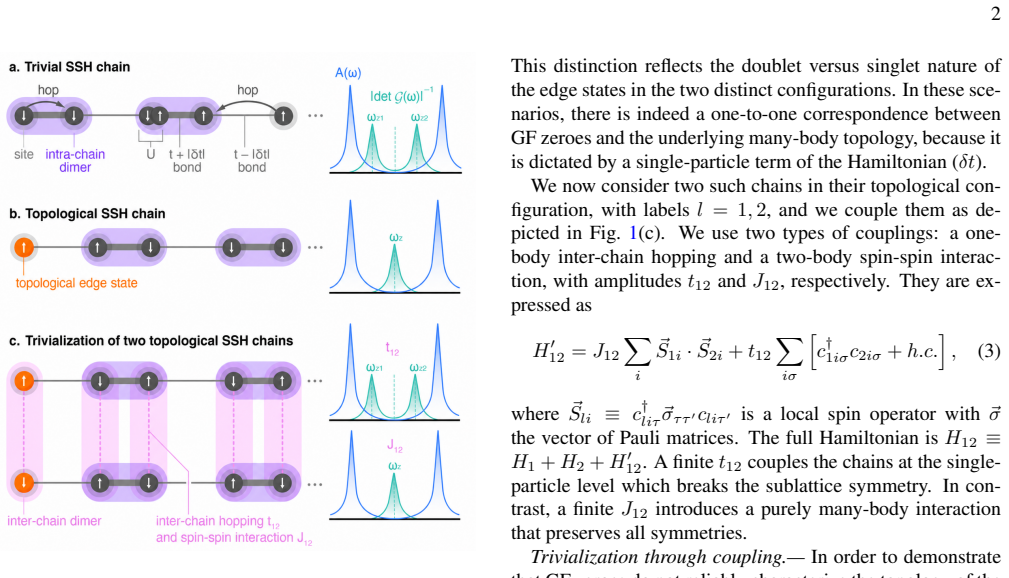
A finitet 12 couples the chains at the single- particle level which breaks the sublattice symmetry. In con- trast, a finiteJ 12 introduces a purely many-body interaction that preserves all symmetries. Trivialization through coupling.—In order to demonstrate that GF zeroes do not reliably characterize the topology of the many-body state in the bulk, in par...
-
[2]
On the other hand, in Fig
We find that any finiteJ 12 or t12 opens a spin gap, reflecting the formation of singlets be- tween the two topological edge spin-½ modes and therefore signaling the trivialization of the system as soon as inter-chain coupling is introduced. On the other hand, in Fig. 2(b), we present the GF topolog- ical indicatorZ[G]for three cases: in full blue, dotted...
-
[3]
Alexandradinata, X
A. Alexandradinata, X. Dai, and B. A. Bernevig, Wilson-loop characterization of inversion-symmetric topological insulators, Phys. Rev. B89, 155114 (2014)
2014
-
[4]
C.-K. Chiu, J. C. Y . Teo, A. P. Schnyder, and S. Ryu, Classifica- tion of topological quantum matter with symmetries, Rev. Mod. Phys.88, 035005 (2016)
2016
-
[5]
Chen, Z.-C
X. Chen, Z.-C. Gu, and X.-G. Wen, Classification of gapped symmetric phases in one-dimensional spin systems, Phys. Rev. B83, 035107 (2011)
2011
-
[6]
Pollmann, E
F. Pollmann, E. Berg, A. M. Turner, and M. Oshikawa, Symme- try protection of topological phases in one-dimensional quan- tum spin systems, Phys. Rev. B85, 075125 (2012)
2012
-
[7]
Senthil, Symmetry-Protected Topological Phases of Quan- tum Matter, Annual Review of Condensed Matter Physics6, 299 (2015)
T. Senthil, Symmetry-Protected Topological Phases of Quan- tum Matter, Annual Review of Condensed Matter Physics6, 299 (2015)
2015
-
[8]
Verresen, R
R. Verresen, R. Moessner, and F. Pollmann, One-dimensional symmetry protected topological phases and their transitions, Phys. Rev. B96, 165124 (2017)
2017
-
[9]
Wang, X.-L
Z. Wang, X.-L. Qi, and S.-C. Zhang, Topological Order Pa- rameters for Interacting Topological Insulators, Phys. Rev. Lett. 105, 256803 (2010)
2010
-
[10]
Wang and S.-C
Z. Wang and S.-C. Zhang, Simplified Topological Invariants for Interacting Insulators, Phys. Rev. X2, 031008 (2012)
2012
-
[11]
Gurarie, Single-particle green’s functions and interacting topological insulators, Phys
V . Gurarie, Single-particle green’s functions and interacting topological insulators, Phys. Rev. B83, 085426 (2011)
2011
-
[12]
S. R. Manmana, A. M. Essin, R. M. Noack, and V . Gu- rarie, Topological invariants and interacting one-dimensional fermionic systems, Phys. Rev. B86, 205119 (2012)
2012
-
[13]
Yoshida, R
T. Yoshida, R. Peters, S. Fujimoto, and N. Kawakami, Charac- terization of a Topological Mott insulator in One Dimension, Phys. Rev. Lett.112, 196404 (2014)
2014
-
[14]
Iraola, N
M. Iraola, N. Heinsdorf, A. Tiwari, D. Lessnich, T. Mertz, F. Ferrari, M. H. Fischer, S. M. Winter, F. Pollmann, T. Neupert, R. Valent´ı, and M. G. Vergniory, Towards a topological quan- tum chemistry description of correlated systems: The case of the Hubbard diamond chain, Phys. Rev. B104, 195125 (2021)
2021
-
[15]
Lessnich, S
D. Lessnich, S. M. Winter, M. Iraola, M. G. Vergniory, and R. Valent´ı, Elementary band representations for the single- particle Green’s function of interacting topological insulators, Phys. Rev. B104, 085116 (2021)
2021
-
[16]
Blason and M
A. Blason and M. Fabrizio, Unified role of Green’s function poles and zeros in correlated topological insulators, Phys. Rev. B108, 125115 (2023)
2023
-
[17]
Bollmann, C
S. Bollmann, C. Setty, U. F. P. Seifert, and E. J. K ¨onig, Topo- logical Green’s Function Zeros in an Exactly Solved Model and Beyond, Phys. Rev. Lett.133, 136504 (2024)
2024
-
[18]
Peralta Gavensky, S
L. Peralta Gavensky, S. Sachdev, and N. Goldman, Connect- ing the many-body chern number to luttinger’s theorem through stˇreda’s formula, Phys. Rev. Lett.131, 236601 (2023)
2023
-
[19]
Wagner, L
N. Wagner, L. Crippa, A. Amaricci, P. Hansmann, M. Klett, E. J. K ¨onig, T. Sch ¨afer, D. D. Sante, J. Cano, A. J. Millis, A. Georges, and G. Sangiovanni, Mott insulators with bound- ary zeros, Nature Communications14, 7531 (2023)
2023
-
[20]
Wagner, D
N. Wagner, D. Guerci, A. J. Millis, and G. Sangiovanni, Edge Zeros and Boundary Spinons in Topological Mott Insulators, Phys. Rev. Lett.133, 126504 (2024)
2024
-
[21]
Setty, F
C. Setty, F. Xie, S. Sur, L. Chen, M. G. Vergniory, and Q. Si, Electronic properties, correlated topology, and Green’s function zeros, Phys. Rev. Res.6, 033235 (2024)
2024
-
[22]
Setty, S
C. Setty, S. Sur, L. Chen, F. Xie, H. Hu, S. Paschen, J. Cano, and Q. Si, Symmetry constraints and spectral crossing in a Mott in- sulator with Green’s function zeros, Phys. Rev. Res.6, L032018 (2024)
2024
-
[23]
Nourafkan and G
R. Nourafkan and G. Kotliar, Electric polarization in correlated insulators, Phys. Rev. B88, 155121 (2013)
2013
- [24]
- [25]
-
[26]
Poles-zeros duality in semi-holographic Mott insulators
T. K ¨ogel, A. Caddeo, A. Pitters, F. Paoletti, L. Crippa, G. Sangiovanni, R. Meyer, and J. Erdmenger, Poles-zeros duality in semi-holographic mott insulators, arXiv preprint arXiv:2605.20321 (2026)
work page internal anchor Pith review Pith/arXiv arXiv 2026
- [27]
-
[28]
Dzyaloshinskii, Some consequences of the Luttinger theo- rem: The luttinger surfaces in non-fermi liquids and mott insu- lators, Phys
I. Dzyaloshinskii, Some consequences of the Luttinger theo- rem: The luttinger surfaces in non-fermi liquids and mott insu- lators, Phys. Rev. B68, 085113 (2003)
2003
-
[29]
T. D. Stanescu, P. Phillips, and T.-P. Choy, Theory of the Luttinger surface in doped Mott insulators, Phys. Rev. B75, 104503 (2007)
2007
-
[30]
Rosch, Breakdown of Luttinger’s theorem in two-orbital Mott insulators, The European Physical Journal B59, 495 (2007)
A. Rosch, Breakdown of Luttinger’s theorem in two-orbital Mott insulators, The European Physical Journal B59, 495 (2007)
2007
-
[31]
Seki and S
K. Seki and S. Yunoki, Topological interpretation of the Lut- tinger theorem, Phys. Rev. B96, 085124 (2017)
2017
-
[32]
Skolimowski and M
J. Skolimowski and M. Fabrizio, Luttinger’s theorem in the presence of Luttinger surfaces, Phys. Rev. B106, 045109 (2022)
2022
-
[33]
K. B. Dave, P. W. Phillips, and C. L. Kane, Absence of Lut- tinger’s Theorem due to Zeros in the Single-Particle Green Function, Phys. Rev. Lett.110, 090403 (2013)
2013
-
[34]
T. D. Stanescu and G. Kotliar, Fermi arcs and hidden zeros of the Green function in the pseudogap state, Phys. Rev. B74, 125110 (2006)
2006
-
[35]
Sakai, Y
S. Sakai, Y . Motome, and M. Imada, Evolution of Electronic Structure of Doped Mott Insulators: Reconstruction of Poles and Zeros of Green’s Function, Phys. Rev. Lett.102, 056404 (2009)
2009
-
[36]
Sakai, Y
S. Sakai, Y . Motome, and M. Imada, Doped high-T c cuprate superconductors elucidated in the light of zeros and poles of the electronic Green’s function, Phys. Rev. B82, 134505 (2010)
2010
-
[37]
K.-Y . Yang, T. M. Rice, and F.-C. Zhang, Phenomenological theory of the pseudogap state, Phys. Rev. B73, 174501 (2006)
2006
-
[38]
M. S. Scheurer, S. Chatterjee, W. Wu, M. Ferrero, A. Georges, and S. Sachdev, Topological order in the pseudogap metal, Pro- ceedings of the National Academy of Sciences115, E3665 (2018)
2018
-
[39]
P. Worm, M. Reitner, K. Held, and A. Toschi, Fermi and Lut- tinger Arcs: Two Concepts, Realized on One Surface, Phys. Rev. Lett.133, 166501 (2024)
2024
-
[40]
Fabrizio, Emergent quasiparticles at Luttinger surfaces, Na- ture Communications13, 1561 (2022)
M. Fabrizio, Emergent quasiparticles at Luttinger surfaces, Na- ture Communications13, 1561 (2022)
2022
-
[41]
Fabrizio, Spin-Liquid Insulators Can Be Landau’s Fermi Liquids, Phys
M. Fabrizio, Spin-Liquid Insulators Can Be Landau’s Fermi Liquids, Phys. Rev. Lett.130, 156702 (2023)
2023
-
[42]
Blason, I
A. Blason, I. Pasqua, M. Ferrero, and M. Fabrizio, Luttinger surface dominance and Fermi liquid behavior of topological Kondo insulatorsSmB 6 andYbB 12, Phys. Rev. B110, 235115 (2024)
2024
-
[43]
Pasqua and M
I. Pasqua and M. Fabrizio, Fermi-liquid corrections to the in- trinsic anomalous Hall conductivity of topological metals, Sci- 6 Post Phys.19, 014 (2025)
2025
-
[44]
He, H.-Q
Y .-Y . He, H.-Q. Wu, Z. Y . Meng, and Z.-Y . Lu, Topological invariants for interacting topological insulators. I. Efficient nu- merical evaluation scheme and implementations, Phys. Rev. B 93, 195163 (2016)
2016
-
[45]
He, H.-Q
Y .-Y . He, H.-Q. Wu, Z. Y . Meng, and Z.-Y . Lu, Topological invariants for interacting topological insulators. II. Breakdown of single-particle Green’s function formalism, Phys. Rev. B93, 195164 (2016)
2016
-
[46]
J. Zhao, P. Mai, B. Bradlyn, and P. Phillips, Failure of Topolog- ical Invariants in Strongly Correlated Matter, Phys. Rev. Lett. 131, 106601 (2023)
2023
- [47]
- [48]
-
[49]
W. P. Su, J. R. Schrieffer, and A. J. Heeger, Solitons in Poly- acetylene, Phys. Rev. Lett.42, 1698 (1979)
1979
-
[50]
Fidkowski and A
L. Fidkowski and A. Kitaev, Effects of interactions on the topo- logical classification of free fermion systems, Phys. Rev. B81, 134509 (2010)
2010
-
[51]
Queiroz, E
R. Queiroz, E. Khalaf, and A. Stern, Dimensional Hierarchy of Fermionic Interacting Topological Phases, Phys. Rev. Lett.117, 206405 (2016)
2016
-
[52]
Pangburn, C
E. Pangburn, C. P ´epin, and A. Banerjee, Topological charge ex- citations and Green’s function zeros in paramagnetic Mott in- sulators, Phys. Rev. B112, 085105 (2025)
2025
-
[53]
Weinberg, Evidence That the Deuteron Is Not an Elementary Particle, Phys
S. Weinberg, Evidence That the Deuteron Is Not an Elementary Particle, Phys. Rev.137, B672 (1965)
1965
-
[54]
W. A. Benalcazar, B. A. Bernevig, and T. L. Hughes, Quantized electric multipole insulators, Science357, 61 (2017)
2017
-
[56]
Chen and P
K.-T. Chen and P. A. Lee, Unified formalism for calculating polarization, magnetization, and more in a periodic insulator, Phys. Rev. B84, 205137 (2011)
2011
-
[57]
D. V . Else and R. Thorngren, Topological theory of Lieb- Schultz-Mattis theorems in quantum spin systems, Phys. Rev. B101, 224437 (2020)
2020
-
[58]
Fuchs and F
J.-N. Fuchs and F. Pi ´echon, Orbital embedding and topology of one-dimensional two-band insulators, Phys. Rev. B104, 235428 (2021)
2021
-
[59]
Guzm ´an, D
M. Guzm ´an, D. Bartolo, and D. Carpentier, Geometry and topology tango in ordered and amorphous chiral matter, SciPost Phys.12, 038 (2022)
2022
-
[60]
Lehmann, L
C. Lehmann, L. Crippa, G. Sangiovanni, and J. C. Budich, Probing Green’s Function Zeros by Cotunneling through Mott Insulators, Phys. Rev. Lett.135, 106303 (2025)
2025
-
[61]
E. R. Gagliano and C. A. Balseiro, Dynamic correlation func- tions in quantum many-body systems at zero temperature, Phys. Rev. B38, 11766 (1988)
1988
-
[62]
Dagotto, Correlated electrons in high-temperature supercon- ductors, Rev
E. Dagotto, Correlated electrons in high-temperature supercon- ductors, Rev. Mod. Phys.66, 763 (1994)
1994
-
[63]
S. R. White, Density matrix formulation for quantum renormal- ization groups, Phys. Rev. Lett.69, 2863 (1992)
1992
-
[64]
Schollw ¨ock, The density-matrix renormalization group, Rev
U. Schollw ¨ock, The density-matrix renormalization group, Rev. Mod. Phys.77, 259 (2005)
2005
-
[65]
Schollw ¨ock, The density-matrix renormalization group in the age of matrix product states, Annals of Physics326, 96 (2011)
U. Schollw ¨ock, The density-matrix renormalization group in the age of matrix product states, Annals of Physics326, 96 (2011)
2011
-
[66]
Fishman, S
M. Fishman, S. R. White, and E. M. Stoudenmire, The ITen- sor Software Library for Tensor Network Calculations, SciPost Phys. Codebases , 4 (2022)
2022
-
[67]
Zhang, J
S. Zhang, J. Carlson, and J. E. Gubernatis, Constrained path Monte Carlo method for fermion ground states, Phys. Rev. B 55, 7464 (1997)
1997
-
[68]
Zhang and H
S. Zhang and H. Krakauer, Quantum Monte Carlo Method us- ing Phase-Free Random Walks with Slater Determinants, Phys. Rev. Lett.90, 136401 (2003)
2003
-
[69]
Eskridgeet al., private communication; SAFIRE (2026), https://safire.flatironinstitute.org/
B. Eskridgeet al., private communication; SAFIRE (2026), https://safire.flatironinstitute.org/
2026
-
[70]
Hubbard, Electron correlations in narrow energy bands, Pro- ceedings of the Royal Society of London
J. Hubbard, Electron correlations in narrow energy bands, Pro- ceedings of the Royal Society of London. A. Mathematical and Physical Sciences276, 238 (1963)
1963
-
[71]
Hubbard, Electron correlations in narrow energy bands III
J. Hubbard, Electron correlations in narrow energy bands III. An improved solution, Proceedings of the Royal Society of London. A. Mathematical and Physical Sciences281, 401 (1964)
1964
-
[72]
L. M. Roth, Electron Correlation in Narrow Energy Bands. I. The Two-Pole Approximation in a NarrowSBand, Phys. Rev. 184, 451 (1969)
1969
-
[73]
Mancini and A
F. Mancini and A. Avella, The Hubbard model within the equa- tions of motion approach, Advances in Physics53, 537 (2004)
2004
-
[74]
Haurie, M
L. Haurie, M. Grandadam, E. Pangburn, A. Banerjee, S. Burdin, and C. P ´epin, Bands renormalization and superconductivity in the strongly correlated Hubbard model using composite opera- tors method, Journal of Physics: Condensed Matter36, 255601 (2024)
2024
-
[75]
Banerjee, E
A. Banerjee, E. Pangburn, C. Mahato, A. Ghosal, and C. P´epin, Charge density wave solutions of the Hubbard model in the composite operator formalism, Phys. Rev. B111, 165123 (2025)
2025
-
[76]
M. V . Berry, Quantal phase factors accompanying adiabatic changes, Proceedings of the Royal Society of London. A. Math- ematical and Physical Sciences392, 45 (1984)
1984
-
[77]
Xiao, M.-C
D. Xiao, M.-C. Chang, and Q. Niu, Berry phase effects on elec- tronic properties, Rev. Mod. Phys.82, 1959 (2010). 1 Supplemental Materials to Fundamental limitations of single-particle Green’s-function zeroes as probes of many-body topology Emile Pangburn1,2, Olivier Gingras 2,1 1Institut de Physique Th´eorique, Universit´e Paris Saclay, CEA CNRS, Orme de...
1959
-
[78]
Lehmann representation of the Green’s function We study the relationship between the topologies of the ground state and of the GF in fermionic models. In particular, we focus on single-particle retarded (R) GF defined as GR ij(t) =−iθ(t) Dn c† j(t), ci oE ,(A1) wherec i (c† i ) is the annihilation (creation) operator of an elec- tron with quantum numbersi...
-
[79]
Our discussion follows Ref
Existence of Green’s function zeroes We now discuss the relationship between the number of poles and zeroes of the single-particle GF within a fixed set of quantum numbers. Our discussion follows Ref. S29. For diagonal GF elements associated with conserved quan- tum numbers, the difference between the number of poles and zeroes is invariant under continuo...
-
[80]
A zero occurs at a frequency ωwhen this determinant vanishes, indicating that the GF pos- sesses a zero mode at that energy
Determinant of the Green’s function In practice, GF zeroes are identified by examining the deter- minant of the single-particle GF. A zero occurs at a frequency ωwhen this determinant vanishes, indicating that the GF pos- sesses a zero mode at that energy. Sayw z is a zero, then |detG(ω z)|= 0.(A4) GF zeroes can also be understood as divergences of the se...
-
[81]
Chiral symmetry and topological invariants The topology of the SSH chain is protected by sublattice- symmetry, allowing the definition of topological invariants. This symmetry acts on the many-body HamiltonianHas ˆSH ˆS −1 =H,where ˆS −1ciσ ˆS= (−1) ic† iσ.(A6) This transformation assigns opposite signs to the two sublat- tices, reflecting the bipartite s...
discussion (0)
Sign in with ORCID, Apple, or X to comment. Anyone can read and Pith papers without signing in.