Local magnon modes studied by dynamic magnetic pair-density function analysis
Pith reviewed 2026-07-01 03:14 UTC · model grok-4.3
The pith
The dynamic magnetic pair-density function obtained from inelastic neutron scattering reveals local magnon modes with sign changes in spin-pair correlations in real space.
A machine-rendered reading of the paper's core claim, the machinery that carries it, and where it could break.
Core claim
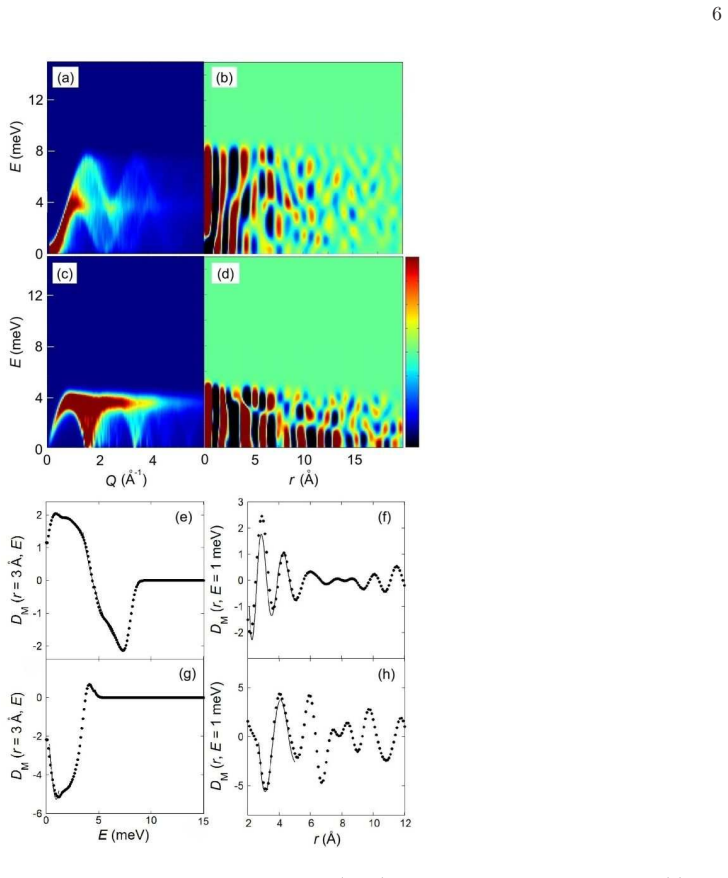
The Fourier transform of the measured dynamic magnetic structure factor S_M(Q, E) produces the dynamic magnetic pair-density function D_M(r, E), whose energy dependence encodes local magnon modes through sign changes in each spin-pair correlation at given energies, including the acoustic-to-optical transition, and remains interpretable even under non-periodic conditions.
What carries the argument
The dynamic magnetic pair-density function D_M(r, E), the real-space Fourier transform of S_M(Q, E) that maps energy-dependent local spin-pair correlations.
If this is right
- Local magnon modes become visible through sign changes in spin-pair correlations at specific energies in real space.
- The acoustic-to-optical magnon transition appears as a characteristic energy dependence in D_M(r, E).
- The approach works for non-periodic systems, allowing local magnetic dynamics to be studied in disordered or nanostructured magnets.
- Equations derived for simple models in the low-energy limit match numerical simulations of D_M(r, E).
Where Pith is reading between the lines
- The method could be tested on materials with intentional defects to see whether local modes around those defects produce distinct real-space signatures.
- It may complement reciprocal-space fitting by providing an independent check on the spatial extent of magnon coherence.
- If applied to doped cuprates or other systems with short-range order, the sign-change patterns could constrain models of local spin fluctuations.
Load-bearing premise
The Fourier transform of the measured S_M(Q, E) directly produces interpretable D_M(r, E) without major artifacts from limited Q-range, instrument resolution, or processing steps, especially at low energies.
What would settle it
Apply the analysis to a simple, well-characterized periodic antiferromagnet, compute the expected D_M(r, E) sign patterns from the model equations, and check whether the measured real-space function matches those patterns at low energies without extra features from truncation or resolution effects.
Figures


read the original abstract
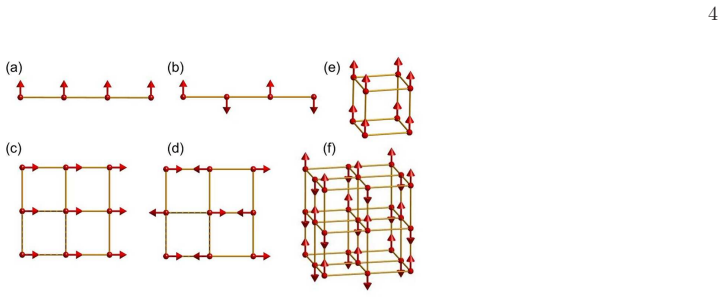
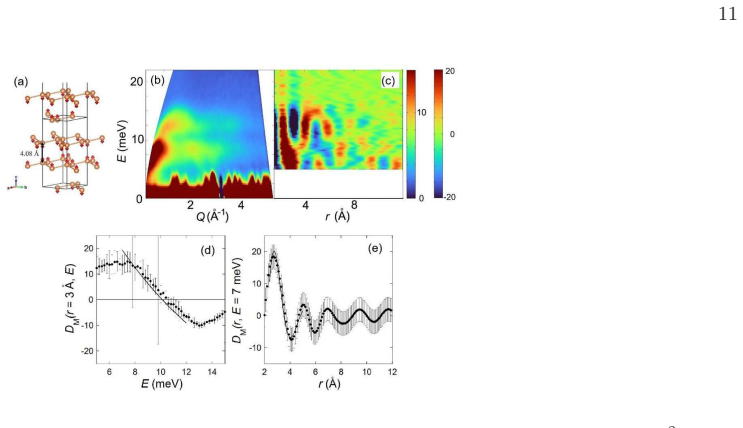
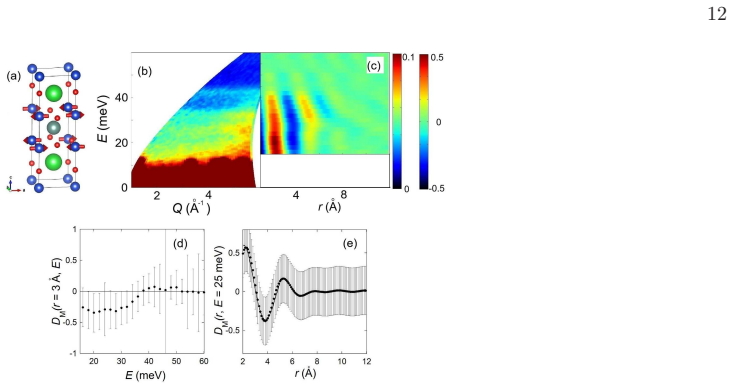
The dynamic magnetic pair-density function (DymPDF) $D_{\rm M}(r, E)$ is obtained via the Fourier transform of the dynamic magnetic structure factor, $S_{\rm M}(Q, E)$, which is measured using nonpolarized inelastic neutron scattering. While there is a long history of magnetic excitation studies with $S_{\rm M}(Q, E)$, there are no reports on $D_{\rm M}(r, E)$. In this study, we examine simple magnet models and representative magnet examples, such as FeTiO$_{3}$ and YBa$_{2}$Cu$_{3}$O$_{6}$, to investigate the real-space dynamics of $D_{\rm M}(r, E)$. We derive the $D_{\rm M}(r, E)$ equations for simple magnet models in a low energy limit. By comparing these equations to the simulations, we demonstrate the characteristic energy dependence of real-space local magnon modes, including the transition of the magnon mode from acoustic to optical. Our novel analysis reveals the local magnon modes accompanied by a sign change in each spin-pair correlation at a given energy in nanoscale real space even under non-periodic conditions. This method is unique for studying local magnetic dynamics.
Editorial analysis
A structured set of objections, weighed in public.
Referee Report
Summary. The manuscript introduces the dynamic magnetic pair-density function D_M(r, E), obtained as the Fourier transform of the dynamic magnetic structure factor S_M(Q, E) from inelastic neutron scattering. It derives analytic expressions for D_M(r, E) in simple magnet models under the low-energy limit, compares these to simulations, and applies the approach to FeTiO3 and YBa2Cu3O6 to claim observation of local magnon modes, including acoustic-to-optical transitions and sign changes in spin-pair correlations at fixed energy in nanoscale real space, even without periodicity.
Significance. If the extracted real-space functions prove robust against data-processing artifacts, the DymPDF method would provide a distinctive real-space view of local magnetic dynamics that complements conventional reciprocal-space analysis and could be particularly useful for disordered or nanoscale systems.
major comments (2)
- [Abstract] Abstract and § on model derivations: the central claim that sign changes in spin-pair correlations are genuine features of local magnon modes (rather than Fourier artifacts) is load-bearing, yet the manuscript derives analytic forms only in the ideal low-energy limit and compares them to simulations that assume complete Q coverage; it provides no quantitative assessment of how finite |Q| truncation, missing high-Q intensity, or instrumental resolution propagate into the reported sign changes for FeTiO3 and YBa2Cu3O6.
- [Simulation and experimental comparison] Section comparing simulations to experiment: the transition from acoustic to optical magnon modes and the associated sign changes are presented as directly interpretable from D_M(r, E), but without explicit tests (e.g., varying Q-range cutoffs or adding resolution broadening to the simulated S_M(Q, E) before transforming) it remains unclear whether these features survive the same data limitations present in the measured datasets.
minor comments (2)
- Notation for D_M(r, E) and S_M(Q, E) should be introduced with explicit definitions of the Fourier transform convention and any normalization factors to avoid ambiguity in the low-energy limit derivations.
- Figure captions for the real-space plots should state the Q-range and energy resolution used in the transforms so readers can assess potential termination effects.
Simulated Author's Rebuttal
We thank the referee for the careful and constructive review. We address the two major comments point by point below. Both concerns identify a genuine gap in the current manuscript, which we will close by adding the requested quantitative tests.
read point-by-point responses
-
Referee: [Abstract] Abstract and § on model derivations: the central claim that sign changes in spin-pair correlations are genuine features of local magnon modes (rather than Fourier artifacts) is load-bearing, yet the manuscript derives analytic forms only in the ideal low-energy limit and compares them to simulations that assume complete Q coverage; it provides no quantitative assessment of how finite |Q| truncation, missing high-Q intensity, or instrumental resolution propagate into the reported sign changes for FeTiO3 and YBa2Cu3O6.
Authors: We agree that the absence of a quantitative assessment of finite-Q truncation, missing high-Q intensity, and resolution effects on the reported sign changes constitutes a limitation. In the revised manuscript we will add explicit tests that truncate the simulated S_M(Q,E) to the experimental Q range, suppress high-Q intensity, and convolve with realistic resolution before computing D_M(r,E). These tests will be performed on the same model systems used for the analytic derivations and will be compared directly with the FeTiO3 and YBa2Cu3O6 results to quantify any artifact contribution. revision: yes
-
Referee: [Simulation and experimental comparison] Section comparing simulations to experiment: the transition from acoustic to optical magnon modes and the associated sign changes are presented as directly interpretable from D_M(r, E), but without explicit tests (e.g., varying Q-range cutoffs or adding resolution broadening to the simulated S_M(Q, E) before transforming) it remains unclear whether these features survive the same data limitations present in the measured datasets.
Authors: We concur that the manuscript currently lacks explicit tests that apply the experimental Q-range cutoffs and resolution broadening to the simulated S_M(Q,E) before the Fourier transform. We will incorporate these tests in the revision, showing the acoustic-to-optical transition and the associated sign changes in D_M(r,E) both with and without the data limitations, thereby demonstrating that the features survive under conditions matching the measured datasets. revision: yes
Circularity Check
No circularity; central step is direct Fourier transform of measured data with independent model derivations
full rationale
The paper obtains D_M(r, E) via standard Fourier transform of measured S_M(Q, E). Analytic expressions are derived from simple magnet models in the low-energy limit and compared to separate simulations; these steps are independent of the experimental data and do not reduce to fitted inputs or self-citations. No load-bearing self-citation chains, self-definitional loops, or renamed predictions are present. The method is self-contained against external model benchmarks.
Axiom & Free-Parameter Ledger
axioms (1)
- standard math Fourier transform of S_M(Q, E) yields D_M(r, E) that captures local spin-pair correlations
Reference graph
Works this paper leans on
-
[1]
Egami, Local Dynamics in Liquids and Glassy Materials, J
T. Egami, Local Dynamics in Liquids and Glassy Materials, J. Phys. Soc. Jpn. 88 , 081001 (2019)
2019
-
[2]
K. Iida, K. Kodama, Y. Inamura, M. Nakamura, L.-J. Chang, S. Shamoto, Magnon mode transition in real space, Sci. Rep. 12 : 20663 (2022)
2022
-
[3]
Kajimoto et al
R. Kajimoto et al. , The Fermi Chopper Spectrometer 4SEASONS at J-PARC, J. Phys. Soc. Jpn. 80 , SB025 (2011)
2011
-
[4]
Nakamura et al
M. Nakamura et al. , First Demonstration of Novel Method for Inelastic Neutron Scattering Measurement Utilizing Multiple Incident Energies, J. Phys. Soc. Jpn. 78 , 093002 (2009)
2009
-
[5]
A. C. Hannon, M. Arai, R. N. Sinclair, A. C. Wright, A dynamic correlation function for amorphous solids. J. Non-Cryst. Solids , 150 , 239 (1992)
1992
-
[6]
M. Arai, A. C. Hannon, T. Otomo, A. Hiramatsu, T. Nishijima, Dynamic correlation function studies of the medium-range order in materials. J. Non-Cryst. Solids 192 & 193 , 230?237 (1995)
1995
-
[7]
Dmowski et al
W. Dmowski et al. Local lattice dynamics and the origin of the relaxor ferroelectric behavior. Phys. Rev. Lett. 100 , 137602 (2008)
2008
-
[8]
Dmowski et al
W. Dmowski et al. Observation of dynamic atom-atom correlation in liquid helium in real space. Nat. Commun. 8 , 15294 (2017)
2017
-
[9]
K. A. Acosta, H. C. Walker and A. M. Fry-Petit, Optimizing the dynamic pair distribution function method for inelastic neutron spectrometry, Nature Reviews Physics 5 , 236?249 (2023)
2023
-
[10]
Momma, F
K. Momma, F. Izumi, VESTA 3 for three-dimensional visualization of crystal, volumetric and morphology data, J. Appl. Crystallogr. 44 , 1272?1276 (2011)
2011
-
[11]
Egami and S.J.L
T. Egami and S.J.L. Billinge, Underneath the Bragg Peaks Structural Analysis of Complex Materials ( Pergamon Materials Series 16 , 2003)
2003
-
[12]
B. A. Frandsen, X. Yang, S. J. L. Billinge, Magnetic pair distribution function analysis of local magnetic correlations, Acta Crystallogr. Sect. A 70 , 3 (2014)
2014
-
[13]
Kodama, K
K. Kodama, K. Ikeda, S. Shamoto, and T. Otomo, Magnetic structure of short-range ordering in intermetallic antiferromagnet Mn _ 3 RhSi. J. Phys. Soc. Jpn. 90 , 074710 (2021)
2021
-
[14]
G. L. Squires, Introduction to the Theory of Thermal Neutron Scattering ( Cambridge University Press, Cambridge , 1978)
1978
-
[15]
Shamoto, T
S. Shamoto, T. U. Ito, H. Onishi, H. Yamauchi, Y. Inamura, M. Matsuura, M. Akatsu, K. Kodama, A. Nakao, T. Moyoshi, K. Munakata, T. Ohhara, M. Nakamura, S. Ohira-Kawamura, Y. Nemoto and K. Shibata, Neutron scattering study of yttrium iron garnet, Phys. Rev. B 97 , 054429 (2018)
2018
-
[16]
Shamoto, H
S. Shamoto, H. Yamauchi, K. Iida, K. Ikeuchi, A. E. Halle, Y. Chen, M. K. Lee, G. Balakrishnan, and L.-J. Chang, Spiral spin cluster in the hyperkagome antiferromagnet Mn _ 3 RhSi, Commun. Phys. 6 , 248 (2023)
2023
-
[17]
Toth and B
S. Toth and B. Lake, Linear spin wave theory for single-Q incommensurate magnetic structures. J. Phys. Condens. Matter 27 , 166002 (2015)
2015
-
[18]
Inamura, T
Y. Inamura, T. Nakatani, J. Suzuki, T. Otomo, Development Status of Software ‘Utsusemi‘ for Chopper Spectrometers at MLF, J-PARC, J. Phys. Soc. Jpn. 82 , SA031 (2013)
2013
-
[19]
Moriya, Spin Fluctuations in Itinerant Electron Magnetism, (Springer, Berlin1985)
T. Moriya, Spin Fluctuations in Itinerant Electron Magnetism, (Springer, Berlin1985)
-
[20]
Kato et al
H. Kato et al. , Neutron scattering study of magnetic excitations in oblique easy-axis antiferromagnet FeTiO _ 3 , J. Phys. C Solid State Phys. 19 , 6993 (1986)
1986
-
[21]
Chung, K
J.-H. Chung, K. Shin, T. R. Yokoo, D. Ueta, M. Imai, H.-S. Kim, D. H. Kiem, M. J. Han, and S. Shamoto, Massive Dirac magnons in the three-dimensional honeycomb magnetic oxide FeTiO _ 3 , Sci. Rep. 15 :5978 (2025)
2025
-
[22]
J. D. Jorgensen, M. A. Beno, D. G. Hinks, L. Soderholm, K. J. Volin, R. L. Hitterman, J. D. Grace, and Ivan K. Schuller, C. U. Segre, K. Zhang, and M. S. Kleefisch, Oxygen ordering and the orthorhombic-to-tetragonal phase transition in YBa _ 2 Cu _ 3 O _ 7-x , Phys. Rev. B 36 , 3608 (1987)
1987
-
[23]
Shamoto, M
S. Shamoto, M. Sato, J. M. Tranquada, B. J. Sternlieb, and G. Shirane, Neutron-scattering study of antiferromagnetism in YBa _ 2 Cu _ 3 O _ 6.15 , Phys. Rev. B 48 , 13817 (1993)
1993
-
[24]
S. M. Hayden, G. Aeppli, T. G. Perring, H. A. Mook, F. Dog a n, High-frequency spin waves in YBa _ 2 Cu _ 3 O _ 6.15 Phys. Rev. B 54 , R6905 (1996)
1996
-
[25]
MATLAB version: R2021b, Natick, Massachusetts: The MathWorks Inc.; 2021
2021
-
[26]
Shamoto, K
S. Shamoto, K. Iida, Y. Inamura, M. Nakamura, H. Yamauchi, M. K. Lee, and L.-J. Chang, Dynamic magnetic pair-density function analysis of hyperkagome lattice altermagnets, in preparation
discussion (0)
Sign in with ORCID, Apple, or X to comment. Anyone can read and Pith papers without signing in.