Thermal transport and low-temperature specific heat in 4Hb-TaS₂
Pith reviewed 2026-07-01 01:16 UTC · model grok-4.3
The pith
Residual low-energy states in 4Hb-TaS₂ do not form an itinerant heat-conduction channel.
A machine-rendered reading of the paper's core claim, the machinery that carries it, and where it could break.
Core claim
The paper establishes that the finite residual linear specific heat in the superconducting state does not correspond to a measurable zero-field electronic thermal conductivity, so the residual low-energy states remain non-itinerant. The nuclear Schottky upturn is isolated by its contrasting field and transport signatures, while the field-induced quasiparticle heat transport is broadly consistent with multigap nodeless superconductivity for out-of-plane fields yet steeper for in-plane fields.
What carries the argument
Ultra-low-temperature specific-heat and thermal-conductivity measurements that distinguish electronic from nuclear contributions through their differing magnetic-field responses and the presence or absence of a transport signal.
If this is right
- The residual thermodynamic density of states remains localized and does not carry heat current at zero field.
- Electronic thermal conductivity extrapolates to zero at zero field for both field orientations within experimental uncertainty.
- Out-of-plane field response of thermal conductivity matches expectations for multigap nodeless superconductivity.
- In-plane field response is steeper than the standard multigap picture predicts, indicating additional complexity in the quasiparticle spectrum.
Where Pith is reading between the lines
- If the localized states arise from disorder or impurities, analogous separation of thermodynamic and transport signatures may appear in other layered or van der Waals superconductors.
- The stronger in-plane field response could reflect anisotropic vortex motion or gap structure tied to the layered crystal geometry.
- Extending the measurements to still lower temperatures or controlled disorder levels would test whether the residual states remain non-itinerant across sample variations.
Load-bearing premise
The upturn below 0.3 K can be fully attributed to a nuclear Schottky term whose weak field dependence and lack of transport signature allow clean separation from electronic contributions.
What would settle it
Detection of a finite zero-field electronic thermal-conductivity coefficient whose magnitude scales with the residual specific-heat coefficient would indicate itinerant states and falsify the non-itinerant interpretation.
Figures


read the original abstract
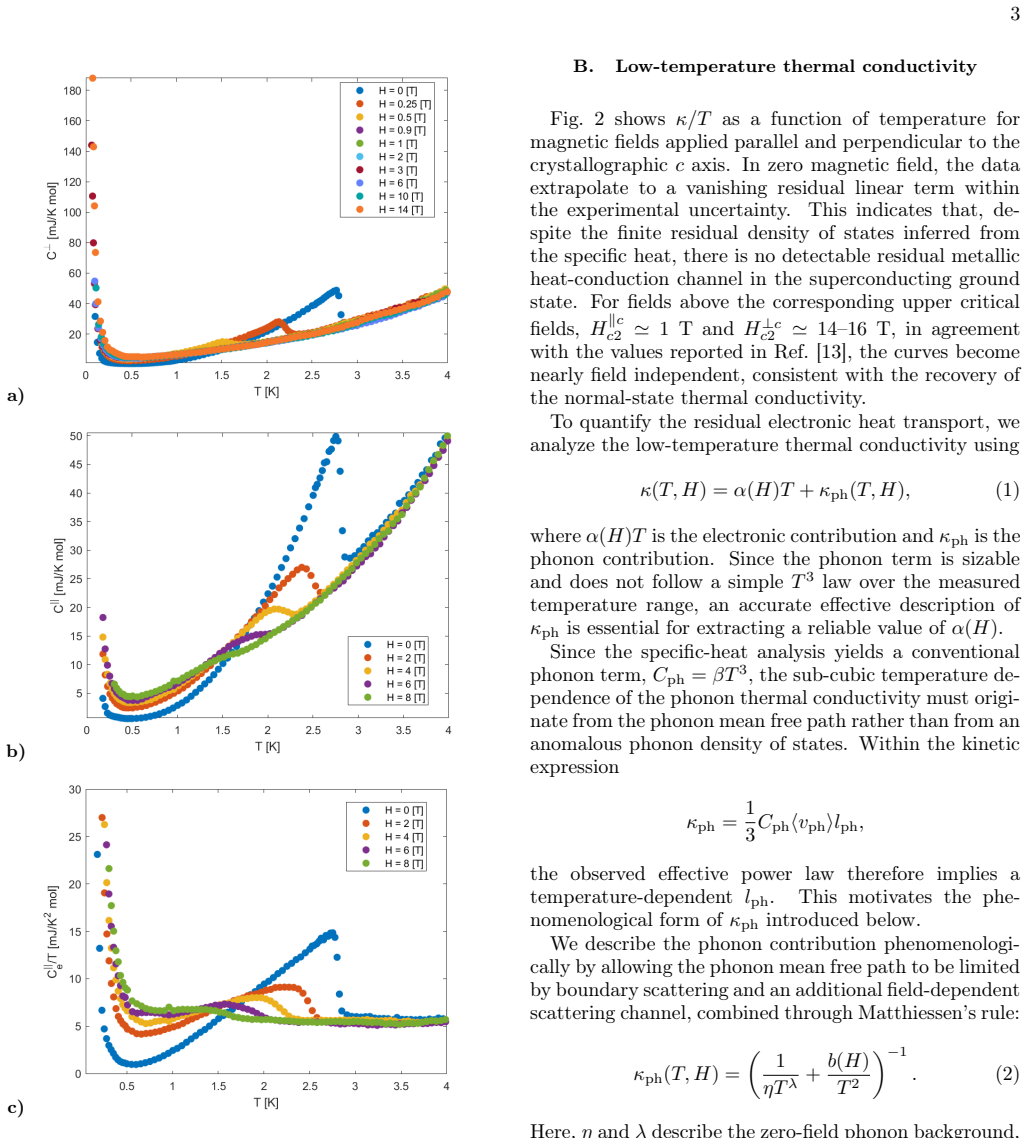
We investigate the low-energy excitation spectrum of the van der Waals heterostructure superconductor 4Hb-TaS$_2$ using ultra-low-temperature specific-heat and thermal-conductivity measurements with magnetic fields applied parallel and perpendicular to the crystallographic $c$ axis. The specific heat is broadly consistent with a nodeless superconducting gap, but retains a finite residual linear contribution, indicating a small residual low-energy density of states in the superconducting state. In addition, a pronounced upturn appears below approximately 0.3K. Its weak magnetic-field dependence, together with the absence of a corresponding feature in thermal transport, supports an interpretation in terms of localized degrees of freedom, most likely a nuclear Schottky contribution. In contrast to the finite residual thermodynamic density of states, the thermal conductivity extrapolates to a vanishing zero-field electronic linear term within experimental uncertainty for both field orientations. Thus, the residual low-energy states do not form a detectable itinerant heat-conduction channel. In finite magnetic field, the electronic heat transport grows rapidly. For out-of-plane fields, this response is broadly consistent with previous thermal-conductivity measurements and with the behavior commonly associated with multigap nodeless superconductivity. The even steeper increase observed for in-plane fields suggests that the field-induced quasiparticle response of 4Hb-TaS$_2$ is more complicated than the standard multigap picture alone.
Editorial analysis
A structured set of objections, weighed in public.
Referee Report
Summary. The manuscript reports ultra-low-temperature specific-heat and thermal-conductivity measurements on the van der Waals superconductor 4Hb-TaS₂ in magnetic fields parallel and perpendicular to the c axis. It finds behavior broadly consistent with a nodeless gap, a residual linear specific-heat term, and an upturn below ~0.3 K interpreted as a nuclear Schottky anomaly on the basis of its weak field dependence and absence in thermal transport. Thermal conductivity extrapolates to zero in zero field (no itinerant residual channel) but grows rapidly in finite field, with a steeper response for in-plane orientation than expected from the standard multigap nodeless picture.
Significance. If the separation of contributions and the zero-field extrapolation hold, the work establishes that residual low-energy states in 4Hb-TaS₂ are localized rather than itinerant and supplies new data on the anisotropic field-induced quasiparticle response. This adds a concrete experimental constraint on models of superconductivity in layered heterostructures.
major comments (2)
- [specific-heat results section] The attribution of the upturn below 0.3 K to a nuclear Schottky term (specific-heat results section) is load-bearing for the claim that the residual linear specific-heat coefficient reflects non-itinerant states. The manuscript relies on qualitative statements of weak field dependence and absence in thermal transport; a quantitative comparison of the measured upturn amplitude and field evolution to the expected Schottky anomaly calculated from the nuclear moments of ¹⁸¹Ta and ³³S (including hyperfine constants) is required to exclude paramagnetic-impurity or other localized contributions.
- [thermal-transport results] The central claim that the zero-field electronic thermal conductivity extrapolates to zero within uncertainty (thermal-transport results) rests on the linear extrapolation procedure. The manuscript must specify the temperature window used for the fit, the functional form assumed for the electronic term, how the uncertainty on the intercept is propagated from the data, and whether the same procedure applied to the in-plane and out-of-plane data yields consistent null results.
minor comments (2)
- [abstract] The abstract refers to 'previous thermal-conductivity measurements' on the same material; adding the specific citation(s) would allow readers to assess the claimed consistency directly.
- [figures] Figure captions and axis labels should explicitly state the field orientations (H ∥ c versus H ⊥ c) and the symbols used for raw versus subtracted data to improve readability.
Simulated Author's Rebuttal
We thank the referee for the constructive comments and positive recommendation. We address both major points below and will revise the manuscript to incorporate the requested details and quantitative analysis.
read point-by-point responses
-
Referee: [specific-heat results section] The attribution of the upturn below 0.3 K to a nuclear Schottky term (specific-heat results section) is load-bearing for the claim that the residual linear specific-heat coefficient reflects non-itinerant states. The manuscript relies on qualitative statements of weak field dependence and absence in thermal transport; a quantitative comparison of the measured upturn amplitude and field evolution to the expected Schottky anomaly calculated from the nuclear moments of ¹⁸¹Ta and ³³S (including hyperfine constants) is required to exclude paramagnetic-impurity or other localized contributions.
Authors: We agree that a quantitative comparison strengthens the interpretation and will add it to the revised manuscript. Using the known nuclear spins, moments, and estimated hyperfine constants for ¹⁸¹Ta (I=7/2) and ³³S (I=3/2), we will compute the expected Schottky anomaly amplitude and its weak field dependence, then directly overlay it on the measured C/T upturn below 0.3 K. This comparison will be presented in a new figure panel or inset in the specific-heat section, confirming consistency with a nuclear origin while ruling out dominant paramagnetic impurities. revision: yes
-
Referee: [thermal-transport results] The central claim that the zero-field electronic thermal conductivity extrapolates to zero within uncertainty (thermal-transport results) rests on the linear extrapolation procedure. The manuscript must specify the temperature window used for the fit, the functional form assumed for the electronic term, how the uncertainty on the intercept is propagated from the data, and whether the same procedure applied to the in-plane and out-of-plane data yields consistent null results.
Authors: We will expand the thermal-transport results section to include these details. The linear extrapolation of κ/T vs T is performed over the window 50–250 mK (field-dependent to avoid phonon dominance), assuming the form κ_e/T = a + bT where a is the residual electronic term. Uncertainties on a are obtained from the covariance matrix of the weighted least-squares fit, with data points weighted by their experimental errors. The same procedure applied to both in-plane and out-of-plane data yields intercepts a consistent with zero within 1σ (explicit values and error bars will be tabulated). This will be stated explicitly with reference to the fitting range and method. revision: yes
Circularity Check
No significant circularity
full rationale
This is an experimental paper reporting specific-heat and thermal-conductivity data on 4Hb-TaS2. All central claims (vanishing zero-field electronic thermal conductivity, interpretation of the low-T upturn as nuclear Schottky on the basis of its field dependence and absence from transport, and the field-induced quasiparticle response) rest on direct extrapolation of measured quantities and comparison with external benchmarks. No equations, fitted parameters, or self-citations are used to derive predictions that reduce to the same inputs by construction. The analysis is therefore self-contained against the reported data.
Axiom & Free-Parameter Ledger
axioms (1)
- domain assumption The measured specific heat and thermal conductivity can be decomposed into electronic, phononic, and nuclear contributions using standard low-T functional forms.
Reference graph
Works this paper leans on
-
[1]
Topological insulators and superconductors,
X.-L. Qi and S.-C. Zhang, “Topological insulators and superconductors,” Rev. Mod. Phys.83, 1057 (2011)
2011
-
[2]
New directions in the pursuit of majorana fermions in solid state systems,
J. Alicea, “New directions in the pursuit of majorana fermions in solid state systems,” Reports on Progress in Physics75, 076501 (2012)
2012
-
[3]
Topological superconductors: a review,
M. Sato and Y. Ando, “Topological superconductors: a review,” Reports on Progress in Physics80, 076501 (2017)
2017
-
[4]
Non-abeliananyonsandtopologicalquan- tum computation,
C. Nayak, S. H. Simon, A. Stern, M. Freedman, and S.DasSarma,“Non-abeliananyonsandtopologicalquan- tum computation,” Rev. Mod. Phys.80, 1083 (2008)
2008
-
[5]
Exploring topological su- perconductivity in topological materials,
Y. Li and Z.-A. Xu, “Exploring topological su- perconductivity in topological materials,” Ad- vanced Quantum Technologies2, 1800112 (2019), https://advanced.onlinelibrary.wiley.com/doi/ pdf/10.1002/qute.201800112
-
[6]
Chiralp-wave order in Sr2RuO4,
C. Kallin, “Chiralp-wave order in Sr2RuO4,” Reports on Progress in Physics75, 042501 (2012)
2012
-
[7]
Chiral superconductors,
C. Kallin and J. Berlinsky, “Chiral superconductors,” Re- ports on Progress in Physics79, 054502 (2016)
2016
-
[8]
Even odder after twenty-three years: the superconduct- ing order parameter puzzle of sr2ruo4,
A. P. Mackenzie, T. Scaffidi, C. W. Hicks, and Y. Maeno, “Even odder after twenty-three years: the superconduct- ing order parameter puzzle of sr2ruo4,” npj Quantum 6 Materials2, 40 (2017)
2017
-
[9]
Split superconducting and time-reversal symmetry-breaking transitions in Sr2RuO4 under stress,
V. Grinenko, S. Ghosh, R. Sarkar, J.-C. Orain, A. Nikitin, M. Elender, D. Das, Z. Guguchia, F. Brück- ner, M. E. Barber,et al., “Split superconducting and time-reversal symmetry-breaking transitions in Sr2RuO4 under stress,” Nature Physics17, 748 (2021)
2021
-
[10]
Chiral superconductivity in heavy-fermion metal UTe2,
L. Jiao, S. Howard, S. Ran, Z. Wang, J. O. Rodriguez, M. Sigrist, Z. Wang, N. P. Butch, and V. Madhavan, “Chiral superconductivity in heavy-fermion metal UTe2,” Nature579, 523 (2020)
2020
-
[11]
Nonunitarytripletsuperconductivitytuned by field-controlled magnetization: Urhge, ucoge, and ute 2,
K.Machida,“Nonunitarytripletsuperconductivitytuned by field-controlled magnetization: Urhge, ucoge, and ute 2,” Physical Review B104, 014514 (2021)
2021
-
[12]
Topological superconductors from a materials perspective,
M. Mandal, N. C. Drucker, P. Siriviboon, T. Nguyen, A. Boonkird, T. N. Lamichhane, R. Okabe, A. Chotrat- tanapituk, and M. Li, “Topological superconductors from a materials perspective,” Chem. Mater.35, 6184 (2023)
2023
-
[13]
Chiral superconductivity in the alternate stacking compound 4Hb-TaS 2,
A. Ribak, R. Skiff, M. Mograbi, P. Rout, M. Fis- cher, J. Ruhman, K. Chashka, Y. Dagan, and A. Kanigel, “Chiral superconductivity in the alternate stacking compound 4Hb-TaS 2,” Science Advances6 (2020), 10.1126/sciadv.aax9480
-
[14]
Charge carrier localization in pure and doped 1T-TaS2,
P. Fazekas and E. Tosatti, “Charge carrier localization in pure and doped 1T-TaS2,” Physica B+ C99, 183 (1980)
1980
-
[15]
1T-TaS2 as a quantum spin liquid,
K. T. Law and P. A. Lee, “1T-TaS2 as a quantum spin liquid,” Proceedings of the National Academy of Science of the United States of America114, 6996 (2017)
2017
-
[16]
Gapless excitations in the ground state of1T−TaS 2,
A. Ribak, I. Silber, C. Baines, K. Chashka, Z. Salman, Y. Dagan, and A. Kanigel, “Gapless excitations in the ground state of1T−TaS 2,” Phys. Rev. B96, 195131 (2017)
2017
-
[17]
Coexisting localized and itinerant gapless excita- tions in a quantum spin liquid candidate 1T-TaS2,
H. Murayama, Y. Sato, X. Xing, T. Taniguchi, S. Kasa- hara, Y. Kasahara, M. Yoshida, Y. Iwasa, and Y. Mat- suda, “Coexisting localized and itinerant gapless excita- tions in a quantum spin liquid candidate 1T-TaS2,” arXiv preprint arXiv:1803.06100 (2018)
-
[18]
Ev- idence of topological boundary modes with topological nodal-point superconductivity,
A. K. Nayak, A. Steinbok, Y. Roet, J. Koo, G. Mar- galit, I. Feldman, A. Almoalem, A. Kanigel, G. A. Fiete, B. Yan, Y. Oreg, N. Avraham, and H. Beidenkopf, “Ev- idence of topological boundary modes with topological nodal-point superconductivity,” Nature Physics17, 1413 (2021)
2021
-
[19]
Magnetic memory and spontaneous vor- ticesinavanderwaalssuperconductor,
E. Persky, A. V. Bjørlig, I. Feldman, A. Almoalem, E. Altman, E. Berg, I. Kimchi, J. Ruhman, A. Kanigel, and B. Kalisky, “Magnetic memory and spontaneous vor- ticesinavanderwaalssuperconductor,” Nature607,692 (2022)
2022
-
[20]
Two-componentnematicsuperconductiv- ity in 4hb-tas2,
I. Silber, S. Mathimalar, I. Mangel, A. K. Nayak, O. Green, N. Avraham, H. Beidenkopf, I. Feldman, A. Kanigel, A. Klein, M. Goldstein, A. Banerjee, E. Sela, andY.Dagan,“Two-componentnematicsuperconductiv- ity in 4hb-tas2,” Nature Communications15, 824 (2024)
2024
-
[21]
Charge transfer and spin- valley locking in 4Hb-TaS2,
A. Almoalem, R. Gofman, Y. Nitzav, I. Mangel, I. Feldman, J. Koo, F. Mazzola, J. Fujii, I. Vobornik, J. Sánchez-Barriga, O. J. Clark, N. C. Plumb, M. Shi, B. Yan, and A. Kanigel, “Charge transfer and spin- valley locking in 4Hb-TaS2,” npj Quantum Materials9, 36 (2024), arXiv:2405.16523
-
[22]
Robust gapless superconductivity in 4Hb−TaS2,
D. Dentelski, E. Day-Roberts, T. Birol, R. M. Fernandes, and J. Ruhman, “Robust gapless superconductivity in 4Hb−TaS2,” Phys. Rev. B103, 224522 (2021)
2021
-
[23]
Ne- matic Ising superconductivity with hidden magnetism in few-layer 6R-TaS2,
S.-B. Liu, C. Tian, Y. Fang, H. Rong, L. Cao, X. Wei, H. Cui, M. Chen, D. Chen, Y. Song, J. Cui, J. Li, S. Guan, S. Jia, C. Chen, W. He, F. Huang, Y. Jiang, J. Mao, X. C. Xie, K. T. Law, and J.-H. Chen, “Ne- matic Ising superconductivity with hidden magnetism in few-layer 6R-TaS2,” Nature Communications15, 7569 (2024)
2024
-
[24]
Nodeless superconductivity in 4Hb-TaS2 with broken time rever- sal symmetry,
Y.Zhou, F.Meng, Y.Huang, J.Zhang, J.Zhan, Y.Chen, Y. Liu, H. Lei, M. Smidman, and H. Yuan, “Nodeless superconductivity in 4Hb-TaS2 with broken time rever- sal symmetry,” Physical Review B112, 014507 (2025), originally circulated as arXiv:2507.07584; APS metadata accessed via official short DOI., arXiv:2507.07584
-
[25]
H. Wang, Y. Jiao, F. Meng, X. Zhang, D. Dai, C. Tu, C. Zhao, L. Xin, S. Huang, H. Lei, and S. Li, “Ev- idence for multiband gapless superconductivity in the topological superconductor candidate 4Hb-TaS2,” Phys- ical Review Letters135, 126002 (2025), aPS metadata accessed via official short DOI; arXiv preprint version is arXiv:2412.08450., arXiv:2412.08450
-
[26]
The observation ofπ-shifts in the Little- Parks effect in 4Hb-TaS2,
A. Almoalem, I. Feldman, I. Mangel, M. Shlafman, Y. E. Yaish, M. H. Fischer, M. Moshe, J. Ruhman, and A. Kanigel, “The observation ofπ-shifts in the Little- Parks effect in 4Hb-TaS2,” Nature Communications15, 4623 (2024), arXiv:2208.13798
discussion (0)
Sign in with ORCID, Apple, or X to comment. Anyone can read and Pith papers without signing in.