Deconfined criticality between an antiferromagnetic insulator and a nodal d-wave superconductor: a quantum Monte Carlo study
Pith reviewed 2026-07-03 18:54 UTC · model grok-4.3
The pith
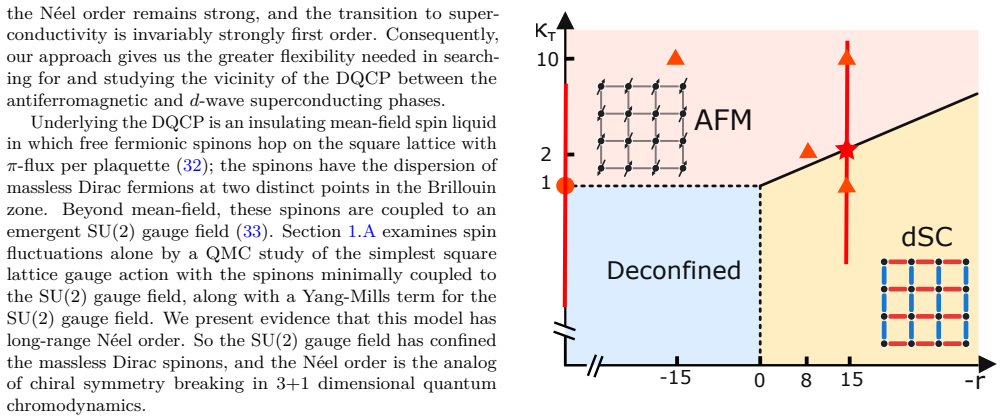
A parton-based quantum Monte Carlo study finds evidence that the transition between the Néel antiferromagnetic insulator and the nodal d-wave superconductor is a continuous second-order deconfined quantum phase transition.
A machine-rendered reading of the paper's core claim, the machinery that carries it, and where it could break.
Core claim
We find evidence for a second-order deconfined quantum phase transition at which both the Néel and d-wave superconductivity orders vanish continuously. We compute correlators of the spinon-chargon composite with the same quantum numbers as the electron: we find a gapless Dirac dispersion inside the d-wave superconductor, turning into a gapped dispersion in the antiferromagnet.
What carries the argument
The parton representation of the electron as fermionic spinons and bosonic chargons moving in a π-flux background and coupled to a quantum fluctuating SU(2) lattice gauge field.
If this is right
- Both the antiferromagnetic and superconducting order parameters vanish continuously rather than jumping discontinuously.
- The electron spectral function changes from gapless Dirac cones to a gapped spectrum when crossing from the superconductor into the antiferromagnet.
- The transition is mediated by deconfined fractionalized excitations rather than conventional order-parameter fluctuations.
- The same parton construction can be used to study other frustrated regimes on the square lattice without a sign problem.
Where Pith is reading between the lines
- The method opens a route to examine the evolution of the transition line when small doping or next-nearest-neighbor hopping is added.
- If the deconfined point persists under doping, it would place the cuprate quantum critical point in the same universality class.
- Neutron scattering or ARPES experiments could search for the predicted change in the single-particle dispersion across the transition.
Load-bearing premise
The parton representation faithfully reproduces the low-energy physics and universality class of the original electronic model without introducing artifacts that change the order of the transition.
What would settle it
A direct, sign-problem-free simulation of the microscopic electronic model that instead finds a first-order transition or hysteresis loop at the same parameter values would falsify the claim.
Figures


read the original abstract
We present a quantum Monte Carlo study of the transition between the insulating N\'eel state and the nodal $d$-wave superconductor on the square lattice at half-filling. We access a regime of frustrated magnetic order without a sign problem using a parton representation of the electron in terms of fermionic spinons and bosonic chargons. Both partons move in a background $\pi$-flux (so the electron experiences no net flux) and are coupled to a quantum fluctuating SU(2) lattice gauge field. In contrast to earlier studies directly on the electronic degrees of freedom, we find evidence for a second-order deconfined quantum phase transition at which both the N\'eel and $d$-wave superconductivity orders vanish continuously. We compute correlators of the spinon-chargon composite with the same quantum numbers as the electron: we find a gapless Dirac dispersion inside the $d$-wave superconductor, turning into a gapped dispersion in the antiferromagnet.
Editorial analysis
A structured set of objections, weighed in public.
Referee Report
Summary. The manuscript presents a quantum Monte Carlo study of a parton construction for electrons on the square lattice at half filling, representing them as fermionic spinons and bosonic chargons moving in a π-flux background and coupled to a fluctuating SU(2) lattice gauge field. It reports numerical evidence that the transition between the Néel antiferromagnetic insulator and the nodal d-wave superconductor is second-order (deconfined), with both orders vanishing continuously, and that the dispersion of spinon-chargon composites (with electron quantum numbers) is gapless Dirac-like inside the superconductor but gapped inside the antiferromagnet.
Significance. If the parton mapping is faithful and the numerical evidence for continuity is robust, the result would supply concrete, sign-problem-free support for deconfined criticality between two conventional orders, including a direct computation of the composite fermion spectrum across the transition. Such data are currently scarce and would be useful for benchmarking field-theoretic descriptions and for guiding searches in related microscopic models.
major comments (2)
- [Results section (data on order parameters)] The claim that both orders vanish continuously (central to the deconfined-criticality interpretation) is presented without reported system sizes, finite-size scaling collapses, or quantitative error control on the order-parameter extrapolations. This information is required to distinguish a true second-order point from a weakly first-order transition disguised by limited sizes.
- [Model and Methods sections] The manuscript assumes the parton-gauge theory lies in the same universality class as the original electronic Hamiltonian, yet provides no cross-check (e.g., comparison of critical exponents or monopole scaling against a sign-problem-free electronic limit) that would confirm the gauge-field and constraint implementation does not convert a first-order transition into an apparently continuous one.
minor comments (2)
- [Model section] Notation for the SU(2) gauge field and the precise definition of the composite operator whose correlators are measured should be stated explicitly in the text rather than only in the supplementary material.
- [Figure captions] Figure captions should include the precise linear system sizes and the number of Monte Carlo sweeps used for each data point.
Simulated Author's Rebuttal
We thank the referee for the careful reading and for highlighting the potential significance of our results. We address the two major comments below and will revise the manuscript accordingly.
read point-by-point responses
-
Referee: [Results section (data on order parameters)] The claim that both orders vanish continuously (central to the deconfined-criticality interpretation) is presented without reported system sizes, finite-size scaling collapses, or quantitative error control on the order-parameter extrapolations. This information is required to distinguish a true second-order point from a weakly first-order transition disguised by limited sizes.
Authors: We agree that more explicit documentation of the numerical evidence is needed. The original simulations used lattices up to L=16 with extensive Monte Carlo sampling, and order parameters were extrapolated using multiple system sizes. In the revised manuscript we will add a new subsection (or appendix) that tabulates all system sizes, presents finite-size scaling collapses for both the Néel and d-wave order parameters, and reports quantitative extrapolation uncertainties. These additions will make the evidence for continuity fully transparent. revision: yes
-
Referee: [Model and Methods sections] The manuscript assumes the parton-gauge theory lies in the same universality class as the original electronic Hamiltonian, yet provides no cross-check (e.g., comparison of critical exponents or monopole scaling against a sign-problem-free electronic limit) that would confirm the gauge-field and constraint implementation does not convert a first-order transition into an apparently continuous one.
Authors: The parton representation is constructed so that electron operators are recovered exactly as spinon-chargon composites, and the gauge-field implementation follows standard, gauge-invariant procedures used in the literature. A direct numerical cross-check against the original electronic Hamiltonian is not feasible because the latter suffers from a sign problem. We will nevertheless expand the Model and Methods sections with an explicit discussion of the mapping, the enforcement of the local constraint, and additional consistency checks (e.g., gauge-invariant correlators and comparison to known limits). This will clarify why the observed continuous transition is unlikely to be an artifact of the formulation. revision: partial
Circularity Check
Direct numerical QMC simulation on parton model; no reduction of claims to inputs by construction
full rationale
The paper reports results from quantum Monte Carlo sampling of a parton-gauge theory Hamiltonian. The central claim (second-order transition with continuous vanishing of orders) follows from computed correlation functions and order parameters extracted from the simulation output. No equations define a quantity in terms of itself, no fitted parameters are relabeled as predictions, and no load-bearing premise reduces to a self-citation chain. The parton representation is introduced as a standard auxiliary construction (with citations to prior literature), but the numerical evidence stands independently of any such citation. This is a self-contained computational study against external benchmarks.
Axiom & Free-Parameter Ledger
axioms (2)
- domain assumption The parton representation with π-flux background and SU(2) gauge field accurately represents the electron physics at the transition without altering the order of the phase transition.
- domain assumption Quantum Monte Carlo simulations in this representation can reliably determine the continuous or discontinuous nature of the transition via order parameter vanishing.
invented entities (1)
-
Fermionic spinons and bosonic chargons coupled to SU(2) gauge field
no independent evidence
Reference graph
Works this paper leans on
-
[1]
Results A. Spinon matter alone.We begin by describing the SU(2) lattice gauge theory with fermionic spinonsfiα, α=↑,↓on the sites,i, of the square lattice. This can be derived from the π-flux saddle point of an insulating antiferromagnet with Heisenberg exchange interactions (11, 32). The Lagrangian can be decomposed as Ls =L f +LU +LUτ,[1] and the lattic...
-
[2]
We also showed that the nodal Bogoliubov quasiparticles of the dSC acquire a gap in the AFM state
Discussion We have presented significant evidence for a DQCP on the half-filled square lattice between the AFM and dSC states. We also showed that the nodal Bogoliubov quasiparticles of the dSC acquire a gap in the AFM state. These results provide support for the framework for the hole-doped cuprates described in Refs. (11, 12, 14, 15). In these works, su...
-
[3]
D. Vollhardt and P . Wolfle,The Superfluid Phases of Helium 3, Dover Books on Physics Series, Dover Publications, Incorporated (2013)
work page 2013
- [4]
-
[5]
D.J. Scalapino, E. Loh and J.E. Hirsch,d-wave pairing near a quantum-fluctuation-driven antiferromagnetic instability,Physical Review B34(1986) 8190
work page 1986
-
[6]
M.T. Béal-Monod, C. Bourbonnais and V.J. Emery,Possible superconductivity in nearly antiferromagnetic itinerant fermion systems,Physical Review B34(1986) 7716
work page 1986
-
[7]
Pairing mechanism in Fe-based superconductors
A.V. Chubukov,Pairing mechanism in Fe-based superconductors,Annual Review of Condensed Matter Physics3(2012) 57 [1110.0052]
work page internal anchor Pith review Pith/arXiv arXiv 2012
-
[8]
Scalapino,The case ford x2 −y2 pairing in the cuprate superconductors,Physics Reports250(1995) 329
D.J. Scalapino,The case ford x2 −y2 pairing in the cuprate superconductors,Physics Reports250(1995) 329. 6
work page 1995
-
[9]
Superconducting phases of f-electron compounds
C. Pfleiderer,Superconducting phases of f -electron compounds,Reviews of Modern Physics 81(2009) 1551 [0905.2625]
work page internal anchor Pith review Pith/arXiv arXiv 2009
-
[10]
D.N. Basov and A.V. Chubukov,Manifesto for a higherT c,Nature Physics7(2011) 272
work page 2011
-
[11]
High Temperature Superconductivity in the Cuprates
B. Keimer, S.A. Kivelson, M.R. Norman, S. Uchida and J. Zaanen,From quantum matter to high-temperature superconductivity in copper oxides,Nature518(2015) 179 [1409.4673]
work page internal anchor Pith review Pith/arXiv arXiv 2015
-
[12]
P .A. Lee, N. Nagaosa and X.-G. Wen,Doping a Mott insulator: Physics of high-temperature superconductivity,Rev. Mod. Phys.78(2006) 17 [cond-mat/0410445]
work page internal anchor Pith review Pith/arXiv arXiv 2006
-
[13]
M. Christos, Z.-X. Luo, L. Shackleton, Y .-H. Zhang, M.S. Scheurer and S. Sachdev,A model of d-wave superconductivity, antiferromagnetism, and charge order on the square lattice, Proceedings of the National Academy of Sciences120(2023) e2302701120 [2302.07885]
-
[14]
M. Christos, L. Shackleton, S. Sachdev and Z.-X. Luo,Deconfined quantum criticality of nodal d-wave superconductivity, Néel order, and charge order on the square lattice at half-filling, Physical Review Research6(2024) 033018 [2402.09502]
-
[15]
Y . Ran, A. Vishwanath and D.-H. Lee,A direct transition between a Neel ordered Mott insulator and adx2 −y2 superconductor on the square lattice,arXiv e-prints(2008) arXiv:0806.2321 [0806.2321]
work page internal anchor Pith review Pith/arXiv arXiv 2008
-
[16]
Thermal SU(2) lattice gauge theory for intertwined orders and hole pockets in the cuprates
H. Pandey, M. Christos, P .M. Bonetti, R. Shanker, A. Nikolaenko, S. Sharma et al.,Thermal SU(2) lattice gauge theory of the cuprate pseudogap: reconciling Fermi arcs and hole pockets, Proceedings of the National Academy of Sciences123(2026) e2606117123 [2507.05336]
work page internal anchor Pith review Pith/arXiv arXiv 2026
-
[17]
Fractionalized Fermi liquids and the cuprate phase diagram
P .M. Bonetti, M. Christos, A.A. Patel and S. Sachdev,Fractionalized Fermi liquids and the cuprate phase diagram,Reports on Progress in Physics89(2026) 044501 [2508.20164]
work page internal anchor Pith review Pith/arXiv arXiv 2026
-
[18]
F .F . Assaad, M. Imada and D.J. Scalapino,Quantum Transition between an Antiferromagnetic Mott Insulator anddx2−y2 Superconductor in Two Dimensions,Physical Review Letters77 (1996) 4592 [cond-mat/9609034]
work page internal anchor Pith review Pith/arXiv arXiv 1996
-
[19]
T. Ohgoe and M. Imada,Competition among Superconducting, Antiferromagnetic, and Charge Orders with Intervention by Phase Separation in the 2D Holstein-Hubbard Model,Physical Review Letters119(2017) 197001 [1703.08899]
work page internal anchor Pith review Pith/arXiv arXiv 2017
- [20]
- [21]
-
[22]
A. Götz, F .F . Assaad and N.C. Costa,Tuning the order of a deconfined quantum critical point, arXiv e-prints(2024) arXiv:2412.17215 [2412.17215]
- [23]
- [24]
- [25]
- [26]
- [27]
-
[28]
H.-X. Wang, Y .-F . Jiang and H. Y ao,Robustd-wave superconductivity from the Su-Schrieffer-Heeger-Hubbard model: Possible route to high-temperature superconductivity, Science Bulletin70(2025) 2260 [2211.09143]
-
[29]
Z. Han and S.A. Kivelson,Resonating Valence Bond States in an Electron-Phonon System, Physical Review Letters130(2023) 186404 [2210.16321]
- [30]
-
[31]
X.Y . Xu, Y . Qi, L. Zhang, F .F . Assaad, C. Xu and Z.Y . Meng,Monte carlo study of lattice compact quantum electrodynamics with fermionic matter: The parent state of quantum phases,Physical Review X9(2019) 021022
work page 2019
-
[32]
C. Chen, T. Yuan, Y . Qi and Z.Y . Meng,Fermi arcs and pseudogap in a lattice model of a doped orthogonal metal,Physical Review B103(2021) 165131
work page 2021
-
[33]
C. Chen, U.F .P . Seifert, K. Feng, O.A. Starykh, L. Balents and Z.Y . Meng,Emergent gauge flux in mixed QED3 with flavor chemical potential: application to magnetized U(1) Dirac spin liquids,arXiv e-prints(2025) arXiv:2508.08528 [2508.08528]
work page internal anchor Pith review Pith/arXiv arXiv 2025
-
[34]
I. Affleck and J.B. Marston,Large-nlimit of the Heisenberg-Hubbard model: Implications for high-Tc superconductors,Physical Review B37(1988) 3774
work page 1988
-
[35]
Quantum Orders and Symmetric Spin Liquids
X.-G. Wen,Quantum orders and symmetric spin liquids,Physical Review B65(2002) 165113 [cond-mat/0107071]
work page internal anchor Pith review Pith/arXiv arXiv 2002
-
[36]
G. Pan and Z.Y . Meng,The sign problem in quantum monte carlo simulations, inEncyclopedia of Condensed Matter Physics (Second Edition), T. Chakraborty, ed., (Oxford), pp. 879–893, Academic Press (2024), DOI
work page 2024
-
[37]
N. Ma, G.-Y . Sun, Y .-Z. Y ou, C. Xu, A. Vishwanath, A.W. Sandvik et al.,Dynamical signature of fractionalization at a deconfined quantum critical point,Physical Review B98(2018) 174421. 36.The Monte Carlo update schemes and more simulation results are given in this Supporting Information
work page 2018
-
[38]
S. Pujari, T.C. Lang, G. Murthy and R.K. Kaul,Interaction-induced dirac fermions from quadratic band touching in bilayer graphene,Physical Review Letters117(2016) 086404
work page 2016
-
[39]
K. Feng, C. Chen and Z.Y . Meng,Scalable hybrid quantum Monte Carlo simulation ofU(1) gauge field coupled to fermions on GPU,SciPost Phys.20(2026) 060
work page 2026
-
[40]
C. Wang, A. Nahum, M.A. Metlitski, C. Xu and T. Senthil,Deconfined Quantum Critical Points: Symmetries and Dualities,Physical Review X7(2017) 031051 [1703.02426]
work page internal anchor Pith review Pith/arXiv arXiv 2017
-
[41]
SU(2) gauge theory of the Hubbard model and application to the honeycomb lattice
M. Hermele,SU(2) gauge theory of the Hubbard model and application to the honeycomb lattice,Physical Review B76(2007) 035125 [cond-mat/0701134]
work page internal anchor Pith review Pith/arXiv arXiv 2007
-
[42]
S. Gazit, F .F . Assaad, S. Sachdev, A. Vishwanath and C. Wang,Confinement transition ofz2 gauge theories coupled to massless fermions: Emergent quantum chromodynamics and so(5) symmetry,Proceedings of the National Academy of Sciences115(2018) E6987
work page 2018
-
[43]
Identifying the maximum entropy method as a special limit of stochastic analytic continuation
K.S.D. Beach,Identifying the maximum entropy method as a special limit of stochastic analytic continuation,arXiv e-prints(2004) cond [cond-mat/0403055]
work page internal anchor Pith review Pith/arXiv arXiv 2004
-
[44]
H. Shao, Y .Q. Qin, S. Capponi, S. Chesi, Z.Y . Meng and A.W. Sandvik,Nearly deconfined spinon excitations in the square-lattice spin-1/2heisenberg antiferromagnet,Physical Review X7(2017) 041072
work page 2017
-
[45]
Z. Zeng, C. Zhou, H. Zhou, L. Han, R. Chi, K. Li et al.,Spectral evidence for dirac spinons in a kagome lattice antiferromagnet,Nature Physics20(2024) 1097
work page 2024
-
[46]
F . Ferrari and F . Becca,Dynamical structure factor of theJ1−J2 heisenberg model on the triangular lattice: Magnons, spinons, and gauge fields,Physical Review X9(2019) 031026
work page 2019
-
[47]
T. Senthil, S. Sachdev and M. Vojta,Fractionalized Fermi Liquids,Physical Review Letters90 (2003) 216403 [cond-mat/0209144]
work page internal anchor Pith review Pith/arXiv arXiv 2003
- [48]
- [49]
-
[50]
J.-Y . Zhao, S. Chatterjee, S. Sachdev and Y .-H. Zhang,Y amaji effect in models of underdoped cuprates,Physical Review B113(2026) 245150 [2510.13943]
work page internal anchor Pith review Pith/arXiv arXiv 2026
-
[51]
Y . Zhong, F .-C. Zhang and K. Jiang,Y amaji effect and quantum oscillation in Y ang-Rice-Zhang model of underdoped cuprates,arXiv e-prints(2025) arXiv:2512.10475 [2512.10475]. 51.HPC2021, Information Technology Services, The University of Hong Kong. 52.Beijing PARATERA Tech CO.,Ltd. 7 Supplementary Information for Deconfined criticality between an antife...
-
[52]
DQMC Formulation In order to do the simulation for the model in the main text using DQMC. We need to choose a representation for the SU(2) gauge field and a way to perform the trace of fermion in partition functionZ = Tre−βH. A. Quaternion Representation. There are two popular ways to parameterize SU(2) group elements: quaternion parameterization and expo...
-
[53]
Because of thef†f†and ff terms in the expanded Hamiltonian, we cannot naively perform the trace. We are at half-filling. Use particle hole transformation for spin down partfi↓→(−1)i ˜f† i↓, while leave the spin up unchanged but redefinefi↑→˜fi↑. Thenff and f†f†can be map to˜f†˜f as follows. f† i↑fj↑→˜f† i↑ ˜fj↑ f† i↑f† j↓→˜f† i↑(−1)j ˜fj↓ fi↓fj↑→(−1)i ˜f†...
-
[54]
B doesn’t couple to fermion directly, so its update is cheaper thanU
Update Methods in DQMC We need to perform the update of SU(2) gauge fieldU and chargon fieldB. B doesn’t couple to fermion directly, so its update is cheaper thanU. SU(2) gauge fieldU is coupled to fermion and enter determinant in partition function. Calculation of ratio when perform theU update require more intensive computations, more importantly, once ...
-
[55]
− sinh(∆τ √ K12K† 12) √ K12K† 12 K12 −K† 12 sinh(∆τ √ K12K† 12) √ K12K† 12 cosh(∆τ √ K† 12K12) ,K 12K† 12 =J2I2,K† 12K12 =J2I2 [S18] = ( cosh(∆τJ)I2 −sinh(∆τJ) J I2K12 −K† 12 sinh(∆τJ) J I2 cosh(∆τJ)I2 ) [S19] Now let’s try to get the∆ matrix. ∆ = e−∆τK’e∆τK−I4 ( ∆ 11 ∆ 12 ∆ 21 ∆ 22 ) = ( cosh(∆τJ)I2 −sinh(∆τJ) J I2K ′ 12 −K ′† 12 sinh(∆τJ) J I2 cos...
-
[56]
More Numerical Data A. Spectra at r =−15,κτ= 10.We note that, at largeκτ, the AFM phase in the phase diagram extends over both positive and negative values ofr. In the main text, we presented the electron and spin spectra for positiver, which display the characteristic features of the AFM phase. Here we provide complementary spectral data at negativer. Th...
discussion (0)
Sign in with ORCID, Apple, or X to comment. Anyone can read and Pith papers without signing in.