Exact interlayer triplet-pairing eigenstates in the extended Hubbard model
Pith reviewed 2026-07-02 05:29 UTC · model grok-4.3
The pith
Exact interlayer triplet-pair eigenstates with off-diagonal long-range order exist in bilayer and trilayer extended Hubbard models.
A machine-rendered reading of the paper's core claim, the machinery that carries it, and where it could break.
Core claim
A set of exact condensate-pair eigenstates can be constructed using interlayer triplet-pairing operators in the extended Hubbard model on bilayer and trilayer lattices. These states exhibit off-diagonal long-range order and arise from restricted spectrum generating algebra enabled by interlayer Hubbard interactions. The model retains on-site eta-pairing symmetry when interlayer interactions are absent, allowing both singlet and triplet pairs to coexist in the eigenstates.
What carries the argument
Interlayer triplet-pairing operators that generate exact eigenstates via restricted spectrum generating algebra in the presence of interlayer Hubbard interactions for bilayer and trilayer systems.
If this is right
- The proposed states are exact eigenstates only for bilayer and trilayer geometries.
- Off-diagonal long-range order is present in these condensate-pair states.
- Both singlet eta-pairs and triplet pairs coexist when interlayer interactions are turned off.
- Quench dynamics can be used to demonstrate the properties of these states numerically.
Where Pith is reading between the lines
- Similar constructions might apply to other layered geometries if analogous algebras can be identified.
- The coexistence suggests possible mixed pairing symmetries in real materials with weak interlayer coupling.
- These exact states could serve as benchmarks for approximate methods in strongly correlated electron systems.
Load-bearing premise
The interlayer Hubbard interactions permit a restricted spectrum generating algebra that produces exact eigenstates only for bilayer and trilayer geometries.
What would settle it
Demonstrating through exact diagonalization or other methods that the constructed states are not eigenstates of the bilayer Hamiltonian would falsify the existence of these exact states.
Figures


read the original abstract
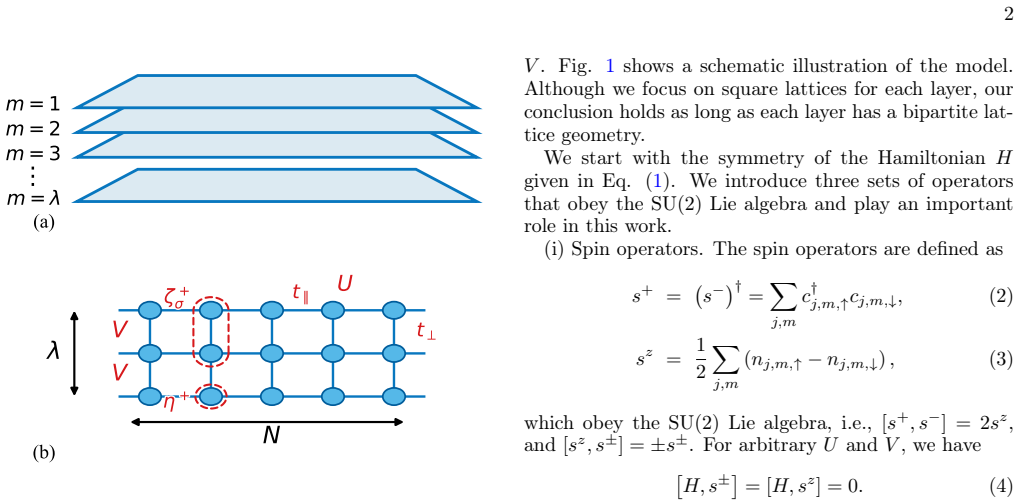
$\eta$-pairing symmetry generalizes the pairing mechanisms in superconductivity but is broken in the presence of interlayer interactions. In this work, we extend this approach to triplet pairs. We propose interlayer triplet-pairing operators for the multi-layer extended Hubbard model. We find that a set of exact condensate-pair eigenstates can be constructed, which exhibit off-diagonal long-range order. In contrast to the $\eta$-pairing mechanism, this originates from restricted spectrum generating algebra and is only available for bilayer and trilayer systems in the presence of interlayer Hubbard interactions. Nevertheless, the system also retains the original on-site $\eta$-pairing symmetry in the absence of interlayer interactions. Consequently, both singlet and triplet pairs coexist in the eigenstates of the multi-layer Hubbard model. We employ quench dynamics to demonstrate the results through numerical simulations. Our findings open avenues for the study of exact condensate-pair states in strongly correlated systems.
Editorial analysis
A structured set of objections, weighed in public.
Referee Report
Summary. The manuscript extends η-pairing to triplet pairs in the multi-layer extended Hubbard model via interlayer triplet-pairing operators. It constructs exact condensate-pair eigenstates with off-diagonal long-range order (ODLRO) using a restricted spectrum-generating algebra that closes only for bilayer (N=2) and trilayer (N=3) geometries when interlayer Hubbard terms are present. The construction preserves the original on-site η-pairing when interlayer interactions vanish, allowing coexistence of singlet and triplet pairs. Quench dynamics simulations are used to illustrate the results.
Significance. If the algebraic construction holds, the work supplies exact eigenstates with ODLRO in a strongly correlated multi-layer setting, extending the η-pairing framework to triplet channels and demonstrating their coexistence without additional fitting parameters. The explicit commutation relations [H, Γ] = λΓ on the relevant subspace and the geometry-specific closure of the algebra constitute a concrete, falsifiable advance for bilayer and trilayer Hubbard models.
minor comments (3)
- §3, after Eq. (12): the statement that the algebra 'closes only for N=2,3' would benefit from an explicit counter-example computation for N=4 showing the failure of the commutation relation, to make the restriction fully transparent.
- Fig. 2 caption: the quench protocol (initial state, time step, observable) is described only qualitatively; adding the precise initial condition and the definition of the plotted correlator would improve reproducibility.
- §4.2: the claim of 'coexistence' of singlet and triplet pairs is supported by the algebra but would be strengthened by a short remark on whether the two pairing channels occupy orthogonal subspaces or can interfere in the same eigenstate.
Simulated Author's Rebuttal
We thank the referee for their positive assessment of the manuscript, including the recognition of the algebraic construction, the geometry-specific closure for N=2 and N=3, and the coexistence of singlet and triplet pairing. The recommendation for minor revision is noted; however, the report contains no specific major comments to address.
Circularity Check
No circularity; explicit algebra yields eigenstates directly
full rationale
The paper defines interlayer triplet-pairing operators explicitly and demonstrates that they satisfy [H, Γ] = λ Γ on the relevant subspace for bilayer and trilayer geometries when interlayer Hubbard terms are present. This commutation relation is derived from the model Hamiltonian and operator algebra within the manuscript itself, without reduction to fitted parameters, self-referential definitions, or load-bearing self-citations. The retention of on-site η-pairing when interlayer terms vanish is likewise shown by direct substitution into the same algebra. The construction is therefore self-contained and does not collapse to its inputs by definition.
Axiom & Free-Parameter Ledger
axioms (1)
- domain assumption Existence of a restricted spectrum generating algebra for the multilayer extended Hubbard Hamiltonian with interlayer terms
Reference graph
Works this paper leans on
-
[1]
C. N. Yang,ηpairing and off-diagonal long-range order in a Hubbard model, Phys. Rev. Lett.63, 2144 (1989)
1989
-
[2]
C. N. Yang and S. C. Zhang,SO(4)symmetry in a Hub- bard model, Mod. Phys. Lett. B04, 759 (1990)
1990
-
[3]
Pernici, Spin and pairing algebras and ODLRO in a Hubbard model, Europhys
M. Pernici, Spin and pairing algebras and ODLRO in a Hubbard model, Europhys. Lett.12, 75 (1990)
1990
-
[4]
Rosch, D
A. Rosch, D. Rasch, B. Binz, and M. Vojta, Metastable superfluidity of repulsive fermionic atoms in optical lat- tices, Phys. Rev. Lett.101, 265301 (2008)
2008
-
[5]
Kantian, A
A. Kantian, A. J. Daley, and P. Zoller,ηcondensate of fermionic atom pairs via adiabatic state preparation, Phys. Rev. Lett.104, 240406 (2010)
2010
-
[6]
T.Kaneko, T.Shirakawa, S.Sorella, andS.Yunoki,Pho- toinducedηpairing in the Hubbard model, Phys. Rev. Lett.122, 077002 (2019)
2019
-
[7]
Kaneko, S
T. Kaneko, S. Yunoki, and A. J. Millis, Charge stiff- ness and long-range correlation in the optically induced η-pairing state of the one-dimensional Hubbard model, Phys. Rev. Research2, 032027 (2020)
2020
-
[8]
Ejima, T
S. Ejima, T. Kaneko, F. Lange, S. Yunoki, and H. Fehske, Photoinducedη-pairing at finite tempera- tures, Phys. Rev. Research2, 032008 (2020)
2020
-
[9]
Werner, J
P. Werner, J. Li, D. Golež, and M. Eckstein, Entropy- cooled nonequilibrium states of the Hubbard model, Phys. Rev. B100, 155130 (2019)
2019
-
[10]
J. Li, D. Golez, P. Werner, and M. Eckstein,η-paired superconducting hidden phase in photodoped Mott insu- lators, Phys. Rev. B102, 165136 (2020)
2020
-
[11]
Kitamura and H
S. Kitamura and H. Aoki,η-pairing superfluid in periodically-driven fermionic Hubbard model with strong attraction, Phys. Rev. B94, 174503 (2016)
2016
-
[12]
Peronaci, O
F. Peronaci, O. Parcollet, and M. Schiró, Enhancement of local pairing correlations in periodically driven Mott insulators, Phys. Rev. B101, 161101 (2020)
2020
-
[13]
M. W. Cook and S. R. Clark, Controllable finite- momenta dynamical quasicondensation in the period- ically driven one-dimensional Fermi-Hubbard model, Phys. Rev. A101, 033604 (2020)
2020
-
[14]
Tindall, B
J. Tindall, B. Buča, F. Schlawin, M. A. Sentef, and D. Jaksch, Analytical solution for the steady states of the driven Hubbard model, Phys. Rev. B103, 035146 (2021)
2021
-
[15]
Tindall, B
J. Tindall, B. Buča, F. Schlawin, M. A. Sentef, and D. Jaksch, Lieb’s theorem and maximum entropy con- densates, Quantum5, 610 (2021)
2021
-
[16]
Diehl, A
S. Diehl, A. Micheli, A. Kantian, B. Kraus, H. P. Büch- ler, and P. Zoller, Quantum states and phases in driven open quantum systems with cold atoms, Nat. Phys.4, 878 (2008)
2008
-
[17]
Kraus, H
B. Kraus, H. P. Büchler, S. Diehl, A. Kantian, A. Micheli, and P. Zoller, Preparation of entangled states by quan- tum markov processes, Phys. Rev. A78, 042307 (2008)
2008
-
[18]
Bernier, P
J.-S. Bernier, P. Barmettler, D. Poletti, and C. Kollath, Emergence of spatially extended pair coherence through incoherent local environmental coupling, Phys. Rev. A 87, 063608 (2013)
2013
-
[19]
B. Buča, J. Tindall, and D. Jaksch, Non-stationary co- herent quantum many-body dynamics through dissipa- tion, Nat. Commun.10, 1730 (2019)
2019
-
[20]
Tindall, B
J. Tindall, B. Buča, J. R. Coulthard, and D. Jaksch, Heating-induced long-rangeηpairing in the Hubbard model, Phys. Rev. Lett.123, 030603 (2019)
2019
- [21]
-
[22]
M. Nakagawa, N. Tsuji, N. Kawakami, and M. Ueda,η pairing of light-emitting fermions: Nonequilibrium pair- ing mechanism at high temperatures, arXiv:2103.13624 (2021)
-
[23]
Murakami, S
Y. Murakami, S. Takayoshi, T. Kaneko, Z. Sun, D. Golež, A. J. Millis, and P. Werner, Exploring nonequilibrium phases of photo-doped Mott insulators with generalized Gibbs ensembles, Commun. Phys.5, 23 (2022)
2022
-
[24]
X. Z. Zhang and Z. Song, Steady off-diagonal long-range order state in a half-filled dimerized Hubbard chain in- duced by a resonant pulsed field, Phys. Rev. B106, 094301 (2022)
2022
-
[25]
S. Iwai, M. Ono, A. Maeda, H. Matsuzaki, H. Kishida, H. Okamoto, and Y. Tokura, Ultrafast optical switching to a metallic state by photoinduced Mott transition in a halogen-bridged nickel-chain compound, Phys. Rev. Lett. 91, 057401 (2003)
2003
-
[26]
Sensarma, D
R. Sensarma, D. Pekker, E. Altman, E. Demler, N. Strohmaier, D. Greif, R. Jördens, L. Tarruell, H. Moritz, and T. Esslinger, Lifetime of double occu- pancies in the Fermi-Hubbard model, Phys. Rev. B82, 224302 (2010)
2010
-
[27]
Eckstein and P
M. Eckstein and P. Werner, Thermalization of a pump- excited Mott insulator, Phys. Rev. B84, 035122 (2011)
2011
-
[28]
Ichikawa, S
H. Ichikawa, S. Nozawa, T. Sato, A. Tomita, K. Ichiyanagi, M. Chollet, L. Guerin, N. Dean, A. Cav- alleri, S.-i. Adachi,et al., Transient photoinduced hidden phase in a manganite, Nature Materials10, 101 (2011)
2011
-
[29]
Lenarčič and P
Z. Lenarčič and P. Prelovšek, Ultrafast charge recombi- nation in a photoexcited Mott-Hubbard insulator, Phys. Rev. Lett.111, 016401 (2013)
2013
-
[30]
Stojchevska, I
L. Stojchevska, I. Vaskivskyi, T. Mertelj, P. Kusar, D. Svetin, S. Brazovskii, and D. Mihailovic, Ultrafast switching to a stable hidden quantum state in an elec- tronic crystal, Science344, 177 (2014)
2014
-
[31]
Mitrano, G
M. Mitrano, G. Cotugno, S. R. Clark, R. Singla, S. Kaiser, J. Stähler, R. Beyer, M. Dressel, L. Baldas- sarre, D. Nicoletti,et al., Pressure-dependent relaxation in the photoexcited Mott insulator ET-F2TCNQ: Influ- ence of hopping and correlations on quasiparticle recom- bination rates, Phys. Rev. Lett.112, 117801 (2014)
2014
-
[32]
Werner, M
P. Werner, M. Eckstein, M. Müller, and G. Refael, Light-induced evaporative cooling of holes in the Hub- bard model, Nature Communications10, 5556 (2019)
2019
-
[33]
J. R. Coulthard, S. R. Clark, S. Al-Assam, A. Cavalleri, and D. Jaksch, Enhancement of superexchange pairing in the periodically driven Hubbard model, Phys. Rev. B 96, 085104 (2017)
2017
-
[34]
X. Z. Zhang and Z. Song, Dynamical preparation of a steady off-diagonal long-range order state in the Hubbard model with a local non-hermitian impurity, Phys. Rev. B 102, 174303 (2020)
2020
-
[35]
X. Z. Zhang and Z. Song,η-pairing ground states in the non-hermitianHubbardmodel,Phys.Rev.B103,235153 (2021)
2021
-
[36]
X. M. Yang and Z. Song, Dynamic transition from in- sulating state toη-pairing state in a composite non- 7 hermitian system, Phys. Rev. B105, 195132 (2022)
2022
-
[37]
K. L. Zhang and Z. Song, Topologically protected two- fluid edge states, Phys. Rev. B104, 184515 (2021)
2021
-
[38]
Wang and Z
R. Wang and Z. Song, Flat band andη-pairing states in a one-dimensional Moiré Hubbard model, Chinese Physics Letters41, 047101 (2024)
2024
-
[39]
Bulut, D
N. Bulut, D. J. Scalapino, and R. T. Scalettar, Nodeless d-wave pairing in a two-layer Hubbard model, Phys. Rev. B45, 5577 (1992)
1992
-
[40]
R. T. Scalettar, J. W. Cannon, D. J. Scalapino, and R. L. Sugar, Magnetic and pairing correlations in coupled Hubbard planes, Phys. Rev. B50, 13419 (1994)
1994
-
[41]
R. R. dos Santos, Magnetism and pairing in Hubbard bilayers, Phys. Rev. B51, 15540 (1995)
1995
-
[42]
M. Gall, N. Wurz, J. Samland, C. F. Chan, and M. Köhl, Competing magnetic orders in a bilayer Hubbard model with ultracold atoms, Nature589, 40 (2021)
2021
-
[43]
Karakuzu, S
S. Karakuzu, S. Johnston, and T. A. Maier, Super- conductivity in the bilayer Hubbard model: Two Fermi surfaces are better than one, Phys. Rev. B104, 245109 (2021)
2021
-
[44]
T. I. Vanhala, J. E. Baarsma, M. O. J. Heikkinen, M. Troyer, A. Harju, and P. Törmä, Superfluidity and densityorderinabilayerextendedHubbardmodel,Phys. Rev. B91, 144510 (2015)
2015
-
[45]
Golor and S
M. Golor and S. Wessel, Nonlocal density interactions in auxiliary-field quantum Monte Carlo simulations: Appli- cation to the square lattice bilayer and honeycomb lat- tice, Phys. Rev. B92, 195154 (2015)
2015
-
[46]
Moudgalya, N
S. Moudgalya, N. Regnault, and B. A. Bernevig,η- pairing in Hubbard models: From spectrum generating algebrastoquantummany-bodyscars,Phys.Rev.B102, 085140 (2020)
2020
-
[47]
W. S. Bakr, J. I. Gillen, A. Peng, S. Fölling, and M. Greiner, A quantum gas microscope for detecting sin- gle atoms in a Hubbard-regime optical lattice, Nature 462, 74 (2009)
2009
-
[48]
M. F. Parsons, F. Huber, A. Mazurenko, C. S. Chiu, W. Setiawan, K. Wooley-Brown, S. Blatt, and M. Greiner, Site-resolved imaging of fermionic Li-6 in an optical lattice, Phys. Rev. Lett.114, 213002 (2015)
2015
-
[49]
L. W. Cheuk, M. A. Nichols, M. Okan, T. Gersdorf, V. V. Ramasesh, W. S. Bakr, T. Lompe, and M. W. Zwierlein, Quantum-gasmicroscopeforfermionicatoms,Phys.Rev. Lett.114, 193001 (2015)
2015
-
[50]
L. W. Cheuk, M. A. Nichols, K. R. Lawrence, M. Okan, H. Zhang, and M. W. Zwierlein, Observation of 2D fermionic Mott insulators of K-40 with single-site reso- lution, Phys. Rev. Lett.116, 235301 (2016)
2016
-
[51]
M. F. Parsons, A. Mazurenko, C. S. Chiu, G. Ji, D. Greif, and M. Greiner, Site-resolved measurement of the spin- correlationfunctionintheFermi-Hubbardmodel,Science 353, 1253 (2016)
2016
-
[52]
Esslinger, Fermi-Hubbard physics with atoms in an optical lattice, Annu
T. Esslinger, Fermi-Hubbard physics with atoms in an optical lattice, Annu. Rev. Condens. Matter Phys.1, 129 (2010)
2010
-
[53]
E. S. Ma, K. L. Zhang, and Z. Song, Steady he- lix states in a resonant XXZ Heisenberg model with Dzyaloshinskii-Moriya interaction, Phys. Rev. B106, 245122 (2022)
2022
-
[54]
Core8, 013 (2025)
C.H.ZhangandZ.Song,Coalescinghardcore-bosoncon- densate states with nonzero momentum, SciPost Phys. Core8, 013 (2025)
2025
-
[55]
D. K. He and Z. Song,η-pairing states in the Hubbard model with nonuniform Hubbard interaction, Phys. Rev. B112, 075135 (2025)
2025
-
[56]
J.Y.Liu-Sun, E.S.Ma, andZ.Song,Condensateground states of hardcore bosons induced by an array of impuri- ties, Phys. Rev. B112, 035117 (2025)
2025
-
[57]
J. Y. Liu-Sun and Z. Song, Exceptional-point induced dynamic sensitivity to particle-number parity, Phys. Rev. B113, 115158 (2026)
2026
-
[58]
J. Y. Liu-Sun and Z. Song, Resonant fields inducing en- ergy towers in Lieb quantum spin lattices, Phys. Rev. B 113, 155122 (2026)
2026
-
[59]
F. X. Liu, E. S. Ma, and Z. Song, Conden- sate states in Fermi and Bose-Hubbard ladders, arXiv:2604.21296 (2026), 10.48550/arXiv.2604.21296, arXiv:2604.21296 [cond-mat.str-el]
work page internal anchor Pith review Pith/arXiv arXiv doi:10.48550/arxiv.2604.21296 2026
-
[60]
C. N. Yang, Concept of off-diagonal long-range order and the quantum phases of liquid He and of superconductors, Rev. Mod. Phys.34, 694 (1962)
1962
discussion (0)
Sign in with ORCID, Apple, or X to comment. Anyone can read and Pith papers without signing in.