Generalized quantum geometry formulated through interacting vertex correlations
Pith reviewed 2026-07-03 18:24 UTC · model grok-4.3
The pith
Quantum geometry generalizes beyond Bloch momentum when the tensor is encoded by correlations of interacting vertices.
A machine-rendered reading of the paper's core claim, the machinery that carries it, and where it could break.
Core claim
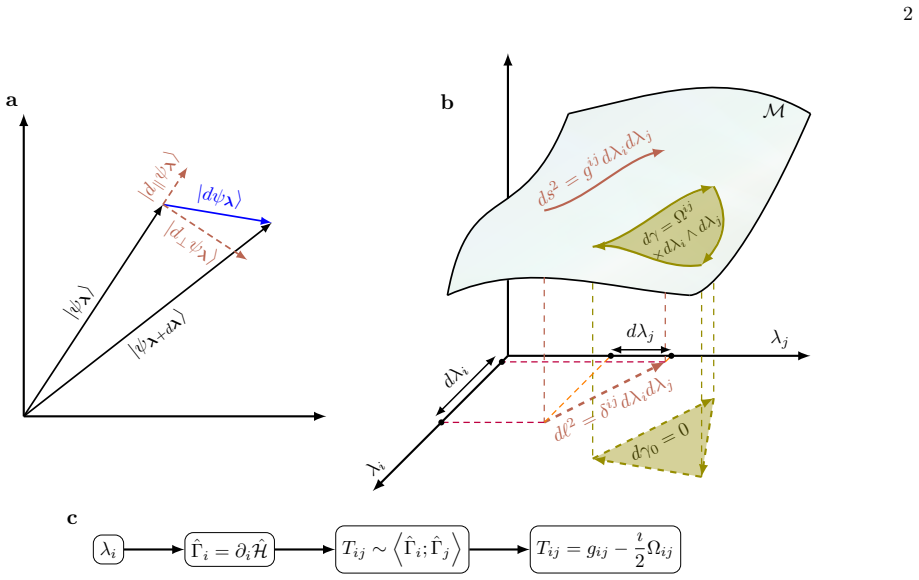
Quantum geometry characterizes the variation of electron wavefunctions along a parameter space. Conventionally that space is crystal momentum, but Bloch momentum is not the only possible choice. The paper shows that the generalized quantum geometric tensor is encoded by correlations of interacting vertices conjugate to the deformation parameters, allowing the same geometric object to be defined on manifolds generated by collective bosonic fluctuations, external fields, or structural distortions, including those arising from Hubbard-Stratonovich fields or Jahn-Teller configurations. The formulation is framed by general manifolds and therefore applies to generic structural, collective, and int
What carries the argument
Generalized quantum geometric tensor encoded by correlations of interacting vertices conjugate to the deformation parameters.
If this is right
- The quantum geometric tensor can be evaluated on manifolds generated by Hubbard-Stratonovich bosonic fields.
- The same tensor applies to Jahn-Teller configurational spaces.
- Quantum-geometric interpretations become available for responses to structural distortions and external fields.
- The formulation covers generic interactive many-body systems framed by arbitrary manifolds.
Where Pith is reading between the lines
- Geometric quantities could be extracted from correlation functions already computed in auxiliary-field Monte Carlo simulations.
- The approach may connect quantum geometry to collective-mode spectra without an intermediate single-particle band projection.
- Strain or magnetic-field manifolds could be treated uniformly with the same vertex-correlation language.
Load-bearing premise
A wavefunction can evolve along adiabatic parameters that are not crystal momentum, such as collective or structural deformation coordinates.
What would settle it
In a Hubbard model with auxiliary bosonic fields, compute the quantum geometric tensor by direct variation of the ground-state wavefunction with respect to the auxiliary-field amplitudes and compare the result to the explicit vertex-correlation expression; mismatch would falsify the encoding claim.
Figures

read the original abstract
Quantum geometry characterizes the variation of electron wavefunctions in solids along a parameter space. Conventionally, crystal momentum is chosen as the parameter, since it couples to electromagnetic fields, offering an interpretation of quantum geometry in terms of dipole matrix elements, polarization fluctuations, and optical responses. However, Bloch momentum is not the only possible parameter space in which a wavefunction can evolve. In this work, we show that quantum geometry can be extended beyond the bare Bloch-band geometry to manifolds whose adiabatic parameters represent deformations of the ground state, including collective bosonic fluctuations, external fields, or structural distortions. We show that the generalized quantum geometric tensor is encoded by correlations of interacting vertices, conjugate to the deformation parameters. By way of illustration, we briefly discuss the application of these extended geometric concepts to manifolds generated by Hubbard-Stratonovich bosonic fields, or Jahn-Teller configurational spaces. The formulation presented here is framed by general manifolds, which extend quantum geometry to generic structural, collective, and interactive many-body systems.
Editorial analysis
A structured set of objections, weighed in public.
Referee Report
Summary. The manuscript proposes an extension of quantum geometry beyond conventional Bloch momentum space to general adiabatic parameter manifolds representing ground-state deformations, including collective bosonic fluctuations, external fields, and structural distortions. The central claim is that the generalized quantum geometric tensor is encoded by correlations of interacting vertices conjugate to these deformation parameters, with brief illustrations for Hubbard-Stratonovich bosonic fields and Jahn-Teller configurational spaces, all framed within a general manifold approach for many-body systems.
Significance. If the formulation can be shown to hold with explicit derivations, the work would offer a conceptual bridge between quantum geometry and vertex functions in interacting systems, potentially enabling geometric interpretations of responses in deformed or fluctuating many-body states. The parameter-free framing and generality are strengths that could broaden applicability, though the significance hinges on verifiable reduction to known cases and concrete utility.
major comments (2)
- [Abstract and main formulation section] The central result—that the generalized quantum geometric tensor is encoded by correlations of interacting vertices conjugate to the deformation parameters—is stated directly in the abstract and introduction without derivation steps, explicit conjugation relations, or checks against standard limits (e.g., recovery of the usual quantum metric when parameters reduce to crystal momentum). This is load-bearing for the claim and requires a dedicated section with the mapping shown explicitly.
- [Introduction and formulation] The weakest assumption (that Bloch momentum is not the only possible parameter space) is used to motivate the extension, but the text does not address potential violations of adiabaticity when parameters include collective fluctuations or structural distortions; an explicit statement of the adiabatic condition in the generalized setting is needed to support the tensor definition.
minor comments (2)
- [Abstract] The abstract would benefit from one additional sentence summarizing the key steps linking vertex correlations to the tensor components.
- [Main text] Notation for the deformation parameters and their conjugate vertices should be introduced with a clear table or equation list to aid readability across the general manifold discussion.
Simulated Author's Rebuttal
We thank the referee for their careful reading and constructive comments. We address each major point below and have revised the manuscript to strengthen the presentation.
read point-by-point responses
-
Referee: [Abstract and main formulation section] The central result—that the generalized quantum geometric tensor is encoded by correlations of interacting vertices conjugate to the deformation parameters—is stated directly in the abstract and introduction without derivation steps, explicit conjugation relations, or checks against standard limits (e.g., recovery of the usual quantum metric when parameters reduce to crystal momentum). This is load-bearing for the claim and requires a dedicated section with the mapping shown explicitly.
Authors: We agree that the central claim requires explicit derivation and verification against known limits. In the revised manuscript we have added a dedicated section (Section 2) deriving the generalized quantum geometric tensor from the correlations of interacting vertices, including the explicit conjugation relations between deformation parameters and vertices. A subsection demonstrates recovery of the standard quantum metric and Berry curvature when the parameters reduce to crystal momentum. revision: yes
-
Referee: [Introduction and formulation] The weakest assumption (that Bloch momentum is not the only possible parameter space) is used to motivate the extension, but the text does not address potential violations of adiabaticity when parameters include collective fluctuations or structural distortions; an explicit statement of the adiabatic condition in the generalized setting is needed to support the tensor definition.
Authors: We thank the referee for this observation. The revised manuscript now includes an explicit statement of the adiabatic condition in the formulation section: the deformation parameters must vary slowly compared to the inverse of the many-body energy gaps so that the instantaneous ground state remains non-degenerate. This condition is stated to apply to collective bosonic fluctuations and structural distortions provided the variations remain adiabatic. revision: yes
Circularity Check
No significant circularity
full rationale
The paper presents a conceptual extension of the quantum geometric tensor to generalized adiabatic parameter manifolds (deformations, bosonic fields, structural distortions) expressed via interacting vertex correlations. The abstract states the result directly as a formulation on general manifolds without any exhibited derivation chain, equations, or self-citations that reduce the central claim to its inputs by construction. No fitted parameters are renamed as predictions, no uniqueness theorems are invoked from prior self-work, and no ansatzes are smuggled via citation. The derivation is self-contained against external benchmarks as a general theoretical framing.
Axiom & Free-Parameter Ledger
axioms (2)
- domain assumption Quantum geometry can be defined on general manifolds whose adiabatic parameters represent deformations of the ground state.
- ad hoc to paper The generalized quantum geometric tensor is encoded by correlations of interacting vertices conjugate to the deformation parameters.
Reference graph
Works this paper leans on
-
[1]
A. Gao, N. Nagaosa, N. Ni, and S.-Y. Xu, arXiv 10.48550/arXiv.2508.00469 (2025), arXiv:2508.00469 [cond-mat.str-el]
-
[2]
J. Yu, B. A. Bernevig, R. Queiroz, E. Rossi, P. Törmä, and B.-J. Yang, npj Quantum Materials10, 101 (2025)
work page 2025
- [3]
- [4]
-
[5]
N. Wang, D. Kaplan, Z. Zhang, T. Holder, N. Cao, A. Wang, X. Zhou, F. Zhou, Z. Jiang, C. Zhang,et al., Nature621, 487 (2023)
work page 2023
-
[6]
S. Kim, Y. Chung, Y. Qian, S. Park, C. Jozwiak, E. Rotenberg, A. Bostwick, K. S. Kim, and B.-J. Yang, Science388, 1050 (2025)
work page 2025
-
[7]
M. Kang, S. Kim, Y. Qian, P. M. Neves, L. Ye, J. Jung, D.Puntel, F.Mazzola, S.Fang, C.Jozwiak,et al.,Nature Physics21, 110 (2025)
work page 2025
-
[8]
G.Sala, M.T.Mercaldo, K.Domi, S.Gariglio, M.Cuoco, C. Ortix, and A. D. Caviglia, Science389, 822 (2025)
work page 2025
-
[9]
Törmä, Physical Review Letters131, 240001 (2023)
P. Törmä, Physical Review Letters131, 240001 (2023)
work page 2023
- [10]
- [11]
- [12]
-
[13]
P. Sukhachov, N. H. Aase, K. Mæland, and A. Sudbø, Physical Review B111, 085143 (2025)
work page 2025
- [14]
-
[15]
T. Kashihara, Y. Michishita, and R. Peters, Physical Re- view B107, 125116 (2023)
work page 2023
-
[16]
A. S. Miñarro and G. Herranz, arXiv (2026), arXiv preprint, arXiv:2605.19820 [cond-mat.str-el]
work page internal anchor Pith review Pith/arXiv arXiv 2026
-
[17]
H. Bruus and K. Flensberg,Many–Body Quantum The- ory in Condensed Matter Physics: An Introduction(Ox- ford University Press, 2004)
work page 2004
-
[18]
M. El-Batanouny, One-electron theory, inAdvanced Quantum Condensed Matter Physics: One-Body, Many- Body, and Topological Perspectives(Cambridge Univer- sity Press, 2020) p. 1–2
work page 2020
-
[19]
G. Stefanucci and R. van Leeuwen, Mbpt and varia- tional principles for the grand potential, inNonequilib- rium Many-Body Theory of Quantum Systems: A Mod- ern Introduction(Cambridge University Press, 2013) p. 295–322
work page 2013
-
[20]
H. J. K. Haug and A. P. Jauho,Quantum Kinet- ics in Transport and Optics of Semiconductors, 1st ed. (Springer Berlin, Heidelberg, 2007)
work page 2007
-
[21]
J. Schirmer, Perturbation theory for the electron prop- agator, inMany-Body Methods for Atoms, Molecules and Clusters(Springer International Publishing, Cham,
-
[22]
G. Stefanucci and R. van Leeuwen, One-particle green’s function, inNonequilibrium Many-Body Theory of Quan- tum Systems: A Modern Introduction(Cambridge Uni- versity Press, 2013) p. 153–204
work page 2013
-
[23]
Coleman,Introduction to Many-Body Physics(Cam- bridge University Press, 2015)
P. Coleman,Introduction to Many-Body Physics(Cam- bridge University Press, 2015)
work page 2015
-
[24]
Khomskii,Transition Metal Compounds(Cambridge University Press, Cambridge, UK, 2014)
D. Khomskii,Transition Metal Compounds(Cambridge University Press, Cambridge, UK, 2014)
work page 2014
-
[25]
I. Bersuker,The Jahn-Teller effect and vibronic interac- tions in modern chemistry(Springer Science & Business Media, 2013)
work page 2013
-
[26]
H. A. Jahn and E. Teller, Proceedings of The Royal So- ciety A161, 220 (1937)
work page 1937
-
[27]
B. Tsukerblat,Group Theory in Chemistry and Spec- troscopy: A Simple Guide to Advanced Usage, Dover Books on Chemistry (Dover Publications, 2006)
work page 2006
-
[28]
I. B. Bersuker and V. Z. Polinger,Vibronic Interactions in Molecules and Crystals, 1st ed. (Springer, Heidelberg, Berlin, 1989)
work page 1989
-
[29]
A. S. Miñarro and G. Herranz, Phys. Rev. B106, 165108 (2022)
work page 2022
-
[30]
S. V. Streltsov and D. I. Khomskii, Physical Review X 10, 031043 (2020)
work page 2020
-
[31]
Takada, Physica C: Superconductivity and its Appli- cations364-365, 71 (2001)
Y. Takada, Physica C: Superconductivity and its Appli- cations364-365, 71 (2001)
work page 2001
-
[32]
Y. Takada and M. Masaki, Journal of Molecular Struc- ture838, 207 (2007), proceedings of the Symposium on the Jahn-Teller Effect
work page 2007
-
[33]
S. A. Trugman, L.-C. Ku, and J. Bonča, Journal of Su- perconductivity17, 193 (2004)
work page 2004
-
[34]
K. I. Kugel and D. Khomski˘ ı, Soviet Physics Uspekhi25, 231 (1982)
work page 1982
- [35]
-
[36]
I. B. Bersuker,The Jahn–Teller Effect(Cambridge Uni- versity Press, Cambridge, UK, 2006)
work page 2006
-
[37]
D. I. Khomskii and S. V. Streltsov, Chemical Reviews 121, 2992 (2020)
work page 2020
-
[38]
C. Jin, S. Park, Y. Jeung, Y. Chung, and K. S. Kim, Nature Reviews Physics , 1 (2026)
work page 2026
discussion (0)
Sign in with ORCID, Apple, or X to comment. Anyone can read and Pith papers without signing in.