Phonon spectral function of Holstein polaron: Investigation of many-body effects with self-energy and vertex correction
Pith reviewed 2026-07-03 05:48 UTC · model grok-4.3
The pith
Many-body effects suppress the polaronic phonon spectral weight at large wave vectors in the Holstein model.
A machine-rendered reading of the paper's core claim, the machinery that carries it, and where it could break.
Core claim
Within the weak-coupling approach that respects the Ward identity, the electron self-energy and vertex corrections produce opposing shifts to the polaronic spectral weight of the Holstein polaron. These shifts nearly cancel for small-q modes, while the self-energy contribution dominates and suppresses the weight for large-q modes near the zone boundary. The perturbative treatment is reliable deep in the antiadiabatic regime but requires quasiparticle renormalization when phonon energy becomes comparable to the bandwidth.
What carries the argument
The net many-body correction to the phonon propagator arising from the difference between the electron self-energy term and the vertex correction term in the phonon self-energy.
If this is right
- The polaronic spectral weight is only weakly affected for small-q phonons due to cancellation.
- Significant suppression of the spectral weight occurs for large-q modes near the zone boundary.
- The weak-coupling method reliably estimates many-body effects when phonon energy is much smaller than the electronic bandwidth.
- Quasiparticle renormalization becomes necessary for accurate results as phonon energy approaches the bandwidth.
Where Pith is reading between the lines
- The zone-boundary suppression may be detectable in neutron scattering or Raman experiments on quasi-one-dimensional materials.
- Cancellation at long wavelengths suggests that simpler self-energy-only approximations remain useful for infrared-active modes.
- Similar calculations in higher dimensions could test whether the wave-vector dependence of the net correction is universal.
Load-bearing premise
The weak-coupling perturbative expansion accurately captures the many-body effects without quasiparticle renormalization when the phonon energy is much smaller than the electronic bandwidth.
What would settle it
Exact numerical computation of the phonon spectral function for the one-dimensional Holstein model at parameters deep in the antiadiabatic regime, compared against the perturbative result at the zone boundary, would confirm or refute the predicted suppression.
Figures




read the original abstract
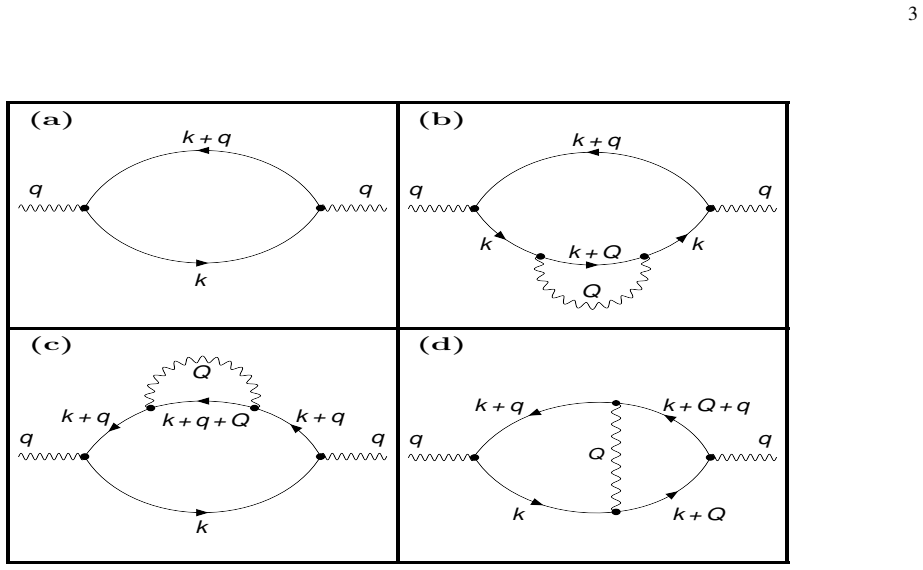
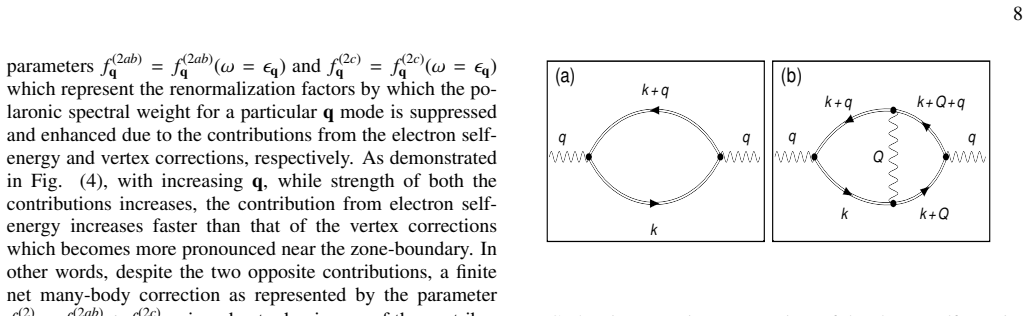
We study the impact of the many-body effects on the phonon spectral function of Holstein polaron in one-dimension in the antiadiabatic regime by incorporating the contributions from the electron self-energy and vertex corrections within a weak-coupling approach that respects the charge-conserving Ward identity. We find that while the polaronic spectral weight is suppressed due to contribution from the electron self-energy, on the other hand, the same is enhanced due to contribution from the vertex corrections. While strength of both the contributions increases with increasing the wave vector ($\q$) of phonons, they nearly cancel each other for the small-$\q$ modes so that the polaronic spectral weight is weakly affected due to the many-body effects. For the large-$\q$ modes near the zone boundary, the net many-body correction is dominated by the contribution of the electron self-energy which increases faster in comparison to that of the vertex corrections with increasing the wave vector thereby resulting in a significant suppression of the polaronic spectral weight. We find that while the weak-coupling perturbative approach provides a reliable estimation of the impact of the many-body effects deep inside the antiadibatic regime, the renormalization of quasiparticle spectrum must be taken into account for an accurate estimation when the phonon energy approaches the electronic bandwidth.
Editorial analysis
A structured set of objections, weighed in public.
Referee Report
Summary. The manuscript studies the phonon spectral function of the one-dimensional Holstein polaron in the antiadiabatic regime via a weak-coupling perturbative expansion that incorporates electron self-energy and vertex corrections while respecting the charge-conserving Ward identity. It reports opposing effects on the polaronic spectral weight—suppression from the self-energy and enhancement from the vertex corrections—with near cancellation at small q but net suppression at large q near the zone boundary because the self-energy contribution grows faster. The authors state that the approach is reliable deep in the antiadiabatic regime but requires inclusion of quasiparticle renormalization when the phonon energy approaches the electronic bandwidth.
Significance. If the reported q-dependent competition holds under the stated approximations, the work would clarify how many-body corrections shape phonon spectra in polaronic systems and demonstrate the utility of a Ward-identity-preserving perturbative treatment that separates self-energy and vertex contributions. The direct perturbative expansion without fitted parameters or circular reductions is a methodological strength.
major comments (1)
- [Abstract] Abstract: the central claim that self-energy dominates vertex corrections at large q, producing 'significant suppression' of the polaronic spectral weight, is obtained within a weak-coupling expansion that explicitly neglects quasiparticle renormalization. The manuscript asserts this approximation is reliable deep inside the antiadiabatic regime, yet reports no comparisons to non-perturbative benchmarks (exact diagonalization, DMRG, or QMC) on the same 1D Holstein model to quantify the incurred error. Because the reported q-dependence of the two contributions rests on this untested regime assumption, the quantitative statements remain conditional.
minor comments (1)
- [Abstract] Abstract: 'antiadibatic' is misspelled (should be 'antiadiabatic').
Simulated Author's Rebuttal
We thank the referee for their careful reading of the manuscript and for the constructive feedback. We address the single major comment below.
read point-by-point responses
-
Referee: [Abstract] Abstract: the central claim that self-energy dominates vertex corrections at large q, producing 'significant suppression' of the polaronic spectral weight, is obtained within a weak-coupling expansion that explicitly neglects quasiparticle renormalization. The manuscript asserts this approximation is reliable deep inside the antiadiabatic regime, yet reports no comparisons to non-perturbative benchmarks (exact diagonalization, DMRG, or QMC) on the same 1D Holstein model to quantify the incurred error. Because the reported q-dependence of the two contributions rests on this untested regime assumption, the quantitative statements remain conditional.
Authors: We agree that the reported results are obtained strictly within a weak-coupling perturbative expansion that neglects quasiparticle renormalization and that the manuscript contains no direct comparisons to non-perturbative benchmarks. The claim of reliability is grounded in the smallness of the expansion parameter deep in the antiadiabatic limit (ω_{0} ≫ t), where the phonon frequency greatly exceeds the electronic bandwidth and higher-order diagrams are parametrically suppressed. The central methodological contribution is the consistent separation of self-energy and vertex corrections while enforcing the Ward identity; this separation and the resulting q-dependent competition are exact within the chosen perturbative order. To address the referee’s concern we will revise the abstract and add a short paragraph in the discussion section that explicitly qualifies the results as perturbative, states the regime of expected validity, and notes the absence of non-perturbative benchmarks as a limitation for future work. We therefore disagree that the q-dependence itself is untested within the stated approximation, but we accept that the quantitative statements should be presented with greater caution. revision: partial
Circularity Check
Direct perturbative expansion; no equations reduce outputs to fitted inputs or self-citations
full rationale
The manuscript computes the phonon spectral function via a weak-coupling perturbative expansion that includes electron self-energy and vertex corrections while enforcing the Ward identity. All reported q-dependent suppressions and enhancements follow directly from evaluating the perturbative diagrams in the antiadiabatic regime; no parameter is fitted to the target spectral weights, no result is renamed from a prior self-citation, and no ansatz is smuggled in. The central claim therefore remains an independent evaluation rather than a tautology.
Axiom & Free-Parameter Ledger
axioms (3)
- domain assumption Weak-coupling perturbative expansion in the electron-phonon coupling strength
- domain assumption The method respects the charge-conserving Ward identity
- domain assumption One-dimensional lattice in the antiadiabatic regime where phonon energy is much smaller than electronic bandwidth
Reference graph
Works this paper leans on
-
[1]
A. S. Alexandrov and J. T. Devreese, Advances in Polaron Physics, Springer Series in Solid-State Sciences, V ol.159 (Springer, Berlin, 2010)
2010
-
[2]
Franchini, M
For a recent review, see, for example, C. Franchini, M. Reticci- oli, M. Setvin, and U. Diebold, Nat. Rev. Mater.6, 560 (2021)
2021
-
[3]
L-Bartolome, C
J. L-Bartolome, C. Lian, W. H. Sio, I. G. Gurtubay, A. Eiguren, and F. Giustino, Phys. Rev. B106, 075119 (2022)
2022
-
[4]
Holstein, Ann
T. Holstein, Ann. Phys.8, 325 (1959)
1959
-
[5]
Holstein, Ann
T. Holstein, Ann. Phys.8, 343 (1959)
1959
-
[6]
Marsiglio, Phys
F. Marsiglio, Phys. Lett. A180, 280 (1993)
1993
-
[7]
A. S. Alexandrov, V . V . Kabanov, and D. K. Ray, Phys. Rev. B 49, 9915 (1994)
1994
-
[8]
Ciuchi, F
S. Ciuchi, F. de Pasquale, S. Fratini, and D. Feinberg, Phys. Rev. B56, 4494 (1997)
1997
-
[9]
Zhang, E
C. Zhang, E. Jeckelmann, and S. R. White, Phys. Rev. B60, 14092 (1999)
1999
-
[10]
Hohenadler, M
M. Hohenadler, M. Aichhorn, and W. von der Linden, Phys. Rev. B68, 184304 (2003)
2003
-
[11]
O. S. Bari ˇsi´c, Phys. Rev. B69, 064302 (2004)
2004
-
[12]
De Filippis, V
G. De Filippis, V . Cataudella, V . Marigliano Ramaglia, and C. A. Perroni, Phys. Rev. B72014307 (2005)
2005
-
[13]
J. Loos, M. Hohenadler, A. Alvermann, and H Fehske, J. Phys.: Condens. Matter.18, 7299 (2006)
2006
-
[14]
G. L. Goodvin, M. Berciu, and G. A. Sawatzky, Phys. Rev. B 74, 245104 (2006)
2006
-
[15]
Berciu and G
M. Berciu and G. L. Goodvin, Phys. Rev. B76, 165109 (2007)
2007
-
[16]
Vidmar, J
L. Vidmar, J. Bon ˇca, and S. A. Trugman, Phys. Rev. B82, 104304 (2010)
2010
-
[17]
Bon ˇca, S
J. Bon ˇca, S. A. Trugman, and M. Berciu, Phys. Rev. B100, 094307 (2019)
2019
-
[18]
Jankoviˇc and N
V . Jankoviˇc and N. Vukmirovi ˇc, Phys. Rev. B105, 054311 (2022)
2022
-
[19]
Mitriˇc, V
P. Mitriˇc, V . Jankoviˇc, N. Vukmiroviˇc, and D. Tanaskoviˇc, Phys. Rev. Lett.129, 096401 (2022)
2022
-
[20]
M. Kang, S. W. Jung, W. J. Shin, Y . Sohn, S. H. Ryu, T. K. Kim, M. Hoesch, and K. S. Kim, Nat. Mater.17, 676 (2018)
2018
-
[21]
A. B. Migdal, Sov. Phys. JETP 34, 996 (1958)
1958
-
[22]
P. B. Allen and B. Mitrovi´c, in Solid State Physics, edited by H. Ehrenreich, F. Seitz, and D. Turnbull (Academic, New York, 1983), V ol. 37, pp. 1–92
1983
-
[23]
Meden, K
V . Meden, K. Sch¨onhammer, and O. Gunnarsson, Phys. Rev. B 50, 11179 (1994)
1994
-
[24]
Pietronero, S
L. Pietronero, S. Str ¨assler, and C. Grimaldi, Phys. Rev. B52, 10516 (1995)
1995
-
[25]
Grimaldi, L
C. Grimaldi, L. Pietronero, and S. Str ¨assler, Phys. Rev. B52, 10530 (1995). 12
1995
-
[26]
Miller, J
P. Miller, J. K. Freericks, and E. J. Nicol, Phys. Rev. B58, 14498 (1998)
1998
-
[27]
J. P. Hague, J. Phys.: Condens. Matter15, 2535 (2003)
2003
-
[28]
J. P. Hague, J. Phys.: Condens. Matter17, 5663 (2005)
2005
-
[29]
Bauer, J
J. Bauer, J. E. Han, and O. Gunnarsson, Phys. Rev. B84, 184531 (2011)
2011
-
[30]
Esterlis, B
I. Esterlis, B. Nosarzewski, E. W. Huang, B. Moritz, T. P. De- vereaux, D. J. Scalapino, and S. A. Kivelson, Phys. Rev. B97, 140501(R) (2018)
2018
-
[31]
Schrodi, P
F. Schrodi, P. M. Oppeneer , and A. Aperis, Phys. Rev. B102, 024503 (2020)
2020
-
[32]
Schrodi, A
F. Schrodi, A. Aperis, and P. M. Oppeneer, Phys. Rev. B104, 174518 (2021)
2021
-
[33]
Pandey, Phys
S. Pandey, Phys. Rev. B110, 064321 (2024)
2024
-
[34]
Pisana, M
S. Pisana, M. Lazzeri, C. Casiraghi, A. K. Novoselov, K. S. Geim, A. C. Ferrari, and F. Mauri, Nat. Mater.6, 198 (2007)
2007
-
[35]
P. T. Araujo, D. L. Mafra, K. Sato, R. Saito, J. Kong, and M. S. Dresselhaus, Phys. Rev. Lett.109, 046801 (2012)
2012
-
[36]
J. Li, J. Tang, Z. Tao, R. Shi, X. Gao, S. Xue, X. Gao, W. Sun, G. Miao, Z. Su, X. Shi, S. Hu, R. Mao, X. Zhang, P. He, W. Wang, P. Gao, H. Peng, C. Lian, J. Guo, and X. Zhu, Phys. Rev. Lett.135, 026204 (2025)
2025
-
[37]
Q. Wang, Y . L. Huang, Q. Zhang, J. Ma, X. Luo, and Y .-M. Li, Phys. Rev. B109, L121202 (2024)
2024
-
[38]
G. D. Mahan,Many-Particle Physics(Plenum Press, New York, 1990)
1990
-
[39]
Engelsberg and J
S. Engelsberg and J. R. Schrieffer, Phys. Rev.131, 993 (1963)
1963
-
[40]
A. V . Chubukov, Phys. Rev. B72, 085113 (2005)
2005
-
[41]
Z. H. Levine and E. Cockayne, J. Res. Natl. Inst. Stand. Tech- nol.113, 299 (2008)
2008
-
[42]
Wellein and H
G. Wellein and H. Fehske, Phys. Rev. B56, 4513 (1997)
1997
discussion (0)
Sign in with ORCID, Apple, or X to comment. Anyone can read and Pith papers without signing in.