Phase Time Crystals and Pairing in Binary Active Chiral Systems
Pith reviewed 2026-06-30 09:45 UTC · model grok-4.3
The pith
Binary active chiral particles driven 180 degrees out of phase form bound pairs assembling into a triangular lattice.
A machine-rendered reading of the paper's core claim, the machinery that carries it, and where it could break.
Core claim
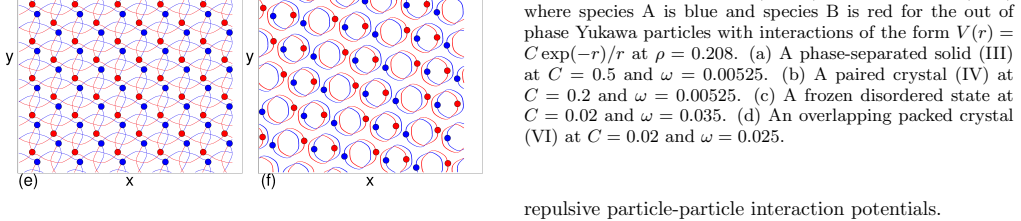
A binary assembly of particles with intermediate or long-range repulsive interactions subjected to circular drives of uniform chirality but 180 degrees out of phase from each other can organize into a rich variety of dynamical crystalline states, including bound pairs that assemble into a triangular lattice, as well as stripe phases, overlapping packed crystals, disordered phase glass states, mixed fluids, and phase-separated states.
What carries the argument
Phase time crystals, defined as binary particle systems under exactly 180-degree out-of-phase circular drives of uniform chirality, which enable formation of bound pairs and multiple dynamical lattices.
If this is right
- The paired crystal melts into a paired fluid when thermal fluctuations are increased.
- Opposite chirality drives produce stripes and packed lattices but no paired crystal.
- Modifying the chiral driving produces dynamic square spin ice geometries and higher-order complex structures.
- All reported states remain stable against the addition of thermal fluctuations.
Where Pith is reading between the lines
- Similar phase-offset driving protocols could be used in colloidal or active-matter experiments to select specific lattice symmetries.
- The pairing mechanism may be related to synchronization effects in other driven non-equilibrium systems.
- Varying the interaction range systematically would test how far the pairing effect depends on repulsion extending beyond nearest neighbors.
Load-bearing premise
Particles must have intermediate or long-range repulsive interactions and each species must follow a circular drive of uniform chirality exactly 180 degrees out of phase from the other.
What would settle it
Running the system with a phase difference other than exactly 180 degrees or with only short-range interactions and checking whether the bound-pair triangular lattice still appears.
Figures







read the original abstract
We introduce a class of dynamic systems we call phase time crystals consisting of a binary assembly of particles with intermediate or long-range repulsive interactions that are subjected to a circular drive of uniform chirality in which each particle species is out of phase from the other by 180 degrees. As a function of the particle density and orbit radius, this system can organize into a rich variety of dynamical crystalline states, including one in which the out of phase particles form bound pairs that assemble into a triangular lattice. We also find stripe phases, overlapping packed crystals, disordered or phase glass states with no diffusion, mixed fluids, and different types of phase-separated states. We show that these states are robust against the addition of thermal fluctuations, and that the paired crystal can melt into a paired fluid. If the drive on each particle species is of opposite chirality, the system forms stripes and packed lattices, but no paired crystal is present. We demonstrate that by modifying the nature of the chiral driving, it is possible to realize numerous kinds of active molecular lattices, including dynamic square spin ice geometries and higher-order complex structures.
Editorial analysis
A structured set of objections, weighed in public.
Referee Report
Summary. The manuscript introduces 'phase time crystals' as a class of dynamical states in binary mixtures of particles with intermediate or long-range repulsive interactions, each species driven in circular orbits of uniform chirality but exactly 180° out of phase. As functions of particle density and orbit radius the system is reported to form paired triangular lattices, stripe phases, overlapping packed crystals, phase-glass states without diffusion, mixed fluids, and phase-separated states. These states are stated to remain robust under added thermal noise, with the paired crystal melting into a paired fluid; opposite chirality eliminates the paired state while still producing stripes and packed lattices. Modification of the drive is claimed to enable additional structures such as dynamic square spin ice.
Significance. If the numerical evidence substantiates the emergence of these states from the stated drive and interaction rules without additional fitting parameters, the work would provide a concrete route to engineering non-equilibrium paired crystals and other active lattices via phase-offset chiral driving. The explicit demonstration that reversing chirality or altering interaction range removes the paired state supplies a falsifiable prediction that could guide both simulation and experiment in active-matter systems.
major comments (2)
- [Abstract] Abstract: the central claim that a 'rich variety of dynamical crystalline states' including a paired triangular lattice emerges as a function of density and orbit radius rests on simulation results, yet no order parameters, structure factors, diffusion coefficients, or phase-diagram boundaries are supplied; without these quantitative diagnostics it is impossible to judge whether the reported states are distinct or merely visual impressions.
- [Abstract] Abstract: the statement that 'these states are robust against the addition of thermal fluctuations' is load-bearing for the claim of stable dynamical crystals, but the manuscript provides neither the temperature range explored nor the metric used to quantify persistence of order (e.g., time-averaged pair correlations or Lindemann parameter), preventing assessment of the robustness claim.
minor comments (2)
- [Abstract] The interaction potential (range, functional form) and the precise parametrization of the circular drive (radius, frequency, amplitude) are not stated, making reproduction of the reported states impossible from the given text.
- [Abstract] The term 'phase time crystals' is introduced without a clear operational definition distinguishing it from other driven crystalline or time-crystalline states in the active-matter literature.
Simulated Author's Rebuttal
We thank the referee for their careful reading of the manuscript and for highlighting the need for quantitative support of the claims made in the abstract. We address each major comment below.
read point-by-point responses
-
Referee: [Abstract] Abstract: the central claim that a 'rich variety of dynamical crystalline states' including a paired triangular lattice emerges as a function of density and orbit radius rests on simulation results, yet no order parameters, structure factors, diffusion coefficients, or phase-diagram boundaries are supplied; without these quantitative diagnostics it is impossible to judge whether the reported states are distinct or merely visual impressions.
Authors: We agree that quantitative diagnostics strengthen the distinction between states. The manuscript presents extensive simulation snapshots, trajectories, and configuration data demonstrating the states as functions of density and orbit radius. To make the distinctions rigorous, we will revise the manuscript to include the static structure factor for the triangular lattice identification, mean-squared displacements to extract diffusion coefficients (confirming zero diffusion in crystals and glasses), and explicit phase-diagram boundaries determined from these metrics. These additions will be placed in the results section and referenced in the abstract. revision: yes
-
Referee: [Abstract] Abstract: the statement that 'these states are robust against the addition of thermal fluctuations' is load-bearing for the claim of stable dynamical crystals, but the manuscript provides neither the temperature range explored nor the metric used to quantify persistence of order (e.g., time-averaged pair correlations or Lindemann parameter), preventing assessment of the robustness claim.
Authors: The manuscript does contain simulations with added thermal noise, including the melting of the paired crystal into a paired fluid. However, the abstract omits the specific temperature range and order metrics. In revision we will specify the explored temperature range in reduced units and add quantitative measures, including time-averaged pair correlation functions and an active-system adaptation of the Lindemann parameter, to document order persistence. These details will appear in both the abstract and a dedicated methods/results subsection. revision: yes
Circularity Check
No significant circularity in derivation chain
full rationale
The paper introduces a model of binary particles with specified repulsive interactions and 180° out-of-phase circular drives, then reports states (paired crystals, stripes, etc.) observed via direct numerical simulation as functions of density and orbit radius. No equations, predictions, or first-principles derivations are presented that reduce by construction to fitted inputs, self-definitions, or self-citation chains; the central claims are explicit outcomes of the stated simulation protocol rather than reparameterizations of prior results. Self-citations, if any, are not load-bearing for the reported states.
Axiom & Free-Parameter Ledger
free parameters (2)
- particle density
- orbit radius
axioms (2)
- domain assumption Particles interact via intermediate or long-range repulsive potentials
- domain assumption Each particle species follows a circular drive with uniform chirality and exactly 180-degree phase offset
invented entities (1)
-
phase time crystals
no independent evidence
Reference graph
Works this paper leans on
-
[1]
Phase Time Crystals and Pairing in Binary Active Chiral Systems
or attractive interactions [37]. Less is known about FIG. 1. Schematics illustrating active chiral driving for a binary system of particles with intermediate or long-range repulsion. (a) Two particles that both rotate in the same direction while in phase. (b) The two particles rotate in the same direction but are out of phase by 180 ◦. (c) Particles that ...
work page internal anchor Pith review Pith/arXiv arXiv 2026
-
[2]
spin ice lattice
and magnetic colloids on patterned substrates [53] could act as time-crystal-like systems. The system we describe in the present work could be realized for charged or magnetic colloidal assemblies where there is an addi- tional chiral activity term, or using mixtures of charged particles where half of the particles also have magnetic interactions. It coul...
-
[3]
C. A. Murray and D. H. Van Winkle, Experimental obser- vation of two-stage melting in a classical two-dimensional screened Coulomb system, Phys. Rev. Lett.58, 1200 (1987)
1987
-
[4]
Pertsinidis and X
A. Pertsinidis and X. S. Ling, Diffusion of point defects in two-dimensional colloidal crystals, Nature (London) 413, 147 (2001)
2001
-
[5]
Lib´ al, C
A. Lib´ al, C. Reichhardt, and C. J. O. Reichhardt, Point- defect dynamics in two-dimensional colloidal crystals, Phys. Rev. E75, 011403 (2007)
2007
-
[6]
K. Zahn, R. Lenke, and G. Maret, Two-stage melting of paramagnetic colloidal crystals in two dimensions, Phys. Rev. Lett.82, 2721 (1999)
1999
-
[7]
Guillamon, H
I. Guillamon, H. Suderow, A. Fernandez-Pacheco, J. Sese, R. Cordoba, J. M. De Teresa, M. R. Ibarra, and S. Vieira, Direct observation of melting in a two-dimensional superconducting vortex lattice, Nature Phys.5, 651 (2009)
2009
-
[8]
X. Z. Yu, Y. Onose, N. Kanazawa, J. H. Park, J. H. Han, Y. Matsui, N. Nagaosa, and Y. Tokura, Real-space ob- servation of a two-dimensional skyrmion crystal, Nature (London)465, 901 (2010)
2010
-
[9]
Y. Tsui, M. He, Y. Hu, E. Lake, W. Taige, K. Watanabe, T. Taniguchi, M. Zaletel, and A. Yazdani, Direct obser- vation of a magnetic-field-induced wigner crystal, Nature (London)628, 287 (2024)
2024
-
[10]
Thomas, G
H. Thomas, G. E. Morfill, V. Demmel, J. Goree, B. Feuer- bacher, and D. M¨ ohlmann, Plasma crystal: Coulomb crystallization in a dusty plasma, Phys. Rev. Lett.73, 652 (1994)
1994
-
[11]
Lemelle, J.-F
L. Lemelle, J.-F. Palierne, E. Chatre, and C. Place, Coun- terclockwise circular motion of bacteria swimming at the air-liquid interface, J. Bacteriol.192, 6307 (2010)
2010
-
[12]
K¨ ummel, B
F. K¨ ummel, B. ten Hagen, R. Wittkowski, I. Buttinoni, R. Eichhorn, G. Volpe, H. L¨ owen, and C. Bechinger, Circular motion of asymmetric self-propelling particles, Phys. Rev. Lett.110, 198302 (2013)
2013
-
[13]
N. H. P. Nguyen, D. Klotsa, M. Engel, and S. C. Glotzer, Emergent collective phenomena in a mixture of hard shapes through active rotation, Phys. Rev. Lett.112, 075701 (2014)
2014
-
[14]
L¨ owen, Chirality in microswimmer motion: From cir- cle swimmers to active turbulence, Eur
H. L¨ owen, Chirality in microswimmer motion: From cir- cle swimmers to active turbulence, Eur. Phys. J. Spec. Top.225, 2319 (2016)
2016
-
[15]
van Zuiden, J
B. van Zuiden, J. Paulose, D. Irvine, W. Bartolo, and V. Vitelli, Spatiotemporal order and emergent edge cur- rents in active spinner materials, Proc. Natl. Acad. Sci. (USA)128, 12919 (2016)
2016
-
[16]
Banerjee, A
D. Banerjee, A. Souslov, A. G. Abanov, and V. Vitelli, Odd viscosity in chiral active fluids, Nature Commun.8, 1573 (2017)
2017
-
[17]
M. Han, J. Yan, S. Granick, and E. Luijten, Effective temperature concept evaluated in an active colloid mix- ture, Proc. Natl. Acad. Sci. (USA)114, 7513 (2017)
2017
-
[18]
V. Soni, E. S. Bililign, S. Magkiriadou, S. Sacanna, D. Bartolo, M. J. Shelley, and W. T. M. Irvine, The odd free surface flows of a colloidal chiral fluid, Nature Phys. 15, 1188 (2019)
2019
-
[19]
Q. L. Lei, M. P. Ciamarra, and R. Ni, Nonequilibrium strongly hyperuniform fluids of circle active particles with large local density fluctuations, Sci. Adv.5, eaau7423 (2019)
2019
-
[20]
Reichhardt and C
C. Reichhardt and C. J. O. Reichhardt, Reversibility, pattern formation, and edge transport in active chiral and passive disk mixtures, J. Chem. Phys.150, 064905 (2019)
2019
-
[21]
Liebchen and D
B. Liebchen and D. Levis, Chiral active matter, EPL139, 67001 (2022)
2022
-
[22]
T. H. Tan, A. Mietke, J. Li, Y. Chen, H. Higinbotham, P. J. Foster, S. Gokhale, J. Dunkel, and N. Fakhri, Odd dynamics of living chiral crystals, Nature607, 287 (2022)
2022
-
[23]
Baconnier, D
P. Baconnier, D. Shohat, C. L´ opez, C. Coulais, V. D´ emery, G. D¨ uring, and O. Dauchot, Selective and col- lective actuation in active solids, Nature Phys.18, 1234 (2022)
2022
-
[24]
Fruchart, C
M. Fruchart, C. Scheibner, and V. Vitelli, Odd viscosity and odd elasticity, Ann. Rev. Condens. Matter Phys.14, 471 (2023)
2023
-
[25]
Gelvan, A
M. Gelvan, A. Chirko, J. Kirpitch, Y. Lavie, N. Israel, and N. Oppenheimer, Hydrodynamic spin-pairing and active polymerization of oppositely spinning rotors, Na- ture Commun.16, 10368 (2025)
2025
-
[26]
Caprini, A
L. Caprini, A. Petrini, and U. Marconi, Modeling chiral active particles: from circular motion to odd interactions, J. Stat. Mech. , 024001 (2026)
2026
-
[27]
M. Han, M. Fruchart, C. Scheibner, S. Vaikuntanathan, J. J. de Pablo, and V. Vitelli, Fluctuating hydrodynamics of chiral active fluids, Nature Phys.17, 1260 (2021)
2021
-
[28]
C. J. O. Reichhardt and C. Reichhardt, Active rheology in odd-viscosity systems, EPL137, 66004 (2022)
2022
-
[29]
Huang, M
Z. Huang, M. te Vrugt, R. Wittkowski, and H. L¨ owen, Anomalous grain dynamics and grain locomotion of odd crystals, Proc. Natl. Acad. Sci. (USA)122, e2511350122 (2025)
2025
-
[30]
Massana-Cid, D
H. Massana-Cid, D. Levis, R. J. H. Hern´ andez, I. Pag- onabarraga, and P. Tierno, Arrested phase separation in chiral fluids of colloidal spinners, Phys. Rev. Res.3, L042021 (2021)
2021
-
[31]
E. S. Bililign, F. B. Usabiaga, Y. A. Ganan, A. Poncet, V. Soni, S. Magkiriadou, M. J. Shelley, D. Bartolo, and W. T. M. Irvine, Motile dislocations knead odd crystals into whorls, Nature Phys.18, 212 (2022)
2022
-
[32]
R. Guo, J. Li, and B. Ai, Chirality-induced phase separa- tion and collective dynamics in binary mixtures of chiral particles, Phys. Rev. E111, 045423 (2025)
2025
-
[33]
Zhang and A
B. Zhang and A. Snezhko, Hyperuniform active chiral fluids with tunable internal structure, Phys. Rev. Lett. 128, 218002 (2022)
2022
-
[34]
Jeong, Y
K. Jeong, Y. Kuroda, Y. Asatani, T. Kawasaki, and K. Miyazaki, Crystallization of chiral active Brownian particles at low densities, Phys. Rev. Res.7, 043212 (2025)
2025
-
[35]
J. Wang, Z. Sun, H. Chen, G. Wang, D. Chen, G. Chen, 17 J. Shuai, M. Yang, Y. Jiao, and L. Liu, Hyperuniform networks of active magnetic robotic spinners, Phys. Rev. Lett.134, 248301 (2025)
2025
-
[36]
Kiechl, A
T. Kiechl, A. Altshuler, A. L¨ uders, Y. Roichman, and T. Franosch, Free chiral self-propelled robots compared to active Brownian circle swimmers, Phys. Rev. E113, 045409 (2026)
2026
-
[37]
Aubret, M
A. Aubret, M. Youssef, S. Sacanna, and J. Palacci, Tar- geted assembly and synchronization of self-spinning mi- crogears, Nature Phys.14, 1114 (2018)
2018
-
[38]
C. B. Caporusso, G. Gonnella, and D. Levis, Phase co- existence and edge currents in the chiral Lennard-Jones fluid, Phys. Rev. Lett.132, 168201 (2024)
2024
-
[39]
J. Li, R. Guo, and B. Ai, Spontaneous separation of attractive chiral mixtures, Phys. Rev. E110, 024608 (2024)
2024
-
[40]
Massana-Cid, C
H. Massana-Cid, C. Maggi, N. Gnan, G. Frangipane, and R. Di Leonardo, Multiple temperatures and melting of a colloidal active crystal, Nat. Commun.15, 6574 (2025)
2025
-
[41]
Sungar, J
N. Sungar, J. Sharpe, L. Ijzerman, and J.-W. Barotta, Synchronization and self-assembly of free capillary spin- ners, Phys. Rev. E111, 035104 (2025)
2025
-
[42]
P. W. A. Vyas, A. D.and Sch¨ onh¨ ofer, T. M. Hopkins, A. D. Hollingsworth, S. Sacanna, S. C. Glotzer, and P. Chaikin, Two-dimensional non-equilibrium melting of charged colloids, Nature Phys.22, 287 (2026)
2026
-
[43]
C. C. de Souza Silva, M. V. Correia, and J. C. P. Vel´ asquez, Emergent self-propulsion of skyrmionic mat- ter in synthetic antiferromagnets, Phys. Rev. Lett.135, 086701 (2025)
2025
-
[44]
Nisoli, R
C. Nisoli, R. Moessner, and P. Schiffer, Colloquium: Ar- tificial spin ice: Designing and imaging magnetic frustra- tion, Rev. Mod. Phys.85, 1473 (2013)
2013
-
[45]
Ortiz-Ambriz, C
A. Ortiz-Ambriz, C. Nisoli, C. Reichhardt, C. J. O. Re- ichhardt, and P. Tierno, Colloquium: Ice rule and emer- gent frustration in particle ice and beyond, Rev. Mod. Phys.91, 041003 (2019)
2019
-
[46]
Wilczek, Quantum time crystals, Phys
F. Wilczek, Quantum time crystals, Phys. Rev. Lett. 109, 160401 (2012)
2012
-
[47]
Shapere and F
A. Shapere and F. Wilczek, Classical time crystals, Phys. Rev. Lett.109, 160402 (2012)
2012
-
[48]
Bruno, Impossibility of spontaneously rotating time crystals: A no-go theorem, Phys
P. Bruno, Impossibility of spontaneously rotating time crystals: A no-go theorem, Phys. Rev. Lett.111, 070402 (2013)
2013
-
[49]
N. Y. Yao, C. Nayak, L. Balents, and M. P. Zaletel, Clas- sical discrete time crystals, Nature Phys.16, 43 (2020)
2020
-
[50]
Z. G. Nicolaou and A. E. Motter, Anharmonic classical time crystals: A coresonance pattern formation mecha- nism, Phys. Rev. Res.3, 023106 (2021)
2021
-
[51]
Zhao and I
H. Zhao and I. Smalyukh, Space-time crystals from particle-like topological solitons, Nature Mater.24, 1802 (2025)
2025
-
[52]
M. C. Morrell, L. Elliott, and D. G. Grier, Nonreciprocal wave-mediated interactions power a classical time crys- tal, Phys. Rev. Lett.136, 057201 (2026)
2026
- [53]
-
[54]
Lib´ al, T
A. Lib´ al, T. Bal´ azs, C. Reichhardt, and C. J. O. Reich- hardt, Colloidal dynamics on a choreographic time crys- tal, Phys. Rev. Lett.124, 208004 (2020)
2020
-
[55]
Ernst, A
A. Ernst, A. M. E. B. Rossi, and T. M. Fischer, Adiabatic and irreversible classical discrete time crystals, SciPost Phys.13, 091 (2022)
2022
-
[56]
Reichhardt and C
C. Reichhardt and C. J. O. Reichhardt, Depinning and nonequilibrium dynamic phases of particle assemblies driven over random and ordered substrates: a review, Rep. Prog. Phys.80, 026501 (2017)
2017
-
[57]
Lekner, Summation of Coulomb fields in computer- simulated disordered-systems, Physica A176, 485 (1991)
J. Lekner, Summation of Coulomb fields in computer- simulated disordered-systems, Physica A176, 485 (1991)
1991
-
[58]
Grønbech-Jensen, Lekner summation of long range interactions in periodic systems, Int
N. Grønbech-Jensen, Lekner summation of long range interactions in periodic systems, Int. J. Mod. Phys. C8, 1287 (1997)
1997
-
[59]
Reichhardt and C
C. Reichhardt and C. J. O. Reichhardt, Nonlinear dy- namics, avalanches, and noise for driven Wigner crystals, Phys. Rev. B106, 235417 (2022)
2022
-
[60]
See supplemental material for animations showing the motion of the particles
-
[61]
Malescio and G
G. Malescio and G. Pellicane, Stripe phases from isotropic repulsive interactions, Nature Mater.2, 97 (2003)
2003
-
[62]
M. A. Glaser, G. M. Grason, R. D. Kamien, A. Kosmrlj, C. D. Santangelo, and P. Ziherl, Soft spheres make more mesophases, EPL78, 46004 (2007)
2007
-
[63]
M. M. Fogler, A. A. Koulakov, and B. I. Shklovskii, Ground state of a two-dimensional electron liquid in a weak magnetic field, Phys. Rev. B54, 1853 (1996)
1996
-
[64]
Sciortino, S
F. Sciortino, S. Mossa, E. Zaccarelli, and P. Tartaglia, Equilibrium cluster phases and low-density arrested dis- ordered states: The role of short-range attraction and long-range repulsion, Phys. Rev. Lett.93, 055701 (2004)
2004
-
[65]
C. J. Olson Reichhardt, C. Reichhardt, and A. R. Bishop, Structural transitions, melting, and intermediate phases for stripe- and clump-forming systems, Phys. Rev. E82, 041502 (2010)
2010
-
[66]
Hooshanginejad, J.-W
A. Hooshanginejad, J.-W. Barotta, V. Spradlin, G. Pucci, R. Hunt, and D. M. Harris, Interactions and pattern formation in a macroscopic magnetocapillary salr system of mermaid cereal, Nature Commun.15, 5466 (2024)
2024
-
[67]
Reichhardt, I
C. Reichhardt, I. Regev, K. Dahmen, S. Okuma, and C. J. Olson Reichhardt, Reversible to irreversible transi- tions in periodic driven many-body systems and future directions for classical and quantum system, Phys. Rev. Res.5, 021001 (2023)
2023
-
[68]
Corte, P
L. Corte, P. M. Chaikin, J. P. Gollub, and D. J. Pine, Random organization in periodically driven systems, Na- ture Phys.4, 420 (2008)
2008
-
[69]
Regev, T
I. Regev, T. Lookman, and C. Reichhardt, Onset of irre- versibility and chaos in amorphous solids under periodic shear, Phys. Rev. E88, 062401 (2013)
2013
-
[70]
N. C. Keim, J. D. Paulsen, Z. Zeravcic, S. Sastry, and S. R. Nagel, Memory formation in matter, Rev. Mod. Phys.91, 035002 (2019)
2019
-
[71]
England, Dissipative adaptation in driven self- assembly, Nature Nanotech.10, 919 (2015)
J. England, Dissipative adaptation in driven self- assembly, Nature Nanotech.10, 919 (2015)
2015
-
[72]
B. A. Grzybowski, X. Jiang, H. A. Stone, and G. M. Whitesides, Dynamic, self-assembled aggregates of mag- netized, millimeter-sized objects rotating at the liquid- air interface: Macroscopic, two-dimensional classical ar- tificial atoms and molecules, Phys. Rev. E64, 011603 (2001)
2001
-
[73]
Goto and H
Y. Goto and H. Tanaka, Purely hydrodynamic ordering of rotating disks at a finite reynolds number, Nature Com- mun.6, 5994 (2015)
2015
discussion (0)
Sign in with ORCID, Apple, or X to comment. Anyone can read and Pith papers without signing in.