Rheological and Photoelastic Response of Hydrated Soft Granular Particles
Pith reviewed 2026-07-01 01:09 UTC · model grok-4.3
The pith
Hydrated photoelastic particles require new characterization techniques to measure their changed rheological and optical properties for fluid-immersed experiments.
A machine-rendered reading of the paper's core claim, the machinery that carries it, and where it could break.
Core claim
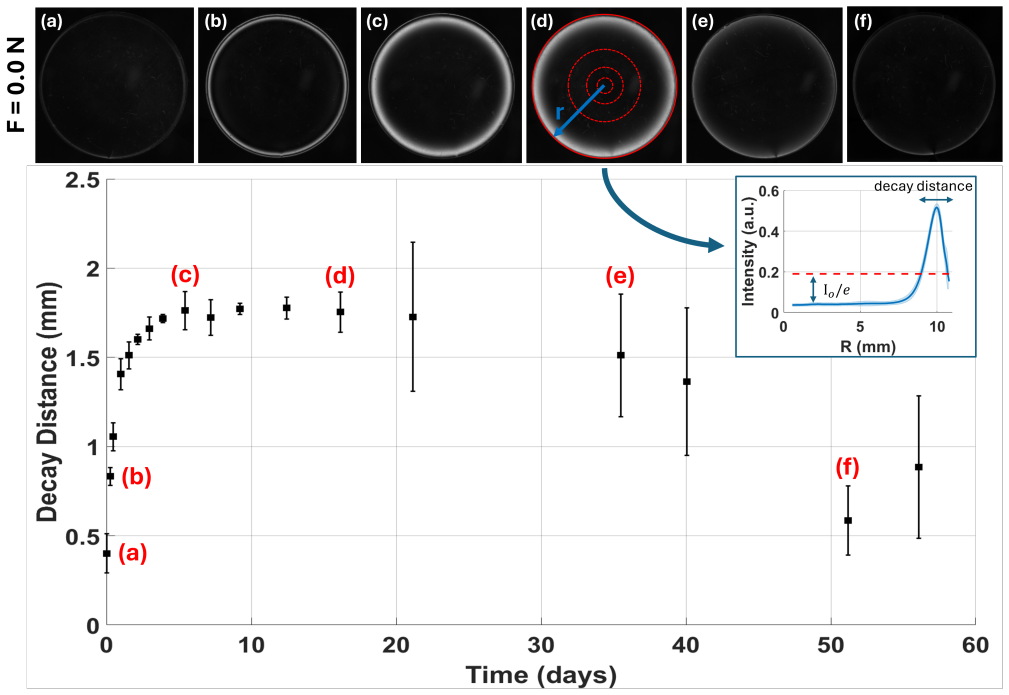
We introduce characterization techniques to probe changes in rheological and optical properties of hydrated photoelastic particles, and report considerations for use of photoelastic particles in immersion-based experiments to provide a framework for studying hydrodynamic interactions in 2D systems of photoelastic particles immersed in a fluid medium.
What carries the argument
Characterization techniques that measure shifts in rheological behavior and photoelastic response when particles transition from dry to hydrated states.
If this is right
- Force chains can be visualized and quantified in 2D granular suspensions using the calibrated particles.
- Contact force magnitudes and directions become measurable inside fluid-immersed systems.
- Particle-level stress tensors with shear and normal components can be extracted in the presence of fluid.
- Hydrodynamic interactions can be isolated and studied by combining the optical and rheological data.
Where Pith is reading between the lines
- The same calibration steps could be adapted to test whether 3D particle assemblies in fluid retain similar photoelastic utility.
- Industrial mixing or sediment transport models might incorporate the reported hydration corrections to improve force predictions.
- Optical setups could combine the new particle characterizations with existing fluid visualization methods to track both solid and liquid phases simultaneously.
Load-bearing premise
The introduced characterization techniques will remain valid and sufficient when the particles are immersed in fluid without major unaccounted changes in behavior.
What would settle it
Measurements showing that the stress-optic response or contact force calibration of the particles deviates significantly from the reported characterizations once the particles are placed in fluid.
Figures




read the original abstract
Photoelasticity is a qualitative and quantitative optical technique to image internal stress distributions in transparent materials. In the past few decades, discrete photoelastic particles have been used as a proxy for dry granular materials in both static, quasistatic, and dynamic analogue experiments. The technique allows the visualization of force chains, determination of the location and magnitude of contact forces, and outputs a stress tensor for each particle with shear and normal stress components. To date, little to no work has investigated photoelastic suspensions, where photoelastic granular particles are immersed in a fluid medium, despite its relevance in industrial and natural applications. The introduction of a fluid phase yields additional considerations in the rheological and photoelastic behavior of our proxy particles. In this manuscript, we summarize the state-of-the-art in resolving forces in immersed photoelastic granular materials. We introduce characterization techniques to probe changes in rheological and optical properties of hydrated photoelastic particles, and we report considerations for use of photoelastic particles in immersion-based experiments. We intend for this work to provide the leading framework to study the hydrodynamic interactions in 2D systems of photoelastic particles immersed in a fluid medium.
Editorial analysis
A structured set of objections, weighed in public.
Referee Report
Summary. The manuscript summarizes the state-of-the-art for force resolution in photoelastic granular materials, introduces characterization techniques for rheological and optical properties of hydrated (fluid-immersed) photoelastic particles, reports considerations for their experimental use, and positions the work as the leading framework for studying hydrodynamic interactions in 2D immersed photoelastic systems.
Significance. If the introduced techniques are shown to remain valid under fluid immersion, the work would address an underexplored area with relevance to industrial and natural granular-fluid systems. The manuscript correctly identifies that fluid immersion introduces additional considerations beyond dry-particle photoelasticity. However, the absence of any presented data, recalibration results, or validation against fluid-specific effects (refractive-index mismatch, light transmission changes, or contact-mechanics alterations) limits the immediate impact.
major comments (2)
- [Abstract] Abstract: The central claim that the work provides 'the leading framework' for hydrodynamic-interaction studies rests on the untested assumption that dry-particle force-chain visualization and stress-tensor extraction remain valid and sufficient once particles are hydrated. No experimental results, recalibration data, or error analysis addressing fluid-specific effects are shown, leaving the assumption unsupported.
- [Abstract] Abstract (and implied methods sections): The manuscript states that it 'introduces characterization techniques to probe changes in rheological and optical properties' yet provides neither the techniques themselves nor any quantitative comparison (e.g., force magnitude accuracy or stress-tensor components) between dry and immersed conditions. This omission makes it impossible to evaluate whether the techniques account for the 'additional considerations' mentioned.
Simulated Author's Rebuttal
We thank the referee for their constructive feedback. The comments correctly identify that our manuscript focuses on introducing a framework and characterization techniques without presenting new experimental validation data for fluid-immersed conditions. We address each point below and will make revisions to clarify the scope and strengthen the presentation.
read point-by-point responses
-
Referee: [Abstract] Abstract: The central claim that the work provides 'the leading framework' for hydrodynamic-interaction studies rests on the untested assumption that dry-particle force-chain visualization and stress-tensor extraction remain valid and sufficient once particles are hydrated. No experimental results, recalibration data, or error analysis addressing fluid-specific effects are shown, leaving the assumption unsupported.
Authors: We agree that the claim of providing 'the leading framework' may be premature without explicit validation data under immersion. The manuscript summarizes the state-of-the-art for dry systems and outlines considerations and techniques for immersed systems based on existing knowledge. We will revise the abstract to describe the work as 'a framework' rather than 'the leading framework' and explicitly state the need for future validation experiments addressing fluid-specific effects such as refractive index mismatch. revision: yes
-
Referee: [Abstract] Abstract (and implied methods sections): The manuscript states that it 'introduces characterization techniques to probe changes in rheological and optical properties' yet provides neither the techniques themselves nor any quantitative comparison (e.g., force magnitude accuracy or stress-tensor components) between dry and immersed conditions. This omission makes it impossible to evaluate whether the techniques account for the 'additional considerations' mentioned.
Authors: The full manuscript details the characterization techniques in the methods and results sections, including protocols for measuring rheological properties (e.g., viscosity changes due to hydration) and optical properties (e.g., birefringence under immersion). However, we acknowledge that direct quantitative comparisons and error analyses between dry and immersed conditions are not included, as the work emphasizes the introduction of the techniques and considerations rather than a full comparative study. We will revise to include more explicit descriptions or examples of the techniques and note where quantitative validation is required. revision: partial
Circularity Check
Methodological paper with no derivation chain or fitted predictions; no circularity detected
full rationale
The paper is explicitly a summary of state-of-the-art plus introduction of characterization techniques and considerations for use in immersed photoelastic systems. No equations, derivations, predictions, or parameter-fitting steps are described in the abstract or reader-provided context. The central claim (providing a leading framework) rests on reported experimental considerations rather than any self-referential reduction of outputs to inputs. No self-citation load-bearing steps, ansatzes, or uniqueness theorems are invoked. This is the expected honest non-finding for a purely descriptive/methodological contribution.
Axiom & Free-Parameter Ledger
Reference graph
Works this paper leans on
-
[1]
J. T. Jenkins and S. B. Savage. A theory for the rapid flow of identical, smooth, nearly elastic, spherical particles.Journal of Fluid Mechanics, 130:187–202, 1983
1983
-
[2]
On dense granular flows.The European Physical Journal E, 14(4):341–365, 2004
GDR MiDi. On dense granular flows.The European Physical Journal E, 14(4):341–365, 2004
2004
-
[3]
Dauxois, T
T. Dauxois, T. Peacock, P. Bauer, C. P. Caulfield, C. Cenedese, C. Gorl ´e, G. Haller, G. N. Ivey, P. F. Linden, E. Meiburg, N. Pinardi, N. M. Vriend, and A. W. Woods. Confronting Grand Challenges in environmental fluid mechanics.Physical Review Fluids, 6(2):020501, 2021. 10
2021
-
[4]
H. M. Jaeger and Sidney R. Nagel. Physics of the Granular State.Science, 255(5051):1523–1531, 1992
1992
-
[5]
Photo-elastic Method for Determination of Stress in Powdered Mass.Journal of the Physical Society of Japan, 5(5):383–385, 1950
Takao Wakabayashi. Photo-elastic Method for Determination of Stress in Powdered Mass.Journal of the Physical Society of Japan, 5(5):383–385, 1950
1950
-
[6]
Drescher and G
A. Drescher and G. de Josselin de Jong. Photoelastic verification of a mechanical model for the flow of a granular material.Journal of the Mechanics and Physics of Solids, 20(5):337–340, 1972
1972
-
[7]
Jaeger, Sidney R
Heinrich M. Jaeger, Sidney R. Nagel, and Robert P. Behringer. The Physics of Granular Materials.Physics Today, 49(4):32–38, 1996
1996
-
[8]
Howell, R
Daniel W. Howell, R. P. Behringer, and C. T. Veje. Fluctuations in gran- ular media.Chaos: An Interdisciplinary Journal of Nonlinear Science, 9(3):559–572, 1999
1999
-
[9]
T. S. Majmudar and R.P. Behringer. Contact force measurements and stress anisotropy in granular materials.Nature, 435:1079–1082, 2005
2005
-
[10]
O’Hern, and Robert P
Jonathan Bar ´es, Dengming Wang, Dong Wang, Thibault Bertrand, Corey S. O’Hern, and Robert P. Behringer. Local and global avalanches in a two-dimensional sheared granular medium.Physical Review E, 96(5):052902, 2017
2017
-
[11]
T. S. Majmudar, M. Sperl, S. Luding, and R. P. Behringer. Jamming Transition in Granular Systems.Physical Review Letters, 98(5):058001, 2007
2007
-
[12]
Clark, Lou Kondic, and Robert P
Abram H. Clark, Lou Kondic, and Robert P. Behringer. Particle Scale Dynamics in Granular Impact.Physical Review Letters, 109(23):238302, 2012
2012
-
[13]
E. T. Owens and K. E. Daniels. Sound propagation and force chains in granular materials.Europhysics Letters, 94(5):54005, 2011
2011
-
[14]
The impact of fluid flow on force chains in granular media.Applied Physics Letters, 110:041907, 2017
Nariman Mahabadi and Jaewon Jang. The impact of fluid flow on force chains in granular media.Applied Physics Letters, 110:041907, 2017
2017
-
[15]
Brzinski, Michael Shearer, and Karen E
Zhu Tang, Theodore A. Brzinski, Michael Shearer, and Karen E. Daniels. Nonlocal rheology of dense granular flow in annular shear experiments. Soft Matter, 14(16):3040–3048, 2018
2018
-
[16]
Brzinski, Karen E
Aghil Abed Zadeh, Jonathan Bar ´es, Theodore A. Brzinski, Karen E. Daniels, Joshua Dijksman, Nicolas Docquier, Henry O. Everitt, Jonathan E. Kollmer, Olivier Lantsoght, Dong Wang, Marcel Workamp, Yiqiu Zhao, and Hu Zheng. Enlightening force chains: a review of pho- toelasticimetry in granular matter.Granular Matter, 21(4):83, 2019
2019
-
[17]
Daniels, Jonathan E
Karen E. Daniels, Jonathan E. Kollmer, and James G. Puckett. Photoelas- tic force measurements in granular materials.Review of Scientific Instru- ments, 88(5):051808, 2017
2017
-
[18]
Validation and correction of photoelastic techniques for frictional granular systems
Benjamin McMillan, Stuart B Dalziel, and Nathalie M Vriend. Validation and correction of photoelastic techniques for frictional granular systems. Measurement Science and Technology, 36(5):055212, 2025
2025
-
[19]
Dalziel, and Nathalie M
Benjamin McMillan, Stuart B. Dalziel, and Nathalie M. Vriend. Dynamic response, viscoelastic relaxation and boundary deformation in granular photoelasticity.Granular Matter, 28(2):32, 2026
2026
-
[21]
A. L. Thomas, Zhu Tang, Karen E. Daniels, and N. M. Vriend. Force fluctuations at the transition from quasi-static to inertial granular flow. Soft Matter, 15(42):8532–8542, 2019
2019
-
[22]
Microscopic origin of granular fluidity: An experimental investigation.Physical Re- view E, 108(6):064902, 2023
Rebecca N Poon, Amalia L Thomas, and Nathalie M Vriend. Microscopic origin of granular fluidity: An experimental investigation.Physical Re- view E, 108(6):064902, 2023
2023
-
[23]
Farnaz Fazelpour and Karen E. Daniels. Controlling rheologyviabound- ary conditions in dense granular flows.Soft Matter, 19(12):2168–2175, 2023
2023
-
[24]
Rheology of dense granular suspensions.Journal of Fluid Mechanics, 852:P1, 2018
´Elisabeth Guazzelli and Olivier Pouliquen. Rheology of dense granular suspensions.Journal of Fluid Mechanics, 852:P1, 2018
2018
-
[25]
Stabile and Kevin T
Christopher J. Stabile and Kevin T. Turner. High Strength and Dynami- cally Tunable Adhesion Enabled by Composite Micropillar Arrays Fabri- cated via Solvent-Assisted Molding.Advanced Materials Technologies, 10(7):2401588, 2025
2025
-
[26]
Elliott Cramer, Maurice Hayward, and William T
K. Elliott Cramer, Maurice Hayward, and William T. Yost. Quantification of Residual Stress from Photonic Signatures of Fused Silica. InAIP Con- ference Proceedings, volume 1581, pages 1679–1686. AIP Publishing, 2014
2014
-
[27]
Document No
Vishay Precision Group, Micro-Measurements.PhotoStress ® Coatings. Document No. 11222, August 2015. Revision: 06-Aug-2015.https:// vishay-straingauge.com/pdf/photostress/11222BPhoto.pdf
2015
-
[28]
Smooth-On, Inc.Clear Flex ® Series Technical Bulletin. 2025. Technical bulletin for Clear Flex 50 and Clear Flex 95 water-clear urethane rub- bers.https://www.smooth-on.com/tb/files/CLEAR_FLEX_50_ 95_TB.pdf
2025
-
[29]
February 2025
BJB Enterprises, Inc.WC-55AM A/B Water Clear Shore 55 A Polyurethane Elastomer. February 2025. Technical data sheet, dated 2025-02-20.https://bjbmaterials.com/media/wysiwyg/pdfs/ Water-Clear-Shore-A/WC-55AM.pdf
2025
-
[30]
Lee, Ephraim Bililign, Emilien Az ´ema, and Karen E
Carmen L. Lee, Ephraim Bililign, Emilien Az ´ema, and Karen E. Daniels. Particle Scale Anisotropy Controls Bulk Properties in Sheared Granular Materials.Phys. Rev. Lett., 135(10):108201, 2025
2025
-
[31]
Dynamic photoelastic studies of wave propagation in gran- ular media.Optics and Lasers in Engineering, 14(3):165–184, 1991
Arun Shukla. Dynamic photoelastic studies of wave propagation in gran- ular media.Optics and Lasers in Engineering, 14(3):165–184, 1991
1991
-
[32]
Behringer
Meredith Cox, Dong Wang, Jonathan Bar ´es, and Robert P. Behringer. Self-organized magnetic particles to tune the mechanical behavior of a granular system.EPL (Europhysics Letters), 115(6):64003, 2016
2016
-
[33]
Experimental observations of root growth in a controlled photoelastic granular material.Epj Web of Conferences, 140:14008, 2016
Jonathan Bar ´es, Serge Mora, Jean-Yves Delenne, and Thierry Fourcaud. Experimental observations of root growth in a controlled photoelastic granular material.Epj Web of Conferences, 140:14008, 2016
2016
-
[34]
Photoelastic methods wiki (available athttps://photoelasticity. net)
-
[35]
Goodier.Theory of elasticity
Stephen Timoshenko and J.N. Goodier.Theory of elasticity. McGraw- Hill, 2nd edition
-
[36]
Ferry.Viscoelastic properties of polymers
John D. Ferry.Viscoelastic properties of polymers. John Wiley & Sons, third edition, 1980
1980
-
[37]
A. L. Thomas and N. M. Vriend. Photoelastic study of dense granular free-surface flows.Phys. Rev. E, 100(1):012902, 2019
2019
-
[38]
Baumgaertel and H
M. Baumgaertel and H. H. Winter. Determination of discrete relaxation and retardation time spectra from dynamic mechanical data.Rheologica Acta, 28(6):511–519, 1989
1989
-
[39]
Takeh and S
A. Takeh and S. Shanbhag. A Computer Program to Extract the Contin- uous and Discrete Relaxation Spectra from Dynamic Viscoelastic Mea- surements.Applied Rheology, 23(2), 2012
2012
-
[40]
Dunderdale, Matt W
Chihiro Urata, Gary J. Dunderdale, Matt W. England, and At- sushi Hozumi. Self-lubricating organogels (SLUGs) with exceptional syneresis-induced anti-sticking properties against viscous emulsions and ices.J. Mater. Chem. A, 3(24):12626–12630, 2015. 11
2015
discussion (0)
Sign in with ORCID, Apple, or X to comment. Anyone can read and Pith papers without signing in.