Self-consistent field theory of semiflexible nematics: Density-nematic coupling, anisotropic elasticity, and defect core sizes
Pith reviewed 2026-07-01 01:03 UTC · model grok-4.3
The pith
Strong density-nematic coupling can destabilize the uniform nematic state in semiflexible chains.
A machine-rendered reading of the paper's core claim, the machinery that carries it, and where it could break.
Core claim
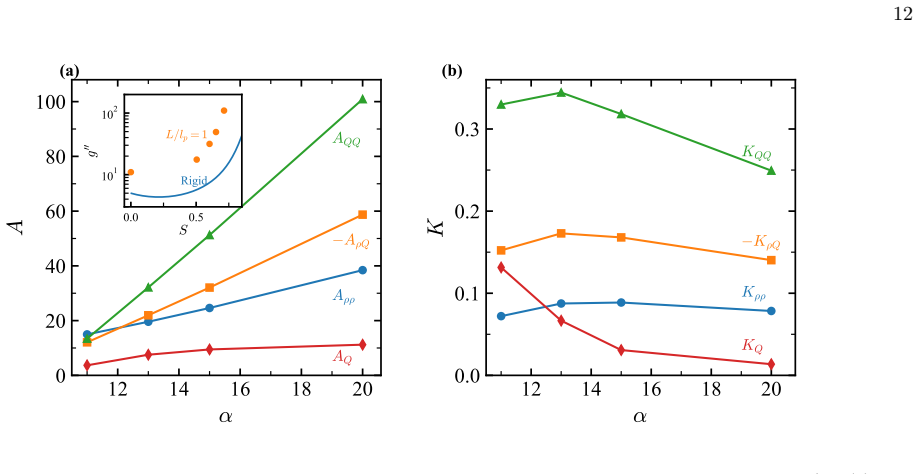
The effective free energy couples density and nematic order such that strong coupling destabilizes the nematic state at a critical value of u0/u2. Director distortions remain decoupled at linear order. The resulting Frank elastic constants show a crossover from bend- to splay-dominated behavior with increasing chain flexibility. The correlation lengths extracted from the same analysis reproduce the director profile and core size of a +1/2 disclination, with the core radius scaling directly with the equilibrium correlation length.
What carries the argument
Effective free energy in segment density and uniaxial nematic order parameter, derived via self-consistent field theory for wormlike chains with Maier-Saupe and excluded-volume interactions.
If this is right
- Nematic stability depends on the excluded-volume to nematic interaction ratio u0/u2.
- Increasing flexibility suppresses twist and bend elasticity more than splay, producing a splay-dominated regime.
- The computed elastic anisotropy and correlation lengths determine the structure of +1/2 disclination cores.
- Core size scales proportionally with the equilibrium correlation length.
Where Pith is reading between the lines
- The density-order coupling identified here may control the width of the isotropic-nematic coexistence region in lyotropic solutions.
- Because linear response keeps density and director modes decoupled, separate hydrodynamic treatments of each may remain valid near defects.
- The predicted elasticity crossover could be checked by measuring splay, twist, and bend constants in polymer solutions of controlled persistence length.
Load-bearing premise
The isotropic excluded-volume term correctly represents solvent-mediated interactions, and director distortions couple to density and order only beyond linear order.
What would settle it
Observation of a nematic instability or loss of order at a specific value of the excluded-volume to orientational interaction ratio in a semiflexible lyotropic system.
Figures




read the original abstract
The linear response of wormlike chains in the nematic phase is studied by self-consistent field theory. The model Hamiltonian incorporates Maier--Saupe orientational interactions together with an isotropic excluded volume interaction. The latter models implicitly solvent mediated chain interactions, as appropriate for a lyotropic nematic. An effective free energy description for uniform nematic states is constructed in terms of the chain segment density and uniaxial nematic order parameter, providing a unified framework for density--degree of order coupling, isotropic-nematic coexistence, and the limit of stability of the nematic phase. Our results show that strong density--nematic degree of order coupling can destabilize the nematic state. The location of the instability depends on the ratio of excluded volume and nematic interaction, $u_0/u_2$. In contrast, director distortions couple to density and nematic order variations only at higher order, remaining effectively decoupled in the linear response regime. The Frank elastic constants and the correlation lengths are obtained from a linear response analysis based on the self-consistent field theory free energy. Increasing flexibility strongly suppresses twist and bend elasticity while affecting splay elasticity comparatively weakly, leading to a crossover from bend-dominated to splay-dominated elasticity. The correlation lengths and Frank elastic anisotropy obtained from the linear response analysis explain well director profiles around a +1/2 disclination core, including the core size. The latter is proportional to the equilibrium correlation length, in agreement with Landau--de Gennes scaling.
Editorial analysis
A structured set of objections, weighed in public.
Referee Report
Summary. The manuscript develops a self-consistent field theory (SCFT) for semiflexible wormlike chains in the nematic phase with Maier-Saupe orientational interactions plus an isotropic excluded-volume term modeling solvent-mediated interactions. An effective free energy is constructed for uniform states in terms of segment density and uniaxial nematic order parameter, demonstrating that strong density-nematic coupling can destabilize the nematic phase at a u0/u2-dependent point. Director distortions are shown to couple to density and order variations only at higher order. Frank elastic constants and correlation lengths are extracted from linear-response analysis of the SCFT free energy; flexibility is found to suppress twist and bend elasticity more strongly than splay, producing a crossover in elastic anisotropy. These quantities are then used to account for director profiles around +1/2 disclination cores, with core size proportional to the equilibrium correlation length in agreement with Landau-de Gennes scaling.
Significance. If the central derivations hold, the work supplies a microscopic SCFT route to anisotropic elasticity and defect structure in lyotropic semiflexible nematics, together with a unified treatment of density-order coupling and the limit of nematic stability. The explicit linear-response decoupling and the resulting parameter-dependent but derived elastic constants and lengths constitute the main technical contribution.
major comments (1)
- [linear response analysis] The decoupling of director distortions from density and nematic order at linear order is load-bearing for all subsequent elasticity and defect analysis (abstract and the paragraph on effective free energy and linear response). The manuscript must show the explicit expansion of the SCFT free energy confirming the absence of linear cross terms; without this verification the claim that linear response remains decoupled rests on an unexamined assumption.
minor comments (2)
- [Abstract] The ratio u0/u2 appears in the abstract without a preceding definition; a one-sentence definition at first use would improve accessibility.
- [defect core analysis] The statement that the correlation lengths and Frank anisotropy 'explain well' the +1/2 core profiles should be accompanied by a quantitative measure (e.g., RMS deviation or overlay figure) rather than a qualitative assertion.
Simulated Author's Rebuttal
We thank the referee for their careful reading of the manuscript and for the recommendation of minor revision. We address the single major comment below.
read point-by-point responses
-
Referee: [linear response analysis] The decoupling of director distortions from density and nematic order at linear order is load-bearing for all subsequent elasticity and defect analysis (abstract and the paragraph on effective free energy and linear response). The manuscript must show the explicit expansion of the SCFT free energy confirming the absence of linear cross terms; without this verification the claim that linear response remains decoupled rests on an unexamined assumption.
Authors: We agree that an explicit verification of the linear decoupling is necessary to support the subsequent analysis. In the revised manuscript we will add a dedicated subsection (or appendix) that performs the second-order expansion of the SCFT free energy in the three perturbation fields (density, uniaxial order, and director angle). The calculation will explicitly demonstrate that all linear cross terms between the director distortion and the scalar fields vanish by symmetry, while quadratic cross terms appear only at higher order. This addition will be placed immediately after the construction of the effective free energy for uniform states. revision: yes
Circularity Check
Derivation self-contained from SCFT Hamiltonian; no reductions by construction or load-bearing self-citations
full rationale
The paper starts from a standard SCFT model Hamiltonian with Maier-Saupe orientational interactions plus isotropic excluded-volume term, constructs an effective free energy for uniform states, identifies the density-nematic coupling instability at a u0/u2-dependent point, states the explicit decoupling of director distortions at linear order, extracts Frank constants and correlation lengths from that linear response, and applies them to +1/2 defect profiles. All steps follow directly from the SCFT equations without any fitted parameter being renamed as a prediction, without any ansatz smuggled via self-citation, and without any uniqueness theorem imported from the authors' prior work. The reported core-size scaling is a derived consequence, not an input. The derivation is therefore self-contained against external benchmarks.
Axiom & Free-Parameter Ledger
free parameters (1)
- u0/u2
axioms (3)
- domain assumption Maier-Saupe orientational interactions
- domain assumption Isotropic excluded-volume interaction models solvent-mediated effects in lyotropic nematics
- domain assumption Wormlike-chain statistics for semiflexible polymers
Reference graph
Works this paper leans on
-
[1]
For a spatially uniform state, the translational gradient term in the MDE, Eq
Equation (16) reduces to the scalar relationS= −(3/2L)∂lnZ 1/∂wQ, which implicitly definesw ∗ Q(S). For a spatially uniform state, the translational gradient term in the MDE, Eq. (10), vanishes. Factoring out the w0 contribution throughq(u, s) =e −w0s˜q(u, s),˜q(u, s) satisfies ∂˜q(u, s) ∂s = 1 2lp ∇2 u −w Q (u·n) 2 − 1 3 ˜q(u, s),(18) with ˜q(u,0) = 1.Th...
-
[2]
Shri, Curvature elasticity in liquid crystals, Physics Reports277, 283 (1996)
S. Shri, Curvature elasticity in liquid crystals, Physics Reports277, 283 (1996)
1996
-
[3]
Dunmur and K
D. Dunmur and K. Toriyama, Elastic properties of liq- uid crystals, inHandbook of liquid crystals, edited by D. Demus, J. W. Goodby, G. W. Gray, H. W. Spiess, and V. Vill (Weinheim: Wiley-VCH, 1998) p. 253
1998
-
[4]
J. V. Selinger,Introduction to the theory of soft matter: from ideal gases to liquid crystals, Vol. 408 (Springer, 2016)
2016
-
[5]
Zhou,Lyotropic Chromonic Liquid Crystals(Springer,
S. Zhou,Lyotropic Chromonic Liquid Crystals(Springer,
-
[6]
ph.D. Thesis. Kent State University
-
[7]
Varytimiadou, D
S. Varytimiadou, D. Revignas, F. Giesselmann, and A. Ferrarini, Elasticity of lyotropic nematic liquid crys- tals: a review of experiments, theory and simulation, Liq- uid Crystals Reviews12, 57 (2024)
2024
-
[8]
S. Zhou, Y. A. Nastishin, M. M. Omelchenko, L. Tortora, V. G. Nazarenko, O. P. Boiko, T. Ostapenko, T. Hu, C. C. Almasan, S. N. Sprunt, J. T. Gleeson, and O. D. Lavrentovich, Elasticity of lyotropic chromonic liquid crystals probed by director reorientation in a magnetic field, Phys. Rev. Lett.109, 037801 (2012)
2012
-
[9]
Jeong, Z
J. Jeong, Z. S. Davidson, P. J. Collings, T. C. Luben- sky, and A. Yodh, Chiral symmetry breaking and surface faceting in chromonic liquid crystal droplets with giant elastic anisotropy, Proceedings of the National Academy of Sciences111, 1742 (2014)
2014
-
[10]
S. Zhou, S. V. Shiyanovskii, H.-S. Park, and O. D. Lavrentovich, Fine structure of the topological defect cores studied for disclinations in lyotropic chromonic liq- uid crystals, Nature Communications8, 14974 (2017)
2017
-
[11]
C. F. Dietrich, P. J. Collings, T. Sottmann, P. Rudquist, and F. Giesselmann, Extremely small twist elastic con- stants in lyotropic nematic liquid crystals, Proceedings of the National Academy of Sciences117, 27238 (2020), https://www.pnas.org/doi/pdf/10.1073/pnas.1922275117
-
[12]
M. C. Marchetti, J. F. Joanny, S. Ramaswamy, T. B. Liverpool, J. Prost, M. Rao, and R. A. Simha, Hydrody- namics of soft active matter, Rev. Mod. Phys.85, 1143 (2013)
2013
-
[13]
Doostmohammadi, J
A. Doostmohammadi, J. Ign´ es-Mullol, J. M. Yeomans, and F. Sagu´ es, Active nematics, Nature communications 9, 3246 (2018)
2018
-
[14]
Zhang, N
R. Zhang, N. Kumar, J. L. Ross, M. L. Gardel, and J. J. De Pablo, Interplay of structure, elasticity, and dynam- ics in actin-based nematic materials, Proceedings of the National Academy of Sciences115, E124 (2018)
2018
-
[15]
L. C. Head, C. Dore, R. R. Keogh, L. Bonn, G. Ne- gro, D. Marenduzzo, A. Doostmohammadi, K. Thijssen, T. L´ opez-Le´ on, and T. N. Shendruk, Spontaneous self- constraint in active nematic flows, Nature Physics20, 492 (2024)
2024
-
[16]
Onsager, The effects of shape on the interaction of colloidal particles, Annals of the New York Academy of Sciences51, 627 (1949)
L. Onsager, The effects of shape on the interaction of colloidal particles, Annals of the New York Academy of Sciences51, 627 (1949)
1949
-
[17]
Odijk, Elastic constants of nematic solutions of rod- like and semi-flexible polymers, Liquid Crystals1, 553 (1986)
T. Odijk, Elastic constants of nematic solutions of rod- like and semi-flexible polymers, Liquid Crystals1, 553 (1986)
1986
-
[18]
De Gennes and J
P.-G. De Gennes and J. Prost,The physics of liquid crys- tals, 83 (Oxford university press, 1993)
1993
-
[19]
Khokhlov and A
A. Khokhlov and A. Semenov, Liquid-crystalline ordering in the solution of long persistent chains, Physica A: Sta- tistical Mechanics and its Applications108, 546 (1981)
1981
-
[20]
Fredrickson,The equilibrium theory of inhomogeneous polymers, Vol
G. Fredrickson,The equilibrium theory of inhomogeneous polymers, Vol. 134 (OUP Oxford, 2005)
2005
-
[21]
J. Z. Chen, Theory of wormlike polymer chains in con- finement, Progress in Polymer Science54, 3 (2016)
2016
-
[22]
Qing and J
L. Qing and J. Vi˜ nals, Self consistent field theory of isotropic–nematic interfaces and disclinations in a semi- flexible molecule nematic, Soft Matter21, 5447 (2025)
2025
-
[23]
Jiang and J
Y. Jiang and J. Z. Chen, Isotropic- nematic interface in a lyotropic system of wormlike chains with the onsager interaction, Macromolecules43, 10668 (2010)
2010
-
[24]
Ghosh, Q
A. Ghosh, Q. MacPherson, Z.-G. Wang, and A. J. Spakowitz, Semiflexible polymer solutions. ii. fluctua- tions and frank elastic constants, The Journal of Chem- ical Physics157(2022)
2022
-
[25]
Q. MacPherson, Frank elastic constants of semiflexi- ble polymer solutions (2022), arXiv:2207.07188 [cond- mat.soft]
-
[26]
Jiang, C
Y. Jiang, C. Greco, K. C. Daoulas, and J. Z. Chen, Ther- modynamics of a compressible maier-saupe model based on the self-consistent field theory of wormlike polymer, Polymers9, 48 (2017)
2017
-
[27]
R. K. Spencer, N. Saeidi, and B.-Y. Ha, Nematic ordering 18 of worm-like polymers near an interface, The Journal of Chemical Physics152(2020)
2020
-
[28]
M. P. Taylor and J. Herzfeld, Shape anisotropy and or- dered phases in reversibly assembling lyotropic systems, Physical Review A43, 1892 (1991)
1991
-
[29]
Qing and J
L. Qing and J. Vi˜ nals, Unpublished
-
[30]
Skolnick and M
J. Skolnick and M. Fixman, Electrostatic persistence length of a wormlike polyelectrolyte, Macromolecules10, 944 (1977)
1977
-
[31]
Shi and J
A.-C. Shi and J. Noolandi, Theory of inhomogeneous weakly charged polyelectrolytes, Macromolecular Theory and Simulations8, 214 (1999)
1999
-
[32]
Muthukumar, 50th anniversary perspective: A per- spective on polyelectrolyte solutions, Macromolecules50, 9528 (2017)
M. Muthukumar, 50th anniversary perspective: A per- spective on polyelectrolyte solutions, Macromolecules50, 9528 (2017)
2017
-
[33]
Muthukumar,Physics of Charged Macromolecules (Cambridge University Press, 2023)
M. Muthukumar,Physics of Charged Macromolecules (Cambridge University Press, 2023)
2023
-
[34]
Muthukumar, Ordinary–extraordinary transition in dynamics of solutions of charged macromolecules, Pro- ceedings of the National Academy of Sciences113, 12627 (2016)
M. Muthukumar, Ordinary–extraordinary transition in dynamics of solutions of charged macromolecules, Pro- ceedings of the National Academy of Sciences113, 12627 (2016)
2016
-
[35]
J. U. Kim and M. W. Matsen, Finite-stretching cor- rections to the milner-witten-cates theory for polymer brushes, The European Physical Journal E23, 135 (2007)
2007
-
[36]
Ciferri, W
A. Ciferri, W. R. Krigbaum, and R. B. Meyer, eds.,Poly- mer Liquid Crystals(Academic Press, New York, 1982)
1982
-
[37]
Popa-Nita, T
V. Popa-Nita, T. Sluckin, and A. Wheeler, Statics and kinetics at the nematic-isotropic interface: Effects of bi- axiality, Journal de Physique II7, 1225 (1997)
1997
-
[38]
Y.-K. Kim, S. V. Shiyanovskii, and O. D. Lavren- tovich, Morphogenesis of defects and tactoids during isotropic–nematic phase transition in self-assembled ly- otropic chromonic liquid crystals, Journal of Physics: Condensed Matter25, 404202 (2013)
2013
-
[39]
Dzyaloshinskiˇ ı, Theory of disinclinations in liquid crys- tals, Soviet Journal of Experimental and Theoretical Physics31, 773 (1970)
I. Dzyaloshinskiˇ ı, Theory of disinclinations in liquid crys- tals, Soviet Journal of Experimental and Theoretical Physics31, 773 (1970)
1970
-
[40]
Myers, C
L. Myers, C. Swift, J. Rønning, L. Angheluta, and J. Vi˜ nals, A computational study of nematic core structure and disclination interactions in elastically anisotropic nematics, Soft Matter20, 2900 (2024)
2024
-
[41]
Qing, Scft code for wormlike chain nematics: linear response and defect calculations (2026)
L. Qing, Scft code for wormlike chain nematics: linear response and defect calculations (2026)
2026
-
[42]
K. C. Daoulas, D. N. Theodorou, V. A. Harman- daris, N. C. Karayiannis, and V. G. Mavrantzas, Self- consistent-field study of compressible semiflexible melts adsorbed on a solid substrate and comparison with atom- istic simulations, Macromolecules38, 7134 (2005)
2005
-
[43]
M. Deng, Y. Jiang, H. Liang, and J. Z. Chen, Wormlike polymer brush: a self-consistent field treatment, Macro- molecules43, 3455 (2010)
2010
discussion (0)
Sign in with ORCID, Apple, or X to comment. Anyone can read and Pith papers without signing in.