Single Chain Expulsion from Diblock Copolymer Micelles with Dense Corona
Pith reviewed 2026-07-02 05:07 UTC · model grok-4.3
The pith
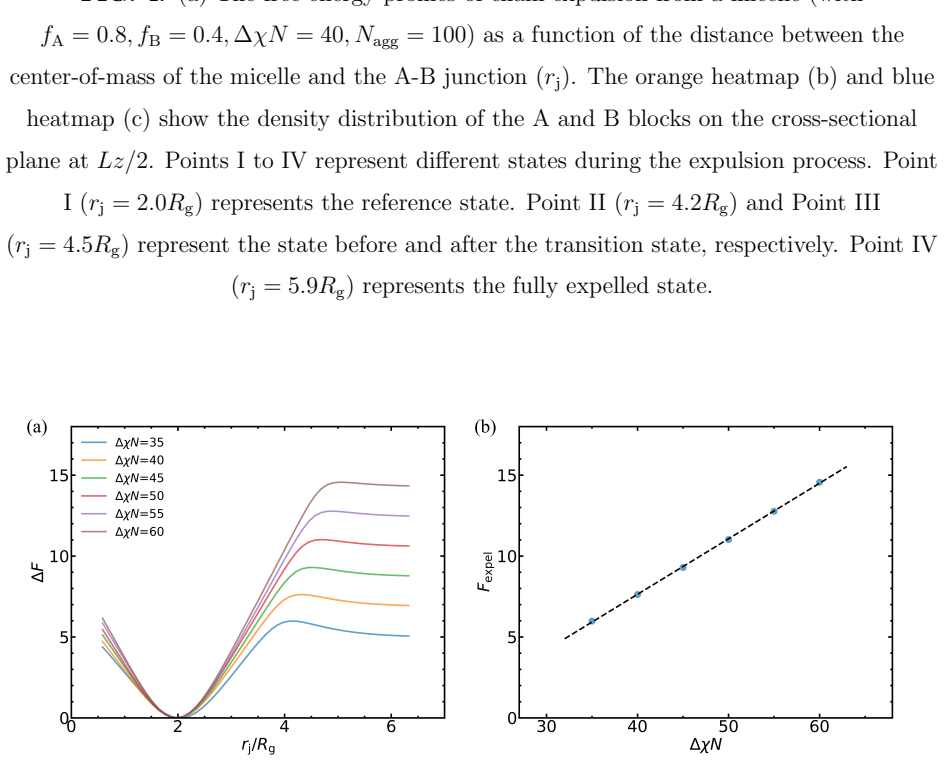
The free energy barrier for expelling one chain from a diblock copolymer micelle grows linearly with hydrophobic block length and solvent selectivity.
A machine-rendered reading of the paper's core claim, the machinery that carries it, and where it could break.
Core claim
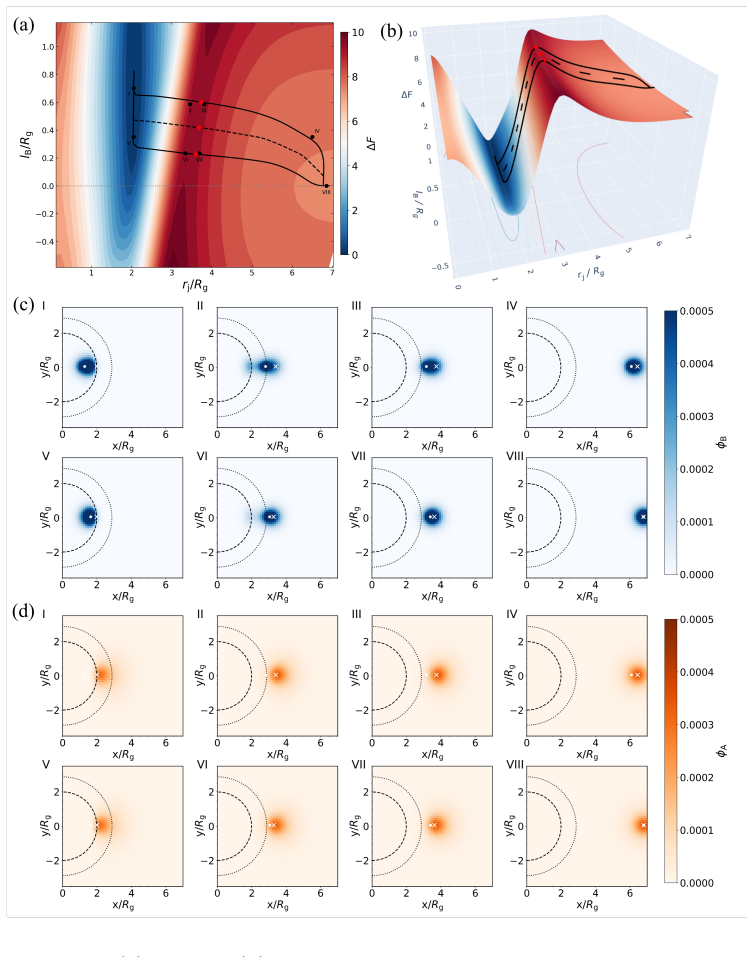
Using the distance from the micelle center-of-mass to the hydrophilic-hydrophobic junction as the reaction coordinate, the expulsion free energy barrier scales linearly with both the hydrophobic block length and the solvent selectivity. A second coordinate tracking the end-to-end distance of the hydrophobic block produces a two-dimensional free energy surface on which the string method identifies a single nearly degenerate reaction channel that all minimum-energy paths reach, regardless of starting point; within that channel the end-to-end distances are broadly distributed yet the barriers remain nearly identical.
What carries the argument
Two-dimensional free energy surface spanned by the junction-to-center distance and the end-to-end distance of the hydrophobic block, with the string method locating the minimum-energy path on that surface.
If this is right
- Barrier height increases linearly with hydrophobic block length, so exchange rates can be predicted from block length alone once the proportionality constant is known.
- Changing solvent selectivity tunes the barrier height linearly, giving direct experimental control over exchange kinetics.
- The transition-state ensemble consists of many different hydrophobic-block extensions that nevertheless share essentially the same barrier height.
- All initial pathways collapse onto one effective channel, so one-dimensional models may capture the dominant rate-limiting step.
Where Pith is reading between the lines
- The linear scaling could be checked by measuring exchange times in a series of micelles whose hydrophobic blocks differ by only a few monomers.
- Because the final channel tolerates a wide range of stretches, the rate may be insensitive to small changes in the precise definition of the reaction coordinate.
- The same convergence to a degenerate channel may appear in other soft-matter systems where a chain must be pulled through a dense layer.
Load-bearing premise
A mean-field description of chain shapes inside the crowded corona stays accurate enough when the path is tracked only by the center-to-junction distance and the stretch of the inner block.
What would settle it
Measure the activation energy for chain exchange while varying hydrophobic block length at fixed solvent selectivity; a clear deviation from linear scaling would falsify the reported dependence.
Figures





read the original abstract
We use self-consistent field theory to investigate the free energy landscape for single-chain expulsion from a diblock copolymer micelle with a dense corona. Using the distance from the micelle center-of-mass to the hydrophilic-hydrophobic junction of the chain as the reaction coordinate, we compute the free energy landscape for chain exchange. Our results show that the expulsion free energy barrier scales linearly with both the hydrophobic block length and the solvent selectivity, consistent with recent experiments. To accurately resolve chain conformation, we introduce a second reaction coordinate: the distance between the junction and the free end of the hydrophobic block, and construct a two-dimensional free energy surface. Using the string method to identify the minimum energy path, we find that all pathways converge to a nearly degenerate reaction channel, irrespective of the initial path. Within this channel, the end-to-end distance of the hydrophobic block exhibits a broad distribution, yet the corresponding expulsion barriers remain nearly indistinguishable. Together, these findings establish a continuum-level theoretical foundation for understanding the hyperstretching mechanism and the transition state ensemble in micellar chain exchange.
Editorial analysis
A structured set of objections, weighed in public.
Referee Report
Summary. The manuscript applies self-consistent field theory (SCFT) to map the free-energy landscape governing single-chain expulsion from diblock copolymer micelles possessing a dense corona. With the micelle center-of-mass to junction distance as the primary reaction coordinate, the authors report that the expulsion barrier scales linearly with hydrophobic block length and solvent selectivity. A second coordinate (junction-to-hydrophobic-end distance) is introduced to construct a two-dimensional free-energy surface; the string method is then used to locate minimum-energy paths, which are shown to converge onto a nearly degenerate channel in which barriers remain similar despite a broad distribution of hydrophobic end-to-end distances. The work claims to furnish a continuum-level account of the hyperstretching mechanism and the transition-state ensemble.
Significance. If the reported linear scaling and pathway convergence hold, the results supply a parameter-free theoretical foundation for chain-exchange kinetics in dense-corona micelles that aligns with recent experiments. The explicit use of two reaction coordinates together with the string method to demonstrate degeneracy of the transition-state ensemble is a clear methodological strength. The derivation of linear barrier scaling directly from the SCFT saddle-point evaluation under the chosen coordinates constitutes a reproducible, parameter-free prediction.
minor comments (3)
- [Abstract] The abstract states that barriers 'remain nearly indistinguishable' within the converged channel; the main text should report the numerical spread in barrier heights (e.g., maximum difference in units of kT) to substantiate the claim of degeneracy.
- The definition and normalization of the two reaction coordinates should be stated explicitly in the methods section, including any discretization or grid-spacing details used for the SCFT calculation.
- Figure captions for the two-dimensional free-energy surfaces should indicate the precise range of the second coordinate and the contour interval employed.
Simulated Author's Rebuttal
We thank the referee for their supportive review, positive assessment of the significance, and recommendation for minor revision. The report raises no specific major comments.
Circularity Check
No significant circularity in derivation chain
full rationale
The paper applies standard SCFT to compute free-energy surfaces on two explicit reaction coordinates (junction-to-center distance and hydrophobic end-to-end distance), followed by the string method to locate the MEP. The linear scaling of the expulsion barrier with block length and selectivity is obtained directly from saddle-point evaluation of the SCFT functional under those coordinates; no parameter is fitted to a subset of results and then re-predicted, no self-citation supplies a load-bearing uniqueness theorem, and no ansatz is smuggled in. The mean-field character of SCFT is the conventional approximation for dense-corona micelles and is not shown to break down inside the reported regime. The derivation is therefore self-contained against external benchmarks.
Axiom & Free-Parameter Ledger
axioms (1)
- domain assumption Self-consistent field theory supplies a quantitatively useful free-energy landscape for chain expulsion in dense-corona micelles
Reference graph
Works this paper leans on
-
[1]
hyperstretching
INTRODUCTION Diblock copolymers self-assemble in selective solvents to form micelles of various nanos- tructures, such as spherical micelles, wormlike micelles, or vesicles [1, 2]. Their broad ap- plications in drug delivery [3], nanoreactors [4], and nanolithography [5] have made them a focus of research in soft matter science. In solution, micelles are ...
-
[2]
Self-Consistent Field Theory We consider a system consisting ofn P number of AB diblock chains andn S number of short homopolymer chains as solvents in a volumeV
COMPUTATIONAL METHODS 2.1. Self-Consistent Field Theory We consider a system consisting ofn P number of AB diblock chains andn S number of short homopolymer chains as solvents in a volumeV. Each diblock chain comprises NA =f ANA-segments andN B =f BNB-segments. We independently varyf A orf B to study the effect of block length, thereforef A +f B does not ...
-
[3]
This ordinary differential equation is solved using the forward Euler method
The first step involves the evolution of the beads, where each bead is moved according to the full potential force field: φ∗ i =φ n i −∆t∇V(φ n i ) Here,ndenotes the iteration step (withn= 0 representing the initial path), and ∆t is the time step in the iteration. This ordinary differential equation is solved using the forward Euler method
-
[4]
We parameterize by equal arc length to maintain a uniform distribution of beads along the path
The second step is the reparameterization of the string. We parameterize by equal arc length to maintain a uniform distribution of beads along the path. The cumulative arc length of the current path is first computed:s 0 = 0,s i =s i−1 +|φ ∗ i −φ ∗ i−1|, wherei= 1, . . . , N. The arc length parameters are then normalized:α ∗ i =s i/sN. Cubic spline interp...
-
[5]
bead- by-bead
RESULTS AND DISCUSSIONS 3.1. Thermodynamic Stability of Micelles In the grand canonical ensemble, the size of micelles is tuned by the chemical potential of the chainsµ P. We calculate the total concentration ¯ϕand the bulk concentrationϕ b for different chemical potentials. Figure 3(a) shows the results for the representative system, withf A = 0.8, fB = ...
-
[6]
We systematically examined the scaling of the ex- pulsion free energy barrier with respect to chain parameters and the characteristics of the transition state
SUMMARY This study focuses on the free energy landscape of single chain expulsion in AB diblock copolymer micelles with dense corona. We systematically examined the scaling of the ex- pulsion free energy barrier with respect to chain parameters and the characteristics of the transition state. The expulsion energy barrier scales linearly with both the leng...
-
[7]
Liquid crystallinity in lipid-water systems,
Krister Fontell, “Liquid crystallinity in lipid-water systems,” Mol. Cryst. Liq. Cryst.63, 59–82 (1981)
1981
-
[8]
Role of chain length in the formation of Frank-Kasper phases in diblock copolymers,
Ronald M. Lewis, Akash Arora, Haley K. Beech, Bongjoon Lee, Aaron P. Lindsay, Timothy P. Lodge, Kevin D. Dorfman, and Frank S. Bates, “Role of chain length in the formation of Frank-Kasper phases in diblock copolymers,” Phys. Rev. Lett.121, 208002 (2018)
2018
-
[9]
Enhancing drug function,
Jeffrey A. Hubbell, “Enhancing drug function,” Science300, 595–596 (2003). 26
2003
-
[10]
Functionalized organocatalytic nanoreactors: Hydrophobic pockets for acylation reactions in water,
Pepa Cotanda, Annhelen Lu, Joseph P. Patterson, Nikos Petzetakis, and Rachel K. O’Reilly, “Functionalized organocatalytic nanoreactors: Hydrophobic pockets for acylation reactions in water,” Macromolecules45, 2377–2384 (2012)
2012
-
[11]
Nanopatterning by block copolymer micelle nano- lithography and bioinspired applications,
Theobald Lohm¨ uller, Daniel Aydin, Marco Schwieder, Christoph Morhard, Ilia Louban, Clau- dia Pacholski, and Joachim P. Spatz, “Nanopatterning by block copolymer micelle nano- lithography and bioinspired applications,” Biointerphases6, MR1–MR12 (2011)
2011
-
[12]
Logarithmic exchange kinetics in monodisperse copolymeric micelles,
Fabi´ an A. Garc´ ıa Daza, Josep Bonet Avalos, and Allan D. Mackie, “Logarithmic exchange kinetics in monodisperse copolymeric micelles,” Phys. Rev. Lett.118, 248001 (2017)
2017
-
[13]
Mechanism of molecular exchange in diblock copolymer micelles: Hypersensitivity to core chain length,
Soo-Hyung Choi, Timothy P. Lodge, and Frank S. Bates, “Mechanism of molecular exchange in diblock copolymer micelles: Hypersensitivity to core chain length,” Phys. Rev. Lett.104, 047802 (2010)
2010
-
[14]
Polymeric micelles: their relaxation kinetics,
A. Halperin and S. Alexander, “Polymeric micelles: their relaxation kinetics,” Macromolecules 22, 2403–2412 (1989)
1989
-
[15]
Effect of solvent selectivity on chain exchange kinetics in block copolymer micelles,
En Wang, Jiahao Zhu, Dan Zhao, Shuyi Xie, Frank S. Bates, and Timothy P. Lodge, “Effect of solvent selectivity on chain exchange kinetics in block copolymer micelles,” Macromolecules 53, 417–426 (2020)
2020
-
[16]
Effect of corona block length on the structure and chain exchange kinetics of block copolymer micelles,
En Wang, Jie Lu, Frank S. Bates, and Timothy P. Lodge, “Effect of corona block length on the structure and chain exchange kinetics of block copolymer micelles,” Macromolecules51, 3563–3571 (2018)
2018
-
[17]
Molecular exchange in ordered diblock copolymer micelles,
Soo-Hyung Choi, Frank S. Bates, and Timothy P. Lodge, “Molecular exchange in ordered diblock copolymer micelles,” Macromolecules44, 3594–3604 (2011)
2011
-
[18]
Addition of corona block homopolymer retards chain exchange in solutions of block copolymer micelles,
J. Lu, F. S. Bates, and T. P. Lodge, “Addition of corona block homopolymer retards chain exchange in solutions of block copolymer micelles,” Macromolecules49, 1405–1413 (2016)
2016
-
[19]
Remarkable effect of molecular architecture on chain exchange in triblock copolymer micelles,
J. Lu, Frank S. Bates, and Timothy P. Lodge, “Remarkable effect of molecular architecture on chain exchange in triblock copolymer micelles,” Macromolecules48, 2667–2676 (2015)
2015
-
[20]
Equilibrium chain exchange kinetics of diblock copolymer micelles: Effect of morphology,
Reidar Lund, Lutz Willner, Vitaliy Pipich, Isabelle Grillo, Peter Lindner, Juan Colmenero, and Dieter Richter, “Equilibrium chain exchange kinetics of diblock copolymer micelles: Effect of morphology,” Macromolecules44, 6145–6154 (2011)
2011
-
[21]
Exchange kinetics for a single block copoly- mer in micelles of two different sizes,
Dan Zhao, Yuanchi Ma, and Timothy P. Lodge, “Exchange kinetics for a single block copoly- mer in micelles of two different sizes,” Macromolecules51, 2312–2320 (2018). 27
2018
-
[22]
Equilibrium exchange kinetics in n-alkyl-PEO polymeric micelles: single exponential relaxation and chain length dependence,
Thomas Zinn, Lutz Willner, Reidar Lund, Vitaliy Pipich, and Dieter Richter, “Equilibrium exchange kinetics in n-alkyl-PEO polymeric micelles: single exponential relaxation and chain length dependence,” Soft Matter8, 623–626 (2012)
2012
-
[23]
Molecular exchange in diblock copolymer micelles: Bimodal distribution in core-block molecular weights,
J. Lu, S. Choi, F. S. Bates, and T. P. Lodge, “Molecular exchange in diblock copolymer micelles: Bimodal distribution in core-block molecular weights,” ACS Macro Lett.1, 982–985 (2012)
2012
-
[24]
Comparison of gel relaxation times and end-block pullout times in ABA triblock copolymer networks,
Andrew J. Peters and Timothy P. Lodge, “Comparison of gel relaxation times and end-block pullout times in ABA triblock copolymer networks,” Macromolecules49, 7340–7349 (2016)
2016
-
[25]
Kinetics of chain exchange in asymmetric ABA triblock polymer micelles by time-resolved small-angle neutron scattering,
Taehyoung Kim, En Wang, Joanna M. White, Frank S. Bates, and Timothy P. Lodge, “Kinetics of chain exchange in asymmetric ABA triblock polymer micelles by time-resolved small-angle neutron scattering,” Macromolecules57, 9977–9983 (2024)
2024
-
[26]
Free energy trajectory for escape of a single chain from a diblock copolymer micelle,
Sarah C. Seeger, Kevin D. Dorfman, and Timothy P. Lodge, “Free energy trajectory for escape of a single chain from a diblock copolymer micelle,” ACS Macro Lett.10, 1570–1575 (2021)
2021
-
[27]
Mechanism of escape of a single chain from a diblock copolymer micelle,
Sarah C. Seeger, Timothy P. Lodge, and Kevin D. Dorfman, “Mechanism of escape of a single chain from a diblock copolymer micelle,” Macromolecules55, 10220–10228 (2022)
2022
-
[28]
Kinetics of chain exchange between diblock copolymer micelles,
Ammu Prhashanna, Saif A. Khan, and Shing Bor Chen, “Kinetics of chain exchange between diblock copolymer micelles,” Macromol. Theor. Simul.25, 383–391 (2016)
2016
-
[29]
Equilibrium chain exchange kinetics in block copoly- mer micelle solutions by dissipative particle dynamics simulations,
Zhenlong Li and Elena E. Dormidontova, “Equilibrium chain exchange kinetics in block copoly- mer micelle solutions by dissipative particle dynamics simulations,” Soft Matter7, 4179–4188 (2011)
2011
-
[30]
Micelle self-assembly and chain exchange kinetics of tadpole block copolymers with a cyclic corona block,
Ammu Prhashanna and Elena E. Dormidontova, “Micelle self-assembly and chain exchange kinetics of tadpole block copolymers with a cyclic corona block,” Macromolecules53, 982–991 (2020)
2020
-
[31]
Chain exchange kinetics of asymmetric B 1AB2 linear triblock and AB 1B2 branched triblock copolymers,
Andrew J. Peters and Timothy P. Lodge, “Chain exchange kinetics of asymmetric B 1AB2 linear triblock and AB 1B2 branched triblock copolymers,” Macromolecules50, 6303–6313 (2017)
2017
-
[32]
Nonphysical sampling distributions in monte carlo free-energy estimation: Umbrella sampling,
G.M. Torrie and J.P. Valleau, “Nonphysical sampling distributions in monte carlo free-energy estimation: Umbrella sampling,” J. Comput. Phys.23, 187–199 (1977)
1977
-
[33]
Using collective variables to drive molecular dynamics simulations,
Giacomo Fiorin, Michael L. Klein, and J´ erˆ ome H´ enin, “Using collective variables to drive molecular dynamics simulations,” Mol. Phys.111, 3345–3362 (2013). 28
2013
-
[34]
Mechanisms of chain exchange in diblock copolymer micelles,
Samuel Varner, Marcus M¨ uller, Alejandro Gallegos, Timothy P. Lodge, Kevin D. Dorfman, and Zhen-Gang Wang, “Mechanisms of chain exchange in diblock copolymer micelles,” (2025), arXiv:2509.06528 [cond-mat.soft]
-
[35]
The standard gaussian model for block copolymer melts,
M. W. Matsen, “The standard gaussian model for block copolymer melts,” J. Phys.: Condens. Matter14, R21 (2001)
2001
-
[36]
Accelerated pseudo-spectral method of self-consistent field theory via crystallographic fast Fourier transform,
Yicheng Qiang and Weihua Li, “Accelerated pseudo-spectral method of self-consistent field theory via crystallographic fast Fourier transform,” Macromolecules53, 9943–9952 (2020)
2020
-
[37]
Stabilizing the Frank- Kasper phases via binary blends of AB diblock copolymers,
Meijiao Liu, Yicheng Qiang, Weihua Li, Feng Qiu, and An-Chang Shi, “Stabilizing the Frank- Kasper phases via binary blends of AB diblock copolymers,” ACS Macro Lett.5, 1167–1171 (2016)
2016
-
[38]
Expanding alternating spherical and cylindrical regions by tai- loring binary symmetric ABC/ABC blends,
Qingyun Li and Weihua Li, “Expanding alternating spherical and cylindrical regions by tai- loring binary symmetric ABC/ABC blends,” Macromolecules54, 8622–8631 (2021)
2021
-
[39]
σphase formed in conformationally asymmetric AB-type block copolymers,
Nan Xie, Weihua Li, Feng Qiu, and An-Chang Shi, “σphase formed in conformationally asymmetric AB-type block copolymers,” ACS Macro Lett.3, 906–910 (2014)
2014
-
[40]
Sta- bility of the A15 phase in diblock copolymer melts,
Morgan W. Bates, Joshua Lequieu, Stephanie M. Barbon, Ronald M. Lewis, Kris T. Delaney, Athina Anastasaki, Craig J. Hawker, Glenn H. Fredrickson, and Christopher M. Bates, “Sta- bility of the A15 phase in diblock copolymer melts,” Proc. Natl. Acad. Sci.116, 13194–13199 (2019)
2019
-
[41]
Mechanism of micelle birth and death,
Joshua A. Mysona, Alon V. McCormick, and David C. Morse, “Mechanism of micelle birth and death,” Phys. Rev. Lett.123, 038003 (2019)
2019
-
[42]
Simulation of diblock copoly- mer surfactants. I. Micelle free energies,
Joshua A. Mysona, Alon V. McCormick, and David C. Morse, “Simulation of diblock copoly- mer surfactants. I. Micelle free energies,” Phys. Rev. E100, 012602 (2019)
2019
-
[43]
Simulation of diblock copoly- mer surfactants. II. Micelle kinetics,
Joshua A. Mysona, Alon V. McCormick, and David C. Morse, “Simulation of diblock copoly- mer surfactants. II. Micelle kinetics,” Phys. Rev. E100, 012603
-
[44]
dissertation, University of Minnesota (2020)
Joshua Mysona,Dynamical Behavior of Micellar Surfactant Solutions, Ph.D. dissertation, University of Minnesota (2020)
2020
-
[45]
Improved numerical algorithm for exploring block copoly- mer mesophases,
K. Ø. Rasmussen and G. Kalosakas, “Improved numerical algorithm for exploring block copoly- mer mesophases,” J. Polym. Sci. Part B: Polym. Phys.40, 1777–1783 (2002)
2002
-
[46]
Efficient computation of the structural phase behavior of block copolymers,
G. Tzeremes, K. Ø. Rasmussen, T. Lookman, and A. Saxena, “Efficient computation of the structural phase behavior of block copolymers,” Phys. Rev. E65, 041806 (2002). 29
2002
-
[47]
Improved convergence in block copoly- mer self-consistent field theory by Anderson mixing,
R. B. Thompson, K. Ø. Rasmussen, and T. Lookman, “Improved convergence in block copoly- mer self-consistent field theory by Anderson mixing,” J. Chem. Phys.120, 31–34 (2004)
2004
-
[48]
Efficiency of pseudo-spectral algorithms with anderson mixing for the SCFT of periodic block-copolymer phases,
P. Stasiak and M. W. Matsen, “Efficiency of pseudo-spectral algorithms with anderson mixing for the SCFT of periodic block-copolymer phases,” Eur. Phys. J. E34, 110 (2011)
2011
-
[49]
String method for the study of rare events,
Weinan E, Weiqing Ren, and Eric Vanden-Eijnden, “String method for the study of rare events,” Phys. Rev. B66, 052301 (2002)
2002
-
[50]
Simplified and improved string method for computing the minimum energy paths in barrier-crossing events,
Weinan E, Weiqing Ren, and Eric Vanden-Eijnden, “Simplified and improved string method for computing the minimum energy paths in barrier-crossing events,” J. Chem. Phys.126, 164103 (2007)
2007
-
[51]
Critical micelle concentration of micelles with different ge- ometries in diblock copolymer/homopolymer blends,
Jiajia Zhou and An-Chang Shi, “Critical micelle concentration of micelles with different ge- ometries in diblock copolymer/homopolymer blends,” Macromol. Theory Simul.20, 690–699 (2011)
2011
-
[52]
Coil-to-globule transition in polymeric solvents,
Yuci Xu and Zhen-Gang Wang, “Coil-to-globule transition in polymeric solvents,” Macro- molecules54, 10984–10993 (2021)
2021
-
[53]
A variational field-theoretical approach to control the center-of-mass of macromolecules,
Luofu Liu, Chao Duan, and Rui Wang, “A variational field-theoretical approach to control the center-of-mass of macromolecules,” Macromolecules57, 10694–10703 (2024). 30 Appendix A: Convergence Behavior of the String Method with Step Size Step sizes ranging from 0.001 to 0.5 were tested for the reference system (A 0.8B0.4). The step size has little effect ...
2024
discussion (0)
Sign in with ORCID, Apple, or X to comment. Anyone can read and Pith papers without signing in.