Ultrafast directed transport via energy recuperation in non-Markovian systems
Pith reviewed 2026-06-30 00:50 UTC · model grok-4.3
The pith
Energy recuperation is a generic feature of non-Markovian systems, including free Brownian particles, and drives ultrafast directed transport in periodic potentials.
A machine-rendered reading of the paper's core claim, the machinery that carries it, and where it could break.
Core claim
Energy recuperation is a generic feature of non-Markovian systems both in and out of equilibrium, even as simple as a free Brownian particle. Moreover, inertia alone, even in the strong damping regime, can lead to this effect despite the absence of any external forcing. This novel mechanism of energy recovery is the source of memory-induced ultrafast directed transport of a particle in a periodic potential in which it almost attains its top speed corresponding to the system with no energy barriers.
What carries the argument
The memory kernel in the generalized Langevin equation, which encodes non-Markovian bath interactions and enables the particle to recover dissipated energy.
If this is right
- Energy recuperation occurs without external driving in inertial non-Markovian systems.
- Inertia suffices to produce recuperation even in the overdamped limit.
- Memory effects allow particles to traverse periodic barriers at speeds approaching the free-particle limit.
- Viscoelasticity of the cytosol may facilitate efficient intracellular particle transport.
Where Pith is reading between the lines
- The same recuperation mechanism may operate in other memory-bearing media such as polymer solutions or crowded cellular environments.
- Microscale devices could exploit non-Markovian baths to achieve directed motion without continuous external input.
- Extensions to active matter or multi-particle systems would test whether recuperation scales to collective transport.
Load-bearing premise
The viscoelastic fluid model and its memory kernel accurately represent the non-Markovian dynamics that produce energy recuperation in the extended cases.
What would settle it
A direct measurement showing zero energy recuperation for a free Brownian particle in a viscoelastic fluid under equilibrium conditions would disprove the claimed generality.
Figures



read the original abstract
A recent pioneering experiment [Nat. Commun. 16, 10114 (2025)] demonstrated that a driven overdamped colloidal particle in a harmonic trap immersed in a viscoelastic fluid can recuperate energy dissipated into the surrounding bath and convert it into useful work. In this article we considerably extend the original predictions. In particular, we show that energy recuperation is a generic feature of non-Markovian systems both in and out of equilibrium, even as simple as a free Brownian particle. Moreover, we demonstrate that inertia alone, even in the strong damping regime, can lead to this effect despite the absence of any external forcing. These results suggest that energy recuperation can be ubiquitous in nature and it may be the modus operandi of various phenomena in setups with memory. We show that this novel mechanism of energy recovery is the source of memory-induced ultrafast directed transport of a particle in a periodic potential in which it almost attains its top speed corresponding to the system with no energy barriers. Our results may answer from the fundamental point of view the question why the cytosol, the intracellular fluid in biological cells, is viscoelastic.
Editorial analysis
A structured set of objections, weighed in public.
Referee Report
Summary. The manuscript extends a 2025 Nat. Commun. experiment on energy recuperation by a driven overdamped colloidal particle in a harmonic trap within a viscoelastic fluid. It claims that energy recuperation is a generic feature of non-Markovian dynamics (both in and out of equilibrium), occurring even for a free Brownian particle, that inertia alone suffices to produce the effect in the strong-damping regime without external forcing, and that this mechanism underlies memory-induced ultrafast directed transport in a periodic potential, nearly attaining the barrier-free speed.
Significance. If the central claims hold after verification, the work would be significant: it would establish energy recuperation as a ubiquitous, inertia-enabled feature of non-Markovian baths rather than an artifact of confinement or driving, with potential implications for transport in biological viscoelastic media such as the cytosol. No machine-checked proofs, reproducible code, or parameter-free derivations are presented.
major comments (2)
- [Abstract] Abstract and introduction: the claim that energy recuperation emerges generically from any non-Markovian dynamics, including the free-particle GLE with inertia retained, rests on inserting the memory kernel extracted from the 2025 trapped-colloid experiment. No derivation, simulation, or quantitative check is supplied showing that this kernel continues to produce net recuperation once the harmonic trap is removed or when inertial back-reaction is restored; this assumption is load-bearing for the generality and inertia-only assertions.
- [Abstract] Abstract: the further claim that the same recuperation mechanism is the source of ultrafast directed transport in a periodic potential (nearly reaching the barrier-free speed) is presented without any supporting calculation, comparison to the Markovian limit, or demonstration that the effect survives removal of the original driving and confinement; the link therefore remains unverified.
Simulated Author's Rebuttal
We thank the referee for the careful and constructive review of our manuscript. We address the major comments point by point below. We agree that the presentation can be strengthened by including additional explicit verifications, which we will provide in the revised version.
read point-by-point responses
-
Referee: [Abstract] Abstract and introduction: the claim that energy recuperation emerges generically from any non-Markovian dynamics, including the free-particle GLE with inertia retained, rests on inserting the memory kernel extracted from the 2025 trapped-colloid experiment. No derivation, simulation, or quantitative check is supplied showing that this kernel continues to produce net recuperation once the harmonic trap is removed or when inertial back-reaction is restored; this assumption is load-bearing for the generality and inertia-only assertions.
Authors: While the full manuscript contains numerical solutions of the GLE for the free particle using the experimental memory kernel, showing net energy recuperation, we acknowledge that a more explicit demonstration would be beneficial. In the revision, we will add a new figure and accompanying text that quantitatively compares the energy input and output for the free particle case, both overdamped and with inertia, confirming that recuperation occurs independently of the trap. The kernel is used as is, and the back-reaction is included in the inertial term of the GLE. revision: yes
-
Referee: [Abstract] Abstract: the further claim that the same recuperation mechanism is the source of ultrafast directed transport in a periodic potential (nearly reaching the barrier-free speed) is presented without any supporting calculation, comparison to the Markovian limit, or demonstration that the effect survives removal of the original driving and confinement; the link therefore remains unverified.
Authors: The manuscript includes simulations of directed transport in a periodic potential under non-Markovian dynamics derived from the same kernel. To address the concern, we will expand the relevant section to include direct comparisons with the Markovian limit (where transport is slower) and show that the speed approaches the barrier-free limit due to the recuperation effect. We will also present results for the case without external driving, demonstrating that the memory-induced effect persists. These additions will make the connection explicit. revision: yes
Circularity Check
No significant circularity; derivation extends external experiment independently
full rationale
The paper takes the memory kernel directly from the cited 2025 Nat. Commun. experiment and inserts it into the GLE for new cases (free particle, inertia-only, periodic potential). No parameter is fitted to the target observables and then relabeled as a prediction; the kernel is an external input. No self-citation chain supports the central claim, no ansatz is smuggled via prior work by the same authors, and no uniqueness theorem is invoked. The derivation consists of solving the GLE under the imported kernel, which remains logically independent of the conclusions about genericity and ultrafast transport.
Axiom & Free-Parameter Ledger
Reference graph
Works this paper leans on
-
[1]
How- ever, whenτincreases, the particle can reachx max > x b and overcome the potential barrier thanks to the energy recuperated from the bath
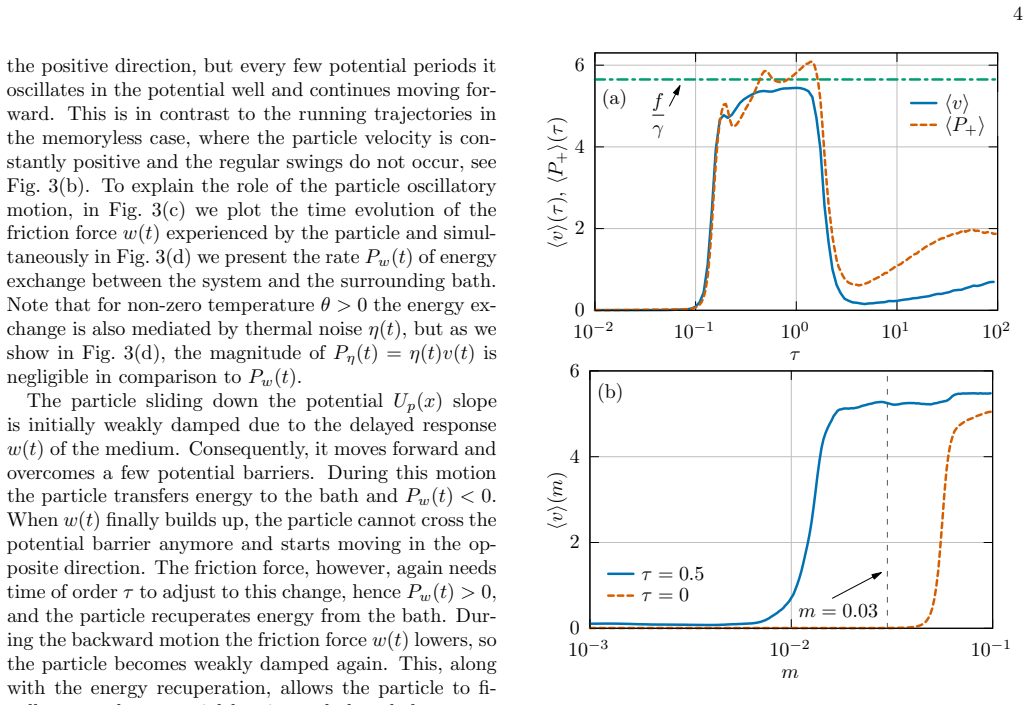
where only the locked solutions exist in the phase space and there is no directed transport⟨v⟩= 0. How- ever, whenτincreases, the particle can reachx max > x b and overcome the potential barrier thanks to the energy recuperated from the bath. Consequently the running trajectories may emerge. A representative example of a single running trajectory of the p...
2024
-
[2]
van Kampen, Braz
N. van Kampen, Braz. J. Phys.28(1998)
1998
-
[3]
M. Odeh, K. Godeneli, E. Li, R. Tangirala, H. Zhou, X. Zhang, Z.-H. Zhang, and A. Sipahigil, Nat. Phys.21, 406–411 (2025)
2025
-
[4]
X. Cao, D. Das, N. Windbacher, F. Ginot, M. Kr¨ uger, and C. Bechinger, Nat. Phys.19, 1904–1909 (2023)
1904
-
[5]
P´ elissier, M
A. P´ elissier, M. Phan, D. Le Bail, N. Beerenwinkel, and M. Rodr´ ıguez Mart´ ınez, Nat. Commun. (2026)
2026
-
[6]
Engbring, D
K. Engbring, D. Boriskovsky, Y. Roichman, and B. Lind- ner, Phys. Rev. X13, 021034 (2023)
2023
-
[7]
Li and C
Y. Li and C. Jia, Phys. Rev. Lett.135, 048401 (2025)
2025
-
[8]
B. A. Dalton, C. Ayaz, H. Kiefer, A. Klimek, L. Tep- per, and R. R. Netz, Proc. Natl. Acad. Sci. USA120, e2220068120 (2023)
2023
-
[9]
Barbier-Chebbah, O
A. Barbier-Chebbah, O. B´ enichou, R. Voituriez, and T. Gu´ erin, Nat. Commun.15, 7408 (2024)
2024
-
[10]
Ginot, J
F. Ginot, J. Caspers, M. Kr¨ uger, and C. Bechinger, Phys. Rev. Lett.128, 028001 (2022)
2022
-
[11]
B. R. Ferrer, J. R. Gomez-Solano, and A. V. Arzola, Phys. Rev. Lett.126, 108001 (2021)
2021
-
[12]
B. A. Dalton, H. Kiefer, and R. R. Netz, Nat. Commun. 15, 3761 (2024)
2024
-
[13]
Abbasi, R
A. Abbasi, R. R. Netz, and A. Naji, Phys. Rev. Lett. 131, 228202 (2023)
2023
-
[14]
Tucci, ´E
G. Tucci, ´E. Rold´ an, A. Gambassi, R. Belousov, F. Berger, R. Alonso, and A. Hudspeth, Phys. Rev. Lett. 129, 030603 (2022)
2022
-
[15]
Wi´ sniewski and J
M. Wi´ sniewski and J. Spiechowicz, Chaos34, 073101 (2024)
2024
-
[16]
Wi´ sniewski and J
M. Wi´ sniewski and J. Spiechowicz, Phys. Rev. E111, 024130 (2025)
2025
-
[17]
C. D. Chapman and R. M. Robertson-Anderson, Phys. Rev. Lett.113, 098303 (2014)
2014
-
[18]
J. R. Gomez-Solano and C. Bechinger, New J. Phys.17, 103032 (2015)
2015
-
[19]
M. P. Pruszczyk, D. Venturelli, and A. Gambassi, J. Stat. Mech.2025, 113202 (2025)
2025
-
[20]
Berner, B
J. Berner, B. M¨ uller, J. R. Gomez-Solano, M. Kr¨ uger, and C. Bechinger, Nat. Commun.9, 999 (2018)
2018
-
[21]
Venturelli and A
D. Venturelli and A. Gambassi, New J. Phys.25, 093025 (2023)
2023
-
[22]
Ginot and C
F. Ginot and C. Bechinger, Nat. Commun.16, 10114 (2025)
2025
-
[23]
T. A. Waigh, Rep. Prog. Phys.68, 685–742 (2005)
2005
-
[24]
Spiechowicz and J
J. Spiechowicz and J. Luczka, Sci. Rep.11, 4088 (2021)
2021
-
[25]
P. C. Bressloff and J. M. Newby, Rev. Mod. Phys.85, 135–196 (2013)
2013
-
[26]
Zwanzig, J
R. Zwanzig, J. Stat. Phys.9, 215–220 (1973)
1973
-
[27]
H¨ anggi, inStochastic Dynamics(Springer Berlin Hei- delberg, Berlin, Heidelberg, 1997) pp
P. H¨ anggi, inStochastic Dynamics(Springer Berlin Hei- delberg, Berlin, Heidelberg, 1997) pp. 15–22
1997
-
[28]
Wi´ sniewski, J
M. Wi´ sniewski, J. Luczka, and J. Spiechowicz, Phys. Rev. E109, 044116 (2024)
2024
-
[29]
Wi´ sniewski and J
M. Wi´ sniewski and J. Spiechowicz, Phys. Rev. E110, 054117 (2024)
2024
-
[30]
H¨ anggi, Z
P. H¨ anggi, Z. Phys. B31, 407–416 (1978)
1978
-
[31]
Zwanzig,Nonequilibrium Statistical Mechanics(Ox- ford University Press New York, NY, 2001)
R. Zwanzig,Nonequilibrium Statistical Mechanics(Ox- ford University Press New York, NY, 2001)
2001
-
[32]
Kubo, Rep
R. Kubo, Rep. Prog. Phys.29, 255–284 (1966)
1966
-
[33]
Risken,The Fokker-Planck Equation: Methods of Solution and Applications(Springer Berlin Heidelberg, 1996)
H. Risken,The Fokker-Planck Equation: Methods of Solution and Applications(Springer Berlin Heidelberg, 1996)
1996
-
[34]
Wi´ sniewski and J
M. Wi´ sniewski and J. Spiechowicz, New J. Phys.24, 063028 (2022)
2022
-
[35]
Luczka, Chaos15, 026107 (2005)
J. Luczka, Chaos15, 026107 (2005)
2005
-
[36]
Sekimoto,Stochastic Energetics(Springer Berlin Hei- delberg, 2010)
K. Sekimoto,Stochastic Energetics(Springer Berlin Hei- delberg, 2010)
2010
-
[37]
Jung and F
P. Jung and F. Marchesoni, Chaos21, 047516 (2011). End Matter Dimensionless GLEThe Generalized Langevin Equation describing our final setup in the dimensional form reads M˙v(t) =−Γ Z t 0 K(t−t ′)v(t′)dt′ −U ′(x) +η(t) (9) with ⟨η(t)η(t ′)⟩= Γk BT K(t−t ′),(10) U(x) = ∆Usin(2πx/L)−F x,(11) wherek B is the Boltzmann constant, andTis the tem- perature. Eq. (...
2011
discussion (0)
Sign in with ORCID, Apple, or X to comment. Anyone can read and Pith papers without signing in.