Includes theoretical contributions to Contract Theory, Decision Theory, Game Theory, General Equilibrium, Growth, Learning and Evolution, Macroeconomics, Market and Mechanism Design, and Social Choice.
We introduce endogenous shareholding auctions for production economies where a monopolist must elicit consumer demand in order to determine price and quantity. Each of these auctions has the property that the auction's profit is distributed across the monopolist and the consumers in accordance with ownership shares that are determined over the course of the auction. We characterize this class, and a larger class, on the basis of standard axioms. Finally, we investigate optimal auctions according to both prior-free domination and subjective expected welfare.
When an early information producer is judged only after others have reviewed and revised the work, the same review that sharpens the final decision can blur the question of who deserves the credit. This paper asks how an organization can still reward careful early work once a chain of later reviewers has acted on it. In the model, an analyst's hidden effort makes an initial report more likely to be right; a sequence of reviewers then reacts to it; and the organization can pay only on the record this process leaves behind. The main result splits the value of any such record into two parts: how much effort improved the first report, and how well the final record still indicates whether the first report was accurate. When later reviewers can overturn a flawed report, review improves decisions but washes the analyst's effort out of the final outcome; therefore, rewarding the final outcome stops working, while rewarding agreement between the first and last word has incentive value instead. When the first report is simply copied by downstream reviewers, the reverse holds. Which reward is better comes down to one thing: how likely the review process is to repair an initial mistake.
We present a multi-agent system for studying the allocation of discrete, congested resources among heterogeneous strategic agents, motivated by the problem of railway slot allocation under deregulation. Multiple operator-agents, differing in size and capacity, interact through a shared auction mechanism over repeated rounds under time-constrained decision-making. The mechanism combines a congestion-based base price that increases with aggregate demand with an asymmetric corrective adjustment that penalises the agent requesting the most slots and rewards the agent requesting the fewest, and is designed to mitigate strategic dominance by large agents while preserving transparency and congestion sensitivity. We formulate the interaction as a repeated game with incomplete information and implement the system as a real-time, web-based multi-agent environment in which human participants control individual agents and observe live marginal-cost and competitor feedback.
We report exploratory observations from two structured sessions with domain experts acting as operator-agents. The congestion mechanism responds to aggregate demand as designed and the corrective incentives are actively triggered, but agents representing large operators persist with high-request strategies despite the penalty, suggesting that corrective pricing is necessary but not sufficient to neutralise strategic dominance in this multi-agent setting. A post-session debrief indicates that participants' decisions were driven by the assumed agent role rather than personal disposition, and provides qualitative support for strategic motives, such as preserving market presence and raising rivals' costs, operating alongside short-term profit maximisation. We discuss implications for multi-agent mechanism design under asymmetric budgets and outline directions for analytical validation and larger-scale multi-agent experiments.
Law-invariance, monotonicity under vector dominance, and background-risk invariance force this exact structure.
abstractclick to expand
Suppose we want to assign a certainty equivalent--one number--to a multivariate risk. Which such assignments are law-invariant, monotone with respect to vector stochastic dominance, and invariant to independent background risk? I show that every such certainty equivalent is a positive mixture of scalar entropic certainty equivalents applied to positive projections of the vector risk. The same representation yields a robust-order characterization: unanimity across such certainty equivalents is equivalent, up to closure, to dominance after adding independent multidimensional background risk. In a social-welfare specialization, the corresponding shadow valuations are welfare weights.
A generalized decomposition lemma isolates the relevant dominance relations and yields a unique set computable by standard tools.
abstractclick to expand
This paper studies the structure and computation of von Neumann-Morgenstern (vNM) stable sets in one-to-one matching markets. While pairwise stability and corewise stability coincide under strict preferences and provide a well-understood benchmark, vNM stability is defined through dominance relations among sets of matchings and remains considerably more difficult to characterize. A key contribution of the paper is a generalization of the classical Decomposition Lemma. We show that the structural decomposition traditionally used to compare stable matchings extends to any pair of matchings belonging to the same internally stable set. This result reveals a previously unexplored connection between internal stability and the cycle structure underlying matching markets. Building on this characterization, we identify the relationships that are relevant for dominance-based stability and derive a reduced environment that concentrates all undominated outcomes. Our main result shows that the vNM stable set is unique and admits a simple characterization in terms of the core of this reduced environment. The characterization provides both structural insight and a constructive procedure for computing the vNM stable set using standard matching theoretic tools.
This work addresses the problem of assessing player importance in coalitional settings where the available information concerns the relative strength between pairs of coalitions, rather than the absolute worth of each coalition. We introduce a novel framework that is flexible enough to represent all coalitional pseudo-games and, through the use of coalitional networks, naturally accommodates scenarios with limited or heterogeneous coalition comparisons. Importantly, this framework still enables the computation of semivalues of pseudo-games, such as the Banzhaf and Shapley values, that can be expressed as weighted sums of differences in specific coalition comparisons, thus offering interpretations beyond traditional approaches. Furthermore, for ranking players rather than computing exact numerical attributions, we introduce the concept of a player's score, which simplifies the process of determining rankings based on semivalues, and shifts the perspective from average marginal contribution to average coalitional worth. This turns out to be particularly enlightening for the Banzhaf value.
In an incentivized laboratory experiment, we study how people account for and respond to others' incentives for paying attention. Participants learn a binary state from an attention task under high or low accuracy incentives. We ask subjects to predict their peers' accuracy based on the peers' incentives and to aggregate answers from multiple peers with different incentives. Most subjects fail to consistently understand that peers with stronger incentives are more accurate, and these subjects also perform worse in individual attention tasks. Subjects also participate in a social-learning task where they first learn the binary state from an attention task, then observe a peer's guess about the state in the same task, and finally make a guess themselves. We find behavior in these tasks is inconsistent with leading models of flexible costly information acquisition. In particular, subjects fail to pay more attention when paired with lower incentive peers. Overall, we find that many decision-makers do not respond to others' incentives for accuracy even when those incentives are transparent.
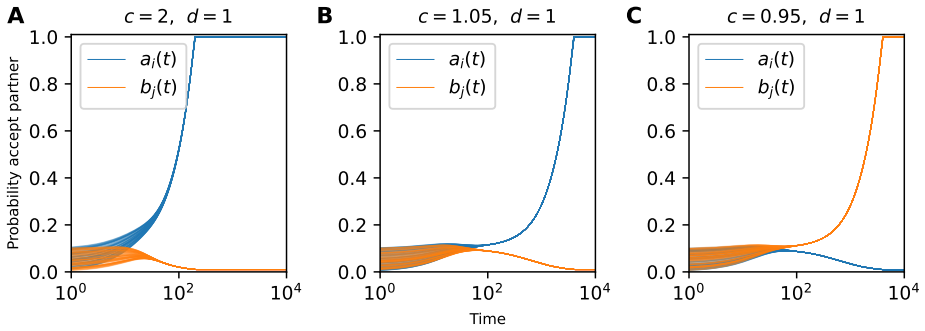
Many bipartite social networks exhibit pronounced asymmetries in selectivity and matching opportunities: members of one side can afford to be highly selective, while members of the opposite side are forced to accept less desirable matches. While it is natural to try to explain this asymmetry in terms of the intrinsic characteristics of the two sides or other exogenous factors, here we show that such asymmetries can also emerge endogenously through a feedback process generated by the matching process itself: as one side becomes more selective, the other side is pushed to be less selective due to reduced matching opportunities, and vice versa. We develop a model in which individuals repeatedly form one-to-one matches across two groups and adapt their selectivity to achieve a target matching rate. Using both analytic and numerical methods, we show that when encounters are sufficiently frequent, the unique equilibrium is for one group to be highly selective and the other non-selective. This qualitative outcome holds even for heterogeneous groups with overlapping, almost indistinguishable distributions of target matching rates. The model makes several testable predictions, and it provides a mechanism for behavioral differentiation in repeated matching environments, with applications ranging from online dating to hiring and housing markets.
Model balances housing costs, the 30 percent affordability limit, and weighted social benefits to decide relocation.
abstractclick to expand
Deciding where to live involves a complex balance between commuting and moving, as households must weigh housing affordability, transportation expenses, access to workplaces, and social ties. Traditional urban economic theories focus on the balance between housing expenses and commuting costs, while modern studies also consider housing affordability, transportation access, and utility maximization. However, few studies have combined these elements into a clear mathematical model that can be used for both policy analysis and household decision-making. This paper introduces an algebraic model for deciding whether to commute or move, expanding on traditional residential location theories by including direct housing and commuting expenses, income-related affordability limits, indirect social and service access costs, and location-based utility within a single utility-maximization framework. The model uses the common 30% housing affordability rule as a constraint, acknowledging that residential choices are also shaped by social networks, access to institutions, neighborhood ties, and quality-of-life factors. The decision rule derived from the model integrates direct financial costs with weighted social benefits and indirect access costs to assess when moving offers more overall utility than staying put and commuting. Unlike complex discrete-choice, nested-logit, or agent-based models, this framework offers a mathematically clear, understandable, and flexible decision model that can easily be expanded to include more household characteristics, transportation options, or policy factors. The model advances urban economics, migration studies, and housing affordability research by providing a practical analytical tool for assessing residential mobility decisions within financial and behavioral limits.
Goto and Nakada (2026) showed that the Baldwin rule can be characterized using Neutrality}, Bottom Consistency, Faithfulness, Cancellation and Bottom Independence. While their proof relies on the technique of linear algebra and graph theory, in this note, we provide a simpler proof using purely combinatorial arguments based on permutations and amplified preference profiles, thereby providing a more transparent proof of the characterization.
Decision-makers often rely on multiple probabilistic forecasts that are individually calibrated but need not be fully informative. We develop a framework for aggregating such forecasts when the decision-maker knows only that experts satisfy calibration. We show that the joint distribution of calibrated forecasts can contain decision-relevant information that is unavailable from any single expert, so the standard optimal-in-hindsight (OIH) benchmark may substantially understate attainable performance. To formalize this idea, we introduce a robust max-min benchmark: the best payoff a decision-maker can guarantee against all profile-wise conditional-mean mappings compatible with calibration. This benchmark is tractable, admits a linear-programming formulation, and dominates the OIH benchmark up to calibration error. It can nevertheless be strictly below the Bayesian benchmark, clarifying the value of knowing experts' information structures. Finally, we provide online algorithms that attain the robust benchmark under forecast-only feedback and stronger contextual benchmarks under state feedback.
The coordination of prices in economics is one of the most complex phenomena. In particular, the classical and neoclassical approaches related to the economic theory provide some insights into such a complex coordination based on different formulations. However, these formulations have not been successful for explaining simple mechanisms to understand and predict a set of prices that theoretically clears all markets. Consequently, elementary cellular automata can contribute to clarify such a coordination problem by using simple computational rules to describe the theoretical bases of the classical and neoclassical economics. Therefore, we propose to use this type of cellular automata for explaining different escenarios of price coordination in which simple rules of price interactions generate stable and unstable patterns of coordination. We used an explorative data analysis based on the Shannon entropy for computing the uncertainty related to such generated patterns of coordination, and a Monte Carlo simulation approximation based on a Spearman correlation for evaluating the statistical significance of such price coordination. Findings suggested that the classical economics provides a consistent approach for understanding the coordination of prices because it emphasizes human interactions based on logical choices related to an objective data. On the other hand, the neoclassical approach does not propose any type of mechanism for describing the price coordination. The neoclassical individual is just a spectator and receiver of the unpredictable and supposed event of price coordination. As a result, by modeling the economic theory based on computational concepts, we reveal facts and believes behind the classical and neoclassical economics.
Pareto optimal contracts with many policyholders and insurers across indemnity types reduce to one aggregate minimization problem.
abstractclick to expand
This paper proves a sum-minimization characterization of Pareto efficient insurance with multiple policyholders, multiple insurers, and multiple indemnity environments. We also provide a result regarding the pairwise implementability of the policyholder- and insurer-aggregate level arrangements in the multiple policyholders and multiple insurers setting.
We study prophet inequalities with discounted rewards, where i.i.d. base rewards are multiplicatively discounted over time. Our main message is that even this structured and arbitrarily weak form of nonstationarity can erase the classical advantage of the stationary i.i.d. setting. Focusing on single-quantile threshold policies, we show that the competitive ratio transitions from the classical $1-1/e$ guarantee to a fundamental $1/2$ barrier as discounting accumulates over many phases in a canonical regime with a common-decay factor and equal-length phases. We further show that, in the same regime, the $1/2$ barrier persists even for arbitrary stopping rules. Consequently, i.i.d. base rewards under discounting can be as hard as the fully non-i.i.d. case. On the algorithmic side, we design single-quantile threshold rules that attain the tight bounds by calibrating acceptance decisions to an effective horizon induced by discounting, and we extend this calibration to heterogeneous decay factors and unequal phase lengths. We further show that a similar discontinuous breakdown persists in an infinite-horizon continuous-decay benchmark, where arbitrarily weak decay collapses the stationary benchmark from $1$ to $1/2$.
Spectral social aggregation obeys Pareto if and only if its spectrum uses quantiles present in society, rendering full representation dictat
abstractclick to expand
Many collective decisions under risk are made by people who care about different parts of the outcome distribution: downside losses, typical performance, or upside gains. This paper models this disagreement with quantile preferences and studies how the represented quantile levels can be aggregated. Our main result is a spectral support theorem: a spectral social aggregation satisfies the Pareto principle if and only if its social spectrum puts mass only on quantile levels represented in society. Hence, Pareto consistency makes representative-quantile aggregation a dictatorial case. In addition, we derive spectral aggregation from rank-based axioms, develop finite and threshold-Pareto consequences, and show when local benchmark-affine and elliptical common-shape domains admit a representative-quantile reduction.
Conditions derived for the model allow checking data without parameters, and most cases fail even when payments are risky.
abstractclick to expand
We present a revealed preference characterization of the discounted expected utility model with a concave utility function. The characterization offers a nonparametric test of the model. We apply the test to an experimental data set in the literature and find that the model is almost always rejected even when all payments involved are subject to risk.
Firms shift from training the least-skilled to the most-skilled below the AI level when workers can switch jobs.
abstractclick to expand
When firms deploy autonomous AI, they must decide how much work to leave to the system and how much to keep workers engaged. This decision affects current output and future human capital. We develop a parsimonious two-period model in which AI may outperform the worker when it functions, but may fail with positive probability. A firm chooses worker engagement; engagement lowers current output for below-benchmark workers, but changes future skill through learning and erosion. We distinguish two dimensions of AI progress: capability, the system's output when it works, and reliability, the probability that it works. In a single-firm benchmark, engagement is valuable only as fallback investment. The firm engages the least-skilled workers most, because they have the largest skill gaps and are least costly to bring toward a useful fallback level. With worker mobility, engagement also affects labor-market sorting: workers prefer jobs that build more valuable skill trajectories. This sorting motive targets higher-skill workers near the AI frontier, where skill gains are more valuable and engagement is less costly. Mobility can therefore reverse the engagement pattern, shifting investment from the least-skilled toward the most-skilled workers below the AI benchmark. Mobility also reshapes how AI progress affects engagement: greater capability raises engagement by increasing the value of the skill trajectory a firm offers, whereas greater reliability can raise or lower it because it reduces fallback need while also changing learning opportunities. Under worker mobility, human-AI work design becomes a problem of human-capital investment, in which allocating work today shapes future skill.
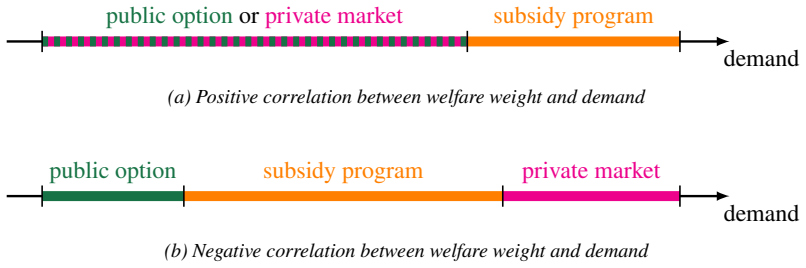
This paper studies how topping up -- allowing recipients of in-kind transfers to supplement subsidized consumption in a private market -- affects optimal redistribution. Consumers can access a competitive private market, while a social planner offers an alternative nonlinear price schedule. We show that the effect of topping up depends on the correlation between redistributive priority and demand. When the correlation is positive, topping up does not affect the optimal mechanism. When the correlation is negative, topping up weakens screening and reduces redistribution. At the extensive margin, topping up reduces the set of environments in which intervention is optimal. At the intensive margin, topping up weakly reduces both the scope of a free public option and the mass of consumers served, and shifts redistribution away from the consumers with the highest redistributive priority. We characterize the optimal mechanisms and show how topping up changes the comparative statics of optimal redistribution with respect to redistributive priorities.
We introduce a moral hazard model in which public information about a payoff-relevant state arrives over time, an agent decides when to make an irreversible investment, and a principal commits to a state-contingent policy to incentivize investment. To discourage the agent from waiting for more information, the principal's optimal policy provides certainty, reducing the degree to which the agent's payoff depends on the state. This is inefficient -- both players would be better off with less certainty. We study when the agent receives positive rent, and when moral hazard delays investment. Our results apply to environmental subsidies and R&D incentives.
The competitive equilibrium of general equilibrium theory exists as a fixed point and is, by the theorys own results on aggregate excess demand, in general silent on whether that fixed point is unique, stable, or attained. This paper takes the economy to be not a configuration to be solved for but a process to be recovered, an asymptotically mean stationary information source carrying a partially identified operator of statistical dependence, populated by agents that are finite-capacity information channels. Within this adaptive order the competitive, rational expectations equilibrium is recovered exactly, as a joint limit taken along an explicit scaling path. Three parameter limits and two fixed-point conditions deliver it, the entropy rate falls to zero, agent channel capacity diverges, selection intensity grows infinitely sharp, adaptive learning reaches its expectationally stable rest point, and the recovered structure ceases to coevolve. At that corner the limiting object satisfies the axioms of the canon and its rest state is a Walrasian equilibrium, away from it the adaptive economy is a strict generalisation, carrying a positive entropy rate and a recovered dependence structure that the equilibrium primitive cannot express. We give the nesting as a theorem, establish the result by result correspondence with existence, with the Sonnenschein Mantel Debreu indeterminacy, and with the regular economies recovery, and characterise exactly what the equilibrium limit erases.
In many matching markets, agents care not only about their own partners but also about the matches formed by others. With externalities, stability depends on what agents believe would happen after a deviation. We introduce rationalizable conjectures: beliefs that survive iterated elimination, in the spirit of rationalizability in non-cooperative games. These beliefs define conjecture-rationalizable stability, a solution concept that always exists, extends Gale--Shapley stability, and coincides with it when externalities are absent. We also introduce rationalizable matchings, a non-equilibrium counterpart, and show that every conjecture-rationalizable stable matching is rationalizable. In matching with couples, our concept yields non-empty predictions even when standard stability is vacuous. Finally, we provide an epistemic foundation: rationalizability is behaviorally implied by pairwise rationality and common belief in pairwise rationality, while conjecture-rationalizable stability additionally requires belief correctness.
Large Language Models (LLMs) are increasingly used as stand-ins in behavioural games. These stand-ins rely on the assumption that the LLM's distribution of choices meaningfully matches how humans play the same game. This study tests that assumption through two games. The first is a p-beauty contest, and the second one is a public goods game. The study first investigates five local-model settings within the same model family. These settings are varied together in a 360-cell factorial, which balances temperature, scale (0.5-32B), quantisation, instruct vs base, and framing. Each cell's distribution is then compared against whole choice distributions in published human data. Each deployment setting, except for quantisation, governs a different aspect of fidelity. Mechanically, while the dispersion of human players can be somewhat recovered through deployment settings, the strategic process behind it cannot. Through the lens of the level-k cognitive theory, we find that LLMs act as static, category-retrieved level-k players, where k is set by the model scale. The models also do not run within-game belief-updating or backward induction throughout multiple-round horizon settings. While human contributions decayed in the public goods game, LLMs stayed flat or rose at every scale. When the horizon test was administered, LLMs were more cooperative under an indefinite horizon compared to a finite one. However, LLMs ignore their relative round position, so no last-round defection was displayed. This implies that LLMs retrieved levels relative to the horizon category rather than working out iteratively from the specific game setting.
In this paper, we study reactive strategies in repeated additive games between two players with finitely many actions. Reactive strategies condition only on the opponent's previous action, making them one of the simplest ways players can respond to past interactions. Additive games include important models of cooperation, such as the donation game and games with a punishment option. We show that, for this class of games and strategies, the conditions for symmetric Nash equilibria reduce to a system of linear equalities and inequalities in the strategy parameters, allowing us to characterise all such equilibria. We establish a one-to-one correspondence between non-empty subsets S of the action set and equilibrium classes, which we call S-supporting equilibria. These are equilibria that use exactly the actions in S when playing against themselves. As a special case, we recover the well-known equalizer strategies as the equilibria supported on the entire action set. To assess which equilibrium classes are most evolutionarily relevant, we complement our analytical characterisation with simulations of social learning dynamics. We find that their prevalence is determined by two factors: how likely they are to be generated and how robust they are against invasion.
Exact certification forces first-order extra costs at the bottom while losing only higher-order decision value.
abstractclick to expand
Labels -- grades, credentials, scores, ratings, ranks -- do two things. They inform receivers, and they give agents something to chase. I study optimal classification when labels must be earned through costly self-selection. I show that exact certification is inefficiently fine: pooling a small bottom interval saves first-order signaling costs while losing only higher-order decision value. I provide sufficient conditions for lower censorship to maximize efficiency as well as for every optimal classification to use finitely many categories.
Finite bounds on slack and multiplier variables strengthen convex relaxations in spatial branch-and-bound for three-player Kuhn poker.
abstractclick to expand
There has been significant recent progress in algorithms for approximation of Nash equilibrium in large two-player zero-sum imperfect-information games and exact computation of Nash equilibrium in multiplayer strategic-form games. While counterfactual regret minimization and fictitious play are scalable to large games and have convergence guarantees in two-player zero-sum games, they do not guarantee convergence to Nash equilibrium in multiplayer games. Recently, an approach has been presented for exact computation of Nash equilibrium in multiplayer imperfect-information games that solves a quadratically constrained program based on a nonlinear complementarity problem formulation derived from the sequence-form game representation. This formulation was solved using Gurobi's nonconvex quadratic solver, which employs spatial branch-and-bound to iteratively refine variable bounds by solving convex relaxations of bilinear terms via McCormick envelopes. During presolve, Gurobi introduces auxiliary variables and, in some cases, binary variables, leading to an internal MIQCP reformulation. This approach was demonstrated to outperform prior algorithms from the Gambit software suite and quickly solve three-player Kuhn poker after removal of dominated actions; however, the algorithm was not able to solve the full version of the game within 24 hours. In this paper, we derive finite bounds on slack and multiplier variables in the nonlinear complementarity formulation. These bounds strengthen the convex relaxations used within spatial branch-and-bound and lead to substantial computational improvements. We demonstrate the impact of the proposed bounds on exact Nash equilibrium computation in three-player Kuhn poker.
For every k a maximal frame exists whose shortest coherence violation has length exactly 2k+2, so no bounded fragment suffices.
abstractclick to expand
This theoretical note studies the finite axiomatizability of strict majority reasoning in finite social decision frames. Moss and Pedersen (2026) <doi: 10.48550/arXiv.2606.23853> introduce a coherence criterion that characterizes exactly when qualitative majority judgments are representable by a finitely additive measure. The question addressed here is whether that coherence criterion can be replaced, in the finite setting, by any bounded finite fragment. We prove that it cannot. For every $k\ge 1$, we construct a maximal standard frame whose shortest coherence violation has length exactly $2k+2$. Hence there is no uniform finite bound on the incoherence index of social decision frames, resolving Conjecture 5.7 stated by Moss and Pedersen (2026). The construction is geometric, in the sense that it proceeds via orthogonality and dimension in rational vector spaces, and self-contained: it isolates a symmetric family of half-sized voting blocs and extends it to a maximal frame in which every shorter balanced obstruction is excluded. Along the explicit infinite sequence of universe sizes obtained in the construction, this also establishes the middle-layer family predicted by Conjecture B.25 by Moss and Pedersen (2026). Together with the soundness and completeness theorem for the Moss-Pedersen minimal logic for strict majorities, this establishes that measurable social decision frames are not finitely axiomatizable in that language.
We consider the social aggregation of preferences over lotteries in the presence of other-regarding preferences. If society respects each individual's sovereignty, an axiom we propose akin to Sen's Liberalism, then society's utility is a linear combination of individuals' self-regarding utilities. That is, other-regarding preferences can only influence the weights society places on each individual. We next characterize the unique weighting method under which society's weight ratio between two individuals is the geometric mean of that of all individuals. The first distinguishing axiom concerns the consistency of sequential aggregation, while the second concerns consensus across changes in individuals' other-regarding preferences. We extend the first result to a setting with feasibility constraints and a setting with subjective uncertainty.
It alone meets both new criteria that protect against model misspecification and outlier voters under single-peaked preferences.
abstractclick to expand
This paper proposes new robustness criteria for social choice correspondences under single-peaked preferences, inspired by the concepts of robustness in statistical estimation, where robust estimators are designed to be resilient to both model misspecification and outliers. Motivated by robustness to model assumptions, we introduce peak-robustness: a voting rule is peak-robust if it never selects an alternative that is a majority loser relative to some unchosen alternative for any preference profile sharing the same peak profile. To capture robustness to outliers, we propose tail-invariance, which requires that variations in the tails of the peak distribution do not affect the collective decision. Our main result shows that the median voting rule is the unique efficient rule satisfying these robustness criteria. When peak-robustness is weakened, we characterize the broader class of quantile rules. Taken together, these results provide a robustness-based axiomatic foundation for median and quantile voting rules, independent of the traditional strategy-proofness approach.
Energy poverty persists even among households that are not income-poor, suggesting a deeper mechanism than mere budget constraints. We develop a model in which indoor thermal comfort is produced through a non-convex technology that couples energy input with dwelling efficiency. A critical efficiency threshold emerges below which the minimum comfort level is physically unattainable, regardless of how much energy is purchased. Households below this threshold suffer from structural energy poverty, which income transfers alone cannot cure. The model yields three sharp policy predictions: energy price shocks are strongly regressive, efficiency investments dominate income transfers and price subsidies in reducing energy poverty, and a cost-effective anti-poverty strategy must combine targeted retrofits with temporary income support. The results are illustrated with symbolic diagrams and formal proofs.
Electricity procurement constitutes a significant share of operational costs for large electricity consumers, and thus exposure to extreme prices poses a substantial financial risk. This paper proposes a method to generate EUPHEMIA-compatible bids for flexible demand to enable their participation in the European day-ahead electricity market while minimizing risks. Two strategies are considered, resulting in two bid formats: hourly bids (HBs), representing flexibility via marginal price responsiveness through price-quantity pairs, and exclusive-group bids (EBs), representing flexibility via mutually exclusive operational schedules submitted at opportunity cost. Our method is evaluated on a hypothetical electrolyzer system and a real-world steel plant under different market conditions. Results show that the economic performance of each strategy depends on the operational characteristics of the load and market conditions. Under volatile market conditions, highly flexible systems achieve better economic outcomes with EBs, while less flexible systems with stronger intertemporal constraints perform better with HBs.
We study a continuous-time stochastic Stackelberg control problem in which a leader steers a system of strategic followers through two non-standard channels - the information structure and a transfer mechanism - rather than through the dynamics directly. The latent environment is a jump-diffusion; the leader commits to a Gaussian public-signaling channel whose belief consequences are tracked by a finite-dimensional projection filter (the exact filter being infinite-dimensional), together with a Groves transfer that aligns the followers' incentives. Under truthful disclosure, efficient behavior is a dominant-strategy best response, and the induced differential game admits saturated and bang-bang Nash feedback. We cast the leader's distributionally robust problem, over a relative-entropy ambiguity neighborhood, as a two-controller Isaacs equation; prove that incentive alignment collapses the bilevel Stackelberg problem to a single robust control problem with an exact first-order condition; and characterize the value function as the unique viscosity solution, with a verification theorem valid for the non-smooth bang-bang feedback and a semiconcavity result that renders the switching set Lebesgue-null. We instantiate the framework on resilient multi-area power-system coordination under extreme weather. Calibrated to the 2021 Winter Storm Uri, an Isaacs solve over ERCOT's near-islanded interconnection (a 0.82 GW tie, under 2% of peak) shows mutual aid removes about 8% of social cost, rising to roughly 30% under the FERC/DOE-recommended interregional transfer capability; a reserve-scheduling experiment shows that public disclosure lowers welfare cost by 37% under autarky and 48% under market coupling, and that information design and market coupling are complements under common (systemic) risk.
We study public-good provision when a planner observes agents' preferences only through a fixed local-privacy channel that randomizes each report before it reaches the planner. We characterize the optimal reduced-form allocation: the project is implemented when an aggregate posterior score is positive, where each agent's score combines the posterior expected valuation and posterior virtual value. Privacy enters through these posterior objects, muting the responsiveness of provision to private preferences and, under weak monotone likelihood ratios, potentially generating pooling. We then distinguish the optimal reduced-form allocation from its implementation through signal-measurable transfers: the required transfers solve a Fredholm integral equation whose solution is unique under completeness when it exists, while existence requires a separate range condition. Maximum reduced-form revenue exhibits three population regimes: it is asymptotically linear, of square-root order, or exponentially small according as the lower endpoint of the valuation distribution is positive, zero, or negative. Finally, welfare comparisons depend on the privacy calibration. At a common noise scale, Laplace Blackwell-dominates logistic noise, while under a common tight $\mu$-GDP calibration the ordering reverses for the maximally separated binary endpoint experiment. Thus the preferred privacy channel depends on the standard used to hold privacy fixed.
This paper examines how a developing country can benefit from trade liberalization. We develop a two-period model, comprising an autarky phase and a globalization phase, and a two-country framework, featuring a developing country and a developed country (representing the rest of the world). Our findings indicate that globalization may disadvantage a developing country when its total factor productivity (TFP) is significantly lower than that of the developed country. However, we demonstrate that the developing country can still achieve gains from trade openness by allocating part of its capital to innovation during the autarky period, thereby enhancing its TFP.
This paper studies strict majority reasoning in finite electorates using so-called $\textit{social decision frames}$: finite sets of voters equipped with distinguished families of coalitions interpreted as those voting blocs evaluated to form a strict majority. A coherence criterion for qualitative majority judgments is identified and shown to give an exact characterization for representability of strict majorities by finitely additive measures. In addition, a minimal natural logic for reasoning about strict majorities is shown to be sound and complete. These developments motivate examination of associated combinatorial questions concerning incoherence in finite families of sets; partial results and a conjecture are given. Finally, the results of this paper are applied to correct a classical representation theorem for weak qualitative probability structures due to Patrick Suppes and to establish a May-type characterization for ordinary strict majority rule for social decision frames.
Their share of all possible networks shrinks to zero almost surely as the number of agents increases.
abstractclick to expand
This paper studies probabilistic properties of pairwise stability for a network model where individual utilities are random variables. We study the probability that a given network is pairwise stable and the expected number of pairwise stable networks. We provide a closed-form solution for the latter number.
As the evaluation of the exact expression is computationally challenging for large populations, we provide tractable lower and upper bounds for this expression which allow us to pin down the asymptotic behavior of the expected number of pairwise stable networks up to a multiplicative constant. This asymptotic behavior is described by the number of networks $ 2^{n(n-1)/2} $ times $ (2/n+1)^{n} $, a sequence that tends to infinity fast. We normalize the number of pairwise stable networks by this sequence and show that the variance of the normalized number of pairwise stable networks converges to zero as $ n $ tends to infinity.
We conclude that almost surely the number of pairwise stable networks tends to infinity, while the fraction of pairwise stable networks tends to $ 0 $ as $ n $ goes to infinity.
Lexicographic relations describe them; on restricted domains their existence requires non-Ramsey collections.
abstractclick to expand
In this paper we examine the constructive nature of social welfare orders on infinite utility streams $X=Y^{\mathbb{N}}$ satisfying Strong Equity, Hammond Equity, or the Pigou--Dalton transfer principle. The constructive social welfare orders are described using lexicographic preference relations. Social welfare orders satisfying Strong Equity, Hammond Equity, or the Pigou--Dalton transfer principle admit explicit descriptions when $Y(<)$ is well-ordered. We describe restrictions on the domain $Y$ under which the existence of social welfare orders satisfying the aforementioned equity axioms entails the existence of a non-Ramsey collection. For this, we rely on the existence of a non-Ramsey collection, which is treated here as a nonconstructive object.
We study flow games with public arcs, an extension of classical cooperative flow games that allows players to use public resources. In these games, a coalition corresponds to a set of arcs, while certain arcs, called public arcs, can be used freely by any coalition. The value of a coalition is the maximum flow value achievable using the arcs controlled by the coalition along with the public arcs. These games have significant applications in financial, communication, and supply-chain networks. We investigate two solution concepts, the least core and the nucleolus. Both solution concepts provide principled ways to allocate the value of the grand coalition among individual players. We provide characterizations of the least core of these games. We also give a polynomial-time algorithm to compute the nucleolus when the core is non-empty.
Each firm best-responds to any rival menus by offering only a single price when the buyer's valuation distribution satisfies the condition.
abstractclick to expand
We study competition among multiple firms that offer differentiated varieties of the same good to a unit-demand agent. The agent has heterogeneous valuations for goods from different firms. Firms do not observe the agent's exact valuations, but they know their distribution. Firms simultaneously post menus of contracts, after which the agent chooses a firm and one of its contracts to maximize her utility. This defines a game in which firms aim to maximize expected revenue. We introduce a sufficient condition, density-regularity, under which each firm's best response to any arbitrary menu profile posted by its opponents is equivalent to posting a menu that contains only a posted-price contract. Our result is not a direct extension of the canonical Myersonian model with a single seller. The standard argument in the literature breaks down once heterogeneous preferences and competition are introduced. We therefore adopt an optimal-control approach, in which the density-regularity condition is essential for establishing the optimality of posted prices. When this condition fails, posted prices may fail to be a best response.
In generic symmetric two-player games the index decides whether any myopic learning process can stabilize the equilibrium.
abstractclick to expand
A Nash equilibrium is learnable if there exists a myopic adjustment dynamic for which it is asymptotically stable. In generic symmetric two-player games, a Nash equilibrium is learnable if and only if it has index +1.
Vague test dates arise when credibility limits what the teacher can credibly convey to grade-oriented students.
abstractclick to expand
This paper studies a cheap-talk model of strategic test announcements. A teacher observes the day of the test of the next week decided by the nature and makes an announcement to his students who choose effort levels of studying. The competing forces are the teacher's value on consistent study habits and the students' grade orientation. We characterize the pure strategy Nash equilibrium under the linear-quadratic student utility. We also study what happens when the teacher can commit to an information policy.
Testing single, adversarial, and multi-agent methods on mechanism design shows external checks catch errors that polished text misses.
abstractclick to expand
Empirical economists often start their projects with a toolbox. Shared packages, replication archives, and circulated guides shorten the time between and idea and a rough initial draft. Theorists, on the other-hand, largely start from a blank page. By 2026, large language models can a produce and check nontrivial mathematics. The can also hallucinate and write wrong claims very convincingly. The current bottleneck on machine-assisted theory is no longer production but trust: a model will claim to prove a false theorem as readily as a true one. Building on recent attempts in mathematics, I present 3 methods for doing economic theory with a language model. These methods differ on how the work is verified: a single disciplined pass, an adversarial prover-verifier pair (Claude Opus~4.8 proposing, OpenAI Codex refuting), and a structured multi-agent project with a reviewer gate (inspired by the Google co-mathematician architecture). I demonstrate these protocols on one open worked example: designing a Groves/Pigouvian incentive mechanism for the Gans--Kominers eigengrade model of grade inflation. None of the three runs produced a strict direct-revelation VCG/Clarke mechanism (as requested, perhaps due to the non-existence of such mechanism). Three phenomena recur. First, convergent discovery: two runs derive the same effective-resistance externality kernel on opposite margins. Second, adversarial verification is load-bearing: the pair caught three of its own false claims and the gate rejected a sub-goal. Third, polish is not rigor: the most finished-looking output was the least verified. The methodological takeaway is that external verification, not model capability, is the design variable.
This paper studies information design when the designer lacks precise knowledge of agents' payoff coefficients. The Calibrated Bayes Correlated Equilibrium (Cal-BCE) is introduced as a solution concept that augments the Bayes correlated equilibrium with a corrector policy preserving incentive compatibility under the designer's structural uncertainty, adapting its revelation principle to this setting. The design problem is nonconvex in general, but under a linear-quadratic-Gaussian structure it admits convex second-order cone and semidefinite reformulations under two-sided probabilistic and conditional value-at-risk (CVaR) constraints, with feasibility guaranteed by a Hadamard invertibility condition. A joint decentralization theorem shows that both designs cap cross-agent action covariances, the CVaR design more tightly at a common tolerance; but because the formulations operate at design-specific feasibility thresholds, the realized ordering is calibration-dependent. Experiments on fifteen sector ETFs confirm the trade-off: the probabilistic design attains higher mean welfare and the CVaR design better tail protection, with neither dominating outright.
This paper develops a general equilibrium overlapping-generations model with endogenous fertility, in which firms accumulate both physical and artificial intelligence (AI) capital, and uses it to study the macroeconomic transmission of two structural disturbances: an AI technology shock and a longevity shock. The AI shock acts as a capital-demand disturbance: it raises all rates of return, most sharply the return to AI capital, reallocates investment from physical to AI capital, and produces a front-loaded output expansion that decays monotonically. The longevity shock acts as a saving-supply disturbance: it deepens the aggregate capital stock, compresses returns and the real interest rate, and generates hump-shaped, persistent dynamics. The two shocks move fertility in opposite directions: AI raises it modestly through an income effect, while longevity lowers it by strengthening the life-cycle saving motive and the cost of childrearing. A forecast-error variance decomposition attributes most aggregate volatility to the longevity shock, while the AI shock dominates the variance of the return to AI capital. Fertility is strongly countercyclical and almost perfectly negatively correlated with hours worked, placing household time allocation at the center of the mechanism. Robustness checks across the capital share, the shock persistence, and the utility specification show that only an empirically implausible labor-AI elasticity reverses the wage and fertility signs. A welfare analysis finds the AI shock welfare-improving under complementarity, whereas longevity produces a short-run welfare loss that recedes as capital deepening raises wages, since households initially compress consumption and fertility to finance a longer retirement.
We introduce a new non-manipulability axiom called worst-case strategy-proofness (WCSP). This axiom is weaker than strategy-proofness and stronger than non-obvious manipulability-worst (NOM-worst) by Troyan and Morrill (2020). WCSP focuses on non-manipulability in a worst-case scenario. We examine the implications of WCSP in a voting model. Although many voting rules, such as the plurality rule, the Borda rule, and the Dowdall rule, satisfy NOM-worst, they violate WCSP. We obtain a necessary and sufficient condition for the anti-plurality rule with fixed-order tie-breaking to satisfy WCSP in terms of the numbers of agents and alternatives.
The chosen scale alters elasticity weights so the Kantian first-order condition matches the leader outcome and yields higher payoff than Nas
abstractclick to expand
We study the strategic implications of the non-invariance of multiplicative Kantian equilibrium (MKE) under monotone transformations of the strategy space. Before interacting with a standard Nash player, a Kantian player publicly selects a smooth increasing scale that determines how proportional deviations are evaluated. Material payoffs and feasible actions remain unchanged, but the chosen scale alters the Kantian first-order condition through endogenous elasticity weights. The representation of actions therefore becomes a commitment device. We characterize the stationary outcomes implementable by a common monotone scale. A sharp dichotomy emerges. Under strategic substitutes, the Kantian player can approach the Nash payoff arbitrarily closely but cannot exceed player 2's Nash benchmark; scaling is defensive and eliminates the payoff loss associated with naive Kantian behavior. Under strategic complements, scaling becomes offensive: the Kantian player can stationary-implement the Stackelberg leader outcome and obtain a payoff strictly above the Nash benchmark. In the canonical Cournot and differentiated Bertrand examples, we explicitly construct scales satisfying the required local elasticity ratios and verify the second-order conditions, so the stationary outcomes are local transformed Nash-Kantian equilibria. Allowing player-specific scales would align the Kantian first-order condition with the Stackelberg condition along the entire reaction curve under complements, but would violate monotonicity under substitutes. This reveals a trade-off between universality and strategic flexibility. The results identify endogenous scaling as a commitment mechanism and connect Kantian optimization to strategic leadership and strategic non-equivalence.
In a two-agent public-good model the poor may prefer Nash over Kantian play, and the choice of how to scale actions creates further distribu
abstractclick to expand
Multiplicative Kantian equilibrium has been proposed as a solution to inefficiency in social dilemmas, yet its emergence and stability are associated with a number of coordination and distributional difficulties. Drawing on a simple model of voluntary public good provision with two agents who differ in their initial endowments and have logarithmic preferences, this paper identifies three barriers that arise sequentially when unequal agents attempt to adopt Kantian cooperation voluntarily. The model compares Nash equilibrium with multiplicative Kantian equilibrium under two different parametrizations: one in which the strategic variable is contributions to the public good, and another in which it is private consumption. First, we show that the transition from Nash equilibrium to contribution space Kantian behavior is not always a Pareto improvement: under sufficiently high inequality, the poor agent may prefer the Nash outcome. This barrier can be mitigated by preliminary redistribution. Second, even when agents are willing to cooperate, the choice of a parametrization of the strategic space becomes a distributional issue: different ways of scaling actions lead to different distributive consequences and create a conflict of interest between agents. Third, if the chosen parametrization admits a continuum of Pareto efficient outcomes, an additional coordination problem arises-agreeing on a specific point on the Pareto frontier. The paper reconstructs these barriers as a three step coordination problem in which expectations about later stages affect willingness of agents to enter Kantian cooperation at the outset. On the basis of the results obtained, a program for further formal research is outlined. The findings contribute to understanding the conditions under which Kantian cooperation can be voluntarily adopted and sustainably maintained.
Joint mechanism uses non-monotone treatment probabilities and guaranteed recommendations to beat random allocation plus top-down selection.
abstractclick to expand
We study a model in which a sender allocates limited treatment to agents with heterogeneous quality and later recommends selected agents to a receiver, seeking to maximize the number of agents accepted by the receiver. All agents value treatment, which improves agents' quality, but treatment must be allocated before the sender observes agents' initial quality; recommendation occurs only after quality is learned. A natural benchmark is to design the two instruments separately: allocate treatment randomly first, and then recommend agents from the top down afterward. Our main result shows that the sender can do strictly better by coordinating treatment allocation with recommendations. In the optimal joint mechanism, treatment is non-monotone in quality: an intermediate group has a lower treatment probability than both higher- and lower-quality agents, but is compensated with a guaranteed recommendation when treatment is realized. We provide an implementation through contracts that induce self-selection and discuss applications to education, industrial policy, and startup incubation. The takeaway is simple: coordinate treatment allocation and recommendation.
Nash equilibrium (NE) arises from selfish utility maximization, yet its social welfare can be arbitrarily far from optimal. Moreover, computing an NE is intractable in general. We study augmented game models in which players use budget-balanced internal transfers to improve incentives before play. We first introduce \emph{Self-Enforcing Transfer Equilibrium} (SETE), where players commit to nonnegative peer-to-peer transfers that are paid only if the recipient does not deviate from a prescribed strategy. For polymatrix games, we show that every stationary point of the social welfare function, in particular any socially optimal strategy profile, can be sustained as a SETE. This induces a Nash equilibrium in the agent normal form of the corresponding augmented game. We further propose a polynomial-time algorithm and a decentralized learning dynamic to compute such product-form equilibria. We then introduce \emph{Mediated Self-Enforcing Transfer Equilibrium} (M-SETE), where a mediator makes both the payment schedule and the prescribed strategies binding offers. This additional enforcement resolves the agent-normal-form limitation: an M-SETE is a Nash equilibrium of the augmented game itself, not merely of its agent normal form, and any socially optimal strategy profile can be supported as an M-SETE in any finite game while preserving budget balance. Thus, internal transfers improve welfare and computation while preserving independent play on the equilibrium path. When full sequential-game stability is required, binding mediation provides the corresponding implementation.
The condition identifies when any change to returns produces safer growth-optimal bets and extends Pratt's risk-aversion comparison to inatt
abstractclick to expand
I study transformations of returns in the growth-optimal (Kelly) portfolio problem. In the one-safe-one-risky-asset problem, a return transform f universally produces a more conservative portfolio if and only if f is concave and strictly increasing and r/f is convex. As a corollary, I characterize comparative risk aversion for a rationally-inattentive agent: a more risk-averse agent is one who is sufficiently more risk averse in the Pratt (1964) sense.
In two-sided markets, M♮-concave preferences yield fractional allocations that are stable and fair before the lottery, and that decompose in
abstractclick to expand
Random allocations are widely used to handle ties and indifferences in two-sided environments. In such environments, commonly used procedures such as random tie-breaking may fail to ensure stability and fairness from an ex ante perspective. We show that when agents have discrete concave (M$^\natural$-concave) valuations, there exists an ex ante stable and fair allocation. To establish this result, we relate our framework to the model of stability introduced by Alkan and Gale. In particular, we show that ex ante stable and fair fractional allocations are exactly characterized as Alkan--Gale stable outcomes under choice functions induced from concave closures together with a symmetric strictly convex tie-breaking rule. We further prove that any ex ante stable fractional allocation can be decomposed into a lottery over stable deterministic allocations, using a generalization of the Birkhoff--von Neumann theorem. Finally, we study a setting that does not rely on cardinal valuations and instead assumes ordinal preferences. Within this ordinal framework, we establish the existence of an ex ante stable and fair fractional allocation. This setting is formulated within the matching-with-contracts framework under matroid constraints. The resulting class includes existing models, such as one-to-many random allocation with responsive choice correspondences, and captures a wide range of applications, including controlled school choice with lotteries.
Bottleneck scheduling with finite time menus and shadow-price tolls approximates strategyproof dynamic optimum at quadratic rate in slot wid
abstractclick to expand
A central operator schedules each vehicle's passage time through a bottleneck to achieve a dynamic system optimum (DSO). The assignment depends on each vehicle's preferred arrival time, which is private and must be elicited from each vehicle. Mechanisms that elicit exact preferences, such as the Vickrey-Clarke-Groves (VCG) mechanism, can achieve strategyproofness but involve relatively complex rules and a computational burden on the operator. We focus instead on coarse reporting, in which each vehicle selects from a finite menu of time slots of a common width. This discrete interface already structures reservation and appointment systems in practice, including managed lanes for automated vehicles, airport slot allocation, and delivery appointment windows. We design a slot-based DSO mechanism on this coarse interface, in which the operator implements DSO assignment based on the reported slots and charges a capacity shadow price as a toll, and evaluate its performance. We prove that both the worst-case misreporting gain and the expected efficiency loss decrease quadratically in the slot width. The efficiency loss decays in this way under binding capacity, while the worst-case misreporting gain requires an additional condition on the preferred arrival time distribution and the schedule cost function. Analyzing the no-toll case, we find that the misreporting incentive persists, however finely the slots are refined, indicating that the toll also serves to elicit truthful reports. Numerical experiments support these theoretical results and show that they continue to hold in parameter regions outside the sufficient conditions.
This paper presents an axiomatization of Ludwig von Mises' praxeology in many-sorted first-order logic, isolating the foundational layer. We introduce a formal language with five sorts (Actors, Actions, Ends, Things, Times) and six primitive relations (Acts, Avail, EndOf, Use, a preference order, and a time order), together with a base axiom system organized into three layers: the structure of action itself, the actor's preference order together with its demonstration in choice, and material scarcity. The base system captures purposeful action in its bare praxeological form.
Working entirely within the base system we derive the core classical Misesian propositions as Hilbert-style theorems: the asymmetry of demonstrated preference, the existence of opportunity cost, the structural scarcity of time, the subjectivity of opportunity cost, the law of diminishing marginal utility, and the increasing marginal disutility of labor. Where a theorem requires structure beyond the praxeological core, as with diminishing marginal utility, the additional premises are made explicit; identifying these hidden premises is one of the methodological payoffs of the approach.
A self-contained Lean 4 companion encodes the language as Lean 4 type classes and constructs a concrete infinite-time Robinson Crusoe model whose acceptance by the type-checker is a constructive consistency proof of the full base theory.
Players pick signal strengths to produce contrary receiver assessments, and the model maps exactly onto a square game with full equilibrium
abstractclick to expand
A game of information concerns two players transmitting messages that are obscured by noise. A receiver digests the combination of the two information sources and makes an assessment rationally. The aim of the players is to generate opposing assessments for the receiver by choosing signal-to-noise ratios of their information. It is shown that this problem can be reduced into an elementary infinite game on the square, thus admitting a complete equilibrium solution. Three generalisations of the game are proposed.
The classical expected utility (EU) axioms are not sufficient for finite datasets. There are a number of anomalies (violations of EU) where axioms are satisfied. This paper studies axioms that are immune to this problem and definitively delineate between EU and non-EU. We discuss implications for experimental design and explore the automatic generation of anomalies.
We study how artificial intelligence (AI) interacts with social communication networks to shape the stability of collective knowledge. Agents exchange information through a network while receiving AI-generated content, and AI systems retrain on the aggregate social information they influence. This interaction generates two feedback forces: an AI contagion channel, through which distortions diffuse across the network, and an AI social distortion multiplier, through which retraining amplifies past errors. Despite the high dimensionality of the environment, we show that the long-run behavior of the system admits a two-dimensional representation whose spectral radius determines whether AI-mediated information systems are dynamically stable or unstable. We characterize a sharp regulatory frontier identifying the minimum filtering required for stability and show how network topology shapes systemic informational risk.
This volume develops a knowledge theory of capital for economies in which productive capacity increasingly resides in software, data, models, routines, expertise, platforms, organizations, commons, and public epistemic infrastructure. Beginning from Adam Smith's theory of labour, stock, specialization, and market extent, it asks what changes when knowledge becomes stock-like, mobile across forms, scalable, governable, recombinable, and imperfectly visible in accounting. The book introduces knowledge-bearing stock as the central object and analyses how it is generated, converted into governable form, deployed, improved through feedback, enclosed or shared, measured, impaired, and used as input to future production. It distinguishes embodied, disembodied, institutionalized, commons, and public knowledge forms and develops concepts such as first conversion, cognitive enclosure, feedback capture, dark capital, and expected knowledge loss. The argument is conditional and testable: modern wealth depends not only on capital accumulation, but on how productive knowledge is governed.
We study strategic interaction when players delegate belief formation to predictive machine learning (ML). In a static Bayesian game, each player's ML agent predicts a payoff-relevant outcome variable as a function of the player's type. The ML agent's training sample is endogenous: it is drawn from the outcome distribution generated by players' ML-guided behavior. In Cross-Validation Equilibrium (CVE), each player's ML agent selects a predictive model to minimize expected out-of-sample squared error, given its realized training sample, and each player best-replies to the belief generated by the model her ML agent selected. We analyze CVE and relate it to other equilibrium concepts. We apply CVE to jury voting, speculative betting, and games with linear-quadratic payoffs. E.g., in a team-effort game, endogenous model selection can give rise to multiple equilibria.
It compensates creators and subsidizes innovation where free use leaves them unpaid and strong IP penalizes originality.
abstractclick to expand
How can we design a market of human-generated content for use in training AI models that both enables technological progress and preserves individual incentives for high-quality content creation? Existing approaches take polar positions: a "free-for-all" model based on fair use and a "strong intellectual property rights" model. We show that both fail: Free-for-all does not compensate creators, and -- by modeling as a static Stackelberg game -- strong intellectual property rights also underpower creative incentives. We find this especially true for more innovative creators, a phenomenon we term the "originality penalty." Extending this insight to a dynamic model, we find another market failure undermining AI model performance, even for an initially good model: Such a model induces greater reliance by humans on AI-assisted creation, resulting in homogenized content feeding back into training, which degrades the model performance -- a "curse of precision." We further propose a market design with a data intermediary internalizing cross-creator externalities and subsidizing innovative contributions, thereby restoring efficiency.
A common-tail compensation axiom prices calendar time and yields index optimality as the shadow price of advancing local clocks.
abstractclick to expand
Bandit models typically begin with arms, states, rewards, and transition rules. This paper instead begins with preferences over stopped local contingent schedules: possible unfoldings of a responsibility, project, experiment, or opportunity in its own local time. Behavioral axioms on single schedules characterize a generalized stopping representation with current utility, local discounting, and a broad continuation aggregator. A common-tail compensation axiom then allows calendar time to be priced across schedules. Imposing a tight elapsed-calendar constraint generates a rested generalized bandit and yields index optimality: the index is the shadow price of advancing a local clock. Expected-utility, learning, robust, rank-dependent, Choquet, and Pandora models arise as special cases.
Proof covers Bochner and Gel'fand economies in Banach lattices without differentiability conditions.
abstractclick to expand
We examine the continuity of equilibrium correspondences in infinite-dimensional settings where the commodity spaces are Banach lattices. Economies are modeled as Borel probability measures on a space of characteristics, with aggregate endowments defined via Bochner or Gel'fand integrals. Within this framework, we prove that the equilibrium correspondence is continuous on a dense subset of the domain of economies admitting equilibria, endowed with a suitable Polish topology. These results extend both classical and recent continuity theorems by providing a unified analytical treatment applicable to a substantially broader class of locally convex spaces and encompass models with infinite planning horizons, monopolistic competition, neoclassical economies, financial equilibria, and asymmetric information. Importantly, this study demonstrates that there is no necessity to impose differentiability assumptions that are typically required in regular economies to study equilibrium continuity.
A (δ,ε) definition works on general spaces and yields explicit bounds for Aumann-style theorems even with noisy communication.
abstractclick to expand
Aumann defined common knowledge mathematically and established his now famous Agreement Theorem. We present a novel approach to quantifying how close individuals are to commonly knowing events, $(\delta,\epsilon)$-common knowledge, which is defined for any (and not just countable) probability spaces, and provide quantitative versions of the key results in this field. Specifically, we do this for Aumann's Agreement Theorem and Nielsen's extension thereof to random variables, as well as for the setting in which posteriors are communicated back and forth between individuals. Our results apply in particular to noisy communication settings.
This paper proposes an epistemic foundation for aggregating sets of probabilistic beliefs by retaining only shared beliefs. It develops a model of belief formation under information-acquisition costs and capacity constraints. In this model, different information technologies rationalize different belief-aggregation rules, such as the familiar linear, geometric, power, and multiplicative pooling. Since the ranking of uncertain policies depends on these aggregation rules, failing to base collective beliefs on the underlying technologies can cause welfare losses. An application to financial markets demonstrates how these technologies translate conflicting beliefs into equilibrium prices.
Each agent receives an admissible bundle such that some feasible completion of the rest leaves no envy beyond one good.
abstractclick to expand
We study the problem of fair division of indivisible goods with constraints imposed by a prescribed independence structure, that is, a family of subsets of goods closed under taking subsets. As a motivating example, imagine that the goods to be divided are the available connections in a logistic, financial, or social network. The admissible bundle of goods for each agent must correspond to an acyclic set of edges, corresponding to a basic feasible solution to a linear network problem to be solved. Suppose that all agents assign the same value to each good (in the example, the network connections are equally important for every agent) and evaluate each bundle by summing the values of its goods. Is there a fair partition of the goods into such acyclic bundles?
Surprisingly, the answer is yes, provided that the number of agents is at least the arboricity of $G$, and the fairness requirement is envy-freeness up to one good (EF1). The situation becomes more mysterious when agents have arbitrary additive valuations. Our main result guarantees that, in this case, epistemic EF1 partitions always exist, which means that each agent receives an acyclic bundle for which there exists a feasible partition of the remaining goods into acyclic bundles that they do not envy up to one good.
We derive this conclusion from a general result for abstract independence structures defined on the sets of goods. We also discuss connections with several conjectures concerning matroids. In particular, we prove that any Hamiltonian matroid partitionable into two independent sets admits an EF1 bipartition with respect to a common monotone valuation.
We complement our results with a constructive perspective: we present explicitly two algorithms for computing the fair allocations described above. Finally, we provide illustrative examples to demonstrate these algorithms on specific instances.
The Price of Anarchy (PoA) is a popular measure of the costs of decentralization in terms of efficiency losses. Almost all PoA analyses operate within a framework assuming both Cardinal Full-Comparability (CFC) and smoothness, in which case any derived bounds conveniently extend beyond pure Nash to coarse correlated equilibria and no-regret learning outcomes. However, interpersonal utility comparability is an additional assumption that generally has to be justified. Without it, cardinal utilities (e.g. defined under classical von Neumann--Morgenstern framework) are unique only up to agent-specific affine transformations, rendering both the utilitarian PoA and the classical smoothness conditions representation-dependent. In this paper, we operate under a more general Cardinal Non-Comparability (CNC) framework, under which the weighted Nash welfare is a canonical admissible aggregator. We introduce multiplicative smoothness, a product-form condition matched to the multiplicative structure of Nash welfare, and obtain PoA bounds that are CNC-invariant and extend to coarse correlated equilibria. We demonstrate applicability of our framework on single-choice welfare games, deriving the bounds through simple proof relying on multiplicative retention envelope and geometric closure. The interpretation of this bound in terms of the true cost of decentralization depends crucially on interpersonal comparability of utilities.
A monotone link between patience and endowment mixes rules out price multiplicity for any number of types and curvature above one.
abstractclick to expand
We study global uniqueness of competitive equilibrium in two-good pure-exchange economies with heterogeneous impatience types and a common HARA Bernoulli utility. The paper connects the CRRA sorting result of \citet{GeanakoplosWalsh2018} with the line of HARA uniqueness results developed in \citet{LoiMatta2022,LoiMatta2024}. In the CRRA case, ordered endowments provide a sorting mechanism for uniqueness. In the HARA case, uniqueness is known to hold for arbitrary endowments under the curvature bound $\gamma\le I/(I-1)$, where $I$ is the number of impatience types. For two types, the curvature restriction can be removed under a monotone sorting condition linking patience and endowment composition. The present paper shows that this high-curvature HARA sorting mechanism is not specific to the two-type case.
Our main result proves global uniqueness for any finite number of impatience types and any $\gamma>1$. If types can be ordered so that more patient agents hold weakly more of the first good and weakly less of the second, then the equilibrium price is globally unique. Thus the paper extends the two-type high-curvature HARA result to a genuinely multi-type setting and complements the arbitrary-endowment low-curvature result by replacing the low-curvature restriction with an economically interpretable sorting restriction.
In the CRRA subcase ($b=0$), the ordered-endowment condition coincides with that of \citet{GeanakoplosWalsh2018}, and our corollary recovers their uniqueness result. The contribution of the present paper is therefore not the sorting condition itself but its reach: the same ordered heterogeneity in patience and endowment composition rules out multiplicity throughout the shifted HARA case ($b>0$), for any finite number of types and any $\gamma>1$, through a global coefficient-ratio argument.
We build upon a simple micro-founded model of asset trading proposed by Kyle (1985) to study under what conditions a trader who is privately informed of the future return of the asset may want to share her information with other traders. Despite what conventional wisdom suggests, we show that in the unique equilibrium of the game the informed trader reveals her information with positive probability. A consequence of it is that, in contrast with the corresponding no-communication benchmark, the equilibrium price need not be fully revealing of the asset's return, even if traders are risk neutral. This, in turn, has significant implications on the distribution of the social surplus. While our model initially assumes that inter-agent communication is restricted by an arbitrarily given social network, we also study which such networks arise when links are endogenously formed through traders' prior connection decisions.
The characterization now holds with real probabilities and weaker continuity when each profile has an ordinary finite number of voters.
abstractclick to expand
Brandt et al. (2016) characterized a probabilistic social choice function known as maximal lotteries within a framework based on fractional preference profiles, which abstracts away from individual voters. While this modeling assumption enables a more elegant and transparent proof, it complicates comparison with other results in the literature. The purpose of this note is to transfer their results to the standard model of social choice, where each preference profile is defined for a finite number of voters. Along the way, we prove a slightly stronger version of their main theorem that uses a weaker continuity condition and allows for real-valued (rather than only rational-valued) probabilities.
The Baldwin and Nanson rules are two voting rules proposed to identify the Condorcet winner whenever one exists. Both rules operate as recursive Borda elimination procedures: the Baldwin rule successively eliminates the alternatives with the lowest Borda score, whereas the Nanson rule eliminates all alternatives whose Borda scores do not exceed the mean. This paper investigates the axiomatic properties of the Baldwin and Nanson rules and provides unified axiomatic characterizations. In particular, our axioms are closely comparable to Young's (1974) characterization of the Borda rule.
An agent updates her beliefs over a set of variables after observing some of them. We provide a representation of updated beliefs that captures limited propagation of her observation's implications through the directed acyclic graph that represents the relations between all variables. Failure of contingent thinking occurs when she performs fewer inference steps from unobserved variables than observed ones, leading to correlation neglect and violations of iterated expectations. Our framework offers a new perspective on existing experiments about contingent thinking and suggests new directions. We characterize the model's relationship with familiar Bayesian and non-Bayesian benchmarks, and illustrate it with applications to public-good provision and social learning games.
In staged search models, committing to more stages upfront changes when decision makers stop by raising continuation values.
abstractclick to expand
Sequential development of a new product or technology, or natural resource exploration, often progresses through ordered stages with uncertain rewards and requires costly (ex ante) planning to make future stages accessible. We model this process as an ordered Pandora's box problem where a decision-maker first chooses an initial scope, paying a cost that rises with the number of stages made accessible, and may later expand the scope at a marginal adjustment cost. Since the paid planning costs are sunk, the continuation values depend on the state variable ``paid scope''. We prove existence and uniqueness of scope-dependent reservation values, characterize the optimal search strategy as a threshold rule indexed by paid scope, and derive comparative statics. Interactions among three economic forces shape the optimal behavior -- a guarantee effect (a higher current best offer reduces the expected improvement from the next stage and induces earlier stopping), a paid-scope effect (a larger prepaid scope lowers the marginal cost of future access, raises the continuation value, and supports continuation at higher guarantees), and a remaining-horizon effect (fewer stages remaining shrink the option value of continuing). Two examples illustrate how these forces generate distinct planning and search patterns under normal and fat-tailed rewards.
We build a dynamic model of data-driven automation in which data (i) is heterogeneous and task-specific; (ii) accumulates endogenously as a byproduct of economic activity; and (iii) exhibits spillovers such that data generated by one task can augment the productivity of another. Along the transition path of automation, data plays a dual role in simultaneously augmenting the productivity of already-automated tasks and expanding the automation frontier. We derive tight conditions for the economy to be partially versus fully automated in the long-run. In the latter case, automation exhibits rich short-run dynamics that depend on the pattern of data spillovers but is always slow in the long-run: the share of tasks produced by labor decays asymptotically as a power law in time. We show that the economy is generically inefficient and analyze how a planner optimally tilts the direction of data accumulation. With endogenous capital accumulation, data-driven automation generates explosive growth but stagnant long-run wages.
Characterizing revenue-optimal auctions for multi-item, multi-bidder settings remains a fundamental open problem, with no known closed-form solution existing beyond restrictive binary-type instances. This has motivated interest in computational approaches to optimal auction design. In this paper, we introduce the first computational framework that directly tackles the dual problem for multi-item, multi-bidder auctions and dominant-strategy incentive compatibility (DSIC), generating certified revenue upper bounds. Our approach parametrizes Lagrange multipliers with a structurally guaranteed strict flow-conservation property using neural networks, enabling efficient optimization over feasible dual solutions via gradient descent. To bridge the gap between discrete computational methods and theoretical guarantees for continuous types, we develop a novel lifting technique that maps dual certificates from coarse discretizations to fine refinements. We prove that lifting gives valid revenue upper bounds for multi-item, multi-bidder auctions with continuous uniform valuations. Furthermore, we give a generalized lifting construction for arbitrary continuous distributions and demonstrate that these lifted duals converge to the revenue of the original continuous problem in the discrete limit. We validate this computational framework for the dual auction design problem by recovering known analytical mechanisms for canonical instances. For multi-item multi-bidder problems, our framework establishes a small gap between the optimal revenue and best-known DSIC mechanisms, providing computational certificates of near-optimality.
This paper axiomatizes the bid-ask market maker's quoting rule. A quoting rule maps the maker's state, namely inventory, belief, variance, trade intensity, and informed-trader fraction, to a bid-ask pair. Eight natural axioms, together with six environmental assumptions on the maker's inventory cost, force a unique three-parameter family: the mid-quote is linear in inventory, and the spread decomposes additively into inventory and adverse-selection components. Each of the three parameters is identified from a distinct moment of the observable quoting rule, with the three identifications mutually decoupled. The eight axioms partition into a four-axiom indispensable core, one structural choice, and three modularity extensions. Two structural corollaries follow: the latent inventory cost function is recoverable from the limit order book, and a sharp phase transition separates a functioning regime from a frozen one. A closing meta-theorem identifies four features invariant across all admissible structural primitives within the axiom system. To our knowledge, this is the first forced-uniqueness axiomatization of the quoting rule.
A verified counter-model satisfies weak order and related axioms yet violates the cross-pair condition, marking the exact boundary of what a
abstractclick to expand
We present a Lean 4/Mathlib formalization of the additive representation theory behind Classical Lottery in Action and the Wakker-Debreu-Koopmans (WDK) layer it relies on. Our central result is a machine-checked proof that the cross-pair Thomsen / double-cancellation (hexagon) condition is irreducible from the ordinal axioms of additive conjoint measurement (weak order, restricted solvability, Archimedean condition, and tradeoff consistency). We exhibit an explicit verified counter-model (additiveRealBoolPref) satisfying all ordinal axioms yet failing the cross-pair condition, with every strict standard sequence being an arithmetic progression and hence non-dense. Around this boundary we mechanize the full derivable construction: continuous Debreu/Eilenberg utility from separability, standard-sequence grids, bisection methods from connectedness, and global additive gluing. All public theorems are sorry-free conditional wrappers over this single irreducible structural input. The development is kernel-clean, depending only on standard Lean foundations (propext, Classical.choice, Quot.sound). The companion file ClassicalLotteryInAction.lean formalizes local classical-lottery constructions, average-utility results, matching-frequency lemmas, and ambiguity-attitude statements used by the Management Science paper. This draws a precise, machine-certified line between what additive conjoint measurement can prove and what it must assume.
Tri-valued instances provide the first counterexamples; bi-valued cases also separate EFX from Pareto optimality.
abstractclick to expand
We consider the fair division problem of indivisible chores and resolve the long-standing open problem for the existence of EFX allocations with additive cost functions. We show that, even for tri-valued additive cost functions, for every $n\geq 4$, there exists an instance with $n$ agents where no EFX allocation exists. Our counterexample only uses three types of chores, which is also tight on the number of types, as an EFX allocation is known to exist for two types of chores.
We then consider bi-valued instances. We show that, for every $n\geq 4$, there exists an instance with $n$ agents where every EFX allocation is not Pareto-optimal. This is also the first example showing the incompatibility of EFX and Pareto-optimality when the costs of items are positive: existing examples showing the incompatibility of EFX and Pareto-optimal exploit items with $0$ costs. Our result shows such an example exists even for bi-valued instances. The number of agents $n$ is also tight: for $n\leq 3$, it is known that EFX is compatible with Pareto-optimality. Finally, we also show that an EFX allocation is guaranteed to exist for $n=4$.
We study common-value auctions in which bidders have horizontally differentiated preferences. In a specific two-bidder parameterization, winning conveys good news about the object's value to the winner, a phenomenon we call the winner's bliss in contrast to the conventional winner's curse. Additional implications also differ from the conventional analysis. When bidders' preferences are horizontally differentiated, seller revenue is reduced with information disclosure, and advantageous selection sustains bilateral trade under asymmetric information.
We provide a strategic foundation for information: in any given game with incomplete information we define strategic quotients as information representations that are sufficient for players to compute best-responses to other players. We prove 1/ existence and essential uniqueness of a minimal strategic quotient called the Strategic Type Space (STS) in which a type is given by an interim correlated rationalizability hierarchy and represents a set of beliefs over other players' types and nature that rationalize this hierarchy and 2/ that the minimal STS has a recursive structure that is captured by a finite automaton.
Online hate speech is a global challenge amplified by engagement8-driven social media algorithms. This paper develops an epidemiological model of hate speech propagation capturing the strategic interaction between a profit-maximizing platform and a welfare-maximizing government. The platform's profit depends on the prevalence of hate speech and on its own algorithmic reactivity, creating a feedback loop between the epidemic and economic incentives. The government sets an optimal tax on amplification to internalize the social costs, balancing the benefit of tax revenue against the deadweight loss of taxation. The Stackelberg equilibrium is characterised analytically and solved numerically. The optimal tax reduces hate speech prevalence, eliminates bistability and lowers victim harm.
A well-known model in game theory, the Volunteer's Dilemma describes a group of $n$ players who decide whether to volunteer for a collective benefit at a personal cost, or to abstain and risk forfeiting the benefit altogether. A quantum version of this dilemma, developed within the Eisert-Wilkens-Lewenstein framework, allows each player to manipulate one qubit of a shared entangled state, leading to symmetric Nash equilibria with higher expected payoffs than in the classical game. Existing analyses, however, assume maximal entanglement. Within the same framework, we introduce a generalized Quantum Volunteer's Dilemma with a tunable entanglement parameter $\gamma$ and study the extent to which equilibrium behavior depends on the level of entanglement. We derive explicit conditions relating $\gamma$, the number of players, and the players' strategies under which symmetric Nash equilibria exist, focusing on two canonical strategy profiles: one for $2\leq n\leq 9$, and one for even $n$. We find that maximal entanglement is not required to sustain symmetric equilibria. Instead, equilibrium behavior persists above a threshold value, which we compute analytically in both cases. We also demonstrate that the threshold value directly depends on system size. This characterization is directly relevant for implementations on resource-constrained quantum devices, where entanglement is inherently limited.
The rate is set by the dominant eigenvalue and maximum shock persistence, and the stochastic steady state is the most accurate perturbation
abstractclick to expand
This paper sets out the most general computational and econometric implications of the rigorous stochastic equilibrium theory from SELCKE (Staines (2024a)) arXiv:2312.16214. The analytical backbone is the discovery that the system converges geometrically to long-run equilibrium, at a rate given by the greater of the eigenvalue or inverse eigenvalue (from outside) closest to the unit circle and the maximum shock persistence. High-order shocks converge faster. I develop a simulation procedure to test, with asymptotic power, whether stochastic equilibrium exists for a particular model. The fundamental approximation result asserts that, whatever the order of expansion or loss function, the stochastic steady state delivers the most accurate perturbation solution. I also show that super-consistent parameter estimators $O(1/T)$ arise whenever second-order terms vanish. Besides Calvo, I study stochastic equilibrium in two alternative pricing models. Dynamics simplify considerably. I bound the time the impulse response peaks, by the maximum lag in the errors. This lends empirical support to Taylor contracts, although there are issues surrounding unit roots and the strong cost-channel. For menu costs, I demonstrate that the initial price distribution decays away super-exponentially, producing a system equivalent to Calvo with an endogenous reset probability. The impact of idiosyncratic disturbances appears as an additional wedge between actual and efficient output. Blow-up of the objective function at the boundary is proven, with the help of new distributional arguments, so the model meets existing eigenvalue existence conditions for the recursive equilibrium. Along the way, new light is shone on existing theoretical models and statistical procedures.