AVD Total Coloring of Central Graphs, Subdivision Graphs, and the Join of Graphs
Pith reviewed 2026-07-03 10:48 UTC · model grok-4.3
The pith
Central graphs of regular graphs satisfy the AVD-total coloring conjecture.
A machine-rendered reading of the paper's core claim, the machinery that carries it, and where it could break.
Core claim
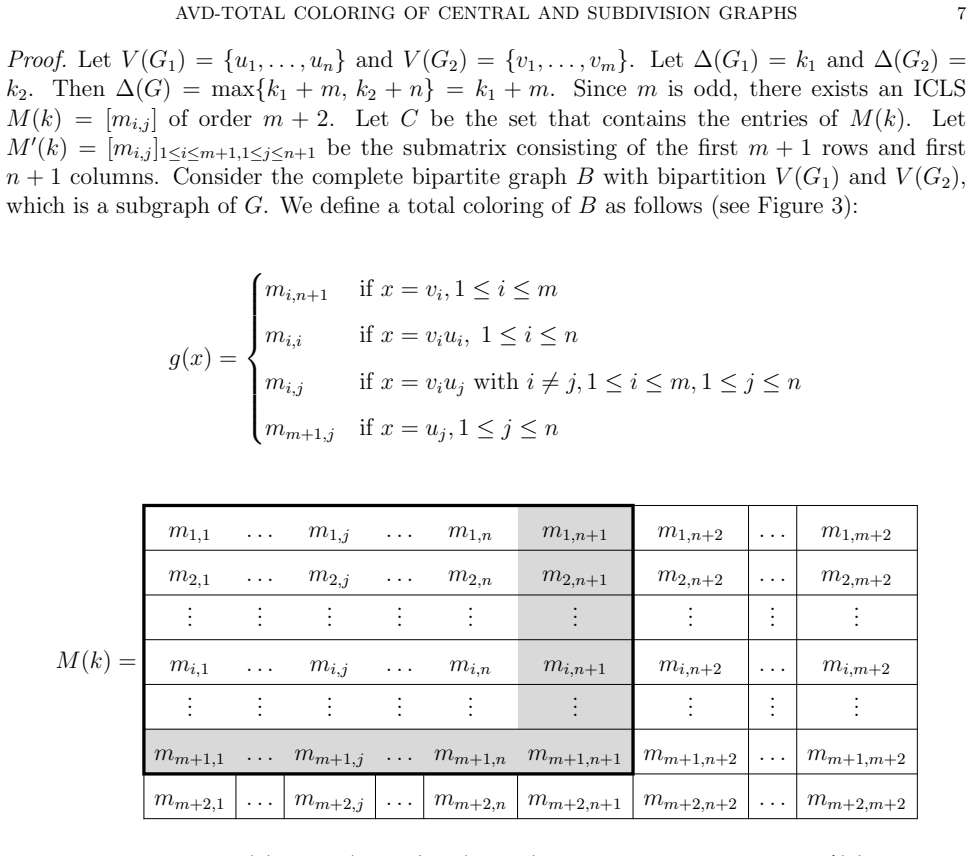
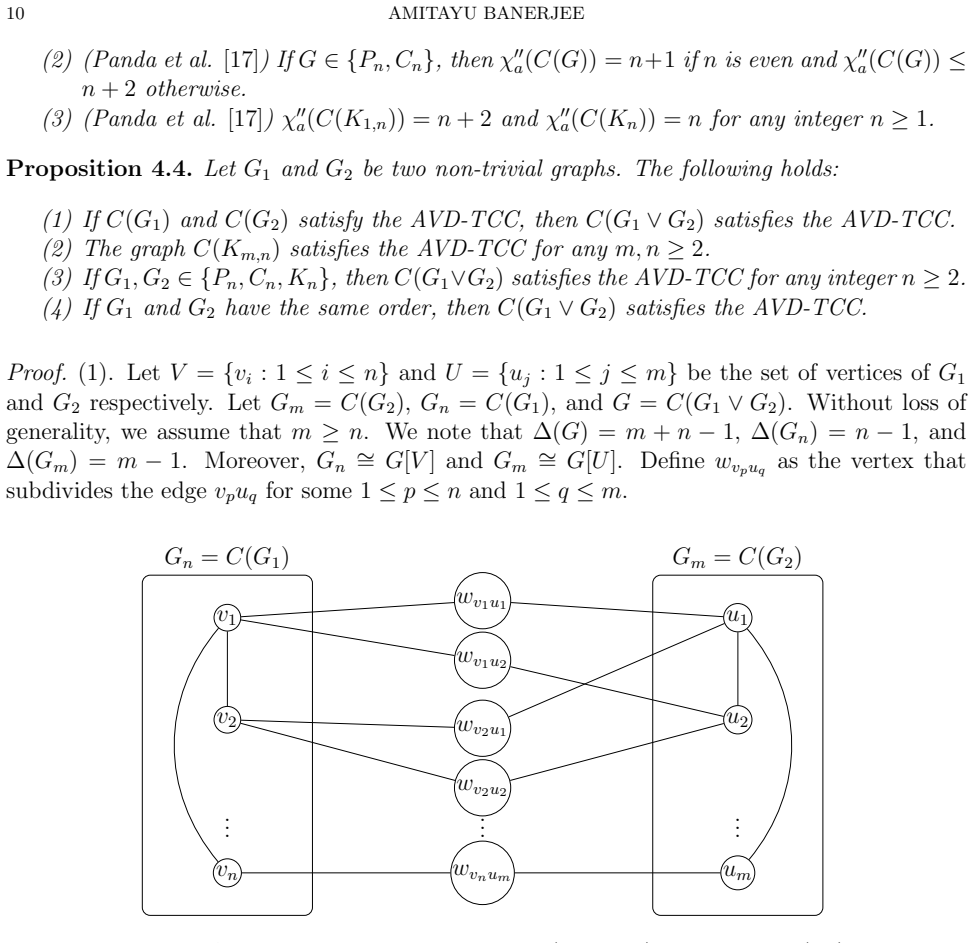
The central graph of every regular graph admits an AVD-total coloring using at most the conjectured number of colors; the same holds for the central graphs of complete bipartite graphs and of joins of two graphs of equal order. The AVD-total chromatic number of every subdivision graph equals its maximum degree plus two. New exact values or bounds are obtained for the AVD-total chromatic numbers of joins of graphs.
What carries the argument
The central graph construction, which augments an input graph by adding a vertex for each edge and connecting those new vertices according to the original non-adjacencies and incidences.
If this is right
- The conjecture holds for the central graphs of all regular graphs.
- The AVD-total chromatic number of every subdivision graph is exactly its maximum degree plus two.
- Joins of two graphs of equal order have central graphs that meet the conjectured bound.
- The same bound applies to central graphs of several further explicitly listed families.
Where Pith is reading between the lines
- If the same proof techniques extend to non-regular graphs, the conjecture would hold for all central graphs.
- The determined chromatic numbers for subdivision graphs may serve as base cases for inductive arguments on larger graph families.
- Exact values for joins suggest that the conjecture could be settled first for graphs with a natural decomposition into equal-order parts.
Load-bearing premise
The standard definitions of central graphs, subdivision graphs, and graph joins used throughout the proofs impose no extra restrictions on the input graphs beyond those stated in the 2020 reference.
What would settle it
Exhibit one regular graph whose central graph requires strictly more than Delta plus two colors in any AVD-total coloring, where Delta is the maximum degree of the central graph.
Figures


read the original abstract
In 2020, Panda, Verma, and Keerti asked whether the central graph of every graph satisfies the AVD-total coloring conjecture. In this paper, we verify the conjecture for central graphs of regular graphs, complete bipartite graphs, graphs that can be expressed as the join of two graphs of the same order, and several other graph classes, thereby providing partial progress towards this open problem. We further determine the AVD-total chromatic number of subdivision graphs and establish new results on the AVD-total coloring of joins of graphs.
Editorial analysis
A structured set of objections, weighed in public.
Referee Report
Summary. The paper verifies the AVD-total coloring conjecture (posed by Panda, Verma, and Keerti in 2020) for central graphs of regular graphs, complete bipartite graphs K_{m,n}, joins G ∨ H where |V(G)| = |V(H)|, subdivision graphs, and several additional graph classes. It determines the AVD-total chromatic number for subdivision graphs and establishes further results on AVD-total colorings of joins.
Significance. The explicit verifications via direct constructions or reductions to known total-chromatic-number bounds supply concrete support for the conjecture on multiple standard families. When the case analyses are complete, this constitutes measurable partial progress on an open problem in graph coloring.
Simulated Author's Rebuttal
We thank the referee for their positive evaluation of the manuscript and for recommending acceptance. The report contains no major comments requiring response.
Circularity Check
No significant circularity identified
full rationale
The paper verifies the AVD-total coloring conjecture on standard, explicitly defined graph families (central graphs of regular graphs, complete bipartite graphs, joins G ∨ H with equal order, subdivision graphs) via direct case analysis and reductions to known total chromatic number bounds plus the AVD condition. No step reduces a claimed prediction or uniqueness result to a fitted parameter, self-definition, or load-bearing self-citation chain; all constructions use external, non-overlapping prior definitions and produce independent colorings for the listed classes.
Axiom & Free-Parameter Ledger
axioms (1)
- standard math Standard definitions of graphs, central graphs, subdivision graphs, join of graphs, and AVD-total coloring as established in prior literature.
Reference graph
Works this paper leans on
-
[1]
Arockia Aruldoss and G
J. Arockia Aruldoss and G. Gurulakshmi, The Dominator Coloring of Central and Middle Graph of Some Special Graphs,Int. J. Math. Appl.4(2016), 67–73
2016
-
[2]
Alib and D.M
C. Alib and D.M. Magpantay, On Some Parameters of the Central Graphs of the Identity Graphs of Finite Cyclic Groups,Eur. j. pure appl. math.15(2022), 1098–1112
2022
-
[3]
R. D. Barish, S. Fujita, F. Kazemnejad, and B. Pahlavsay, Classification of Graphs Via Vertex Cover and Domination Numbers,Graphs Combin.42(2026).https://doi.org/10.1007/s00373-026-03028-6
-
[4]
Behzad, Graphs and their chromatic number, Ph.D.Thesis, Michigan State University, (1965)
M. Behzad, Graphs and their chromatic number, Ph.D.Thesis, Michigan State University, (1965)
1965
-
[5]
Chen, On the adjacent vertex distinguishing total coloring numbers of graphs with ∆=3,Discrete Math
X. Chen, On the adjacent vertex distinguishing total coloring numbers of graphs with ∆=3,Discrete Math. 308(2008), 4003–4007
2008
-
[6]
M. Chen, X. Guo, Adjacent vertex-distinguishing edge and total chromatic numbers of hypercubes,Infor- mation Processing Letters109(2009), 599–602
2009
-
[7]
Chen, M.Y
X.G. Chen, M.Y. Sohn, and Y.F. Wang, Total domination number of central trees,Bull. Korean Math. Soc.57(2020), 245–250
2020
-
[8]
Effantin, A note on Grundy colorings of central graphs,Australas
B. Effantin, A note on Grundy colorings of central graphs,Australas. J. Comb.68(2017), 346–356
2017
-
[9]
Galvin, The list chromatic index of a bipartite multigraph,J
F. Galvin, The list chromatic index of a bipartite multigraph,J. Combin. Theory Ser. B63(1995), 153–158
1995
-
[10]
Kazemnejad and A.P
F. Kazemnejad and A.P. Kazemi, Total dominator coloring of central graphs,Ars Comb.155(2021), 45–67
2021
-
[11]
Kazemnejad and S
F. Kazemnejad and S. Moradi, Total domination number of central graphs,Bull. Korean Math. Soc.56 (2019), 1059–1075
2019
-
[12]
T. Kavaskar and S. Sukumaran, Total Coloring of Some Graph Operations,In: Kalyanasundaram, S., Maheshwari, A. (eds) Algorithms and Discrete Applied Mathematics. CALDAM 2024. Lecture Notes in Computer Science, vol 14508. Springer, Cham.https://doi.org/10.1007/978-3-031-52213-0_21
-
[13]
Y. Lu, J. Li, R. Luo, Z. Miao, Adjacent vertex distinguishing total coloring of graphs with maximum degree 4,Discrete Math.340(2017), 119–123
2017
-
[14]
At´ ılio Luiz, C.N
G. At´ ılio Luiz, C.N. Campos, C.P. de Mello, AVD-total-colouring of complete equipartite graphs,Discrete Appl. Math.184(2015), 189–195
2015
-
[15]
Papaioannou and C
A. Papaioannou and C. Raftopoulou, On the AVDTC of 4-regular graphs,Discrete Math.330(2014), 20–40
2014
-
[16]
Pedrotti, C
V. Pedrotti, C. P. de Mello, Adjacent-vertex-distinguishing total coloring of indifference graphs,Matematica Contemporanea39(2010), 101–110
2010
-
[17]
B. S. Panda, S. Verma, and Y. Keerti, On the total and AVD-total coloring of graphs,AKCE Int. J. Graphs Comb.17(2020), 820–825. doi:https://doi.org/10.1016/j.akcej.2019.10.004
-
[18]
J. V. Vernold, Harmonious coloring of total graphs,n-leaf, central graphs and circumdetic graphs,Ph.D Thesis, Bharathiar University, Coimbatore, India, 2007
2007
-
[19]
Verma, H
S. Verma, H. L. Fu, and B. S. Panda, Adjacent vertex distinguishing total coloring in split graphs,Discrete Math.345(2022), 113061
2022
-
[20]
Vizing, Some unsolved problems in graph theory,Uspekhi Mat
V.G. Vizing, Some unsolved problems in graph theory,Uspekhi Mat. Nauk.23(1968), 117–134
1968
-
[21]
Wang, On the adjacent vertex-distinguishing total chromatic numbers of the graphs with ∆ = 3,J
H. Wang, On the adjacent vertex-distinguishing total chromatic numbers of the graphs with ∆ = 3,J. Comb. Optim.14(2007), 87–109
2007
-
[22]
H. P. Yap and K. H. Chew, Total chromatic number of graphs of high degree, II,J. Austral. Math. Soc. 53(1992), 219–228
1992
-
[23]
Zhang, X
Z. Zhang, X. Chen, J. Li, B. Yao, X. Lu, and J. Wang, On adjacent-vertex-distinguishing total coloring of graphs,Sci. China Ser. A48(2005), 289–299. E¨otv¨os Lor´and University, Budapest, Hungary Email address:banerjee.amitayu@gmail.com
2005
discussion (0)
Sign in with ORCID, Apple, or X to comment. Anyone can read and Pith papers without signing in.