QFedAgent: Quantum-Enhanced Personalized Federated Learning for Multi-Agent Activity Recognition
Pith reviewed 2026-07-03 16:23 UTC · model grok-4.3
The pith
A variational quantum circuit with 72 parameters fuses accelerometer and gyroscope data inside a personalized federated learning model for activity recognition.
A machine-rendered reading of the paper's core claim, the machinery that carries it, and where it could break.
Core claim
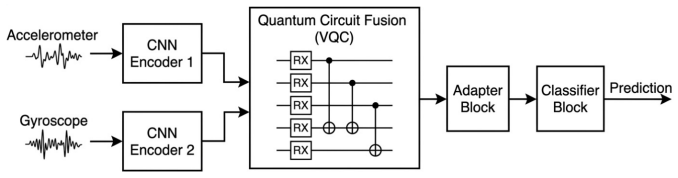
QFedAgent integrates a variational quantum circuit fusion module that models accelerometer-gyroscope interactions through quantum state encoding and entanglement, requiring only 72 quantum rotation parameters versus 33K in classical multi-layer perceptron-based fusion, achieving approximately 10x total parameter reduction. Experiments on the OPPORTUNITY dataset under subject-based non-IID partitions demonstrate 97.7% mean test accuracy, confirming that parameter-efficient quantum fusion remains competitive with conventional federated baselines.
What carries the argument
Variational quantum circuit fusion module that models accelerometer-gyroscope interactions through quantum state encoding and entanglement
Load-bearing premise
The variational quantum circuit with 72 rotation parameters is assumed to capture the necessary cross-sensor interactions at least as effectively as a classical 33K-parameter fusion layer under the tested non-IID partitions.
What would settle it
An ablation that replaces the 72-parameter quantum fusion module with the original 33K-parameter classical layer inside the same personalized FL architecture and measures whether accuracy on the same OPPORTUNITY non-IID splits falls below 97.7 percent.
Figures


read the original abstract
Federated learning (FL) enables collaborative model training across distributed devices without sharing raw data, making it suitable for privacy-sensitive robotic sensing applications. However, multi-agent systems generate heterogeneous and non-independent and identically distributed (non-IID) multimodal sensor streams that degrade conventional FL algorithms, while classical fusion modules introduce substantial parameter overhead and communication cost. This paper proposes QFedAgent, a hybrid quantum-classical personalized FL framework for multi-agent activity recognition. The approach integrates a variational quantum circuit fusion module that models accelerometer--gyroscope interactions through quantum state encoding and entanglement, requiring only 72 quantum rotation parameters versus 33K in classical multi-layer perceptron-based fusion, achieving approximately 10x total parameter reduction. Experiments on the OPPORTUNITY dataset under subject-based non-IID partitions demonstrate 97.7% mean test accuracy, confirming that parameter-efficient quantum fusion remains competitive with conventional federated baselines.
Editorial analysis
A structured set of objections, weighed in public.
Referee Report
Summary. The paper proposes QFedAgent, a hybrid quantum-classical personalized federated learning framework for multi-agent activity recognition. It integrates a variational quantum circuit (VQC) fusion module that encodes accelerometer-gyroscope interactions via quantum state encoding and entanglement, using only 72 rotation parameters compared to 33K in a classical MLP-based fusion layer (approximately 10x total parameter reduction). Experiments on the OPPORTUNITY dataset under subject-based non-IID partitions report a mean test accuracy of 97.7%.
Significance. If substantiated, the result would indicate that variational quantum circuits can enable parameter-efficient multimodal fusion within personalized FL, lowering communication overhead in privacy-sensitive robotic sensing applications. The work would contribute to the intersection of quantum machine learning and federated learning by demonstrating a concrete parameter reduction on a standard activity recognition benchmark.
major comments (2)
- Abstract: The central claim that the VQC fusion module with 72 rotation parameters captures the necessary cross-sensor interactions at least as effectively as the 33K-parameter classical MLP is load-bearing for attributing the reported efficiency gain to the quantum construction. No comparison is provided to a classical fusion module constrained to a comparable ~72-parameter budget, so it remains possible that low-parameter classical solutions suffice and the quantum advantage is not demonstrated.
- Abstract: The reported 97.7% mean test accuracy and parameter counts are presented without any description of the experimental protocol, baseline methods, number of runs, error bars, statistical tests, or circuit diagram. This absence prevents evaluation of whether the performance claim is reproducible or statistically meaningful.
Simulated Author's Rebuttal
We thank the referee for the constructive feedback on our manuscript. We address each major comment below, indicating planned revisions where appropriate.
read point-by-point responses
-
Referee: Abstract: The central claim that the VQC fusion module with 72 rotation parameters captures the necessary cross-sensor interactions at least as effectively as the 33K-parameter classical MLP is load-bearing for attributing the reported efficiency gain to the quantum construction. No comparison is provided to a classical fusion module constrained to a comparable ~72-parameter budget, so it remains possible that low-parameter classical solutions suffice and the quantum advantage is not demonstrated.
Authors: We agree that a direct comparison to a classical fusion module constrained to a comparable parameter budget (~72 parameters) is necessary to substantiate the quantum advantage claim. In the revised manuscript we will add this baseline (a single linear layer or equivalent low-capacity classical fusion module) evaluated on the same subject-based non-IID OPPORTUNITY partitions and report its accuracy alongside the VQC results. revision: yes
-
Referee: Abstract: The reported 97.7% mean test accuracy and parameter counts are presented without any description of the experimental protocol, baseline methods, number of runs, error bars, statistical tests, or circuit diagram. This absence prevents evaluation of whether the performance claim is reproducible or statistically meaningful.
Authors: The abstract is intentionally concise. The full experimental protocol (subject-based non-IID partitioning of OPPORTUNITY, baseline methods including FedAvg and pFedMe, 5 independent runs with standard deviation error bars, and the VQC circuit diagram in Figure 3) is detailed in Sections 4 and 5. We will revise the abstract to include a brief reference to the experimental setup and statistical reporting while retaining its length constraints. revision: partial
Circularity Check
No derivation reduces accuracy or parameter count to fitted inputs by construction
full rationale
The paper reports an empirical outcome (97.7% mean test accuracy on OPPORTUNITY under subject-based non-IID partitions) from a hybrid quantum-classical architecture whose parameter count (72 rotation parameters in the VQC fusion module versus 33K in an MLP) is presented as an architectural fact rather than a quantity derived from or fitted to the target metric. No equations appear that equate the reported accuracy or efficiency gain to quantities defined in terms of themselves. Any self-citations present are not shown to be load-bearing for the central performance claim, which remains an externally falsifiable experimental result.
Axiom & Free-Parameter Ledger
free parameters (1)
- 72 quantum rotation parameters
axioms (1)
- domain assumption Quantum state encoding and entanglement can model accelerometer-gyroscope interactions at least as well as a classical MLP with 33K parameters
invented entities (1)
-
Variational quantum circuit fusion module
no independent evidence
Reference graph
Works this paper leans on
-
[1]
Gutierrez, Gerardo M. and Rincon, Jaime A. and Julian, Vicente , TITLE =. Electronics , month =. 2025 , NUMBER =
work page 2025
-
[2]
Mughal, F. R. and He, J. and Das, B. and Dharejo, Fayaz Ali and Zhu, Nafei and Khan, Surbhi Bhatia and Alzahrani, Saeed , title =. Scientific Reports , month =. 2024 , doi =
work page 2024
-
[3]
Procedia Computer Science , volume =
Yu, Xianjia and Peña Queralta, Jorge and Heikkonen, Jukka and Westerlund, Tomi , title =. Procedia Computer Science , volume =. 2021 , issn =
work page 2021
-
[4]
McMahan, Brendan and Moore, Eider and Ramage, Daniel and Hampson, Seth and Arcas, Blaise Aguera Y , title =. Proceedings of the 20th International Conference on Artificial Intelligence and Statistics (AISTATS) , address =. 2017 , month =
work page 2017
-
[5]
Proceedings of the 3rd MLSys Conference , address =
Tian Li and Anit Kumar Sahu and Manzil Zaheer and Maziar Sanjabi and Ameet Talwalkar and Virginia Smith , title =. Proceedings of the 3rd MLSys Conference , address =
-
[6]
Evaluating analytic gradients on quantum hardware , author =. Physical Review A , volume =. 2019 , month =
work page 2019
-
[7]
and Vasisht, Deepak and Chowdhary, Girish , journal=
Gummadi, Shreya and Gasparino, Mateus V. and Vasisht, Deepak and Chowdhary, Girish , journal=. 2024 , volume=
work page 2024
-
[8]
Proceedings of the 7th International Conference on Networked Sensing Systems (INSS) , year =
Daniel Roggen and Alberto Calatroni and Mirco Rossi and Thomas Holleczek and Kilian Förster and Gerhard Tröster , title =. Proceedings of the 7th International Conference on Networked Sensing Systems (INSS) , year =
-
[9]
A Survey on Model-heterogeneous Federated Learning: Problems, Methods, and Prospects , year =
Fan, Boyu and Jiang, Siyang and Su, Xiang and Tarkoma, Sasu and Hui, Pan , booktitle =. A Survey on Model-heterogeneous Federated Learning: Problems, Methods, and Prospects , year =
-
[10]
Monzón-Verona, José Miguel and García-Alonso, Santiago and Santana-Martín, Francisco Jorge , TITLE =. Sensors , month =. 2025 , NUMBER =
work page 2025
-
[11]
Multimodal feature fusion for human activity recognition using human centric temporal transformer , journal =. 2025 , issn =
work page 2025
discussion (0)
Sign in with ORCID, Apple, or X to comment. Anyone can read and Pith papers without signing in.