REVIEW 1 major objections 42 references
Real-world dirty postal addresses with ground truth expose limits of data cleaning methods.
Reviewed by Pith at T0; open to challenge. T0 means a machine referee read the full paper against a public rubric. the ladder, T0–T4 →
T0 review · grok-4.3
2026-07-02 16:52 UTC pith:NYXNHGUV
load-bearing objection The paper releases a sizable new dirty postal address dataset with ground truth and shows existing cleaners struggle on it, but the errors are too address-specific to reliably benchmark general tabular cleaning methods. the 1 major comments →
Clean Me If You Can: A Large Collection of Real-World Addresses for Data Cleaning Benchmarking
The pith
A machine-rendered reading of the paper's core claim, the machinery that carries it, and where it could break.
Core claim
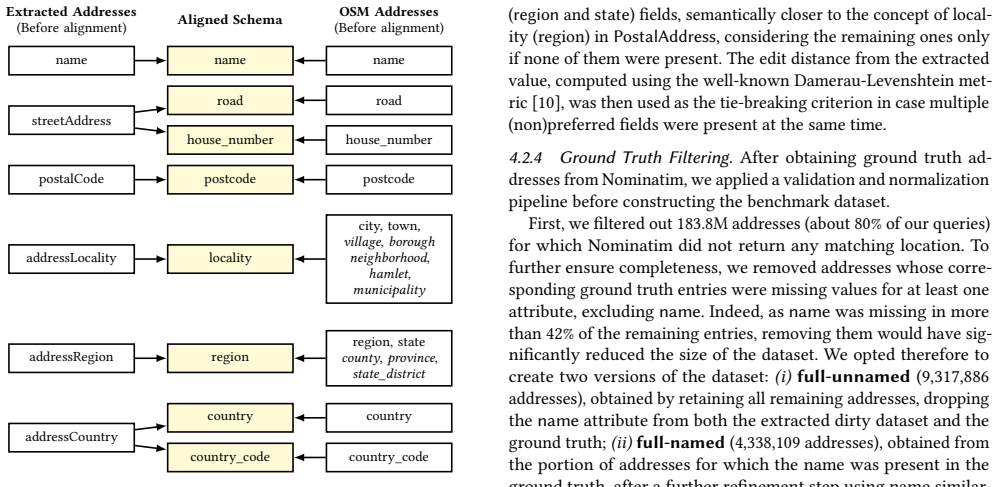
We address this gap by providing a large, dirty dataset with postal entries and their corresponding ground truth. We discuss the design decisions and challenges for obtaining the dataset. We demonstrate the limitations of existing cleaning approaches when faced with our proposed datasets and derive guidelines for future research.
What carries the argument
Large collection of real-world postal address data with ground truth for benchmarking data cleaning.
Load-bearing premise
The collected postal data is representative enough of real-world dirty tabular data to expose meaningful limitations in existing cleaning approaches.
What would settle it
Existing cleaning approaches performing as well on this dataset as on prior benchmarks would indicate the dataset does not reveal new limitations.
If this is right
- Data cleaning methods require testing on real-world dirty data to assess true effectiveness.
- Current approaches face challenges with the error types present in postal address entries.
- Future research should focus on developing methods that handle realistic data distributions.
- Guidelines from the benchmark can inform the design of more robust cleaning systems.
Where Pith is reading between the lines
- Similar large-scale ground truth collections could be created for other data types to advance benchmarking in the field.
- The dataset enables reproducible experiments that compare cleaning performance across different tools on identical real data.
- Insights from address cleaning limitations may apply to other structured text data like names or descriptions.
Editorial analysis
A structured set of objections, weighed in public.
Referee Report
Summary. The manuscript claims to address the lack of real-world dirty tabular datasets for data cleaning research by releasing a large collection of postal address entries paired with ground truth. It discusses design decisions and challenges in dataset collection, demonstrates limitations of existing cleaning approaches on the proposed data, and derives guidelines for future research.
Significance. If the dataset's error distributions are shown to be representative of broader tabular cleaning challenges, the release would be a valuable contribution by enabling realistic benchmarking in a field that currently relies on controlled or synthetic data. The explicit evaluation of existing methods' shortcomings and the resulting guidelines are constructive. The provision of a large-scale real-world dataset with ground truth supports reproducibility and is a clear strength.
major comments (1)
- [Abstract] Abstract: The central motivation—that the postal dataset exposes meaningful limitations in existing (general-purpose) cleaning approaches—depends on the representativeness of postal-specific error modes (formatting inconsistencies, zip mismatches) for general tabular issues such as cross-column dependencies or numerical outliers. The design decisions discussion must provide concrete evidence or analysis that the collected dirtiness is not narrowly address-centric; without this, the claim that the dataset addresses the documented gap in real-world tabular data remains insecure.
Simulated Author's Rebuttal
We thank the referee for the constructive feedback on the abstract and motivation. We agree that strengthening the discussion of representativeness is valuable and will revise the manuscript to include additional analysis.
read point-by-point responses
-
Referee: [Abstract] Abstract: The central motivation—that the postal dataset exposes meaningful limitations in existing (general-purpose) cleaning approaches—depends on the representativeness of postal-specific error modes (formatting inconsistencies, zip mismatches) for general tabular issues such as cross-column dependencies or numerical outliers. The design decisions discussion must provide concrete evidence or analysis that the collected dirtiness is not narrowly address-centric; without this, the claim that the dataset addresses the documented gap in real-world tabular data remains insecure.
Authors: We acknowledge the referee's point that postal address errors have domain-specific characteristics. However, the dataset does capture several error types relevant to general tabular cleaning, including cross-column dependencies (e.g., inconsistencies between street, city, and zip fields that violate real-world constraints), formatting variations, abbreviations, and missing values. These arise from the real-world collection process described in the design decisions section. To make the claim more secure, we will revise the manuscript to add a dedicated subsection with quantitative breakdown of error categories, their frequencies, and explicit mapping to common tabular issues (such as dependency violations), along with examples showing overlap beyond purely address-centric problems. This will be supported by statistics from the released dataset. revision: yes
Circularity Check
Dataset release paper exhibits no circularity
full rationale
The paper contributes a new real-world dirty postal address dataset with ground truth labels. Its claims rest on data collection, design decisions, and empirical evaluation of existing cleaners on this data; no equations, fitted parameters, predictions, or derivations are present that could reduce to inputs by construction. No self-citation chains, uniqueness theorems, or ansatzes are invoked as load-bearing steps. The representativeness assumption is an external validity concern, not a circularity issue.
Axiom & Free-Parameter Ledger
read the original abstract
There has been extensive research on automating and scaling data cleaning, i.e., the detection and correction of erroneous values in tabular data. Yet, existing approaches often perform well only within controlled environments. One of the major bottlenecks in data cleaning research is the lack of real-world datasets. In this paper, we address this gap by providing a large, dirty dataset with postal entries and their corresponding ground truth. We discuss the design decisions and challenges for obtaining the dataset. We demonstrate the limitations of existing cleaning approaches when faced with our proposed datasets and derive guidelines for future research.
Figures


Reference graph
Works this paper leans on
-
[1]
Mohamed Abdelaal, Christian Hammacher, and Harald Schöning. 2023. REIN: A Comprehensive Benchmark Framework for Data Cleaning Methods in ML Pipelines. InProceedings of the International Conference on Extending Database Technology (EDBT). 499–511. https://doi.org/10.48786/edbt.2023.43
-
[2]
Akcora, Mourad Ouzzani, Paolo Papotti, and Michael Stonebraker
Ziawasch Abedjan, Cuneyt G. Akcora, Mourad Ouzzani, Paolo Papotti, and Michael Stonebraker. 2015. Temporal Rules Discovery for Web Data Cleaning. Proceedings of the VLDB Endowment (PVLDB)9, 4 (2015), 336–347. https://doi. org/10.14778/2856318.2856328
-
[3]
Ilyas, Mourad Ouzzani, Paolo Papotti, Michael Stonebraker, and Nan Tang
Ziawasch Abedjan, Xu Chu, Dong Deng, Raul Castro Fernandez, Ihab F. Ilyas, Mourad Ouzzani, Paolo Papotti, Michael Stonebraker, and Nan Tang. 2016. De- tecting Data Errors: Where are we and what needs to be done?Proceedings of 12 the VLDB Endowment (PVLDB)9, 12 (2016), 993–1004. https://doi.org/10.14778/ 2994509.2994518
-
[4]
Arocena, Boris Glavic, Giansalvatore Mecca, Renée J
Patricia C. Arocena, Boris Glavic, Giansalvatore Mecca, Renée J. Miller, Paolo Papotti, and Donatello Santoro. 2015. Messing Up with BART: Error Generation for Evaluating Data-Cleaning Algorithms.Proceedings of the VLDB Endowment (PVLDB)9, 2 (2015), 36–47. https://doi.org/10.14778/2850578.2850579
-
[5]
Christopher Barrington-Leigh and Adam Millard-Ball. 2017. The World’s User- Generated Road Map Is More Than 80% Complete.PLOS ONE12, 8 (2017), e0180698. https://doi.org/10.1371/journal.pone.0180698
-
[6]
Divya Bhadauria, Hazar Harmouch, Felix Naumann, Divesh Srivastava, and Lisa Ehrlinger. 2026. A Catalog of Data Errors.CoRRabs/2604.09277 (2026). https://doi.org/10.48550/ARXIV.2604.09277 arXiv:2604.09277
work page internal anchor Pith review Pith/arXiv arXiv doi:10.48550/arxiv.2604.09277 2026
-
[7]
Felix Bießmann, Tammo Rukat, Philipp Schmidt, Prathik Naidu, Sebastian Schel- ter, Andrey Taptunov, Dustin Lange, and David Salinas. 2019. DataWig: Missing Value Imputation for Tables.Journal of Machine Learning Research (JMLR)20, Article 175 (2019), 6 pages. https://jmlr.org/papers/v20/18-753.html
2019
-
[8]
Alexander Brinkmann, Anna Primpeli, and Christian Bizer. 2023. The Web Data Commons Schema.org Data Set Series. InCompanion Proceedings of the ACM Web Conference 2023, WWW 2023, Austin, TX, USA, 30 April 2023 - 4 May 2023, Ying Ding, Jie Tang, Juan F. Sequeda, Lora Aroyo, Carlos Castillo, and Geert-Jan Houben (Eds.). ACM, 136–139. https://doi.org/10.1145/...
-
[9]
Xu Chu, Ihab F. Ilyas, and Paolo Papotti. 2013. Holistic Data Cleaning: Putting Violations Into Context. InProceedings of the IEEE International Conference on Data Engineering (ICDE). 458–469. https://doi.org/10.1109/ICDE.2013.6544847
-
[10]
Fred Damerau. 1964. A Technique for Computer Detection and Correction of Spelling Errors.Communications of the ACM (CACM)7, 3 (1964), 171–176. https://doi.org/10.1145/363958.363994
-
[11]
Edith Desiree de Leeuw. 1992. Data Quality in Mail, Telephone and Face to Face Surveys. https://eric.ed.gov/?id=ED374136
1992
-
[12]
Xiaoou Ding, Zekai Qian, Hongzhi Wang, Siying Chen, Yafeng Tang, Hongbin Su, Huan Hu, and Chen Wang. 2025. UniClean: A Scalable Data Cleaning Solution for Mixed Errors based on Unified Cleaners and Optimized Cleaning Workflow.Proceedings of the VLDB Endowment (PVLDB)18, 11 (2025), 4117–4130. https://doi.org/10.14778/3749646.3749681
-
[13]
Anna-Christina Glock, Christine Dominka-Kiss, Philipp Korom, and Lisa Ehrlinger. 2025. Detecting and Cleaning Errors in Personal Contact Information with Large Language Models.Proceedings of the VLDB Endowment (PVLDB) (2025)
2025
-
[14]
Jean-Nicholas Hould. 2017. Craft Beers Dataset. https://www.kaggle.com/ nickhould/craft-cans. Version 1
2017
-
[15]
Ykä Huhtala, Juha Kärkkäinen, Pasi Porkka, and Hannu Toivonen. 1999. TANE: An Efficient Algorithm for Discovering Functional and Approximate Dependen- cies.Comput. J.42, 2 (1999), 100–111. https://doi.org/10.1093/COMJNL/42.2.100
-
[16]
Philipp Jung, Sebastian Jäger, Nicholas Chandler, and Felix Biessmann. 2025. Towards Realistic Error Models for Tabular Data.ACM J. Data Inf. Qual.17, 4 (2025), 28:1–28:27. https://doi.org/10.1145/3774914
-
[17]
Bojan Karlas, Peng Li, Renzhi Wu, Nezihe Merve Gürel, Xu Chu, Wentao Wu, and Ce Zhang. 2020. Nearest Neighbor Classifiers over Incomplete Information: From Certain Answers to Certain Predictions.Proceedings of the VLDB Endowment (PVLDB)14, 3 (2020), 255–267. https://doi.org/10.14778/3430915.3430917
-
[18]
Levenshtein
Vladimir I. Levenshtein. 1966. Binary Codes Capable of Correcting Deletions, Insertions, and Reversals.Soviet Physics Doklady10, 8 (1966), 707–710
1966
-
[19]
Peng Li, Xi Rao, Jennifer Blase, Yue Zhang, Xu Chu, and Ce Zhang. 2021. CleanML: A Study for Evaluating the Impact of Data Cleaning on ML Classification Tasks. InProceedings of the IEEE International Conference on Data Engineering (ICDE). https://doi.org/10.1109/ICDE51399.2021.00009
-
[20]
Xian Li, Xin Luna Dong, Kenneth Lyons, Weiyi Meng, and Divesh Srivastava
-
[21]
https://doi.org/10.14778/2535568
Truth Finding on the Deep Web: Is the Problem Solved?Proceedings of the VLDB Endowment (PVLDB)6, 2 (2012), 97–108. https://doi.org/10.14778/2535568. 2448943
-
[22]
Yi Li and Gao Cong. 2025. GeoBloom: Revisiting Lightweight Models for Geo- graphic Information Retrieval.Proceedings of the VLDB Endowment (PVLDB)18, 5 (2025), 1348–1361. https://doi.org/10.14778/3718057.3718064
-
[23]
Yiding Liu, Tuan-Anh Nguyen Pham, Gao Cong, and Quan Yuan. 2017. An Experimental Evaluation of Point-of-interest Recommendation in Location-based Social Networks.Proceedings of the VLDB Endowment (PVLDB)10, 10 (2017), 1010–1021. https://doi.org/10.14778/3115404.3115407
-
[24]
Mohammad Mahdavi and Ziawasch Abedjan. 2020. Baran: Effective Error Correction via a Unified Context Representation and Transfer Learning.Pro- ceedings of the VLDB Endowment (PVLDB)13, 11 (2020), 1948–1961. https: //doi.org/10.14778/3407790.3407801
-
[25]
Mohammad Mahdavi, Ziawasch Abedjan, Raul Castro Fernandez, Samuel Mad- den, Mourad Ouzzani, Michael Stonebraker, and Nan Tang. 2019. Raha: A Configuration-Free Error Detection System. InProceedings of the ACM In- ternational Conference on Management of Data (SIGMOD). 865–882. https: //doi.org/10.1145/3299869.3324956
-
[26]
Sedir Mohammed, Lukas Budach, Moritz Feuerpfeil, Nina Ihde, Andrea Nathansen, Nele Sina Noack, Hendrik Patzlaff, Felix Naumann, and Hazar Har- mouch. 2025. The effects of data quality on machine learning performance on tabular data.Information Systems132, Article 102549 (2025), 18 pages. https://doi.org/10.1016/j.is.2025.102549
-
[27]
Sedir Mohammed, Lisa Ehrlinger, Hazar Harmouch, Felix Naumann, and Divesh Srivastava. 2025. The Five Facets of Data Quality Assessment.ACM SIGMOD Record54, 2 (2025), 18–27. https://doi.org/10.1145/3749116.3749120
- [28]
-
[29]
Wei Ni, Kaihang Zhang, Xiaoye Miao, Xiangyu Zhao, Yangyang Wu, Yaoshu Wang, and Jianwei Yin. 2025. ZeroED: Hybrid Zero-Shot Error Detection Through Large Language Model Reasoning. In41st IEEE International Conference on Data Engineering, ICDE 2025, Hong Kong, May 19-23, 2025. IEEE, 3126–3139. https: //doi.org/10.1109/ICDE65448.2025.00234
-
[30]
Mourad Ouzzani, Hossam Hammady, Zbys Fedorowicz, and Ahmed Elmagarmid
-
[31]
https://doi.org/10.1186/s13643-016-0384-4
Rayyan—a web and mobile app for systematic reviews.Systematic Reviews 5, Article 210 (2016), 10 pages. https://doi.org/10.1186/s13643-016-0384-4
-
[32]
Theodoros Rekatsinas, Xu Chu, Ihab F. Ilyas, and Christopher Ré. 2017. Holo- Clean: Holistic Data Repairs with Probabilistic Inference.Proceedings of the VLDB Endowment (PVLDB)10, 11 (2017), 1190–1201. https://doi.org/10.14778/ 3137628.3137631
-
[33]
Valerie Restat, Gerrit Boerner, André Conrad, and Uta Störl. 2022. GouDa - Generation of universal Data Sets: Improving Analysis and Evaluation of Data Preparation Pipelines. InProceedings of the Workshop on Data Management for End-To-End Machine Learning (DEEM). Article 2, 6 pages. https://doi.org/10. 1145/3533028.3533311
-
[34]
Aref, Ahmed K
El Kindi Rezig, Mourad Ouzzani, Walid G. Aref, Ahmed K. Elmagarmid, Ahmed R. Mahmood, and Michael Stonebraker. 2021. Horizon: Scalable Dependency-driven Data Cleaning.Proceedings of the VLDB Endowment (PVLDB)14, 11 (2021), 2546–
2021
-
[35]
https://doi.org/10.14778/3476249.3476301
-
[36]
Sebastian Schelter, Tammo Rukat, and Felix Biessmann. 2021. JENGA - A Frame- work to Study the Impact of Data Errors on the Predictions of Machine Learning Models. InProceedings of the International Conference on Extending Database Technology (EDBT). 529–534. https://doi.org/10.5441/002/edbt.2021.63
-
[37]
Shafaq Siddiqi, Roman Kern, and Matthias Boehm. 2023. SAGA: A Scalable Framework for Optimizing Data Cleaning Pipelines for Machine Learning Ap- plications.Proceedings of the ACM on Management of Data (PACMMOD)1, 3, Article 218 (2023), 26 pages. https://doi.org/10.1145/3617338
-
[38]
Jasmin Singh and Heiko Gebauer. 2024. Clean Customer Master Data for Cus- tomer Analytics: A Neglected Element of Data Monetization.Digital4, 4 (2024), 1020–1038. https://doi.org/10.3390/digital4040051
-
[39]
Nishant Subramani, Sasha Luccioni, Jesse Dodge, and Margaret Mitchell. 2023. Detecting Personal Information in Training Corpora: an Analysis. InProceedings of the Workshop on Trustworthy Natural Language Processing (TrustNLP). 208–220. https://doi.org/10.18653/v1/2023.trustnlp-1.18
-
[40]
The Unicode Consortium. 2024. The Unicode Standard, Version 15.1. https: //www.unicode.org/versions/Unicode15.1.0/
2024
-
[41]
United States Postal Service. 2014. Undeliverable as Addressed Mail. https: //www.uspsoig.gov/reports/audit-reports/undeliverable-addressed-mail
2014
-
[42]
Yangyang Wu, Chen Yang, Mengying Zhu, Xiaoye Miao, Wei Ni, Meng Xi, Xinkui Zhao, and Jianwei Yin. 2025. A Zero-Training Error Correction System with Large Language Models. InProceedings of the IEEE International Conference on Data Engineering (ICDE). 2949–2962. https://doi.org/10.1109/ICDE65448.2025.00221 13
discussion (0)
Sign in with ORCID, Apple, or X to comment. Anyone can read and Pith papers without signing in.