Approximate Nearest Neighbor Search with Graph Range Filters
Pith reviewed 2026-07-02 03:23 UTC · model grok-4.3
The pith
DLH creates distance-aware labeling sets for efficient graph range filters in approximate nearest neighbor search.
A machine-rendered reading of the paper's core claim, the machinery that carries it, and where it could break.
Core claim
DLH builds distance-aware labeling sets on the filter graph so that graph range filters become simple set intersections; large sets are hashed into Bloom filters for fast queries, and memoizing the query node's index in DLH-M further reduces work.
What carries the argument
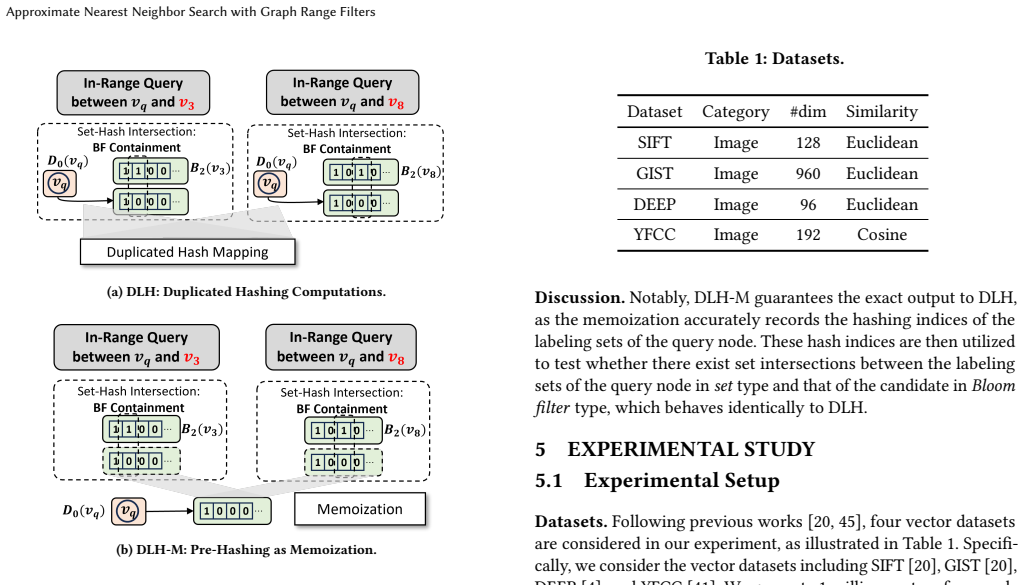
Distance-aware Labeling index with Hashing compression (DLH), which uses labeling sets for set intersection and Bloom filters for compression.
If this is right
- Throughput improves by up to 70.3 percent on diverse datasets.
- Recall stays above 98.5 percent with limited extra storage.
- DLH-M provides further gains by memoizing the query node's hashing index.
- The approach supports complex real-world filters expressed as distances on a graph.
Where Pith is reading between the lines
- The same labeling idea could extend to other structured filters that admit set-intersection checks.
- Existing vector databases could adopt the method by supplying only the filter graph as additional input.
- Alternative compression schemes might trade a small amount of recall for even lower storage overhead.
Load-bearing premise
The filter graph is provided in advance and its distance metric aligns with the labeling scheme so set intersections correctly identify in-range nodes without excessive false results from the Bloom filters.
What would settle it
Run the method on datasets where filter-graph distances are deliberately uncorrelated with vector distances and check whether recall falls below 98 percent or the reported throughput gains disappear.
Figures




read the original abstract
Vector databases have become a fundamental component for high-dimensional vector retrieval in artificial intelligence applications. Recent research has focused on filtered approximate nearest neighbor search (filtered ANN), which involves retrieving the nearest vectors that satisfy a given attribute-based filter. However, existing filters are generally limited to numerical range constraints or categorical existence checks, which restricts their applicability in more complex, real-world scenarios. In this paper, we investigate filtered ANN using graph range filters, where the retrieved vectors must be within a specified distance from the query node in a predefined filter graph. To address this problem, we propose DLH, a Distance-aware Labeling index with Hashing compression. DLH creates distance-aware labeling sets to enable efficient graph range filters via the simplified set intersection operations. Large labeling sets are further compressed into Bloom filters to improve query efficiency in DLH. Furthermore, recognizing that the query node is always involved in in-range queries of the graph range filters, we enhance DLH by memoizing the intermediate hashing index for the query node, yielding an optimized version called DLH-M. Experimental evaluations on diverse datasets demonstrate that DLH and DLH-M improve throughput by up to 70.3%, and could maintain recall rates over 98.5% with limited extra storage, validating the practical availability of the proposed solution.
Editorial analysis
A structured set of objections, weighed in public.
Referee Report
Summary. The paper proposes DLH (Distance-aware Labeling index with Hashing compression) and its optimized variant DLH-M for filtered approximate nearest neighbor search under graph range filters. The core idea is to precompute distance-aware labeling sets on a supplied filter graph so that range checks reduce to set intersection; large label sets are compressed via Bloom filters. The query node is memoized in DLH-M. Experiments on diverse datasets report up to 70.3% throughput gains while keeping recall above 98.5% with modest extra storage.
Significance. If the labeling construction is sound and the experimental claims are reproducible, the work would fill a gap between standard filtered ANN (numerical/categorical predicates) and graph-distance predicates, which appear in several real-world vector-database scenarios. The reported speedups are practically relevant, but the absence of a formal argument for correctness and limited experimental detail reduce the assessed contribution.
major comments (2)
- [§3] Labeling construction (likely §3): the manuscript states that DLH creates 'distance-aware labeling sets' enabling correct identification via set intersection, yet supplies neither the explicit labeling algorithm nor a proof that membership encodes graph distance (i.e., a node receives label L iff dist(query,node) ≤ r). Without this, the claim that intersection yields the required in-range nodes (and that Bloom-filter false positives are tolerable) is unverified and directly undermines the reported recall figures.
- [§5] Experimental evaluation (likely §5): throughput and recall numbers are presented without error bars, without a precise description of how recall was measured (e.g., ground-truth construction, distance threshold handling), and with insufficient baseline implementation details. These omissions make it impossible to assess whether the 70.3% throughput gain and >98.5% recall are robust or depend on particular dataset characteristics.
minor comments (1)
- Notation for Bloom-filter parameters (size and hash count) is introduced but their concrete values and sensitivity analysis are not tabulated; a small table would improve reproducibility.
Simulated Author's Rebuttal
We thank the referee for the constructive feedback. We address each major comment below, providing clarifications on the labeling construction and experimental methodology. We will revise the manuscript to include the requested details.
read point-by-point responses
-
Referee: [§3] Labeling construction (likely §3): the manuscript states that DLH creates 'distance-aware labeling sets' enabling correct identification via set intersection, yet supplies neither the explicit labeling algorithm nor a proof that membership encodes graph distance (i.e., a node receives label L iff dist(query,node) ≤ r). Without this, the claim that intersection yields the required in-range nodes (and that Bloom-filter false positives are tolerable) is unverified and directly undermines the reported recall figures.
Authors: The distance-aware labeling sets are constructed via a per-node breadth-first search traversal on the filter graph, limited to depth r; label L is assigned to v precisely when dist(v, L) ≤ r. Set intersection therefore returns exactly the nodes satisfying the range predicate by construction. Bloom-filter false positives introduce extra candidates that are discarded after exact distance verification in the final ranking phase, so recall is unaffected. We will add the explicit algorithm (with pseudocode) and a short inductive proof of the distance-encoding property to §3 in the revision. revision: yes
-
Referee: [§5] Experimental evaluation (likely §5): throughput and recall numbers are presented without error bars, without a precise description of how recall was measured (e.g., ground-truth construction, distance threshold handling), and with insufficient baseline implementation details. These omissions make it impossible to assess whether the 70.3% throughput gain and >98.5% recall are robust or depend on particular dataset characteristics.
Authors: Recall is defined as the fraction of ground-truth in-range neighbors retrieved; ground truth is obtained by exhaustive all-pairs distance computation on the filter graph for each query. Throughput figures are means over 10 independent query batches; we will report standard deviations as error bars. Baseline code follows the original HNSW and filtered-ANN papers (hnswlib and faiss implementations with the versions stated in our artifact). We will expand §5 with these details, the exact distance-threshold handling, and links to the evaluation scripts. revision: yes
Circularity Check
No circularity: algorithmic construction validated experimentally
full rationale
The paper introduces DLH as an algorithmic index construction (distance-aware labeling sets + Bloom filter compression) for graph range filters in filtered ANN. All performance numbers (throughput up to 70.3 %, recall >98.5 %) are obtained from direct experimental measurement on external datasets rather than from any fitted parameter or equation that re-derives the same quantity. The filter graph is explicitly supplied as input; no derivation chain, uniqueness theorem, or self-citation is invoked to justify the labeling semantics. Consequently the reported gains do not reduce to the method's own inputs by construction.
Axiom & Free-Parameter Ledger
free parameters (1)
- Bloom filter parameters (size and hash count)
axioms (2)
- domain assumption Set intersection on distance-aware labels correctly identifies nodes within graph distance threshold
- domain assumption Bloom filter false positives do not materially degrade recall in the evaluated workloads
invented entities (1)
-
Distance-aware labeling sets
no independent evidence
Reference graph
Works this paper leans on
-
[1]
Vector index in Qdrant
2025. Vector index in Qdrant. https://qdrant.tech/documentation/concepts/ indexing/#vector-index
2025
-
[2]
Takuya Akiba, Yoichi Iwata, and Yuichi Yoshida. 2013. Fast exact shortest-path distance queries on large networks by pruned landmark labeling. InSIGMOD
2013
-
[3]
Anas Ait Aomar, Karima Echihabi, Marco Arnaboldi, Ioannis Alagiannis, Damien Hilloulin, and Manal Cherkaoui. 2025. RWalks: Random Walks as Attribute Approximate Nearest Neighbor Search with Graph Range Filters Diffusers for Filtered Vector Search.SIGMOD(2025)
2025
-
[4]
Lempitsky
Artem Babenko and Victor S. Lempitsky. 2016. Efficient Indexing of Billion-Scale Datasets of Deep Descriptors. InCVPR
2016
-
[5]
Burton H. Bloom. 1970. Space/Time Trade-offs in Hash Coding with Allowable Errors.CACM(1970)
1970
-
[6]
Qi Chen, Bing Zhao, Haidong Wang, Mingqin Li, Chuanjie Liu, Zengzhong Li, Mao Yang, and Jingdong Wang. 2021. SPANN: Highly-efficient Billion-scale Approximate Nearest Neighborhood Search. InNeurIPS
2021
-
[7]
Prateek Chhikara, Dev Khant, Saket Aryan, Taranjeet Singh, and Deshraj Yadav
-
[8]
Mem0: Building Production-Ready AI Agents with Scalable Long-Term Memory.CoRR(2025)
2025
-
[9]
Matthijs Douze, Alexandr Guzhva, Chengqi Deng, Jeff Johnson, Gergely Szilvasy, Pierre-Emmanuel Mazaré, Maria Lomeli, Lucas Hosseini, and Hervé Jégou. 2024. The Faiss library.CoRR(2024)
2024
-
[10]
Darren Edge, Ha Trinh, Newman Cheng, Joshua Bradley, Alex Chao, Apurva Mody, Steven Truitt, and Jonathan Larson. 2024. From Local to Global: A Graph RAG Approach to Query-Focused Summarization.CoRR(2024)
2024
-
[11]
Erdös and A
P. Erdös and A. Rényi. [n.d.]. On Random Graphs I.Publicationes Mathematicae Debrecen([n. d.]), 290
-
[12]
Wenqi Fan, Yujuan Ding, Liangbo Ning, Shijie Wang, Hengyun Li, Dawei Yin, Tat-Seng Chua, and Qing Li. 2024. A Survey on RAG Meeting LLMs: Towards Retrieval-Augmented Large Language Models. InKDD
2024
-
[14]
Cong Fu, Chao Xiang, Changxu Wang, and Deng Cai. 2019. Fast Approximate Nearest Neighbor Search With The Navigating Spreading-out Graph.VLDB (2019)
2019
-
[15]
Jianyang Gao and Cheng Long. 2024. RaBitQ: Quantizing High-Dimensional Vectors with a Theoretical Error Bound for Approximate Nearest Neighbor Search.SIGMOD(2024)
2024
-
[16]
Yunfan Gao, Yun Xiong, Xinyu Gao, Kangxiang Jia, Jinliu Pan, Yuxi Bi, Yi Dai, Jiawei Sun, Qianyu Guo, Meng Wang, and Haofen Wang. 2023. Retrieval- Augmented Generation for Large Language Models: A Survey.CoRR(2023)
2023
-
[17]
Tiezheng Ge, Kaiming He, Qifa Ke, and Jian Sun. 2014. Optimized Product Quantization.TPAMI(2014)
2014
-
[18]
Siddharth Gollapudi, Neel Karia, Varun Sivashankar, Ravishankar Krishnaswamy, Nikit Begwani, Swapnil Raz, Yiyong Lin, Yin Zhang, Neelam Mahapatro, Premku- mar Srinivasan, Amit Singh, and Harsha Vardhan Simhadri. 2023. Filtered- DiskANN: Graph Algorithms for Approximate Nearest Neighbor Search with Filters. InWWW
2023
-
[19]
Chawla, Thomas Laurent, Yann Le- Cun, Xavier Bresson, and Bryan Hooi
Xiaoxin He, Yijun Tian, Yifei Sun, Nitesh V. Chawla, Thomas Laurent, Yann Le- Cun, Xavier Bresson, and Bryan Hooi. 2024. G-Retriever: Retrieval-Augmented Generation for Textual Graph Understanding and Question Answering. In NeurIPS
2024
-
[20]
Yongfeng Huang, Yanyang Li, Yichong Xu, Lin Zhang, Ruyi Gan, Jiaxing Zhang, and Liwei Wang. 2023. MVP-Tuning: Multi-View Knowledge Retrieval with Prompt Tuning for Commonsense Reasoning. InACL
2023
-
[21]
Hervé Jégou, Matthijs Douze, and Cordelia Schmid. 2011. Product Quantization for Nearest Neighbor Search.TPAMI(2011)
2011
-
[22]
Rezaul Karim, Felix Hermsen, Sisay Adugna Chala, Paola de Perthuis, and Avikarsha Mandal
Md. Rezaul Karim, Felix Hermsen, Sisay Adugna Chala, Paola de Perthuis, and Avikarsha Mandal. 2024. Scalable Semi-Supervised Graph Learning Techniques for Anti Money Laundering.IEEE Access(2024)
2024
-
[23]
Mocheng Li, Xiao Yan, Baotong Lu, Yue Zhang, James Cheng, and Chenhao Ma
-
[24]
Attribute Filtering in Approximate Nearest Neighbor Search: An In-depth Experimental Study.CoRR(2025)
2025
-
[25]
Shiyang Li, Yifan Gao, Haoming Jiang, Qingyu Yin, Zheng Li, Xifeng Yan, Chao Zhang, and Bing Yin. 2023. Graph Reasoning for Question Answering with Triplet Retrieval. InACL
2023
-
[26]
Wen Li, Ying Zhang, Yifang Sun, Wei Wang, Mingjie Li, Wenjie Zhang, and Xuemin Lin. 2020. Approximate Nearest Neighbor Search on High Dimensional Data - Experiments, Analyses, and Improvement.TKDE(2020)
2020
-
[27]
Zhuoyang Li, Liran Deng, Hui Liu, Qiaoqiao Liu, and Junzhao Du. 2024. UniOQA: A Unified Framework for Knowledge Graph Question Answering with Large Language Models.CoRR(2024)
2024
-
[28]
Anqi Liang, Pengcheng Zhang, Bin Yao, Zhongpu Chen, Yitong Song, and Guangxu Cheng. 2024. UNIFY: Unified Index for Range Filtered Approximate Nearest Neighbors Search.VLDB(2024)
2024
-
[29]
Sean Wang
Yanjun Lin, Kai Zhang, Zhenying He, Yinan Jing, and X. Sean Wang. 2025. Survey of Filtered Approximate Nearest Neighbor Search over the Vector-Scalar Hybrid Data.CoRR(2025)
2025
-
[30]
Dawei Liu, Bolong Zheng, Ziyang Yue, Fuhao Ruan, Xiaofang Zhou, and Chris- tian S. Jensen. 2025. Wolverine: Highly Efficient Monotonic Search Path Repair for Graph-based ANN Index Updates.VLDB(2025)
2025
-
[31]
Shige Liu, Zhifang Zeng, Li Chen, Adil Ainihaer, Arun Ramasami, Songting Chen, Yu Xu, Mingxi Wu, and Jianguo Wang. 2025. TigerVector: Supporting Vector Search in Graph Databases for Advanced RAGs. InSIGMOD
2025
-
[32]
Jiarui Luo, Miao Qiao, Chaoji Zuo, and Dong Deng. 2025. Tag-Filtered Approxi- mate Nearest Neighbor Search. InICDE
2025
-
[33]
Lailong Luo, Deke Guo, Richard T. B. Ma, Ori Rottenstreich, and Xueshan Luo
-
[34]
Optimizing Bloom Filter: Challenges, Solutions, and Comparisons.IEEE Commun. Surv. Tutor.(2019)
2019
-
[35]
Qin Lv, William Josephson, Zhe Wang, Moses Charikar, and Kai Li. 2007. Multi- Probe LSH: Efficient Indexing for High-Dimensional Similarity Search. InVLDB
2007
-
[36]
Malkov and Dmitry A
Yury A. Malkov and Dmitry A. Yashunin. 2020. Efficient and Robust Approximate Nearest Neighbor Search Using Hierarchical Navigable Small World Graphs. TPAMI(2020)
2020
-
[37]
Hoos, and James J
Julieta Martinez, Shobhit Zakhmi, Holger H. Hoos, and James J. Little. 2018. LSQ++: Lower Running Time and Higher Recall in Multi-codebook Quantization. InECCV
2018
-
[38]
Zhaojie Niu, Xinhui Tian, Xindong Peng, and Xing Chen. 2025. BlendHouse: A Cloud-Native Vector Database System in ByteHouse. InICDE
2025
-
[39]
Liana Patel, Peter Kraft, Carlos Guestrin, and Matei Zaharia. 2024. ACORN: Per- formant and Predicate-Agnostic Search Over Vector Embeddings and Structured Data.SIGMOD(2024)
2024
-
[40]
Diego Sanmartin. 2024. KG-RAG: Bridging the Gap Between Knowledge and Creativity.CoRR(2024)
2024
-
[41]
Gaurav Sehgal and Semih Salihoglu. 2025. NaviX: A Native Vector Index Design for Graph DBMSs With Robust Predicate-Agnostic Search Performance.VLDB (2025)
2025
-
[42]
Teng Shi, Jun Xu, Xiao Zhang, Xiaoxue Zang, Kai Zheng, Yang Song, and Han Li
-
[43]
Retrieval Augmented Generation with Collaborative Filtering for Person- alized Text Generation. InSIGIR
-
[44]
Liang Su, Mingyang Zhang, Kangxiang Jia, Tengfei Liu, Weiqiang Wang, Yun Xiong, Xixi Wu, Xinyu Gao, Yongrui Fu, and Jiawei Zhang. 2025. Towards Explainable Transaction Risk Analysis With Dual Graph Retrieval Augmented Generation. InCIKM
2025
-
[45]
Shamma, Gerald Friedland, Benjamin Elizalde, Karl Ni, Douglas Poland, Damian Borth, and Li-Jia Li
Bart Thomee, David A. Shamma, Gerald Friedland, Benjamin Elizalde, Karl Ni, Douglas Poland, Damian Borth, and Li-Jia Li. 2016. YFCC100M: the new data in multimedia research.CACM(2016)
2016
-
[46]
Yao Tian, Xi Zhao, and Xiaofang Zhou. 2024. DB-LSH 2.0: Locality-Sensitive Hashing With Query-Based Dynamic Bucketing.TKDE(2024)
2024
-
[47]
Jianguo Wang, Xiaomeng Yi, Rentong Guo, Hai Jin, Peng Xu, Shengjun Li, Xi- angyu Wang, Xiangzhou Guo, Chengming Li, Xiaohai Xu, Kun Yu, Yuxing Yuan, Yinghao Zou, Jiquan Long, Yudong Cai, Zhenxiang Li, Zhifeng Zhang, Yihua Mo, Jun Gu, Ruiyi Jiang, Yi Wei, and Charles Xie. 2021. Milvus: A Purpose-Built Vector Data Management System. InSIGMOD, Guoliang Li, Z...
2021
-
[48]
Mengzhao Wang, Xiaoliang Xu, Qiang Yue, and Yuxiang Wang. 2021. A Com- prehensive Survey and Experimental Comparison of Graph-Based Approximate Nearest Neighbor Search.VLDB(2021)
2021
-
[49]
Yuxiang Wang, Ziyuan He, Yongxin Tong, Zimu Zhou, and Yiman Zhong. 2025. Timestamp Approximate Nearest Neighbor Search Over High-Dimensional Vec- tor Data. InICDE
2025
-
[50]
Chuangxian Wei, Bin Wu, Sheng Wang, Renjie Lou, Chaoqun Zhan, Feifei Li, and Yuanzhe Cai. 2020. AnalyticDB-V: A Hybrid Analytical Engine Towards Query Fusion for Structured and Unstructured Data.VLDB(2020)
2020
-
[51]
Jiadong Xie, Jeffrey Xu Yu, and Yingfan Liu. 2025. Graph-Based K-Nearest Neighbor Search Revisited.TODS(2025)
2025
-
[52]
Yuexuan Xu, Jianyang Gao, Yutong Gou, Cheng Long, and Christian S. Jensen
-
[53]
iRangeGraph: Improvising Range-dedicated Graphs for Range-filtering Nearest Neighbor Search.SIGMOD(2024)
2024
-
[54]
Shuo Yang, Jiadong Xie, Yingfan Liu, Jeffrey Xu Yu, Xiyue Gao, Qianru Wang, Yanguo Peng, and Jiangtao Cui. 2025. Revisiting the Index Construction of Proximity Graph-Based Approximate Nearest Neighbor Search.VLDB(2025)
2025
-
[55]
Mengdan Zhu, Senhao Cheng, Guangji Bai, Yifei Zhang, and Liang Zhao. 2025. Cross-modal RAG: Sub-dimensional Retrieval-Augmented Text-to-Image Gener- ation.CoRR(2025)
2025
-
[56]
Chaoji Zuo, Miao Qiao, Wenchao Zhou, Feifei Li, and Dong Deng. 2024. SeRF: Seg- ment Graph for Range-Filtering Approximate Nearest Neighbor Search.SIGMOD (2024)
2024
discussion (0)
Sign in with ORCID, Apple, or X to comment. Anyone can read and Pith papers without signing in.