pith. sign in

q-fin.MF

Mathematical Finance

Mathematical and analytical methods of finance, including stochastic, probabilistic and functional analysis, algebraic, geometric and other methods

Top Pith
5
q-fin.MF 2026-06-29

Lean 4 verifies arbitrage-free markets admit martingale measures

by Raphael Coelho

The Fundamental Theorem of Asset Pricing, Formalized in Lean 4

Explicit minimization of a convex potential replaces Hahn-Banach in the multi-asset one-period case.

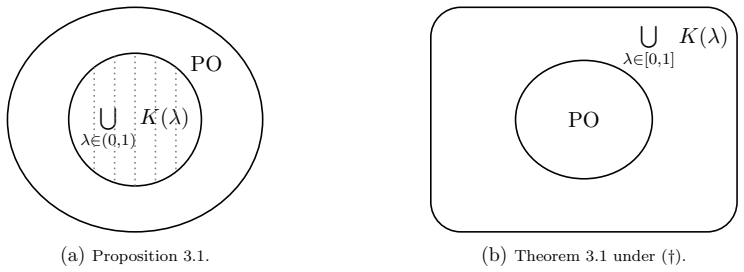
Figure from the paper full image
abstract click to expand
The Fundamental Theorem of Asset Pricing states that a market is free of arbitrage exactly when it admits an equivalent martingale measure. We formalize it in Lean 4 over Mathlib in three settings: a finite-state market over a finite horizon (Harrison-Pliska), a one-period market on an arbitrary probability space with a single scalar return (Follmer-Schied), and a one-period market with finitely many assets. The finite case is the geometry of a separating hyperplane; the scalar one-period case is an elementary change of measure. In the $d$-asset case the equivalent martingale measure is constructed explicitly, as the minimiser of the smooth convex potential $\mathbb{E}[\log(1+e^{\langle\theta,Y\rangle})]$: absence of arbitrage is precisely coercivity of the potential, its first-order condition is the martingale property, and the minimiser's logistic weight is the density of the measure. The construction uses no Hahn-Banach theorem, no $L^0$-closedness argument, no measurable selection, and no non-redundancy hypothesis. To our knowledge this is the first machine-checked Fundamental Theorem of Asset Pricing in any proof assistant. The boundary is explicit: the general multi-period Dalang-Morton-Willinger theorem lies outside the development. Every theorem is sorry-free, each headline result's axioms are pinned to Mathlib's classical defaults by a build-enforced gate, and the whole is reproducible from a pinned toolchain.
0
0
q-fin.GN 2026-07-03

Cap-axis curve checks whether factors price cap-rank subspace

by Useong Shin

A Cap-Axis Integral Diagnostic of Factor Models

Lifting pricing errors along capitalization axis flags subspace violations even when Sharpe frontier improves

Figure from the paper full image
abstract click to expand
I propose a cap-axis integral diagnostic for factor-model evaluation. Low-dimensional factor models can improve the maximum-Sharpe frontier while leaving zero-alpha violations on economically fixed subspaces. The diagnostic studies one such subspace by lifting pricing errors into a bridge-alpha curve along the market-capitalization rank axis. Under an aggregate-market gate, a zero curve is equivalent to pricing the market's internal cap-rank subspace. In 1967-2024 CRSP data, q5's daily negative bridge attenuates under lead-lag correction, while Fama-French and Carhart bridges are more visible monthly. Across 154 factors, the cap-axis norm is distinct from Sharpe gain and size exposure.
0
0
q-fin.MF 2026-07-03

MACD signals emerge as optimal estimators of latent asset drift

by Dannin J. Eccles, Roger Lee

Portfolio Optimization under Fast and Slow Latent Mean-Reverting and Momentum Drift

In two-scale latent factor models the filtered mean-reversion level reduces to fast-slow EMA difference plus Volterra term.

abstract click to expand
We consider a class of partial-information portfolio optimization problems in which the drift of a risky asset is driven by two latent stochastic factors evolving at distinct time scales. We show that the filtered estimate of the latent mean-reversion level is driven by the difference between fast and slow exponential moving average (EMA)-type processes of the trailing price history, yielding a Moving Average Convergence Divergence (MACD)-type signal, along with a deterministic Volterra correction. Under logarithmic, power, and exponential utility, we derive candidate optimal strategies in explicit feedback form and establish admissibility and verification results. In particular, the results provide a mathematical foundation for the endogenous emergence of MACD-type trading signals as estimators of latent drift information contained in observed price paths.
0
0
q-fin.TR 2026-07-02

Heavy liquidity tails make large trades less news-like

by Umut Çetin, Mingwei Lin +1 more

When large trades are not news: Liquidity tail risk and price discovery

Student-t uninformed demand keeps imbalances ambiguous, flattening impact and slowing price discovery from order flow.

abstract click to expand
When is a large trade news, and when is it a liquidity shock? We study this question in a sequential competitive limit order book with asymmetric information. In our model, liquidity suppliers observe aggregate order flow but not its decomposition into informed demand and uninformed liquidity demand. We model uninformed order flow with Student-$t$ tails, interpreted as a reduced form for rare liquidity regimes. The tail index of liquidity demand determines how informative large trades are. With thin-tailed noise, large order imbalances are quickly interpreted as private information. With heavy-tailed liquidity demand, the same imbalances remain plausibly liquidity-driven. This liquidity-tail ambiguity flattens and concavifies price impact, slows learning from order flow, and delays the decline of adverse-selection premia. We characterize equilibrium through a fixed-point equation for the marginal-cost schedule. Heavy-tailed liquidity demand changes the mathematics of equilibrium: the Gaussian monotonicity and compactness arguments fail because remote liquidity states remain pricing-relevant at polynomial order. We construct fixed points on a tail-controlled compact class and study learning and large-order asymptotics along selected monotone branches. Repeated order flow reveals the fundamental value under stable information-rate conditions, but heavier liquidity tails slow finite-horizon price discovery. Large-order impact obeys regular-variation asymptotics whose exponents depend on the liquidity-tail index, informed competition, and posterior beliefs. The model identifies liquidity tail risk as a state variable for market impact, spread resilience, and the informativeness of large trades.
0
0
q-fin.MF 2026-07-02

Puts and trend following split protection across crash and drawdown regimes

by Miquel Noguer i Alonso, Ali Al Fallouji

Tail Risk Management with Puts and Trend Following: A CVaR Framework for Crashes and Drawdowns

A CVaR model shows immediate jump repricing from options versus lagged but sustained defense from trend signals, supporting hybrid mandates.

Figure from the paper full image
abstract click to expand
Tail-risk management is not only an instrument-selection problem. It is an allocation problem across loss mechanisms: abrupt crash states, volatility repricing, and persistent drawdowns require different forms of protection. This paper develops a continuous-time CVaR framework that places two common protection sleeves -- long out-of-the-money put options and systematic trend-following overlays -- inside one coherent tail-risk mandate. The option sleeve is modeled as a marked-to-market traded asset, so premium drag, diffusion exposure, and jump repricing enter through its physical return process rather than through inconsistent terminal-payoff accounting. The resulting Markov state contains wealth, spot, stochastic variance, and an exponentially weighted log-return signal, and we derive the associated Hamilton--Jacobi--Bellman equation in viscosity form. The main analytical separation is temporal: convex insurance reprices immediately on jump impact, whereas trend following is late on the first shock because its signal must cross zero, but becomes increasingly defensive during persistent drawdowns without requiring fresh option premium. We then give sufficient and local conditions for an interior hybrid allocation, derive a CVaR policy-gradient identity, and introduce a four-axis diagnostic layer separating conditional convexity, tail-event reliability, non-stress carry, and drawdown persistence. Stylized Monte Carlo experiments illustrate the mechanism: fixed equal-weight hybrids and grid-optimized hybrids reduce terminal CVaR relative to either pure sleeve in the reported regimes, while the exact weight location remains calibration-dependent. The contribution is a transparent risk-management framework for deciding how much convex crash protection and how much signal-driven drawdown protection a mandate should hold.
0
0
q-fin.RM 2026-06-30

Hidden dependence preserves worst-case tail risk bounds

by Corrado De Vecchi, Max Nendel +1 more

Hidden Dependence and Aggregate Tail Risk

Small perturbations of the joint distribution that keep marginals fixed match the risk limits from full dependence uncertainty for gamma-tai

Figure from the paper full image
abstract click to expand
We study risk aggregation problems for arbitrary non-decreasing aggregation functions and tail risk measures under dependence uncertainty in a distributionally robust setting. To this end, we introduce the notion of hidden dependence for random vectors, which is built on the concepts of risk concentration and common tail events developed in Wang and Zitikis (2020). We show that, starting from a tail event $A$ of the aggregate loss for an arbitrary random vector $Y$, one can construct a random vector with hidden dependence that dominates $Y$ on the tail event $A$. We then focus on the case in which model uncertainty is described by small perturbations of the distribution of a random vector with respect to a suitable probability distance without changing the marginals. We show that these perturbations of the reference distribution are compatible with hidden dependence and thus lead to the same worst-case risk bounds as in the unconstrained case for arbitrary $\gamma$-tail risk measures with a suitable level $\gamma$. Finally, we apply our results in a credit risk context and quantify the potential underestimation of portfolio risk arising from uncertainty in the dependence structure. In particular, we show that even small deviations from a reference Gaussian dependence model can, in principle, justify dramatic increases in capital requirements.
0
0
q-fin.MF 2026-06-30

Convex risk measures turn resilience into worst-case adjusted drift

by Matteo Ferrari, Roger J. A. Laeven +2 more

Financial Resilience Evaluation: From Conditional Expectations to Dynamic Convex Risk Measures

When induced by a Lipschitz or quadratic BSDE driver, the evaluation of price increments equals the infimum over zero-penalty measures of an

abstract click to expand
Financial resilience concerns the rate at which a position recovers, or further deteriorates, in response to adverse conditions. As a first step, Laeven, Ferrari, Rosazza Gianin, and Zullino (arXiv:2505.07502) introduced the resilience rate, defined as the expected instantaneous rate of (favorable) change of a price or risk-assessment process. Since this quantity captures only the conditional mean of future increments, it cannot distinguish between positions having the same expected recovery but different conditional risk profiles. We obtain a richer characterization by evaluating such increments through a genuine, possibly nonlinear, dynamic risk measure. More precisely, for an It\^o process $\pi$ and a normalized, cash-additive dynamic risk measure $\rho$, we define the resilience evaluation by \[\mathcal D_s^\rho\pi_t := L^1\text{-}\lim_{\varepsilon\to0^+} \frac{1}{\varepsilon}\rho_s(\pi_{t+\varepsilon}-\pi_t), \qquad 0\leq s\leq t<T,\] whenever the limit exists. When $\rho$ is a convex dynamic risk measure induced by a BSDE with a Lipschitz or quadratic driver, we prove that this limit is well-posed and admits an explicit dual representation. It is given by the worst-case conditional expectation, over a zero-penalty class of measure changes, of an effective drift combining the drift of $\pi$ with the risk adjustment assigned by $\rho$ to its volatility. We further establish attainment of the optimal scenario and illustrate the scope of the construction, as well as the role of the assumptions, through examples and counterexamples.
0
0
q-fin.MF 2026-06-29

Valuation rules recover their generating uncertainty structures

by Jongjin Park, Hyungbin Park

Valuation Reveals Uncertainty

Observed dynamic sublinear valuations allow explicit identification of latent models and nonparametric estimation from limited data.

Figure from the paper full image
abstract click to expand
This paper studies the recovery of uncertainty from dynamic sublinear valuation rules. A robust valuation assigns each payoff its worst-case expected value across plausible models under uncertainty and induces a dynamic sublinear valuation rule. While valuation rules are observable in practice, the underlying uncertainty structure is latent. First, we show that the latent uncertainty structure can be identified from an observed valuation rule and provide an explicit procedure for recovering it. Second, we develop the notion of time consistency for uncertainty structures as the uncertainty-side counterpart of time consistency in valuation. Third, we characterize all time-consistent uncertainty structures that represent a given valuation rule. Finally, we develop nonparametric estimators for recovering uncertainty from limited valuation data. These results overturn the traditional Knightian view that uncertainty is inherently non-measurable. Indeed, valuation contains sufficient information to identify, characterize, and statistically recover the uncertainty structures that generate it.
0
0
math.PR 2026-06-29

Weighted approximations improve right-tail fits for lognormal sums

by Chunle Huang

Comonotonic and moment matching approximations for sums of lognormal random variables

New methods based on weighted distributions are both comonotonic and moment-matching while outperforming classical versions in the right tai

abstract click to expand
In this paper, based on the concept of weighted distribution, we introduce a kind of new approximations for sums of lognormal random variables, such that they are both comonotonic and moment matching. Numerical results show that the approximation performance of the newly presented approximations is, overall, comparable to the classical comonotonic approximations, but in terms of the right tail of the distribution of the original sum our approximations perform better than the classical comonotonic ones. Another contribution of this article is the establishment of the step-weighting theory for continuous random variables.
0
0
q-fin.MF 2026-06-29

Forward-curve hedging error splits into bucket

by Riccardo Alberti, Sven Karbach

Hedging Maturity-Specific Risk in Forward Curve Derivatives under Stochastic Volatility

Exact decomposition holds under infinite-rank stochastic volatility in the HJMM framework, with residual acting as volatility floor in enlar

Figure from the paper full image
abstract click to expand
We study the variance-optimal hedging of European contingent claims written on forwards. We assume that the dynamics of the underlying forward curves follow a Heath--Jarrow--Morton--Musiela stochastic partial differential equation modulated by an infinite-rank stochastic covariance component. The variance-optimal hedge is then given by the Galtchouk--Kunita--Watanabe projection with respect to some covariance-norm quotient generated by the forward curve martingale. We show density of finite-maturity and delivery-window strategies, convergence of spectral finite-rank hedge projections and an exact decomposition of the quadratic hedging error into bucket, rank and residual risk components. In enlarged filtrations, the residual risk is a stochastic-volatility floor for claims loading on non-traded covariance noise. We illustrate the hedging framework in affine stochastic covariance and multiplicative HJMM models, and give a concrete example of the decomposition in a CIR stochastic covariance model.
0
0
math.PR 2026-06-29

Hawkes processes close under finite linear signature dynamics

by Miquel Noguer i Alonso

A General Theory of Paths: Signatures, Jump Lifts, and Expected Signatures of Self-Exciting Processes

State-weight augmentation produces closed equations for expected signatures and recovers excitation parameters in the scalar case.

Figure from the paper full image
abstract click to expand
This paper develops a path-first theory using the signature as a universal coordinate for deterministic paths, rough paths, jump streams, and path-valued random variables. Geometricity is presented as a first-order algebraic property with second-order obstructions: a bracket for non-geometric lifts, and a covariance when averaging random paths. This framework links the shuffle identity, Marcus-Ito distinction, expected signatures, signature kernels, and free nilpotent group geometry. We offer four main contributions. (1) The Geometricity-Defect Theorem identifies quadratic covariation and coordinate covariance as the canonical failures of shuffle multiplicativity. (2) The Hopf Square proves that for pure-jump finite-variation paths, the forward Ito signature equals the iterated-sums signature, while the Marcus signature is Hoffman's exponential image of it. (3) Affine and exponential Hawkes processes are shown to admit finite-dimensional linear closures for truncated expected signatures after state-weight augmentation. For scalar Hawkes clocks, this allows explicit identification of baseline, excitation, and decay parameters. (4) An antisymmetric second-level cross-area is proved to detect two-channel Hawkes excitation direction to first order. Secondary results cover kernel-MMD decompositions, free nilpotent truncations, stable-law thresholds, heavy-tail normalizations, and a large-deviation principle. All identities and formulas are validated by a reproducibility script.
0
0
q-fin.MF 2026-06-29

Combined distress regions lift both value and survival

by Benjamin Avanzi, Bernard Wong +1 more

Balancing Shareholder Value and Financial Stability under a Reduced-Form Liquidation Model

A distress zone spanning both sides of the ruin threshold improves shareholder payouts and firm longevity simultaneously, unlike single-side

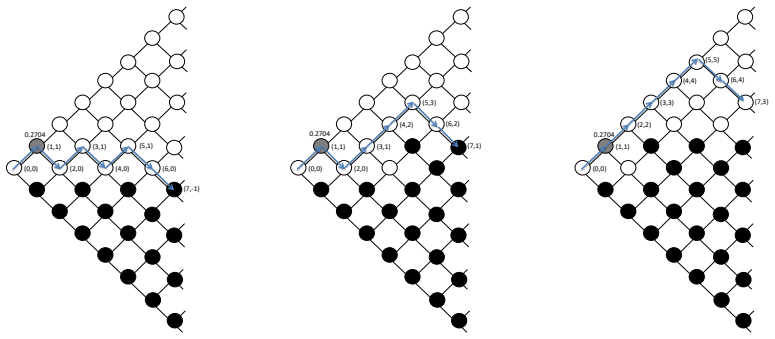
Figure from the paper full image
abstract click to expand
Modern resolution and prudential regimes increasingly wind up a distressed firm not at a single hard threshold but through a graduated, state-dependent process. We study how the design of such a regime shapes the trade-off between shareholder value and financial stability for a firm whose surplus follows a general diffusion. Forced liquidation is modelled in reduced form, arriving at a surplus-dependent hazard rate that rises as the firm's position deteriorates. The framework has three regions: an unregulated region where dividends may be paid, a regulated region where solvency requirements prohibit distributions, and a distress region in which the firm faces the liquidation hazard. To quantify shareholder value we solve the resulting singular stochastic control problem: which is to maximise the expected present value of distributions until liquidation. We establish a verification theorem, prove that a barrier strategy is optimal, and obtain tractable expressions for the value function and the expected survival time, so that alternative designs can be compared at low cost. We show that a distress region placed solely below or solely above the classical ruin threshold does not consistently improve both shareholder value and firm survival, whereas combining the two yields a Pareto improvement. Regulatory design is decisive.
0
0
q-fin.MF 2026-06-29

Electric aircraft cut emissions over 70% in five years on Canadian routes

by Elham Soufiani, Mehrdad Pirnia

Optimal Deployment of Electric Aircraft for Canadian Domestic Flights

Model finds fleet capacity and schedules, not charging stations, limit how quickly the switch can occur without leaving demand unmet.

Figure from the paper full image
abstract click to expand
This paper presents a multi-period mixed-integer linear programming (MILP) framework for planning the transition from conventional to electric aircraft in regional aviation. The model jointly optimizes fleet acquisition, infrastructure deployment, and service allocation over time, while accounting for policy constraints such as emissions reduction targets, electric service share, and budget limits. A real-world case study based on Helijet's short-haul network in British Columbia demonstrates the applicability of the model. The results show that electrification can reduce emissions by more than 70\% within five years while remaining economically viable. However, the transition is primarily limited by the capacity of the fleet and operational structure, rather than the charging infrastructure, leading to unmet demand under direct aircraft replacement. These findings emphasize the need for coordinated planning across fleet sizing, scheduling, and route prioritization to ensure a practical and efficient transition to electric aviation.
0
0
q-fin.ST 2026-06-29

Grünwald-Letnikov filter restores Hurst test under long memory

by Daniele Angelini

(In)Efficient Market States and Rough Volatility Detected via Grunwald-Letnikov Fractional Derivative

The method detects rough volatility and efficient versus persistent market states from single financial trajectories.

Figure from the paper full image
abstract click to expand
Testing self-similarity in fractional processes from a single observed trajectory is difficult under long-range dependence, because the associated Kolmogorov--Smirnov (KS) statistic undergoes a phase transition when $H>1/2$. In this regime, the classical limit collapses to a non-functional absolute Gaussian law and finite-sample convergence becomes severely distorted. This paper introduces a regime-adaptive KS/GL--KS framework based on the discrete Gr\"{u}nwald--Letnikov (GL) fractional derivative. The GL filter removes the low-frequency long-memory singularity while preserving the finite-dimensional $H$-self-similarity needed for distributional identification. We derive the filtered empirical-process limit, prove consistency and local asymptotic behavior of the resulting Hurst estimator, and validate the method through Monte Carlo simulations. Financial applications to realized volatility and equity index prices show how the procedure detects rough volatility and persistent, anti-persistent, or efficient market states.
0
0
q-fin.CP 2026-06-26

Volterra equation prices American FX timing options

by Leif Andersen, Andrey Itkin +1 more

Valuing American options and Flexible Forwards contracts in time-dependent models

Spectral methods solve it in 1-2 seconds and reveal nonlinear variance dependence, outperforming finite differences by an order of magnitude

abstract click to expand
A flexible forward (FF) is a customized FX hedging instrument that guarantees a fixed exchange rate while letting the holder choose the delivery date within a pre-agreed window. It is therefore an American-style option on timing, and its valuation must respect the volatility skew of the underlying currency pair. We price FF contracts (and, more generally, American options) under a time-inhomogeneous Heston model which captures the forward-skew term structure while preserving analytical tractability through a recursive (matrix) Riccati solution for the joint characteristic function. Extending the integral-equation (decomposition) approach to time-dependent coefficients, we derive a Volterra equation characterizing the early-exercise surface. The expectation in the decomposition formula is evaluated by two complementary spectral methods: a double cosine (COS) expansion of the transition density, and a damped-Sinc (DSINC) local-basis scheme that is more accurate and stays robust when a low Feller ratio or large vol-of-vol induces Gibbs oscillations in the COS series. Benchmarked against a penalty-iteration MCS-ADI finite-difference solver, both methods price a contract in about 1-2 seconds, roughly an order of magnitude faster than the finest finite-difference grid, while DSINC improves median accuracy over COS by about a factor of twelve. The experiments also show that the early-exercise surface is a substantially nonlinear function of the variance, contrary to the linear-in-variance approximation common in earlier work.
0
0
q-fin.MF 2026-06-26

Pretrained models top rankings but beat random walk in only 2 of 10 equity tasks

by Miquel Noguer i Alonso, Rodolfo Pereira Franklin

Pretrained Time-Series Foundation Models for Financial Return Forecasting

Tests on five U.S. stocks find foundation models reduce development cost yet deliver few statistically reliable gains over a naive benchmark

Figure from the paper full image
abstract click to expand
Financial return forecasting is a difficult test case for time-series foundation models (TSFMs) due to low signal-to-noise ratios, structural breaks, heavy tails, and weak persistence. This paper benchmarks pretrained TSFMs against train-from-scratch neural baselines in a deliberately conservative financial setting. We evaluate TimeGPT/TimeGPT-LH, TimesFM-2.5, Moirai-2.0, Chronos, and Chronos-2 against NBEATS, NHITS, PatchTST, iTransformer, and KAN on five liquid U.S. equities (AAPL, AMZN, GOOG, JPM, META) using linear and log returns. Models are compared under an equalized context budget, a rolling-origin protocol, and against random-walk benchmarks. We provide a theoretical framing of pretraining as an inductive prior, linking PAC-Bayes transfer intuition, information-theoretic predictability limits, and attention geometry. This clarifies why strong model rankings need not imply economically meaningful predictability in noisy markets. Pragmatically, pretrained TSFMs dominate the ranking distribution, accounting for 8 of 10 task-level wins. Moirai-2.0 and TimesFM-2.5 achieve the strongest average ranks, leading tasks for AAPL, JPM, GOOG, and AMZN, while Chronos wins the remaining AMZN task. However, the iTransformer baseline wins both META tasks, showing local supervised learning can still outperform generic pretraining for specific assets. Crucially, gains over the random-walk benchmark are small and sparse. A one-sided Diebold-Mariano test rejects equal or inferior predictive accuracy only for Chronos on AMZN and Moirai-2.0 on GOOG. We conclude that TSFMs serve as useful practical priors that reduce model-development costs in low-data financial forecasting, but are not universal engines for statistically reliable alpha generation in realistic empirical deployment.
0
0
stat.ME 2026-06-26

Recursive conditioning removes LR terms from Leibniz derivative estimator

by Xingyu Ren, Michael C. Fu +1 more

Conditional Leibniz Derivative Estimation with an Application to American Call Min-Options

The resulting estimator avoids dimension-dependent variance growth while remaining unbiased for discontinuous payoffs such as American call

Figure from the paper full image
abstract click to expand
Leibniz derivative estimation is a Monte Carlo technique for estimating derivatives of a discontinuous sample performance in stochastic models with respect to parameters of interest. By combining the push-out likelihood ratio (LR) method with Leibniz integral rules, it generalizes a broad class of existing LR-based derivative estimators. However, as an LR-based method, its variance is often higher than that of perturbation analysis-based methods and may grow linearly with the dimension of the stochastic input whose distribution depends on the parameter. In this paper, we propose a recursive conditioning approach and combine it with the Leibniz derivative estimation framework. The resulting conditional Leibniz estimator does not involve LR terms and therefore is not subject to variance growth with the input dimension. It also has a simple form and is easy to implement. We apply the method to an American call min-option model, and simulation results show its effectiveness and low-variance performance.
0
0
q-fin.MF 2026-06-25

Return risk measures extend geometrically to AM-algebras

by Christian Laudagé

Geometrically convex return risk measures on AM-algebras

The move produces systemic and vector-valued versions with finiteness, continuity, and dual representations for multidimensional payoffs.

abstract click to expand
Monetary risk measures quantify the risk of uncertain monetary payoffs (or losses), whereas in time series analysis risk is typically assessed using logarithmic returns. Return risk measures (RRMs) provide an axiomatic foundation for this latter approach, which relies crucially on the positive cone of the space of essentially bounded random variables. We extend RRMs to general ordered vector spaces and characterize positive homogeneity via the geometric epigraph. To investigate geometric convexity and establish connections with monetary risk measures, we specialize the domain to AM-algebras, encompassing Euclidean spaces and spaces of multidimensional essentially bounded random variables. The latter is novel in the context of RRMs and leads to the new classes of systemic and vector-valued RRMs. We establish results on finiteness, continuity, separability, as well as dual and aggregation-based representations.
0
0
math.OC 2026-06-25

Barrier equilibria exist only under linear and exponential aggregation

by Yue Cao, Guohui Guan +2 more

Equilibrium singular dividend control under ambiguity aggregation of heterogeneous discount rates

Singular dividend control with heterogeneous discount rates admits unique time-homogeneous solutions for linear and exponential aggregators

Figure from the paper full image
abstract click to expand
This paper studies a singular dividend control problem for a firm with heterogeneous shareholders whose discount rates follow a given distribution. The central planner aggregates expected discounted payoffs using an ambiguity aggregation function $phi$, which captures shareholder heterogeneity and ambiguity attitudes but also leads to time inconsistency. To address this issue, we seek a time-homogeneous equilibrium dividend law characterized by a partition of the state space into waiting and dividend-paying regions. We provide a rigorous mathematical characterization by proving a verification theorem and deriving necessary conditions for the equilibrium law. We then analyze barrier-type equilibria, showing non-existence for a class of aggregation functions that includes power-type and logarithmic aggregation functions, and establishing existence and uniqueness under linear and exponential aggregation. In the linear case, the bounded-rate equilibrium is shown to converge to the singular barrier-type equilibrium as the dividend rate bound tends to infinity. Numerical examples illustrate the effects of discount-rate heterogeneity and ambiguity aversion on the equilibrium barrier.
0
0
q-fin.MF 2026-06-24

A Bayesian investor learns asset drift via Kalman-Bucy filter and trades mean-variance…

by Andy Au

Path Space Robust Bayesian Portfolio Selection

The price of robustness is half the variance of the non-robust investor's loss

Figure from the paper full image
abstract click to expand
A Bayesian investor learns an unknown asset drift by Kalman-Bucy filtering and trades the mean-variance optimal portfolio, but his observation model may be wrong. We make the policy robust to an adversary who distorts the law of observed prices, paying for it in relative entropy. Because wealth and beliefs are driven by the same Brownian motion, one distortion corrupts trading profits and the filter together. The robust policy and its price are then closed form. To leading order, the price of robustness is half the variance of the loss the non-robust investor would suffer. The policy pulls back from large positions by a cubic correction. With a known drift the non-robust policy is infinitely costly; under learning the loss is bounded and the cost finite. The new structure, though, comes from how the robustness penalty is scaled rather than from learning: value-scaling preserves the affine policy exactly.
0
0
q-fin.MF 2026-06-23

Arbitrage-free quotes force monotonic k/v(k) in implied vol

by Jian Sun

Monotonicity of Normalized Implied-Volatility Coordinates under No-Arbitrage

Elementary proof using convexity and put-call parity shows the normalized coordinate decreases with strike for both lognormal and normal cas

abstract click to expand
For a fixed maturity, an arbitrage-free option smile induces natural normalized strike coordinates. This paper makes three contributions. First, it gives an elementary discrete no-arbitrage proof of monotonicity for the central Black--Scholes normalized coordinate \(k/v(k)\), using only finite-strike comparisons, convexity, monotonicity, and put--call parity. Thus the argument applies directly to finitely quoted option chains and does not require a continuously quoted smile, differentiability of option prices, differentiability of implied volatility, digital prices, or density extraction. Second, it extends the same monotonicity principle to the normal, or Bachelier, implied volatility formula, proving that the normalized coordinate \((F-K)/\sigma_N(K)\) is decreasing in strike under static no-arbitrage. Third, it proves a model-free normal-variance identity: remaining normal variance can be represented as a normal-density weighted integral of squared Bachelier implied volatility in the normalized coordinate. This third result is the normal/Bachelier analogue of Fukasawa's lognormal variance identity, which expresses variance-type quantities through Black implied variance in normalized coordinates. The paper therefore complements Fukasawa's continuous-strike normalizing transformation theory with a finite-quote no-arbitrage proof and a new normal-variance counterpart, while connecting the results to the volatility-derivatives literature surveyed by Carr and Lee.
0
0
q-fin.MF 2026-06-23

Tsallis entropy gives longer market relaxation times

by Sandhya Devi

Relaxation Times for Nonextensive Systems Using Gradient Flow for the Maximization of Tsallis Entropy: An Application to Financial Market Dynamics

Gradient flow method shows nonextensive systems equilibrate slower than Shannon entropy cases, allowing extended predictions.

Figure from the paper full image
abstract click to expand
In this work, we develop a method to estimate the relaxation time (the time required to reach equilibrium) of a nonextensive system such as financial market dynamics, using a Euclidean Gradient Flow (EGF) framework for the maximization of Tsallis entropy. The equilibrium state is defined as the maximum-entropy state. Specifically, the dynamics are expressed in terms of the time variations of the q-Gaussian parameters -- the entropic index q and the inverse temperature beta -- under the constraint that the distributions remain q-Gaussian at all times. We show that, for nonextensive systems, the relaxation times are longer than those obtained from the maximization of Shannon entropy, indicating that predictions over longer times are possible.
0
0
nlin.PS 2026-06-23

Fractional financial model yields equally spaced spectral lines

by Madhurendra Mishra, Armaan Aryan +2 more

Financial Frequency Combs

Steady-state spectrum forms a frequency comb only inside specific ranges of saving, investment cost and demand elasticity parameters.

Figure from the paper full image
abstract click to expand
Frequency combs are discrete, equally spaced, phase-coherent spectral lines that emerge from nonlinear mode coupling in physical systems. We show that the incommensurate fractional-order financial model of Huang, Li, Ma, and Chen, whose Caputo derivatives encode macroeconomic long-range memory, generates an analogous structure in its steady-state spectrum. The comb appears only over specific values and ranges of the saving amount $a$, the investment cost $b$, and the demand elasticity $c$, outside which the spectral lines lose their equal spacing. It persists across extended parameter regimes and stays invariant to perturbations in the initial interest rate $x_0$ and investment demand $y_0$, while distinct spectral regimes appear at different initial price levels $z_0$. The comb is generated only when the fractional-order exponents $q_1$, $q_2$, and $q_3$ associated with interest rate, investment demand, and price index are above the critical threshold values. At even higher values of these exponents, the frequency comb transitions into chaos. These findings show that the long-run cyclic structure of a memory-bearing financial economy organises into a discrete, deterministic spectral fingerprint rather than a stochastic continuum.
0
0
math.PR 2026-06-23

Affine processes extend to path-dependent coefficients with closed-form transforms

by Boris Günther, Thomas Kruse +2 more

Path-dependent Affine Processes

Generalized Riccati equations give closed-form transforms for path-dependent SDEs, covering delayed Heston models.

abstract click to expand
We extend the classical theory of affine processes to a path-dependent setting by introducing path-dependent coefficients and provide analytic formulas for their Fourier--Laplace transform in terms of generalized Riccati-type equations. In the proposed framework, we define path-dependent affine processes through their exponential-affine Fourier--Laplace transform on the path space and establish a characterization theorem. Conversely, for path-dependent stochastic differential equations with affine path-dependent coefficients, we also provide explicit exponential-affine representations of the Fourier--Laplace functional in terms of those Riccati equations. Moreover, we derive a condition ensuring non-negativity of the path-dependent diffusion coefficient, guaranteeing well-posedness of the model. Finally, we apply these results to a path-dependent volatility model and a path-dependent extension of the Heston model, including a delayed Heston model as a special case.
0
0
q-fin.RM 2026-06-23

New criterion forces every agent into risk-sharing optimization sequence

by Debora Daniela Escobar, Wing Fung Chong

Pareto Optimal Centralized Risk Sharing with Multiple Agents: Inclusivity and Fairness

Inclusive and fair Pareto optimality equates to balanced sequential optimization and lies between Geoffrion-proper and classical versions.

Figure from the paper full image
abstract click to expand
This paper studies centralized risk sharing with endogenous prices. Multiple policyholders transfer risks to a central insurer through indemnity decisions, while prices are determined by pricing functionals applied to ceded risks. The resulting problem is multiobjective, with Pareto optimality as the natural efficiency criterion. We show that classical Pareto optimality may fail to reveal whether all agents are represented in a balanced decision process that scalarized objectives may assign zero weight to some agents, and group aggregates may obscure individual risk positions. Motivated by bilateral Pareto characterizations through sequential optimization, we introduce inclusive and fair Pareto optimality, a representation-based refinement requiring every agent to appear exactly once, either individually or as part of a group, in a finite ordered sequence of optimizations. Our main result proves equivalence between this concept and balanced sequential optimization, placing it between Geoffrion-proper Pareto optimality and classical Pareto optimality. An illustrative example demonstrates the framework using the Expected Shortfall.
0
0
q-fin.MF 2026-06-23

Lévy process model matches VIX data better than Black-Scholes

by Shantanu Awasthi, Minglian Lin +3 more

Enhancing the Black-Scholes Model for Option Valuation via L\'evy Processes and Malliavin Calculus

Adding jumps via Lévy processes and deriving exact implied volatility with Malliavin calculus reproduces observed market volatility features

Figure from the paper full image
abstract click to expand
The Black-Scholes model has been extensively used for option pricing, but exhibits limitations in its reliance on geometric Brownian motion and fixed volatility assumptions. This paper proposes an enhanced model incorporating stochastic volatility with jumps modeled by a L\'evy process. Leveraging multidimensional It\^o calculus, we derive a pricing formula for European call options under the new framework. Additionally, Malliavin calculus enables the derivation of an exact expression for at-the-money implied volatility. The proposed model is shown to better capture empirical features like volatility smiles. Analysis of VIX data demonstrates the model's ability to match observed market volatility. The integration of L\'evy processes and Malliavin calculus represents a valuable advancement in addressing deficiencies in the classic Black-Scholes model. Further empirical testing is warranted to validate the approach across varying market conditions and option types.
0
0
q-fin.MF 2026-06-22

Asymmetric random walks produce closed-form option prices with skewness

by Jagdish Gnawali, Abootaleb Shirvani +4 more

Innovative Extensions to Option Pricing: Asymmetric Brownian Motion and Random Walk Approaches

Local time at the origin generates the asymmetry inside the classical Bachelier-Black-Scholes-Merton setting and yields convergent binomial

Figure from the paper full image
abstract click to expand
Classical option pricing models, such as Bachelier and Black--Scholes--Merton, postulate symmetric Brownian diffusion, which limits their capacity to reflect empirical phenomena including return skewness, heavy tails, and volatility asymmetry. This paper develops an innovative extension: the Geometric Asymmetric Brownian Motion (GABM), unifying asymmetric Brownian motion and random walk methodologies within the Bachelier--Black--Scholes--Merton framework. The approach harnesses the Cherny--Shiryaev--Yor invariance principle (CSYIP) to define asymmetric random walk integrals, where local time at the origin generates skewness and state-dependent risk. Closed-form option pricing formulas are derived, and a discrete-time binomial tree algorithm is constructed and shown to converge rigorously to the GABM limit. By incorporating a smoothed functional form based on the normal inverse Gaussian distribution, the model allows for flexible, state-dependent volatility calibration. Numerical experiments demonstrate the resulting option price and implied volatility surfaces, highlighting the framework's enhanced ability to capture persistent market asymmetry and complex risk behaviors observed in empirical data.
0
0
q-fin.MF 2026-06-22

Optimal AMM fees rise with volatility and ignore LP wealth

by Farbod Ghasemlu

Optimal Dynamic Fees for Automated Market Makers: A Stochastic Control Approach to Loss-Versus-Rebalancing

A control model shows the best fee is a pointwise function of variance, independent of wealth and risk aversion, and improves growth over st

Figure from the paper full image
abstract click to expand
We study the fee policy of a liquidity provider (LP) in a constant-product automated market maker (AMM) whose fee can be adjusted continuously, as enabled by programmable hooks. Building on the loss-versus-rebalancing (LVR) framework of Milionis et al. (2022) and its extension to nonzero fees by Milionis et al. (2024), we model the LP's wealth relative to the continuously rebalanced benchmark as a controlled process in which the fee governs two opposing forces: it raises revenue per uninformed trade while discouraging uninformed volume, and it widens the no-arbitrage band, which lowers the rate at which arbitrageurs extract value. Because the fee enters only the drift of relative wealth and never its diffusion, the LP's expected-utility problem reduces to an ergodic control problem whose solution is a pointwise volatility feedback. We prove that the growth-optimal fee is independent of the LP's wealth and of its constant relative risk aversion, that it collapses to a static constant when volatility is constant, and that it is strictly increasing in instantaneous variance, so that the optimal schedule is pro-cyclical. When volatility is stochastic, we characterise the optimal fee through a scalar ergodic Hamilton-Jacobi-Bellman equation and a linear Poisson equation, solved by a finite-difference scheme. We further show that the optimal fee is invariant to price jumps under logarithmic preferences, relate the optimal fee to a stylised model of competition among venues, and treat gas costs through an impulse-control dead-band. In a calibration to liquid large-capitalisation conditions, the optimal dynamic fee weakly dominates every static and volatility-linked heuristic fee on each simulated path, improving the LP's growth rate over the best static fee by a modest but uniformly positive margin, with a dead-band rendering gas costs negligible.
0
0
q-fin.MF 2026-06-19

Forecasting reduces to coherent conditional distributions along one spine

by Miquel Noguer i Alonso

The Mathematics of Modeling the Future

Connecting filtrations to generators produces dynamically consistent future laws constrained by information and geometry.

Figure from the paper full image
abstract click to expand
Modeling the future requires specifying conditional laws relative to an evolving information flow and describing their movement across time. This paper provides a unified mathematical synthesis of this problem along a single spine. Filtrations encode known data; conditional expectation and regular conditional probabilities yield point and distributional forecasts; Markov kernels and semigroups propagate observables and laws; and infinitesimal generators encode local dynamics, producing Kolmogorov equations and stochastic differential equations. Along this spine, martingales isolate surprise, filtering handles partial observation, finance prices futures, stochastic control optimizes choices, and ergodic theory describes the far future. The contribution is architectural. We explicitly connect derivations that turn classical objects into a unified forecasting calculus: the tower property becomes the semigroup law; Ito's formula yields the backward equation after conditioning; integration by parts provides the forward operator; and generator perturbations become model-risk distortions. Forecasting is shown not as mere data extrapolation, but the construction of dynamically coherent conditional distributions constrained by information, geometry, and admissible models. These concepts are illustrated via Gaussian Ornstein--Uhlenbeck and non-Gaussian Cox--Ingersoll--Ross processes, demonstrating how abstract machinery produces explicit transition laws, spectral decompositions, term-structure formulae, and asymptotics in diverse geometries. We recast density evolution as a Wasserstein gradient flow, place forecasting within Hilbert, Fisher--Rao, and Wasserstein geometries, provide a discrete-time empirical dictionary, and address model-risk. The result is a compact mathematical map from information to prediction, local dynamics to global laws, and idealized models to empirical forecasting.
0
0
q-fin.ST 2026-06-19

Trends drive rising volatility and correlations

by Sara A. Safari, Christoph Schmidhuber

Trends, Volatility, Correlations, and Critical Phenomena in Financial Markets

Quadratic polynomials of trend strength refine risk forecasts and support lattice gas models near criticality

Figure from the paper full image
abstract click to expand
We forecast future volatilities and correlations of financial markets based on the current trends in these markets. This complements previous work that models future expected returns by a cubic polynomial of the current trend strength. Empirically, we observe that volatilities and correlations tend to increase day after day in times of strong up- or down-trends. This effect is particularly pronounced in down-trends. It can be accurately quantified by quadratic polynomials of today's trend strengths, which refine common mean-reversion models of volatilities and correlations. Our results improve the prediction of market risk by accounting for market trends. They also support a recent proposal to model financial markets by a lattice gas near its critical point.
0
0
q-fin.ST 2026-06-18

Tempered skew-t fits S&P500 multi-day returns

by Siqi Shao, R. A. Serota

Fitting Accumulated Stock Returns with Tempered Skew t-Distribution

The model captures symmetry breaking between gains and losses plus near-linear scaling of means and variances with accumulation days.

Figure from the paper full image
abstract click to expand
We analyze distributions of historic S&P500 multi-day returns, for the number of days of accumulation from 20 to 120. With the increase of the number of days of accumulation, we observe clear tempering of power-law tails toward a seemingly finite value. To explain this phenomenon, we employ a model that produces a "capped Inverse Gamma" stationary (steady-state) distribution for stochastic volatility which, in turn, produces a "tempered Student-t" distribution for returns. We then employ Jones-Faddy-like symmetry breaking mechanism that produces a "tempered Skew-t" distribution. This distribution provides rather good fits to the distributions of accumulated multi-day S&P500 returns, which exhibit symmetry breaking between gains and losses -- as reflected by positive mean and negative skew. Tempered Skew-t fits are also consistent with near perfect linear dependence on the number of days of accumulation of the mean values and, even more so, of the variances (mean squared realized volatility) of the distributions.
0
0
q-fin.MF 2026-06-18

No collective arbitrage closes aggregate feasibility cone

by Alessandro Doldi, Marco Frittelli +1 more

Collective completeness and pricing-hedging duality II

When risk exchanges form a finitely generated convex cone, this yields extensions of the collective fundamental theorems and equates strong

Figure from the paper full image
abstract click to expand
This paper complements and extends Doldi, Frittelli and Maggis, Collective completeness and pricing-hedging duality, Math. Finan. Econ. 19, 757-784 (2025), by studying collective pricing and hedging when admissible risk exchanges form a finitely generated convex cone. The collective First Fundamental Theorem of Asset Pricing and the collective pricing-hedging duality are extended to this setting. A key contribution is a closedness result showing that no collective arbitrage implies the closedness of the aggregate feasibility cone combining infinite-dimensional trading opportunities with finite-dimensional exchanges. The paper also proves that no-collective-arbitrage prices for vectors of contingent claims form a relatively open convex set. Finally, strong collective replicability is introduced and shown to be equivalent to price uniqueness. This leads to an enhanced collective Second Fundamental Theorem of Asset Pricing, providing equivalent characterizations of collective completeness and strong collective completeness in terms of the uniqueness of the collective equivalent martingale measure. We highlight that several core aspects of the theory are substantially altered when exchanges belong to a convex cone rather than a vector space.
0
0
math.OC 2026-06-18

Duality reduces retirement shortfall problem to 2D stopping task

by Lijun Bo, Yijie Huang +1 more

Optimal Consumption and Retirement Time under Shortfall Risk Measure

The transformed problem yields an explicit retirement boundary and shows more conservative investment after retirement.

abstract click to expand
This paper studies the optimal portfolio, consumption, and endogenous early retirement problem within a benchmark tracking framework by incorporating a new relative performance evaluation. In this framework, the investor maximizes expected lifetime consumption utility while managing the maximum wealth shortfall relative to a benchmark, with shortfall-management costs that may differ before and after retirement. Mathematically, the problem is a hybrid stochastic control problem involving both regular controls and an optimal stopping time, in which the running maximum process records the investor's largest benchmark shortfall. We introduce an auxiliary reflected state process and establish an equivalent hybrid stochastic control problem. By proving the convex duality theorem, we technically transform the original problem into a two-dimensional pure optimal stopping problem with state reflection. This enables us to characterize the geometric structure of the stopping set and derive the feedback-form optimal retirement boundary, as well as optimal portfolio and consumption policies. Analytical examples and numerical simulations reveal a two-stage structure with more conservative investment and more aggressive consumption after retirement. Driven by the retirement option, the expected largest shortfall risk follows a pronounced U-shaped pattern with respect to wealth. Shortfall management costs, labor income, and leisure preference significantly influence retirement timing, investment, and consumption.
0
0
q-fin.MF 2026-06-15

Itô integral realized as continuous local martingale in Lean

by Raphael Coelho

A Machine-Checked It\^o Calculus for Brownian Motion

The first machine-checked version reaches the pathwise form on the half-line and includes Itô's formula for C3 functions.

Figure from the paper full image
abstract click to expand
We develop the It\^o calculus of Brownian motion, machine-checked in Lean~4 over Mathlib and the \lean{BrownianMotion} package. On a bounded interval $[0,T]$ the It\^o integral is built as a Hilbert-space isometry, from a predictable-rectangle $\pi$-system through the density of simple adapted processes. Realized as a process, it is a continuous $L^2$ martingale. One structural identity drives this: the integral at time $t$ is the conditional-expectation projection of its terminal value onto $\F_t$, and from it adaptedness, the martingale property, the contraction bound, and both the terminal and time-indexed It\^o isometries follow as corollaries. On this integral we prove It\^o's formula for $C^3$ functions with bounded derivatives, including the time-dependent form $df = f_x\,dB + (f_t + \tfrac12 f_{xx})\,dt$, by a discrete-to-continuous argument through weighted quadratic variation with explicit $L^2$ remainder bounds. We then pass from the $L^2$ theory to the pathwise. The integral process has an almost-surely continuous modification, and its everywhere-continuous representative is a local martingale for the null-augmented Brownian filtration; gluing the bounded-horizon representatives along the half-line yields the It\^o integral as a continuous local martingale on all of $\R_{\ge 0}$, the form it takes in the classical theory. To our knowledge these are the first machine-checked constructions of the It\^o integral and of It\^o's formula in any proof assistant, and the first to reach a pathwise-continuous local martingale. The boundary is explicit. The $L^2$ integral and It\^o's formula are developed on $[0,T]$ with bounded-derivative integrands; the unrestricted $C^2$ formula, integrators beyond brownian motion, and right-continuity of the filtration lie outside the development.
2 0
0
q-fin.MF 2026-06-10

CPT gamblers in unfair games have finite values and quit sooner

by Sang Hu, Xun Yu Zhou

Optimal exit strategies of CPT gamblers in unfair gambles

Infinite-horizon problems admit explicit solutions showing reduced loss tolerance and zero participation when games are bad enough.

Figure from the paper full image
abstract click to expand
In this paper we study optimal exit strategies of gamblers with cumulative prospect theory (CPT) preferences in games where the expected payoff is strictly negative at each play, and formulate the problem as optimal stopping on asymmetric random walks. Applying a geometric transformation of the underlying cumulative gain/loss process, engaging randomized strategies and changing the decision variable from stopping times to probability distribution of the accumulated gain or loss at exit time, we solve the problem via the Skorokhod embedding. Drastically different from the fair gamble problem studied by He et al. (2019a), we show that the unfair problem in the infinite time horizon has finite values for a wide range of CPT parameter specifications. We then present the analytical solutions in the case of piece-wise power utility and power probability distortion functions. Compared to the strategies used in fair gambling, the CPT gamblers in unfair gambles are less loss-tolerant and choose not to gamble at all when the games are sufficiently unfavorable.
0
0
q-fin.MF 2026-06-09

Heston American puts stay C^{1,2} regular at zero volatility

by Khai Nguyen, Huy Chau

On regularity of finite-maturity American put options in the Heston model

PDE analysis proves smooth-fit holds inside the exercise region for finite-maturity contracts

abstract click to expand
This paper studies the regularity of finite-maturity American value functions in the Heston model. Although the Heston operator is degenerate when the volatility is zero, we are able to establish C^{1,2} regularity of the American value functions in the exercise domain and the smooth-fit principle, using PDE techniques.
0
0
math.FA 2026-06-09

Weighted Nachbin theorem gives derivative approximation on manifolds

by Philipp Schmocker, Josef Teichmann

Weighted universal approximation of differentiable maps on infinite-dimensional manifolds

Functional neural networks can now approximate both maps and their derivatives for non-anticipative functionals on weighted infinite-dimensi

Figure from the paper full image
abstract click to expand
We generalize the universal approximation theorem for functional input neural networks (FNN) to differentiable maps by including the approximation of the derivatives. A FNN maps the input from a possibly infinite-dimensional weighted manifold to the real-valued hidden layer, on which a non-linear scalar activation function is applied, and then returns the output into a Banach space via some linear readouts. By proving a weighted Nachbin theorem, we establish a universal approximation theorem for differentiable maps, which goes beyond the usual formulation on compact sets and also includes the approximation of the derivatives. This leads us to approximation results for non-anticipative functionals including the horizontal and vertical derivatives. As a further application, we show that linear functions of the signature are able to approximate path space functionals including their directional derivatives.
0
0
q-fin.PR 2026-06-09

Operational-time lattice yields generalized option pricing PDE

by Chris Angstmann, Tim Gebbie

Option prices from operational-time reaction-boundary lattices

Backward equation from nearest-neighbour log-price Markov lattice recovers Black-Scholes-Merton under risk-neutral drift while separating un

Figure from the paper full image
abstract click to expand
We consider the role of a continuum operational time u and its mapping to calendar time t and how these relate to event time for option pricing problems. We derive option-pricing equations from an operational-time Markov lattice rather than from a calendar-time diffusion. The primitive model is a nearest-neighbour log-price lattice with state- and time-dependent transition probabilities. Its Chapman-Kolmogorov decomposition yields discrete forward and backward equations, which converge under local finite-variance scaling to the usual continuum adjoint pair. In price variables, the backward equation gives a generalized European pricing PDE and reduces to Black-Scholes-Merton under the risk-neutral drift restriction and constant volatility. Interpreted as a reaction-boundary model for limit-order-book mid-prices, the construction identifies local volatility with an activity-rescaled risk-neutral bid-ask reaction-boundary variance. The framework separates the operational kernel, calendar-time projection, and pricing-measure choice, to clarify how unspanned clock, jump, or renewal risks can lead to incomplete-market pricing.
0
0
q-fin.TR 2026-06-09

Regime models beat standard volatility forecasts on Chinese stocks

by Xinyue Fang, Robert Ślepaczuk

Volatility Forecasting and Return Prediction under Market Regimes: Evidence from High-Frequency Chinese Equity Data

Return signals stay weak except in calm periods, and only filtered strategies beat costs.

Figure from the paper full image
abstract click to expand
This study investigates whether regime-dependent volatility forecasting and machine-learning-based return prediction can be jointly integrated to improve both statistical forecasting performance and economic strategy outcomes in equity markets. Using high-frequency CSI 300 Index data from 2005 to 2023, a sequential twostage framework is developed. In the first stage, realized volatility is modeled using regime-augmented HARQ specifications combined with Markov-switching GJR-GARCH filtering to capture long-memory dynamics, asymmetry, and structural market regimes. In the second stage, volatility forecasts, regime indicators, and return-related predictors are incorporated into an XGBoost return-prediction model estimated through a strictly walk-forward out-of-sample procedure. The empirical results demonstrate that regime-aware volatility forecasting consistently outperforms baseline HARQ models across forecast evaluation metrics and is generally supported by formal forecast comparison tests. In contrast, return predictability remains weak, state-dependent, and concentrated primarily in low-volatility regimes. Although naive predictive trading strategies generally fail after accounting for realistic transaction costs, carefully designed implementations incorporating volatility scaling, low-volatility gating, threshold calibration, and turnover controls can improve defensive economic performance. The findings suggest that the practical value of predictive systems in financial markets may depend less on generating strong unconditional return forecasts and more on transforming weak state-dependent signals into economically robust portfolio allocation rules. Overall, the study contributes by integrating econometric volatility modeling, regime classification, machine-learning return prediction, and implementation realism within a unified framework.
0
0
q-fin.MF 2026-06-09

Axioms force unique three-parameter quoting rule

by Frank M. V. Feys

Axiomatic Market Making

Mid-quotes move linearly with inventory while the spread splits into inventory and adverse-selection parts.

Figure from the paper full image
abstract click to expand
This paper axiomatizes the bid-ask market maker's quoting rule. A quoting rule maps the maker's state, namely inventory, belief, variance, trade intensity, and informed-trader fraction, to a bid-ask pair. Eight natural axioms, together with six environmental assumptions on the maker's inventory cost, force a unique three-parameter family: the mid-quote is linear in inventory, and the spread decomposes additively into inventory and adverse-selection components. Each of the three parameters is identified from a distinct moment of the observable quoting rule, with the three identifications mutually decoupled. The eight axioms partition into a four-axiom indispensable core, one structural choice, and three modularity extensions. Two structural corollaries follow: the latent inventory cost function is recoverable from the limit order book, and a sharp phase transition separates a functioning regime from a frozen one. A closing meta-theorem identifies four features invariant across all admissible structural primitives within the axiom system. To our knowledge, this is the first forced-uniqueness axiomatization of the quoting rule.
0
0
q-fin.MF 2026-06-09

Centralized trading lifts PoS staking and spreads validator stakes

by Wenpin Tang

Proof of Stake economy under centralized exchanges--a mean field model

Mean-field model shows market incentives raise participation and flatten stake concentration.

Figure from the paper full image
abstract click to expand
We consider the interaction between centralized trading and decentralized Proof of Stake (PoS) blockchain ecosystems. Motivated by the increasing dominance of centralized exchanges and the institutionalization of crypto markets, we study how trading activities on centralized exchanges affect staking behavior, token allocation, and decentralization within a PoS blockchain. We formulate a continuous-time mean field model, where the miners simultaneously act as validators in the PoS protocol and traders in a centralized market with price impact. Under suitable assumptions, we establish the local well-posedness of the mean field system, and derive a semi-explicit characterization of the equilibrium trading strategy. Numerical results suggest that centralized trading activities may enhance staking participation, and promote decentralization of the staking distribution through market incentives. We also study the effects of transaction costs and token supply mechanisms on the equilibrium staking ratio and concentration profile. These results illustrate how market microstructure and centralized liquidity provision can exert significant influence on decentralized blockchain protocols.
0
0
q-fin.MF 2026-06-08

Markets are not random but hard to predict for structural reasons

by Miquel Noguer i Alonso

Markets Are Not Random, They Are Hard to Predict

Hidden causes, strategic use, and capacity limits raise forecast costs without requiring ontic chance.

abstract click to expand
Financial returns are often called ``random,'' but the word conflates ontic chance, epistemic ignorance, strategic feedback, and model instability. This essay argues that financial markets are not random in the ontic sense in which a quantum measurement is random. They are causal economic systems whose future is hard to predict because relevant causes are hidden, costly to observe, strategically used, capacity constrained, and sometimes governed by a changing law. The formal language of finance already encodes this distinction. Prices live on filtered probability spaces because agents have partial information; derivatives are priced under a risk-neutral measure $\Q\ne\Prob$ because pricing is an instrumental change of measure rather than a statement about the real data-generating law; and no-arbitrage gives martingality under an equivalent pricing measure, not full predictability failure under every real-world information set. The paper separates no-arbitrage, informational efficiency, and net exploitability; uses the Doob decomposition to isolate risk-compensated predictable drift from martingale innovation; adds a capacity-and-survival layer explaining why positive signals need not be scalable; relates the $\Prob$--$\Q$ wedge to stochastic-discount-factor geometry and relative entropy; formalises filtration sufficiency, model-selection landscape risk, and intervention-stable causality; and connects reflexivity, microstructure, and Knightian ambiguity to a unified entropy ledger. The disciplined thesis is therefore not that markets are unknowable, nor that they are literally random. Markets are hard to predict, and hardest exactly where prediction is costly, competitive, self-defeating, capacity limited, or invalidated by regime change.
0
0
q-fin.MF 2026-06-08

Utility-consumption model sets ETH price baseline scaling with adoption

by Mikhail Perepelitsa

Bubbles vs. Baselines: Token Valuation and Institutional Capital in PoS Networks under EIP-1559

PoS token valuation anchors to network usage and removes institutional yield premium under EIP-1559 fee burn.

Figure from the paper full image
abstract click to expand
This paper presents an open-economy macroeconomic equilibrium model for Proof-of-Stake (PoS) networks with fee-burn mechanics (EIP-1559) that formalizes the strategic interplay between a Kelly-optimizing rational institutional investor and a utility-driven retail consumer. We analyze network dynamics across two behavioral regimes. In The Unbounded Accumulation Model, the consumer purely accumulates tokens, creating an exclusive buy-side pressure that interacts with institutional portfolio rebalancing to fuel an ever-expanding speculative bubble and generate compounding excess returns for investors. Conversely, in The Utility-Consumption Model, the consumer dynamically buys and sells tokens to balance crypto wealth against real-world fiat consumption. Within this framework, we derive an explicit steady-state equilibrium price for ETH, demonstrating how token valuation anchors to a stable fundamental baseline that scales directly with network adoption while completely dissolving the institutional yield premium. Our numerical simulations show that while exogenous traditional finance (TradFi) shocks propagate through portfolio rebalancing to drive high token price volatility, network inflation remains highly stable. Furthermore, we prove that network security is insulated from institutional monopoly by counter-cyclical consumer behavior. Our findings reveal that institutional excess wealth creation in PoS ecosystems is not native to the staking protocol itself, but is strictly driven by the leveraged extraction of the retail consumer's continuous demand for transactional utility.
0
0
math.PR 2026-06-08

Rough Volterra square-root kernels force hitting zero with positive probability

by Martin Friesen, Stefan Gerhold +1 more

Boundary behaviour of the Volterra square-root process

The resulting atom at the boundary restricts equivalent martingale measures in the Volterra Heston model to cases with very special drift.

abstract click to expand
In this work, we study the boundary behaviour of the Volterra square-root process on $\R_+$. For regular Volterra kernels, we establish a time-dependent Feller condition that guarantees that the process does not hit zero on $[0,T]$, and prove finiteness of negative $p$-moments. For rough kernels that are regularly varying at zero, we show that the process necessarily hits zero with positive probability, and that its law has an atom at the boundary. Finally, we establish analogous results for the limit distribution. Our proofs are based on comparison principles for Volterra integral equations and generalized Riemann--Liouville fractional equations. The latter provide us with upper and lower bounds for the solution of the associated Volterra Riccati equation, and hence bounds on the Laplace transform. As an application, we study the structure of equivalent martingale measures in the Volterra Heston model. For the rough case, we show that equivalent martingale measures exist only under very restrictive assumptions on the drift under the real-world measure.
1 0
0
q-fin.MF 2026-06-05

Fast Heston limit sends prices through intervals at once

by Ryan McCrickerd

Fast-excursion limit of the Heston model

The resulting paths leave vanilla prices unchanged yet raise one-month barrier hits by roughly 10 percent.

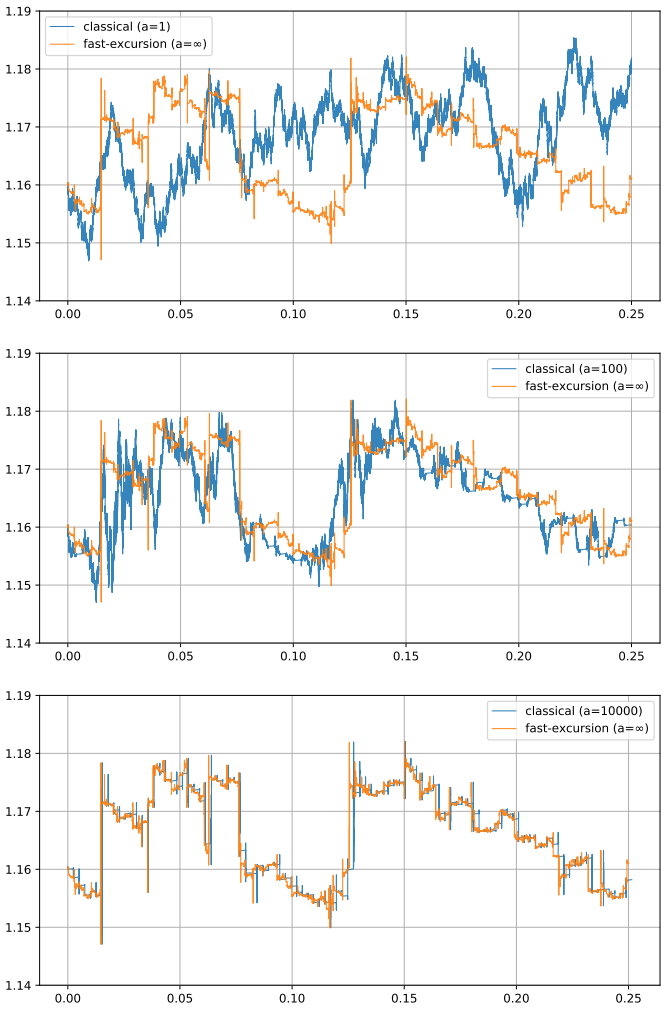
Figure from the paper full image
abstract click to expand
This article introduces an unconventional model for price processes in finance that emerges from the classical Heston model under Mechkov's fast-reversion limit. This new fast-excursion Heston model exhibits instantaneous (i.e. fast) excursions through an interval of prices at each time, which are invisible to vanilla options but critical for hitting probabilities and continuously monitored exotics. Theoretically, the model provides a rare example of a non-degenerate limit of stochastic volatility models that escapes the Skorokhod topologies. This leads us to a class of interval-valued processes which exist as lifts of subordinated Levy processes, through the concept of selections in the theory of random closed sets. On the practical side, we show how the model can be simulated using price-time parametric representations, and utilise a purpose-built classical Heston simulation scheme in order to visualise convergence. Finally we demonstrate how this model raises hitting probabilities for barrier options considerably (of order 10% for one-month EURUSD options), due to taking excursion risk into account.
0
0
q-fin.TR 2026-06-05

Internalising dealers externalise more against rivals

by Robert Boyce, Eyal Neuman

Competition in Dealer Markets with Internalisation and Externalisation

Equilibrium competition raises hedging costs for dealers and client transaction costs.

Figure from the paper full image
abstract click to expand
We model a market with multiple dealers who compete for client order flow by dynamically updating their bid and ask quotes for a risky asset. Dealers aim to maximise expected profits while controlling inventory risk by skewing their quotes to attract offsetting order flow (internalisation) or by directly offloading positions in the market (externalisation). Using a variational approach, we derive a closed-form equilibrium for the resulting Nash competition, shedding light on key features of dealer market dynamics. We show that dealers relying on internalisation are compelled to increase their externalisation activity when competing with externalising dealers. This strategic shift in equilibrium leads to significantly higher hedging costs for all dealers and substantially wider spreads for clients.
0
0
q-fin.MF 2026-06-05

Derivative training cuts vega error 40% in option pricing surrogates

by Miquel Noguer i Alonso

Derivative-Informed Operator Learning for Finance: On-the-Fly Greeks, Surfaces, Hedging, and Control

Matching Fréchet derivatives alongside prices improves hedging accuracy and reduces optimizer instability across standard models

abstract click to expand
Financial decision systems require fast surrogate models for pricing, calibration, hedging, XVA, stress testing, and portfolio optimization. Standard neural surrogates reproduce prices or risk quantities, but downstream tasks depend as much on derivatives: deltas, vegas, curve and credit-spread sensitivities, exposure and objective gradients. We formulate a derivative-informed operator-learning framework in which the learned map -- a neural operator, random-feature operator, or finite-dimensional surrogate -- is trained both to match a high-fidelity pricing or risk operator and to match directional Fr\'echet derivatives generated on the fly. The framework combines operator learning, adjoint algorithmic differentiation, tangent sensitivity equations, random sketching of Jacobian actions, and no-arbitrage constraints. We derive error bounds showing derivative accuracy controls local stress errors, hedging error, and optimizer instability, and that discrete-time hedging error is also governed by second-order (gamma) accuracy. A Black--Scholes network over eight seeds shows a tuned derivative weight cuts vega error by 40\% and delta error by 15\% while modestly improving prices, but not an unsupervised second-order Greek. Heston and Bates random-feature experiments reduce stochastic-volatility and jump-parameter sensitivity errors by 60--76\%. A random-feature DeepONet/Galerkin operator mapping instantaneous-volatility curves to dense price surfaces reduces out-of-sample JVP error by 44\% and price RMSE by 23\% over eight seeds; it also shows derivative consistency alone does not remove no-arbitrage violations, so economic constraints must be imposed explicitly. The framework gives a disciplined route from value-only surrogates to derivative-aware engines that output differentiable instruments for hedging, risk, and control.
0
0
q-fin.MF 2026-06-05

ESG cuts stress cofragility probability by 9 percent

by Minxuan Hu, Jiayu Yi +3 more

Stress Amplified Resilience: ESG and Joint Fragility in Equity Markets

One-standard-deviation higher ESG score lowers severe joint fragility odds during market stress, via return, volatility, and liquidity chann

Figure from the paper full image
abstract click to expand
Market stress rarely harms investors through one channel alone. Losses, volatility spikes, and deteriorating tradability often arrive together. We examine whether ESG is associated with lower exposure to clustered fragility in equity markets. Using monthly data on S&P 500 constituents from 2014 to 2025, we study downside returns, volatility, illiquidity, and a cofragility state that captures their joint occurrence within the same firm month. The evidence supports a stress-amplified resilience interpretation rather than an unconditional ESG return premium. In the return channel, the ESG association is concentrated in the extreme downside tail during stress months. In the volatility channel, higher ESG is associated with smaller risk spikes when aggregate conditions are weak. In the illiquidity channel, the association is more persistent, suggesting a liquidity-quality component whose relevance increases when market-wide trading conditions deteriorate. The central evidence comes from the joint analysis: a one-standard-deviation increase in ESG lowers the stress-period probability of severe cofragility by 0.92 percentage points, about 9% relative to the baseline. Double Machine Learning shows a similar negative ESG association after flexible adjustment for observable firm characteristics. Pillar evidence suggests stronger baseline resilience for Environmental scores and clearer stress amplification for Social scores. Overall, the findings characterize ESG as a multi-channel fragility signal for tail-risk monitoring, stress analysis, and pillar-level ESG assessment.
0
0
q-fin.MF 2026-06-02

Value function minimises functional whose Euler-Lagrange recovers HJB

by Erhan Bayraktar, Emmet Lawless

Infinite Horizon Optimal Consumption: Intertemporal Hedging under Epstein-Zin Preferences

Verification theorem supplies feedback rules for consumption and investment under Epstein-Zin preferences in incomplete markets.

Figure from the paper full image
abstract click to expand
We study an infinite-horizon optimal consumption-investment problem for an investor with Epstein-Zin stochastic differential utility with stochastic investment opportunities in an incomplete market. Risk aversion and intertemporal substitution are separated, and we work in the regime $\theta\in(0,1)$, where there exists a unique generalised utility process for arbitrary non-negative progressively measurable consumption streams. Our main contribution is a variational characterisation of the value function. We show that the value function is the unique minimiser of a functional whose Euler-Lagrange equation coincides with the Hamilton-Jacobi-Bellman equation. Although the functional may be non-convex, the direct method yields existence, and we prove every minimiser is strictly positive, bounded, and classical. A verification theorem identifies any minimiser with the value function and gives feedback representations for optimal consumption and investment policies. The proof combines a change of measure to the myopic probability with uniqueness results for Epstein-Zin BSDEs and a perturbation argument for optimality. Examples with stochastic volatility, Gaussian excess returns, and fat-tailed excess returns illustrate the scope of the framework and its implications for intertemporal hedging.
0
0
q-fin.MF 2026-06-02

AI market blends fundamentals with localized bubbles

by Qianan Wang, Zen Chen

Boom, Bubble, or Buildout? A Multi-Method Evaluation of Whether Artificial Intelligence Is in an Ongoing Financial Bubble

Review of valuations finds revenue growth and adoption provide support but flags faster capex and concentrated holdings as fragilities.

Figure from the paper full image
abstract click to expand
The rapid expansion of artificial intelligence (AI) investment has revived a recurrent question in financial economics: are AI-related assets experiencing a bubble, or is the market capitaliz- ing a durable general-purpose technology? This paper develops a hybrid review and diagnostic framework for evaluating whether AI is in an ongoing financial bubble as of May 2026. The analysis begins from asset-pricing foundations in state prices, stochastic discount factors, martingale valuation, and pricing kernels, then connects these foundations to rational bubbles, behavioral bubbles, technology manias, and modern econometric bubble-detection methods. Current evidence shows both genuine fundamentals and bubble-like fragilities. On the fundamental side, realized revenue growth, enterprise adoption, and productivity evidence support a nontrivial share of AI valuations. On the fragile side, capital expenditure has accelerated faster than observed monetization in some layers, private- market valuations are concentrated in a small number of firms, and investor narratives often capitalize future productivity gains before they have appeared in cash flows. The paper proposes a five-pillar diagnostic framework that combines fundamental valuation, residual-exuberance tests, SADF/GSADF explosive-root procedures, LPPL/HLPPL price-pattern diagnostics, sen- timent and issuance measures, and capex-payback analysis. The central conclusion is that AI is best understood as a real technological revolution with localized bubble dynamics rather than as either a pure speculative mania or a bubble-free productivity miracle.
0
0
q-fin.MF 2026-06-01

Axioms force Avellaneda-Stoikov and Cartea-Jaimungal to share one parameter

by Frank M. V. Feys

Avellaneda-Stoikov and Cartea-Jaimungal as One Framework: A Forced Uniqueness Theorem for Inventory Market Making

The running penalty must satisfy φ = γ σ² / 2, turning two free parameters into a single scalar with an immediate calibration cross-check.

Figure from the paper full image
abstract click to expand
In inventory market making, the running-penalty coefficient $\phi$ of the Cartea-Jaimungal framework and the risk-aversion parameter $\gamma$ of the Avellaneda-Stoikov framework are typically treated as independent free parameters, calibrated separately. We show that they are in fact not independent. A small set of axioms on the market maker's dynamic preference functional, namely cash-additivity, normalization, concavity, strong dynamic consistency, and law-invariance, forces the preference functional to be the entropic certainty-equivalent on liquidation-adjusted terminal wealth, parametrized by a single positive scalar $\gamma$. The Avellaneda-Stoikov framework is the unique representative of this axiom class. The Cartea-Jaimungal framework is its second-order Taylor expansion in inventory magnitude, with the running coefficient forced to $\phi = \gamma\sigma^2/2$ and (under a mild regularity condition on the liquidation cost) the terminal coefficient forced to $\alpha = \frac{1}{2}L''(0)$. The two frameworks, typically presented as competing alternatives with the choice between them driven by tractability, are different manifestations of a single underlying object. The forced relation is invertible, $\gamma = 2\phi/\sigma^2$, giving a consistency cross-check on independently calibrated desk parameters.
1 0
0
q-fin.MF 2026-06-01

Lean library constructs L2 Ito integral and derives risk-neutral measure

by Raphael Coelho

A Formally Verified Library of Mathematical Finance in Lean 4

Over 200 theorems are machine-checked with explicit classification of how each matches classical statements and which axioms it uses.

abstract click to expand
We describe a library of mathematical finance built in the Lean~4 proof assistant, on top of Mathlib and the \lean{BrownianMotion} package. It is broad: more than two hundred \lean{sorry}-free theorems across eleven areas, from the measure-theoretic foundations of continuous-time stochastic calculus through derivative pricing to applied risk, portfolio, and fixed-income theory, and, to our knowledge, the most comprehensive machine-checked development of mathematical finance to date. Two things make it more than a catalogue. It reaches into the continuous theory far enough to construct the $L^2$ It\^o integral as a bounded linear isometry and to \emph{derive}, rather than assume, the risk-neutral pricing measure. And it audits its own faithfulness: every result is classified by how its Lean statement relates to the mathematics it claims, and a build-enforced gate pins the axioms each proof actually uses, so a reader can see precisely what has been proved and what has only been proved under added hypotheses. We close with a finding: a formal base over classical financial mathematics yields certified \emph{unification} of known results rather than new financial theory. The contribution is therefore methodological and infrastructural (reusable verified foundations for mathematical finance, together with the faithfulness audit above), not a new financial result.
2 0
0
q-fin.MF 2026-06-01

Volatility states cut Markov discrepancy 5.6% in markets

by Jan Rovirosa, Jesse Schmolze

Inspectable Neural Markov Models for Non-Stationary Time Series

Neural parameterization of transition matrices yields more consistent chains and better held-out likelihood in 9 of 10 assets when states us

abstract click to expand
Modeling non-stationary stochastic systems requires balancing the representational capacity of deep learning with the structural transparency of classical probabilistic models. Markov transition matrices provide such a framework, but traditional frequency-based estimation collapses at high resolutions due to data sparsity. We propose a hybrid approach that parameterizes the manifold of stochastic matrices through a neural network, enabling estimation of time-inhomogeneous Markov chains in sparse-data regimes, and use financial markets as a testbed to investigate the Markov state variable as a critical inductive bias. We show that conditioning on realized volatility produces a more internally consistent Markovian structure than return-based states, achieving a $5.6\%$ reduction in Chapman-Kolmogorov discrepancy and superior held-out likelihood in 9 of 10 assets. Unlike black-box sequence models, our approach generates explicit matrices amenable to direct geometric analysis, surfacing structural findings such as the universal homogenization of transition probabilities under high-volatility regimes.
0
0
q-fin.PR 2026-05-29

Volatility model cuts S&P 500 option pricing error 39 percent

by Abigail Anokyewaa Mensah, Ayush Jha +4 more

Option Pricing under Stochastic Volatility and Jumps:A PIDE Framework with Empirical Evidence

Jumps add only small accuracy gains for short maturities and deep out-of-the-money options after GMM calibration

Figure from the paper full image
abstract click to expand
We develop a partial integro-differential equation (PIDE) framework for option pricing under joint stochastic volatility and jump dynamics, and evaluate its empirical content using the S&P500 index option contracts across three maturities. The framework is derived from the infinitesimal generator of an affine L\'evy-type process and implemented via finite-difference discretization with FFT-based treatment of the nonlocal jump operator. Calibration via GMM reveals that stochastic volatility accounts for the dominant share of pricing improvement, where relative to Black-Scholes, the Heston specification reduces implied-volatility RMSE by 39%. Jump augmentation via either Merton or CGMY specifications yields marginal improvements concentrated at short maturities and in the deep out-of-the-money region. The calibrated CGMY activity index supports a compound-Poisson structure, consistent with high-frequency evidence on S&P500 index returns.
0
0
q-fin.PM 2026-05-29

Black-Litterman model delivers steadier portfolios than mean-variance

by Ajay Kumar Verma, Shravya Barkam

From Classical Optimization to Bayesian Integration: A Comprehensive Analysis of Systematic Portfolio Management

Bayesian blending of market equilibrium and investor views reduces concentration and improves stability in tests on ten U.S. stocks.

Figure from the paper full image
abstract click to expand
This paper compares a series of contemporary portfolio construction approaches by employing ten U.S. stocks (TSLA, WMT, BAC, GS, LLY, MRK, GOOG, META, AAPL and XOM) in a time frame from September 2023 to December 2025. The paper explores both basic mean-variance optimization, constrained optimization, Fama French five factor regression modeling, Monte Carlo simulation, and the Black-Litterman model to determine how constraints to a solution, risk factors to a strategy, simulated approximations, and specific market views may all impact the outcome of portfolio allocation, performance and stability. Overall, the results show that standard optimization may result in highly concentrated portfolios, while constrained optimization leads to changes in portfolio allocations by altering the efficient frontier, five factor regression models suggest that a basic investment style of defensive large value and profitability exposure, Monte Carlo approximation is a viable technique to arrive at mean-variance optimal portfolios provided the simulations are high enough especially under a box constraint, the Black Litterman portfolio approach produces more economically intuitive allocations and greater stability compared to standard mean-variance optimization as the approach balances equilibrium returns with investor views.
0
0
q-fin.MF 2026-05-29

Credit spread identity leaves 640 bp gap in Brazil

by Raphael Coelho

Three-Currency HJM for Brazilian Credit Markets

Three-currency model says nominal and inflation credit spreads differ only by breakeven inflation, yet same-issuer data show stable residual

Figure from the paper full image
abstract click to expand
This paper develops a three-currency Heath-Jarrow-Morton framework in which corporate credit is treated as a separate economy, connected to the nominal and real economies through synthetic inflation and credit exchange rates. The framework produces a testable identity. Under joint no-arbitrage, the credit spread of an issuer expressed over the inflation-rateindexed risk-free curve equals the same issuer's credit spread expressed over the nominalrate-indexed risk-free curve plus the model-implied breakeven inflation forward at the same maturity. The identity holds within any single calibration of the framework. It is empirically falsifiable across two parallel corporate-bond segments of the same market, in a segmented market the two segments may price different corporate credit economies, and the gap between their implied corporate forwards measures the failure of the shared-credit-economy assumption. Applied to Brazilian debenture markets, the framework delivers a sharp empirical finding. Fifteen large issuers placed paper in both the CDI-indexed general-purpose segment and the IPCA-indexed infrastructure segment between January 2021 and February 2026. The within-issuer triangle residual at the 3-year tenor averages 640 basis points, with crosssectional standard deviation of 26 basis points across the 15 issuer means, and remains stable through both the 2021-2023 BCB tightening cycle and the 2024-2026 easing phase. A retail post-tax indifference benchmark anchored on Lei 12.431 closes the bulk of the residual. The remainder is consistent with institutional participation on the CDI side, contractual asymmetries between debentures with different use-of-proceeds restrictions, and segment-specific liquidity gaps.
0
0
q-fin.PM 2026-05-28

Bond index forecasts improve most from data transformation

by Ajay Kumar Verma, Jul Jon Ramirez General +1 more

Deep Learning Forecasting of the U.S. Aggregate Bond Index

Fractionally differenced series lets MLPs beat persistence benchmarks while CNN image encodings fail on every version.

Figure from the paper full image
abstract click to expand
This study looks at the statistical properties and predictability using deep learning methods of the U.S. aggregate bond index in daily observations spanning 2018 to February 2026. We first establish that index levels are extremely persistent and consistent with unitroot behavior (Dickey and Fuller), while log returns are covariance-stationary with weak linear dependence and pronounced volatility clustering characteristic of ARCH-type processes (Engle; Bollerslev). Motivated by the trade-off between stationarity and information retention, we construct a "stationary but maximally persistent" representation via fractional differencing (Granger and Joyeux; Hosking) following the procedure of L\'opez de Prado, and evaluate shorthorizon forecast using two neural paradigms: (i) Multilayer Perceptrons (MLPs) trained on lagged vectors with joint lag-length and hyperparameter tuning (Hornik et al.; Rumelhart et al.); and (ii) Convolutional Neural Networks (CNNs) trained on Gramian Angular Field (GAF) image encodings (Wang and Oates). Empirically, MLPs match the strong naive persistence benchmark on levels, collapse toward near-zero forecasts on returns, and achieve the strongest incremental performance on the fractionally differenced series, where moderate dependence remains but unit-root drift is attenuated. In contrast, CNN-GAF models deliver consistently negative out-of-sample R 2 across all three representations. Overall, the results imply that, for short-horizon forecasting of broad bond indices, the primary determinant of predictive performance is the transformation of the series-its degree of stationarity and memory-rather than architectural complexity. Lag-based models remain competitive under persistence, while GAFbased CNNs are better suited to pattern-based tasks than to persistence-dominated next-step prediction.
0
0
q-fin.PM 2026-05-28

Volatility dominates near-term option prices

by Nunik Srikandi Putri, Ajay Kumar Verma +1 more

Stochastic Volatility, Jumps, and Rates: A Unified Framework for Option Pricing and Term-Structure Simulation

Heston-Bates-CIR calibration to equity options and Euribor shows continuous volatility controls short horizons while stochastic rates affect

abstract click to expand
This study develops an integrated stochastic modeling framework for pricing short and medium-maturity equity options and assessing interest-rate risk using the Heston (1993), Bates (1996), and CIR (1985) models. We calibrate the Heston model using both the Lewis (2001) Fourier inversion and the Carr-Madan (1999) FFT approach, finding near-identical parameter sets, which is consistent with the calibration stability reported in recent studies such as Agazzotti et al. (2025). Extending the model to Bates shows that jump intensities converge to values effectively equal to zero for 60-day maturities, echoing empirical findings that jumps contribute marginally to short-term smile fitting. We further compare our calibration approach with the joint volatility-surface and variance-term-structure framework proposed by Yoo (2025), confirming that standard Heston/Bates calibration remains robust for the maturities considered. Finally, we calibrate the CIR short-rate model to the Euribor term structure, generating positive and economically consistent forward-rate scenarios in line with recent stochastic-rate option-pricing research by Jeon and Kim (2025). Overall, our results show that continuous stochastic volatility dominates near-term pricing dynamics, while stochastic interest rates materially influence valuations beyond one year.
0
0
q-fin.PM 2026-05-28

RL on HMM regimes posts highest Sharpe and lowest drawdowns

by Ajay Kumar Verma, Nunik Srikandi Putri +1 more

Regime-Based Portfolio Allocation Using Hidden Markov Models and Reinforcement Learning

Three-asset strategy using low-vol, transitional and high-vol states beats passive benchmark out of sample while remaining interpretable.

Figure from the paper full image
abstract click to expand
This study develops a regime-aware portfolio allocation framework that integrates Markov switching models with Reinforcement Learning (RL) to dynamically allocate across equities (SPY), long-term Treasuries (TLT), and gold (GLD). Using daily ETF data from 2004-2025, we first characterize market behavior through a discrete Markov chain and then estimate a three-state Gaussian Hidden Markov Model (HMM) selected by the Bayesian Information Criterion (BIC). The estimated regimes-low-volatility, transitional, and high-volatility-exhibit strong persistence and state-dependent return dynamics consistent with recent findings on nonlinear market states (Ardia et al., 2024; Gupta & Pierdzioch, 2023). State-conditional analysis shows that SPY dominates in stable regimes, while TLT and GLD provide protection during stressed periods, motivating regime-conditioned allocation rules. We evaluate rule-based rotation and RL-driven strategies using a 30% out-of-sample test window with a one-day execution lag to avoid look-ahead bias. Both HMM-based allocations outperform a passive SPY benchmark, while the RL policy achieves the highest risk-adjusted performance, delivering the strongest Sharpe ratio and materially lower drawdowns, yet remains fully interpretable through discrete regime-dependent actions. Sensitivity analysis confirms the robustness of the three-state specification relative to two-state alternatives. Overall, the results demonstrate that RL can systematically enhance HMM-based regime detection, providing a transparent, adaptive, and empirically grounded framework for tactical asset allocation. The combined HMM-RL system provides a transparent, rules-based approach to tactical allocation that improves risk-adjusted performance relative to standard benchmark strategies.
0
0
q-fin.MF 2026-05-27

Pricing uses adjusted probabilities to match market values

by Zhang Chen, Chen Kay

Historical Developments in Probability Measures for Asset Pricing: From State Prices to Modern Pricing Kernels

Review shows asset pricing selects measures via discounting, numeraire changes, and utility weights rather than real-world odds.

abstract click to expand
This review summarizes the historical development of probability measures in asset pricing, from early mathematical finance and state price theory to risk-neutral valuation, martingale measures, forward measures, stochastic discount factors, incomplete-market measure selection, benchmark pricing, robust and nonlinear pricing, and modern data-driven probability transformations. The central theme is that asset pricing is not merely an exercise in estimating physical probabilities. Instead, pricing theory constructs, transforms, or selects probability measures so that market prices can be represented as expectations after discounting, numeraire normalization, marginal utility weighting, entropy penalization, calibration, or information conditioning. The paper emphasizes landmark contributions including Bachelier's probabilistic model of speculation, Arrow-Debreu state-contingent claims, Black-Scholes-Merton option pricing, Harrison-Kreps and Harrison-Pliska's martingale formalization, Delbaen and Schachermayer's fundamental theorem, Breeden-Litzenberger implied state price densities, change of numeraire methods, Hansen-Jagannathan stochastic discount factor restrictions, Cochrane's SDF synthesis, and recent empirical and machine learning work on learned pricing kernels. Text-, attention-, and sentiment-based probability transformations are treated as recent information-adjusted forecasting extensions that complement, rather than replace, martingale, numeraire, SDF, and incomplete-market frameworks. The paper also collects key formulas for state prices, stochastic discount factors, Radon-Nikodym densities, Girsanov changes of measure, risk-neutral valuation, forward measures, implied densities, coherent risk measures, benchmark pricing, learned SDFs, and information-adjusted forecasting.
1 0
0
q-fin.MF 2026-05-26

Existence shown for MFG of mean-variance portfolios with peer risk aversion

by Weilun Cheng, Zongxia Liang +2 more

Mean-field game of mean-variance portfolio management with peer-based relative risk aversion

Smooth regularization of the piecewise risk-aversion function yields a limit equilibrium satisfying the discontinuous FBSDE consistency cond

abstract click to expand
This paper investigates a mean-field game (MFG) problem for mean-variance (MV) portfolio management, highlighting a new type of relative performance encoded by the peer-based risk aversion. Specifically, the risk aversion is formulated as a piecewise form that depends on whether the individual's wealth is above or below the population average. Due to the inherent time-inconsistency in the MV criterion, together with the piecewise risk aversion, we encounter a class of time-inconsistent MFG, new to the literature. Our goal is to seek a mean-field equilibrium, characterized by a forward-backward stochastic differential equation (FBSDE) system and a mean-field consistency condition. The new challenge stems from the discontinuous coefficients induced by the piecewise risk aversion. In response, we first propose a smooth regularization technique and obtain the existence of the equilibrium in the intra-personal game for the representative agent by establishing the solution to the discontinuous multi-dimensional FBSDE. Next, by invoking fixed-point arguments and convergence analysis as smoothing regularization vanishes, we conclude the existence of the mean-field equilibrium in the time-inconsistent MFG.
0
0
q-fin.MF 2026-05-26

Jump-diffusion and default models give closed-form EPS prices with unhedgeable losses

by Marek Rutkowski, Huansang Xu

Valuation of Variable Annuities with Equity Protection Swaps under Jumps and Default Risks

Default risk produces residual losses that force explicit adjustments to initial premiums in both Black-Scholes and jump settings.

Figure from the paper full image
abstract click to expand
This paper examines the valuation and hedging of standard equity protection swap (EPS) products proposed by Xu et al.. To account for financial crises and counterparty default risk, we develop pricing frameworks based on Merton's jump-diffusion model and Szimayer's independent random time default model, under which closed-form valuation formulas and put-call parity relations for European options are derived. Hedging strategies for EPS products are analysed under jump and default risks. While static hedging remains effective in the absence of default, counterparty default risk leads to residual losses that cannot be fully hedged. These losses are quantified and used to define default-adjusted initial premiums under both Black-Scholes and jump-diffusion settings. Numerical results illustrate the effects of jump characteristics and default intensity on hedging costs and premiums, highlighting the importance of incorporating crisis and credit risks in EPS pricing and risk management.
0
0
q-fin.MF 2026-05-26

Jumps in offshore costs explain Renminbi forward split

by Samuel Drapeau, Peng Luo +2 more

One Currency, Two Forward Prices: The Onshore-Offshore Renminbi Puzzle

Model with random liquidity stress matches observed CNY-CNH forward prices while keeping spot prices aligned.

abstract click to expand
Partially convertible economies face a market-design problem: trade integration, cross-border investment, and domestic balance-sheet exposure increase the demand for currency hedging before full financial integration is complete. China adopted a distinctive architecture for this problem by fostering a deliverable offshore Renminbi market (CNH) alongside the segmented onshore market (CNY), rather than relying only on non-deliverable forwards. This creates two venues for closely related claims on the same currency. Spot prices are tightly linked, yet CNY and CNH forwards display a persistent and economically large discrepancy. We study that discrepancy in a joint equilibrium model for spot and forward trading with transaction costs and segmented supply. In the benchmark case with common constant supply and deterministic costs, spot parity implies a forward differential with the wrong sign relative to the data. Random offshore stress, modeled as a jump in trading costs, overturns this benchmark while preserving tight spot parity. The model yields a semi-explicit representation in the CNY/CNH application and a calibration of the observed forward discrepancy in terms of the market-implied likelihood and severity of offshore liquidity stress.
0
0
q-fin.TR 2026-05-25

Entropy-regularized Bellman operator converges for risk-sensitive market making

by Tenghan Zhong

Entropy-Regularized Certainty-Equivalent Bellman Policies for Risk-Sensitive Market Making

The operator regularizes certainty-equivalent scores and achieves O(h + λ log λ) uniform convergence to the continuous-time optimum.

Figure from the paper full image
abstract click to expand
We study a finite-inventory risk-sensitive market making problem in which a dealer controls bid and ask quotes, faces Brownian midprice risk, and receives liquidity-taking orders through point processes with quote-dependent intensities. The objective is the certainty equivalent induced by exponential utility with terminal and running inventory penalties. We introduce an exact discrete entropy-regularized Bellman operator that applies log-sum-exp regularization to deterministic-action certainty-equivalent scores, rather than to a risk-neutral one-step reward. This distinction is essential because the exponential certainty equivalent does not commute with quote randomization. For time step \(h\) and entropy parameter \(\lambda\), we prove uniform convergence to the unregularized continuous-time risk-sensitive value at rate \[ O\bigl(h+\lambda(1+|\log\lambda|)\bigr). \] We also prove certainty-equivalent performance bounds for the induced Gibbs policies under a fresh-sampling relaxed implementation, in which quote marks are sampled at potential fill events rather than frozen over a time step. Under a quadratic growth condition on the Hamiltonian in the relevant quote coordinates, these policies concentrate around the unregularized optimal quote set. Finally, we show that a lower-cost Hamiltonian-Gibbs proxy satisfies a certainty-equivalent performance bound of the same order as the exact Bellman Gibbs policy. Numerical experiments in an Avellaneda--Stoikov specification support the predicted scaling for discretization error, entropy bias, policy gap, quote concentration, and exact-versus-proxy consistency.
0
0
q-fin.TR 2026-05-25

Optimal execution with limit orders yields explicit quotes via triangular HJB reduction

by Fenghui Yu

Explicit Signal-Adaptive Sequential Optimal Execution Quotes

Four criteria reduce to closed-form value functions and signal-adaptive strategies for sequential quoting.

Figure from the paper full image
abstract click to expand
This paper develops a unified explicit solution theory for optimal execution through sequential limit-order placement in a limit order book. Rather than controlling only the trading speed of a metaorder, we determine how individual limit orders should be quoted over time. The model incorporates signal-dependent drift, price impact, inventory risk, and execution risk, with fills modeled by point processes whose intensities depend on the submitted quotes. We formulate four execution criteria: expected terminal wealth, expected terminal wealth with running inventory penalty, CARA utility of terminal wealth, and CARA utility with running inventory penalty. For general price-impact and inventory-penalty functions, we derive the corresponding HJB equations and show that all four problems reduce to a triangular finite-dimensional structure which can be solved explicitly, leading to fully explicit value functions and optimal quotes across all cases. We also prove well-posedness, admissibility, and verification results. The explicit formulas reveal connections between quoting strategies under different criteria, support long-horizon asymptotic analysis, and show numerically that signal-dependent drift can substantially affect optimal execution.
0
0
q-fin.CP 2026-05-22

Arbitrage removal step yields stable densities from short options

by Aaron Wizman, Gabriel Turinici +1 more

From Arbitrage Removal to Density Extraction: A Model-Free Framework for Short-Dated Options

ARIES cleans bid-ask quotes first; SEDEx then recovers risk-neutral densities even hours before expiry without a pricing model.

Figure from the paper full image
abstract click to expand
We study risk-neutral density extraction from short-dated option chains. As expiry approaches, option premia decline and bid--ask spreads can be large relative to prices, making mid quotes particularly uninformative. Stale or asynchronous quotes may also generate potential static arbitrages, rendering standard procedures infeasible or unstable. We develop a model-free pipeline that treats bid-ask quotes as the primitive market constraint. The pipeline consists of two steps. First, a procedure called ``Arbitrage Removal Iterative Executable Strategy'' (ARIES) filters executable static arbitrage at quoted bid and ask prices under market-depth constraints. Second, the ``Smooth Entropic Density EXtraction'' (SEDEx) then recovers the density through a criterion leveraging smoothness and entropy under bid-ask constraints. We test the pipeline on synthetic Heston panels and short-dated SPX option data, sampled from a few hours to one week before expiry. Computation is fast and returns robust densities across various market conditions, including scheduled macroeconomic announcements. As an empirical application, we use the recovered densities to construct short dated implied-volatility smiles.
0
0
q-fin.MF 2026-05-21 1 theorem

Optimal transport penalties give explicit generators for risk measures

by Sven Fuhrmann, Michael Kupper +1 more

An optimal transport foundation for a class of dynamically consistent risk measures

Linear scaling yields drift corrections while martingale constraints produce volatility adjustments in consistent dynamic evaluations.

abstract click to expand
We study a class of dynamically consistent risk measures that robustify a time-homogeneous Markovian reference model by allowing for distributional uncertainty in its transition laws. We start from one-step convex risk evaluations in which ambiguity is captured by penalized worst-case expectations over alternative transition laws. Imposing time consistency then yields a convex monotone semigroup on bounded continuous payoff functions, and this semigroup represents the associated dynamic risk measure. The semigroup is uniquely characterized by its risk generator. Under a lower bound on the family of penalties in terms of suitable optimal transport costs relative to the reference laws, we identify the generator on smooth test functions. For optimal transport bounds with linear small-time scaling, this produces a first-order, drift-type correction given by a convex Hamiltonian acting on the gradient. Under martingale transport constraints and a different scaling, however, the leading correction is genuinely of second order and is described by a convex monotone functional acting on the Hessian. We illustrate both regimes for Wasserstein and martingale Wasserstein penalizations and derive explicit formulas via convex conjugates of the underlying transport costs. The associated dynamic risk measures admit stochastic control representations in which the control acts on the drift in the first-order case and on the volatility in the second-order case.
0
0
q-fin.MF 2026-05-19 2 theorems

Amortizing options let DeFi share tail risk without central clearing

by Maxim Bichuch, Zachary Feinstein

Designing On-Chain Options: Amortizing Perpetual Options

Contract design creates on-chain primitives for collateralization and de-peg insurance under blockchain limits.

Figure from the paper full image
abstract click to expand
Financial options are fundamental to traditional markets, enabling strategies ranging from hedging to speculating. Yet, while the Automated Market Maker paradigm has revolutionized decentralized spot markets, no equivalent standard has emerged for on-chain options. Typical designs attempt to replicate centralized exchange mechanics, requiring high-frequency oracles and robust liquidation engines which may fail during stress events. This paper presents a design for amortizing perpetual options tailored to the operational and adversarial constraints of blockchain environments. Leveraging this primitive, we introduce a decentralized market framework with minimal consistency requirements. We demonstrate that this contract functions as a foundational risk primitive for DeFi, enabling applications such as endogenous collateralization and explicitly priced de-peg insurance, thereby showing that this design provides a layer for mutualizing tail risk across protocols without reliance on centralized clearing institutions.
0
0
stat.ML 2026-05-19

Particle filter on diffusion paths yields unbiased posterior

by Lifu Wei, Yinuo Ren +2 more

SURGE: Approximation and Training Free Particle Filter for Diffusion Surrogate

Sequential Monte Carlo reweighting corrects observation-guided diffusion sampling without training or approximation.

Figure from the paper full image
abstract click to expand
Data assimilation (DA) addresses the problem of sequentially estimating the state of a dynamical system from noisy and incomplete observations. In this work, we employ a diffusion model as a world model to simulate and predict the system's dynamics. Recently, score-based diffusion models have learned global diffusion priors that effectively model (stochastic) dynamics, revealing strong potential for data assimilation. In this paper, we investigate how information from noisy observations can be incorporated to enable continuous correction and refinement of the predicted system state when using a diffusion prior. Motivated by particle filtering methods, we represent the posterior distribution using a set of particles. After receiving noisy observations, the diffusion model is guided using the observation likelihood to steer the generation process toward observation-consistent states. Nevertheless, such guidance does not guarantee sampling from the true posterior. We therefore employ a Sequential Monte Carlo approach over the diffusion trajectory, viewed as a path measure, to reweight and resample particles, thereby correcting the generation process and ensuring convergence toward the desired posterior distribution. This leads to an unbiased particle filtering method that rigorously fuses observational data with diffusion model simulations.
0
0
q-fin.RM 2026-05-19 Recognition

Unexpected losses vanish in large portfolios exactly when risk measure is continuous at 0

by Max Nendel

Asymptotic Behaviour of Unexpected Losses and Risk Ratios for Co-Monotonic Alternatives

Equivalence holds for monotone cash-additive measures under weak law and integrability, clarifying when diversification shrinks capital Buff

abstract click to expand
The aggregation of individual risks in large credit and insurance portfolios is guided by diversification and the law of large numbers, which formalizes the convergence of sample averages to their means. At the same time, regulatory capital requirements and insurance premia are designed to provide a capital buffer or risk margin above the mean. The resulting excess, given by the difference between the nonlinear valuation of the aggregate loss and the corresponding mean, reflects the idea of protection against unexpected losses in the sense of banking and insurance regulation. This paper studies the asymptotic behaviour of this excess for large weighted portfolios. The main result shows that, for monotone cash-additive risk measures on Banach-lattice-valued Orlicz spaces, convergence along weighted averages satisfying a weak law of large numbers together with a uniform integrability condition is equivalent to scalar continuity at the origin. If the risk measure is positively homogeneous, this continuity condition is automatically satisfied, and we prove that the unexpected losses of large weighted portfolios are of order $o(n\overline\lambda_n)$, where $\overline\lambda_n$ denotes the average weight assigned to the first $n$ random variables. We establish analogous asymptotic results for Choquet insurance premia. Finally, we derive risk-ratio limits that quantify the potential underestimation arising when diversified portfolios are compared with co-monotonic alternatives.
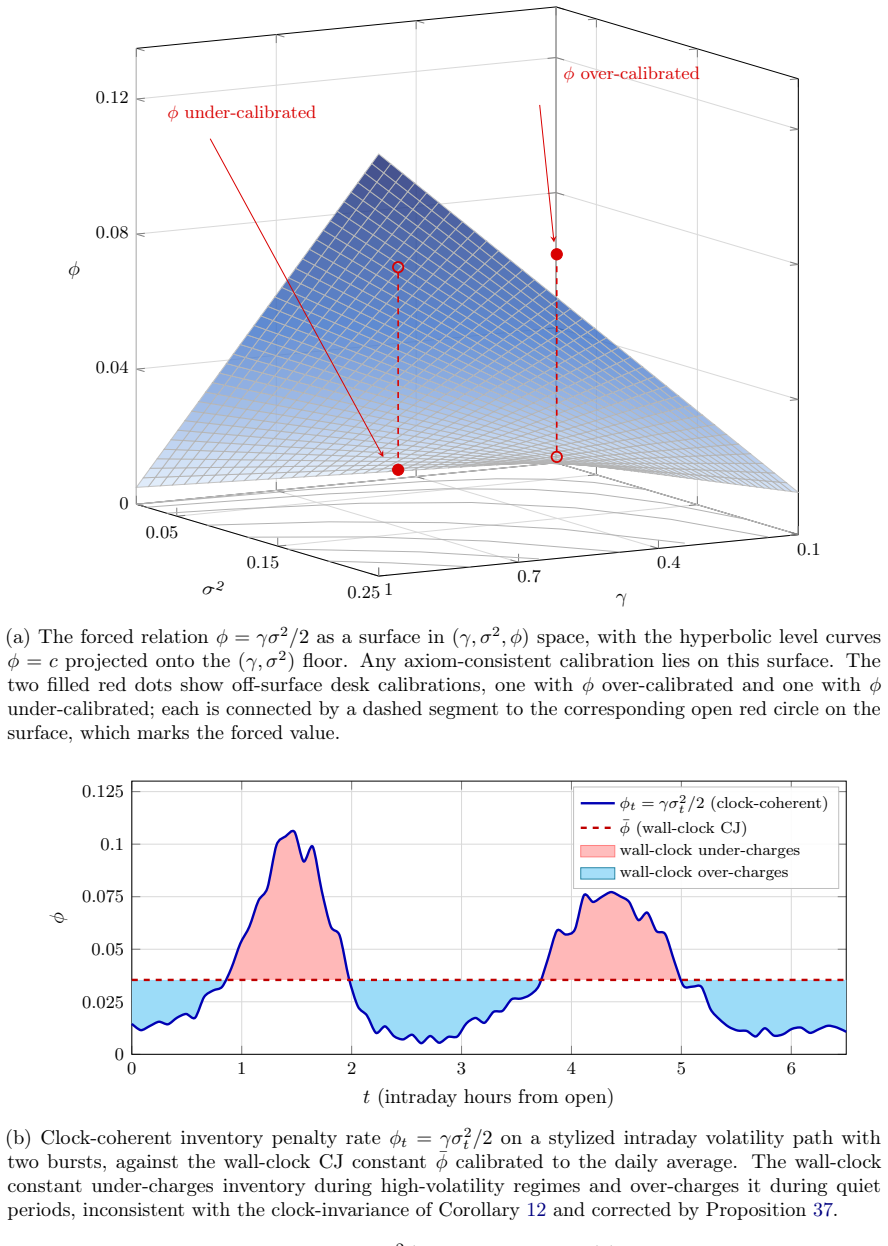
1 0
0
q-fin.MF 2026-05-18 2 theorems

Sparse OTM quotes suffice for continuous arbitrage-free option prices

by Masaaki Fukasawa, Shunta Murayama

Robust Volatility Index Calculation with OTM Option-implied Probability

Fewer parameters keep the volatility index stable when most strikes lack trading activity.

Figure from the paper full image
abstract click to expand
In financial markets, accurately measuring the risk of future fluctuations in asset prices is of paramount importance. Studies such as Carr and Madan have shown that the expected value of the quadratic variation of log prices can be expressed as an integral of European option prices over a continuum of strikes. This has led to the widespread estimation of model-free volatility (implied variance). However, this theoretical calculation assumes that options are continuously traded across all strike prices, which creates a fundamental gap with real-world market environments where options are only traded at discrete strikes. How to appropriately address this gap and robustly estimate volatility is a crucial issue for both practitioners and academics, and is the primary objective of this paper. Focusing on the fact that volatility indices are primarily calculated from the prices of out-of-the-money (OTM) options, this paper proposes a novel method for constructing a continuous European option pricing function that is consistent with the bid-ask spreads of observed OTM options and strictly satisfies arbitrage-free conditions (such as monotonicity and convexity). Although previous studies have attempted to construct arbitrage-free option pricing functions from bid-ask spreads, the construction method proposed in this paper requires fewer market parameters than existing methods. This makes it possible to robustly calculate volatility indices while maintaining theoretical consistency, even in markets with extremely low liquidity.
1 0
0
q-fin.MF 2026-05-18 Recognition

Signature volatility models gain global solutions on admissible tensor algebras

by Akmal Xodarev

On the Structural Foundations of Signature Volatility Models: Existence, Arbitrage, Completeness, and the Hedging-Error Decomposition

Summability and exponential-integrability conditions deliver martingale pricing, finite-depth completeness, and explicit hedging-error bound

abstract click to expand
We establish four structural results for signature volatility models. First, we prove global existence and uniqueness of strong solutions to the signature SDE $dS_t = S_t \langle \ell, \widehat{W}_t \rangle \, dB_t$ on the weighted tensor algebra $T_w$, identifying the admissibility class through a summability condition H1 and an exponential-integrability condition H3 for the square-integrable stochastic-exponential construction. Second, we establish the asset-pricing part on the natural filtration of the prolonged signature and separate it from transform non-explosion: H3 makes the reference-measure stochastic exponential a true martingale, hence yields NFLVR, while global solvability of the associated infinite-dimensional Riccati equation is the additional condition equivalent to absence of explosion for finite signature transforms. Third, we characterise market completeness on the price filtration via the density of the truncated signature span $\mathrm{span}\{\langle e_I, \widehat{W}_T \rangle : |I| \leq N\}$ inside $L^2(\mathcal{F}^S_T, \mathbb{Q})$, and identify the minimal such $N$, the price-filtration completeness depth. Fourth, we derive the hedging-error decomposition $X = \mathbb{E}_\mathbb{Q}[X] + \int_0^T H_s \, dS_s + \varepsilon_T$ for square-integrable payoffs, with residual expanded through the Gram projection of signature components beyond the completeness depth and bounded by a model-dependent projection error. The four results are tied by an architectural identity: the admissible weighted tensor algebra on which the stochastic exponential is a true martingale and finite signature transforms do not explode is the natural valuation cell of a signature SDE. The proofs are self-contained except for standard results from rough path theory, stochastic integration, and quadratic hedging, recalled in the appendices.
0
0
q-fin.MF 2026-05-18 1 theorem

Liability clearing equals global sections of a sheaf on hypergraphs

by Robert Ghrist

Clearing in Liability Networks via Sheaves on Directed Hypergraphs

Sheaf on directed hypergraphs frames clearing as finite-limit equalizer and preserves solutions across payment categories via functoriality

abstract click to expand
We associate to a decorated liability network a liability sheaf on a directed hypergraph whose hyperedges separate the distribution of payments from the collection of receipts. Clearing configurations are precisely the global sections of this sheaf, and the global-section object is canonically the equalizer of the identity and a clearing operator $\Phi=A\circ D$ factored into collective distribution $D$ and aggregation $A$; an institution-edge duality identifies it equivalently with the equalizer of the dual operator $D\circ A$ on the edge side. This identifies liability clearing as a finite-limit construction in the ambient data category. The construction is functorial under change of coefficient category: a Clearing Invariance Theorem shows that a finite-limit-preserving functor compatible with constraint subobjects induces a canonical isomorphism on global-section objects, enabling uniform comparison of clearing problems across categories of payment data. Existence, uniqueness, and iterative computation of clearing sections are organized by the structure carried on payment objects: Tarski's theorem yields existence and a complete-lattice structure under complete-lattice global elements; Scott continuity refines this to convergent Kleene iteration; an acyclic underlying graph admits a unique clearing section in finitely many steps with no order or metric hypothesis; and Banach's theorem on global elements yields uniqueness under metric contraction. The Eisenberg--Noe model and lattice liability networks arise as special cases.
0
0
q-fin.ST 2026-05-18 2 theorems

Risk appetite of market makers drives price chaos

by Will Hicks

Market Makers and Risk Aversion: A Hamiltonian Approach to the Excess Volatility Puzzle

Hamiltonian model shows unpredictable changes arise from internal oscillator coupling without needing external shocks.

Figure from the paper full image
abstract click to expand
In this article we model chaotic dynamics in financial markets by treating the market price, and market makers' inventory, as anharmonic oscillators with a nonlinear coupling. The market makers' risk appetite being the key parameter that determines the degree of chaos in the system. The article demonstrates that whilst external shocks and random noise are important in the treatment of financial time-series, they are not necessary in order to generate unpredictable price changes.
0
0
stat.AP 2026-05-14

Existing risk model improved by adding transient factors from returns

by Alexandros E. Tzikas, Emmanuel J. Candès +4 more

Enhancing a Risk Model by Adding Transient Statistical Factors

Maximum likelihood estimation on historical data captures missed structure in US equity returns for covariance modeling.

Figure from the paper full image
abstract click to expand
Estimating the covariance of asset returns, i.e., the risk model, is a key component of financial portfolio construction and evaluation. Most risk modeling approaches produce a factor model that decomposes the asset variability into two components: the first attributed to a small number of factors that are common among the assets and the second attributed to the idiosyncratic behavior of each asset. Third-party providers typically provide risk models to investors, and while these models are typically of high quality, they may fail to capture important information, e.g., changing market regimes and transient factors. To overcome these limitations, we propose a systematic method based on maximum likelihood estimation to enhance an existing factor model by both refining the given model and adding new statistical factors. Our approach relies only on the observed sequence of realized returns and on the choice of two hyperparameters: the number of additional factors and the half-life parameter that determines the weights assigned to returns in the log-likelihood objective. Importantly, our methodology applies to the situation where asset returns may be missing, making it suitable for typical equity datasets. We demonstrate our approach on the Barra short-term US risk model, a high-quality risk model used in practice, for a universe of US high-capitalization equities. We show that the proposed extension captures structure in the returns that is missed by the original model.
0
0
q-fin.MF 2026-05-13

VAE-neural SDE hybrid forecasts yields at 6.58 bps RMSE

by Fusheng Luo, H'elyette Geman

Yield Curves Dynamics Using Variational Autoencoders Under No-arbitrage

A two-stage model extracts heavy-tailed manifolds and enforces no-arbitrage PDE penalties on latent dynamics, sidestepping HJM violations ac

Figure from the paper full image
abstract click to expand
This paper introduces a physics-informed generative framework that resolves the fundamental conflict between the statistical flexibility of deep learning and the rigorous theoretical constraints of fixed-income modeling. We demonstrate that standard generative models and unconstrained statistical extrapolations suffer from "manifold collapse" and severe arbitrage violations when forecasting term structures across diverse macroeconomic regimes. To overcome this, we propose a two-stage architecture. First, a Student-t Conditional Variational Autoencoder with Dynamic Level Injection (CVAEsT+LS) extracts a robust, heavy-tailed term structure manifold, effectively decoupling macroeconomic shape dynamics from absolute base rates. Second, the latent dynamic evolution is governed by a continuous-time Neural Stochastic Differential Equation (SDE) strictly penalized by a No-Arbitrage Partial Differential Equation (PDE). Empirical results across multiple sovereign currencies (USD, GBP, JPY) confirm that our synergistic approach drastically reduces out-of-sample forecasting errors -- achieving an exceptional 6.58 bps Mean Tenor RMSE -- and successfully overcomes the massive parallel drift and zero-lower-bound violations exhibited by the classical HJM model in extreme environments. Furthermore, through phase space vector field analysis, we demonstrate the model's superior capability in unsupervised macroeconomic regime detection and high-quality continuous-time scenario generation. Ultimately, this research provides a highly scalable, mathematically sound evolutionary engine for term structure modeling.
0
0
q-fin.MF 2026-05-13 2 theorems

Closed-form optimal rules derived for PAYG pension investments with buffer funds

by Jennifer Alonso-Garcia, Caroline Hillairet +2 more

Optimal investment and Pension policy in Pay-As-You-Go systems under forward utility and ageing population

Forward CRRA utilities yield explicit policies balancing sustainability and adequacy amid population aging and market risks.

Figure from the paper full image
abstract click to expand
This paper investigates optimal investment and pension policies in a Pay-As-You-Go (PAYG) system supplemented by a buffer fund used as an intergenerational risk-sharing mechanism. The social planner's preference criterion is represented by non-zero volatility forward Constant Relative Risk Aversion (CRRA) utilities, and explicitly accounts for both sustainability and adequacy constraints. The optimal policies are characterized in closed form, and an in-depth analysis of the impact of preference sensitivities on the pension scheme is conducted. A detailed numerical analysis is performed to evaluate the sustainability and benefit adequacy of this hybrid PAYG buffer fund arrangement under a range of demographic, financial, and macroeconomic scenarios.
0
0
math.PR 2026-05-13 2 theorems

Filtering equations now cover predictable jumps

by Thorsten Schmidt, Félix B. Tambe-Ndonfack

Nonlinear filtering with stochastic discontinuities

Kushner-Stratonovich and Zakai equations are derived for signals and observations that jump at known times, covering clinical visits and div

Figure from the paper full image
abstract click to expand
Filtering problems with jumps in both the signal and the observation have been extensively studied, typically under the assumption that jump times are totally inaccessible. In many applications, however, jump times are known in advance (i.e., predictable), such as scheduled clinical visits, dividend payment dates, or inspection times in engineering systems. Taking predictable jump times as a starting point, we investigate a filtering problem in which both the signal and the observations can exhibit jumps at predictable times. We derive the corresponding Kushner-Stratonovich and Zakai equations, thereby extending classical nonlinear filtering results to a setting with predictable discontinuities. We illustrate the framework on a Kalman filtering model with predictable jumps and on applications to longitudinal clinical studies, such as spinal muscular atrophy (SMA), as well as to machine learning models (neural jump ODEs) and credit risk.
0
0
q-fin.MF 2026-05-13 2 theorems

Optimal utility stays continuous under price tweaks in cost markets

by Yuri Kabanov, Artur Sidorenko

On convergence of the Mayer problems arising in the theory of financial markets with transaction cost

In the geometric model with price and solvency processes, small changes to S keep maximal expected terminal utility close and strategies are

abstract click to expand
The geometric approach to financial markets with proportional transaction cost prescribes to imbed a specific model (of stock market, of currency market etc.), usually given in a parametric form, into a natural framework defined by the two random processes, S and K. The first one, d-dimensional, models the price evolution of basic securities while the second one, cone-valued, describes the evolution of the solvency set. It happened that the fundamental questions -- no-arbitrage criteria, hedging problems, portfolio optimization -- can be studied in this general setting opening the door to set-valued techniques. In this note we explore, in such a general framework, the stochastic Mayer control problem, consisting in the maximization of the expected utility of the portfolio terminal wealth. We get results on continuity of the optimal value and the optimal control under price approximations in a general multi-asset framework described by the geometric formalism.
0
0
q-fin.MF 2026-05-12 2 theorems

Explicit optimal control derived for Ethena yield positions

by Matthew Lorig

Optimal Control of the Ethena Yield-Bearing Stablecoin

The model shows how the rate of building the delta-neutral carry trade balances staking rewards and funding income against permanent basis-n

Figure from the paper full image
abstract click to expand
We formulate and solve stochastic control problems that model the core yield-generating strategy of the Ethena protocol, a decentralized finance (DeFi) stablecoin that earns yield by combining a long position in staked Ethereum (stETH) with an equal-sized short position in ETH perpetual futures. The combined position is delta-neutral with respect to the ETH spot price, yet earns carry from two sources: staking rewards on the stETH leg, and funding-rate payments received from long perpetual holders when the perpetual trades at a premium to spot. A key feature of our model is that the control -- the rate of simultaneously buying stETH and shorting the perpetual -- exerts two distinct types of price impact. \textit{Permanent} impact shifts the mid-market prices of both legs, compressing the basis and permanently eroding future funding income. \textit{Temporary} impact reflects execution slippage on each leg. We study both an infinite-horizon discounted problem and a finite-horizon problem in which the protocol maximizes total wealth up to a fixed date $T$, subject to a terminal cost for liquidating any remaining position. In both cases the optimal control is obtained explicitly.
0

browse all of q-fin.MF → full archive · search · sub-categories