pith. sign in

econ.EM

Econometrics

Econometric Theory, Micro-Econometrics, Macro-Econometrics, Empirical Content of Economic Relations discovered via New Methods, Methodological Aspects of the Application of Statistical Inference to Economic Data.

Top Pith
1
econ.EM 2026-05-14 2 theorems

Claude Sonnet leads on live energy data benchmark

by Eliseo Curcio

EnergyAgentBench: Benchmarking LLM Agents on Live Energy Infrastructure Data

New tasks require agents to query real electricity prices, grid carbon, and cost trajectories, exposing wide gaps on causal reasoning.

Figure from the paper full image
abstract click to expand
Selecting the right electricity market region for a hyperscale AI datacenter requires reasoning across live electricity prices, grid carbon intensity, technology cost trajectories, and causal grid dynamics -- a multi-step, multi-source analytical task that static knowledge benchmarks cannot evaluate. We introduce EnergyAgentBench, the first agentic benchmark grounded in live electricity market data for this problem class. The benchmark comprises 70 task variants across five families: datacenter siting under cost-carbon trade-offs (F1), long-horizon portfolio siting (F1-LH), lifetime LCOE ranking over multi-decade cost trajectories (F2), 30-year portfolio optimization (F2-LH), and causal grid diagnosis (F3). Tasks require 3 to 48 sequential tool calls against live endpoints from the QuarluxAI infrastructure platform, the U.S. Energy Information Administration (EIA), and the National Renewable Energy Laboratory (NREL) with ground truth derived from trained XGBoost cost-surface models (R^2 0.967--0.995) and the NREL Annual Technology Baseline 2024. We evaluate nine models across Anthropic, OpenAI, and HuggingFace over 1,414 runs at three random seeds. Claude Sonnet 4.6 achieves the highest overall score (0.900) at one-quarter the cost of Claude Opus 4.7 (0.889). Claude Haiku 4.5 leads on long-horizon procedural siting (0.986), outperforming all frontier models including those costing 16x more per run. F3 Causal is the most discriminating family, with a 30.7-point spread between Sonnet (0.793) and Llama 3.3 70B (0.486), versus a 6.6-point spread on F1 Siting. A failure taxonomy of 135 coded failures identifies null-value integration in NREL ATB trajectories as the dominant failure mode (70%), followed by premature commitment on causal tasks (20%) and adversarial injection blindness (6%). Benchmark code, run trajectories, and the failure taxonomy dataset are publicly released.
0
0
stat.ME 2026-07-03

The paper develops design-based inference for experiments that randomly assign…

by Jiawei Fu, Cyrus Samii +1 more

Inference for Group Interaction Experiments

In a sparse-sampling regime, standard cluster methods account for dependencies from interference and group formation.

Figure from the paper full image
abstract click to expand
A common experimental research design is one in which individuals are randomly allocated into groups that then interact under different group-level treatment conditions. We develop design-based inference for such "group interaction" experiments, covering scenarios in which groups are either fixed or randomly formed and in which potential outcomes are either fixed relative to others' group assignments or subject to interference. For each scenario, we characterize the causal estimand that the design targets and the inferential strategy appropriate to it. Working in a sparse-sampling asymptotic regime, we show that cluster-robust inference remains consistent and accounts for dependencies from various sources when interference is present, delivering valid inference on marginalized exposure effects. When interference is absent and groups are formed randomly, the design reduces to an individually randomized experiment, and individual-level heteroskedasticity-robust inference suffices for the average treatment effect. Our results on the asymptotic distribution of commonly used estimators rely on a novel coupling strategy that may be useful for design-based inference in other complex experiments.
0
0
econ.EM 2026-07-03

GIV consistent at √T only when few units dominate aggregate

by Gokul Gopalan Ramachandran

Granular Instrumental Variables in Large Panels: Identification and Inference Across Strong, Nearly Weak, and Weak GIV

Three regimes of instrument strength arise from unit sizes in growing panels, dictating rates and valid inference methods.

Figure from the paper full image
abstract click to expand
I develop the asymptotic theory of instrument strength for Granular Instrumental Variables (GIV) in large panels with both $N$ and $T$ growing. The strength of the GIV depends on the presence of dominant units. I formalise what dominance means and characterise three regimes of instrument strength. When a few units dominate the aggregate, the instrument is strong. The GIV estimator is consistent and asymptotically normal at the standard $\sqrt{T}$ rate. When large units stand out but do not dominate, the instrument weakens. But I show that the parameter of interest remains recoverable. The GIV estimator remains consistent and asymptotically normal, now at a rate slower than $\sqrt{T}$. When units are comparable in size and none stands out, the instrument is weak in the standard sense. The GIV estimator is inconsistent and has a non-standard distribution. Wald inference is reliable only outside the weak regime. When the instrument is weak, I recommend Anderson-Rubin confidence sets. In practice, the instrument must be constructed in a first stage. I show that the feasible estimator attains the same rate, but its asymptotic variance picks up an additional term from the first-stage estimation. Valid inference must use standard errors that account for this term. I apply the GIV estimator with the correct standard errors to recover the short-run demand elasticities of three commodities: refined copper, crude oil, and natural gas.
0
0
econ.EM 2026-07-03

SLV projects full stock profit to correct short A/B test bias

by Geoffrey Decrouez, Tobias Huelden +2 more

Measuring Opportunity Cost with Stock Lifetime Value

Metric sums expected lifecycle value so weekly experiments reflect months-long opportunity costs in inventory settings.

Figure from the paper full image
abstract click to expand
Measuring the long-term opportunity cost of interventions remains a critical challenge in e-commerce A/B testing. While strategic levers (such as dynamic pricing, ranking algorithms, and promotional campaigns) trigger shifts in consumer behaviour that persist over months, operational constraints necessitate fast decision-making cycles that are typically limited to weekly experimental windows. Standard metrics like revenue and conversion are inherently short-sighted, biasing decisions toward immediate gains. We introduce Stock Lifetime Value (SLV), a stock-centric metric that captures long-term opportunity cost within short experiments by aggregating expected profit from current inventory through the end of its selling lifecycle. We develop the methodology in the context of fashion e-commerce at Zalando, where stock constraints and seasonal lifecycles make the trade off between short-term and long-term outcomes particularly relevant. SLV aggregates the expected profit from current inventory through the end of its selling lifecycle, providing a way to evaluate interventions against their true profit impact. We discuss three applications: (a) SLV efficiency as a metric for article-level and customer-level A/B tests, validated against realized 18-month lifecycle outcomes; (b) SLV as an optimization target for pricing algorithms, aligning the metric used for measurement with the objective used for decision-making; and (c) a framework for annualizing treatment effects into financial reporting metrics required by business stakeholders. While our empirical setting is fashion retail, the framework applies broadly to any inventory-constrained environment where value decays over time or interventions shift demand across periods.
0
0
econ.EM 2026-07-02

Binary instrument identifies nonlinear multivariate IV models

by Florian Gunsilius

A condition for the identification of multivariate models with binary instruments -- with Corrigendum and Addendum

Cyclic monotonicity condition on the first stage enables point identification with general heterogeneity.

Figure from the paper full image
abstract click to expand
This article introduces an empirical condition for the nonparametric point-identification of multivariate instrumental variable models with continuous endogenous variables using binary instruments. Verifying this condition can confirm point-identification in settings in which traditional approaches are not applicable. In particular, it shows that nonlinear instrumental variable models with general heterogeneity can be point-identified with only a binary instrument. This generalizes existing identification results which either restrict the unobserved heterogeneity substantially or require the instrument to have a large support. The main assumption on the instrumental variable model is cyclic monotonicity of its first stage, a multivariate generalization of the classical rank-invariance assumption for univariate models. Asymptotic convergence results for the empirical observable distributions are derived that allow to check the condition in practice. The identification rests on a fixed-set convergence result of cyclically monotone maps between quasi-concave functions. The corrigendum corrects the proof of Lemma 1. The proof given there incorrectly identifies preservation of distributional level sets with preservation of the underlying probability measure via Brenier maps. We replace that argument by one based on inverse Brenier maps, which play the role of multivariate ranks. The corrected argument applies to a different but significantly more flexible class of distributions than the quasi-concave class considered in the original paper. In particular, it allows for smooth non-quasi-concave and multimodal densities on compact supports, provided the associated rank fixed set satisfies a nondegeneracy condition. Moreover, it is generically satisfied for smooth parmetric classes of distributions.
0
0
econ.EM 2026-07-02

Low order flow creates illiquidity premium via price impact

by Irene Aldridge

Liquidity Premium and Investment Horizons

Daily estimates of Kyle's lambda from equity order flow forecast returns and resolve Constantinides puzzle through temporary price depressio

Figure from the paper full image
abstract click to expand
We estimate Kyle's (1985) price-impact coefficient $\lambda$ directly from daily equity order flow and test its ability to forecast the cross-section of subsequent stock returns. Using CRSP data from 2020 to 2025, we construct firm-month measures of signed order flow and two estimators of $\hat\lambda_{it}$: a within-month price-impact regression and an Amihud-style ratio. Signed order flow strongly predicts contemporaneous and one-month-ahead returns, while volume volatility predicts lower subsequent returns, consistent with widening price impact degrading price discovery. Fama-MacBeth regressions confirm that our order-flow signal carries significant cross-sectional return information after Newey--West adjustment. Theoretically, we resolve the liquidity premium puzzle of Constantinides (1986) through an adverse-selection mechanism: low order flow widens $\lambda$ and depresses prices today; subsequent normalization restores prices, generating the illiquidity premium without risk-based compensation.
0
0
econ.EM 2026-07-02

Valid intervals for network densities survive group selection from data

by Eric Auerbach, Jonathan Auerbach +1 more

Post-selection inference for network structure

Two methods ensure coverage when communities or markets are identified using the observed connections themselves.

Figure from the paper full image
abstract click to expand
Researchers often use the density of connections between groups of agents, such as communities, blocs, or markets, to characterize the structure of a social or economic network. In many cases, these groups are selected using the network data, making conventional fixed-group inference procedures potentially invalid. To address this issue, we develop two new confidence intervals that are universally valid post-selection in the sense that they guarantee simultaneous coverage asymptotically over all pairs of groups whose relative sizes do not vanish. Our first interval builds on a strategy of \cite{berk2013valid}. Our second interval is based on a Talagrand-type concentration inequality for empirical processes. Both intervals are simple to compute and scalable to large networks, but a key technical contribution of our paper is show that only the second interval achieves the best-possible width asymptotically up to a constant factor. Three empirical illustrations show that accounting for selection can matter in practice. Some evidence for homophily in a social network and a hub-and-spoke structure in a trade network survives our correction, while evidence for disjoint market segments in a worker transition network does not.
0
0
cs.LG 2026-07-02

Causal models recover Airbnb guest price responses from booking data

by Yufei Wu, Daniel Schmierer

Understanding Guest Preferences and Optimizing Two-sided Marketplaces: Airbnb as an Example

Elasticity and heterogeneity estimates are used to optimize host pricing tools and guest recommendations.

Figure from the paper full image
abstract click to expand
Airbnb is a community based on connection and belonging -- many hosts on Airbnb are everyday people who share their worlds to provide guests with the feeling of connection and being at home; Airbnb strives to connect people and places. Among our efforts to connect guests and hosts, we provide tools to enable hosts to set competitive prices, which helps improve affordability for guests while helping hosts get more bookings. We also personalize the guest experience to show them the listings that match their needs. To help inform these efforts, we combine economic modeling and causal inference techniques to understand how guests book stays based on the prices hosts set, among other factors, and how that preference varies across different guests and listings. Such understanding helps us identify opportunities for Airbnb to support the marketplace and better connect guests and hosts. For example, understanding how much guests respond to different prices helps optimize the tools that we provide to hosts, in order to enable hosts to choose and set competitive prices that further balance demand and supply. As another example, understanding heterogeneity in guest preferences helps us personalize the guest experience and better match them with the listings that meet their needs, based on how much they respond to different prices and other factors.
0
0
econ.EM 2026-07-01

Plug-in estimator for quantile compositions reaches root-n normality with unbounded variab

by Julien Chhor, Xavier D'Haultf{oe}uille +2 more

Asymptotic Properties of Empirical Quantile-Based Estimators

New variance estimator is also consistent and improves finite-sample inference in changes-in-changes settings.

Figure from the paper full image
abstract click to expand
We consider inference for parameters of the form $\theta_0 = E[F_Y^{-1}\circ F_Z(X)]$ for some variables $X$, $Y$ and $Z$. Such parameters appear, in particular, in the ``changes-in-changes'' model of \cite{AtheyImbens2006}. We first establish that $\widehat{\theta}$, a plug-in estimator of $\theta_0$, is root-$n$ consistent and asymptotically normal under weaker conditions than those previously available, allowing in particular for unbounded variables. Next, we propose a new estimator of the asymptotic variance of $\widehat{\theta}$ and show its consistency, also allowing for unbounded variables. Monte Carlo simulations suggest that the conditions for root-$n$ consistency and asymptotic normality are, in some sense, minimal. These simulations highlight that our variance estimator also leads to more accurate inference than some alternative approaches.
0
0
math.PR 2026-07-01

Graph geometry and dependence set empirical rates

by Mengsi Gao, Demian Pouzo

Coupling and Maximal Inequalities for Graph-Dependent Empirical Processes

Maximal inequalities show convergence speed depends on function-class complexity, graph growth, and how fast dependence fades with distance.

abstract click to expand
We develop maximal inequalities for empirical processes indexed by graph-dependent observations. Our bounds separate the complexity of the indexing class from two features specific to graph dependence: the geometry of the underlying graph and the cost of coupling graph-separated blocks to independent copies. The coupling construction combines a novel graph-adapted dependence coefficient with a coloring of a block partition. We specialize the results to graphs with polynomial and exponential growth and to directed dyadic graphs. We then derive Glivenko--Cantelli results and characterize the associated effective sample size. A central implication is that graph-dependent empirical processes need not exhibit a generic root-$n$ rate: convergence is jointly determined by function-class complexity, graph geometry, and the decay of dependence with graph distance. Finally, we apply the results to obtain uniform laws of large numbers for network autoregressive models, nonlinear local-propagation models, and treatment-interference settings.
0
0
econ.EM 2026-07-01

Certified delegation rights reduce deadweight loss in AI use

by Yukun Zhang, Kemu Xu

Delegation Rights: Property, Agency, and Investment Incentives in the Age of AI Agents

By making access conditional on verifiable standards, the regime encourages investment while limiting risks to platforms and third parties.

Figure from the paper full image
abstract click to expand
AI agents increasingly operate inside digital accounts by exercising privileges that users already hold, raising a new control question: whether an existing account entitlement must be exercised manually or may be exercised through a user-authorized automated proxy. We define \emph{delegation rights} as the revocable, identity-preserving, scope-limited, and mode-specific authority of an account holder to authorize such proxy execution. We develop a three-party incomplete-contracts model with a User, an AI Agent provider, and a Platform. The contested object is not platform ownership, account transferability, data portability, or unrestricted API access, but residual control over the mode of account execution. Under Platform Control, the platform can protect infrastructure, identity systems, privacy boundaries, and third parties, but its discretionary veto weakens the User--Agent coalition's disagreement payoff and depresses relationship-specific investment. Under User Control, hold-up is reduced, but security, privacy, congestion, and third-party risks may remain insufficiently internalized. We then analyze \emph{Certified Delegation}, under which access protection is conditional on verifiable authorization, revocability, auditability, rate-limit compliance, data minimization, and risk mitigation. Certification is therefore not merely a technical safety screen; it is a conditional allocation of residual control. Illustrative mechanism simulations show how this regime can reduce deadweight loss by restoring delegation incentives while bounding residual risk.
0
0
econ.EM 2026-07-01

QBHM matches GMM asymptotics for strong params and Bayes rule for weak

by Desmond Fairall, Thomas Glinnan

Quasi-Bayesian Hierarchical Models

Quasi-posterior mean preserves group objectives while the pooling term supplies decision-theoretic optimality in weak-GMM limits.

abstract click to expand
We develop the Quasi-Bayesian Hierarchical Model (QBHM) for grouped GMM settings. The framework combines Bayesian hierarchical modelling with Laplace-type estimation: it preserves each group-specific objective function, while introducing a pooling term for economically comparable parameters. When the number of studies is fixed, the QBHM estimator-the quasi-posterior mean-has the same asymptotic distribution as GMM when estimating strongly identified study parameters. For weakly identified studies, we analyze the asymptotic properties of the method via a weak-GMM limit experiment: an asymptotic approximation in which the sample-moment criterion remains a random function over the weak parameter space, and the upper-level pooling relation induces a family of priors over weak values. In this experiment, the weak-limit QBHM rule is a Bayes rule under squared loss for the hierarchy-induced weak-limit prior, which provides a decision-theoretic justification for our procedure. We also extend our results to mixed within-study blocks, allowing a single study to contain both strongly and weakly identified parameters. Pooling can also reduce the pointwise asymptotic mean squared error (MSE) relative to unpooled estimation when the bias--variance tradeoff is favorable. Gaussian likelihood, nonlinear weak-GMM, and weak-IV calculations show when this happens, while simulations and a microenterprise application illustrate the method.
0
0
econ.EM 2026-07-01

HAC overstates variance for design-based time-series GMM

by Thomas Glinnan

Design-Based Inference for Time-Series GMM

Design long-run variance Ω_R is smaller than the HAC target Ω_R + Ω_μ, so covariate projections yield tighter yet still conservative interva

Figure from the paper full image
abstract click to expand
This paper studies inference for time-series GMM when uncertainty comes from shock assignment within a realized historical episode. Rather than treating the data as one random draw from a population of hypothetical economies, the framework conditions on the historical environment and considers alternative realizations of shocks and instruments. For locally correctly specified GMM estimators, the centered moment has design long-run variance $\Omega_R$, which determines the sandwich covariance for the finite-history estimand. Conventional HAC estimators instead converge to $\Omega_R^+=\Omega_R+\Omega_\mu$, where $\Omega_\mu\succeq0$ is the long-run variance of the centered mean-moment path. HAC inference is therefore conservative for scalar functions of the finite-history estimand. Projection adjustment using predetermined covariates can reduce this HAC variance limit in Loewner order and, under an additional long-run orthogonality condition, yields a tighter conservative bound on the corresponding asymptotic covariance. Monte Carlo evidence shows when the distinction is quantitatively important. In a monetary-policy application, standard-error reductions from rich macro covariates provide a diagnostic for economically meaningful predictable variation in the mean-moment path.
0
0
cs.LG 2026-07-01

Debiased ML with Bayesian priors estimates supply effects on bookings

by Yufei Wu, Daniel Schmierer +1 more

Estimating Supply Incrementality in Two-sided Marketplaces: A Causal Machine Learning Approach

The approach uses segment similarity features to produce plausible causal estimates of how extra listings change total marketplace transacti

Figure from the paper full image
abstract click to expand
In two-sided marketplaces with heterogeneous products, it is important to understand the causal relationship between additional supply and marketplace outcomes, such as the total quantity transacted or transaction value in the marketplace. This paper studies a causal machine learning approach to estimating this relationship across product segments. We use the Airbnb marketplace as an example, focusing on the impact of additional listing supply on total bookings, but the methodology applies to other two-sided marketplaces. Our approach combines double/debiased machine learning with a hierarchical Bayesian framework that leverages pre-existing knowledge as priors. We construct tractable and informative features for the model by leveraging measures of product segment similarity from the geospatial literature. We find that such a model provides plausible estimates of the marketplace returns to additional supply and strong out of sample performance.
0
0
econ.EM 2026-06-30

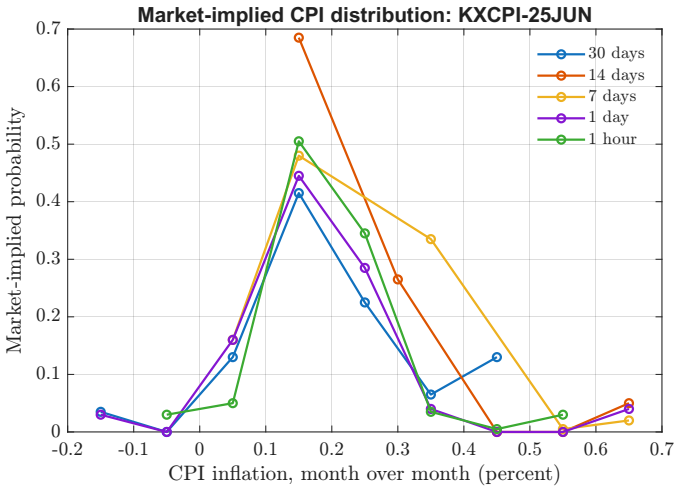
Prediction markets flag inflation risk that point forecasts overlook

by Giovanni Angelini

The Shape of Macroeconomic Beliefs

Kalshi data show past surprises boost odds of high monthly inflation even after consensus adjustment.

Figure from the paper full image
abstract click to expand
Macroeconomic expectations are usually observed through point forecasts or through asset prices whose mapping into beliefs is model-dependent. This paper uses prediction-market prices to recover high-frequency distributions of short-run macroeconomic beliefs. We construct a panel of Kalshi-implied distributions for CPI and core CPI releases by converting adjacent threshold contracts into probability mass over inflation outcomes. The data reveal market-implied means, uncertainty, and upper-tail probabilities from 30 days to one hour before each release. The market-implied mean contains meaningful forecast information, especially for headline CPI, but the main signal is distributional. Lagged Reuters Poll surprises do not predict systematic deviations of Kalshi means from the current Reuters consensus. By contrast, large lagged surprises are associated with higher implied uncertainty, and positive lagged surprises raise the probability assigned to fixed high-inflation outcomes. In the baseline specification with variable-by-horizon fixed effects, a 0.1 percentage point positive lagged surprise raises the probability of monthly inflation above 0.3 percent by about 4.7 percentage points, even after controlling for the current consensus forecast. In release-level validation tests, Kalshi upper-tail probabilities also predict the realization of high-inflation states, including episodes in which the market-implied mean remains close to the Reuters consensus. The evidence suggests that prediction markets can provide real-time information about inflation risk that is missed by point forecasts.
0
0
econ.EM 2026-06-30

GMM informativeness drops below one under undetected misspecification

by Fangzhou Yu, Seojeong Lee

Sensitivity, Informativeness, and Misspecification in GMM Estimation

New Delta measure shows efficiency losses from the moments that the J-test can miss, illustrated in demand, insurance, and democracy models.

Figure from the paper full image
abstract click to expand
This paper develops misspecification-robust sensitivity and informativeness diagnostics for GMM estimators, evaluated at pseudo-true values. The sensitivity matrix nests that of Andrews, Gentzkow, and Shapiro (2017) under correct specification. The informativeness $\Delta$ measures the share of an estimator's asymptotic variance explained by sampling variation in the moments, a notion of structural efficiency that equals one under correct specification and can fall below one under misspecification, even when the Hansen $J$-test does not reject. We derive influence-function representations for one-step, two-step, iterated, and continuously updating GMM. We show that in minimum-distance estimation, estimating the optimal weight matrix adds estimator variance that the moments do not explain, lowering informativeness, while simpler weight matrices largely avoid it. The choice of weight matrix therefore involves a trade-off between classical efficiency and informativeness. In applications to the automobile demand model of Berry, Levinsohn, and Pakes (1995), the consumption insurance model of Blundell, Pistaferri, and Preston (2008), and the income-and-democracy regressions of Acemoglu, Johnson, Robinson, and Yared (2008), misspecification reorders sensitivity rankings, simpler weights preserve the informativeness that the optimal weight loses, and $\Delta$ detects structural-efficiency losses that the $J$-test does not.
0
0
stat.ME 2026-06-30

Historical data cuts bias and variance in model evaluations

by Xinrui Ruan, Zhenyu Zhao +5 more

HERO: Improving the Reliability and Sensitivity of Generative Model Evaluation Using Historical Data

HERO calibrates noisy silver labels from past rounds and anchors to precise covariates for more reliable current tests.

Figure from the paper full image
abstract click to expand
Reliable generative AI models critically rely on expert human annotations to evaluate output quality, yet these "gold" labels are expensive to collect and limited in quantity. Organizations thus often turn to collecting vast but noisy "silver" labels from crowdsourced workers or vendor annotators as proxies for gold labels. Because gold remains the evaluation target, naively aggregating noisy silver labels may introduce bias, and estimators built on sparsely observed gold labels may have high variance to resolve the model performance gaps that guide practical decisions. Model evaluation has become an ongoing operational practice rather than a one-time exercise, with evaluation rounds repeating across model versions, releases, and content domains. A natural question is whether the previous historical evaluation data can be used to improve each new round of evaluation. We introduce HERO (History Enhanced RObust model evaluation), a novel framework that uses historical data to suppress bias (improve reliability) and reduce variance (improve sensitivity) in model performance evaluation. HERO calibrates silver labelers' performance learned from historical gold annotations, and stabilizes the resulting estimator by anchoring it to covariate information measured with high precision in the historical data. HERO can be broadly applied across multiple common evaluation tasks, and remains valid when only a subset of historical labelers appears in the current round. We establish conditions under which the bias and variance reductions hold, showcase HERO's performance in simulation studies, and demonstrate its effectiveness on real-world model evaluation benchmarking datasets.
0
0
econ.EM 2026-06-30

Cross-nested logit captures joint mode and time shifts under tolls

by Mohammad Amin Ashena, Adam Weiss +2 more

Modeling Mode and Departure Time Responses to Congestion Pricing: A Spatial and Behavioral Analysis Using Cross-Nested Logit Model

Calgary commuter survey shows the model allows simultaneous substitutions and reveals stronger responses to central and peak pricing.

abstract click to expand
Effective congestion management strategies require a detailed understanding of how travellers respond to different pricing interventions. This paper presents an in-depth analysis of traveller behaviour under congestion pricing scenarios, focusing specifically on mode and departure time decisions. Utilizing stated preference survey data from commuters in Calgary, Canada, three discrete choice models including Multinomial Logit, Nested Logit, and Cross-Nested Logit are developed and compared. Results indicate that the Cross-Nested Logit model provides superior behavioural realism and flexibility by capturing simultaneous substitutions across modes and departure times. Spatial analysis and elasticity assessments reveal substantial geographic variation in traveller sensitivity to pricing, particularly highlighting stronger responses among commuters travelling to high-demand central locations and during peak travel periods. Further elasticity analyses clarify behavioural patterns, identifying traveller groups with varying degrees of flexibility. Policy analyses underscore the effectiveness of targeted, dynamic tolling, particularly cordon-based pricing combined with time-specific toll adjustments, in reducing congestion levels. Additionally, the findings highlight the necessity of complementary measures, including improved transit services and targeted discounts, to ensure equitable outcomes. The findings offer targeted insights into how specific pricing strategies such as cordon, distance, and travel time-based tolls can be used to influence travel behaviour, reduce peak-period congestion, and guide equitable policy design in urban transportation planning.
0
0
econ.EM 2026-06-30

Factor models recover treatment effects as shifts in loadings on common shocks

by Jushan Bai, Peng Wang

Causal Inference Using Factor Models

Framework dispenses with parallel trends, works for one or many treated units, and supplies confidence intervals.

abstract click to expand
We develop a factor-model framework for causal inference in panels with policy interventions. Treatment effects are represented as structural changes in treated units' exposure to latent common shocks and, in extensions, changes in the factor process itself. The approach does not impose the standard parallel-trends restriction, accommodates one or many treated units, and targets systematic effects when unit-time idiosyncratic effects are not point identified. We provide estimation and inference under both fixed and treatment-dependent factor processes. Simulations show coverage close to nominal levels. In applications to California tobacco control and German reunification, the method produces estimates broadly consistent with synthetic control while delivering formal confidence intervals.
0
0
econ.EM 2026-06-29

Goal pursuit theory models goal conflicts AI travel predictions miss

by Jason Hawkins, Omid Armantalab

Why Do We Need Travel Behavior Theory in the Age of AI? Multiple Goal Pursuit as an Illustrative Theory

It captures context-dependent goal activation and resolution across time scales, shown in scheduling, ownership, and location applications.

abstract click to expand
Travel behavior and demand modeling seeks to understand the factors that motivate transportation decisions. At the same time, the field is increasingly adopting algorithmic and artificial intelligence (AI) tools that improve predictive accuracy, often at the cost of a grounding in hypothesis-based theory validation and behavioural explanation. In this discussion paper, we use goal pursuit theory (GPT) to illustrate why behavioral theory is a necessary complement to prediction in travel behavior research. Unlike random utility maximization (RUM) or close alternatives (e.g., random regret minimization (RRM)), GPT explicitly models how travelers (1) activate context-dependent goals (hedonic, gain, normative), (2) resolve conflicts between competing objectives, and (3) make sequential decisions across temporal scales. We demonstrate GPT's merits through three transport applications: activity scheduling (handling hierarchical goal structures), vehicle ownership (disentangling bundled mobility goals), and location choice (capturing latent goal interactions via matrix factorization). We provide actionable guidance for implementation, including: (a) hybrid choice model specifications linking goals to observable behaviors, (b) parallels to complementary behavioral theories from the transportation field, and (c) data requirements and comparative benchmarks against RUM/RRM models.
0
0
econ.EM 2026-06-29

Liberalization raised Bolivian poverty by up to 7.4 points

by Ricardo Alonzo Fernandez Salguero

Stabilization without Inclusive Development: Neoliberalism, Economic Liberalization, Poverty, and Inequality in Bolivia

10-point economic freedom score gain tied to higher poverty at three lines and +3.91 Gini points in heterogeneous IV estimates.

Figure from the paper full image
abstract click to expand
This article reconstructs the economic and social history of Bolivian neoliberalism and evaluates whether economic liberalization reduced or increased poverty and inequality in Bolivia. The historical argument is that the Bolivian neoliberal cycle was not a single event but a layered sequence: hyperinflation and emergency stabilization, the 1985 New Economic Policy, labor displacement and mining restructuring, second-generation reform in the 1990s, capitalization, decentralized state restructuring, commodity dependence, and the social conflicts that culminated in the collapse of the party system. The empirical contribution is to integrate macroeconomic indicators, economic-freedom indices, poverty and inequality series, IMF and financial-reform data, commodity and disaster controls, Bolivian export aggregates, and harmonized historical survey indicators. The preferred design is a heterogeneous instrumental-variables model that instruments domestic liberalization with lagged regional leave-one-out policy diffusion and allows Bolivia to differ from the Latin American average. The central estimate is that a 10-point increase in the Heritage economic-freedom score is associated, for Bolivia, with approximately +4.46 percentage points of poverty at the USD 4.20/day line, +3.61 percentage points at the USD 3/day line, +7.40 percentage points at the USD 8.30/day line, and +3.91 Gini points. These results remain socially regressive in sign after adding export-structure controls to the poverty specifications, although the causal interpretation remains conditional on the exclusion restriction. The article therefore advances a qualified conclusion: Bolivian neoliberalism stabilized hyperinflation, but the historically specific liberalization package appears to have increased social vulnerability and inequality rather than producing inclusive development.
0
0
econ.EM 2026-06-29

Fourier terms filter common factors in panel models with breaks

by Hasraddin Guliyev

Second-Generation Heterogeneous Panel Data Model with Individual and Common Shocks

F-CCEMG records lowest RMSE and near-nominal coverage in Monte Carlo tests for G7 renewable-energy data.

abstract click to expand
We study estimation of the mean slope in heterogeneous panels that combine cross-sectional dependence from unobserved common factors with unit-specific structural breaks occurring at different dates. We organize the available second-generation Mean Group estimators into a regime map indexed by the cross-section size, the strength of the cross-sectional dependence, and the nature of the structural change, and we examine two estimators for the small-to-moderate-dependence panels common in applied macroeconomics and energy economics. The Fourier SUR Mean Group (F-SURMG) estimator augments a seemingly unrelated regression system with unit-specific Fourier terms. The proposed Fourier Common Correlated Effects Mean Group (F-CCEMG) estimator augments the CCE regression with deterministic Fourier terms, filtering the common factor while absorbing the heterogeneously timed breaks. In a Monte Carlo study with R = 500 replications across weak, moderate, and strong dependence, F-CCEMG attains the lowest root mean squared error in almost every configuration and near-nominal coverage once the cross-section is not minimal, while F-SURMG gives the best-calibrated inference in the small-N, weak-dependence corner; estimators that do not filter the factor lose coverage as dependence rises. An application to the renewable energy-growth nexus in the G7 over 1965-2019 finds no significant aggregate effect of renewable energy consumption on growth.
0
0
econ.EM 2026-06-29

Regret statistic classifies algo liquidity demand from data alone

by Irene Aldridge

Liquidity-Based Audit of Algorithmic Trading Strategies

Trade and price history recovers informed-trader versus market-maker distinction for linear strategies

abstract click to expand
We show that net demand for liquidity by algo strategies is identifiable from its trade and price history alone, with no knowledge of its signal or optimization problem. An exact multi-period regret decomposition implies that the sign of this statistic classifies a linear strategy as a net liquidity consumer or provider, recovering the Kyle (1985) informed-trader/market-maker dichotomy from observables alone. Under an AR(1) cost process, the same statistic equals the product of strategy size and the squared Roll (1984) implied spread, making the correction a direct proxy for prevailing illiquidity. Extending to endogenous price impact and aggregating across N correlated strategies yields a liquidity-balance condition whose violation produces welfare loss scaling as N squared, a closed-form fire-sale externality. We calibrate to CRSP equity data (2016-2025), tracking implied spreads through the COVID-19 and 2022 rate-shock episodes, with an estimator computable in O(Tnd) time.
0
0
stat.ME 2026-06-29

OLS makes three recursive causal estimators identical in finite samples

by Wisse Rutgers, Rahul Singh

Generated outcomes as generated regressors: Equivalences in recursive causal estimation

The equivalence holds for time-varying effects, surrogates, and mediation whether or not the models are correct.

abstract click to expand
Time-varying treatment effects, surrogate-identified treatment effects, and mediation effects can all be written as recursive regressions, in which each regression's predicted values become generated outcomes for the next regression. We study how standard causal estimators behave in this setting. Formally, we compare the recursive plug-in, recursive balancing weight, and recursive doubly robust estimators. When every stage is fitted by ordinary least squares (OLS), the three recursive estimators coincide in any finite sample, whether or not the models are correctly specified. As such, estimation by recursively regressing generated outcomes is numerically equivalent to estimation by recursively balancing generated regressors. Under ridge penalisation for the balancing weights, the doubly robust estimator is a backward recursion of stage-wise blends of penalised and OLS regressions. The weight on the recursive OLS regression decays geometrically in the number of time periods. Therefore, the intuition from the cross-sectional setting, where the bias correction moves the estimator towards OLS, applies less and less as the number of time periods increases. For general convex penalties, we derive an identity at each stage.
0
0
econ.EM 2026-06-29

Selectivity correction shrinks effects to 12-21% of published averages

by Peter Ganong, Avik Garg +1 more

Literature Review and Evidence Aggregation: a Toolkit for Applied Micro

Toolkit adjusts for selective publication and reweights estimates using covariates to forecast in new contexts even with few studies.

Figure from the paper full image
abstract click to expand
Consider an analyst interested in predicting the size of an effect. She has identified a set of prior published studies of similar effects. We provide a toolkit for (i) summarizing the prior literature, (ii) making predictions of effects in new contexts, and (iii) correcting for the bias from selectivity in the prior literature. We illustrate these methods with empirical examples from labor, public, behavioral, environmental, and development economics. Some of the tools are relevant even when only three prior studies are available. We show how it is possible to use covariates to transparently make predictions for a new context by reweighting prior estimates. The mean effect 0 after correcting for selectivity - is between 12% and 21% of the simple mean in our empirical examples. We conclude with a cookbook for practitioners producing meta-analyses.
0
0
econ.EM 2026-06-29

MACROCAST trains leak-free model for real-time macro forecasts

by Andrea Carriero, Davide Pettenuzzo +1 more

MACROCAST: A Vintage-Consistent Time Series Foundation Model for Real-Time Macroeconomic Forecasting

Using only synthetic series from vintage data, it avoids future information while matching existing models on FRED-MD tests.

Figure from the paper full image
abstract click to expand
We introduce MACROCAST, a lightweight Time Series Foundation Model (TSFM) for real-time macroeconomic forecasting. Existing TSFMs suffer from data leakage in two forms: temporal contamination, as the model may have seen the realized values of the series it forecasts, and revision bias, as training on fully revised data diverges from the preliminary, vintage-specific releases available to real-time forecasters. MACROCAST is, to our knowledge, the first TSFM that rules out both forms of leakage entirely: at no stage of training is the model exposed to information that would not have been available to a forecaster in real time. We train MACROCAST first on purely synthetic time series in approximately one GPU-day and then fine-tune it on synthetic time series drawn from Bayesian VARs, dynamic factor models, and ARIMA specifications estimated on vintage-specific ALFRED data. Because pretraining uses only simulated data and fine-tuning uses only real-time vintages, no observed future or revised value ever enters the model; each fine-tuning run takes nine minutes. Evaluated on the FRED-MD database in a genuine real-time out-of-sample exercise, MACROCAST improves on the AR(1) benchmark for roughly 80% of series-horizon pairs, matches or surpasses Chronos-2 -- the strongest currently available TSFM -- and outperforms the Bayesian VAR and dynamic factor model benchmarks, all in a data-leakage-free manner.
0
0
econ.EM 2026-06-29

Toolkit locates zero crossings in treatment effect curves

by Alessandro Baldi Antognini, Paolo Verme

A Toolkit for the Study of Treatment-Effect Discontinuities

HDA and VDA with bias-corrected Wald tests find sign switches along the treatment effects curve and validate the workflow on synthetic and P

Figure from the paper full image
abstract click to expand
This paper provides a toolkit for the study of distributional treatment effects (DTEs) focused on treatment-effect discontinuities defined as points where marginal distributional effects change sign. Building on the Treatment Effects Curve (TEC, Verme, 2010), the paper makes three contributions. First, we propose a methodological framework comprising a Horizontal Discontinuity Analysis (HDA) comparing groups in regions of opposite-signed effects using causal forests, and a Vertical Discontinuity Analysis (VDA) examining sign-switch points. Second, we adapt crossing-point asymptotics to locate where a TEC crosses zero and to test the non-tangentiality of its local slope with a bias-corrected Wald statistic. Third, we illustrate the full workflow on synthetic data and add a diagnostic application to Mexico's PROGRESA data. The paper shows how these contributions complement and expand existing instruments for DTE analyses.
0
0
econ.EM 2026-06-29

Transition demand shocks lift copper and nickel prices for longer

by Andrea Bastianin, Luca Rossini +1 more

Quantifying Demand Shocks in the Green and Digital Transition

SVAR models using web-search demand indexes show these shocks outlast supply and metal-specific demand shocks in global markets.

Figure from the paper full image
abstract click to expand
We use web search data to construct monthly indexes of derived demand for cobalt, copper, and nickel, which are key inputs in technologies driving the energy and digital transitions. We incorporate these indexes into Structural Vector Autoregressive (SVAR) models of global metal markets and identify structural shocks using zero, sign, and magnitude restrictions. This approach disentangles supply shocks from several demand-side drivers of metal prices and isolates a transition demand (TD) shock linked to the diffusion of metal-intensive technologies. We find that TD shocks generate persistent price effects, especially for copper and nickel, whereas supply and metal-specific demand shocks are more immediate and less persistent.
0
0
cs.LG 2026-06-25

Adapter embeds foundation model predictions in MNL with preserved substitution rates

by Yingshuo Wang, Xian Sun +3 more

Embedding Foundation Model Predictions in Discrete-Choice Models with Structural Guarantees

Accuracy rises 6.4 points on average while value-of-time estimates stay economically valid.

Figure from the paper full image
abstract click to expand
Tabular foundation models achieve strong accuracy on choice prediction tasks, but their predictions often violate the economic logic those tasks require: raising a price can increase predicted demand, implied willingness-to-pay estimates are frequently negative or implausible, and unavailable alternatives receive nonzero probability. We propose a two-stage adapter that takes a foundation model's predicted choice probabilities as a precomputed feature and embeds them inside a multinomial logit's utility. In Stage 1, we fit the multinomial logit's structural coefficients by maximum likelihood with sign constraints; in Stage 2, we freeze those coefficients and fit a small neural correction operating on the foundation model's predictions. We prove that this composition exactly preserves the multinomial logit's marginal rate of substitution, so analytically computable value-of-time becomes a mathematical guarantee rather than an empirical accident. Across three datasets and two foundation models, the adapter gains 6.4 percentage points (pp) of test accuracy on average over the multinomial logit and up to 12.8 pp, maintains 100% cost monotonicity, and produces values of time within the published transportation-economics range on the transportation datasets. Performance degrades gracefully under foundation-model context restriction, retaining at least 6 pp of accuracy gain even at 10% of the original foundation-model context.
0
0
econ.EM 2026-06-25

Sensitivity statistic picks calibration split that bounds local bias

by Joan Alegre Canton

Choosing What to Calibrate and What to Estimate in Structural Models

Minimizing the local response of policy effects and welfare measures to calibrated-parameter errors yields the most robust partition without

abstract click to expand
Structural models often fix (calibrate) some parameters and estimate the rest, but this calibration-estimation partition is usually chosen by convention. This paper treats that choice as an econometric partition-selection problem. For each admissible partition, we construct a scalar sensitivity statistic measuring the local response of a target object -- such as a policy effect, welfare measure, impulse response, or treatment effect -- to perturbations of the calibrated parameters. The selected partition minimizes this statistic and therefore minimizes worst-case local bias from calibration errors. We first illustrate the decision problem in two canonical examples. We then apply it to the New Keynesian model of Nakamura and Steinsson (2018), where the partition choice has large implications for credibility: some partitions remain reliable under sizeable miscalibrations, whereas others generate large bias from small calibration errors. The procedure requires only local derivatives, avoids repeated re-estimation, and applies to a broad class of structural models.
0
0
econ.EM 2026-06-25

Penalized averaging gives optimal time-varying network VAR weights

by Degui Li, Yuying Sun +1 more

Time-Varying Model Averaging of Multi-layer Network Vector Autoregressions

The method combines multiple adjacency matrices for spillover effects and establishes convergence rates for both fitting and forecasting lar

Figure from the paper full image
abstract click to expand
In this paper, we introduce a flexible time-varying multi-layer network vector autoregression (VAR) model framework for large-scale time series, allowing agents in dynamic systems to interact through multiple channels and incorporating multiple adjacency matrices to capture network spillover effects. We propose a penalized model averaging method to determine a time-varying optimal combination of multi-layer network VAR candidate models whose number may be divergent. Under some regularity conditions, the asymptotic properties such as asymptotic optimality and convergence rates of the proposed time-varying weight estimation are derived in the contexts of both the in-sample fitting and out-of-sample prediction. In addition, we extend the conformal prediction method to construct prediction bands for locally stationary time series. Monte-Carlo simulation studies and an empirical application to forecast CPI inflation by combining multiple network information are given to illustrate reliable finite-sample estimation and predictive performance of the developed methodology.
0
0
econ.EM 2026-06-24

Lower bounds on standard errors for combined samples derived via geometry

by Jooyoung Cha, Yuya Sasaki +1 more

Bounds for Standard Errors in Combined Data

Sharp explicit limits when correlations are unknown; otherwise recovered by a semidefinite program, shown in macro and IV examples.

Figure from the paper full image
abstract click to expand
We propose methods for constructing lower bounds on the standard errors of parameters estimated from moment conditions obtained across different samples. Sharp explicit bounds are derived by exploiting geometric inequalities when no information about correlations across samples is available. Furthermore, we develop computationally tractable sharp bounds for more general settings with no or partial correlation information, which can be obtained by solving a simple semidefinite program. Finally, we illustrate the practical usefulness of our method through three empirical cases: two macroeconomics examples involving menu cost and Heterogeneous Agent New-Keynesian models; and a two sample instrumental variable microeconomic study.
0
0
econ.EM 2026-06-24

New model finds varied peer effects on U.S

by Duong Trinh, Santiago Montoya-Blandón

Heterogeneous Peer Effects with Endogenous Network Formation

Joint modeling of link formation and heterogeneous outcomes shows positive but differing influences on research spending once endogeneity is

Figure from the paper full image
abstract click to expand
This paper introduces a new econometric framework for modeling social interactions with heterogeneous peer responses, addressing endogenous link formation. Our Selection-corrected Heterogeneous Spatial Autoregressive (SCHSAR) approach jointly models link formation and outcome determination. We incorporate a finite mixture structure to capture heterogeneity in peer effects and account for unobserved individual-specific factors driving both network formation and outcome equations, addressing network endogeneity for credible estimation of heterogeneous spillover effects. We propose a fully Bayesian data augmentation approach for estimation and inference, overcoming challenges posed to standard likelihood-based methods. A simulation study validates our approach. Our empirical application to an innovation network among U.S. firms reveals significant positive, yet heterogeneous, peer effects on corporate R&D investments, after accounting for endogenous network formation. The findings highlight varying firm behaviors in response to exogenous R&D policy shocks and and quantify firm-level direct and spillover effects, offering valuable insights for evidence-based and targeted policy design.
0
0
econ.EM 2026-06-24

New DiD estimand removes covariate imbalance from group treatment effects

by Nora Bearth, Nadja van 't Hoff +1 more

Group-Level Treatment Effect Heterogeneity in Difference-in-Differences: A Balanced Approach

BGATT targets response heterogeneity alone under conditional parallel trends and supports valid inference via influence functions.

Figure from the paper full image
abstract click to expand
Understanding how treatment effects vary across groups is central to policy evaluation. In Difference-in-Differences designs, heterogeneity is often studied using subgroup or triple-difference analyses, which can suffer from conservative inference, reliance on parametric interaction structures, and sensitivity to differences in covariate distributions across groups. We propose the Balanced Group Average Treatment Effect on the Treated (BGATT), a new estimand that isolates heterogeneity in treatment responses from differences in covariate composition and is identified under standard conditional parallel-trends assumptions. BGATT provides a transparent target for comparing group-specific treatment effects. We derive an influence-function representation and develop estimators that are $\sqrt{n}$-consistent and asymptotically normal under flexible machine-learning estimation of high-dimensional nuisance components, enabling valid inference on both group-specific effects and differences across groups. Simulation evidence shows favorable finite-sample performance.
0
0
econ.EM 2026-06-24

Distance-based weights keep SDPD parameters consistent

by Abhimanyu Gupta, Xi Qu +1 more

Semi-nonparametric estimation of spatial dynamic panel data models with nonparametric spatial weights

Sieve GMM yields √[n(T-1)] consistency for the main coefficients while treating spatial weights as unknown functions of economic distances.

Figure from the paper full image
abstract click to expand
We develop a semi-nonparametric framework for spatial dynamic panel data (SDPD) models with two-way fixed effects when the spatial interaction structure is unknown beyond a distance measure. This is accomplished by modelling spatial weights in the outcome, lagged-outcome, and disturbance channels as unknown functions of underlying economic distances. These enter the SDPD system through matrix-function operators, providing a unified approach that accommodates both spatial autoregressive and matrix exponential spatial specifications. Allowing for unknown heteroskedasticity, we propose sieve GMM estimators based on a stacked set of linear and quadratic moment conditions, and derive a feasible optimal GMM estimator and a more efficient feasible best GMM estimator. As $(n, T) \rightarrow \infty$, the parametric component is $\sqrt{n(T - 1)}$-consistent and asymptotically normal, echoing classical semi-nonparametric results. Monte Carlo experiments indicate excellent finite-sample performance. We apply the method to 'witch' killings as studied by Miguel (2005), and find that economic-geography proximity rather than cultural-geography proximity between communities significantly amplifies spatial dependence in these economic murders.
0
0
stat.ME 2026-06-24

Sparse validation questions correct AI mapping errors in surveys

by Tyler H. McCormick

When Surveys Become Conversations: Adaptive Matrix Validation for AI-Assisted Interviews

Two-step estimator borrows strength across respondents then adjusts per individual to recover means and regressions from noisy interview map

Figure from the paper full image
abstract click to expand
AI-assisted interviews promise to reduce respondent burden in surveys by allowing respondents to describe experiences naturally while an AI system noisily maps those accounts into structured survey variables. That mapping is a measurement process that is fallible, versioned, adaptive, and potentially behaves differently across subgroups. This paper proposes Adaptive Matrix Validation (AMV), a design in which each respondent completes an AI-assisted interview, which is then mapped into tabular data by the AI. Respondents are also asked a small, randomized set of structured questions, which are used for statistical adjustment. The estimator first calibrates the mapped values using validation answers from other respondents, then corrects the remaining error with the validation answers observed for the target respondent. The paper develops estimators for item means, subgroup estimates, and regression coefficients when outcomes, predictors, or both are mapped from interviews. It also gives planning formulas the number of validation questions required and the sample size. A design-calibration simulation, an American Time Use Survey emulation, and a CHAMPS verbal-autopsy narrative study show when sparse validation can improve precision and when it cannot
0
0
econ.EM 2026-06-24

Plainclothes inspectors detect 26% more fare evaders per hour

by Hannes Wallimann, Cédric Brütsch +1 more

Visible or Covert? The Causal Effect of Inspector Visibility on Fare Evasion Detection: A Causal Machine Learning and Policy Learning Approach

Swiss bus data and causal methods show covert checks outperform uniforms on most routes and guide assignment rules.

Figure from the paper full image
abstract click to expand
Fare evasion generates substantial revenue losses for public transport operators and is typically combated through fare inspections, yet little is known about how the mode of inspection-uniformed versus plainclothes-affects detection efficiency. Using a unique dataset of 21,727 inspection records from PostAuto, the largest regional bus operator in Switzerland, we apply causal machine learning to estimate the causal effect of inspector visibility on inspection efficiency, defined as detected fare evaders per inspection hour. Our results indicate that plainclothes inspections are, on average, significantly more effective than uniformed inspections, with an estimated average treatment effect of -0.173 incidents per hour, corresponding to a relative reduction of approximately 26%. Heterogeneity analyses find no evidence of systematic effect variation across contextual characteristics, suggesting that the superiority of plainclothes inspections is robust and pervasive across the PostAuto network. When applying optimal policy learning (based on policy trees) to optimally target subgroups by one or the other treatment depending on relative effectiveness, plainclothes inspections are recommended for the large majority of contexts (83.3%), with uniformed inspections suggested only for lines characterised by a below-median share of foreign residents and above-median population size.
0
0
stat.ME 2026-06-23

SD-flat priors hold one-unit risk advantage near origin

by Wayne Yuan Gao, Zhiheng You

Variance or Standard Deviation? Shell Geometry and Global-Scale Priors in High-Dimensional Shrinkage

Variance-flat priors cross over in critical regime but become equivalent for strong signals under radial-power benchmark

Figure from the paper full image
abstract click to expand
We study how the choice of default prior for a common Gaussian scale affects high-dimensional shrinkage risk, highlighting the role played by high-dimensional geometry. Formally, we consider a high-dimensional setting in which the near-zero behavior of the common scale prior has first-order consequences for shrinkage risk, and show that priors that are flat on the variance and those flat on the standard deviation allocate markedly different mass near the zero-scale boundary, leading to distinct shrinkage behavior and informing principled default prior selection. Specifically, under a radial-power benchmark, we establish that the SD-flat benchmark has a one-unit asymptotic risk advantage near the origin, crosses over in the critical regime, and is second-order equivalent to the variance-flat benchmark for strong signals. Proper single global-scale hyperpriors and bounded coordinate-multiplier mixtures inherit these limits through the near-zero exponent of their SD-scale density. For heavier-tailed or sparse priors, that exponent still classifies the common global-scale component, while local-scale tails, model-size priors, or allocation priors can also affect risk.
0
0
econ.EM 2026-06-23

Demand shock dispersed East German academic hire quality without raising female share

by Anna Bindler, Barbara Boelmann +2 more

A missed opportunity? Labor demand and workforce diversity

Hires came from less selective departments and gender patterns converged to West Germany, with simulations showing overlooked qualified wome

Figure from the paper full image
abstract click to expand
How do labor demand shocks affect workforce diversity in the absence of targeted diversity policies? A conceptual framework illustrates the potential trade-off between the demographic and quality composition of a workforce when there is a positive labor demand shock. Exploiting the German reunification as a natural experiment, we analyze the academic labor market where nearly all social sciences professors in East Germany were replaced while STEM faculty remained largely unchanged. Using administrative data and a regional difference-in-differences design, we find increased dispersion in the institutional quality of hires, indicating that the new hires came from less select departments. At the same time, female representation did not increase despite qualified women in the pipeline. Instead, East German hiring patterns converged to those in West Germany in terms of gender composition. In simulations, we investigate implied losses: Under conservative assumptions, we show that, considering the pipeline of qualified applicants, the marginal female hire's quality is approximately half a standard deviation higher than the marginal male hire's quality.
0
0
econ.EM 2026-06-22

Pandemic behavior stays inside mobility-defined communities

by Sepehr Ilami, Margherita Comola +2 more

Networked risk perception and behavioral bubbles: the case of a pandemic

Spillovers localize within pre-pandemic networks and survive after controlling for case exposure and demographics.

abstract click to expand
Risk perception is typically modeled as an individual cognitive readout of objective hazard, yet during crises what people judge as risky is shaped by what their peers do. Using weekly mobility data from 313 Massachusetts municipalities over the first year of the COVID-19 pandemic and a pre-pandemic inter-town mobility network that fixes interaction structure before the shock, we estimate two-way fixed-effects panel regressions that separate local case response, inter-town behavioral spillover along the mobility network, and within-town inertia; the pre-shock network and a lagged peer signal address the standard reflection and endogenous-group concerns. Three findings emerge. First, inter-town behavioral spillovers are substantial and localize almost entirely within mobility-defined communities, with effectively no propagation across community boundaries, the empirical referent of behavioral bubbles. Second, the within-community spillover carries behavioral content beyond peer-town case information: when network-exposure-to-cases and network-exposure-to-behavior are raced, the behavioral channel survives and the case-exposure channel goes null. Third, a joint mobility-by-demographic decomposition shows the spillover requires both routine connection and demographic similarity. It concentrates where towns are connected and similar, and vanishes between similar towns that are not connected, ruling out a shared-conditions confound and pointing to an observational and normative channel rather than a purely informational one. These results recast risk perception as a networked phenomenon and identify mobility-defined communities, rather than administrative units, as the operative scale of behavioral response. The pattern should generalize wherever exposure is uncertain, evolving, and socially negotiated, including climate adaptation and financial contagion.
0
0
econ.EM 2026-06-22

Projection similarity scores identify dependence geometries

by Ulrich Hounyo

Learning Dependence Structures for Econometric Inference

A low-dimensional profile built from empirical operators selects the right robust inference procedure and matches an oracle that knows the g

Figure from the paper full image
abstract click to expand
We develop a framework for learning dependence structures from empirical dependence operators. Rather than treating cluster, factor, and sparse dependence as maintained assumptions, we represent them as covariance geometries in a common Hilbert space and summarize dependence through a low-dimensional dependence profile based on projection similarity scores. We establish identification under a principal-angle separation condition, prove consistency and asymptotic normality of the estimated profile, and derive finite-sample classification error bounds. We further show that when covariance-geometry tangent spaces overlap, no statistical procedure can distinguish the geometries at first order, providing a formal characterization of ambiguous dependence structures. Projection-residual diagnostics assess absolute goodness-of-fit and detect misspecified covariance dictionaries. Finally, we establish oracle adaptivity of profile-guided inference: dependence profiles can be used to select dependence-robust procedures in a data-driven manner, yielding inference that is asymptotically equivalent to an infeasible oracle that knows the dominant covariance geometry in advance.
0
0
econ.EM 2026-06-22

ARMA-augmented neural net beats LSTM on cloud cover forecasts

by Sebastian Jensen, Siem Jan Koopman

Neural networks for nonlinear regression with serially correlated disturbances: Evidence from cloud cover

The model embeds autoregressive moving average error dynamics directly into feedforward networks, improving accuracy over existing methods e

Figure from the paper full image
abstract click to expand
We propose a new treatment of nonlinear regression with serially correlated disturbances that incorporates autoregressive moving average structures into feedforward neural networks. The resulting model provides an alternative to modeling temporal dependence using lagged variables. In simulations, the proposed method accurately recovers regression functions of varying complexity and the underlying error dynamics across a range of time-series lengths and signal-to-noise ratios. Finite-sample properties and out-of-sample predictive performances are shown to be robust to model misspecification induced by omitted lagged variables and incorrect specification of the error dynamics. Cloud cover is an important factor in climate projections. In an empirical study of cloud cover prediction for a grid of locations within and around the Mediterranean Sea, our proposed model yields more accurate predictions than existing methods, including long short-term memory networks. Improvements are observed broadly and are particularly pronounced in mountain areas relative to linear models with serially correlated errors, consistent with the presence of stronger nonlinear effects in cloud composure in such regions.
0
0
math.ST 2026-06-22

DML estimators asymptotically inadmissible for quadratic functionals

by Lin Liu, Rajarshi Mukherjee +1 more

On the Asymptotic Inadmissibility of Double Machine Learning Estimators Under Structure-Agnostic Models

Under structure-agnostic models, second-order HOIF U-statistics dominate DML for two of three functionals even though both achieve minimax r

abstract click to expand
Structure-agnostic (SA) models introduced by Balakrishnan et al. (2026) aim to reflect the general lack of knowledge of structural assumptions on data-generating laws such as smoothness or sparsity in practice. Roughly speaking, SA models restrict the observed-data generating law to be in some rn-neighborhood of (black-box machine learning) estimates, treated as given and fixed, where rn encodes the convergence rates of the estimates to the truth. Under SA models, Balakrishnan et al. (2026) show that the popular Double Machine Learning (DML) estimators for three functionals, the quadratic functional in the Gaussian sequence model, the quadratic density integral functional and the expected conditional covariance, are minimax. However, minimax estimators may be inadmissible. In this paper, we show that, for the first two of the three functionals, the DML estimator is asymptotically inadmissible under the SA model. In particular, we show that these two functionals fall into a class of functionals, which we refer to as the monotone bias class. For this class, we exhibit second-order (U-statistic) estimators, which asymptotically dominate DML estimators, under the SA model. These second-order estimators are empirical higher-order influence function (HOIF) estimators introduced in Liu et al. (2017). Furthermore, the empirical HOIF estimator, like the DML estimator, is minimax for the third functional (the expected conditional covariance), although neither asymptotically dominates the other.
0
0
econ.EM 2026-06-22

Latent types tighten ATE bounds below linear cutoff

by Sung Jae Jun, Federico Zincenko

Sensitivity Analysis for the Average Treatment Effect under Discrete Unobserved Confounders

Sharp identified sets for the average treatment effect are smaller than Manski bounds when the number of mixture components is modest.

abstract click to expand
We model unobserved confounding through an unknown finite number of latent types. This assumption induces finite-mixture representations of the treated and control outcome distributions. Using the identified mixture components, we characterize the sharp identified set for the number of latent types and derive the sharp identified set for the average treatment effect (ATE) corresponding to each admissible value, thereby providing a natural framework for sensitivity analysis. We further obtain a cutoff beyond which the identified set for the ATE coincides with a version of the Manski bounds, whereas below the cutoff it is strictly smaller. This cutoff grows only linearly with the numbers of mixture components in the treated and control groups, although the maximum admissible number of latent types grows quadratically. We also provide estimation and inference procedures with asymptotic guarantees and illustrate our methodology using LaLonde's data.
0
0
physics.soc-ph 2026-06-22

Central physicians cut opioid prescriptions more after CDC guideline

by Yi-Ning Weng, Hsuan-Wei Lee

Professional networks and the diffusion of clinical guidelines in opioid prescribing

Medicare analysis shows 0.30 percentage point larger reduction by 2020 for 90th percentile network centrality

Figure from the paper full image
abstract click to expand
Large and persistent differences in opioid prescribing across physicians and regions cannot be explained by patient characteristics or physician attributes alone. We developed a behavioral framework in which prescribing evolves through persistence, exposure to peers in professional networks, and heterogeneous responses to a common policy signal that varies with network centrality. Using nationwide Medicare Part D data from 2013 to 2020, covering more than two million physician-year observations, we tested three hypotheses implied by this framework. Physicians exposed to higher peer prescribing subsequently prescribe more; more central physicians reduce prescribing more following the introduction of the 2016 CDC guideline, with no evidence of differential pre-trends; and changes in peer prescribing are closely associated with changes in individual prescribing in the post-guideline period. By 2020, physicians at the 90th percentile of network centrality exhibited prescribing reductions 0.30 percentage points larger than those at the 10th percentile, with the gap widening steadily after the introduction of the CDC guideline. Together, these results indicate that opioid prescribing operates through professional networks, in which policy effects spread through connections and appear to be shaped by network position. This suggests that engaging highly connected physicians may help extend the reach of opioid stewardship programs. It also raises questions about how the burden and benefits of such targeting would be distributed across physicians and patients.
0
0
econ.EM 2026-06-22

Finite channel menu identifies distributional Granger causality

by Ayush Jha

Distributional Granger Causality: Identification, Sequential Inference, and Adaptive Testing

Complete under determinacy conditions, the menu supports adaptive sequential tests with finite-sample size control and oracle-level power.

Figure from the paper full image
abstract click to expand
Predictive dependence in time series need not be confined to the conditional mean. Outside the Gaussian setting, causal content may arise through conditional scale, tail behavior, asymmetry, or other distributional features, implying that no single Granger-type test provides a complete characterization of predictive dependence. This paper develops a framework for distributional Granger causality based on a finite collection of channel-specific restrictions. Under suitable determinacy conditions, the channel menu is shown to be complete, yielding an identification result that links distributional Granger non-causality to a finite set of testable hypotheses. Building on this representation, we develop an adaptive sequential testing procedure that allocates inferential resources across channels while maintaining familywise error control through an alpha-investing mechanism. A policy-invariant validity theorem establishes finite-sample size control under arbitrary admissible selection rules, while an asymptotic efficiency theorem shows that a confidence-bound allocation rule achieves power equivalent to that of an infeasible oracle benchmark. The theoretical guarantees are derived from primitive mixing and moment conditions together with a circular-block permutation scheme.
0
0
econ.EM 2026-06-22

Procedures count dynamic factors under weaker assumptions

by Sangmyung Ha

Determining the Structure of Dynamic Factor Models

Methods extend earlier criteria to allow direct lagged factor effects and jointly select factor count with lag length.

Figure from the paper full image
abstract click to expand
We propose two procedures for determining the number of dynamic factors, extending Bai and Ng (2002) and Ahn and Horenstein (2013) to dynamic factor models where lagged factors may directly influence the observed variables. As an intermediate step, we develop a simple and computationally efficient alternating least squares algorithm that directly estimates the dynamic factors, rather than their static representations. By working with these direct estimates, our approach enables joint determination of the number of factors and the filter length. Our test is shown to be consistent under weaker conditions than those in Bai and Ng (2007) and Amengual and Watson (2007). We apply our procedures to estimate the number of primitive shocks in a large panel of US macroeconomic time series.
0
0
econ.EM 2026-06-22

Panel methods narrow unit intervals by integrating over group uncertainty

by Mikihito Nishi, Ryo Okui

Inference methods for unit-specific coefficients in panel data models with latent group structure

Two procedures combine tests with membership confidence sets and supply adjusted standard errors valid for short panels.

Figure from the paper full image
abstract click to expand
This paper introduces statistical inference procedures for unit-specific coefficients in panel data models, where the coefficients exhibit a latent group structure. The proposed methods achieve efficiency gains by clustering units into a small number of groups, while explicitly accounting for the statistical uncertainty of group assignments. The core idea is to integrate standard inference procedures, such as the $t$-test and Wald tests, with confidence sets for group membership. Two methods are proposed: the first takes the minimum of the test statistics over the confidence set for group membership, and the second corrects for bias caused by possible group misassignment. The former can produce shorter but possibly disconnected sets, while the latter guarantees connected, interpretable intervals at some cost in length. We also develop standard errors that are adjusted for possible group misassignment and valid even with short time periods, which may be of independent interest. Monte Carlo simulations demonstrate that our approach yields narrower confidence sets for units with relatively large error variances than unit-by-unit time-series methods. In contrast, ignoring statistical uncertainty in the group membership estimation leads to distortions in size and coverage. We illustrate the method with an empirical example that estimates the effect of the minimum wage in each U.S. state.
0
0
stat.ME 2026-06-22

Distributional DiD test detects effects missed by means

by Satarupa Bhattacharjee, Bing Li +1 more

A Test for Treatment Heterogeneity under a Distributional Difference-in-Difference Framework

Optimal transport builds counterfactuals from control drifts; an MMD test then flags changes in any part of the outcome distribution.

Figure from the paper full image
abstract click to expand
We develop a novel distributional Difference-in-Differences (DiD) framework to capture treatment heterogeneity across outcome distributions. By leveraging optimal transport, we use the control group to estimate the untreated distributional drift from the pre- to post-treatment period and apply it to the treated group's pre-treatment baseline, constructing a counterfactual distribution under the assumption of no treatment effect. We frame the null hypothesis as a distributional equality between the transported counterfactual distribution and the observed treated post-treatment distribution, and test it using a maximum mean discrepancy statistic in a reproducing kernel Hilbert space (RKHS). The resulting nonparametric omnibus test is sensitive to changes in location, scale, shape, and tail behavior. Under the null, we derive the asymptotic Gaussian quadratic-form limit of the test statistic, while under local alternatives, we provide a unified characterization of power that establishes its Pitman local power and moderate-deviation consistency. Our theory reveals how detectability is shaped by the interaction between transport-induced drift and RKHS geometry. Simulations and an application to the Card--Krueger minimum-wage data demonstrate that the proposed method identifies key distributional treatment effects missed by classical mean-based DiD.
0
0
econ.EM 2026-06-22

Formula instrument estimates flip with small distribution changes

by Peizan Sheng (University of Chicago, Harris School of Public Policy) +2 more

What's the Magic Formula Instrument?

Reanalysis of two applications recovers estimates of different signs and magnitudes from minor tweaks to the shock distribution assumption

abstract click to expand
Two recent papers by Borusyak and Hull (2023, 2026) propose using known formulas to adjust linear instrumental variable estimators for confounding covariates. Implementing this "formula instrument" approach requires making a parametric assumption on the distribution of the unobserved shocks that generated the instrument. We develop a method for systematically evaluating the sensitivity of formula instrument estimates to this parametric assumption. The method is straightforward to implement using our companion R package formulaiv. We use our method to reanalyze the applications in both Borusyak and Hull (2023) and Borusyak and Hull (2026). In both applications, we find that a variety of estimates of different signs and magnitudes can be recovered by slightly changing the shock distribution.
0
0
econ.EM 2026-06-22

Multiplier bootstrap yields uniform bands for infinite-dimensional parameters

by Shunsuke Imai, Yuta Okamoto

Uniform Confidence Bands for Infinite-Dimensional Partially Identified Parameters

The procedure delivers valid coverage for partially identified objects even when the indexing class is non-Donsker.

abstract click to expand
Infinite-dimensional parameters are ubiquitous in empirical economics. This paper develops an Imbens--Manski--Stoye type confidence band for infinite-dimensional partially identified parameters. In particular, we propose multiplier bootstrap-based construction of a uniform confidence band. By employing approximation theorems for suprema of non-centered empirical processes indexed by possibly non-Donsker classes \citep{chernozhukov2016empirical}, we confirm the uniform validity of the proposed procedure.
0
0
econ.EM 2026-06-19

Hybrid DIDM estimator minimizes regret when results are ordered

by Yechan Park, Yuya Sasaki

Choosing A Headline Estimand from Matching, DID, and Hybrid Designs: A Minimax-Regret Approach

Conditions place the combined approach between matching and DID, making it the safest single report under uncertainty about assumptions.

Figure from the paper full image
abstract click to expand
Researchers using panel data to estimate causal effects routinely choose among three approaches to using past outcomes: difference-in-differences (DID), conditioning on lagged outcomes (matching, M), and a hybrid that does both (DIDM). The corresponding identifying assumptions are non-nested, leaving little guidance on which to report. We give conditions under which the corresponding estimands are ordered, with DIDM bracketed between matching and DID. This makes DIDM the minimax-regret choice among the three under a broad class of loss functions. We recommend reporting DIDM as the headline estimate, with matching and DID as bounds. We illustrate in applications.
0
0
econ.EM 2026-06-19

State net inflows to Chinese agriculture hit 168.6 billion yuan after 1957

by Jiyuan Lyu

Institutions, Inputs, and Agricultural Growth in China:Revisiting Several Controversies, 1949--1986

Unified dataset shows brief early extraction, lagged investment benefits, and reform effects on maintenance capacity rather than spending le

abstract click to expand
Scholarly debates on China's agricultural growth between 1949 and 1986 continue to differ over the extent of the price scissors, the effect of heavy industrial investment, the role of the 1978 reforms, and the impact of decollectivization on irrigation. Using a single dataset and complementary econometric methods, this paper addresses each of these controversies. The results show that 1952--1957 was the only net extraction period across all three channels, after which the state channelled a net inflow of about 168.6 billion yuan into agriculture via fiscal and credit instruments. Heavy industrial investment exerted a significant positive lagged effect on agriculture, while the contemporaneous negative correlation stemmed from the zero-sum nature of the investment share indicator. The input-output elasticity shifted abruptly in 1970, and collective agricultural loans broke in 1971, both pointing to the rectification effects of the North China Agricultural Conference. Disaster prevention capacity fell from 0.70 under the collective era to 0.53 after household contracting, mainly because the collective maintenance system collapsed rather than because state investment declined. After 1979 the price elasticity of agricultural supply approached zero, suggesting that the 1979 procurement price increase acted more like a one-off recalibration than a sustained marginal incentive.
0
0
econ.EM 2026-06-19

Two-sample IV uses only six summary statistics for efficient estimates

by Fatima Kasenally, Ruoxi Guan +1 more

Two-Sample IV: Efficient Two-Step Estimation and Tests for Overidentification and Weak-Instruments

Procedure handles different sample distributions and heteroskedastic errors with regression coefficients and variance matrices alone.

abstract click to expand
Two-sample IV is a popular estimation method when the outcome and treatment variables are available in different samples, whereas instruments are available in both samples. The standard estimator is two-sample two-stage least squares estimator, which is efficient under homoskedasticity and homogeneity of the samples. We develop a robust two-step procedure for efficient estimation under general heteroskedasticity and heterogeneity of the samples, and propose a related two-sample Hansen overidentification test. A key feature of our approach is that only summary statistics from the linear regressions of the reduced form and first-stage in the two samples are needed. These are the six objects of the estimated coefficient vectors, and the homoskedastic and heteroskedasticity robust estimated variance matrices. We further show that the first-stage F-statistic in the treatment sample can be used as a test for weak instruments in the standard way under homoskedasticity and homogeneity, with the relative bias here a proportional bias. We propose an extension of the effective F-statistic of Montiel-Olea and Pflueger (2013) for the heteroskedastic case, following the generalization in Windmeijer (2025). We illustrate the estimators and tests in an application studying the effect of education on voting behavior from Marshall (2019), with cluster robust inference.
0
0
econ.EM 2026-06-19

Biodiversity media coverage lowers European stock prices

by Andres Azqueta-Gavaldon, Ben Jabeur Sami +1 more

Biodiversity Media Narratives and Stock Market Performance: Evidence from Europe

Impacts peak three to ten months later, with stronger gains from low-risk periods than losses from high-risk ones.

Figure from the paper full image
abstract click to expand
This study constructs novel biodiversity related media risk indicators for France, Germany, Italy, and Spain over 2015-2025, capturing media attention to biodiversity threats using the GDELT Global Knowledge Graph. Using panel Granger causality tests and an augmented inverse probability weighting (AIPW) event-study design, we find highly significant evidence that biodiversity risk reduces stock prices, with effects peaking between 3 and 10 months after a shock. Moreover, we uncover a marked asymmetry whereby the positive effects of low biodiversity risk episodes outweigh the negative effects of high-risk episodes. Results are robust across quantiles of the return distribution and hold when controlling for European equity market volatility and economic policy uncertainty. Our findings provide the first evidence that biodiversity media narratives drive stock market valuations in Europe.
0
0
eess.SY 2026-06-18

MDCP pricing removes bid-cost recovery in ramp markets

by Cong Chen, Valentina Norambuena +1 more

Ramping Procurement and Bid-Cost Recovery in Real-Time Market

It also creates truthful bidding incentives for price-taking generators and raises producer profits relative to LMP.

Figure from the paper full image
abstract click to expand
We study ramping procurement co-optimized with economic dispatch under net-demand uncertainty. We examine two flexible ramp product designs implemented by grid operators: single-interval and multi-interval co-optimization. Both rely on rolling-window stochastic optimization with binding and advisory interval decisions. We develop analytical frameworks to evaluate generator profits, consumer payments, bid cost recovery (BCR), and operational efficiency. In particular, net-demand uncertainty may lead to generator under-compensation, requiring discriminatory BCR. While operational efficiency is invariant to energy and ramp prices, producer profits and consumer payments depend critically on pricing. We examine locational marginal pricing (LMP) and two uniform pricing: maximum dispatch cost pricing (MDCP) and maximum temporal locational marginal pricing (MTLMP). With out-of-market BCR, LMP yields discriminatory energy prices, whereas MDCP eliminates BCR and MTLMP does so in most cases. This property enables us to establish truthful bidding incentives for price-taking generators under MDCP. Our analysis highlights trade-offs between single- and multi-interval co-optimization and pricing designs: single-interval energy-ramp co-optimization is advantageous under high forecast uncertainty and moderate ramping requirements, whereas multi-interval co-optimization is superior when net-demand forecasts are relatively accurate and ramp needs are challenging. Empirical results on CAISO and ERCOT data show that MDCP and MTLMP increase producer profits with negligible BCR, albeit at the expense of higher consumer payments relative to LMP.
0
0
q-fin.ST 2026-06-18

Tempered skew-t fits S&P500 multi-day returns

by Siqi Shao, R. A. Serota

Fitting Accumulated Stock Returns with Tempered Skew t-Distribution

The model captures symmetry breaking between gains and losses plus near-linear scaling of means and variances with accumulation days.

Figure from the paper full image
abstract click to expand
We analyze distributions of historic S&P500 multi-day returns, for the number of days of accumulation from 20 to 120. With the increase of the number of days of accumulation, we observe clear tempering of power-law tails toward a seemingly finite value. To explain this phenomenon, we employ a model that produces a "capped Inverse Gamma" stationary (steady-state) distribution for stochastic volatility which, in turn, produces a "tempered Student-t" distribution for returns. We then employ Jones-Faddy-like symmetry breaking mechanism that produces a "tempered Skew-t" distribution. This distribution provides rather good fits to the distributions of accumulated multi-day S&P500 returns, which exhibit symmetry breaking between gains and losses -- as reflected by positive mean and negative skew. Tempered Skew-t fits are also consistent with near perfect linear dependence on the number of days of accumulation of the mean values and, even more so, of the variances (mean squared realized volatility) of the distributions.
0
0
stat.ME 2026-06-18

Wasserstein barycenters give sqrt regret for distributional policy learning

by Yiyan Huang, Cheuk Hang Leung +2 more

Wasserstein Policy Learning for Distributional Outcomes

Finite-sample bounds depend only on policy class complexity, with matching minimax lower bound.

abstract click to expand
Offline policy learning has received growing attention in causal inference. The primary objective is to learn a policy (individualized treatment rule) as a mapping from covariates to treatment that maximizes the empirical welfare defined as the mean of scalar-valued potential outcomes. In this paper, we study offline policy learning with distribution-valued outcomes, where each potential outcome is a probability measure on $\mathbb{R}$ and the reward is defined through a utility functional applied to the Wasserstein barycenter of induced outcome distributions. We establish statistical guarantees for the policy learning framework based on both Inverse Probability Weighting (IPW) and Doubly Robust (DR) estimators. By handling the challenging uniform deviation over the product of the combinatorial policy class and the infinite-dimensional quantile domain, we prove that the finite-sample regret has leading dependence $\widetilde{\mathcal{O}}(\sqrt{\mathrm{N\text{-}dim}(\Pi)/N})$. In the one-dimensional Wasserstein setting and under the stated regularity conditions, the leading regret rate is still governed by the policy-class complexity. Moreover, we provide a minimax lower bound establishing the sharpness of the leading dependence on $N$ and $\mathrm{N\text{-}dim}(\Pi)$.
0
0
econ.EM 2026-06-18

Ensemble tracks Brazil neutral rate proxy at 9.48% for May 2026

by Gabriel de Macedo Santos

Tracking Brazil's Real Neutral Rate: A Multi-Block Ensemble Framework Combining Statistical Trends, Market Prices, and State-Space Models

The resulting 0.56 p.p. gap places policy in neutral stance relative to recent real-rate and market-price measures.

Figure from the paper full image
abstract click to expand
This paper presents an implementable framework for tracking Brazil's real neutral-rate proxy, using a block-based ensemble of complementary models. The project begins with daily macro-financial data, converts the series to monthly frequency, computes an ex-ante real Selic rate through the Fisher equation, builds activity-cycle measures from IBC-Br, and then combines five methodological blocks: simple moving averages, statistical trend filters, market-implied curve proxies, a yield-curve state-space model, and a semi-structural IS-Phillips state-space model. The final implementation treats the semi-structural block conservatively: because the IS-Phillips Kalman model falls back to a local-level trend in the current sample, its output is not labeled as structural r-star and receives zero weight in the final ensemble. The latest estimate, for May 2026, places the final operational neutral-rate proxy at 9.48% p.a., with a P25-P75 block range of 8.71%-9.97%. The ex-ante real rate is 10.04%, implying a policy gap of 0.56 p.p. and a neutral stance under the project's thresholds. This neutral classification should be read strictly relative to the project's elevated operational proxy, not relative to conventional long-run structural estimates. The high level of the estimate should not be interpreted as a definitive long-run structural neutral rate: it reflects recent Brazilian real-rate dynamics, market pricing, and trend-based measures in a restrictive cycle. The estimate should be interpreted as a short-to-medium-run shadow neutral-rate proxy under current restrictive monetary and risk-premium conditions, not as a steady-state structural equilibrium rate. The main contribution is therefore methodological and applied: the project offers a transparent, auditable, and extensible measurement system for tracking r-star proxies and monetary-policy stance in Brazil.
0
0
econ.EM 2026-06-18

Single combinatorial summary bounds regret for saturation ranking

by Seungjin Han, Julius Owusu +1 more

Ranking Treatment Saturations under Clustered Network Interference

Empirical success rule achieves non-asymptotic bounds via two-stage designs and identifies quasi-optimal first-stage allocations.

Figure from the paper full image
abstract click to expand
In this paper, we study how to rank a finite set of treatment saturations for a target population with clustered network interference. We propose an empirical success (ES) ranking rule that, for each pair of saturations, selects the saturation level with the higher estimated welfare using data from a two-stage randomized saturation design. We adopt the statistical decision theory framework with additively separable regret loss to assess the performance of the ES ranking rule. We derive non-asymptotic upper bounds on the maximum regret of the ES ranking rule that depend on the within-cluster network only through a single combinatorial summary of its dependency structure. We exploit these bounds to characterize a quasi-optimal first-stage saturation distribution within the two-stage randomized saturation design. We further show that the ES ranking rule is asymptotically optimal among threshold ranking rules in the sense of minimizing an upper bound on the worst-case regret.
0
0
econ.EM 2026-06-17

Two-way estimator forecasts causal panel effects prospectively

by Dennis Shen

Causal Forecasting in Panel Data: A Two-Way Synthetic Forecasting Approach

By pairing synthetic matching with time-series models under low-rank time factors, it delivers consistency and asymptotic normality beyond t

Figure from the paper full image
abstract click to expand
Estimating causal effects in panel data is a central problem in policy evaluation. Existing methods largely address retrospective questions of the form: what would have happened to a target unit under a different intervention during the observed panel? In many applications, however, decision-makers face prospective questions: what will happen to a target unit under an intervention it has not yet experienced, beyond the observed panel? This article develops a framework for answering such causal forecasting questions by integrating the retrospective counterfactual logic of synthetic-controls-based approaches with the extrapolative structure of multivariate time-series forecasting. Building on the latent factor models that justify unit-side regressions in synthetic controls, we impose low-rank temporal structure on the latent time factors to identify prospective causal forecast estimands. We operationalize this strategy through the Two-Way Synthetic Forecasting estimator, or TWSF, which learns cross-unit relationships from pre-treatment outcomes and combines them with a time-series model learned from treated donor trajectories under the intervention of interest. Under suitable conditions, we establish finite-sample forecasting error bounds that imply pointwise consistency and introduce an orthogonalized correction that yields asymptotic normality and thus enables pointwise inference. We extend the framework to fixed multi-step forecasting horizons through both direct and recursive procedures, each of which inherits analogous pointwise guarantees. We corroborate the theory with simulation studies and illustrate the practical utility of TWSF by studying the public-health impact of opening NFL stadiums during the 2020 season.
0
0
econ.EM 2026-06-17

Polynomial parallel trends restore point identification for staggered DiD

by Zecharias Anteneh

Beyond Parallel Trends in Staggered Difference-in-Differences: Identification under Higher-Order Parallelism

Cohorts satisfying different orders of the condition can be aggregated into overall treatment effects using a new theorem.

Figure from the paper full image
abstract click to expand
In difference-in-differences designs, the parallel trends assumption requires that the outcome gap between treated and control units would have remained flat absent treatment. Pre-treatment event studies frequently reject this flat-gap requirement. Existing responses include parametric trend controls and bounds on the treatment effect under assumptions about the magnitude of the violation. This paper shows that point identification of cohort-specific and aggregate treatment effects in staggered designs remains achievable under strictly weaker assumptions. I replace the flat-gap requirement with a hierarchy of higher-order conditions, Parallel[p], embed this framework in the group-time average treatment effect structure of Callaway and Sant'Anna (2021), and prove an aggregation theorem for the case where different cohorts are identified under different feasible polynomial orders, a challenge unique to staggered designs that has not been previously addressed. A sequential order-selection procedure guides applied practice. Monte Carlo evidence confirms that post-selection bootstrap coverage remains near-nominal and that inference is robust to realistic serial correlation. Applied to Medicaid expansion data, the method yields point estimates resting on an assumption the pre-treatment data do not reject, in contrast to the flat-gap requirement which those same data decisively reject.
0
0
stat.ME 2026-06-16

Bayesian model factors 60 million trade flows into shared low-rank structure

by Jie Jian, Aaron Schein

Bayesian Poisson-Randomized Gamma Tensor Factorization with Application to International Trade Flows

Places low-rank Poisson rates on a four-way tensor and uses slice-varying Gamma magnitudes to recover exporter-importer-product-year depende

Figure from the paper full image
abstract click to expand
We study sparse semi-continuous tensor data with excess zeros, heavy right tails, and slice-specific dispersion. Such features arise naturally in monetary-valued multi-way data, such as international trade, where most exporter--importer--product--year cells are zero while positive values are continuous and highly variable. To model these data, we propose a Bayesian hierarchical tensor factorization model that places a low-rank CP structure on a latent Poisson rate tensor and couples it with a conditional Gamma model for positive outcomes, with rate parameters that can vary across slices within a mode. The model therefore separates the occurrence and magnitude of positive observations while borrowing strength across all tensor dimensions through a shared low-rank latent structure. To scale posterior inference to large arrays, we develop a hybrid variational--Monte Carlo algorithm that combines efficient coordinate ascent updates with a partially collapsed augmented-data sampler. Applied to approximately 60 million trade flows, the method surfaces multiway dependence across exporters, importers, products, and years that is difficult to recover from gravity-type or pairwise network analyses, which do not jointly model the product and temporal dimensions.
0
0
stat.ME 2026-06-16

Calibrating LLM outcomes recovers human A/B test effects

by Joel Persson, M{aa}rten Schultzberg +1 more

Statistical Foundations of LLM-based A/B Testing: A Surrogacy Framework for Human Causal Inference

Surrogacy conditions weaker than distributional equivalence let calibration identify the average treatment effect on humans.

Figure from the paper full image
abstract click to expand
Organizations and researchers show increasing interest in using large language models (LLMs) in place of human participants in A/B tests, in the hope of experimenting faster and at lower cost. We study when a treatment effect estimated on LLM outcomes can recover the effect for the human population of interest. Distributional equivalence between LLM and human outcomes would make any standard estimator valid but is unrealistic. We therefore develop a statistical framework that adapts surrogate endpoint theory to LLMs, showing that calibrating LLM outcomes to human outcomes identifies the average treatment effect under surrogacy and comparability conditions that are jointly weaker than distributional equivalence. We present a falsification test for surrogacy and a bound on the worst-case bias from limited overlap between the LLM and human samples. We further show that the stochasticity inherent to LLMs can weaken surrogacy for identification while also introducing bias and variance during estimation, but that using an average over multiple LLM draws per unit as the surrogate mitigates these issues. Simulations validate the results, and an empirical application to the Upworthy Research Archive dataset shows that raw LLM outputs recover only 39% of the human treatment effect while nonparametric calibration closes the gap. A central takeaway is that A/B testing on LLM responses is correct only by assumption, whereas A/B testing on humans is correct by design, and that the required assumptions are hardest to justify precisely where LLMs promise the greatest benefit. We discuss the choice of LLM, prompting, and temperature as design variables, the compounded challenge posed by long-term outcomes, and how to size human pilot studies for validation.
0
0
econ.EM 2026-06-15

Calibrated scores bound latent prevalence from LLM reports

by Xiaohong Chen, Ashesh Rambachan +1 more

Partial Identification from LLM Prompts

Arbitrary error dependence in LLM binary outputs does not block sharp bounds when external calibration disciplines the mixture; agreement pa

abstract click to expand
Large language models are increasingly used as binary classifiers when the true label is latent. We study partial identification of the prevalence $\theta = P(X^* = 1)$ from panels of LLM reports whose errors may be arbitrarily dependent given the truth. The design of replication determines the observable, and hence the identifying content: repeated prompts to one model yield a count, several named models a response vector, and both a response matrix. Cast as a two-component finite mixture, the problem makes the identification failure transparent: absent restrictions that separate the latent components, the prevalence $\theta$ is completely unidentified, and weak stochastic-ordering restrictions (first-order dominance, monotone likelihood ratio, mean ordering) leave the identified set at $[0,1]$. Identifying power comes instead from externally calibrated scores and events, which discipline the mixture in the spirit of the misclassification and corrupted-data literature. We characterize the resulting bounds, establishing validity and sharpness, and give an exact account of the identifying information in the full score distribution beyond its mean. When named models are asked repeated versions of the same question, what identifies $\theta$ is not the number of positive answers but which models agree across prompts -- a feature a vote count discards. An extension derives implied bounds on regression coefficients when $X^*$ is a regressor of interest that is not directly observed.
0
0
econ.EM 2026-06-12

Gas demand on Ethereum nearly inelastic after endogeneity correction

by Pranay Anchuri, Akaki Mamageishvili

Price Elasticity of Gas Demand on L1 and L2: Evidence from Ethereum and Arbitrum

IV estimates give elasticity of -0.006 on L1 and -0.036 on L2, showing limited response to fee increases.

abstract click to expand
We estimate the causal price elasticity of gas demand on Ethereum mainnet (L1) and Arbitrum One (L2), a quantity necessary for calibrating fee mechanism simulations, evaluating resource pricing reforms, and explaining observed usage patterns. A two-way fixed effects panel regression instrumented by each wallet's own lagged base fee removes the congestion-driven endogeneity that causes naive regressions to substantially underestimate demand sensitivity. On Ethereum mainnet (full year 2025), the pooled IV elasticity is -0.006***, near-inelastic: a 10% fee increase reduces total gas demand by approximately 0.06%. On Arbitrum One (October 2025--April 2026), the pooled IV elasticity is -0.036**. Both chains are inelastic in the aggregate, with L2 measurably more responsive than L1. A per-resource decomposition of L2 demand reveals elasticities ranging from modestly elastic computation (-0.027*) to -0.27*** for refunds, with storage growth (-0.15***) and calldata (-0.06*) in between. Behavioral clustering identifies always-on protocol wallets as near-inelastic and high-volume operators as substantially more responsive, with cluster-level elasticities up to roughly 6x the pooled estimate. These results establish an empirical foundation for downstream simulations and for evaluating fee mechanism designs.
0
0
econ.EM 2026-06-12

Semiparametric estimator reaches root-T rate for nonlinear impulse responses

by Silvia Goncalves, Ana Maria Herrera +3 more

Semiparametric Local Projections

It identifies average responses in state-dependent and nonlinear macro models via a doubly robust condition and cross-fitting.

Figure from the paper full image
abstract click to expand
We propose a semiparametric local projection estimator of nonlinear impulse response functions for a broad class of structural dynamic models relevant for applied macroeconomics, including models with nonlinearly transformed regressors, state dependent coefficients, and nonlinear interactions between shocks and state variables. The estimator is based on a doubly robust moment condition that identifies the average response function as a linear functional of a nonparametric conditional mean, augmented by a density ratio that captures the effect of shifting the shock of interest. We combine this moment condition with cross-fitting that handles serial dependence. The resulting estimator is $\sqrt{T}$-consistent and asymptotically normal. We examine the finite-sample performance of the estimator across a range of nonlinear data generating processes and illustrate its use in two empirical examples.
0
0
stat.ML 2026-06-12

Unlabeled regressors tighten causal inference variance bound

by Masahiro Kato

Prediction-Powered Causal Inference by Automatic Debiased Machine Learning and Semi-Supervised Riesz Regression

Semi-supervised DML estimators achieve efficiency bound smaller than the labeled-data limit by estimating the Riesz representer

abstract click to expand
This study investigates semiparametric efficient estimation of causal and structural parameters in a semi-supervised setting. In our setting, unlabeled auxiliary regressors are available in addition to labeled observations consisting of outcomes and regressors. Our goal is to construct estimators of causal and structural parameters whose asymptotic variances are smaller than those of estimators constructed using only labeled data. We refer to this framework as prediction-powered causal inference (PPCI). We first derive the efficient influence function and the efficiency bound, which imply that the use of auxiliary regressors can attain a smaller asymptotic variance than the efficiency bound attainable from labeled observations alone. Then, by combining the efficient influence function with the debiased machine learning (DML) framework, we propose methods that we call DML-PPCI. If we construct an estimating-equation estimator, we refer to the method as EE-DML-PPCI; if we construct a targeted-learning estimator, we refer to the method as TMLE-DML-PPCI. The asymptotic variances of both estimators match our derived efficiency bound. In the construction of the estimators, estimation of the efficient influence function plays an important role. In our study, the efficient influence function is also a Neyman orthogonal score, which depends on the Riesz representer and the regression function. For Riesz representer estimation, we develop semi-supervised generalized Riesz regression with convergence rate guarantees.
0
0
econ.GN 2026-06-12

U.S

by Shaowen Luo, Kwok Ping Tsang +1 more

Partial Identification of Spatial Production Networks

Shipment moments reject proportional regionalization in goods sectors yet leave wide uncertainty from services.

Figure from the paper full image
abstract click to expand
Which regional exposure conclusions are identified when public data do not observe buyer-seller links across states? We study this question by treating the missing intermediate-input spatial kernel as an unknown coupling constrained by regional activity margins, support restrictions, and auxiliary shipment moments. For linear exposure statistics, the sharp identified set is computed by transportation linear programs. Applying the method to U.S. state-sector data, we find that shipment data are inconsistent with the spatial diffuseness implied by proportional regionalization in key goods sectors. However, they do not identify a unique regional production network or a precise ranking of state exposure to local shocks. Bilateral shipment restrictions tighten the bounds, but much of the remaining uncertainty comes from large service and mixed sectors that are weakly covered by goods-movement data. The results show which exposure conclusions are supported by public data and which are imposed by maintained regionalization assumptions.
0
0
econ.EM 2026-06-11

Penalized splines adapt to smoothness in panel models

by Ivan Korolev

Estimating Semiparametric and Nonparametric Fixed Effects Panel Data Models with mgcv

Simulations confirm accurate estimation of unknown functions and near-nominal test sizes with adjusted covariance in fixed effects settings.

abstract click to expand
This paper provides a practical guide to estimating semiparametric and nonparametric fixed-effects panel data models using the mgcv package in R. The focus is implementation: handling fixed effects with unit indicators, first differencing, or penalized unit effects; specifying smooth terms; and conducting cluster-robust inference. Monte Carlo experiments compare \code{mgcv::bam} estimators with linear and fixed-series spline estimators. Simulations suggest that penalized splines adapt to unknown smoothness and estimate functions accurately in the designs studied here. A penalty-adjusted cluster-robust covariance estimator yields tests with near-nominal size for finite-dimensional parameters, and confidence bands provide accurate coverage for centered unknown functions.
0
0
econ.EM 2026-06-11

SURE averages spatial shrinkage rules nearly as well as the best

by Harvey Barnhard

Assumption-Lean Shrinkage and Model Averaging for Spatial Parameters

Selection among candidate estimators for neighborhood effects cuts estimated error 27% versus non-spatial benchmarks without assuming a true

abstract click to expand
Economic decisions often depend on many noisy estimates of neighborhood effects, school quality, and hospital performance. Shrinkage estimation can reduce this noise by pooling information across related units. When units are related through geography, adjacency, or shared characteristics, the main challenge is not only how much to shrink, but which relationships should guide pooling. We use Stein's Unbiased Risk Estimate (SURE) to select among and average over flexible shrinkage estimators, allowing researchers to compare candidate definitions of relatedness without treating any one prior, covariance model, or adjacency rule as the true model for the latent parameters. Under regularity conditions stated directly on the estimator maps, SURE selection performs nearly as well as the best rule in a candidate class. The SURE-chosen weighted average likewise performs nearly as well as the best fixed weighted average of trained candidates, including nonlinear shrinkage rules whose fitted values use the full vector of noisy estimates. In an application to Opportunity Atlas economic mobility data from 20 commuting zones, the best individual spatial specification varies across zones, and the SURE-chosen average reduces reported SURE-estimated mean squared error by about 27% relative to the best-performing non-spatial empirical Bayes benchmark.
0
0
econ.EM 2026-06-11

R package estimates structural breaks under linear restrictions

by Cheolju Kim, Zhongjun Qu

Rbreak: An R Package for Estimating Structural Breaks under Linear Restrictions with Application to Linear Model Tree

rbreak supplies break dates, confidence intervals, and a restricted sup-F test plus linear model trees where each leaf fits its own regressi

Figure from the paper full image
abstract click to expand
The package \texttt{rbreak} implements methods for detecting structural breaks and estimating break locations for linear multiple regression models under general linear restrictions on the coefficient vector. Restrictions can be within regimes, across regimes, or both, and are supported in two forms: an affine parameterization (Form A: \texttt{delta = S*theta + s}) and explicit linear constraints (Form B: \texttt{R*delta = r}). It provides break date estimation with confidence interval, a restricted sup-F test for the null of no structural change, simulation of critical values by Monte Carlo, and a bootstrap restart procedure to reduce the risk of convergence to spurious local optima. It also implements a generalized regression tree (linear model tree) procedure where each leaf contains a linear regression rather than a local average. This note explains the methods and illustrates them with applications.
0
0
econ.EM 2026-06-11

Modified statistic yields pivotal IV tests under weak ID

by Bertille Antoine, Pascal Lavergne

Pivotal and identification-robust nonparametric inference in linear IV models

Direct adjustment for unknown heteroskedasticity lets standard critical values be used even when instruments are weak.

Figure from the paper full image
abstract click to expand
We develop new inference procedures for a linear IV model that are robust to identification strength and heteroskedasticity of unknown form, and nonparametric with respect to the first-stage equation. Our first test is tailored for inference on parameters of endogenous explanatory variables. Our new statistic modifies that of Antoine and Lavergne (2003) to directly account for heteroskedasticity of unknown form. As a result, it is asymptotically pivotal, so that inference is greatly facilitated in practice. We also develop (i) an identification-robust subvector inference procedure that does not rely on the knowledge of identification strength for the remaining parameters, and (ii) a pure specification test. In both cases, the tests are conservative but powerful. We show that our procedures are computationally friendly and competitive with existing ones in simulations and an application.
0
0
econ.EM 2026-06-11

Least squares estimator for threshold effects in fixed-T panels

by Jan Ditzen (1), Yiannis Karavias (2 +7 more

Threshold Regression for Fixed-T Panel Data with Interactive Fixed Effects

New toolbox gives inference on thresholds and slopes while controlling for interactive fixed effects in short panels.

abstract click to expand
This paper develops a new toolbox for estimation and inference in panel data threshold regression models with interactive fixed effects and a fixed number of time periods, T. The toolbox is designed to be simple, accurate and computationally efficient. It is based on a simple least squares style estimator of the model parameters, and includes a number of inferential procedures for testing hypotheses regarding not only the threshold but also other parameters. The new toolbox is applied to study the impact of inflation on economic growth.
0
0
stat.ME 2026-06-11

Long-term delay effects identified from order data

by Chenyu Qiu, Xu Kuang +3 more

What is the Long-Term Value of Reliability?

Sequential unconfoundedness plus covariate balancing recovers marginal policy effects on business metrics.

Figure from the paper full image
abstract click to expand
We describe Chronos LTV, a system to measure the long-term impact of delays and other service defects on key business metrics. We use Markov decision processes to model customer interactions over time, and formalize our target estimand as the marginal policy effect with respect to moving the average delay rate. Given this setup, we show that we can identify long-term effects under a sequential unconfoundedness assumption where delays are as good as random given observed order characteristics; and can estimate these effects using a simple covariate-balancing algorithm.
0
0
econ.EM 2026-06-10

Panel bias in individual demand vanishes as markets grow large

by Sarah Moon, Whitney K. Newey

Panel Data Estimation of Individual Demand in Markets with Many Consumers

Differencing yields consistent estimates once consumers per market increase if idiosyncratic preferences stay uncorrelated with supply shock

abstract click to expand
The purpose of this paper is to consider whether and how panel data can be used to estimate individual demand, as opposed to market-level demand, while accounting for simultaneity resulting from prices being determined in markets. We consider linear demand models and random coefficient demand models, together with linear supply models. We find that the bias of individual demand estimates obtained using familiar panel data methods, like differencing, disappears as the number of consumers in each market grows, as long as the time-varying, i.e. idiosyncratic, component of preferences is orthogonal to the unobserved, time-varying component of supply. This approximate control is assumed in many panel discrete choice models and is plausible in other models where idiosyncratic preferences represent random variation in preferences over time. Macroeconomic effects can be allowed for by including regressors characterizing time effects, such as trends and time period dummies, or fixed time effects.
0
0
physics.soc-ph 2026-06-09

Sovereign stress avalanches follow power law with exponent 1.77

by Diego Vallarino

Sovereign Stress Avalanches and Network Amplification in Latin America

Latin American events synchronize beyond chance; large clusters align with common-factor networks rather than direct contagion.

Figure from the paper full image
abstract click to expand
This paper studies sovereign stress avalanches and network amplification in Latin American credit markets using monthly J.P. Morgan EMBI Global Diversified spreads for eleven sovereigns over 2007-2026. Country stress events are defined as positive log-spread innovations exceeding country-specific volatility thresholds, and regional avalanches count the number of stressed countries in each month. The empirical design combines finite-sample power-law diagnostics, threshold robustness checks, a country-level reshuffling placebo, and rolling correlation, partial-correlation, and minimum-spanning-tree networks. Avalanche sizes are heavy-tailed, with an estimated exponent of 1.77, while spread changes and inter-event times lie in a heavy-tail boundary regime. The placebo shows synchronization far above independent stress timing, with p-values below 0.001. Large avalanches coincide with denser and more spectrally amplifying raw-correlation networks, but not after partial-correlation filtering, indicating common-factor co-movement rather than conditional regional propagation. Network metrics describe contemporaneous stress regimes rather than early-warning signals. The results provide a finite-size criticality framework for monitoring sovereign fragility in emerging markets.
0
0
econ.EM 2026-06-09

Synthetic control on distribution parameters recovers counterfactual distributions

by Dominik Wied

A Synthetic Control Approach to Conditional Distributional Treatment Effects

Parallel trends imposed directly on distribution regression parameters produces a closed-form estimator whose asymptotics treat both sources

Figure from the paper full image
abstract click to expand
This paper proposes a synthetic control (SC) framework for the estimation of conditional distributional treatment effects. Identification rests on a parallel trends condition formulated in the parameter space of the semiparametric distribution regression (DR) model, which keeps the counterfactual conditional distribution within the model class. The weights solve a least-squares problem subject to an adding-up constraint, yielding a closed-form estimator. We derive the asymptotic distribution of the counterfactual estimator, with DR estimation error and weight estimation error contributing at the same rate to the asymptotic variance. Moreover, we propose a supremum test for the null of no treatment effect, whose limit is the supremum of a Gaussian process. Simulations illustrate that conditioning on covariates can reveal effects being difficult to detect from the unconditional distribution alone. An application to the 1992 New Jersey minimum wage increase using CPS data finds effects concentrated in the minimum-wage corridor for low-education, low-experience workers.
0
0
econ.EM 2026-06-09

Estimator converges geometrically in explosive AR under dependence

by Kasper Sunn Blumensaat

Asymptotics of an Explosive Autoregression under Dependence

Generalizes Anderson 1959 by relaxing independence to alpha-mixing and supplying a robust test for Gaussian ARMA errors.

abstract click to expand
We generalize the convergence results of an explosive autoregression, pioneered in Anderson (1959), in three ways: First, we demonstrate that the centered least-squares estimator converges geometrically to a ratio of limits, even in settings where the innovations are correlated and not centered around zero. Secondly, we demonstrate that the requirement of independent innovations in Anderson (1959), Theorem 2.3, can be relaxed to $\alpha$-mixing. Third, we provide an autocorrelation-robust feasible test statistic for the explosive parameter under Gaussian ARMA innovations.
0
0
econ.EM 2026-06-09

Sharp bounds tighten complier treatment effects under selection

by Yingying Dong, Phillip Heiler

Sharp Bounds and Inference in Sample Selection Models with Treatment Endogeneity

New method produces tighter intervals than earlier work and supports root-n inference with high-dimensional covariates in program evaluation

abstract click to expand
This paper provides partial identification and inference for treatment effects in nonparametric sample selection models with endogenous treatment and (weak) sample selection monotonicity. Outcomes are observed only for a non-randomly selected subsample and treatment is endogenous because of noncompliance with assignment. The proposed bounds for intensive margin treatment effects among compliers are sharp and tighter than those of Chen and Flores (2015). For inference, we develop semiparametrically efficient orthogonal moments and a debiased machine learning procedure that permits valid root-$n$ inference under high-dimensional covariates and/or flexible functional forms. Simulation results indicate good finite sample performance. Applications to Job Corps and the Oregon Health Insurance Experiment show that the method can deliver substantially tighter effect bounds and confidence intervals than existing alternatives.
0

browse all of econ.EM → full archive · search · sub-categories