Evolved Collectives Combine Complex Internal Representations with Simple Outputs
Pith reviewed 2026-06-28 11:43 UTC · model grok-4.3
The pith
Evolved swarms develop more complex hidden layers while making their output mappings more linear to reach higher collective order.
A machine-rendered reading of the paper's core claim, the machinery that carries it, and where it could break.
Core claim
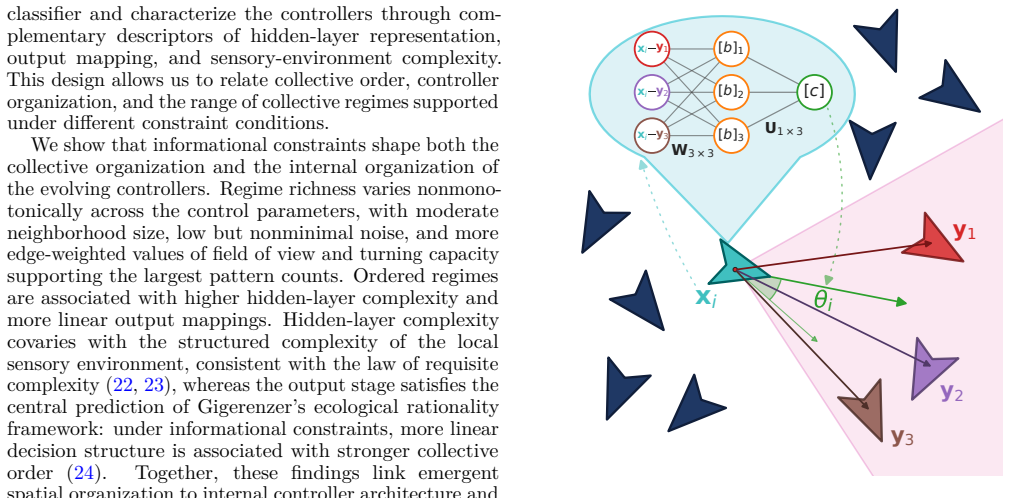
Under explicit sensory and actuation constraints, the most ordered regimes in evolved swarms exhibit two simultaneous effects: hidden-layer complexity increases while the effective output mapping becomes more linear. Output linearization persists in unevolved controls, whereas the hidden-complexity relation requires the evolutionary process. Behavioral diversity varies nonmonotonically with control parameters according to parameter-specific tradeoffs. These observations are presented as consistent with the law of requisite complexity for internal representations and ecological rationality for outputs, supporting the existence of a partitioned controller organization.
What carries the argument
Partitioned controller organization in shallow neural networks, in which hidden-layer complexity grows while the output mapping linearizes under evolutionary search and explicit constraints.
If this is right
- Highest collective order arises specifically from the joint increase in hidden complexity and increase in output linearity.
- Diversity of recurrent collective behaviors is shaped by tradeoffs that depend on the particular control parameters rather than a single optimum.
- Output linearization can occur without evolutionary adaptation, while hidden-layer complexity increase depends on optimization.
- Adaptive collective intelligence can emerge from a single controller that maintains both representational richness and action-level simplicity.
Where Pith is reading between the lines
- The same separation of complex internals and linear outputs might appear in other adaptive systems when similar sensory and actuation limits are imposed.
- Repeating the measurements on controllers optimized by non-evolutionary methods would test whether selection pressure is necessary for the complexity increase.
- Applying the same analysis to controllers with additional hidden layers could show whether the linearization effect remains stable as depth grows.
Load-bearing premise
The selected measures of hidden-layer complexity and output nonlinearity, together with the evolutionary process across 3024 conditions, correctly capture the link between internal controller structure and collective order.
What would settle it
Finding that the highest-order collective regimes show neither an increase in hidden-layer complexity nor a decrease in output nonlinearity would falsify the reported dual effect.
Figures


read the original abstract
Collective intelligence emerges from local interactions among agents with limited information, yet how internal controller organization relates to emergent collective order remains unclear. Here, we study evolved swarms with shallow neural controllers under explicit sensory and actuation constraints and compare collective order with hidden-layer complexity and output nonlinearity across 3024 conditions. Under these constraints, the most ordered regimes exhibit two simultaneous and seemingly contrasting effects: hidden-layer complexity increases, while the effective output mapping becomes more linear. The diversity of recurrent collective behaviors varies nonmonotonically across the control parameters, with pattern richness shaped by parameter-specific tradeoffs rather than a single generic constraint optimum. Unevolved controls show that output linearization persists without adaptation, whereas the hidden-complexity relation depends on optimization. These two effects are respectively consistent with the law of requisite complexity and ecological rationality, suggesting that adaptive collective intelligence can arise through a partitioned controller organization in which representational complexity and action-level linearization coexist within the same system.
Editorial analysis
A structured set of objections, weighed in public.
Referee Report
Summary. The paper claims that evolved swarms using shallow neural controllers under explicit sensory and actuation constraints exhibit a partitioned organization in the most ordered regimes: hidden-layer complexity increases while the effective output mapping becomes more linear. Across 3024 conditions, behavioral diversity varies nonmonotonically due to parameter-specific tradeoffs. Unevolved controls indicate that output linearization occurs without adaptation while the complexity increase depends on optimization. These effects are interpreted as consistent with the law of requisite complexity and ecological rationality.
Significance. If the operationalizations of complexity and linearity prove robust, the result would be significant for collective intelligence research by showing how representational richness and output simplicity can coexist under constraints, supported by the scale of 3024 conditions and explicit controls separating adaptation effects. This provides a concrete example of partitioned controller organization rather than a generic optimum.
major comments (3)
- [Abstract] Abstract: the central claim that ordered regimes simultaneously increase hidden-layer complexity while linearizing the effective output mapping depends on the specific measures of these quantities, yet the abstract (and by extension the reported results) provides no equations, algorithms, or definitions for how complexity is quantified (e.g., number of distinct activations, entropy) or how linearity is assessed (e.g., regression R², mutual information). This is load-bearing because the nonmonotonic diversity pattern and the separation from unevolved controls both rely on these metrics remaining stable and non-circular.
- [Abstract] Abstract: no statistical tests, confidence intervals, or details on post-hoc selection are mentioned for the reported patterns across 3024 conditions or the nonmonotonic diversity claim; without these it is impossible to evaluate whether the simultaneous complexity/linearity effects are statistically distinguishable from noise or from metric artifacts.
- [Abstract] Abstract: the statements that the two effects are 'respectively consistent with the law of requisite complexity and ecological rationality' are presented as interpretive mappings; without explicit definitions of the fitted quantities or derivations showing that the reported relations do not reduce to a fitted parameter by construction, the consistency claims cannot be assessed as independent evidence.
Simulated Author's Rebuttal
We thank the referee for the constructive comments. We address each major comment below, focusing on improving the abstract while noting that detailed operationalizations and analyses appear in the Methods and Results sections of the manuscript.
read point-by-point responses
-
Referee: [Abstract] Abstract: the central claim that ordered regimes simultaneously increase hidden-layer complexity while linearizing the effective output mapping depends on the specific measures of these quantities, yet the abstract (and by extension the reported results) provides no equations, algorithms, or definitions for how complexity is quantified (e.g., number of distinct activations, entropy) or how linearity is assessed (e.g., regression R², mutual information). This is load-bearing because the nonmonotonic diversity pattern and the separation from unevolved controls both rely on these metrics remaining stable and non-circular.
Authors: We agree the abstract would benefit from greater self-containment. The manuscript defines hidden-layer complexity via the number of distinct activations and entropy over the hidden units, and output linearity via R² from linear regression on the effective input-output mapping together with mutual information. These are applied uniformly across all 3024 conditions and are not circular by construction, as confirmed by the unevolved controls. In revision we will add one sentence to the abstract briefly indicating these operationalizations and directing readers to the Methods for the algorithms. revision: yes
-
Referee: [Abstract] Abstract: no statistical tests, confidence intervals, or details on post-hoc selection are mentioned for the reported patterns across 3024 conditions or the nonmonotonic diversity claim; without these it is impossible to evaluate whether the simultaneous complexity/linearity effects are statistically distinguishable from noise or from metric artifacts.
Authors: Statistical support for the reported patterns, including tests for the nonmonotonic diversity and separation from controls, is provided in the Results section. Because abstracts have strict length limits we omitted the full test statistics, but we will revise the abstract to state that the key effects are statistically significant (details in Results) so readers can immediately appreciate that the patterns are distinguishable from noise. revision: partial
-
Referee: [Abstract] Abstract: the statements that the two effects are 'respectively consistent with the law of requisite complexity and ecological rationality' are presented as interpretive mappings; without explicit definitions of the fitted quantities or derivations showing that the reported relations do not reduce to a fitted parameter by construction, the consistency claims cannot be assessed as independent evidence.
Authors: The consistency statements are explicitly interpretive, linking the observed partitioned organization (complexity increase plus output linearization) to the qualitative predictions of the two frameworks. The manuscript shows via the unevolved controls that the linearization is not an artifact of the evolutionary fitting procedure, while the complexity increase requires optimization. We will revise the abstract to make this interpretive status and the control-based separation clearer without claiming a formal derivation. revision: yes
Circularity Check
No significant circularity; empirical observations are independent of inputs
full rationale
The paper reports results from evolutionary simulations across 3024 conditions, measuring hidden-layer complexity and output nonlinearity against collective order under sensory/actuation constraints. No derivation chain, equations, or fitted parameters are presented in the abstract or described text that reduce a claimed prediction to its own inputs by construction. The consistency statements with requisite complexity and ecological rationality are post-hoc interpretive mappings, not load-bearing derivations or self-definitional steps. No self-citations, ansatzes, or uniqueness theorems are invoked in a way that forces the central claims. The work is self-contained as an empirical comparison, with unevolved controls providing an external benchmark.
Axiom & Free-Parameter Ledger
Reference graph
Works this paper leans on
-
[1]
M Ballerini, et al., Interaction ruling animal collective behavior depends on topological rather than metric distance: Evidence from a field study.Proc. Natl. Acad. Sci. U. S. A.105, 1232–1237 (2008)
2008
-
[2]
HFSP J.2, 205–219 (2008)
I Giardina, Collective behavior in animal groups: Theoretical models and empirical studies. HFSP J.2, 205–219 (2008)
2008
-
[3]
Biol.8, e1002678 (2012)
J Gautrais, et al., Deciphering interactions in moving animal groups.PLoS Comput. Biol.8, e1002678 (2012)
2012
-
[4]
V Kumar, R De, Efficient flocking: Metric versus topological interactions.R. Soc. Open Sci.8, 202158 (2021)
2021
-
[5]
W Bialek, et al., Statistical mechanics for natural flocks of birds.Proc. Natl. Acad. Sci. U. S. A. 109, 4786–4791 (2012)
2012
-
[6]
HJ Charlesworth, MS Turner, Intrinsically motivated collective motion.Proc. Natl. Acad. Sci. U. S. A.116, 15362–15367 (2019)
2019
-
[7]
Surv.53, 14:1–14:36 (2020)
S Suran, V Pattanaik, D Draheim, Frameworks for collective intelligence: A systematic literature review.ACM Comput. Surv.53, 14:1–14:36 (2020)
2020
-
[8]
14th Annu
CW Reynolds, Flocks, herds, and schools: A distributed behavioral model.Proc. 14th Annu. Conf. Comput. Graph. Interact. Tech., SIGGRAPH21, 25–34 (1987)
1987
-
[9]
T Vicsek, A Czirk, E Ben-Jacob, I Cohen, O Shochet, Novel type of phase transition in a system of self-driven particles.Phys. Rev. Lett.75, 1226–1229 (1995)
1995
-
[10]
R Olfati-Saber, RM Murray, Consensus problems in networks of agents with switching topology and time-delays.IEEE Trans. Autom. Control.49, 1520–1533 (2004)
2004
-
[11]
A Costanzo, CK Hemelrijk, Spontaneous emergence of milling (vortex state) in a vicsek-like model.J. Phys. D Appl. Phys.51, 134004 (2018)
2018
-
[12]
IEEE87, 1423–1447 (1999)
X Y ao, Evolving artificial neural networks.Proc. IEEE87, 1423–1447 (1999)
1999
-
[13]
(MIT Press, Cambridge, MA), (2000)
S Nolfi, D Floreano,Evolutionary Robotics: The Biology, Intelligence, and Technology of Self-Organizing Machines. (MIT Press, Cambridge, MA), (2000)
2000
-
[14]
Soft Comput.11, 982–990 (2011)
H Kwasnicka, U Markowska-Kaczmar, M Mikosik, Flocking behaviour in simple ecosystems as a result of artificial evolution.Appl. Soft Comput.11, 982–990 (2011)
2011
-
[15]
O Witkowski, T Ikegami, Emergence of swarming behavior: Foraging agents evolve collective motion based on signaling.PLOS ONE11, e0152756 (2016)
2016
-
[16]
RP Ramos, SM Oliveira, SM Vieira, AL Christensen, Evolving flocking in embodied agents based on local and global application of reynolds’ rules.PLoS One14, e0224376 (2019)
2019
-
[17]
(MIT Press, Cambridge, MA), (1992)
JH Holland,Adaptation in Natural and Artificial Systems: An Introductory Analysis with Applications to Biology, Control, and Artificial Intelligence. (MIT Press, Cambridge, MA), (1992)
1992
-
[18]
V Trianni,Evolutionary Swarm Robotics: Evolving Self-Organising Behaviours in Groups of Autonomous Robots, Stud. Comput. Intell. (Springer, Berlin) Vol. 108, (2008)
2008
-
[19]
M Brambilla, E Ferrante, M Birattari, M Dorigo, Swarm robotics: A review from the swarm engineering perspective.Swarm Intell.7, 1–41 (2013)
2013
-
[20]
(2025) OpenReview workshop preprint
GSY Giardini, CR da Cunha, Fear-driven collective topology: Comparing smart-boid vietoris-rips graphs to animal communication networks via persistent features inNeurIPS 2025 Workshop on AI for Non-Human Animal Communication. (2025) OpenReview workshop preprint
2025
-
[21]
G Cybenko, Approximation by superpositions of a sigmoidal function.Math. Control. Signals, Syst.2, 303–314 (1989)
1989
-
[22]
(Chapman & Hall, London), (1956)
WR Ashby,An Introduction to Cybernetics. (Chapman & Hall, London), (1956)
1956
-
[23]
P Allen, S Maguire, B McKelvey
M Boisot, B McKelvey, Complexity and organization–environment relations: Revisiting Ashby’s law of requisite variety inThe SAGE Handbook of Complexity and Management, eds. P Allen, S Maguire, B McKelvey. (SAGE Publications), pp. 279–298 (2011)
2011
-
[24]
(Oxford Univ
G Gigerenzer, PM Todd, ABC Research Group,Simple Heuristics That Make Us Smart. (Oxford Univ. Press, New Y ork), (1999)
1999
-
[25]
N Wiener, Differential-space.J. Math. Phys.2, 131–174 (1923)
1923
-
[26]
A Genthon, The concept of velocity in the history of brownian motion – from physics to mathematics and vice versa.Eur. Phys. J. H45, 49–105 (2020)
2020
-
[27]
CR daCunha,Introduction to econophysics: Contemporary approaches with Python simulationsed. KWG Ltd. (CRC Press, 6000 Broken Sound Parkway NW, Ste. 300, Boca Raton, FL 33487-2742) Vol. 1, p. 279 (2022)
2022
-
[28]
A391, 2193–2196 (2012)
A Lipowski, D Lipowska, Roulette-wheel selection via stochastic acceptance.Phys. A391, 2193–2196 (2012)
2012
-
[29]
CR daCunha,Machine learning for the physical sciences: Fundamentals and prototyping with Juliaed. KWG Ltd. (CRC Press, 2385 NW Executive Center Dr., Ste. 320, Boca Raton, FL 33431) Vol. 1, (2023)
2023
-
[30]
(MIT Press, Cambridge, MA), (2023) Paperback reissue; original eBook edition published in 2008
D Floreano, C Mattiussi,Bio-inspired artificial intelligence: Theories, methods, and technologies. (MIT Press, Cambridge, MA), (2023) Paperback reissue; original eBook edition published in 2008
2023
-
[31]
(Clarendon Press, Oxford) No
PG de Gennes, J Prost,The Physics of Liquid Crystals, International Series of Monographs on Physics. (Clarendon Press, Oxford) No. 83, 2nd edition, (1993)
1993
-
[32]
(American Mathematical Society, Providence, RI) No
FRK Chung,Spectral Graph Theory, CBMS Regional Conference Series in Mathematics. (American Mathematical Society, Providence, RI) No. 92, (1997)
1997
-
[33]
R López-Ruiz, HL Mancini, X Calbet, A statistical measure of complexity.Phys. Lett. A209, 321–326 (1995)
1995
-
[34]
(Monticello, IL, USA), pp
N Tishby, FC Pereira, W Bialek, The information bottleneck method inProceedings of the 37th Annual Allerton Conference on Communication, Control, and Computing. (Monticello, IL, USA), pp. 368–377 (1999)
1999
-
[35]
note on regression and inheritance in the case of two parents.Proc
K Pearson, Vii. note on regression and inheritance in the case of two parents.Proc. R. Soc. Lond.58, 240–242 (1895)
-
[36]
C Spearman, The proof and measurement of association between two things.Am. J. Psychol. 15, 72–101 (1904)
1904
-
[37]
(2026) Accepted; proceedings forthcoming
CR da Cunha, GSY Giardini, M Turqueti, Llm-based reinforcement learning for controlling robot swarms in2026 7th International Conference on Artificial Intelligence, Robotics, and Control (AIRC 2026). (2026) Accepted; proceedings forthcoming
2026
-
[38]
Rev.63, 129–138 (1956)
HA Simon, Rational choice and the structure of the environment.Psychol. Rev.63, 129–138 (1956)
1956
-
[39]
Intell.3, 1–19 (2024)
KJ Friston, et al., Designing ecosystems of intelligence from first principles.Collect. Intell.3, 1–19 (2024)
2024
-
[40]
AK Seth, Distinguishing adaptive from non-adaptive evolution using Ashby’s law of requisite variety inProceedings of the 2002 Congress on Evolutionary Computation (CEC’02). Vol. 2, pp. 1163–1168 (2002)
2002
-
[41]
N Chater, M Oaksford, R Nakisa, M Redington, Fast, frugal, and rational: How rational norms explain behavior.Organ. Behav. Hum. Decis. Process.90, 63–86 (2003)
2003
-
[42]
G Gigerenzer, H Brighton, Homo heuristicus: Why biased minds make better inferences.Top. Cogn. Sci.1, 107–143 (2009)
2009
-
[43]
PM Todd, G Gigerenzer, Environments that make us smart: Ecological rationality.Curr. Dir. Psychol. Sci.16, 167–171 (2007)
2007
-
[44]
SS Iyengar, MR Lepper, When choice is demotivating: Can one desire too much of a good thing?J. Pers. Soc. Psychol.79, 995–1006 (2000)
2000
-
[45]
Stat.7, 1–26 (1979)
B Efron, Bootstrap methods: Another look at the jackknife.Ann. Stat.7, 1–26 (1979). PNASJune 2, 2026 LaTex v2025 Vol. XXX No. XX eXXXXXXXXXX Preprint manuscript. This version has not been peer reviewed or accepted for publication.9 of 9
1979
discussion (0)
Sign in with ORCID, Apple, or X to comment. Anyone can read and Pith papers without signing in.