pith. sign in

nlin.CD

Chaotic Dynamics

Dynamical systems, chaos, quantum chaos, topological dynamics, cycle expansions, turbulence, propagation

0
nlin.CG 2026-07-03

Three timed ternary changes steer binary lattice growth to denser states

by Ma{l}gorzata Nowak-Kȩpczyk

The Binary Crisis Clock: Controlled by Sparse Ternary Interventions

Sparse interventions reset the crisis clock in automata, reducing fragmentation without altering core binary rules.

Figure from the paper full image
abstract click to expand
We investigate modular Laplacian automata on triangular lattices with evolution governed by binary and ternary moduli. Extending previous studies on square lattices, we examine how lattice geometry influences long-term growth, density, fragmentation, and the emergence of self-similar structures. We further investigate whether sparse ternary interventions can stabilize predominantly binary dynamics. The experiments reveal that mask geometry is the primary determinant of large-scale morphology. Full hexagonal masks generate recurrent density crises and fragmentation, whereas triangular masks support persistent growth and reveal a threshold phenomenon governed by growth-capable nuclei. Although seed symmetry influences transient behaviour, the asymptotic morphology is inherited mainly from the mask. To control binary fragmentation, we investigate sparse developmental ternary perturbations in which a small number of carefully timed occurrences of modulus 3 are inserted into an otherwise binary sequence. A Monte Carlo optimization demonstrates that as few as three interventions are sufficient to redirect the subsequent binary evolution toward substantially denser carpet-like configurations. The effectiveness of this strategy depends primarily on the timing of the interventions rather than on their number. Analysis of the post-intervention dynamics shows that ternary shaping does not replace binary evolution. Instead, it produces denser self-similar structures, substantially reduces crisis depth, and resets the phase of the binary crisis clock. The results suggest that geometry determines the family of admissible morphologies, whereas sparse developmental perturbations select favourable long-term trajectories within that family.
0
0
cs.NE 2026-07-03

Phase-locked loop yields simple bursting neuron circuit

by Lev V. Takaishvili, Vladimir I. Ponomarenko +2 more

Electronic Bursting Neuron: design, equations and hardware implementation

Adjusted equations produce hardware that matches demanded regimes and extends to small networks.

Figure from the paper full image
abstract click to expand
Electronic neurons are a keystone for construction of the spiking neural networks which have numerous applications in neuroprosthetics, artificial memory, intensive calculations etc. A number of concepts of electronic neurons has been already proposedm with some of them implemented in hardware. However, new schemes are of significant interest since the existing ones do not fit all requirements: either they are too complex and expensive in realization, or they are not able to demonstrate all demanded regimes, or their do not have a appropriate mathematical description and therefore may be investigated only experimentally etc. In this study we propose a new design of bursting electronic neuron constructed as a circuit implementation of the equations of a phase-locked loop system. To succeed, we use a novel hybrid approach: we start from the phenomenological equations providing the demanded, then we adjust and modify these equations to simplify the implementation rather than implementing the biophysical equations into thee hardware directly or writing equations for the already constructed circuit. The resulting circuit is simple in implementation and well matches the underlying equations. It can be used for description of not only a single neuron, but small neural circuits too.
0
0
physics.flu-dyn 2026-07-03

Intermediate Froude numbers produce VSHFs and steepened spectra

by Chandra Shekhar Lohani, Vishwanath Shukla

Energy transfer, Intermittency and Mixing in Shear-Driven Stratified Turbulence

Shear-driven stratified turbulence develops three regimes where mixing coefficient holds near 0.1 and forward transfer dominates.

Figure from the paper full image
abstract click to expand
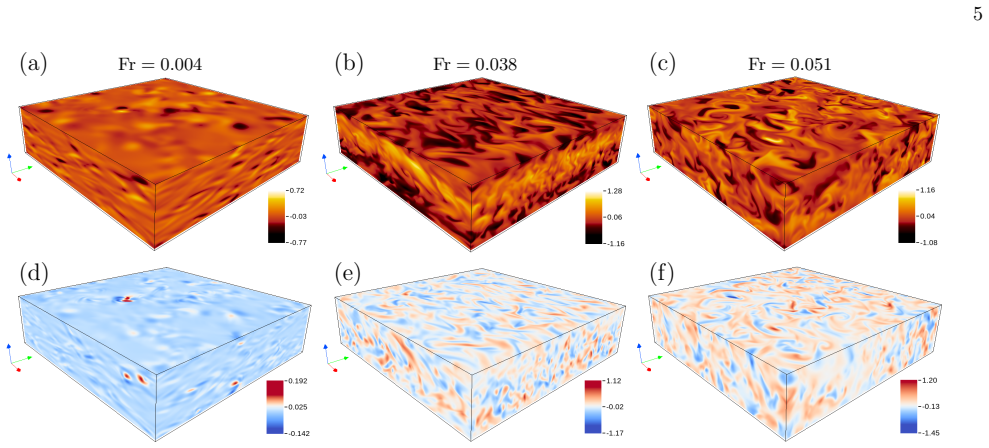
We investigate a stably stratified flow driven by deterministic Kolmogorov forcing that generates horizontal shear, using direct numerical simulations over a broad range of stratification strengths characterized by the Froude number $Fr$. As the stratification is progressively weakened, the flow exhibits a sequence of regimes: a buoyancy-dominated, strongly stratified regime, an intermediate regime characterized by Kelvin--Helmholtz instabilities and enhanced mixing, and a nearly isotropic turbulent regime. A key feature of the intermediate stratification range is the emergence of energetically significant vertically sheared horizontal flows (VSHFs), accompanied by a marked steepening of the reduced one-dimensional perpendicular kinetic energy spectra. The spectral energy transfer remains predominantly forward, although the perpendicular flux becomes negative at large horizontal scales; this apparent upscale transfer reflects anisotropic energy redistribution rather than a true inverse cascade. Strong stratification enhances intermittency, producing increasingly non-Gaussian vertical velocity fluctuations and large kurtosis associated with localized vertical bursts. The energetics-based mixing coefficient remains of order $10^{-1}$ over the parameter range investigated, with a modest enhancement near the Kelvin--Helmholtz instability regime.
0
0
q-bio.PE 2026-07-02

Immune history stabilizes recurrent variant epidemics

by Ryuichi Kumata, Yuma Fujimoto +2 more

Immune history shapes recurrent epidemics of antigenically related variants

Recurrence map shows equal-sized waves are stable but size peaks at moderate transmission due to cross-immunity

Figure from the paper full image
abstract click to expand
Population immunity carried over from past epidemics of an antigenically variable pathogen influences the epidemic of new variants based on their antigenic similarity to the previous ones. We develop a recurrent SIR model where a population faces sequential, antigenically related variants. The model yields a recurrence map for the population susceptibility to successive variants under the assumption of status-based population immunity. The model reveals that stable, equal-sized recurrent epidemics occur across broad parameter ranges, but can be destabilized when transmission is strong and antigenic escape is limited, leading to period-2 or more, or even more complex epidemic dynamics. Epidemic size is maximized at an intermediate basic reproduction number: higher transmissibility boosts immediate infection but also enhances cross-immunity, reducing future susceptibility of the population. Our results clarify how immune history shapes recurrent epidemics and why success in one wave does not ensure larger future epidemics.
0
0
nlin.CD 2026-07-01

Cusp-of-cycles point creates isolas of limit cycles in glycolysis

by Fangyuan Wang, Lendert Gelens +2 more

Isolas of limit cycles and birhythmicity induced by cooperative feedback in a glycolysis model

The codimension-2 point plus saddle-node bifurcations divide parameter space into six regimes including birhythmicity and threshold-dependen

Figure from the paper full image
abstract click to expand
We investigate how cooperative feedback shapes global oscillatory dynamics in a glycolysis model with product recycling and allosteric phosphofructokinase regulation. Using bifurcation theory and numerical continuation, we analyze the stability of equilibria and characterize Hopf and generalized Hopf bifurcations, using the Hill exponent as an effective measure of cooperativity. We show that a codimension-2 cusp-of-cycles point governs the creation and annihilation of detached branches of limit cycles (isolas) and, together with saddle-node bifurcations of limit cycles, organizes a regime map of six qualitatively distinct dynamical regions. In the birhythmic regime two stable oscillatory states coexist on connected branches; in the isola regime a stable oscillation exists on a fully disconnected branch, producing threshold-dependent onset of rhythmic activity. Time-domain simulations confirm coexistence of distinct rhythms and illustrate how the choice of initial condition determines which attractor is reached. Together, these results show how variations in cooperative feedback strength can generate isolated oscillatory modes and multistability in metabolic networks, highlighting isola dynamics as a general mechanism for rhythm selection and switching in nonlinear biological oscillators.
0
0
nlin.CD 2026-07-01

Stochastic van der Pol model unifies bifurcations

by Shenglan Yuan, Xiang Zhou

Dynamics of Coupled Stochastic van der Pol Oscillators: Bifurcations, Synchronization and Chaos

One framework links these behaviors in coupled oscillators with noise and extends to large networks and collective patterns.

Figure from the paper full image
abstract click to expand
This work presents a comprehensive analysis of coupled stochastic van der Pol oscillators, a paradigm for understanding synchronization, bifurcations, and chaos in nonlinear systems subject to random fluctuations. The system comprises two or more oscillators with nonlinear damping, linear diffusive coupling, and additive Gaussian white noise. We develop a unified framework that systematically connects global bifurcations, synchronization phenomena, and chaotic dynamics within a single coherent stochastic model. We explore the stochastic dynamics of coupled van der Pol oscillators by seamlessly blending theoretical principles with in-depth numerical simulations. This integrated approach forms a robust framework for analysis, with essential phenomena clearly depicted in the accompanying figures. We then extend this framework to a comprehensive investigation of large networks, focusing on their continuum limit, emergent pattern formation, the role of noise, and the onset of collective chaos.
0
0
quant-ph 2026-07-01

Laser frequency tuning erases predictability in optomechanical chaos

by Xiao-Jun Zhang

Topological phase transition in chaotic optomechanical systems

The switch-off corresponds to a topological change in phase space, with entropy from causal-state transitions serving as the order parameter

Figure from the paper full image
abstract click to expand
Hidden structures with well-defined predictability are uncovered in the evolution of a chaotic optomechanical system from the perspective of the $\epsilon$-machine. Tuning the frequency of the driving laser can switch off this predictability, and such behaviour corresponds to a phase transition that is deeply related to topological changes in phase space. The transition probabilities between causal states allow us to define an entropy (uncertainty) that serves as an effective order parameter. This phase transition can be readily demonstrated in currently available experiments by monitoring the quadrature of the optical mode. We hope that this work could fundamentally broaden the regimes of cavity micromechanics and nonlinear optics.
0
0
physics.flu-dyn 2026-07-01

Methods compute 2D turbulence equilibria from arbitrary initial vorticity

by Koki Ryono, Keiichi Ishioka

New numerical methods for calculating statistical equilibria of two-dimensional turbulent flows, strictly based on the Miller-Robert-Sommeria theory

The techniques preserve all Casimir invariants and recover states matching time-dependent simulations, including symmetry-broken ones.

Figure from the paper full image
abstract click to expand
New numerical methods are proposed for the mixing entropy maximization problem in the context of Miller-Robert-Sommeria's (MRS) statistical mechanics theory of two-dimensional turbulence, particularly in the case of spherical geometry. Two of the methods are for the canonical problem; the other is for the microcanonical problem. The methods are based on the original MRS theory and thus take into account all Casimir invariants. Compared to the methods proposed in previous studies, our new methods make it easier to detect multiple statistical equilibria and to search for solutions with broken zonal symmetry. The methods are applied to a zonally symmetric initial vorticity distribution which is barotropically unstable. Two statistical equilibria are obtained, one of which has a wave-like structure with zonal wavenumber 1, and the other has a wave-like structure with zonal wavenumber 2. While the former is the maximum point of the mixing entropy, the wavenumber 2 structure of the latter is nearly the same as the structure that appears in the end state of the time integration of the vorticity equation. The new methods allow for efficient computation of statistical equilibria for initial vorticity distributions consisting of many levels of vorticity patches without losing information about all the conserved quantities. This means that the statistical equilibria can be obtained from an arbitrary initial vorticity distribution, which allows for the application of statistical mechanics to interpret a wide variety of flow patterns appearing in geophysical fluids.
0
0
cs.LG 2026-06-30

Scalar embedding retains Lyapunov exponents from neural training

by Pedro Jiménez-González, Miguel C. Soriano +1 more

Scalar Representations of Neural Network Training Dynamics

Low-dimensional time series from parameter trajectories reconstruct sensitivity to initial conditions and decorrelation times in high-dimens

Figure from the paper full image
abstract click to expand
Training in artificial neural networks can be viewed as a trajectory evolving through a high-dimensional loss landscape. However, the large number of trainable parameters makes the direct analysis of these dynamics challenging. In this work, we treat such training trajectories as temporal networks and apply recently proposed strategies for the scalar embedding of temporal networks. We investigate whether such a scalar embedding provides a meaningful low-dimensional representation of neural network training dynamics. Using a multilayer perceptron trained on the MNIST classification task, we show that the embedding preserves the main dynamical features observed in the original parameter space, including the emergence of sensitivity to initial conditions for specific learning rate regimes and an accurate reconstruction of the network's maximum Lyapunov exponent. We then use the embedded scalar trajectory to define a characteristic time, analogous to a Lyapunov time, after which the exponential separation between initially close embedded trajectories saturates. This characteristic time captures the typical decorrelation time between initially close network trajectories in the original high-dimensional system. Finally, we investigate the statistical organization of asymptotic training states through a spacing observable defined in the embedded space. We find that the distributions of rescaled asymptotic spacings collapse onto a common form across initial conditions and are compatible with a skew lognormal distribution. Altogether, our results suggest that scalar low-dimensional embeddings provide a useful framework for studying and visualizing the dynamical properties of neural network optimization trajectories.
0
0
hep-th 2026-06-30

Viscous fluid modes decay linearly with n

by Yan Liu, Hao-Tian Sun

Nonlinear nature of near-equilibrium viscous fluids

An attractor locks higher harmonics to multiples of the fundamental frequency and enforces a cascading amplitude relation fixed by viscosity

abstract click to expand
We study the late-time relaxation of a neutral relativistic viscous fluid in $d+1$ dimensions. In the long-wavelength regime, linearized hydrodynamics predicts that the sound mode at momentum $nk$ decays as $e^{-n^2\omega_I t}$. However, nonlinear analysis gives a decay of $e^{-n\omega_I t}$. We derive a closed asymptotic attractor solution in which the frequency of the $n$-th harmonic locks to $n$ times the complex frequency of the fundamental mode. The amplitude envelopes for energy current $J$ obey a simple cascading relation, $J_n=\alpha_J^{\,n-1}J_1^n$, with $\alpha_J$ fixed by the equation of state, the longitudinal viscosity, and the fundamental wavenumber. For conformal fluids, $\alpha_J=1/(8\eta k)$, in agreement with the holographic result of arXiv:2512.07242. The existence of the attractor shows that, even near equilibrium, field powers are not equivalent to amplitude order.
0
0
nlin.CD 2026-06-30

Risk sensitivity induces Arnold tongues in population game dynamics

by Konstantinos Metaxas, Themistoklis P. Sapsis

Risk-Sensitive Learning in Population Games under Extreme Events: Bifurcations and Chaotic Dynamics

Perceived risk from extreme events in congestion games leads to invariant curves, phase-locking, and chaos whose time averages reach equilib

Figure from the paper full image
abstract click to expand
Inspired by nonequilibrium phenomena in game dynamics and behavioral evidence on the impact of extreme events on decision making, we investigate the nonlinear dynamics of a discrete-time multiagent learning rule in population congestion games under extreme events affecting one of the actions. The population state, following a risk-sensitive variant of the Multiplicative Weights Update (MWU), is coupled with a belief variable capturing the agents perceived risk and updated through an adaptive expectation rule. We perform a two-parameter bifurcation analysis with respect to the agents controlled parameters, identifying regions of qualitatively distinct behavior. Equilibria are studied first from both game-theoretic and dynamical perspectives. The resulting two-dimensional system exhibits complex behavior, including multi-stability among fixed points, invariant curves, periodic and chaotic attractors. Despite this complexity, the attractors can be grouped into distinct families, while the Ces\`aro averages of the trajectories are shown to converge to the stationary equilibrium. The incorporation of risk associated with the extreme event leads to new dynamical phenomena: attracting invariant curves arise and give rise to phase-locking Arnold tongues, within which the dynamics is qualitatively similar. In this setting, codimension-two resonances are identified as organizing centers, both within individual tongues and along the bifurcation curves associated with the fixed-point family. Chaotic attractors emerge and are destroyed through Feigenbaum cascades and forward or reverse boundary crises, with interior and merging crises also observed, along with transient chaos and narrow periodic windows. For each qualitatively distinct region, representative phase portraits and the associated basins of attraction are examined.
0
0
physics.ao-ph 2026-06-30

Log-ratio rule sets best timing to sample rare weather events

by Justin Finkel

Routes to rare events with optimally timed perturbations: a Tent Map is all you need

In the Tent and Logistic maps the advance split time equals the log of rarity over perturbation size, replacing ad hoc choices in extreme-ev

Figure from the paper full image
abstract click to expand
Extreme weather events are difficult to understand for the same reason that they are dangerous: they happen rarely, catching victims unprepared when they do occur and scientists unable to assess risks confidently, given such limited precedent to learn from in the real world and high computational expense to simulate more examples. Rare event sampling (RES) algorithms seek to reduce this expense by forcing simulations more directly towards the extremes and then compensating for that forcing in statistical analysis. But the performance of RES hinges on several hyperparameter choices which are ad hoc in practice, and must be better understood if RES is to be broadly useful. This paper addresses one particular parameter, the \emph{advance split time} (AST), which prescribes when to perturb a simulation to split off the most informative possible ensemble of alternative extreme event scenarios. We prescribe the optimal AST as the time it takes for an initial perturbation to amplify into the size (inverse rarity) of the extreme event being targeted. For the Logistic and Tent maps, two archetypal examples of one-dimensional chaos, we rigorously derive and express the rule as a simple log-ratio between perturbation size and event rarity. The pair of examples also illuminates where the rule breaks down, and subsequently, we generalize the rule into a maximum-entropy criterion that solidifies recent heuristic and empirical results. Despite the idealized setting, our results deliver theoretical clarity that can anchor future developments of principled RES methods applicable to real-world, high-impact weather and climate extremes.
0
0
nlin.CD 2026-06-29

Stable cycler subfamilies exist in every three-body family examined

by Shane D. Ross, Michael Roberts-Tsoukkas

Stable Families of Ballistic Prograde Cyclers in the Restricted Three-Body Problem

Linear stability to planar and out-of-plane motions arises via saddle-center birth at maximal Jacobi constant.

Figure from the paper full image
abstract click to expand
We report stable, ballistic cycler orbits in the circular restricted three-body problem: periodic trajectories that alternately undergo temporary capture about each primary. We construct continuous families of symmetric cyclers from intersections of the stable and unstable manifold tubes of the $L_1$ Lyapunov orbit and exhibit stable examples across more than two orders of magnitude in mass ratio, from the Sun--Jupiter regime to the equal-mass limit. Linear stability separates naturally into planar and out-of-plane components. The planar-stable branch of every computed family is created together with a hyperbolic branch in a saddle-center bifurcation of the return map at the family's maximal Jacobi constant, while out-of-plane instability occurs only through isolated parametric resonances. Every family examined contains a subfamily that is linearly stable to both planar and out-of-plane perturbations. We conjecture that saddle-center birth is universal among cycler families, implying that stable cyclers are a generic feature of the restricted three-body problem.
0
0
cond-mat.quant-gas 2026-06-29

Dysprosium resonances mix regular and chaotic statistics by magnetic moment

by Julie Veschambre, Alexandre Journeaux +8 more

Coexisting Regular and Chaotic Dynamics in the Dysprosium Feshbach Spectrum

Central magnetic-moment states show level repulsion; lower-edge states follow Poisson statistics in the Feshbach spectrum.

Figure from the paper full image
abstract click to expand
Strongly dipolar gases, such as dysprosium, erbium and thulium, exhibit dense Feshbach spectra whose level statistics have been associated with quantum chaos arising from couplings among many molecular channels. Here, we combine a precise calibration of the Feshbach spectrum of $^{162}$Dy with spectroscopic measurements of the differential magnetic moments of bound states associated with more than 80 resonances between 0 and 30 G. These magnetic moments provide an eigenstate-sensitive probe of the molecular states underlying the resonance spectrum. We find that the level statistics are not uniform: resonances associated with states near the center of the magnetic-moment distribution display enhanced level repulsion, whereas those near the lower edge remain close to Poisson statistics. Our results reveal hidden structure within the chaotic dysprosium Feshbach spectrum and identify molecular-state composition as a key ingredient in the emergence of quantum chaos in strongly dipolar scattering.
0
0
physics.flu-dyn 2026-06-29

Quadrupole vorticity fields emerge as statistical equilibria on sphere

by Koki Ryono, Keiichi Ishioka

Statistical equilibria of two-dimensional turbulent flows for generic initial vorticity fields on a sphere, calculated on the basis of the original Miller-Robert-Sommeria theory

Maximum-entropy states match long-time flow topology but omit the concentrated vortices seen in simulations, underscoring the role of mixing

Figure from the paper full image
abstract click to expand
Based on the original Miller-Robert-Sommeria theory, we explicitly compute a statistical equilibrium of two-dimensional turbulent flow on a sphere for a generic initial vorticity field introduced in a previous study. The macroscopic vorticity field corresponding to the obtained statistical equilibrium has a quadrupole structure. The resulting quadrupole structure is topologically consistent with the final state of the long-term time integration of the vorticity equation. However, the statistical equilibrium does not predict the formation of concentrated vortices as seen in the time integration. We also calculate statistical equilibria for the initial vorticity field with a planetary vorticity term, and find a change of statistical equilibria from quadrupole states to zonally symmetric states as the angular velocity of the sphere increases. The quadrupole statistical equilibria show nearly linear relations between the macroscopic vorticity and the macroscopic stream function, implying that higher-order Casimir invariants are virtually ineffective even when all Casimir invariants are considered. The discrepancy between the equilibria and the time integration results emphasizes the importance of mixing barriers, which prevent the relaxation of the evolving vorticity field to the statistical equilibria and allow the point-vortex-like dynamics of coherent vortices to persist.
0
0
nlin.CD 2026-06-26

Ninth-order terms fix overestimation in spinning pipe deflections

by Ali Fasihi, Grzegorz Kudra +2 more

Large post-critical dynamics of an inextensible spinning fluid-conveying pipe with pinned-roller supports: high-order Galerkin and a modified Hencky bar-chain framework

Cubic Galerkin misses geometric stiffening from inextensibility, while modified Hencky model confirms the amplitude.

Figure from the paper full image
abstract click to expand
This paper investigates the stability and large post-critical dynamics of an inextensible spinning fluid-conveying pipe with pinned-roller supports. Replacing the pinned-pinned support of the extensible counterpart with a sliding support removes the axial-stretching restoring mechanism and fundamentally changes the governing equations of motion. Derived here for this configuration, these equations contain a different set of nonlinear terms -- arising from the inextensibility constraint and the bending curvatures rather than the single axial-stretching term -- that drives a post-critical regime with large deflections. The regime is analysed with two complementary methods. The first is a Galerkin discretisation in which the bending curvatures are Taylor-expanded to ninth order, shown to be the lowest order resolving the post-critical amplitude; the standard cubic truncation overestimates the deflection significantly by missing the geometric stiffening from inextensibility. The second is a modified Hencky bar-chain model with a global angular description: a closed, $n$-independent matrix framework with exact trigonometric kinematics, directly implementable in any standard programming environment with matrix routines and adaptable to both extensible and inextensible configurations through a single boundary-condition reduction. The linearised dynamics give an ellipse-like stability boundary in the flow-velocity--rotational-speed plane with semi-axes $U=\pi$ and $\Omega=\pi^{2}$; three damping regimes are identified, including a high-rotation instability driven by rotating damping. Close agreement between the two methods across linear-stability, bifurcation, and time-history comparisons confirms the ninth-order Galerkin truncation and establishes the modified Hencky bar-chain as a reliable general-purpose discrete framework for spinning fluid-conveying pipes.
0
0
q-bio.QM 2026-06-26

Emulators match marine model skill over decades at lower cost

by Jozef Skakala, Ieuan Higgs +1 more

Deep learning model emulators for marine biogeochemistry forecasting from days to decades

LSTM and 1D-CNN networks stay stable for multi-decadal runs, forecast spring blooms years ahead, and beat the parent model when trained on r

Figure from the paper full image
abstract click to expand
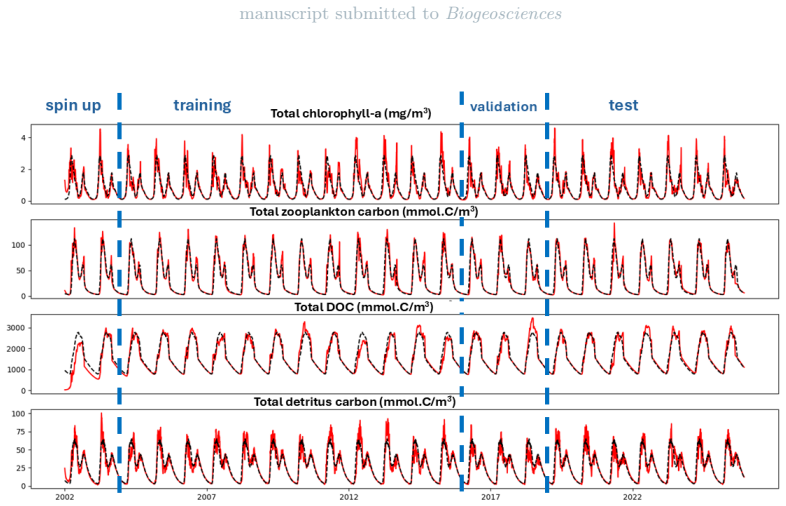
Deep-learning emulators have emerged as a promising approach for reducing the computational cost of Earth System Models while potentially improving forecasting skill. Here, we demonstrate the successful emulation of a high-complexity marine biogeochemistry model within a simplified one-dimensional water-column framework. We explore two emulator architectures: Long Short-Term Memory (LSTM) neural networks that emulate a selected subset of variables at daily resolution, and physics-informed one-dimensional Convolutional Neural Networks (1D CNNs) that emulate the full pelagic system throughout the water column also at daily resolution. Using ocean physics simulator inputs, both emulators remain largely stable over multi-decadal timescales and accurately reproduce the parent model in both decadal climate projections and short-range (10-day) forecasting applications. The former includes the ability to predict the timing of phytoplankton Spring blooms several years in advance. When trained on reanalysis data, the emulators substantially outperform the parent model's forecast skill score for several key ecosystem variables, including phytoplankton and zooplankton. If similar performance can be achieved in three-dimensional regional applications, these emulators could provide substantially higher-quality predictions at a fraction of the computational cost. We further apply novel explainability techniques to identify key drivers of emulator behaviour and gain insights into emergent ecosystem dynamics. Performance is evaluated using a range of metrics, including the reproduction of daily variability and extreme events. These approaches have considerable potential for future applications in operational forecasting, climate-scale simulations, and marine autonomous systems.
0
0
nlin.CD 2026-06-26

Poisson process yields Gamma law for Collatz upward phases

by Weicheng Fu, Xiaobin Liu +1 more

Emergence of Gamma-Type Upward-Phase Statistics in the Collatz Map: An Effective Poisson Process Mechanism

Scale stays fixed at 11.61 while shape grows with log of starting value; cycles remain tightly constrained.

Figure from the paper full image
abstract click to expand
The Collatz map is a simple deterministic transformation whose orbit structure remains highly nontrivial. A recent direction-phase decomposition partitions each orbit into upward and downward steps, and numerical observations indicate that the number of upward phases, $N_{\uparrow}$, follows an approximate Gamma distribution. In this work, we provide a mechanistic explanation for this statistical regularity by modeling the occurrence of upward phases in the odd-compressed, or Syracuse, version of the Collatz map as a homogeneous Poisson process. From the mean-field logarithmic balance and the geometric distribution of $2$-adic valuations, we derive closed-form expressions for the Gamma parameters: the scale parameter $\theta = 2/(2-\log_2 3)^2 \approx 11.61$ is constant, whereas the shape parameter $K$ grows logarithmically with the maximal initial value $X_0=2L+1$. We also analyze the closure conditions for periodic orbits, showing that nontrivial cycles are severely constrained, which supports the plausibility of the statistical framework. Numerical validation for $L$ ranging from $10^5$ to $10^{15}$ confirms the theory with relative errors below $3\%$, and a bias-corrected mean estimate reduces the error to $10^{-3}$--$10^{-2}\%$. These results establish a quantitative link between the arithmetic properties of the Collatz map and Gamma-type statistics, and suggest possible extensions to generalized Collatz-type problems.
0
0
nlin.AO 2026-06-26

Pacemaker creates waveform proportionality in slow oscillators

by Yuzuru Mitsui, Shigefumi Hata +1 more

From phase synchronization to waveform proportionality in a population of R\"ossler oscillators driven by an external pacemaker

External driving produces Taylor's law exponent 2 even without fast intrinsic dynamics or self-oscillation

Figure from the paper full image
abstract click to expand
The dynamical order of self-sustained oscillators is often characterized by phase synchronization, extensively studied within the framework of the Kuramoto model. It has recently been reported that strong coupling leads to further organization of coupled oscillators, termed waveform proportionality (WP), through amplitude dynamics that cannot be addressed using the Kuramoto model. A previous study [Phys. Rev. Lett. 134, 167202 (2025)] showed that, in coupled oscillator systems, synchronization induces Taylor's law (TL). Particularly, it demonstrated that strong coupling gives rise to WP, which leads to TL with an exponent 2. The findings suggested that WP requires the individual oscillators constituting the coupled system to possess sufficiently fast intrinsic frequencies. Here, we show that WP and TL with an exponent 2 can be induced by a pacemaker oscillator, regardless of the magnitude of the intrinsic frequencies of the individual oscillators in a population. Specifically, even in a population composed of oscillators with slow intrinsic frequencies, WP and TL with an exponent 2 can be induced by coupling the population to a fast pacemaker. Furthermore, we demonstrate that WP and TL can also be induced in a population of non-self-oscillatory units by coupling them to a pacemaker. These results indicate that WP and TL with an exponent 2 are more universal than previously thought, extending beyond oscillator populations with fast intrinsic dynamics.
0
0
nlin.CD 2026-06-26

Reservoir predicts noise bifurcations from single condition

by Nozomi Akashi, Takayuki Watanabe +5 more

One-shot prediction of noise-induced bifurcations with reservoir computing

Training on time series at one noise level reconstructs the full structure of induced chaos and order.

abstract click to expand
Dynamical systems can exhibit complex responses when noise is injected. In particular, dynamics can be qualitatively altered by dynamic noise, a phenomenon known as noise-induced bifurcation. Predicting noise-induced bifurcations is a critical challenge in nonlinear physics. Recently, it has been reported that reservoir computing, a machine learning framework, can reconstruct the unseen global structure of a dynamical system, including bifurcations, from limited time series data. However, learning global structures in random dynamical systems has not yet been systematically addressed. In this study, we report that a simple reservoir computing framework can predict the noise-induced bifurcation structure from the time series at a single noise condition. We demonstrate dynamic noise cancellation and the reconstruction of entire noise-induced bifurcation structures, including noise-induced chaos and noise-induced order, in representative dynamical systems. Additionally, we provide a theoretical explanation for noise cancellation and demonstrate noise cancellation of a neuromorphic spintronics device. Our results provide significant insights into understanding and harnessing real-world noisy complex dynamics.
0
0
nlin.CD 2026-06-25

Chaotic three-rotor orbits yield word complexity 3 times 2 to the n-1

by Govind S. Krishnaswami, Anirudh Rameshan

Symbol sequences from three-rotor coincidences and their word-complexity

Coincidence symbols give log 2 entropy for chaos and linear growth for quasiperiodicity, modeled by a subshift of finite type.

Figure from the paper full image
abstract click to expand
In the three-rotor problem, three equally massive point particles move on a circle interacting via attractive pairwise cosine potentials. Rotors can represent superconducting phases of distinct metallic segments in a chain of coupled Josephson junctions. We propose a digitization of the classical dynamics that records successive pair and triple coincidences of rotors using four symbols. Rotor coincidences correspond to boundaries in a disjoint partition of the configuration torus into cells where the rotors are ordered clockwise and anticlockwise. It is shown that isolated rotor coincidences must be crossings. Despite being a rather coarse digitization, we find that replacing trajectories by coincidence symbol sequences captures significant qualitative features of the dynamics through word statistics. Word-complexity $C_n$ measures the diversity of $n$-letter words in the symbol sequence while topological entropy governs asymptotic exponential growth of $C_n$. Sequences from periodic orbits have a word-complexity that saturates at the period. Ultra-high-energy trajectories with irrational 'slope' are quasiperiodic. We show that they have zero entropy and $C_n = n+3$ by examining limiting slopes and by a mapping to Sturmian sequences. We examine their grammar rules and propose how their right-special words may be identified. On the other hand, numerical investigation of sequences from chaotic orbits in the band of global chaos leads us to conjecture an exponentially growing word-complexity $C_n = 3 \times 2^{n-1}$, corresponding to a topological entropy $\log 2$. We identify their grammar rules and model them by a subshift of finite type, unlike the quasiperiodic ultra-high-energy sequences which cannot be modeled as a topological Markov shift.
0
0
nlin.CD 2026-06-25

Kuramoto-Sakaguchi phase oscillators show symmetric replica reliability

by Arkady Pikovsky, Franco Bagnoli +1 more

Internal Reliability of Coupled Kuramoto-Sakaguchi Phase Oscillators

Watanabe-Strogatz theory predicts equal Lyapunov exponents for attractors and repellers.

Figure from the paper full image
abstract click to expand
The notion of internal reliability in dynamical networks describes whether replicas of a particular unit follow the dynamics of the reference unit. Reliability and anti-reliability can be quantified by the transversal Lyapunov exponents. We study phase oscillators coupled via Kuramoto-Sakaguchi-type interactions. Already the simplest solvable system of two oscillators demonstrates nontrivial reliability properties. We present numerical evidence of reliability and anti-reliability in small networks with a uniform distribution of natural frequencies. The dynamics of an ensemble of replicas can be described within the Watanabe-Strogatz theory, which predicts symmetry of the transversal Lyapunov exponents for replica-attractor and replica-repeller.
0
0
hep-th 2026-06-24

String amplitudes show RMT spacing ratios in area eigenvalues

by Massimo Bianchi, Maurizio Firrotta +2 more

Multi-dimensional chaos II: String scattering amplitudes, curve repulsion, and RMT

Non-intersecting curves from amplitude derivatives yield areas whose spacings follow GOE and GUE statistics for different angles.

Figure from the paper full image
abstract click to expand
Multi-dimensional chaos refers to processes described by erratic functions of several dynamical variables. In this letter we analyze the string scattering amplitudes of highly-excited states and ground states. We show that the amplitudes, which depend on a scattering angle and a polarization angle, are characterized by two sets of non-intersecting curves associated with the vanishing of the derivatives with respect to the angles. We introduce the notion of the "area eigenvalue" $A_n$ associated with the $n$-th curve. We compute the spacings $\delta_{n}= A_{n+1}-A_n$ and their ratios $r_{n}=\frac{\delta_{n+1}}{\delta_n}$. We show that the distributions of the spacing ratios take the form of the RMT Gaussian $\beta$-ensembles. The curves associated with the scattering angle tend to converge to the Gaussian Orthogonal Ensemble value of $\beta=1$ and those related to the polarization angle to the Gaussian Unitary Ensemble $\beta=2$. We also compute the ``areas form factor" associated with the areas and discover the regions of decline, ramp and plateau which characterize chaotic processes. The slope of the ramp seems to agree with the $\beta$ values extracted from the distribution of the spacing ratios.
1 0
0
nlin.CD 2026-06-24

Slow modes let reservoir computing reconstruct chaos from partial views

by Satoshi Oishi, Hiroshi Yamashita +2 more

Attractor reconstruction in attracting subspaces: Slow-spectrum preshaping for reservoir computing under partial observation

Preshaping with a few slow modes places the attractor in a stable subspace for robust long-term reproduction without tuning.

Figure from the paper full image
abstract click to expand
Data-driven reproduction of chaotic dynamics under partial observation remains a challenge despite its practical importance. Reservoir computing (RC) and other data-driven approaches often succeed in short-term prediction, yet they are sensitive to hyperparameters and fail to reproduce the long-term statistical properties of the system. We identify one cause of this failure: the reconstructed attractor set is placed in a transversally unstable region of the representation space. We therefore propose a design principle for RC that introduces a few slow modes into its evolution rule in advance, so that a designated attracting low-dimensional subspace retains the history of the input series. We show that this achieves attractor reconstruction in attracting subspaces (ARAS) and, without relying on a posteriori performance-based tuning, enables robust prediction and reproduction of chaos under partial observation.
0
0
math.DS 2026-06-24

Parameter drift pushes trajectories toward chaos

by Eran Igra, Valerii Sopin +1 more

When Entropy flows: drifting along the route to Chaos

The Entropy flow augments any one-parameter family with a drift that drives initial conditions into more disordered states along standard ro

Figure from the paper full image
abstract click to expand
Consider a smooth one-parameter family of vector fields defined over some smooth manifold transitions from order into chaos. Inspired by the Second law of Thermodynamics, one is led to ask: can we find a flow whose dynamics realize this transition? To answer this question, motivated by the Mallet-Yorke Orbit Index theory, the Arnold-Khesin scheme for hydrodynamics and a heuristic argument by Rene Thom, we introduce a construction that transforms any one-parameter family of vector fields into a new object: the "Entropy flow". The Entropy flow is a flow defined on the product of the phase space with the parameter space and is best thought of as a flow generated by the original one-parameter family together with a drift in the parameter space, that pushes the trajectory of a given initial condition into a disordered, more complex state. To exemplify, for the Period Doubling, the Ruelle-Takens-Newhouse and the Intermittency routes to chaos the Entropy flow behaves exactly as expected - that is, it truly pushes trajectories into more complex states. In addition, in the spirit of Forcing Theory, in the paper we use the Conley index to discuss how one can use the Entropy flow to study the connection between topology and bifurcations. Moreover, drawing on the numerical and analytic evidence, we will analyze how the Entropy flow behaves in several examples of famous flows, including the Lorenz system, the R\"ossler attractor, and the breakup of the Shilnikov homoclinic scenario.
0
0
nlin.CD 2026-06-24

Optical-acoustical resonance produces recurrence in diatomic FPUT lattice

by Guo Deng, Andrea Pezzi +2 more

Recursive behavior in a diatomic FPUT lattice

A three-mode resonant interaction between dispersion branches yields periodic energy exchange absent from monatomic chains.

Figure from the paper full image
abstract click to expand
We study the diatomic FPUT lattice with cubic anharmonic potential, and analyze the recurrent behaviour of its solutions. We find that two distinct types of recurrence occur. One type is the classic FPUT recurrence; for such recurrence, we find that the relation between recurrence period and nonlinear strength is similar to that in the monatomic case. The other type, which cannot exist in the monatomic lattice, is the recurrence due to the interactions between modes in the two branches of the dispersion relation. Indeed, we prove the existence of the optical-acoustical-acoustical resonant interaction between three Fourier modes for which a recurrent behavior in the distribution of the energy is observed. In addition, we develop a reduced Fourier-space dynamical model that reproduces the same recurrent behavior. We assess the robustness of our results through numerical simulations of the diatomic Toda lattice and the diatomic granular chain; in both cases, the same recursive behavior is observed. Finally, in the continuous limit, we derive from the diatomic model a system of three coupled PDEs which are known to be integrable.
0
0
cond-mat.quant-gas 2026-06-23

Many-body effects enter quantum turbulence near zero temperature

by Sayak Bhattacharjee, Mahendra K. Verma +2 more

Quantum turbulence in the many-body regime

Fluctuations beyond mean-field in low-dimensional lattice bosons near the superfluid-insulator transition may alter hydrodynamic behavior.

Figure from the paper full image
abstract click to expand
We discuss phenomenology associated with turbulent hydrodynamics in quantum fluids from a condensed-matter perspective. We begin with weakly-interacting superfluids, often modeled by a mean-field theory governed by the Gross-Pitaevskii equation. Considering the effect of quantum fluctuations beyond the mean-field approximation, we propose a study of many-body quantum effects in turbulent hydrodynamics, especially near zero temperature. We motivate examples of quantum many-body systems where such effects may be uncovered. These include bosons confined in a periodic potential in low spatial dimensions (one and two), and the associated quantum critical point of the superfluid-insulator transition, realized in present-day ultracold-atom and quantum computing platforms. We conclude by listing a set of (open) questions that may be answered using modern quantum many-body techniques. This article is part of the theme issue 'Frontiers of turbulence and statistical physics'.
0
0
cond-mat.stat-mech 2026-06-23

Speed-Fisher information diverges in chaotic systems under slow driving

by Nachiket Karve, Nathan Rose +2 more

Universal Dynamical Response to Slow Driving in Chaotic Systems

Divergence with protocol time is set by low-frequency spectral weight and signals instability of stationary states across classical and quan

Figure from the paper full image
abstract click to expand
We propose a unified perspective on classical and quantum chaos based on the stability of a system's stationary states under slow driving. We probe this sensitivity via the system's susceptibility to the average protocol speed, which we call the ``speed-Fisher information," and relate it to irreversible entropy production in the system. We show that chaotic dynamics manifests as a divergence of the speed-Fisher information with the protocol time, and that this response is controlled by the perturbation's low-frequency spectral weight. This approach to chaos applies to both classical and quantum Hamiltonian systems, and naturally extends to non-Hamiltonian classical flows. We illustrate this framework with simple classical and quantum examples, along with a non-Hamiltonian flow that qualitatively exhibits analogous low-frequency spectral behavior.
0
0
nlin.CD 2026-06-23

Recurrence entropy maps chaos structures in Hamiltonian flows

by Matheus Rolim Sales, Leonardo Costa de Souza +3 more

Recurrence in two degrees of freedom Hamiltonian flows

It matches Lyapunov exponents and SALI while showing algebraic decay for sticky episodes

Figure from the paper full image
abstract click to expand
Stickiness in mixed Hamiltonian systems causes chaotic trajectories to remain temporarily trapped near regular structures, making it difficult to distinguish regular, weakly chaotic, and strongly chaotic motion over finite times. We show that the recurrence time entropy (RTE), previously used in discrete maps, also characterizes weak chaos in Hamiltonian flows. In the H\'enon-Heiles system, the RTE reproduces the phase space structures identified by the largest Lyapunov exponent: low values in regular islands, higher values in chaotic regions, and intermediate values in sticky layers. The proportion of chaotic trajectories identified by the RTE is consistent with that obtained from the smaller alignment index (SALI). The finite-time RTE series identify low-entropy episodes near regular islands, associated with temporary trapping. The duration of these episodes displays algebraic decay, while high-entropy episodes display exponential statistics. These results establish the RTE as an effective diagnostic of weak chaos and stickiness in Hamiltonian flows.
0
0
nlin.CD 2026-06-23

Antiferromagnetic oscillator maps to FitzHugh-Nagumo spiking model

by D. Maroulakos, A. Wal +3 more

Hopf bifurcation and stochastic spiking in an antiferromagnetic FitzHugh--Nagumo normal form

Reduced dynamics identify the Hopf point and organize noisy spikes using magnetic parameters.

Figure from the paper full image
abstract click to expand
Antiferromagnets offer ultrafast, stray-field-free dynamics that are attractive for neuromorphic spintronic devices. Here we analyze an antiferromagnetic spin-Hall nano-oscillator in the overdamped regime and derive a reduced set of equations for the N\'eel-vector dynamics constrained to the unit sphere. For spin polarization along the easy axis, the model reduces to an asymmetric rotator, for which analytic solutions and the associated spin-pumping signal are obtained in selected limits. We further show that near a suitable operating point, the projected dynamics can be transformed into a local FitzHugh-Nagumo normal form. The resulting mapping identifies the effective fast variable, recovery variable, bias current, and Hopf condition in terms of magnetic material parameters. We finally extend the reduced model to an It\^o stochastic FitzHugh-Nagumo equation driven by spin-pumping input and additive thermal or electronic fluctuations. The stochastic phase portrait shows that the deterministic nullcline geometry organizes noisy spike cycles and produces controlled spike-time variability. These results provide a minimal analytic framework for AFM-based spiking-neuron elements and suggest design criteria for future neuromorphic spintronic devices.
0
0
cs.LG 2026-06-23

Feature splitting enables zero-shot forecasting across tipping points

by Georg Trede, Charlotte Ricarda Doll +2 more

Topological Out-of-Domain Generalization in Dynamical Systems Reconstruction

Fixes to structural mismatches in reconstruction models allow predictions into unseen dynamical regimes without retraining.

Figure from the paper full image
abstract click to expand
Predicting the behavior of dynamical systems (DS) beyond the dynamical and parameter regimes observed in training is a pivotal and essentially unresolved problem in scientific ML. It is central to any good scientific theory, which we expect to be able to make predictions about regimes not covered by currently available data. Recent hierarchical and hyper-network guided approaches for DS reconstruction (DSR) enable training on many DS simultaneously, and revealed that extracted latent features are often related to crucial control parameters of the underlying DS that varied across the training corpus. However, true out-of-domain forecasting abilities of these models, e.g., across tipping points, remain limited, and fine-tuning, or even full model retraining, on time series from the new dynamical regime is usually required. Here, we mathematically analyze the root of these limitations in previous model formulations and identify three core shortcomings rooted in a mismatch between structural assumptions of the reconstruction model and typical properties of physical systems. We propose a combination of remedies for these shortcomings, most importantly feature splitting, and furthermore derive a closed-form bound on the reliable extrapolation range. We demonstrate empirically that our techniques allow for accurate zero-shot prediction into new dynamical regimes, outside the observed training regime, as, e.g., encountered across tipping points.
0
0
cs.NE 2026-06-23

Evolution locks reservoir networks into shared spectral rules for chaos prediction

by Nima Dehghani

Evolutionary Optimization Reveals Structural Constraints on Reservoir Architecture for Spatiotemporal Chaos

Optimizing five hyperparameters on the Kuramoto-Sivashinsky task reveals conserved modularity and efficiency constraints that improve foreca

Figure from the paper full image
abstract click to expand
Biological systems maintain function in fluctuating environments by transforming past stimulation into internal dynamical states that support future-oriented responses. Reservoir computing provides a computational analogue, but standard formulations often treat the recurrent substrate as a fixed random network and train only the readout. Here we ask how the substrate itself changes when reservoir architecture is placed under evolutionary selection for prediction. Using the Kuramoto--Sivashinsky equation as a testbed for spatiotemporal chaos, we evolved reservoirs over five construction hyperparameters: size, connectivity degree, spectral radius, input scaling, and readout regularization. Evolution reduced prediction error at the population level, extended the low-error forecast horizon, and organized the design space along a diminishing-return size--efficiency frontier. Structural analyses showed that evolved reservoirs remained within a conserved stochastic-block-model-like spectral envelope while refining low-eigenvalue modes, locking modularity to an intermediate band, and pruning connection cost within that band. Pareto analysis showed that elite reservoirs occupied a horizontal floor in the cost--modularity plane, indicating that accuracy and efficiency were achieved jointly rather than through a simple trade-off. These findings show that evolutionary optimization does not merely improve prediction, but exposes interpretable structural constraints on the recurrent substrate: it stabilizes a task-suitable dynamical class and refines the architectural degrees of freedom most relevant for prediction. Evolutionary reservoir computing therefore provides a bio-inspired framework for studying how predictive demands shape adaptive dynamical networks.
0
0
nlin.CD 2026-06-22

Colored noise shrinks amplitude-death regions in coupled oscillators

by Robert Rai, Yuvrajsingh Patil +3 more

Effect of Colored Noise on Coupled Thermoacoustic Oscillators

Intensity reduces the suppression intervals and smooths transitions while correlation time leaves the bifurcation structure unchanged; coher

abstract click to expand
Stochastic fluctuations are inherent to thermoacoustic systems operating under turbulent combustion. Heat release and flow disturbances continuously perturb the acoustic field. In this study, we examine the influence of colored noise on amplitude death (AD) in coupled thermoacoustic systems. AD corresponds to the complete suppression of self-sustained thermoacoustic oscillations. The system consists of two coupled horizontal Rijke tube oscillators with time-delay and dissipative coupling. Stochastic forcing is modeled using an Ornstein-Uhlenbeck process, allowing independent control of noise intensity and correlation time. We find that increasing noise intensity gradually smooths the transition from limit cycle oscillations (LCO) to AD. It also reduces the extent of the AD regions. In contrast, the qualitative bifurcation structure remains largely unaffected by the correlation time of the colored noise. From coherence factor analysis, we find both white and colored noise induced coherence near bifurcation thresholds. The maximum coherence occurs when the correlation time is comparable to the acoustic time scale. For both shorter and longer correlation times, the coherence is reduced. These results highlights the robustness of coupling induced AD under realistic noisy conditions for effective control of thermoacoustic instabilities. Further, the coherence factor can serve as a potential early warning indicator of thermoacoustic instability in coupled thermoacoustic systems.
0
0
eess.SY 2026-06-22

Jet-space reconstruction preserves chaotic symmetries exactly

by Evgeny Nikulchev

Reconstruction of chaotic systems in invariant jet space

Delay coordinates distort group properties but signal derivatives preserve them exactly via Lie algebra isomorphism, as shown for Lorenz and

Figure from the paper full image
abstract click to expand
Takens' theorem is the gold standard for attractor reconstruction from time series, but it guarantees only topological equivalence and does not preserve metric or group properties such as symmetries. We show that switching from delay-coordinate space to jet space (signal and its derivatives) allows one to exactly preserve the symmetry group of the original system. This statement is rigorously justified by a theorem on the isomorphism of Lie algebras under jet prolongation. Numerical experiments on the Lorenz and R\"ossler systems confirm that jet-space reconstruction preserves geometry and symmetries, whereas Takens embedding distorts them. As quantitative metrics we use a variational elastic energy functional and the correlation dimension. It is shown that jet-space reconstruction not only outperforms Takens embedding but in some cases yields more accurate estimates of invariants than projections of the original system. The proposed approach provides a coordinate-invariant criterion for the classification of strange attractors and can serve as a basis for detecting hidden attractors.
0
0
physics.ao-ph 2026-06-22

Tropical models turn chaotic with sub-day Lyapunov times

by Stéphane Vannitsem, Jonathan Demaeyer

Emergence of Chaos in the Tropical Atmosphere: Study of the Weak Temperature Gradient System

Reduced-order vorticity equations under realistic forcing show chaos emerging, contradicting assumptions of high tropical predictability.

Figure from the paper full image
abstract click to expand
The atmospheric tropical belt is believed to be more predictable than the extratropics. This question is revisited here by exploring the emergence of chaos in reduced-order model versions of the vorticity equation under the weak temperature gradient hypothesis, which provides a good description of the large-scale tropical atmosphere. The analysis reveals that under fairly realistic divergence forcing amplitudes, chaos may emerge, sometimes with Lyapunov time scales of less than a day. This result contrasts with the idea of a predictable tropical atmosphere, and opens important questions on the effective origin of predictability in the Tropics.
0
0
physics.flu-dyn 2026-06-22

Turbulence vortices split into coherent and featureless types by roughness

by Susumu Goto, Daiki Watanabe +1 more

Multifractal sets of coherent and incoherent vortices in turbulence

High-Re data directly estimates D(h) and shows h much below 1/3 yields eddy hierarchies while larger h yields none, matching experiments.

Figure from the paper full image
abstract click to expand
We numerically verify multifractal theory (Frisch and Parisi 1985) for turbulence using simulation data at a high Reynolds number. First, we propose a simple method to directly estimate the multifractal dimension $D(h)$ of vortical structures with a given H\"older exponent $h$. Thus measured $D(h)$ is in good agreement with indirectly measured experimental data. Then, we demonstrate that these structures for $h\ll1/3$ form the hierarchy of coherent eddies, while those for $h\gg1/3$ are featureless.
0
0
cs.LG 2026-06-22

Reservoir weights detect hidden regime shifts missed by deep learning

by Davide Prosperino, Haochun Ma +1 more

Distinguishing indistinguishable attractors: Unsupervised anomaly detection with reservoir computers

Kolmogorov-Smirnov test on output weights distinguishes identical attractors and flags drifts seven times smaller than baselines.

Figure from the paper full image
abstract click to expand
Detecting when a nonlinear dynamical system departs from its normal regime is a recurring problem across the sciences, from cardiology to climate and energy systems. We show that a very simple Kolmogorov--Smirnov test on the output weights of a reservoir computer is highly sensitive to regime changes in nonlinear dynamical systems, including those invisible to both classical nonlinear measures and modern deep-learning detectors. The core idea of our algorithm is to treat the readout layer of a reservoir computer as a representation of the input dynamics. Since the input mapping and the reservoir itself are random and fixed, the trained output weights are the only object encoding the system at hand. We summarize this fingerprint by the empirical cumulative distribution function of the readout weights and compare it to a reference band built from the training data. This unsupervised, online detector distinguishes two visually indistinguishable butterfly-shaped attractors, resolves parameter drifts seven times smaller than the strongest deep-learning baseline, flags noise four orders of magnitude below the signal, and identifies ventricular flutter in a clinical ECG recording. More broadly, we aim to establish a perspective on reservoir computers in which the trained output weights are treated as a representation of the learned system in their own right, rather than merely as a means to forecasting.
0
0
cond-mat.stat-mech 2026-06-18

Global swap maps chaotic SFF to non-Hermitian PT transition

by Daniel Harkin, Chun Y. Leung +1 more

Topological spectral form factor reveals emergent non-Hermitian single-particle mathcal{PT} transitions from many-body quantum chaos

The topological spectral form factor changes from monotonic exponential decay to oscillation with system size at a finite interaction streng

Figure from the paper full image
abstract click to expand
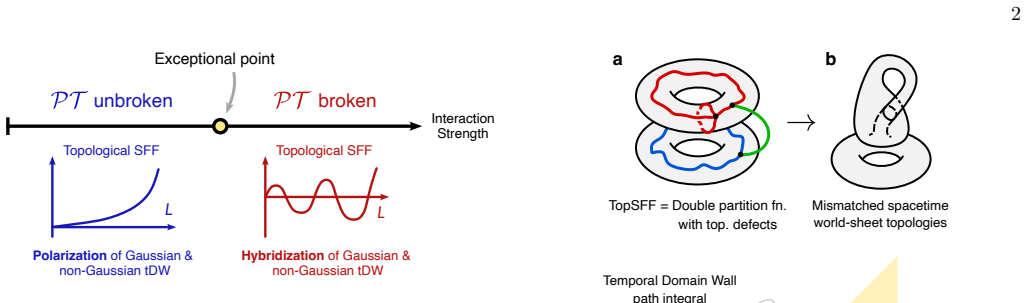
In equilibrium physics, topological defect insertions in quantum and classical partition functions provide non-perturbative probes of phase transitions beyond local observables. In non-equilibrium physics, the spectral form factor provides a minimal probe of universal quantum dynamics, and admits a representation as a product of two partition functions at imaginary inverse temperature. We define the topological spectral form factor (TopSFF) by inserting topological defects acting non-trivially on the doubled partition functions, producing mismatched spacetime world-sheet topologies. For the minimal $\mathbb{Z}_2$ spatially extended defect, implemented by the global swap operator, we derive an exact mapping of the TopSFF of a generic 1D many-body chaotic system to an emergent $(3+1)$D non-Hermitian single-particle problem describing a temporal domain wall (tDW). We show analytically that the effective tDW dynamics undergoes a $\mathcal{PT}$ symmetry breaking transition at a finite interaction strength $\epsilon_{\mathrm{EP}}$: below $\epsilon_{\mathrm{EP}}$, the leading modes are polarized into Gaussian or non-Gaussian tDW sectors and the TopSFF varies monotonically and exponentially with system size; above $\epsilon_{\mathrm{EP}}$, the tDW sectors hybridize and the TopSFF oscillates with system size; at the exceptional point $\epsilon_{\mathrm{EP}}$, Jordan non-diagonality produces a linear-in-system-size enhancement. For temporally extended topological defects, we derive exact universal scaling forms for the TopSFF free energy in systems with time reversal or time translation symmetry, and verify them numerically in independent models.
0
0
cond-mat.stat-mech 2026-06-18

Classical models match LiF spectra from 7.5 K to 1060 K

by Andrea Carati, Luigi Galgani +1 more

Spectra as a classical phenomenon, and the Einstein classical program

Newton-equation calculations fit experimental data better than current quantum ones at high temperatures and work at low temperatures with N

Figure from the paper full image
abstract click to expand
According to Born (\emph{Atomic Physics, page 103}), spectra are \emph{``quantum phenomena, which from a classical standpoint are perfectly unintelligible''}. However we illustrate results on classical calculations of infrared spectra of ionic crystals (actually LiF) which show that the situation is much more complex. Indeed it turns out that: 1) At room temperature and at higher ones (up to 1060 K) the classical computations reproduce the experimental data, even better than the \emph{presently available} quantum ones do; 2) At lower temperatures (even at 7.5 K), the classical computations reproduce pretty well the data, if one accepts the idea advanced in 1916 by Nernst (the inventor of the third principle) that zero-point energy has room in classical physics too. It is eventually pointed out that the mentioned results might be regarded as a first step towards an implementation of the Einstein Classical Program, which aims at deducing quantum physics (admittedly the correct theory) from a realistic theory. In fact, we are considering the Einstein classical program in the extreme version in which the realistic theory is just (\emph{essentially, see below}) classical electrodynamics of matter in bulk, involving phase space orbits, solutions of Newton equations. An Appendix is devoted to illustrate the Nernst approach, which concerns also the relation between equipartition and Planck's law.
0
0
nlin.CD 2026-06-18

Delays in inhibitory networks create slow rhythms

by Xinxin Qie, Matteo Martin +2 more

Dissecting emerging slow rhythms in delay-coupled neural oscillators

Phase-difference models show transmission delays alone generate low-frequency components in fast neural oscillators.

Figure from the paper full image
abstract click to expand
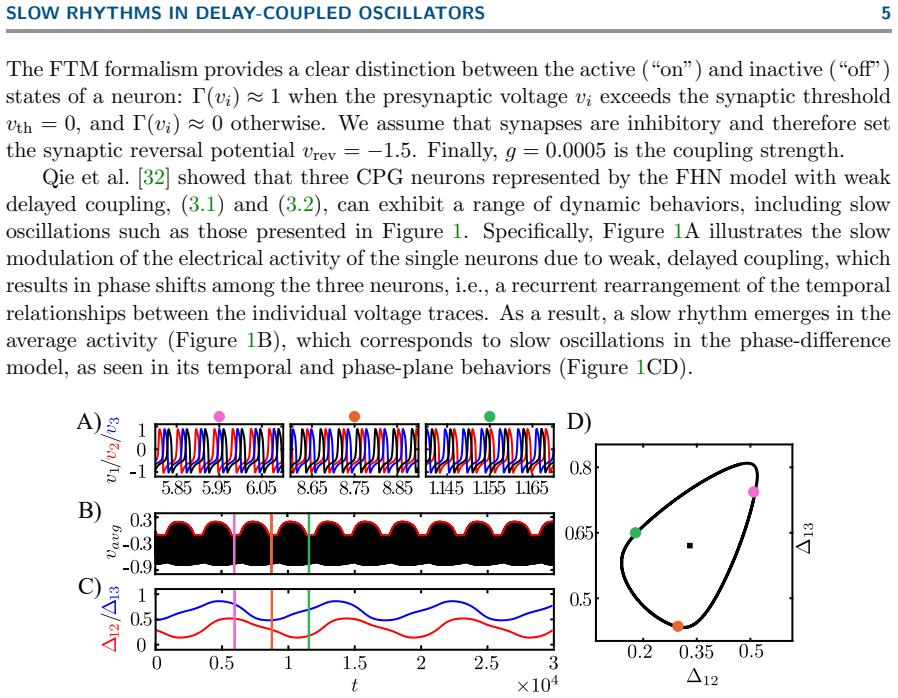
Synaptic transmission delays are ubiquitous in neural circuits and can alter the dynamical repertoire of coupled oscillators quantitatively and qualitatively. Here, we demonstrate that delayed coupling in inhibitory networks introduces an effective slow-fast structure in the phase-difference dynamics, generating low-frequency components that are not due to intrinsic cellular properties, and we show that this behavior is not specific to a particular model structure. The origin of this generic phenomenon is analyzed by numerical continuation and bifurcation analysis, which provides a systematic approach to find such delay-induced slow modulating rhythms. We employ phase reduction based on phase response curves to derive a phase-difference model with delay for mutually inhibitory coupled oscillators, where the individual units are given by the FitzHugh-Nagumo model, the Morris-Lecar model, or a next-generation neural mass model derived from quadratic integrate-and-fire neurons. We use phase planes to study multistability and limit cycles, which correspond to slow modulation of fast oscillations in the full model. Treating the synaptic delay as a bifurcation parameter, we apply numerical continuation to construct delay-dependent bifurcation diagrams. The analysis reveals Hopf, heteroclinic, and saddle-node-of-periodics bifurcations that cause and organize slow rhythmic behavior. Our analysis provides a systematic approach to the search for limit cycles in phase-reduction models corresponding to delay-induced slow rhythms in the original model.
0
0
quant-ph 2026-06-18

OTOC saturation distinguishes integrable from chaotic spin chains

by C Jisha, Shivam Mishra +1 more

Probing chaos and thermalization through out-of-time-ordered correlators in random field spin chains

Integrable regimes relax as 1/t while chaotic regimes show steeper power law then exponential decay

Figure from the paper full image
abstract click to expand
Out-of-time-ordered correlators (OTOCs) have emerged as a diagnostic of information scrambling and quantum chaos in many-body systems. We investigate the imprints of chaos in the dynamics of OTOCs in the Heisenberg spin-$1/2$ chain with random fields. The system is parameterized to exhibit a crossover from integrable to chaotic dynamics. We demonstrate numerically that the approach to saturation of the OTOC can distinguish between integrable and chaotic regimes, with a power-law $(1/t)$ relaxation for integrable systems and a higher-degree power-law decay $(1/t^\alpha; \alpha \ge 1)$ followed by an exponential relaxation for the chaotic regime. We further show that long-range spectral statistics, such as the number variance, are more effective in characterizing quantum chaos in the regime near saturation of OTOC. We also demonstrate that the relaxation and initial scrambling regimes exhibit distinct and universal features, with the former being sensitive and the latter being robust against different realizations of random-fields. The long-time saturation of OTOC also fluctuates with different realizations, and its exact expression is derived through the Eigenstate Thermalization Hypothesis.
0
0
nlin.CD 2026-06-18

Deterministic methods recover chaotic parameters more accurately than stochastic ones

by Ashley Wang, Elizabeth Carlson +1 more

Comparing Deterministic and Stochastic Parameter Recovery Algorithms Applied to Chaotic Systems

Tests on Lorenz systems with added noise show better stability and lower compute cost across noise levels

Figure from the paper full image
abstract click to expand
This paper explores the effectiveness of various novel deterministic and traditional stochastic data assimilation (DA) and parameter recovery (PR) algorithms given noisy data from chaotic systems. We use semi-analytic methods to numerically construct synthetic data from the Lorenz '63 and multiscale Lorenz '96 chaotic dynamical systems, adding white noise. Our findings show that, for different noise levels, deterministic PR algorithms paired with deterministic DA algorithms are shown computationally to be overall more accurate and stable than stochastic PR algorithms. Additionally, deterministic PR methods have demonstrated greater speed and efficiency, requiring less computational power than stochastic PR methods. This suggests that future work should consider exploring the full potential of deterministic PR algorithms in the presence of noise.
0
0
quant-ph 2026-06-17

Quantum noise creates chaos in regular Dicke dynamics

by Ilan Baud, Tamoghna Ray +3 more

Chaos from quantum bath fluctuations

At large but finite spin the dissipative Dicke model develops a strange attractor with positive Lyapunov exponent once quantum bath fluctuat

Figure from the paper full image
abstract click to expand
The effect of a large environment on a finite-size quantum mechanical system is two-fold: It brings dissipation, but also fluctuations of thermal and quantum origin. While dissipation tends to stabilize the dynamics, we question if and how environmental quantum fluctuations can generate chaos in an otherwise classically non-chaotic system. We work out a paradigmatic model of quantum optics: the dissipative Dicke model, where a large spin interacts with a dissipative harmonic mode. We dial in the classical/quantum correspondence by working in the semiclassical regime at large but finite spin. We demonstrate that, starting from a classically regular phase space in the superradiant regime, quantum noise can generate a strange attractor with fractal dimension and a positive Lyapunov exponent. We unveil the deep connection with shear-induced chaos that was recently developed in the mathematical community.
0
0
physics.flu-dyn 2026-06-15

Finite-time sets separate rotation from transport in solar supergranules

by Francisco J. Beron-Vera

Quasi-material finite-time rotationally coherent sets in photospheric supergranulation

Combining two diagnostics shows coherent regions can form by contraction rather than persistent vortices in the photosphere.

Figure from the paper full image
abstract click to expand
Supergranular flows organize transport in the solar photosphere over spatial and temporal scales much larger than granulation. While coherent vortical motions have been identified using objective Lagrangian diagnostics such as the Lagrangian-averaged vorticity deviation (LAVD), rotational coherence captures only one aspect of coherent flow organization. Here we introduce finite-time rotationally coherent sets (FTRCS) by combining the inflated dynamic Laplacian (IDL), which identifies finite-time quasi-material coherent regions, with LAVD-based rotational diagnostics. The IDL extracts coherent structures with finite lifetimes, while LAVD identifies those exhibiting enhanced intrinsic rotation. Application to photospheric velocity fields shows that instantaneous vortical features do not necessarily correspond to finite-time rotationally coherent structures. The analysis also illustrates the effect of compressibility: coherent sets may form through persistent contraction associated with convergent transport, rather than through the persistence of rotating material regions. The combined IDL--LAVD approach separates finite-time transport coherence from intrinsic rotational organization in time-dependent flows.
0
0
math-ph 2026-06-15

Penalty on non-normality breaks Single Ring Theorem

by Joshua Feinberg, Roman Riser +2 more

Flowing to Normality and the Fate of the Single Ring Theorem

Eigenvalue support splits into multiple annuli at a finite penalty value, before reaching normal matrices.

Figure from the paper full image
abstract click to expand
Random non-hermitian matrix ensembles with double-sided rotation invariance obey, in the limit of large matrix size, the Single Ring Theorem, which states that the support of the mean eigenvalue distribution in the complex plane is either a disk or an annulus. In contrast, rotational-invariant random normal matrix ensembles can have mean eigenvalue densities supported over any number of concentric annuli in the complex plane. In this paper we introduce and investigate, both analytically and numerically, a non-hermitian matrix model which flows from a generic matrix distribution obeying the Single Ring Theorem to a distribution of normal matrices by tuning a parameter which penalizes non-normality. We observe numerically breakdown of the Single Ring Theorem as the model flows towards normality, and determine the critical value of the parameter at which the transition occurs. We also study in detail the behavior of the singular values of these matrices under the flow. These singular values form a Fermi gas confined to the positive half-line. In particular, we find that at small values of the flow parameter, the interparticle spacings in the gas exhibit Wigner-Dyson repulsion, whereas for asymptotically large values of the flow parameter, at the normal matrix endpoint of the flow, the spacing statistics is Poissonian. The flow interpolates continuously between these two types of statistics. However, this change in statistics is not related directly to breaking of the Single Ring Theorem, which occurs very early-on along the flow, in the regime of Wigner-Dyson statistics. Finally, we introduce a certain ensemble of random permutations associated with the gas, and make a conjecture on how to use it in order to reconstruct approximately the average density of complex eigenvalues from that of the singular values in the large-$N$ limit.
0
0
physics.flu-dyn 2026-06-15

Odd viscosity yields anisotropic Kolmogorov-Zakharov spectra

by Xander M. de Wit, Léo Touzo +4 more

Wave turbulence theory of odd fluids and solids: kinetic equations and solutions

Kinetic equations for three-wave interactions predict direct cascades in fluids; six-wave interactions predict inverse cascades of wave acti

Figure from the paper full image
abstract click to expand
The theory of wave turbulence describes the properties of physical systems composed of a set of weak-amplitude random waves interacting nonlinearly. Here, we study odd wave turbulence, which arises in chiral media subjected to non-reciprocal stresses, notably odd viscosity and odd elasticity. In both cases, we consider simple models for which we can derive and solve analytically the kinetic equations describing the long-term statistical behavior of spectral quantities such as energy or wave action. For odd viscosity, we consider a three-dimensional model that exhibits wave turbulence involving three-wave interactions, which gives rise to a direct energy cascade characterized by an anisotropic Kolmogorov-Zakharov (KZ) spectrum. For odd elasticity, we consider a quasi-one-dimensional overdamped model that exhibits much slower dynamics involving six-wave interactions. In that case, the KZ spectrum corresponding to a forward cascade of a conserved quantity we call odd energy, is nonlocal and therefore does not constitute a physical solution. However, the other KZ solution, which describes an inverse cascade of wave action, is only marginally non-local and is therefore valid up to a logarithmic correction. These two analytical theories provide a rigorous interpretation of direct numerical simulations, where the KZ spectrum is observed both in the case of odd viscosity (forward cascade) and of odd elasticity (inverse cascade).
0
0
physics.optics 2026-06-15

Restitution model alters onset of complex rocking oscillations

by Fernando Gaibor E., Alexander López +1 more

Characterization of Rocking Block Behaviors with Classical and Alternative Restitution Models

Alternative formulation predicts earlier complex motions and different attractors, with differences decreasing for taller blocks.

abstract click to expand
This work investigates how restitution modeling affects the dynamics of rocking blocks subjected to harmonic excitation. While several studies have reported discrepancies between experimentally observed impact behavior and the predictions obtained using the classical Housner restitution coefficient, the implications of adopting alternative restitution formulations on the global dynamics of rocking systems remain largely unexplored. The system is formulated as a hybrid non-smooth dynamical model and analyzed through bifurcation diagrams, Lyapunov exponents, and basins of attraction for different slenderness ratios. By comparing the classical restitution model proposed by Housner with the alternative formulation of Mao et al., we show that the choice of restitution model strongly influences the predicted system response. The alternative formulation leads to an earlier onset and greater prevalence of complex oscillations, as well as changes in the type, stability, and accessibility of attractors compared to the classical model. However, as the slenderness ratio increases, the dynamical features produced by both formulations progressively converge, indicating a reduced sensitivity to the restitution model for taller blocks. These results provide a dynamical perspective on why alternative restitution formulations, which predict impact responses closer to experimental observations, can produce markedly different behaviors from those obtained using the classical Housner model.
0
0
quant-ph 2026-06-12

Quadratic OTOC growth at resonances in non-KAM oscillator

by Naga Dileep Varikuti

Instabilities in a Non-KAM System via Information Scrambling: A Note

Perturbative expressions tie the growth to the Euler totient function of the frequency ratio, showing resonances control scrambling without

Figure from the paper full image
abstract click to expand
We study operator growth in quantized non-KAM systems using out-of-time-ordered correlators (OTOCs), focusing on the kicked harmonic oscillator as a representative example. Since the classical harmonic oscillator is degenerate, the dynamics fall outside the usual Kolmogorov-Arnold-Moser (KAM) framework, and resonances play a central role in shaping the phase space. We examine the system near resonances, where the ratio between the oscillator and driving frequencies takes integer values. Even though the classical Lyapunov exponent remains small at these points, and hence no conventional chaos, the phase space still undergoes strong structural changes. The OTOCs are particularly sensitive to these resonances, with a quadratic-in-time growth at resonance compared to linear growth away from it. Within a perturbative treatment, we derive closed-form expressions for the OTOCs and uncover a number-theoretic structure emerging in the behavior of OTOCs, governed by the Euler totient function of the frequency ratio. Overall, the results we present in this short note imply that resonant structures can play an important role in controlling information spreading.
0
0
nlin.CD 2026-06-11

Multiple delays affect chaos only through their variance

by Giovanni Giacomelli, Antonio Politi

A mean field approach to multiple, long-delayed systems

Mean-field analysis maps long-delay systems to one description whose only distribution dependence is a generalized variance that sets patter

Figure from the paper full image
abstract click to expand
The concept of multiple, long-delayed feedback systems is introduced and discussed with reference to a paradigmatic model. We analyse how the resulting chaotic dynamics is affected by the delay distribution. Via a mean-field approach, we show that a spatio-temporal representation equivalent to the one developed for the single-delay can be extended to this wider class of dynamical systems. Numerical simulations are complemented by a theoretical study based on a multiple-scale analysis, which, in the vicinity of a Hopf bifurcation, allows mapping the initial model onto a complex Ginzburg Landau equation. As a result, we find that the only relevant feature influenced by the multiple delays is the size of the coherent spatio-temporal structures which, in turn, depends exclusively on a generalized {\it variance} of the delay distribution.
0
0
nlin.CD 2026-06-10

Non-Hermitian matrices set universal stats for open chaotic scattering

by Yan V. Fyodorov, Dmitry V. Savin

Random Matrix Theory for Chaotic Wave Scattering and Transport

Symmetry, openness and channel coupling fix scattering matrices, time delays and resonance distributions.

abstract click to expand
We review random matrix approaches to chaotic wave scattering and transport in open systems. Starting from the effective non-Hermitian Hamiltonian formulation, we discuss the scattering matrix, reaction matrix, time delays, and complex resonances as complementary probes of open chaotic dynamics. We emphasize universal statistics governed by symmetry, openness, and channel coupling. Topics include the maximum-entropy description of fixed-energy scattering and its applications to quantum transport, energy correlations, resonance and eigenfunction statistics, and selected wave-chaotic phenomena induced by finite absorption. The focus throughout is on non-perturbative methods and universal structures underlying open quantum and wave chaotic systems.
0
0
nlin.AO 2026-06-10

Complexity synchronization tracks cooperation in agent systems

by Korosh Mahmoodi, Scott E. Kerick +4 more

Complexity synchronization as a diagnostic and control principle for adaptive systems

Correlation of scaling exponents across variables reveals subsystems that drive success and can be targeted for repair.

Figure from the paper full image
abstract click to expand
Adaptive systems can exhibit similar levels of performance while relying on fundamentally different internal modes of coordination. Standard metrics such as average cooperation or payoff indicate whether a system succeeds, but do not reveal how coordination is organized across interacting components or which adaptive variables should be targeted when performance fails. Here we propose complexity synchronization (CS), the synchronization of evolving temporal complexity across coupled variables, as a diagnostic and intervention guiding principle for adaptive systems. We test this idea in an adaptive multi agent system composed of Selfish Algorithm agents interacting in a reduced Predator Prey model with a Prisoners Dilemma like payoff structure. Temporal complexity is quantified using sliding window modified diffusion entropy analysis (MDEA) and detrended fluctuation analysis (DFA). CS is defined as the correlation between the resulting time dependent scaling exponents. In the high-interaction regime, MDEA-based CS increases with cooperative performance, whereas DFA based CS captures a distinct persistence dominated coordination mode. Our results show that CS can reveal functionally relevant subsystems and provide a principled basis for targeted repair. More broadly, CS offers a general diagnostic and engineering framework for understanding and controlling coordination in biological, social, human machine, and other adaptive systems.
0
0
nlin.AO 2026-06-10

Self-propulsion turns static swarmalator states into traveling and chaotic ones

by Kevin P. O'Keeffe

Self-propulsion in the 1D swarmalator model

Exact solutions exist for drifting clusters and split waves; chaos arises from basin reorganization among attractors.

Figure from the paper full image
abstract click to expand
We study the 1D swarmalator model augmented with self-propulsion. Each swarmalator swims along the ring at a speed $v_0\sin\theta_i$ fixed by its orientation $\theta_i$. Self-propulsion unfolds the static states of the ordinary model into traveling, breathing, split-wave, and chaotic states. Several of these states admit analytic reductions: an exact drifting two-cluster branch with a closed-form stability spectrum, and a four-cluster split-wave ansatz whose active pair reduces, in a constant-orientation approximation, to an Adler equation. Our numerical evidence suggests that the transition to chaos under broad random initial conditions is not caused by local destabilization of the ordered cluster branches, but by basin reorganization among coexisting attractors. The resulting states may serve as qualitative signatures for confined active oscillator arrays.
1 0
0
nlin.AO 2026-06-09

Mixed feedback disorder controls drift versus pinning in rotator networks

by Arpan Dey

Collective drift and pinning in active rotator networks with Kuramoto coupling and mixed-sign feedback disorder

Zero-mean local feedback alone switches networks between pinned states and net positive drift even when every unit has the same intrinsic dr

Figure from the paper full image
abstract click to expand
Active rotator models provide a minimal phase description of excitable and oscillatory systems, and have long been used to study mutual entrainment, synchronization, and collective transitions. Here, we investigate fully connected active rotator networks with Kuramoto coupling, where a common intrinsic drive competes with local feedback amplitudes drawn from a zero-mean Gaussian distribution. This produces a competition between local pinning and collective phase alignment. Using mean absolute late-time drift and the fractions of positive and negative drifting oscillators, we construct numerical regime maps in the feedback-disorder-coupling plane. At weak coupling, increasing the feedback disorder strength suppresses drift, while stronger coupling can restore positive late-time drift when feedback disorder is not too strong. We interpret these regimes using analytical limits for the uncoupled and coherent strong-coupling cases. We also examine finite-size effects and zero-mean distributed intrinsic frequencies. Together, these results show that mixed-sign local feedback alone can reshape the balance between pinning and drifting in coupled active rotator networks, even when the intrinsic drive is homogeneous.
0
0
nlin.CD 2026-06-09

Gaussian bumps turn harmonic wells chaotic

by Tanmayee Patra, Pranaya Pratik Das +1 more

Chaos in cymatics-inspired Gaussian landscapes

Geometry and sign of two perturbations decide whether bounded motion stays regular or becomes chaotic.

Figure from the paper full image
abstract click to expand
This paper presents a focused investigation of a conservative chaotic system, specifically within the context of a two-dimensional harmonic potential well. We analyse the emergence of chaos from a straightforward, non-chaotic harmonic potential well when subjected to perturbations introduced by two Gaussian-like terms in the system's Hamiltonian. The Gaussian-perturbed system serves as a foundation for further inquiries rooted in the cymatics mechanism. In this study, we examine the effects of deformations arising from Gaussian perturbations on the development of chaotic dynamics. These deformations are produced through various configurations of Gaussian bumps in different geometric shapes, along with the modulation of the amplitude of the perturbed term shifting from positive to negative values.
0
0
cond-mat.stat-mech 2026-06-09

Spin chain control transition matches directed percolation class

by Elisha Shmalo, J. H. Pixley +3 more

Control transition in a temporally random classical spin chain

Mixed transition has continuous order parameter but discontinuous Lyapunov exponent, consistent with temporal randomness but not saturating

Figure from the paper full image
abstract click to expand
We theoretically explore a phase transition between controlled and chaotic dynamics in a classical spin chain model subject to chaotic Hamiltonian dynamics and a contractive "control map", which alternate in time. The control map drives the system toward a target configuration that is an unstable fixed point under the chaotic dynamics. When the control is strong enough, the target configuration is the globally attracting stable fixed point of the dynamics; for weaker control, the many-body dynamics remains chaotic for almost all initial states. The phase transition between controlled and chaotic phases has a mixed character: As the transition is approached from the chaotic phase, the fraction of the spins that are far from the target configuration goes continuously to zero, and there are diverging spatial and temporal correlation lengths; however, the leading Lyapunov exponent is discontinuous across the transition, jumping from a positive value in the chaotic phase to a negative value in the controlled phase. We present evidence that this transition is in the same universality class as directed percolation in the presence of temporal randomness, a universality class for which we obtain results that are consistent with the dynamical Harris criterion but do not saturate the bound.
1 0
0
nlin.PS 2026-06-08

Spin chain shows simultaneous sync and desync modes

by R. Arun, M. Lakshmanan +1 more

Collective dynamics in a one-dimensional Heisenberg ferromagnetic spin chain

Field-like torque restores inphase oscillations lost at large spin numbers, with frequencies matching analytical results.

Figure from the paper full image
abstract click to expand
We investigate the different oscillatory modes, namely, complete synchronization, inphase synchronization, antiphase synchronization and desynchronization in a one-dimensional anisotropic Heisenberg ferromagnetic spin chain consisting of a large number of spins. By solving the associated Landau-Lifshitz-Gilbert-Slonczewski equation for the spins we show the simultaneous existence of the above mentioned oscillatory modes in the spins. We observe that when the number of the spins is large the synchronization is lost between the spins; however, we identify that the field-like torque is able to induce synchronous oscillations of the spins in the chain again. We also confirm the agreement of the numerically obtained values of the frequency of the inphase synchronized oscillations with the analytically obtained values.
0
0
physics.flu-dyn 2026-06-08

MMT wave equation simulations confirm cascades and new state

by Gregorio Tibone, Giorgio Krstulovic +1 more

Cascades in the Kinetic Equation for the Majda-McLaughlin-Tabak model

Predictions hold inside and outside well-posed regions, with incurable divergences in corrections.

Figure from the paper full image
abstract click to expand
The Majda-McLaughlin-Tabak (MMT) family of models has proven to be an efficient ground for benchmarking wave turbulence theory, thanks to the low computational cost required to test theoretical ideas and the possibility of tuning nonlinearity and dispersive properties of the equations. Here, we study numerically the wave kinetic equation (WKE) associated with the MMT model and perform simulations to study turbulent cascades. We confirm numerically the predictions of wave turbulence theory, both in the parameter space region where the wave kinetic equation was proven to be well posed and outside of it. We also observe a new stable stationary state in a region where no cascade solutions are expected, a region that, to the best of our knowledge, has not been explored before. Moreover, following recent work, we study next-to-leading-order corrections to the wave kinetic equation; we uncover incurable divergences in the one-dimensional MMT model and, more generally, in higher-dimensional systems with concave power-law dispersion relations.
0
0
nlin.CD 2026-06-08

ML-FTLE combines divergence and Poincare grids for chaos tracking

by S. V. Manivelan, Andrei Velichko +1 more

Unified Geometry-Guided ML-FTLE for Tracking Transient Chaos from Scalar Time Series

Partial least squares regression on occupancy grids calibrates predictive instability to attractor structure for equation-free regime monito

Figure from the paper full image
abstract click to expand
Detecting transient chaos from scalar observations without governing equations represents a fundamental challenge in nonlinear dynamics. We propose a geometry-guided machine learning framework that unifies predictive trajectory divergence with macroscopic attractor morphology to track abrupt regime shifts. The methodology extracts a local instability scale via out-of-sample k-nearest neighbor forecast errors to establish the ML-FTLE estimator, subsequently mapping this temporal divergence onto a structural closeness matrix derived from a minimal dictionary of Poincare occupancy grids. By employing partial least squares regression, we extract a latent geometric component calibrated directly to the empirical finite-time Lyapunov spectrum, yielding the Poincare-based geometric-guided FTLE. Validation against analytical QR-FTLE baselines confirms that fusing topological state spaces with predictive divergence systematically improves continuous transition tracking. The Structural Similarity Index optimally resolves gradual damping, while Hausdorff Distance exhibits extreme resilience during abrupt phase-space collapses. Furthermore, macroscopic spatial discretization acts as a robust topological regularizer against additive Gaussian noise, preserving deterministic signatures even at moderate signal thresholds. This equation-free framework provides a highly accurate, noise-resilient diagnostic for monitoring structural transitions in complex non-stationary systems.
0
0
cond-mat.stat-mech 2026-06-08

Phase lag steers clusters to merge and lift synchronization

by Sudo Yi, Cook Hyun Kim +2 more

Phase lag enhances synchronization in coupled oscillators with inertia

In inertial oscillator systems, a targeted phase lag directs the main cluster to combine with others, raising overall entrainment.

Figure from the paper full image
abstract click to expand
The second-order Kuramoto model with inertia exhibits different dynamical behaviors than the first-order KM without inertia. A central difference is its lower synchronization due to the emergence of multiple synchronized clusters with different frequencies. We aim to investigate how such lowered synchronization can be improved by applying external perturbations to the system in a steady state, for example, a symmetry-breaking phase lag to a subset of oscillators. We find that this phase lag steers the primary cluster along a specific path and enables it to merge with higher-order clusters, thereby enhancing global synchronization. Our results reveal a mechanism by which controlled phase lag can improve entrainment in inertial oscillator systems, with possible implications for synchronization control in inertial oscillator networks.
0
0
nlin.CD 2026-06-08

Delayed observations capture Loop Current extension variability

by Francisco J. Beron-Vera, María J. Olascoaga +1 more

Loop Current Extension as an Effective Delayed Dynamical System

Compact maps from altimetry data forecast better than persistence at 30-90 days, with no extra info from channel flows.

Figure from the paper full image
abstract click to expand
The Loop Current is the dominant circulation feature of the Gulf of Mexico and exhibits pronounced variability associated with northward extension, retraction, and eddy shedding. Despite decades of study, the extent to which this variability admits a reduced dynamical description remains unclear. We investigate this question using delayed-coordinate representations constructed from satellite-altimetry observations of Loop Current extension. Ridge regression, multilayer perceptron forecasting, and Sparse Identification of Nonlinear Dynamics (SINDy) are applied to learn delayed evolution maps from the extension time series. Forecast skill consistently exceeds persistence at lead times of 30--90 days while requiring only a small number of delayed coordinates. Ridge regression reveals saturation with delayed-state dimension, indicating that much of the predictive information is contained within a compact representation. Neural-network forecasts provide modest additional improvements, while delayed SINDy identifies sparse evolution maps involving intraseasonal memory scales, from approximately two weeks to a few months, that remain stable under recursive iteration. Physical diagnostics associated with Yucatan Channel inflow, Florida Straits outflow, gateway geometry, and northern Caribbean vorticity contain predictive information but do not provide additional independent state information once the delayed Loop Current state is included. These results support the interpretation of Loop Current extension as an observable evolving on an effective low-dimensional delayed dynamical system. A substantial fraction of the predictable variability can be reconstructed from a small number of delayed observations and represented through compact delayed evolution maps.
0
0
math.DS 2026-06-05

C-type renormalisation two-cycle proven to exist

by Zainab Rahman, Maria Pickett +1 more

Existence of the C-type renormalisation two-cycle

Rigorous bounds on scaling constants obtained for period-quadrupling route in bidirectionally coupled non-invertible maps

Figure from the paper full image
abstract click to expand
We prove the existence of the C-type renormalisation two-cycle, helping to establish the universality of the C-type route to chaos in families of non-invertible maps of the plane. Families of two-dimensional non-invertible maps, with at least two parameters and critical points of fold type, exhibit a distinct type of critical scaling, the C-type. An accumulation of parameter values leads to an infinite collection of coexisting attracting cycles of periods $4^n$ or $2\cdot 4^n$. Asymptotically, period quadrupling is accompanied by parameter-space scaling and state-space scaling governed by particular universal constants. Kuznetsov et. al. explained this phenomenon in terms of a stationary orbit of period two of the renormalisation group (RG) transformation for period-doubling. We prove the existence of the corresponding renormalisation two-cycle in a Banach space of analytic maps and gain rigorous bounds on the corresponding universal state space scaling constants. This result provides a further step in proving a series of outstanding conjectures concerning distinct universality classes for period-doubling. It extends the recent results for unidirectionally-coupled maps (the FS-type) to bidirectionally-coupled maps, and generalises the framework from fixed points to periodic orbits of the corresponding renormalisation operators. It also provides a further step in establishing the conjectured picture that the C-type universality class is born from the FS-type class via a period-doubling bifurcation in the dynamics of the RG transformation itself. The proof relies on rigorous computations to establish that a variant of Newton's method for the two-cycle is a contraction map. The C-type scaling regularity is known to occur in a number of dynamical systems of interest, perhaps most notably in biologically-plausible models of nephron blood pressure autoregulation.
0
0
nlin.CD 2026-06-05

Adaptive multilayer networks raise coupling threshold for higher-order sync

by Palash Kumar Pal, Dibakar Ghosh +1 more

Synchronization of topological signals in higher-order adaptive multilayer network

Node and projected link signals in higher-order Kuramoto models synchronize only at stronger couplings when layers adapt through order param

Figure from the paper full image
abstract click to expand
The study of synchronization in complex systems has recently been revolutionized by incorporating higher-order interactions through simplicial complexes. Building in particular upon the higher-order Kuramoto model, which considers oscillators on nodes, links, and higher-dimensional simplices. This work extends the monolayer framework of the higher-order Kuramoto model to multilayer networks where the layers are adaptively coupled through order parameters of the oscillators placed on the simplices. We propose two multilayer architectures: one that allows interactions between signals of the same dimension across layers and the other that permits cross-dimensional interactions. We observe that a higher coupling strength is required for synchronization transitions of the node signals and the projected uplink and downlink signals during adaptation. For example, incorporating node dynamics into link evolution delays the onset of synchronization. This study opens an avenue for understanding complex dynamical processes within interconnected higher-order structures. Finally, we present a comprehensive theoretical framework, first for a bilayer network where layers are random networks treated under the annealed approximation, and then extend the analysis to the case of fully connected layers. The theoretical predictions align remarkably well with numerical simulations, accurately capturing the dynamics of the original model in a globally coupled scenario.
0
0
nlin.CD 2026-06-05

Entropy rate vanishes in infinite-measure weak chaos

by Ken-ichi Okubo

Empirical One-Step Conditional Entropy in Infinite Ergodic Systems: Vanishing Entropy Rate, Sparse-Transition Scaling, and Mittag-Leffler Fluctuations

Finite-time sums capture rare laminar transitions with Mittag-Leffler fluctuations instead

Figure from the paper full image
abstract click to expand
Empirical entropy rates are widely used to quantify unpredictability from symbolic or time-series data, yet their interpretation is subtle in weakly chaotic dynamics, where ordinary Lyapunov exponents vanish and invariant measures are infinite. We address this issue by studying the empirical one-step conditional entropy for the fixed finite partitions considered below in one-dimensional intermittent maps with infinite invariant measures. For the modified Bernoulli map and the Boole transformation in the infinite-measure weak-chaos regime, we prove that this per-step empirical entropy converges to zero. Thus, the usual entropy-rate normalization becomes asymptotically blind to subexponential instability. The finite-time information sum, however, remains informative. Rare transitions between long laminar phases occur on the return-sequence scale, and their empirical self-information contributes an additional logarithmic factor. Under the stated regularity and moment assumptions, this mechanism yields a two-term estimate for the ensemble mean decay, supported by numerical simulations. Although the raw entropy rate vanishes, self-normalized fluctuations remain nontrivial and are numerically consistent with normalized Mittag-Leffler laws. A comparison with generalized Lyapunov sums shows that the corresponding information sum is not a Krengel entropy estimator, but a computable, partition-dependent finite-time measure of sparse symbolic transitions. These results clarify what empirical Markov entropy can, and cannot, measure in infinite-measure weak chaos.
0
0
nlin.CD 2026-06-05

Linear projections forecast and suppress extreme events in chaos

by Nicholas Zolman, Sajeda Mokbel +2 more

Uncovering Extreme Event Mechanisms for Prediction and Control with Sensitivity-Balanced Projections

CoBRAS sensitivity-balanced projections yield accurate forecasts and intuitive controllers for turbulent bursts, rogue waves, and synchroniz

Figure from the paper full image
abstract click to expand
Extreme events -- such as earthquakes and coronal mass ejections -- are common in many chaotic dynamical systems, yet are difficult to characterize and predict due to the subtle instability mechanisms that drive them. In this work, we develop an interpretable technique that reveals the underlying mechanisms behind extreme events and uses them to build data-driven forecasts and intuitive event suppression controllers. In particular, we utilize the covariance balancing reduction using adjoint snapshots (CoBRAS) method to identify linear oblique projections that best capture the sensitivity of a quantity of interest and reconstruct the original state. Importantly, we bypass the need for cumbersome adjoint calculations, instead using backpropagation via modern automatically differentiable numerical frameworks. To accommodate spatially localized events, we also introduce a new variant of CoBRAS to obtain local sensitivity-balanced projections. We demonstrate the utility of this approach to characterize extreme events across a diverse set of challenging systems, including turbulent bursts of energy dissipation in the 2D Kolmogorov Flow, spontaneous synchronization in networks of coupled FitzHugh-Nagumo oscillators, and the localized formation of ocean rogue waves from a modified nonlinear Schr\"odinger equation. For each example, we show that our simple forecast models accurately predict extreme events and that the underlying mechanisms may be used to design control laws to prevent these events. Finally, we demonstrate that by learning a neural network surrogate model of the dynamics directly from data, we may extend this approach to experimental systems and systems that are not natively written in an automatically differentiable programming language.
0
0
nlin.CD 2026-06-04

Generalized Allee map has exact tricritical extinction point

by Marcelo A. Pires, José S. Andrade Jr. +1 more

Tricriticality and chaos in a generalized Allee-logistic map

Intermediate Allee strength produces a point separating continuous and jump-like extinction, located by closed-form expression.

Figure from the paper full image
abstract click to expand
We present a novel nonlinear dynamical model, the generalized Allee-logistic (GAL) map given by $x_{t+1} = r x_t (1 - x_t) G(x_t)$ where $G(x_t) = m (x_t - h) + 1 - m$ incorporates the Allee effect with magnitude $m$ and threshold $h$. The case $m = 0$ yields the logistic map with a continuous transition to extinction. Conversely, $m = 1$ recovers a previously studied model that undergoes only a discontinuous extinction-to-active transition. Between these extremes, the GAL map exhibits nontrivial phenomena, including tricriticality with a closed-form expression for the tricritical point and a universal crossover function. Under a small external input, we verify Widom-like relations. We also note that the Allee effect disfavors the onset of chaos. Our work establishes additional bridges between analytically tractable chaotic maps, nonequilibrium tricriticality, and Allee effects.
0
0
nlin.CD 2026-06-03

A** method raises path quality in dynamic multi-agent settings

by Gabriel Fejziaj, Salama Hassona +1 more

On dynamic multi-agent pathfinding methods: review, simulations and modifications

Precomputing several paths offline and switching via space-time rules handles frequent changes and limited sensing more effectively than sta

abstract click to expand
This paper presents a systematic study of pathfinding algorithms in the context of Dynamic Multi-Agent Pathfinding (D-MAPF), a setting that combines dynamic obstacles, partial observability, and inter-agent conflicts. We evaluate six representative algorithms: Dijkstra, D* Lite, Space-Time A*, WHCA*, M*, and a novel method denoted as A** within a unified simulation framework. The proposed A** algorithm introduces a template-based approach that decouples offline geometric path generation from online temporal adaptation. By precomputing multiple diverse candidate paths and dynamically reconnecting to them using space-time planning, A** improves solution quality in environments with frequent changes and limited sensing
0
0
math.DS 2026-06-02

Ulam reductions converge to linear response in nonautonomous systems

by Stefano Galatolo, Valerio Lucarini +1 more

Ulam Approximation for Nonautonomous Systems: Equivariant Measures and Linear Response

Finite Markov models match the projected response of the original system under regularizing transfer operators.

Figure from the paper full image
abstract click to expand
Despite the prevalence of nonautonomous systems in applications, their statistical properties are much less understood than in the autonomous setting. Building on recent results on response theory for nonautonomous systems, we study the approximation of equivariant families and of their linear response by Ulam-type finite-dimensional reductions. First, we show that coarse-graining procedures associated with the classical Ulam method, and more generally with suitable finite-element projections, provide rigorous approximation of equivariant families for sequential systems with memory loss. Second, for systems whose transfer operators are regularizing, we prove that the linear response of the reduced finite-state Markov model converges to the projected linear response of the original system. To the best of our knowledge, a general approximation result of this type has not previously been established in this form, even in the autonomous case. We complement the analysis with numerical experiments on simple but representative time-dependent diffusive models. These results provide a rigorous foundation for the use of Markov approximations in the study of statistical properties of nonautonomous complex systems which almost invariably relies on finite-scale and finite-precision descriptions of their states and dynamics.
0
0
nlin.CD 2026-06-02

Splitting integrator preserves Hamiltonians in dissipative 3D systems

by Bülent Karasözen, Murat Uzunca

Structure preserving integration of 3D dissipative bi-Hamiltonian/Nambu systems

Strang splitting keeps conservative energies constant while computing periodic and chaotic solutions in Lorenz, Chen and Rabinovich models.

Figure from the paper full image
abstract click to expand
A structure-preserving splitting integrator is developed for 3D dissipative bi-Hamiltonian/Nambu systems. The integrator uses Strang splitting for conservative and dissipative parts. For Nambu systems, the divergence-free, conservative part is integrated using the energy/volume-preserving Kahan's method, and the dissipative part is integrated by the forward and backward Euler methods. For dissipative bi-Hamiltonian systems, the conservative part is integrated with the energy-preserving average vector field (AVF) method. In both cases, the Hamiltonians of the conservative parts are preserved in the Lorenz, Chen, and Rabinovich systems. The periodic and chaotic solutions are computed accurately by the conservative-dissipative Strang splitting approach.
0
0
nlin.CD 2026-06-01

Time correlations sort tipping points into continuous or abrupt

by Alejandro Frank, Laurence A. Jacobs

Temporal Matrix Scale Invariance and the Classification of Tipping Points

Equality or inequality of two exponents extracted from the kernel decides whether the shift stays recoverable or becomes catastrophic.

abstract click to expand
We introduce temporal matrix scale invariance (tMSI), a mathematical structure for the two-time correlation kernel of a multivariate observable. A kernel $C(t,t')$ satisfies tMSI of order $\alpha$ if $C(kt, kt') = k^{-\alpha}C(t,t')$ for all $k>0$; this condition holds near a tipping point, where the divergence of the coherence time produces temporal scale freedom. By a kernel factorization theorem, every tMSI kernel separates into a power-law envelope $(tt')^{-\alpha/2}$ and a shape function $F(t/t')$ diagonalized by the Mellin transform. This reveals a decoupling of two independent exponents: the dynamical exponent $\alpha$, carried by the envelope, and the spectral relaxation exponent $\beta$, determined by the eigenvalue decay of the finite-dimensional truncation. Their equality $\alpha = \beta$ characterizes a simple critical point; their inequality $\alpha \neq \beta$ is the signature of temporal multicriticality. We provide a classification of tipping points. The Landau quartic coefficient $a_4$ is given exactly by $a_4 = p^2 + q^2 - 2\lambda pq - g^2_{\alpha\alpha\beta}\Gamma(\sigma_\alpha, \sigma_\beta)$, where $\lambda = 2\sqrt{\sigma_\alpha\sigma_\beta}/(\sigma_\alpha+\sigma_\beta) \in (0, 1]$, $g_{\alpha\alpha\beta}$ is the three-point structure constant, and $\Gamma > 0$ is in explicit closed form. The transition is continuous for $a_4 > 0$, tricritical for $a_4 = 0$, and discontinuous for $a_4 < 0$. The simple critical point $\alpha = \beta$ is maximally fragile: any nonzero operator mixing drives $a_4 < 0$, placing the synchronized state generically at the edge of catastrophe. The framework yields a matrix-valued early warning diagnostic, computable from a multivariate time series without knowledge of the underlying equations, that classifies an approaching tipping point as recoverable or catastrophic. Applications to epilepsy and acute myocardial infarction are discussed.
0
0
cond-mat.stat-mech 2026-06-01

Linearized response tails predict nonlinear fragility

by Surachate Limkumnerd

Pre-failure response spectra predict finite-amplitude fragility

Response spectrum breadth controls the share of dangerous directions beyond the leading failure path

Figure from the paper full image
abstract click to expand
Failure theories often identify a single leading route to failure: the most unstable mode, weakest link, minimum-action escape path, or optimal perturbation. Yet finite-amplitude susceptibility depends not only on the nearest route but on how much of perturbation space lies near dangerous directions. We cast this distinction as a fragility problem: for each perturbation direction, the failure distance is the smallest amplitude that crosses a prescribed boundary, and the fragility curve is the fraction of directions that fail below a given amplitude. Measuring this curve directly requires nonlinear trials over many directions; instead, we show that it is predicted, before any failure occurs, by the tail of a single pre-failure quantity: the boundary-normalized fragility gain computed from the linearized response. The breadth of the associated response spectrum sets how many near-dangerous pathways coexist beyond the strongest direction. We demonstrate the mechanism in a high-dimensional nonlinear non-normal network with the strongest directional gain held fixed: the system with broader response-channel breadth has a larger nonlinear fragility curve, isolating breadth from the worst direction. An independent scalar test in deterministic traffic breakdown confirms the predicted sign: response breadth lowers calibrated jam thresholds once the strongest response is matched, with residual margins screening but never reversing the effect. Response-spectrum breadth thus emerges as a pre-failure coordinate for finite-amplitude fragility beyond the strongest path.
0
0
physics.flu-dyn 2026-06-01

Buoyancy-driven flows reach turbulence subcritically

by Lu Zhang, Ke-Qing Xia

Subcritical transition to turbulence in buoyancy-driven flows with multiple hysteresis loops under quasi-one-dimensional confinement

Simulations reveal steady convection jumps to chaos and turbulence via finite disturbances, producing three hysteresis loops in transport qu

Figure from the paper full image
abstract click to expand
We present both static and quasi-static direct numerical simulations of Rayleigh-B\'enard convection in a quasi-one-dimensional domain, revealing for the first time a clear subcritical transition to turbulence in a buoyancy-driven flow. Within a narrow range of Rayleigh number (Ra), three coexisting flow states are identified: steady convection, oscillatory chaos, and intermittent turbulence. The transitions between these states are accompanied by abrupt jumps in both the Nusselt number (Nu) and Reynolds number (Re), the key global transport quantities in buoyancy-driven flows. Additionally, they exhibit pronounced hysteresis, forming three distinct hysteresis loops in the Nu-Ra plane: normal, reverse, and anomalous loops. More importantly, we show that the steady convection state is linearly stable against infinitesimal perturbations but can transition to intermittent turbulence when subjected to finite-amplitude disturbances, which is a defining hallmark of subcriticality. Thus, contrary to the prevailing view that the transition from convection to turbulence is supercritical, our results demonstrate that buoyancy-driven turbulence can emerge via a subcritical route, paving the way for a unified framework that describes instability mechanisms in both buoyancy-driven and shear-driven flows.
0
0
physics.ao-ph 2026-06-01

Integral relations generalize dynamic emergent constraints in climate

by Francesco Ragone, Valerio Lucarini

A mathematical framework for dynamic emergent constraints in climate science

Response of predictand computed as convolution of predictor response with proxy Green's function

Figure from the paper full image
abstract click to expand
Emergent constraints in climate science are empirical relations that link the response to a forcing of a physical observable to the properties of other observables, with the aim of reducing climate change projection uncertainties. Here we use recent results in linear response theory to develop a mathematical framework for dynamic emergent constraints, a class of emergent constraints linking the response of different observables to the same forcing. We show how traditional dynamic emergent constraints are a special case of more general relations, that we call integral dynamic emergent constraints. These relations allow to compute the response of a predictand as the convolution of the response of a predictor and the proxy Green's function of the predictand-predictor pair. The conditions for the existence of integral emergent constraints are related to the causality of the proxy Green's function and the time scales at which the system is observed. We apply this framework to global warming simulations with the MPI-ESM climate model, to study dynamic emergent constraints between different observables. These results allow to put the theory of dynamic emergent constraints on firm mathematical ground, and suggest a protocol to identify necessary conditions for the existence of such relations in climate data.
0
0
physics.optics 2026-05-29

Chaotic hysteresis mediates symmetry restoration in optical trimer

by Johanne Hizanidis, Konstantinos G. Makris

Symmetry restoration through chaotic hysteresis in a non-Hermitian optical trimer

Nonlinearity in a minimal non-Hermitian photonic lattice organizes chaos localization at edges and multifrequency dynamics after symmetry re

Figure from the paper full image
abstract click to expand
We investigate symmetry restoration and spatially localized dynamics in a non-Hermitian optical trimer composed of three lossy waveguides with complex-valued couplings. Extending our previous analysis of the system's global bifurcation structure, we adopt a site-resolved perspective in order to uncover how collective nonlinear dynamics emerge and reorganize across the individual waveguides. We show that the transition from asymmetric to symmetric states is mediated by a chaotic hysteretic regime involving the coexistence of asymmetric, periodic-symmetric, and chaotic-symmetric attractors. Within this regime, chaotic dynamics become spatially localized predominantly at the edge waveguides, while the central waveguide retains partial spectral coherence. Following symmetry restoration, the system develops multifrequency dynamics through a spatial period-doubling process, where the middle waveguide oscillates at twice the dominant frequency of the edge sites. These results reveal how Kerr nonlinearity and complex coupling organize symmetry restoration, chaos localization, and frequency differentiation in minimal non-Hermitian photonic lattices.
0
0
nlin.CD 2026-05-29

Topology sets power-law threshold for network extreme events

by Christian Hechler, Timo Bröhl +2 more

Complex network topological and spectral determinants of extreme events

The coupling needed for extremes scales the same way with density and connectivity no matter the system or generation mechanism.

Figure from the paper full image
abstract click to expand
We study the impact of the coupling topology on the ability of various networked dynamical systems to generate extreme events. By determining the coupling strength that is necessary to generate an extreme event in the collective dynamics of a given system, we observe a power-law-like relationship between this coupling threshold and both topological (edge density) and spectral (algebraic connectivity) properties of various coupling topologies. Interestingly, this relationship appears to be largely independent of both the investigated system and the underlying mechanism to generate extreme events. This may indicate that the observed relationship is primarily mediated by aspects of the coupling topology.
0
0
nlin.CD 2026-05-29

Memristor parameters tune chaos in thermo-MEMS

by N.G. Koudafokê, Thierry Njougouo +2 more

Characterization of Chaotic and Homogeneous coexisting dynamics of a Memristive Thermo-Controlled MEMS

Varying Ron, Roff, thickness and ionic mobility shifts the coupled resonators between quasi-periodic and chaotic states

abstract click to expand
This work presents the mathematical modeling and numerical investigation of a thermo-controlled Micro-Electro-Mechanical System (MEMS) obtained by coupling an HP memristor with mechanical and electrical resonators. Using the linear drift HP memristor model, the nonlinear electromechanical dynamics are analyzed through Lyapunov exponents, bifurcation diagrams, phase portraits, recurrence plots, Poincar\'e sections, and Fourier spectra. The results reveal parameter-dependent transitions between quasi-periodic and chaotic oscillations, as well as signatures of coexisting dynamical regimes. A systematic investigation of the intrinsic memristor parameters, namely the ON-state resistance Ron, the OFF-state resistance Roff, the oxide thickness D, and the ionic mobility \mu_v, demonstrates that memristive effects strongly influence oscillation amplitudes, resonance frequencies, and nonlinear transitions within the coupled thermo-electro-mechanical system. The state-dependent memristance dynamically modulates the electromechanical coupling and redistributes energy between the electrical and mechanical resonators, thereby generating complex oscillatory responses. In addition, the influence of temperature-sensitive memristive parameters is qualitatively examined through variations of the ionic mobility and resistive states. The results indicate that thermal variations can modify both oscillation amplitudes and dynamical regimes, potentially inducing transitions between quasi-periodic and chaotic behaviors. A comparative discussion with Josephson-junction-based MEMS architectures highlights the operational flexibility and room-temperature compatibility of the HP memristor model for thermo-electro-mechanical applications. These findings suggest promising prospects for adaptive nonlinear oscillators, thermo-sensitive sensors, and chaos-driven electromechanical systems.
0
0
nlin.CD 2026-05-29

Asymmetry triggers nontrivial energy exchange in bead-spring chains

by Yuki Sogo, Yoshiyuki Y. Yamaguchi

Conformation dynamics in asymmetric chain-like three-body bead-spring models

Different springs and masses allow mode interactions that alter bending conformations beyond symmetric limits.

Figure from the paper full image
abstract click to expand
We consider conformation dynamics of a chain-like three-body bead-spring model, in which three point masses are connected in series by two springs and the conformation is defined by the bending angle between the two springs. Previous studies have theoretically shown that an unstable (stable) conformation based on the potential function can be stabilized (destabilized) by exciting spring vibration and stabilization or destabilization depends on amplitudes of vibration modes. However, the system was restricted in symmetric cases in which the two springs are identical and the masses of the two end beads are identical. This symmetry simplifies energy exchange between the vibration modes and conformation dynamics accordingly. We extend the theory into asymmetric systems. This extension can induce nontrivial energy exchange between the modes and a corresponding nontrivial conformation dynamics.
0
0
nlin.CD 2026-05-28

Rapid driving equates nonlinear stability to Mathieu curves

by Afshin Besharat, Alexander A. Penin

Nonlinear Dynamics of Rapidly Driven Systems

High-frequency expansion yields identical transition boundaries for a broad class of nonlinear systems, allowing exact stability analysis.

Figure from the paper full image
abstract click to expand
We consider systems characterized by the presence of a rapidly oscillating force. A general method is presented for the construction of the effective action governing the large-scale nonlinear dynamics of such systems order by order in inverse powers of the oscillation frequency $\omega$. The explicit expression for the effective Lagrangian is derived up to ${\cal O}(1/\omega^6)$ next-to-next-to-leading approximation. The general structure of the high-frequency expansion reveals a broad class of nonlinear systems whose transition curves are identical to those of the linear Mathieu equation, which enables a fully nonperturbative stability analysis in the case of strong driving and nonlinearity. The method is generalized to velocity-dependent forces and configuration space with curvature, characteristic to systems with constraints. Several applications are discussed in detail, including the dynamical magnetic trapping of electric charges.
0
0
q-bio.QM 2026-05-28

Relaxation dynamics shift biological transition and oscillation points

by Pan-Jun Kim

Widespread quasi-steady state assumption in biological interaction modeling mischaracterizes system transitions

The quasi-steady state assumption ignores these effects and gets transition durations and onset points wrong in models of cells, metabolism,

Figure from the paper full image
abstract click to expand
From molecular, cellular, to ecological systems, the modeling of biological processes often stands on the assumption that fast components immediately reach the equilibrium at each moment (quasi-steady state) and only slow components govern the relevant system dynamics. This quasi-steady state approximation (QSSA) simplifies the modeling but discards the effects of the relaxation towards each quasi-steady state. Unclear is the QSSA's suitability around the transition point, a specific condition where the system changes to a qualitatively different state. In this regard, we here derived a theoretical framework for the near-transition dynamics of biological systems, explicitly considering the relaxation processes overlooked by the QSSA. Numerical simulations verify our predictions for cellular decision-making, metabolic oscillations, and ecological cycles. Despite the extreme slowdown near the transition point, the QSSA alone misestimates the duration of the transition from one state to another. Moreover, the QSSA erroneously predicts the transition point itself for the onset of oscillations, while the relaxation dynamics facilitates or suppresses the oscillation onset with a counterintuitive time-delay effect. Common feedback interactions between biological components are pivotal to those relaxation effects. Our study provides an analytical foundation to understand the rich transient or rhythmic dynamics of interacting biological components near the transitions.
0
0
stat.ML 2026-05-28

Squared loss hits a barrier at the conditional mean

by Junfeng Chen

Diagnosing the conditional-mean barrier in scientific machine-learning surrogates

Diagnostics show when point predictors have captured all available information and uncertainty must be modeled separately.

Figure from the paper full image
abstract click to expand
Many problems in computational science and engineering become one-to-many after coarse graining, partial observation, or inverse reconstruction: a resolved state may not determine a unique subgrid forcing, a structural descriptor may not determine a unique effective response, and a low-resolution observation may correspond to many plausible high-resolution fields. In such settings, deterministic surrogates may learn a well-defined mathematical object while still missing application-relevant uncertainty. This tutorial develops a self-contained module centered on the conditional-mean barrier: the point at which a squared-loss predictor has reached the conditional mean and the remaining error is irreducible aleatoric variance. We give two diagnostics for locating this barrier, residual-feature orthogonality and the coefficient of determination against its explained-variance ceiling, and prove that adding latent randomness to a squared-loss predictor collapses it back to the conditional mean. Crossing the barrier therefore requires a loss that scores distributions rather than point predictions. We briefly organize common distributional objectives, including negative log-likelihood, moment and observable matching, variational objectives, adversarial divergences, and score matching, by the feature of the conditional law each targets. The emphasis is the boundary itself and a finite-data procedure for recognizing it, rather than a survey of methods beyond it. CPU-based demonstrations on a two-branch law and a two-scale Lorenz-96 closure problem show how the diagnostics distinguish deterministic underfitting from residual distributional variability.
0
0
physics.flu-dyn 2026-05-27

Stagnation points govern polymer flow thickening in ordered pores

by Emily Y. Chen, Simon J. Haward +2 more

Polymer extension at stagnation points governs flow thickening of polymer solutions in ordered porous media

Model shows extension at these points sets macroscopic resistance; disordered media add fluctuation losses.

Figure from the paper full image
abstract click to expand
Polymer solutions exhibit anomalous flow thickening -- marked by an abrupt increase in the macroscopic flow resistance -- above a threshold flow rate in a porous medium, but not in bulk solution. This phenomenon has evaded a mechanistic description for over half a century. Here, we develop a model that quantitatively links pore-scale flow fields and fluid rheology to macroscopic flow thickening, and validate it in experiments in two- and three-dimensional (2D and 3D) porous media. We find that flow thickening in ordered media is governed by polymer extension at stagnation points -- in contrast to disordered media, where viscous dissipation by unsteady flow fluctuations also contributes substantially. Our results provide a foundation to predict and control such flows in energy, environmental, industrial, and microfluidic applications.
0

browse all of nlin.CD → full archive · search · sub-categories