Degree growth, orbit graphs, and functoriality for birational dynamical systems
Pith reviewed 2026-06-30 02:20 UTC · model grok-4.3
The pith
Normalized orbit graphs and pullback non-functoriality close linear systems for birational degree sequences.
A machine-rendered reading of the paper's core claim, the machinery that carries it, and where it could break.
Core claim
The two kinds of relations—those recorded on normalized finite-window orbit graphs from singularity patterns and those arising from the failure of functoriality of pullbacks—lead to closed linear difference systems governing degree sequences under suitable finite-type assumptions. This construction interprets elementary singularity computations as degree relations on a single normal variety and shows that the mechanisms are complementary in higher-dimensional examples.
What carries the argument
Normalized finite-window orbit graphs that record time-indexed divisorial conditions as valuations of pullbacks, augmented by degree-drop divisors from non-functorial pullbacks.
If this is right
- Degree sequences of birational maps satisfy linear recurrence relations whose coefficients are determined by the orbit-graph and pullback data.
- The method determines degree growth for maps on varieties of dimension greater than two where either mechanism alone leaves the system underdetermined.
- Singularity patterns translate directly into algebraic relations among degrees on a fixed normal variety.
Where Pith is reading between the lines
- The same divisor data may be reusable to track other numerical invariants such as intersection numbers or canonical heights.
- The finite-window graphs could be computed algorithmically from the indeterminacy loci of iterates, turning the method into a decision procedure for growth type.
- The approach may extend to non-birational rational maps by replacing pullbacks with proper transforms.
Load-bearing premise
The normalized finite-window orbit graphs together with the degree-drop divisors capture all relations needed to close the linear difference system for the degree sequence.
What would settle it
A concrete birational map of finite type whose computed degree sequence satisfies no linear recurrence of the order predicted by the combined relations from its orbit graphs and degree-drop divisors.
Figures


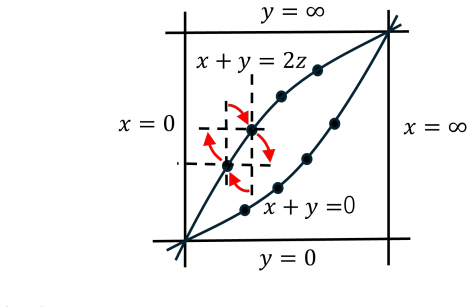

read the original abstract
The purpose of this paper is to give a natural divisor-theoretic formulation of the counting method introduced by Halburd for computing degree growth, in a form applicable to birational dynamical systems on varieties of arbitrary dimension. Instead of counting only preimages of special values, we follow time-indexed divisorial conditions through singularity patterns. These conditions are recorded on normalized finite-window orbit graphs, where the relevant multiplicities are realized as divisorial valuations of pullbacks of time-indexed divisors. This construction explains how the elementary computations appearing in singularity patterns can be interpreted as degree relations on a single normal variety. We then show that further relations arise from the failure of functoriality of pullbacks: when the center of a divisor enters the relevant indeterminacy locus, a degree-drop divisor appears. Under suitable finite-type assumptions, the two kinds of relations lead to closed linear difference systems governing degree sequences. Several examples, including higher-dimensional ones, demonstrate that the two mechanisms are complementary and that their combination determines the degree growth in cases where either mechanism alone is insufficient.
Editorial analysis
A structured set of objections, weighed in public.
Referee Report
Summary. The paper reformulates Halburd's counting method for degree growth of birational dynamical systems in divisor-theoretic terms applicable to varieties of arbitrary dimension. It tracks time-indexed divisorial conditions via normalized finite-window orbit graphs, where multiplicities arise as valuations of pullbacks, and derives additional relations from degree-drop divisors when centers of divisors meet indeterminacy loci due to non-functoriality of pullbacks. Under finite-type assumptions, these two families of relations are asserted to generate closed linear difference systems for the degree sequences; several higher-dimensional examples are given to illustrate that the mechanisms are complementary.
Significance. If the completeness claim holds, the work supplies a geometric, divisor-based framework that systematizes degree-growth computations beyond low-dimensional cases and makes the underlying linear relations explicit on a single normal variety. The explicit use of orbit graphs and functoriality failure provides a clear conceptual advance over purely combinatorial counting, with potential applicability to broader classes of birational maps once the finite-type hypotheses are verified in concrete settings.
major comments (2)
- [§3] §3 (Functoriality and degree-drop divisors): The central claim that the orbit-graph relations together with the degree-drop divisors exhaust all constraints needed to close the linear difference system under finite-type assumptions is stated without an explicit argument that no further independent relations arise from higher-codimension indeterminacy loci, non-reduced structures, or global topological constraints invisible in finite windows. A concrete verification that the resulting matrix is square (or that the solution space is one-dimensional) is required to support the assertion that the predicted degree growth is forced by the construction.
- [§4] §4 (Examples): While the higher-dimensional examples demonstrate that both mechanisms are needed, the text does not exhibit the explicit linear systems or the rank computations showing that the combined relations determine the degree sequence uniquely; without these matrices or the associated characteristic polynomials, it is impossible to confirm that the finite-type hypothesis indeed produces a closed system rather than an under-determined one.
minor comments (1)
- [§2] Notation for the normalized finite-window orbit graphs is introduced without a formal definition of the normalization map or the precise embedding of the time-indexed divisors; a short diagram or explicit coordinate description in §2 would improve readability.
Simulated Author's Rebuttal
We thank the referee for the careful reading and constructive comments on our manuscript. The points raised identify places where additional justification and explicit computations would strengthen the exposition. We respond to each major comment below.
read point-by-point responses
-
Referee: [§3] §3 (Functoriality and degree-drop divisors): The central claim that the orbit-graph relations together with the degree-drop divisors exhaust all constraints needed to close the linear difference system under finite-type assumptions is stated without an explicit argument that no further independent relations arise from higher-codimension indeterminacy loci, non-reduced structures, or global topological constraints invisible in finite windows. A concrete verification that the resulting matrix is square (or that the solution space is one-dimensional) is required to support the assertion that the predicted degree growth is forced by the construction.
Authors: We agree that the manuscript states the exhaustiveness claim under the finite-type hypothesis without a self-contained argument ruling out additional independent relations from higher-codimension loci or non-reduced structures. The finite-type assumption is intended to ensure that all relevant indeterminacy is visible in the finite windows, so that higher-codimension phenomena do not generate new linear constraints on the degree sequences tracked by the orbit graphs; however, this reasoning is only sketched. We will revise §3 to include a short paragraph that counts the number of independent relations produced by the orbit-graph and degree-drop mechanisms and verifies that this count equals the number of degree variables in each finite window, thereby showing the relation matrix is square and the solution space is one-dimensional (corresponding to overall scaling). revision: yes
-
Referee: [§4] §4 (Examples): While the higher-dimensional examples demonstrate that both mechanisms are needed, the text does not exhibit the explicit linear systems or the rank computations showing that the combined relations determine the degree sequence uniquely; without these matrices or the associated characteristic polynomials, it is impossible to confirm that the finite-type hypothesis indeed produces a closed system rather than an under-determined one.
Authors: We accept that the examples would be more convincing if the explicit relation matrices, their ranks, and the resulting characteristic polynomials were displayed. In the revised version we will append, for each higher-dimensional example, the full matrix of orbit-graph and degree-drop relations together with a rank computation confirming that the system is square and closed, as well as the characteristic polynomial that determines the degree growth. revision: yes
Circularity Check
No circularity: relations derived from explicit geometric constructions
full rationale
The paper constructs the closed linear difference systems directly from two geometric sources: (1) time-indexed divisorial conditions recorded as valuations on normalized finite-window orbit graphs, and (2) degree-drop divisors arising when centers meet indeterminacy loci (failure of pullback functoriality). These are presented as independent inputs from the birational geometry under finite-type assumptions, not as parameters fitted to degree data or as self-definitions. No self-citation chain, ansatz smuggling, or renaming of known results is invoked to close the system; the abstract explicitly states the mechanisms are complementary and suffice to determine growth. The derivation chain therefore remains self-contained against external geometric benchmarks rather than reducing to its own outputs by construction.
Axiom & Free-Parameter Ledger
Reference graph
Works this paper leans on
- [1]
- [2]
-
[3]
Bayraktar, Green currents for meromorphic maps of compact K¨ ahler manifolds, J
T. Bayraktar, Green currents for meromorphic maps of compact K¨ ahler manifolds, J. Geom. Anal. 23 (2013), 970–998
2013
-
[4]
Bedford and K
E. Bedford and K. Kim, On the degree growth of birational mappings in higher dimension, J. Geom. Anal. 14 (2004), 567–596
2004
-
[5]
Bedford and K
E. Bedford and K. Kim, Periodicities in linear fractional recurrences: degree growth of bira- tional surface maps, Michigan Math. J. 54 (2006), 647–670
2006
-
[6]
Bedford and K
E. Bedford and K. Kim, Linear fractional recurrences: periodicities and integrability, Ann. Fac. Sci. Toulouse Math. 20 (2011), 33–56
2011
-
[7]
J. P. Bell, J. Diller and M. Jonsson, A transcendental dynamical degree, Acta Math. 225 (2020), 193–225
2020
-
[8]
M. P. Bellon and C.-M. Viallet, Algebraic entropy, Commun. Math. Phys. 204 (1999), 425–437
1999
-
[9]
A. S. Carstea and T. Takenawa, Space of initial conditions and geometry of two 4-dimensional discrete Painlev´ e equations, J. Phys. A: Math. Theor. 52 (2019), 275201
2019
-
[10]
Dang and C
N.-B. Dang and C. Favre, Spectral interpretations of dynamical degrees and applications, Ann. Sci. ´Ec. Norm. Sup´ er. 55 (2022), 739–808
2022
-
[11]
Diller and C
J. Diller and C. Favre, Dynamics of bimeromorphic maps of surfaces, Amer. J. Math. 123 (2001), 1135–1169
2001
-
[12]
J. E. Fornæss and N. Sibony, Complex dynamics in higher dimension. I, Ast´ erisque 222 (1994), 201–231
1994
-
[13]
Grammaticos, A
B. Grammaticos, A. Ramani, A. S. Carstea and R. Willox, A fast algorithmic way to calculate the degree growth of birational mappings, Mathematics 13 (2025), 737
2025
-
[14]
Grammaticos, A
B. Grammaticos, A. Ramani and V. Papageorgiou, Do integrable mappings have the Painlev´ e property?, Phys. Rev. Lett. 67 (1991), 1825–1828
1991
-
[15]
R. G. Halburd, Elementary exact calculations of degree growth and entropy for a class of mappings, Proc. R. Soc. A 473 (2017), 20160831
2017
-
[16]
Hietarinta and C.-M
J. Hietarinta and C.-M. Viallet, Singularity confinement and chaos in discrete systems, Phys. Rev. Lett. 81 (1998), 325–328. 31
1998
-
[17]
Kanki, J
M. Kanki, J. Mada and T. Tokihiro, Singularities of the discrete KdV equation and the Laurent property, J. Phys. A: Math. Theor. 47 (2014), 065201
2014
-
[18]
Kanki, J
M. Kanki, J. Mada, T. Mase and T. Tokihiro, Irreducibility and co-primeness as an integrability criterion for discrete equations, J. Phys. A: Math. Theor. 47 (2014), 465204
2014
-
[19]
T. Mase, R. Willox, A. Ramani and B. Grammaticos, Singularity patterns and dynamical degrees, J. Phys. A: Math. Theor. 52 (2019), 205201
2019
-
[20]
Okamoto, Sur les feuilletages associ´ es aux ´ equations du second ordre ` a points critiques fixes de P
K. Okamoto, Sur les feuilletages associ´ es aux ´ equations du second ordre ` a points critiques fixes de P. Painlev´ e, Japan. J. Math. 5 (1979), 1–79
1979
-
[21]
Ramani, B
A. Ramani, B. Grammaticos, A. S. Carstea and R. Willox, Obtaining the growth of higher order mapping through the study of singularities, J. Phys. A: Math. Theor. 58 (2025), 115201
2025
-
[22]
Ramani, B
A. Ramani, B. Grammaticos, R. Willox and T. Mase, Calculating algebraic entropies: an express method, J. Phys. A: Math. Theor. 50 (2017), 185203
2017
-
[23]
R. K. W. Roeder, The action on cohomology by compositions of rational maps, Math. Res. Lett. 22 (2015), 1099–1125
2015
-
[24]
Sakai, Rational surfaces associated with affine root systems and geometry of the Painlev´ e equations, Commun
H. Sakai, Rational surfaces associated with affine root systems and geometry of the Painlev´ e equations, Commun. Math. Phys. 220 (2001), 165–229
2001
-
[25]
Stokes, T
A. Stokes, T. Takenawa and A. S. Carstea, On the geometry of a 4-dimensional extension of a q-Painlev´ e I equation with symmetry typeA(1) 1 , J. Phys. A: Math. Theor. 58 (2025), 405201
2025
-
[26]
Takenawa, Algebraic entropy and the space of initial values for discrete dynamical systems, J
T. Takenawa, Algebraic entropy and the space of initial values for discrete dynamical systems, J. Phys. A: Math. Gen. 34 (2001), 10533–10545
2001
-
[27]
Takenawa, Discrete dynamical systems associated with the configuration space of 8 points inP 3(C), Commun
T. Takenawa, Discrete dynamical systems associated with the configuration space of 8 points inP 3(C), Commun. Math. Phys. 246 (2004), 19–42
2004
-
[28]
Takenawa, Space of initial conditions for the four-dimensional Fuji–Suzuki–Tsuda system, RIMS Kˆ okyˆ uroku Bessatsu B87 (2021), 99–112
T. Takenawa, Space of initial conditions for the four-dimensional Fuji–Suzuki–Tsuda system, RIMS Kˆ okyˆ uroku Bessatsu B87 (2021), 99–112
2021
-
[29]
Takenawa, M
T. Takenawa, M. Eguchi, B. Grammaticos, Y. Ohta, A. Ramani and J. Satsuma, The space of initial conditions for linearizable mappings, Nonlinearity 16 (2003), 457–477
2003
-
[30]
Willox, T
R. Willox, T. Mase, A. Ramani and B. Grammaticos, Singularities and growth of higher order discrete equations, Open Commun. Nonlinear Math. Phys. 4 (2024), 26–57. 32
2024
discussion (0)
Sign in with ORCID, Apple, or X to comment. Anyone can read and Pith papers without signing in.