REVIEW 1 major objections 1 minor 39 references
Energetic coupling between field dislocation mechanics and phase field crystal ignores the incompatible distortion encoding dislocation topology.
Reviewed by Pith at T0; open to challenge. T0 means a machine referee read the full paper against a public rubric. the ladder, T0–T4 →
T0 review · grok-4.3
2026-07-03 19:53 UTC pith:7UCEBIRK
load-bearing objection L2 coupling between FDM and PFC only affects compatible distortions and stays blind to dislocation topology even in general energetic cases. the 1 major comments →
On the limits of the energetic coupling between field dislocation mechanics and phase field crystal
The pith
A machine-rendered reading of the paper's core claim, the machinery that carries it, and where it could break.
Core claim
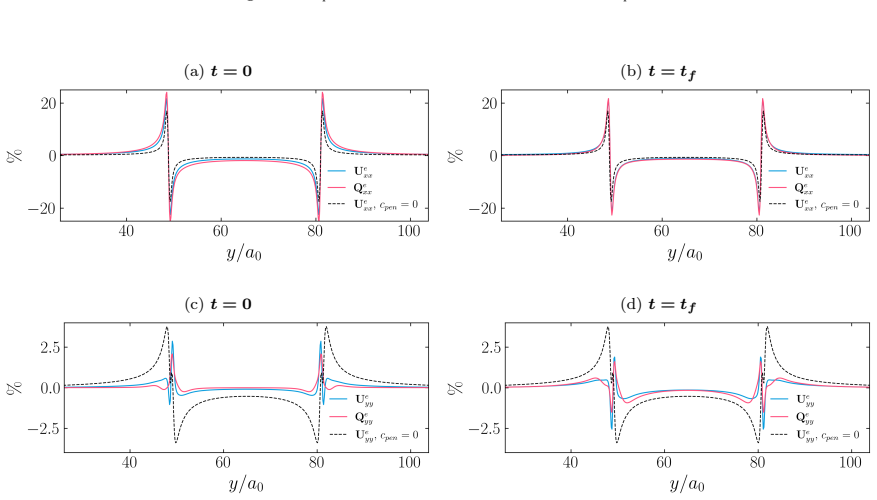
Variational analysis shows that the coupling term in the phase-field evolution equation is divergence-driven and matches only the compatible (curl-free) parts of the distortion fields from FDM and PFC. Its contributions are therefore insensitive to the incompatible (divergence-free) elastic distortion that contains all information on dislocation topology. The configurational nature of the PFC distortion further implies that mechanical boundary conditions are transmitted diffusively from FDM to PFC. Numerical simulations confirm that this coupling cannot prevent the unnatural core spreading in FDM, and the same drawbacks apply to any energetic coupling.
What carries the argument
L2 penalization of the difference between FDM elastic distortion and PFC configurational distortion, whose variational derivative produces a divergence-driven forcing term.
Load-bearing premise
The coupling energy is constructed as an L2 penalization between the FDM elastic distortion and the PFC configurational distortion, leading to a purely divergence-driven variational derivative.
What would settle it
A calculation or simulation where only the incompatible part of the FDM distortion is changed while the compatible part is held fixed, to check if the PFC phase field evolution remains unaffected.
If this is right
- The coupling term is insensitive to incompatible distortion carrying dislocation topology.
- Mechanical boundary conditions transmit diffusively rather than elastically.
- The coupling cannot prevent unnatural core spreading in FDM.
- These limitations persist in the most general energetic coupling.
Where Pith is reading between the lines
- Direct coupling to incompatibility measures or curl components may be required to link dislocation topology.
- Non-energetic or hybrid coupling strategies might overcome the diffusive transmission issue.
- Similar limitations could affect other multi-scale models that rely on energy penalties between continuum and atomistic fields.
Editorial analysis
A structured set of objections, weighed in public.
Referee Report
Summary. The manuscript analyzes the energetic coupling between Field Dislocation Mechanics (FDM) and the Phase Field Crystal (PFC) model, originally proposed via an L² penalization between the FDM elastic distortion and PFC configurational distortion. Variational calculus shows that this term produces only divergence-driven forcing in the PFC evolution equation, coupling exclusively to the compatible (curl-free) distortion components while remaining insensitive to the incompatible (divergence-free) part that encodes dislocation topology. The analysis further concludes that mechanical boundary conditions are transmitted diffusively rather than elastically, that numerical simulations confirm the coupling cannot suppress unnatural core spreading in FDM, and that these limitations persist for arbitrary energetic couplings.
Significance. If the variational results and the extension to the general energetic case are rigorously established, the work provides a clear diagnostic of fundamental limitations in L²-style couplings for reconciling continuum dislocation mechanics with crystallographic models. This could usefully constrain future multiscale modeling efforts in materials science by highlighting the need for couplings that directly engage incompatible distortion fields.
major comments (1)
- [Abstract] Abstract (general-case claim): the assertion that 'even in the most general case, an energetic coupling suffers from the same drawbacks' is load-bearing for the central conclusion, yet the provided variational analysis is constructed around the specific L² inner-product penalization; an explicit derivation for arbitrary energetic functionals (without tacit retention of the L² structure or the assumption that the PFC distortion remains curl-free) is required to substantiate the extrapolation.
minor comments (1)
- The description of the numerical simulations omits quantitative error measures, convergence data, or explicit statements of boundary conditions, which would allow direct assessment of the core-spreading claim.
Simulated Author's Rebuttal
We thank the referee for the careful review and constructive feedback. We address the single major comment below.
read point-by-point responses
-
Referee: [Abstract] Abstract (general-case claim): the assertion that 'even in the most general case, an energetic coupling suffers from the same drawbacks' is load-bearing for the central conclusion, yet the provided variational analysis is constructed around the specific L² inner-product penalization; an explicit derivation for arbitrary energetic functionals (without tacit retention of the L² structure or the assumption that the PFC distortion remains curl-free) is required to substantiate the extrapolation.
Authors: We acknowledge that the explicit variational calculations are performed for the L² penalization. The general-case statement rests on the structural observation that any local energetic coupling of the form ∫ F(β^FDM − β^PFC) dV produces, upon variation with respect to β^PFC, a forcing term whose leading contribution is the divergence of a tensor obtained from the functional derivative of F. Consequently the PFC evolution equation remains insensitive to the curl-free projection of the distortion difference, independent of the specific form of F. The curl-free character of β^PFC follows directly from its construction within the PFC model (as the symmetrized gradient of the phase field). To make this argument fully rigorous and remove any tacit reliance on the L² structure, we will insert an explicit derivation for a general differentiable functional F in a new subsection of the revised manuscript. revision: yes
Circularity Check
No significant circularity; direct variational analysis of stated energy functional
full rationale
The paper applies standard variational calculus to the L2 penalization energy between FDM elastic distortion and PFC configurational distortion (as defined in the 2020 reference being critiqued). The insensitivity to incompatible distortion follows from the divergence structure of the resulting Euler-Lagrange terms, and the general-case extension uses the same structure without introducing fitted parameters, self-referential uniqueness theorems, or ansatzes smuggled via citation. The 2020 citation supplies the object of analysis rather than load-bearing justification for the result. No step reduces the claimed prediction to an input by construction.
Axiom & Free-Parameter Ledger
axioms (2)
- standard math Variational calculus yields the correct evolution equations from the total energy functional that includes the L2 coupling term
- domain assumption The configurational distortion field in the PFC model is of a form whose curl-free part can be directly compared to the FDM elastic distortion
read the original abstract
This paper investigates the energetic coupling between Field Dislocation Mechanics (FDM) and the Phase Field Crystal (PFC) model proposed in Phys. Rev. B 102, 064109, 2020. While FDM correctly solves the initial boundary value problem of a continuum body with dislocation fields, PFC captures the underlying crystallographic structure. The coupling, which penalizes the $L^2$ distance between elastic distortion from FDM and configurational distortion from PFC in the $L^2$ sense, had been proposed to reconcile dislocation mechanics with crystallography in a single continuum framework. Variational analysis reveals that the coupling term acts as a divergence-driven forcing in the phase-field evolution that matches only the compatible (curl-free) parts of the distortion fields. Consequently, its contributions are insensitive to the incompatible (divergence-free) elastic distortion carrying all the information on dislocation topology. Furthermore, the nature of the configurational distortion causes mechanical boundary conditions to be transmitted diffusively from FDM to PFC rather than elastically. Numerical simulations demonstrate that this coupling cannot prevent the unnatural core spreading in FDM. Finally, it is shown that even in the most general case, an energetic coupling suffers from the same drawbacks, which limits its ability to integrate dislocation mechanics with crystallography.
Figures




Reference graph
Works this paper leans on
-
[1]
A. Acharya. A model of crystal plasticity based on the theory of continuously distributed dislo- cations. Journal of the Mechanics and Physics of Solids, 49(4):761–784, Apr. 2001
work page 2001
-
[2]
A. Acharya. Microcanonical Entropy and Mesoscale Dislocation Mechanics and Plasticity.Journal of Elasticity, 104(1-2):23–44, Aug. 2011
work page 2011
-
[3]
A. Acharya, L. Angheluta, and J. Viñals. Elasticity versus phase field driven motion in the phase field crystal model.Modelling and Simulationin Materials Science and Engineering, 30(6):064005, Sept. 2022
work page 2022
-
[4]
A. Acharya and A. Roy. Size effects and idealized dislocation microstructure at small scales: Predictions of a Phenomenological model of Mesoscopic Field Dislocation Mechanics: Part I. Journal of the Mechanics and Physics of Solids, 54(8):1687–1710, Aug. 2006
work page 2006
-
[5]
A. Acharya and J. Viñals. Field dislocation mechanics and phase field crystal models.Physical Review B, 102(6):064109, Aug. 2020
work page 2020
-
[6]
P. M. Anderson, J. P. Hirth, and J. Lothe.Theory of Dislocations. Cambridge University Press, Jan. 2017
work page 2017
- [7]
-
[8]
R. Arora. Computational Approximation of Mesoscale Field Dislocation Mechanics at Finite Deformation. Thesis, Carnegie Mellon University, Mar. 2019
work page 2019
- [9]
- [10]
-
[11]
J. Bradbury, R. Frostig, P. Hawkins, M. J. Johnson, C. Leary, D. Maclaurin, G. Necula, A. Paszke, J. VanderPlas, S. Wanderman-Milne, and Q. Zhang. JAX: Composable transformations of Python+NumPy programs, 2018
work page 2018
-
[12]
P. Y. Chan, G. Tsekenis, J. Dantzig, K. A. Dahmen, and N. Goldenfeld. Plasticity and Dislocation Dynamics in a Phase Field Crystal Model.Physical Review Letters, 105(1):015502, June 2010
work page 2010
-
[13]
S. M. Cox and P. C. Matthews. Exponential Time Differencing for Stiff Systems.Journal of Computational Physics, 176(2):430–455, Mar. 2002
work page 2002
-
[14]
M. C. Cross and P. C. Hohenberg. Pattern formation outside of equilibrium.Reviews of modern physics, 65(3):851, 1993
work page 1993
-
[15]
B. Devincre, V. Pontikis, Y. Brechet, G. Canova, M. Condat, and L. Kubin. Three-Dimensional Simulations of Plastic Flow in Crystals. In M. Mareschal and B. L. Holian, editors,Microscopic Simulations of Complex Hydrodynamic Phenomena, pages 413–423. Springer US, Boston, MA, 1992
work page 1992
-
[16]
K. R. Elder and M. Grant. Modeling elastic and plastic deformations in nonequilibrium processing using phase field crystals.Physical Review E, 70(5):051605, Nov. 2004
work page 2004
-
[17]
K. R. Elder, M. Katakowski, M. Haataja, and M. Grant. Modeling Elasticity in Crystal Growth. Physical Review Letters, 88(24):245701, June 2002
work page 2002
-
[18]
K. R. Elder, N. Provatas, J. Berry, P. Stefanovic, and M. Grant. Phase-field crystal modeling and classical density functional theory of freezing.Physical Review B, 75(6):064107, Feb. 2007
work page 2007
- [19]
-
[20]
StrongStabilityPreservingRunge-KuttaandMultistep Time Discretizations
S.Gottlieb, D.Ketcheson, andC.-W.Shu. StrongStabilityPreservingRunge-KuttaandMultistep Time Discretizations. WORLD SCIENTIFIC, 2011
work page 2011
- [21]
-
[22]
V. Heinonen, C. V. Achim, J. M. Kosterlitz, S.-C. Ying, J. Lowengrub, and T. Ala-Nissila. Con- sistent Hydrodynamics for Phase Field Crystals. Physical Review Letters, 116(2):024303, Jan. 2016
work page 2016
-
[23]
A.M.Kosevich. DYNAMICALTHEORYOFDISLOCATIONS. SovietPhysicsUspekhi, 7(6):837, June 1965
work page 1965
-
[24]
G. F. Mazenko. Vortex Velocities in the $\mathit{O}(\mathit{n})$ Symmetric Time-Dependent Ginzburg-Landau Model. Physical Review Letters, 78(3):401–404, Jan. 1997
work page 1997
-
[25]
T. Mura. Continuous distribution of moving dislocations.Philosophical Magazine, 8(89):843–857, May 1963
work page 1963
-
[26]
A. Roy. Finite element approximation of field dislocation mechanics.Journal of the Mechanics and Physics of Solids, 53(1):143–170, Jan. 2005
work page 2005
-
[27]
A. Skaugen, L. Angheluta, and J. Viñals. Dislocation dynamics and crystal plasticity in the phase-field crystal model.Physical Review B, 97(5):054113, Feb. 2018. 32
work page 2018
-
[28]
A. Skaugen, L. Angheluta, and J. Viñals. Separation of Elastic and Plastic Timescales in a Phase Field Crystal Model.Physical Review Letters, 121(25):255501, Dec. 2018
work page 2018
-
[29]
V. Skogvoll, L. Angheluta, A. Skaugen, M. Salvalaglio, and J. Viñals. A phase field crystal theory of the kinematics of dislocation lines.Journal of the Mechanics and Physics of Solids, 166:104932, Sept. 2022
work page 2022
-
[30]
V. Skogvoll, J. Rønning, M. Salvalaglio, and L. Angheluta. A unified field theory of topological defects and non-linear local excitations.npj Computational Materials, 9(1):1–13, July 2023
work page 2023
-
[31]
V. Skogvoll, M. Salvalaglio, and L. Angheluta. Hydrodynamic phase field crystal approach to interfaces, dislocations, and multi-grain networks, Sept. 2022
work page 2022
-
[32]
P. Stefanovic, M. Haataja, and N. Provatas. Phase-Field Crystals with Elastic Interactions. Physical Review Letters, 96(22):225504, June 2006
work page 2006
-
[33]
M. V. Upadhyay and J. Viñals. Coupling Phase Field Crystal and Field Dislocation Mechanics for a consistent description of dislocation structure and elasticity.European Journal of Mechanics - A/Solids, 108:105419, Nov. 2024
work page 2024
- [34]
-
[35]
S. N. Varadhan, A. J. Beaudoin, A. Acharya, and C. Fressengeas. Dislocation transport using an explicit Galerkin/least-squares formulation. Modelling and Simulation in Materials Science and Engineering, 14(7):1245–1270, Oct. 2006
work page 2006
-
[36]
Sur l’equilibre des cirps elastiques multiplement connexes.Ann
Voltera. Sur l’equilibre des cirps elastiques multiplement connexes.Ann. Ecole Norm. Super, 24:401–517, 1907
work page 1907
- [37]
- [38]
-
[39]
S. J. Zhou, D. L. Preston, P. S. Lomdahl, and D. M. Beazley. Large-scale molecular dynamics simulations of dislocation intersection in copper.Science (New York,N.Y.), 279(5356):1525–1527, Mar. 1998. 33
work page 1998
discussion (0)
Sign in with ORCID, Apple, or X to comment. Anyone can read and Pith papers without signing in.