Strengthening and interface-mediated plastic co-deformation in an ultrafine Cr-Ni eutectic: A nanomechanical investigation
Pith reviewed 2026-07-02 09:40 UTC · model grok-4.3
The pith
A stepped semi-coherent interface with local Ni enrichment lets the hard BCC phase in a Cr-Ni eutectic deform plastically at room temperature.
A machine-rendered reading of the paper's core claim, the machinery that carries it, and where it could break.
Core claim
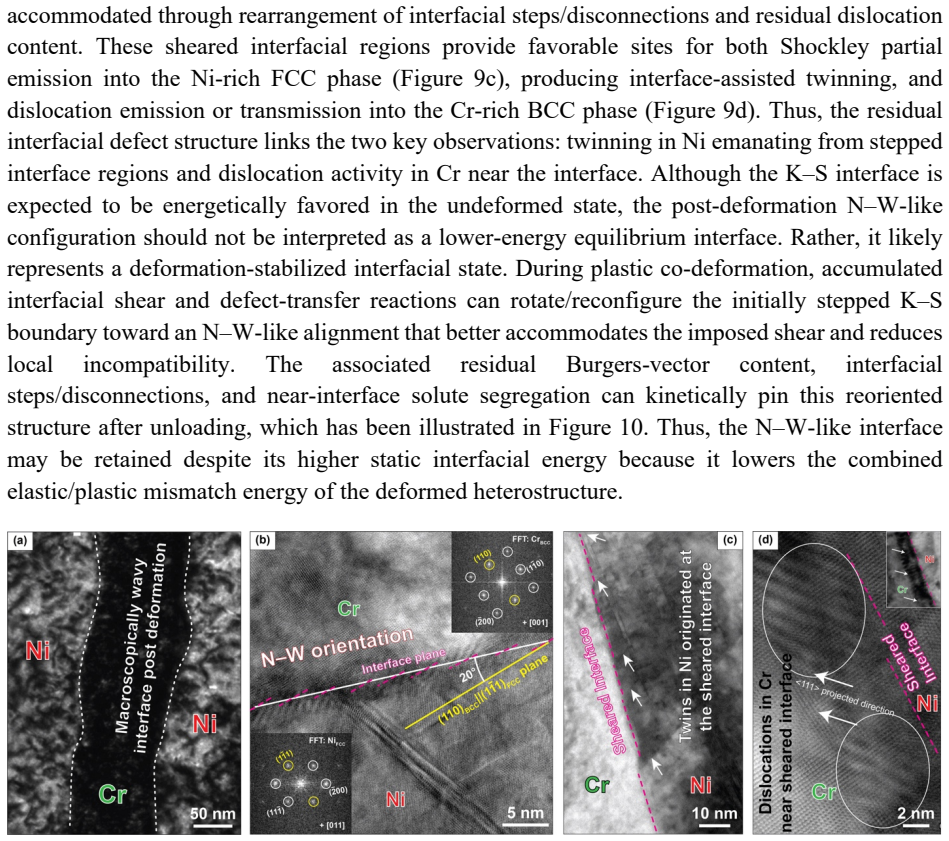
In the Cr-Ni eutectic processed by electron-beam powder bed fusion, the stepped semi-coherent FCC/BCC interface following the Kurdjumov-Sachs orientation relationship, together with Ni enrichment confined to a few atomic planes on the BCC side, promotes dislocation glide in the BCC phase below its monolithic brittle-to-ductile transition temperature. This enables stable plastic co-deformation with the FCC phase, as demonstrated by high flow stresses coupled with large plastic strains in micro-scale tests and by the observed deformation sequence of initial FCC dislocation accumulation, twinning, interfacial shear, and subsequent high-density mobile dislocations in BCC.
What carries the argument
Stepped semi-coherent FCC/BCC interface with confined Ni enrichment under Kurdjumov-Sachs orientation relationship, which activates slip in the hard BCC phase.
If this is right
- Initial plasticity occurs via strain-gradient driven dislocation accumulation in FCC lamellae adjacent to interfaces.
- Deformation twinning in FCC and local interfacial shear precede BCC dislocation activity.
- The BCC phase sustains a high density of mobile dislocations after the FCC phase yields.
- Atomistic modeling links interface atomic structure and chemistry directly to slip activation in the hard phase.
- Plastic incompatibility between phases is accommodated stably without premature fracture.
Where Pith is reading between the lines
- The same interface features could be engineered in other eutectic alloys to promote co-deformation in hard phases.
- Changing lamellar spacing or interfacial chemistry might shift the temperature or stress at which BCC slip activates.
- The mechanism suggests that local chemistry at interfaces can effectively reduce the brittle-to-ductile transition temperature in confined BCC structures.
- Similar nanomechanical tests on eutectics with altered orientation relationships would test whether the stepped K-S structure is required.
Load-bearing premise
The stepped semi-coherent interface and confined Ni enrichment are the main factors allowing BCC slip rather than processing defects or test artifacts.
What would settle it
Observation of brittle cracking in the BCC phase with no mobile dislocations in a similar Cr-Ni eutectic sample lacking the stepped K-S interface and Ni enrichment.
Figures



read the original abstract
Ultrafine eutectic heterostructures provide a stringent test of plasticity in high-strength materials, where deformation must be accommodated through interfaces and strain gradients. Room temperature ductility is typically limited by premature fracture of the hard phase, leaving open the fundamental questions regarding the interface spacing, atomic structure and local chemistry that enable plastic co-deformation. Here we address this question using a model system of Cr-Ni binary alloy, processed via electron-beam powder bed fusion that produces a lamellar eutectic microstructure of Cr-rich BCC and Ni-rich FCC phases, with an average interlamellar spacing of ~450 nm. Atomic-resolution STEM revealed a stepped semi-coherent FCC/BCC interface with the Kurdjumov-Sachs orientation relationship and Ni-enrichment confined to a few atomic planes on the BCC side. In situ micro-scale compression and tension tests in SEM demonstrate high flow stresses coupled with large plastic strains without cracking, indicating stable accommodation of plastic incompatibility. Correlative TEM/HR-STEM establishes a deformation sequence: initial plasticity is dominated by strain-gradient driven dislocation accumulation in the FCC lamellae adjacent to interfaces, followed by deformation twinning in FCC and local interfacial shear and reorientation. The BCC phase subsequently develops a high density of mobile dislocations. Atomistic modeling has been employed to understand the influence of the FCC/BCC interface atomic structure and chemistry on the slip activation in the hard phase. These findings show that nanoscale confinement, stepped K-S interfacial structure, and interfacial chemistry collectively promote dislocation glide in a hard phase below its monolithic brittle to ductile transition temperature, and plastic codeformation at high flow strengths.
Editorial analysis
A structured set of objections, weighed in public.
Referee Report
Summary. The manuscript investigates plastic co-deformation mechanisms in an ultrafine Cr-Ni eutectic alloy fabricated by electron-beam powder bed fusion, consisting of Cr-rich BCC and Ni-rich FCC lamellae with ~450 nm average interlamellar spacing. Atomic-resolution STEM identifies a stepped semi-coherent FCC/BCC interface with Kurdjumov-Sachs orientation relationship and Ni enrichment confined to a few atomic planes on the BCC side. In situ SEM compression and tension tests show high flow stresses with large plastic strains without cracking. Correlative TEM/HR-STEM reveals a deformation sequence starting with strain-gradient dislocation accumulation and twinning in FCC, followed by interfacial shear, enabling subsequent mobile dislocation activity in BCC below its monolithic BDT. Atomistic modeling explores the role of interface structure and chemistry in promoting BCC slip. The central claim is that nanoscale confinement, the stepped K-S interface, and interfacial chemistry collectively enable this plastic co-deformation at high strengths.
Significance. If substantiated, the work offers mechanistic insight into how specific nanoscale interfacial features can activate plasticity in a hard phase at room temperature, advancing design principles for strong, ductile eutectic heterostructures. The correlative use of high-resolution STEM, in situ mechanical testing, and atomistic modeling provides a direct link between observed interface characteristics and the deformation sequence, which is a methodological strength.
major comments (3)
- [In situ micro-scale compression and tension tests] In the in situ micro-scale compression and tension tests description: the central claim of high flow stresses coupled with large plastic strains without cracking requires quantitative support via the number of independent specimens tested, reported variability, and error bars on stress-strain data. Absence of these statistics leaves open whether the observations robustly demonstrate stable accommodation of plastic incompatibility or could reflect test-specific artifacts.
- [Atomistic modeling] In the atomistic modeling description: the claim that interfacial chemistry (Ni enrichment) collectively promotes dislocation glide in BCC is load-bearing, yet it is not specified whether the simulations incorporate the STEM-observed Ni enrichment, compare enriched vs. non-enriched interfaces, or isolate its effect from the stepped K-S structure alone. This distinction is required to substantiate the chemistry contribution.
- [Correlative TEM/HR-STEM] In the correlative TEM/HR-STEM section describing the deformation sequence: while initial FCC plasticity and subsequent BCC dislocation activity are reported, no quantitative metrics (e.g., dislocation density measurements or local strain values across multiple lamellae) are provided to demonstrate that BCC slip is specifically enabled by the stepped interface and Ni enrichment rather than processing defects or other unexamined factors.
minor comments (2)
- [Abstract] The abstract states an average interlamellar spacing of ~450 nm; reporting the measured distribution or standard deviation would improve the precision of the nanoscale confinement description.
- [STEM results] Figure captions and the STEM results section would benefit from explicit annotations highlighting the stepped interface features and Ni-enriched planes to aid reader interpretation of the atomic structure.
Simulated Author's Rebuttal
We thank the referee for their constructive and detailed comments, which help clarify the presentation of our results. We address each major comment below.
read point-by-point responses
-
Referee: [In situ micro-scale compression and tension tests] In the in situ micro-scale compression and tension tests description: the central claim of high flow stresses coupled with large plastic strains without cracking requires quantitative support via the number of independent specimens tested, reported variability, and error bars on stress-strain data. Absence of these statistics leaves open whether the observations robustly demonstrate stable accommodation of plastic incompatibility or could reflect test-specific artifacts.
Authors: We agree that statistical support is required to substantiate the robustness of the reported mechanical behavior. The original manuscript presented representative curves without accompanying statistics. In the revised manuscript we will report results from five independent compression tests and three tension tests, include error bars (standard deviation) on the stress-strain data, and add a supplementary table summarizing variability in yield stress, flow stress, and total strain. revision: yes
-
Referee: [Atomistic modeling] In the atomistic modeling description: the claim that interfacial chemistry (Ni enrichment) collectively promotes dislocation glide in BCC is load-bearing, yet it is not specified whether the simulations incorporate the STEM-observed Ni enrichment, compare enriched vs. non-enriched interfaces, or isolate its effect from the stepped K-S structure alone. This distinction is required to substantiate the chemistry contribution.
Authors: The atomistic simulations were constructed using the STEM-observed stepped K-S interface geometry and explicitly included the Ni enrichment confined to the BCC side. Comparative simulations were performed on both Ni-enriched and non-enriched interface models to isolate the chemical contribution. To remove ambiguity we will revise the modeling section to describe the simulation cells, the placement of Ni atoms, and the quantitative differences in slip activation energy between the two cases. revision: yes
-
Referee: [Correlative TEM/HR-STEM] In the correlative TEM/HR-STEM section describing the deformation sequence: while initial FCC plasticity and subsequent BCC dislocation activity are reported, no quantitative metrics (e.g., dislocation density measurements or local strain values across multiple lamellae) are provided to demonstrate that BCC slip is specifically enabled by the stepped interface and Ni enrichment rather than processing defects or other unexamined factors.
Authors: We acknowledge that quantitative metrics would strengthen the argument that BCC slip is interface-mediated. The present manuscript shows the deformation sequence via representative images from multiple lamellae but does not report numerical values. In the revision we will add dislocation density measurements (from at least four lamellae per phase) before and after deformation together with local strain estimates derived from interface step analysis to better distinguish interface-enabled activity from possible processing defects. revision: yes
Circularity Check
No significant circularity; experimental observations are self-contained
full rationale
The paper is an observational experimental study using electron-beam powder bed fusion processing, in situ SEM micro-compression/tension tests, correlative HR-STEM/TEM, and atomistic modeling to examine deformation sequences in a Cr-Ni eutectic. No equations, fitted parameters presented as predictions, self-citation chains, or ansatzes are invoked that reduce the reported mechanisms (nanoscale confinement, stepped K-S interface, Ni enrichment enabling BCC slip) to prior results by construction. The derivation chain consists of direct data-driven observations of dislocation activity, twinning, and interfacial shear, which stand independently of any internal redefinitions or renamings.
Axiom & Free-Parameter Ledger
axioms (1)
- standard math Kurdjumov-Sachs orientation relationship is the expected interface orientation for FCC/BCC systems
Reference graph
Works this paper leans on
-
[1]
Summary and conclusions This work demonstrates that an EPBF processed ultrafine Cr–Ni eutectic can achieve concurrent high strength and large plastic strain by enabling plastic co-deformation of Ni-rich FCC and Cr-rich BCC lamellae. The results show that the hard Cr-rich BCC phase, which would normally exhibit limited plasticity at room temperature, can b...
-
[2]
T. Maity, B. Roy, J. Das, Mechanism of lamellae deformation and phase rearrangement in ultrafine β-Ti/FeTi eutectic composites, Acta Mater 97 (2015) 170–179. https://doi.org/10.1016/j.actamat.2015.07.007. [4] A. Misra, J.P. Hirth, R.G. Hoagland, Length-scale-dependent deformation mechanisms in incoherent metallic multilayered composites, Acta Mater 53 (20...
-
[3]
J.M. Howe, R.C. Pond, J.P. Hirth, The role of disconnections in phase transformations, Prog Mater Sci 54 (2009) 792–838. https://doi.org/10.1016/j.pmatsci.2009.04.001. [20] C. Körner, Additive manufacturing of metallic components by selective electron beam melting — a review, International Materials Reviews 61 (2016) 361–377. https://doi.org/10.1080/09506...
-
[4]
G.B. McFadden, A.A. Wheeler, On the Gibbs adsorption equation and diffuse interface models, Proceedings of the Royal Society of London. Series A: Mathematical, Physical and Engineering Sciences 458 (2002) 1129–1149. https://doi.org/10.1098/rspa.2001.0908. [36] A. Biswas, D.J. Siegel, D.N. Seidman, Simultaneous Segregation at Coherent and Semicoherent Hete...
-
[5]
H. Mughrabi, The effect of geometrically necessary dislocations on the flow stress of deformed crystals containing a heterogeneous dislocation distribution, Materials Science and Engineering: A 319–321 (2001) 139–143. https://doi.org/10.1016/S0921-5093(01)01003-6. [54] H. Mughrabi, The α-factor in the Taylor flow-stress law in monotonic, cyclic and quasi-...
-
[6]
L. Deléhouzée, A. Deruyttere, The stacking fault density in solid solutions based on copper, silver, nickel, aluminium and lead, Acta Metallurgica 15 (1967) 727–734. https://doi.org/10.1016/0001-6160(67)90353-7. [70] M. Gong, W. Wu, D. Xie, N.A. Richter, Q. Li, Y. Zhang, S. Xue, X. Zhang, J. Wang, First-principles calculations for understanding microstruc...
discussion (0)
Sign in with ORCID, Apple, or X to comment. Anyone can read and Pith papers without signing in.