Topological spectral form factor reveals emergent non-Hermitian single-particle mathcal{PT} transitions from many-body quantum chaos
Pith reviewed 2026-06-26 18:47 UTC · model grok-4.3
The pith
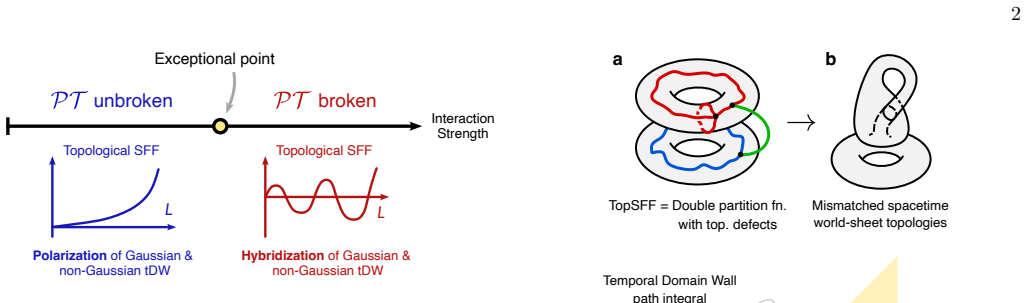
The topological spectral form factor with a global swap defect maps to the dynamics of a temporal domain wall in a non-Hermitian single-particle problem that undergoes a PT symmetry breaking transition.
A machine-rendered reading of the paper's core claim, the machinery that carries it, and where it could break.
Core claim
By inserting a global swap operator as a topological defect, the spectral form factor of any generic one-dimensional many-body chaotic quantum system maps exactly onto the propagation of a temporal domain wall in a (3+1)-dimensional non-Hermitian single-particle theory; this effective theory undergoes a PT-symmetry-breaking transition at finite interaction strength ε_EP, producing three distinct regimes for the system-size dependence of the TopSFF.
What carries the argument
The exact mapping, via the global swap operator, of the topological spectral form factor to the single-particle temporal domain wall (tDW) dynamics in the emergent non-Hermitian theory.
If this is right
- Below ε_EP the leading modes stay polarized into Gaussian or non-Gaussian tDW sectors and the TopSFF decays monotonically and exponentially with system size.
- Above ε_EP the tDW sectors hybridize and the TopSFF oscillates with system size.
- At ε_EP the Jordan non-diagonality yields a linear-in-system-size enhancement of the TopSFF.
- For temporally extended topological defects the TopSFF free energy obeys exact universal scaling forms in the presence of time-reversal or time-translation symmetry.
Where Pith is reading between the lines
- The reduction to a single-particle non-Hermitian problem may simplify the analysis of chaos indicators in larger or higher-dimensional systems.
- The PT transition could be detectable in other many-body observables that incorporate similar topological defects.
- Verification across independent models indicates the transition is a generic feature of chaotic systems under this construction.
Load-bearing premise
The minimal Z2 spatially extended defect given by the global swap operator yields an exact mapping from the TopSFF of any generic 1D many-body chaotic system to the stated non-Hermitian single-particle temporal domain wall problem.
What would settle it
Direct numerical evaluation of the TopSFF in a concrete 1D chaotic Hamiltonian, such as a spin chain, that exhibits a switch from exponential monotonic decay to oscillation in system size at a finite interaction strength.
Figures


read the original abstract
In equilibrium physics, topological defect insertions in quantum and classical partition functions provide non-perturbative probes of phase transitions beyond local observables. In non-equilibrium physics, the spectral form factor provides a minimal probe of universal quantum dynamics, and admits a representation as a product of two partition functions at imaginary inverse temperature. We define the topological spectral form factor (TopSFF) by inserting topological defects acting non-trivially on the doubled partition functions, producing mismatched spacetime world-sheet topologies. For the minimal $\mathbb{Z}_2$ spatially extended defect, implemented by the global swap operator, we derive an exact mapping of the TopSFF of a generic 1D many-body chaotic system to an emergent $(3+1)$D non-Hermitian single-particle problem describing a temporal domain wall (tDW). We show analytically that the effective tDW dynamics undergoes a $\mathcal{PT}$ symmetry breaking transition at a finite interaction strength $\epsilon_{\mathrm{EP}}$: below $\epsilon_{\mathrm{EP}}$, the leading modes are polarized into Gaussian or non-Gaussian tDW sectors and the TopSFF varies monotonically and exponentially with system size; above $\epsilon_{\mathrm{EP}}$, the tDW sectors hybridize and the TopSFF oscillates with system size; at the exceptional point $\epsilon_{\mathrm{EP}}$, Jordan non-diagonality produces a linear-in-system-size enhancement. For temporally extended topological defects, we derive exact universal scaling forms for the TopSFF free energy in systems with time reversal or time translation symmetry, and verify them numerically in independent models.
Editorial analysis
A structured set of objections, weighed in public.
Referee Report
Summary. The paper defines the topological spectral form factor (TopSFF) via insertion of topological defects into the doubled partition function of the spectral form factor. For the minimal Z2 spatially extended defect (global swap operator), it claims an exact mapping of the TopSFF for generic 1D many-body chaotic systems to an emergent (3+1)D non-Hermitian single-particle problem describing a temporal domain wall (tDW). It analytically identifies a PT symmetry breaking transition at finite interaction strength ε_EP, with associated changes in system-size dependence of the TopSFF (monotonic exponential below, oscillatory above, linear enhancement at the point), and derives exact universal scaling forms for temporally extended defects, verified numerically in independent models.
Significance. If the exact mapping holds without additional restrictions, the result is significant: it supplies an analytic route from many-body quantum chaos to emergent non-Hermitian PT physics via topological defect insertion, with falsifiable predictions for TopSFF scaling and exceptional-point behavior. The parameter-free character of the claimed mapping, the analytic PT analysis, and the numerical verification in independent models are concrete strengths that would elevate the contribution beyond purely numerical studies of spectral statistics.
major comments (1)
- [Mapping derivation (global swap to tDW)] The central claim of an exact mapping from the TopSFF (with global swap defect) of any generic 1D chaotic system to the stated (3+1)D non-Hermitian tDW single-particle problem is load-bearing for the subsequent PT transition, polarization, and scaling results. The derivation must be shown to close exactly onto a single-particle non-Hermitian operator without generating extra terms or requiring special properties of the local interactions; if the swap insertion fails to produce this equivalence for arbitrary local chaotic Hamiltonians, the analytic extraction of ε_EP and the change from monotonic to oscillatory system-size dependence does not follow.
minor comments (2)
- Notation for the doubled partition function and the precise definition of the temporal domain wall operator should be cross-referenced explicitly to the standard SFF representation to aid readability.
- The numerical verification section would benefit from an explicit statement of the system sizes, disorder realizations, and error bars used to confirm the oscillatory vs. monotonic regimes and the linear enhancement at ε_EP.
Simulated Author's Rebuttal
We thank the referee for their careful reading, recognition of the significance of the results, and the recommendation for major revision. We address the single major comment point-by-point below.
read point-by-point responses
-
Referee: [Mapping derivation (global swap to tDW)] The central claim of an exact mapping from the TopSFF (with global swap defect) of any generic 1D chaotic system to the stated (3+1)D non-Hermitian tDW single-particle problem is load-bearing for the subsequent PT transition, polarization, and scaling results. The derivation must be shown to close exactly onto a single-particle non-Hermitian operator without generating extra terms or requiring special properties of the local interactions; if the swap insertion fails to produce this equivalence for arbitrary local chaotic Hamiltonians, the analytic extraction of ε_EP and the change from monotonic to oscillatory system-size dependence does not follow.
Authors: The exact mapping is derived in Section III by inserting the global swap into the doubled partition function and showing that the resulting spacetime manifold with the induced temporal domain wall is described by a single-particle non-Hermitian operator. Locality of the Hamiltonian ensures that the swap defect produces no additional many-body terms beyond the effective non-Hermitian potential on the wall; the topological character of the defect enforces factorization independent of the specific form of the local interactions. The only assumptions are spatial locality and the generic chaotic dynamics that justify the universality of the spectral statistics, without further restrictions. This is consistent with the numerical verification across independent models. We will expand the derivation with explicit intermediate steps and an appendix clarifying the absence of extra terms to make the closure fully transparent. revision: yes
Circularity Check
No circularity: mapping derived from defect insertion; PT analysis follows independently
full rationale
The paper derives the TopSFF-to-tDW mapping directly from insertion of the global swap operator (minimal Z2 defect) into the doubled partition function, then analytically extracts the PT-breaking transition, polarization, and scaling from the resulting non-Hermitian single-particle dynamics. No quoted step reduces a claimed prediction to a fitted parameter by construction, renames a known result, or relies on a load-bearing self-citation whose content is itself unverified. The central equivalence is presented as an exact consequence of the defect topology for generic 1D chaotic Hamiltonians, with subsequent PT analysis treated as a downstream consequence rather than an input. The derivation is therefore self-contained; external verification would require checking the swap-operator algebra, not internal redefinition.
Axiom & Free-Parameter Ledger
axioms (2)
- domain assumption The system under study is a generic 1D many-body chaotic system.
- domain assumption The minimal Z2 defect is realized by the global swap operator.
invented entities (1)
-
temporal domain wall (tDW)
no independent evidence
Reference graph
Works this paper leans on
-
[1]
S14 and Fig
EP data Here we provide plots of the complex eigenvalues of the generalized Boltzmann factor against the interac- tion strength in Fig. S14 and Fig. S15, demonstratingPTsymmetry breaking transition in certain momen- tum sectors. In Fig. S14, we plot the complex eigenvalues of the generalized Boltzmann factor of (k b, kc, kd)∈ {(0,0,0),(0,2πm/t,−2πm/t),(π,...
-
[2]
We focus on the sector (k b, kc, kd) = (π, π,0), although the discussion applies more generally to anyPT-symmetric momentum sector
Eigenvalue and eigenvector coalescence at EP In this section, we discuss the signatures of exceptional points (EPs) of thePT-symmetric generalized Boltzmann factor, including eigenvalue coalescence and eigenvector coalescence, as diagnosed by eigenvector self-orthogonality and the divergence of the Petermann factor. We focus on the sector (k b, kc, kd) = ...
-
[3]
Here ˆSis the global swap operator, which reverses the ordering of theLqudits according to ˆS|a 1, a2,
Exact finite-qsymbolic evaluation of TopSFF We now describe the exact finite-qsymbolic computation of the TopSFF,K top(t, L) = Tr[ ˆD( ˆU⊗ ˆU ∗)] = Tr[ˆS ˆU] Tr[ˆU †], with [ ˆD,( ˆU⊗ ˆU ∗)] = 0, where the spatially extended topological defect is ˆD= ˆS⊗1. Here ˆSis the global swap operator, which reverses the ordering of theLqudits according to ˆS|a 1, a...
-
[4]
Exact finite-qanalytical evaluation of TopSFF att= 1 Fort= 1 at finite-q, we evaluate exactly the TopSFF,K top(t, L) = Tr[ ˆD( ˆU⊗ ˆU ∗)] = Tr[ ˆS ˆU] Tr[ˆU †], for the Random Phase Model (RPM) with parity inversion symmetry, defined in App. A 2 a. Att= 1, imposing time translation symmetry makes no difference, since there is only a single time step. The ...
-
[5]
S22.Emergent non-Hermitian single-particle model, as defined in (SJ.6)
Boltzmann factorBin position space Gaussian tDW Non-Gaussian tDW FIG. S22.Emergent non-Hermitian single-particle model, as defined in (SJ.6). The single particle residing in the top (bottom) chain corresponds to the Gaussian (non-Gaussian) temporal domain wall. The intra-chain and inter-chain hopping terms are Hermitian and non-Hermitian respectively. We ...
-
[6]
(SJ.8) wherek= 2πn/(2t) withn= 0,1,
Boltzmann factor eBin momentum space Utilizing the translational invariance ofB, we can express the TopSFF in terms of the generalized Boltzmann factor in momentum space as Ktop =ϕ T BLe ϕ= X k eϕ(−k)T eB(k)Leeϕ(k),(SJ.7) where the discrete Fourier transforms ofϕandBare defined as eϕ(a;k) := 1√ 2t 2t−1X b=0 eikb ϕ(a, b), eBa1a2(k) := 2t−1X ∆b=0 Ba1a2(∆b)e...
-
[7]
(SJ.16) and Eq
Properties of eB(k)andPTsymmetry Here we describe the properties of the momentum space generalized Boltzmann factor in Eq. (SJ.16) and Eq. (SJ.22): •Reality ofdet eB(k)andtr eB(k), and spectral pairing.Since the allowed momenta arek=πn/twith n= 0,1, . . . ,2t−1, we havee −itk = (−1)n ∈R. It follows directly from Eqs. (SJ.16)–(SJ.22) that A(k),B(k),C(k)∈R,...
-
[8]
Boundary states The TopSFF with a spatially extended topological defect is given in Eq. (SJ.1). Here we describe the boundary states in the folded representation, both in position space and in momentum space. Away from the parity-inversion axes, the bulk of the quantum many-body system is parity-inversion symmetric, since it commutes with the global swap-...
-
[9]
(SF.8), we obtain the TopSFF as Ktop =eϕ(0)T eB(0)Leeϕ(0) = 2t φTeB(0)Le φ= 2t g(0)u Le(0),(SJ.31) whereφ= (1, i) T , andu Le(k) andg(k) are defined in Eq
Exact expression of TopSFF without time translational symmetry Since the boundary state has support only atk= 0, using the Cayley-Hamilton form in Eq. (SF.8), we obtain the TopSFF as Ktop =eϕ(0)T eB(0)Leeϕ(0) = 2t φTeB(0)Le φ= 2t g(0)u Le(0),(SJ.31) whereφ= (1, i) T , andu Le(k) andg(k) are defined in Eq. (SF.8). Fork= 0, one finds g(0) =A(0)−C(0)−2B(0) =...
-
[10]
Consistency check with finite-qresult att= 1 As a consistency check, att= 1, Ktop with spatially extended topological defects reduces to Ktop =− 4 p 1−µ 4 p µ4 + 7 p 2(1−µ 4) Le sin Le θ ,(SJ.34) where the angleθis defined such that cosθ= p (1−µ 4)/8 or sinθ= p (µ4 + 7)/8. Eq. (SJ.34) coincides with (i) the large-qexpansion of the exact finite-qresult of ...
-
[11]
The one-dimensional generic quantum many-body chaotic circuit ˆUs(t, L) :=QL i=1 ˆV(t, L) is realized generated by the space-time dual transfer matrices ˆV(t, L) [Fig
Temporally extended global swap defects Here we consider the TopSFF of a temporally extended global swap defect ˆD= ˆS⊗ ˆ1acting onU s ⊗U s in the spatial direction. The one-dimensional generic quantum many-body chaotic circuit ˆUs(t, L) :=QL i=1 ˆV(t, L) is realized generated by the space-time dual transfer matrices ˆV(t, L) [Fig. 3(a) purple] of RPM def...
-
[12]
Now we consider the TopSFF of a temporally extended time translation defect ˆD= ˆT⊗ ˆ1acting onU s ⊗U s in the spatial direction
Temporally extended time translation defects. Now we consider the TopSFF of a temporally extended time translation defect ˆD= ˆT⊗ ˆ1acting onU s ⊗U s in the spatial direction. HereTis the time translational operator defined byT|a 1, a2, . . . at⟩=|a t, a1, . . . at−1⟩, which cyclically shifts the time indices. The one-dimensional generic quantum many-body...
-
[13]
We take ˆUto be the parity inversion symmetric Random Phase Model (RPM) with discrete time translation symmetry, defined in App
Spatially extended topological defects We numerically simulate the finite-qTopSFF with a spatially extended topological defect,K top(t, L) = Tr h ˆD( ˆU⊗ ˆU ∗) i = Tr[ ˆS ˆU] Tr[ˆU †], where ˆD= ˆS⊗1with global swap operator ˆS. We take ˆUto be the parity inversion symmetric Random Phase Model (RPM) with discrete time translation symmetry, defined in App....
-
[14]
The generic quantum many-body chaotic systems ˆUs(t, L) :=QL i=1 ˆV(t, L) is generated by the space-time dual transfer matrices ˆV(t, L) [Fig
Temporally extended topological defects We consider the TopSFF of a temporally extended global swap defect ˆD= ˆS⊗ ˆ1acting onU s ⊗U s in the spatial direction. The generic quantum many-body chaotic systems ˆUs(t, L) :=QL i=1 ˆV(t, L) is generated by the space-time dual transfer matrices ˆV(t, L) [Fig. 3(a) purple] of RPM defined in (SA.20) and HRM define...
discussion (0)
Sign in with ORCID, Apple, or X to comment. Anyone can read and Pith papers without signing in.