Large post-critical dynamics of an inextensible spinning fluid-conveying pipe with pinned-roller supports: high-order Galerkin and a modified Hencky bar-chain framework
Pith reviewed 2026-06-29 00:39 UTC · model grok-4.3
The pith
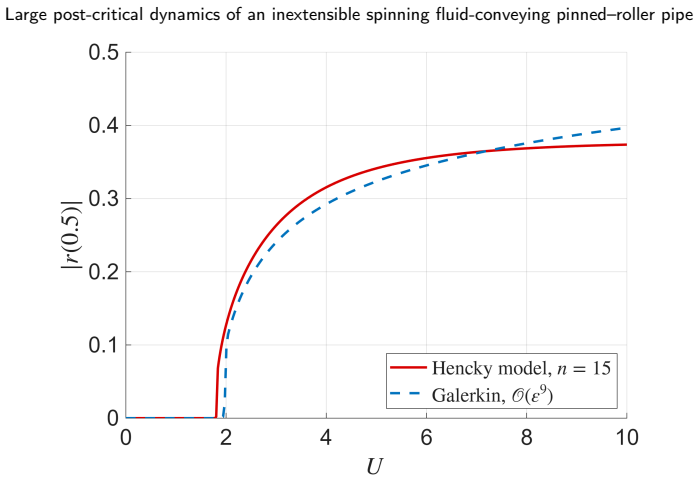
For an inextensible spinning fluid-conveying pipe with pinned-roller supports, ninth-order Galerkin truncation is required to resolve the post-critical amplitude because cubic terms miss the geometric stiffening.
A machine-rendered reading of the paper's core claim, the machinery that carries it, and where it could break.
Core claim
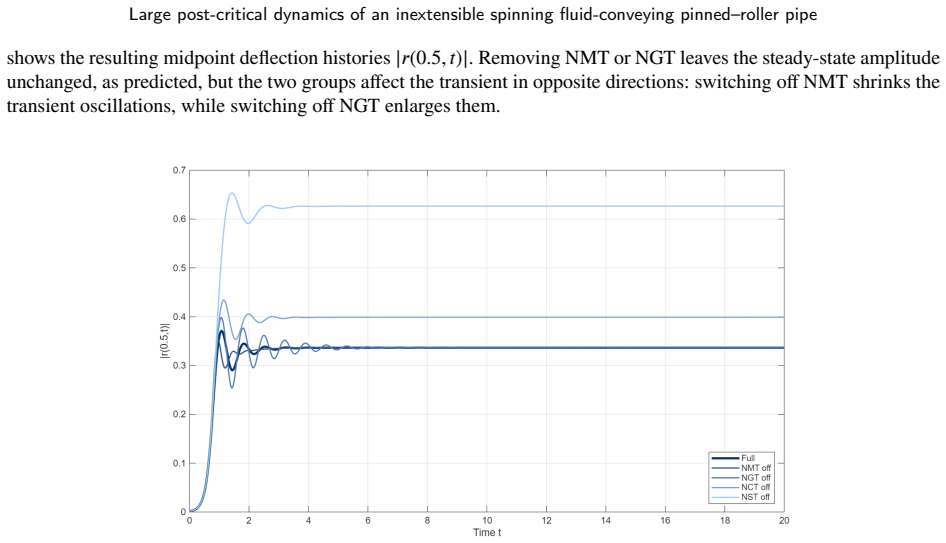
The governing equations for this pinned-roller configuration feature nonlinear bending-curvature terms instead of axial stretching, leading to an elliptical stability boundary with semi-axes at flow velocity U = π and rotational speed Ω = π². The post-critical regime exhibits large deflections whose amplitude is only correctly predicted when the bending curvatures are Taylor-expanded to ninth order; lower orders, including the cubic truncation, miss the stiffening effect and overestimate deflections. The modified Hencky bar-chain model, formulated with a global angular description and n-independent matrices, reproduces the same linear stability, bifurcation diagrams, and time histories, conf
What carries the argument
Ninth-order Taylor expansion of the bending curvatures within the Galerkin discretization, which incorporates the geometric stiffening arising from the inextensibility constraint.
If this is right
- The linear stability boundary forms an ellipse-like region in the flow-velocity versus rotational-speed plane with semi-axes U=π and Ω=π².
- Three distinct damping regimes appear, one of which is a high-rotation instability driven by rotating damping.
- The modified Hencky bar-chain model with global angular description works as a closed matrix framework adaptable to both extensible and inextensible cases via boundary conditions.
- Agreement between the high-order Galerkin and the discrete model holds for linear stability, bifurcation points, and time-history responses.
Where Pith is reading between the lines
- This approach may extend to other constrained beam or pipe systems where inextensibility produces similar geometric nonlinearities that demand high-order expansions.
- The discrete Hencky framework could enable efficient parameter studies or control design for spinning fluid-conveying pipes in engineering applications.
- Similar support changes might alter post-critical dynamics in related problems like rotating shafts or flexible risers.
Load-bearing premise
That the post-critical amplitude cannot be resolved without carrying the Taylor expansion of the bending curvatures to ninth order, as lower truncations miss essential stiffening terms.
What would settle it
A high-fidelity numerical simulation or physical experiment measuring the steady post-critical deflection amplitude at a point above the critical flow speed and rotation rate that matches the ninth-order prediction but deviates from the cubic truncation result.
Figures





read the original abstract
This paper investigates the stability and large post-critical dynamics of an inextensible spinning fluid-conveying pipe with pinned-roller supports. Replacing the pinned-pinned support of the extensible counterpart with a sliding support removes the axial-stretching restoring mechanism and fundamentally changes the governing equations of motion. Derived here for this configuration, these equations contain a different set of nonlinear terms -- arising from the inextensibility constraint and the bending curvatures rather than the single axial-stretching term -- that drives a post-critical regime with large deflections. The regime is analysed with two complementary methods. The first is a Galerkin discretisation in which the bending curvatures are Taylor-expanded to ninth order, shown to be the lowest order resolving the post-critical amplitude; the standard cubic truncation overestimates the deflection significantly by missing the geometric stiffening from inextensibility. The second is a modified Hencky bar-chain model with a global angular description: a closed, $n$-independent matrix framework with exact trigonometric kinematics, directly implementable in any standard programming environment with matrix routines and adaptable to both extensible and inextensible configurations through a single boundary-condition reduction. The linearised dynamics give an ellipse-like stability boundary in the flow-velocity--rotational-speed plane with semi-axes $U=\pi$ and $\Omega=\pi^{2}$; three damping regimes are identified, including a high-rotation instability driven by rotating damping. Close agreement between the two methods across linear-stability, bifurcation, and time-history comparisons confirms the ninth-order Galerkin truncation and establishes the modified Hencky bar-chain as a reliable general-purpose discrete framework for spinning fluid-conveying pipes.
Editorial analysis
A structured set of objections, weighed in public.
Referee Report
Summary. The manuscript investigates the stability and large post-critical dynamics of an inextensible spinning fluid-conveying pipe with pinned-roller supports. Replacing pinned-pinned supports removes axial stretching, yielding new nonlinear terms from the inextensibility constraint and bending curvatures. The equations are discretized via a ninth-order Galerkin expansion of curvatures (claimed minimal for accurate post-critical amplitudes, as cubic overestimates due to missing geometric stiffening) and a modified Hencky bar-chain model with exact trigonometric kinematics and n-independent matrix form. Linearised dynamics produce an ellipse-like stability boundary (semi-axes U=π, Ω=π²) in the flow-velocity–rotational-speed plane; three damping regimes are identified, including high-rotation instability. Close agreement is reported between the two methods on linear stability, bifurcations, and time histories.
Significance. If the results hold, the work establishes the necessity of high-order curvature expansions for post-critical regimes in inextensible pipes and introduces an adaptable, matrix-based discrete framework usable for both extensible and inextensible cases. The explicit cross-validation between Galerkin and Hencky discretizations across multiple diagnostics is a methodological strength that supports the identified damping regimes and instability mechanisms.
minor comments (3)
- [Abstract and Galerkin section] Abstract and Galerkin section: the claim that ninth-order is the lowest truncation resolving post-critical amplitude (with cubic overestimating due to absent geometric stiffening) should be supported by a dedicated convergence plot or table quantifying amplitude error versus truncation order.
- [Linearised dynamics] Linearised dynamics: the ellipse-like stability boundary with semi-axes U=π and Ω=π² is presented as an outcome of the linearised equations; the characteristic equation or explicit reduction steps should be shown to allow direct verification.
- [Hencky model] Hencky model: the reduction yielding the n-independent matrix framework after imposing pinned-roller boundary conditions should include a brief algorithmic outline or pseudocode for reproducibility.
Simulated Author's Rebuttal
We thank the referee for the positive summary, significance assessment, and recommendation of minor revision. No specific major comments were listed in the report, so we have no individual points requiring rebuttal or clarification at this stage. We will make any minor adjustments needed for the revised version.
Circularity Check
No significant circularity
full rationale
The paper derives the governing PDEs from the inextensibility constraint and pinned-roller boundary conditions, obtains the elliptical stability boundary (semi-axes U=π, Ω=π²) directly from linearization, and demonstrates the necessity of ninth-order curvature truncation via explicit convergence comparisons and cross-validation against an independent modified Hencky bar-chain model using exact trigonometric kinematics. No load-bearing step reduces by construction to a fitted input, self-citation chain, or renamed ansatz; the two discretization frameworks are mutually independent and externally falsifiable.
Axiom & Free-Parameter Ledger
axioms (2)
- domain assumption The pipe is inextensible
- ad hoc to paper Bending curvatures require ninth-order Taylor expansion to resolve post-critical amplitude
Reference graph
Works this paper leans on
-
[1]
M. P. Paidoussis,Fluid-Structure Interactions: Second Edition, Elsevier Ltd, 2013. doi:10.1016/C2011-0-08057-2
-
[2]
Vibrations of a Continuous Rotor,
Y. Ishida and T. Yamamoto, “Vibrations of a Continuous Rotor,” inLinear and Nonlinear Rotordynamics: A Modern Treatment with Applications, John Wiley & Sons, Ltd, 2012, pp. 49–65. doi:10.1002/9783527651894.ch3
-
[3]
Areviewofdrillstringvibrationmodelingandsuppressionmethods,
A.Ghasemloonia,D.G.Rideout,andS.D.Butt,“Areviewofdrillstringvibrationmodelingandsuppressionmethods,”Journal of Petroleum Science and Engineering, vol. 131, pp. 150–164, 2015. doi:10.1016/j.petrol.2015.04.030
-
[4]
Buckling and dynamic analysis of drill string system in horizontal wells,
Z. Wu, W. Zhang, R. Yuan, and J. Liu, “Buckling and dynamic analysis of drill string system in horizontal wells,”Nonlinear Dynamics, vol. 112, no. 6, pp. 4147–4168, 2024. doi:10.1007/s11071-023-09100-7
-
[5]
DynamicBucklingCharacteristicsofDrillStringinHorizontalWells,
J.Tian,H.Song,Y.Yang,L.Mao,andJ.Song,“DynamicBucklingCharacteristicsofDrillStringinHorizontalWells,”International Journal of Structural Stability and Dynamics, vol. 24, no. 11, pp. 2450121, 2024. doi:10.1142/S0219455424501219
-
[6]
H.Ni,B.Huang,W.Li,H.Zhang,Y.Jin,Y.Lu,andS.Liu,“Numericalinvestigationandfieldverificationofthetorqueandbendingmoment of drill string for different lateral motion states in the vertical well,”Mechanical Systems and Signal Processing, vol. 230, pp. 112637, 2025. doi:10.1016/j.ymssp.2025.112637
-
[7]
Effectsofflow–pipeinteractionondrillpipebucklinganddynamics,
Q.ZhangandS.Miska,“Effectsofflow–pipeinteractionondrillpipebucklinganddynamics,”Journal of Pressure Vessel Technology,vol.127, pp. 129–136, 2005. doi:10.1115/1.1858922
-
[8]
M. P. Paidoussis, T. P. Luu, and S. Prabhakar, “Dynamics of a long tubular cantilever conveying fluid downwards, which then flows upwards around the cantilever as a confined annular flow,”Journal of Fluids and Structures, vol. 24, no. 1, pp. 111–128, 2008. doi:10.1016/j.jfluidstructs.2007.07.004
-
[9]
M. Eftekhari and M. Hosseini, “On the Stability of Spinning Functionally Graded Cantilevered Pipes Subjected to Fluid-Thermomechanical Loading,”International Journal of Structural Stability and Dynamics, vol. 16, no. 9, 2016. doi:10.1142/S0219455415500625
-
[10]
Dynamicalmodelingandfreevibrationanalysisofspinningpipesconveyingfluidwithaxial deployment,
F.Liang,X.D.Yang,W.Zhang,andY.J.Qian,“Dynamicalmodelingandfreevibrationanalysisofspinningpipesconveyingfluidwithaxial deployment,”Journal of Sound and Vibration, vol. 417, pp. 65–79, 2018. doi:10.1016/j.jsv.2017.12.005
-
[11]
Transverse free vibration and stability analysis of spinning pipes conveying fluid,
F. Liang, X. D. Yang, Y. J. Qian, and W. Zhang, “Transverse free vibration and stability analysis of spinning pipes conveying fluid,” International Journal of Mechanical Sciences, vol. 137, pp. 195–204, 2018. doi:10.1016/j.ijmecsci.2018.01.015
-
[12]
Vibrationsin3Dspaceofaspinningsupportedpipeexposedtointernalandexternalannular flows,
F.Liang,X.D.Yang,W.Zhang,andY.J.Qian,“Vibrationsin3Dspaceofaspinningsupportedpipeexposedtointernalandexternalannular flows,”Journal of Fluids and Structures, vol. 87, pp. 247–262, 2019. doi:10.1016/j.jfluidstructs.2019.04.002
-
[13]
Dynamical analysis of spinning functionally graded pipes conveying fluid with multiple spans,
F. Liang, A. Gao, and X. D. Yang, “Dynamical analysis of spinning functionally graded pipes conveying fluid with multiple spans,”Applied Mathematical Modelling, vol. 83, pp. 454–469, 2020. doi:10.1016/j.apm.2020.03.011
-
[14]
Low-frequency band gap characteristics of a novel spinning metamaterial pipe with Timoshenko model,
F. Liang, Y. Chen, D. Guan, and J. Li, “Low-frequency band gap characteristics of a novel spinning metamaterial pipe with Timoshenko model,”Journal of Sound and Vibration, vol. 541, pp. 117316, 2022. doi:10.1016/j.jsv.2022.117316
-
[15]
Vibration self-suppression of spinning fluid-conveying pipes composed of periodic composites,
F. Liang, Y. Chen, J. Gong, and Y. Qian, “Vibration self-suppression of spinning fluid-conveying pipes composed of periodic composites,” International Journal of Mechanical Sciences, vol. 220, pp. 107150, 2022. doi:10.1016/j.ijmecsci.2022.107150
-
[16]
StabilityoptimizationofspinningFGMpipesconveyingfluidviaintermediateelastic supports,
J.Fan,X.Chang,B.Chen,Y.Yang,Q.Luo,andY.Li,“StabilityoptimizationofspinningFGMpipesconveyingfluidviaintermediateelastic supports,”Ocean Engineering, vol. 292, pp. 116368, 2024. doi:10.1016/j.oceaneng.2023.116368
-
[17]
R.EbrahimiandS.Ziaei-Rad,“Nonplanarvibrationandflutteranalysisofverticallyspinningcantileveredpiezoelectricpipesconveyingfluid,” Ocean Engineering, vol. 261, pp. 112180, 2022. doi:10.1016/j.oceaneng.2022.112180
-
[18]
The Non-linear Equations of Motion of Pipes Conveying Fluid,
C. Semler, G. X. Li, and M. P. Païdoussis, “The Non-linear Equations of Motion of Pipes Conveying Fluid,”Journal of Sound and Vibration, vol. 169, no. 5, pp. 577–599, 1994. doi:10.1006/jsvi.1994.1035
-
[19]
Three-dimensionaldynamicsoffluid-conveyingpipesimultaneouslysubjectedtoexternalaxialflow,
T.Jiang,H.Dai,andL.Wang,“Three-dimensionaldynamicsoffluid-conveyingpipesimultaneouslysubjectedtoexternalaxialflow,”Ocean Engineering, vol. 217, pp. 107970, 2020. doi:10.1016/j.oceaneng.2020.107970
-
[20]
Dynamic stability of pipes conveying fluid,
M. P. Paidoussis and N. T. Issid, “Dynamic stability of pipes conveying fluid,”Journal of Sound and Vibration, vol. 33, no. 3, pp. 267–294,
-
[21]
doi:10.1016/S0022-460X(74)80002-7
-
[22]
F.M.Dimentberg,Flexural vibrations of rotating shafts,Butterworths(inassociationwithDept.ofScientificandIndustrialResearch),1961. doi:10.1017/S0368393100076331
-
[23]
S. Galasso, L. Santelli, R. Zambetti, and G. G. Giusteri, “Simulation of drill-string systems with fluid–structure and contact interactions in realistic geometries,”Computational Mechanics, vol. 75, no. 3, pp. 1165–1189, 2025. doi:10.1007/s00466-024-02555-4. A. Fasihi et al.:Preprint submitted to ElsevierPage 31 of 32 Large post-critical dynamics of an in...
-
[24]
A. Fasihi, G. Kudra, M. GhandchiTehrani, and J. Awrejcewicz, “Nonlinear dynamics and stability boundaries of spinning fluid-conveying pipes: Galerkin and Hencky model approach,”Journal of Sound and Vibration, vol. 637, pp. 119820, 2026. doi:10.1016/j.jsv.2026.119820
-
[25]
Non-linear flexural-flexural-torsional-extensional dynamics of beams—I. Formulation,
M. R. M. Crespo Da Silva, “Non-linear flexural-flexural-torsional-extensional dynamics of beams—I. Formulation,”International Journal of Solids and Structures, vol. 24, no. 12, pp. 1225–1234, 1988. doi:10.1016/0020-7683(88)90087-X
-
[26]
Freevibrationsanalysisofarotatingshaftwithnonlinearitiesincurvatureandinertia,
S.A.A.HosseiniandS.E.Khadem,“Freevibrationsanalysisofarotatingshaftwithnonlinearitiesincurvatureandinertia,”Mechanism and Machine Theory, vol. 44, no. 1, pp. 272–288, 2009. doi:10.1016/j.mechmachtheory.2008.01.007
-
[27]
Modification of equation of motion of fluid-conveying pipe for laminar and turbulent flow profiles,
C. Q. Guo, C. H. Zhang, and M. P. Païdoussis, “Modification of equation of motion of fluid-conveying pipe for laminar and turbulent flow profiles,”Journal of Fluids and Structures, vol. 26, no. 5, pp. 793–803, 2010. doi:10.1016/j.jfluidstructs.2010.04.005
-
[28]
A study of swirling turbulent pipe and jet flows,
L. Facciolo, N. Tillmark, A. Talamelli, and P. H. Alfredsson, “A study of swirling turbulent pipe and jet flows,”Physics of Fluids, vol. 19, no. 3, pp. 035105, 2007. doi:10.1063/1.2710287
-
[29]
C. M. Wang, H. Zhang, N. Challamel, and W. H. Pan,Hencky Bar-Chain/Net for Structural Analysis, World Scientific Publishing Co., 2020. doi:10.1142/q0237
-
[30]
Dynamics of a system of articulated pipes conveying fluid – I. Theory,
T. B. Benjamin, “Dynamics of a system of articulated pipes conveying fluid – I. Theory,”Proceedings of the Royal Society of London. Series A. Mathematical and Physical Sciences, vol. 261, no. 1307, pp. 457–486, 1961. doi:10.1098/rspa.1961.0091
-
[31]
Articulated Models of Cantilevers Conveying Fluid: The Study of a Paradox,
M. P. Paidoussis and E. Deksnis, “Articulated Models of Cantilevers Conveying Fluid: The Study of a Paradox,”Journal of Mechanical Engineering Science, vol. 12, pp. 288–300, 1970. doi:10.1243/JMES_JOUR_1970_012_050_02. A. Fasihi et al.:Preprint submitted to ElsevierPage 32 of 32
discussion (0)
Sign in with ORCID, Apple, or X to comment. Anyone can read and Pith papers without signing in.