Classifying the hidden-charm pentaquarks via a flavor mixing scheme
Pith reviewed 2026-07-02 11:04 UTC · model grok-4.3
The pith
A flavor mixing scheme explains observed hidden-charm pentaquarks as molecular states and predicts new single- and double-strange bound states.
A machine-rendered reading of the paper's core claim, the machinery that carries it, and where it could break.
Core claim
The central claim is that all baryon-meson systems of ground single-charm baryons with D̄(*)/Ds̄(*) mesons can be categorized by the flavor components of their light degrees of freedom; this classification reproduces the observed Pc and Pcs states and generates bound states whose binding arises from the specified channel mixing, with concrete mass spectra obtained by fitting parameters to the measured states.
What carries the argument
The flavor mixing scheme that groups baryon-meson systems by light-flavor components and produces binding via inter-channel mixing between the indicated pairs.
If this is right
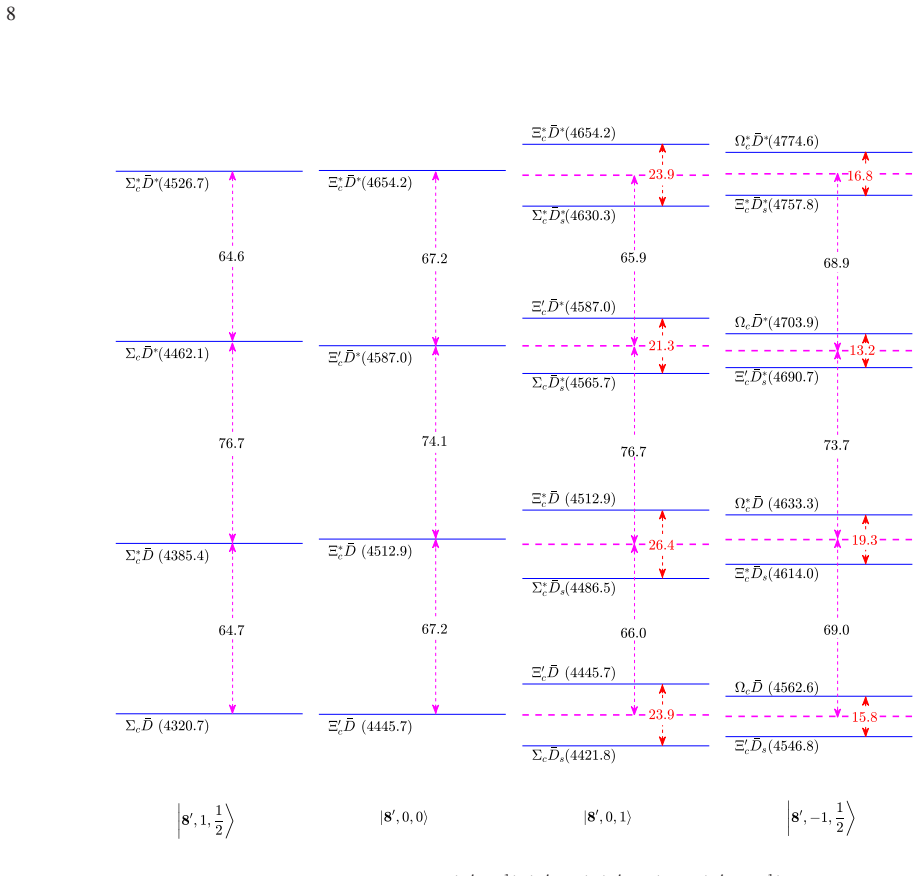
- Single-strange hidden-charm bound states exist due to Σc(*)Ds̄(*)-Ξc′(*)D̄(*) mixing.
- Double-strange hidden-charm bound states exist due to Ξc′(*)Ds̄(*)-Ωc(*)D̄(*) mixing.
- Mass spectra for both sets of new states follow from parameters already fixed by the Pc and Pcs data.
- All baryon-meson combinations are organized into flavor-component categories that explain the known states consistently.
Where Pith is reading between the lines
- Searches focused on invariant-mass distributions near the predicted values could directly test the molecular assignments.
- Confirmation of the strange states would strengthen the case that channel mixing, rather than other mechanisms, drives binding across the full set of hidden-charm molecules.
- The same categorization logic could be applied to bottom-sector analogs to forecast additional states.
Load-bearing premise
The observed Pc and Pcs states are molecular bound states whose binding comes from the same channel-mixing interactions that will bind the single- and double-strange systems.
What would settle it
Non-observation of states near the predicted masses in the single-strange Σc(*)Ds̄(*)-Ξc′(*)D̄(*) or double-strange Ξc′(*)Ds̄(*)-Ωc(*)D̄(*) channels would refute the mass predictions.
Figures



read the original abstract
In this work, we propose a scheme to classify the molecular states consisting of ground single-charm baryons ($\Lambda_c$, $\Xi_c$, $\Sigma_c^{(*)}$, $\Xi_c^{\prime(*)}$, $\Omega_c^{(*)}$) and $\bar{D}^{(*)}/\bar{D}_s^{(*)}$ mesons. Within this framework, all considered baryon-meson systems are categorized according to the flavor components of their light degrees of freedom. We briefly illustrate how this classification scheme can consistently explain the experimentally observed $P_c$ and $P_{cs}$ states. This framework also predicts the existences of single-strange and double-strange hidden-charm bound states. The attractive interactions of these states arise from channel mixing between $\Sigma_c^{(*)}\bar{D}_s^{(*)}$ and $\Xi_c^{\prime(*)}\bar{D}^{(*)}$ for single-strange systems, and mixing between $\Xi_c^{\prime(*)}\bar{D}_s^{(*)}$ and $\Omega_c^{(*)}\bar{D}^{(*)}$ for double-strange systems, respectively. Using parameters fitted from the measured $P_c$ and $P_{cs}$ states, we systematically present the predicted mass spectra for these single- and double-strange hidden-charm bound states.
Editorial analysis
A structured set of objections, weighed in public.
Referee Report
Summary. The manuscript proposes a flavor mixing classification scheme for hidden-charm molecular pentaquarks formed from ground-state single-charm baryons (Σc(*), Ξc(*), Ωc(*), etc.) and anti-D(*)/anti-Ds(*) mesons. Systems are grouped by the flavor quantum numbers of the light degrees of freedom. The scheme is shown to accommodate the observed Pc and Pcs states, and parameters fitted to those states are then used to predict bound states in the single-strange (Σc(*)Ds̄(*)–Ξc′(*)D̄(*) mixing) and double-strange (Ξc′(*)Ds̄(*)–Ωc(*)D̄(*) mixing) sectors.
Significance. If the central assumptions hold, the work supplies a compact phenomenological organizing principle that links existing pentaquarks to a larger set of predicted states and emphasizes channel mixing as the source of attraction. Such a scheme could usefully guide experimental searches for additional hidden-charm states with strangeness, provided the fitted mixing strength remains approximately flavor-independent.
major comments (2)
- [Abstract] Abstract and the predictions section: the mass spectra for single- and double-strange states are generated from parameters fitted exclusively to the measured Pc and Pcs states. This makes the quoted 'predictions' direct extrapolations of the same fit; the manuscript does not supply an independent test that the effective mixing strength is insensitive to the introduction of strangeness, which is required for the central claim to be robust.
- [predictions section] The section on channel mixing: the attractive interaction in the single-strange sector is attributed to Σc(*)Ds̄(*)–Ξc′(*)D̄(*) mixing and in the double-strange sector to Ξc′(*)Ds̄(*)–Ωc(*)D̄(*) mixing, using the same numerical parameters. No estimate or discussion of SU(3)-breaking corrections to the contact or exchange terms is given, yet such corrections would alter the binding condition and therefore undermine the predicted spectra.
minor comments (1)
- [Abstract] The abstract states that 'parameters fitted from the measured Pc and Pcs states' are used but does not specify how many free parameters are involved or the precise fitting procedure; adding this information would improve clarity.
Simulated Author's Rebuttal
We thank the referee for the detailed and constructive report. We address each major comment below, clarifying the assumptions of our flavor-mixing scheme and indicating the revisions that will be incorporated.
read point-by-point responses
-
Referee: [Abstract] Abstract and the predictions section: the mass spectra for single- and double-strange states are generated from parameters fitted exclusively to the measured Pc and Pcs states. This makes the quoted 'predictions' direct extrapolations of the same fit; the manuscript does not supply an independent test that the effective mixing strength is insensitive to the introduction of strangeness, which is required for the central claim to be robust.
Authors: We acknowledge that the quoted mass spectra constitute extrapolations under the assumption that the effective mixing strength fitted to the Pc and Pcs states remains approximately flavor-independent when strangeness is added. This assumption follows directly from the classification by light-flavor quantum numbers and the use of a single set of contact and exchange parameters. No additional measured states currently exist that would allow an independent test. We will revise the abstract and predictions section to state this assumption explicitly and to note that the scheme yields falsifiable predictions for future searches in the strange sectors. revision: partial
-
Referee: [predictions section] The section on channel mixing: the attractive interaction in the single-strange sector is attributed to Σc(*)Ds̄(*)–Ξc′(*)D̄(*) mixing and in the double-strange sector to Ξc′(*)Ds̄(*)–Ωc(*)D̄(*) mixing, using the same numerical parameters. No estimate or discussion of SU(3)-breaking corrections to the contact or exchange terms is given, yet such corrections would alter the binding condition and therefore undermine the predicted spectra.
Authors: We agree that an explicit discussion of SU(3)-breaking corrections is needed. Our present treatment adopts a leading-order flavor-symmetric parametrization for the mixing. We will add a paragraph in the predictions section that (i) acknowledges possible SU(3)-breaking contributions from mass splittings and from the strange-quark mass in the contact and one-pion-exchange terms, (ii) provides a rough estimate of their size by comparing the fitted parameters with the observed baryon and meson mass differences, and (iii) states that the quoted binding energies should be regarded as indicative within this approximation. This addition will make the limitations of the predictions transparent. revision: yes
Circularity Check
No significant circularity; standard phenomenological extrapolation from fit to observed states
full rationale
The paper defines a flavor-component classification for baryon-meson molecular states, shows that the same mixing scheme accounts for the observed Pc and Pcs states once parameters are fitted to them, and then applies those parameters to compute masses in the single- and double-strange sectors. This is ordinary use of a fitted phenomenological model for extrapolation to new systems; the predicted masses are not equivalent to the input data by construction, nor is any central claim reduced to a self-citation or definitional loop. The provided text contains no self-citations, no uniqueness theorems imported from prior work by the same authors, and no renaming of known results. The derivation chain therefore remains self-contained against external benchmarks.
Axiom & Free-Parameter Ledger
free parameters (1)
- parameters fitted from Pc and Pcs states
Reference graph
Works this paper leans on
-
[1]
(4) The operators λ 8 1λ 8 2 (λ 8 1λ 8 2σ 1 · σ 2), ∑3 i=1 λ i 1λ i 2 (∑3 i=1 λ i 1λ i 2σ 1 ·σ 2), and ∑7 j=4 λ j 1λ j 2 (∑7 j=4 λ j 1λ j 2σ 1 ·σ 2) account for the exchanges of isospin singlet, triplet, and t wo doublets light scalar (axial-vector) fictitious meson field s. The redefined coupling parameters ˜gs and ˜ga are propor- tional to g2 s m2 S and g2...
-
[2]
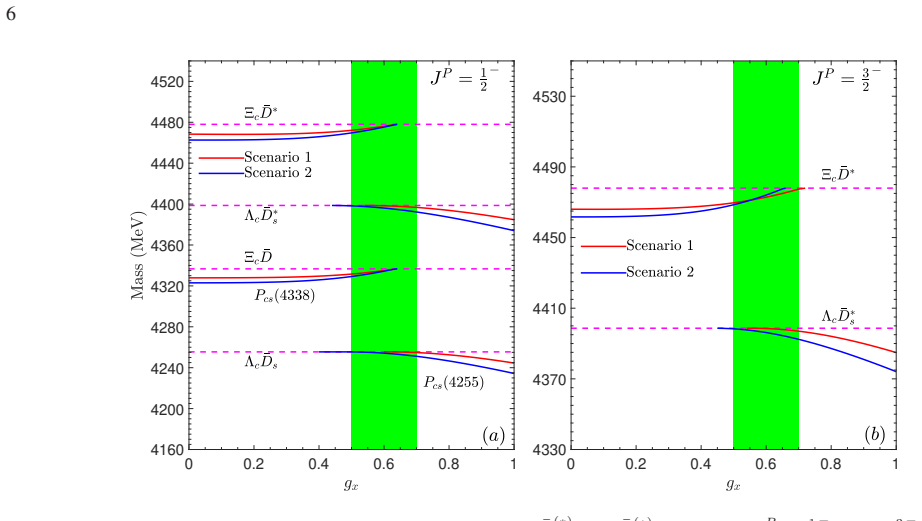
82 < g x < 1, this pole becomes a bound state. For the J P = 3 2 − poles, their behaviors can be discussed in a similar way, and for the J P = 5 2 − , we do not find any poles in scenario 1, thus we only illustrate the pole traject ory calculated from scenario 2. In Table VI, we further present our numerical results for the possible bound/quasi-bound state...
-
[3]
and Ξ ′(∗) c ¯D(∗) s − Ω (∗) c ¯D(∗) (I = 1 2 ) states via SU(3) break- ing, thus some of the states can not gain enough attractive forces to form bound/quasi-bound states. VI. SUMMARY In this work, we construct flavor wave functions built from single-charm baryons ( Λ c, Ξ c, Σ (∗) c , Ξ ′(∗) c , Ω (∗) c ) and an- ticharmed mesons ( ¯D(∗), ¯D(∗) s ) withi...
-
[4]
Aaij et al
R. Aaij et al. [LHCb], Observation of J/ψp Resonances Con- sistent with Pentaquark States in Λ 0 b → J/ψK − p Decays, Phys. Rev. Lett. 115, 072001 (2015)
2015
-
[5]
Aaij et al
R. Aaij et al. [LHCb], Model-independent evidence for J/ψp contributions to Λ 0 b → J/ψpK − decays, Phys. Rev. Lett. 117, no.8, 082002 (2016)
2016
-
[6]
Aaij et al
R. Aaij et al. [LHCb], Observation of a narrow pentaquark state,Pc(4312)+, and of two-peak structure of the Pc(4450)+, Phys. Rev. Lett. 122, no.22, 222001 (2019)
2019
-
[7]
Aaij et al
R. Aaij et al. [LHCb], Observation of a J/ψ Λ Resonance Con- sistent with a Strange Pentaquark Candidate in B → J/ψ Λp Decays, Phys. Rev. Lett. 131, no.3, 031901 (2023)
2023
-
[8]
Aaij et al
R. Aaij et al. [LHCb], Evidence of a J/ψ Λ structure and ob- servation of excited Ξ − states in the Ξ − b → J/ψ ΛK − decay, Sci. Bull. 66, 1278-1287 (2021)
2021
-
[9]
Adachi et al
I. Adachi et al. [Belle and Belle-II], Search for Pcs(4459) and Pcs(4338) in Υ(1S, 2S) inclusive decays at Belle, Phys. Rev. Lett. 135, no.4, 041901 (2025)
2025
-
[10]
H. X. Chen, W. Chen, X. Liu and S. L. Zhu, The hidden-charm pentaquark and tetraquark states, Phys. Rept. 639, 1-121 (2016)
2016
-
[11]
R. F. Lebed, R. E. Mitchell and E. S. Swanson, Heavy-Quark QCD Exotica, Prog. Part. Nucl. Phys. 93, 143-194 (2017)
2017
-
[12]
Esposito, A
A. Esposito, A. Pilloni and A. D. Polosa, Multiquark Reso - nances, Phys. Rept. 668, 1-97 (2017)
2017
-
[13]
F. K. Guo, C. Hanhart, U. G. Meißner, Q. Wang, Q. Zhao and B. S. Zou, Hadronic molecules, Rev. Mod. Phys. 90, no.1, 015004 (2018) 13 [erratum: Rev. Mod. Phys. 94, no.2, 029901 (2022)]
2018
-
[14]
A. Ali, J. S. Lange and S. Stone, Exotics: Heavy Pentaqua rks and Tetraquarks, Prog. Part. Nucl. Phys. 97, 123-198 (2017)
2017
-
[15]
Y . R. Liu, H. X. Chen, W. Chen, X. Liu and S. L. Zhu, Pentaquark and Tetraquark states, Prog. Part. Nucl. Phys. 107, 237-320 (2019)
2019
-
[16]
H. X. Chen, W. Chen, X. Liu, Y . R. Liu and S. L. Zhu, An updated review of the new hadron states, Rept. Prog. Phys. 86, no.2, 026201 (2023)
2023
-
[17]
L. Meng, B. Wang, G. J. Wang and S. L. Zhu, Chiral perturba - tion theory for heavy hadrons and chiral effective field theo ry for heavy hadronic molecules, Phys. Rept. 1019, 1-149 (2023)
2023
-
[18]
Gell-Mann, A Schematic Model of Baryons and Mesons, Phys
M. Gell-Mann, A Schematic Model of Baryons and Mesons, Phys. Lett. 8, 214-215 (1964)
1964
-
[19]
Zweig, An SU(3) model for strong interaction symmetr y and its breaking
G. Zweig, An SU(3) model for strong interaction symmetr y and its breaking. V ersion 1,doi:10.17181/CERN-TH-401
-
[20]
Zweig, An SU(3) model for strong interaction symmetr y and its breaking
G. Zweig, An SU(3) model for strong interaction symmetr y and its breaking. V ersion 2,doi:10.17181/CERN-TH-412
-
[21]
K. Chen, Z. Y . Lin and S. L. Zhu, Comparison between the PN ψ andP Λ ψ s systems, Phys. Rev. D 106, no.11, 116017 (2022)
2022
-
[22]
F. L. Wang, R. Chen and X. Liu, Prediction of hidden-charm pentaquarks with double strangeness, Phys. Rev. D 103, no.3, 034014 (2021)
2021
-
[23]
J. A. Mars´ e-V alera, V . K. Magas and A. Ramos, Double- Strangeness Molecular-Type Pentaquarks from Coupled- Channel Dynamics, Phys. Rev. Lett. 130, no.9, 9 (2023)
2023
-
[24]
L. Roca, J. Song and E. Oset, Molecular pen- taquarks with hidden charm and double strangeness, Phys. Rev. D 109, no.9, 094005 (2024)
2024
-
[25]
Clymton, H
S. Clymton, H. C. Kim and T. Mart, Double-strangeness hidden-charm pentaquarks, Phys. Rev. D 112, no.3, 034015 (2025)
2025
-
[26]
Azizi, Y
K. Azizi, Y . Sarac and H. Sundu, Investigation of hidden-charm double strange pentaquark candidate Pcss via its mass and strong decays, Eur. Phys. J. C 82, no.6, 543 (2022)
2022
-
[27]
V . V . Anisovich, M. A. Matveev, J. Nyiri, A. V . Sarantsev and A. N. Semenova, Nonstrange and strange pentaquarks with hid- den charm, Int. J. Mod. Phys. A 30, no.32, 1550190 (2015)
2015
-
[28]
P . G. Ortega, D. R. Entem and F. Fernandez, Strange hidde n- charmP Λ ψ s (4459) andP Λ ψ s (4338) pentaquarks and additional P Λ ψ s , P Σ ψ s and PN ψ ss candidates in a quark model approach, Phys. Lett. B 838, 137747 (2023)
2023
-
[29]
Doubly-strange hidden-charm pentaquarks from the Fermi statistics of the light-quark cloud
H. Mutuk, [arXiv:2606.10122 [hep-ph]]
work page internal anchor Pith review Pith/arXiv arXiv
-
[30]
Chen and B
K. Chen and B. Wang, From PN ψ and P Λ ψ s to ¯Tf cc: Symmetry analysis of the interactions in the (c¯q)(c¯q), (ccq)(c¯q), and (ccq)(ccq) dihadron systems, Phys. Rev. D 110, no.11, 116017 (2024)
2024
-
[31]
Chen and B
K. Chen and B. Wang, Flavor-spin symmetry of the PN ψ /HN Ω ccc and P Λ ψ s /H Λ Ω cccs molecular states, Phys. Rev. D 109, no.11, 114028 (2024)
2024
-
[32]
T. A. Kaeding, Tables of SU(3) isoscalar factors, Atom. Data Nucl. Data Tabl. 61, 233-288 (1995)
1995
-
[33]
F. L. Wang, X. D. Yang, R. Chen and X. Liu, Hidden-charm pentaquarks with triple strangeness due to the Ω (∗ ) c ¯D(∗ ) s inter- actions, Phys. Rev. D 103, no.5, 054025 (2021)
2021
-
[34]
Z. Y . Yang, F. Z. Peng, M. J. Yan, M. S´ anchez S´ anchez and M. Pavon V alderrama, Molecular Pψ pentaquarks from light-meson exchange saturation, Phys. Rev. D 111, no.1, 014012 (2025)
2025
-
[35]
Clymton, H
S. Clymton, H. C. Kim and T. Mart, Triple-strangeness hi dden- charm pentaquarks, Phys. Rev. D 112, no.9, 094024 (2025)
2025
-
[36]
Q. Meng, E. Hiyama, K. U. Can, P . Gubler, M. Oka, A. Hosaka and H. Zong, Compact sssc¯c pentaquark states predicted by a quark model, Phys. Lett. B 798, 135028 (2019)
2019
-
[37]
Feijoo, W
A. Feijoo, W. F. Wang, C. W. Xiao, J. J. Wu, E. Oset, J. Niev es and B. S. Zou, A new look at the Pcs states from a molecular perspective, Phys. Lett. B 839, 137760 (2023)
2023
-
[38]
Clymton, H
S. Clymton, H. C. Kim and T. Mart, Production mechanism o f hidden-charm pentaquark statesPc¯cs with strangenessS = − 1, Phys. Rev. D 112, no.1, 014041 (2025)
2025
-
[39]
F. Z. Peng, M. Z. Liu, Y . W. Pan, M. S´ anchez S´ anchez and M. Pavon V alderrama, Five-flavor pentaquarks and other ligh t- and heavy-flavor symmetry partners of the LHCb hidden-charm pentaquarks, Nucl. Phys. B 983, 115936 (2022)
2022
-
[40]
E. E. Garcia-Gonzales, V . K. Magas and A. Ramos, Compre- hensive study of hidden charm pentaquarks with an improved unitarization method, arXiv:2605.21205 [hep-ph]
work page internal anchor Pith review Pith/arXiv arXiv
-
[41]
S. X. Nakamura and J. J. Wu, Pole determination of P Λ ψ s (4338) and possible P Λ ψ s (4255) in B → J/ψ Λp, Phys. Rev. D 108, no.1, L011501 (2023)
2023
-
[42]
D. B. Leinweber, A. W. Thomas and R. D. Y oung, Physical nucleon properties from lattice QCD, Phys. Rev. Lett. 92, 242002 (2004)
2004
-
[43]
P . Wang, D. B. Leinweber, A. W. Thomas and R. D. Y oung, Chiral extrapolation of nucleon magnetic form factors, Phys. Rev. D 75, 073012 (2007)
2007
-
[44]
Y . K. Chen, L. Meng, Z. Y . Lin and S. L. Zhu, Virtual states in the coupled-channel problems with an improved complex scal - ing method, Phys. Rev. D 109, no.3, 034006 (2024)
2024
discussion (0)
Sign in with ORCID, Apple, or X to comment. Anyone can read and Pith papers without signing in.