pith. sign in

astro-ph.HE

High Energy Astrophysical Phenomena

Cosmic ray production, acceleration, propagation, detection. Gamma ray astronomy and bursts, X-rays, charged particles, supernovae and other explosive phenomena, stellar remnants and accretion systems, jets, microquasars, neutron stars, pulsars, black holes

Top Pith
2
astro-ph.SR 2026-05-18 Recognition

SN 2023fyq progenitor detected as hot luminous source

by Xinyi Hong, Ning-Chen Sun +10 more

SN 2023fyq: direct detection of a Type Ibn supernova progenitor and its multi-wavelength environmental constraints

The vanished pre-explosion object and its 12-16 million year environment favor a low-mass helium star in a binary over a massive single star

Figure from the paper full image
abstract click to expand
Context. Type Ibn supernovae (SNe) are characterized by narrow helium emission lines arising from ejecta-circumstellar medium interaction, yet their progenitors remain debated, with both massive Wolf-Rayet stars and low-mass helium stars in binaries proposed. Aims. We aim to directly identify the progenitor of the Type Ibn SN 2023fyq and to characterize its environment in order to constrain the progenitor's nature and evolutionary channel. Methods. We search for the SN progenitor based on pre-explosion and late-time HST and JWST images and derive its properties by fitting the spectral energy distribution. We investigate the SN environment by probing the stars, dust, ionized gas and molecular gas with a multi-wavelength dataset including HST and JWST imaging, VLT/MUSE integral-field-unit spectroscopy and ALMA CO (2--1) radio interferometry. Results. We discover a pre-explosion source at the SN position, which is consistent with a hot ($T>$15000 K) and luminous (log($L$/$L_\odot$) $\gtrsim$ 5.5) SN progenitor and a possible host star cluster. The progenitor is confirmed to have disappeared after explosion. Analysis of the SN environment implies that the progenitor likely has an age of log($t$/yr) = 7.1--7.2. These phenomena disfavor a very massive single-star progenitor and instead support a binary scenario involving a low-mass helium star and a compact object; the observed progenitor emission likely arises from binary interaction that began at least $\sim$12 yr before the explosion. Conclusions. SN 2023fyq is the first Type Ibn SN with a directly detected progenitor and a possible host star cluster. It adds to the diversity of Type Ibn SNe in terms of their progenitor channels and mass-loss mechanisms.
1 0
Top Pith
1
astro-ph.HE 2026-05-13 2 theorems

FRB 20240114A central frequency modulates every 112 days

by Rui-Nan Li, Hao-Tian Lan +4 more

Periodic Emission Frequency Modulation in a Hyperactive Fast Radio Burst

More than 1000 bursts show a systematic low-to-high drift within each cycle, hinting at binary or precession mechanisms.

Figure from the paper full image
abstract click to expand
Fast radio bursts (FRBs) are intense, short-duration radio transients of mysterious origin. They have been detected across a wide range of frequencies from 110 MHz to 8 GHz. Their spectral properties, remaining poorly understood, are essential for understanding the intrinsic radiation mechanism and propagation effects. Here, we report the discovery of a periodic modulation in the central emission frequency of FRB 20240114A, based on more than one thousand bursts collected by an ultra-wideband receiving system. The burst central frequencies reveals a significant modulation with a period of $\sim 112$ days. The statistical significance of this detected periodicity exceeds $6\sigma$ for both the Lomb-Scargle and phase-folding methods. Within a single period, the central emission frequency exhibits a systematic drift from lower to higher values. We evaluate several physical mechanisms for this unique spectral evolution. The free-free absorption together with cyclotron resonant absorption in a binary system or free precession models could potentially explain such behavior. The discovery of this periodic frequency modulation unveils a new layer of complexity in the underlying radiation mechanism and propagation effect of FRBs.
1 0
Top Pith
1
gr-qc 2026-05-13 2 theorems

Black hole mergers calibrate gravitational wave detectors

by The LIGO Scientific Collaboration, the Virgo Collaboration +1839 more

GW240925 and GW250207: Astrophysical Calibration of Gravitational-wave Detectors

Two loud binary black hole events yield the first direct astrophysical constraints on LIGO and Virgo calibration uncertainties.

Figure from the paper full image
abstract click to expand
GW240925 and GW250207 are two loud gravitational-wave signals from binary black hole coalescences observed with network signal-to-noise ratios $\sim 32$ and $\sim 69$, respectively, by the LIGO Hanford--LIGO Livingston--Virgo network. Gravitational-wave signals from coalescing binaries have characteristic phase and amplitude evolution predicted by general relativity. These signal waveforms, together with measured instrumental calibration uncertainties, are used to infer source parameters. However, for sufficiently loud detections it is possible to constrain the calibration of the detectors directly using the signals themselves. We present the first informative astrophysical measurements of gravitational-wave detector calibration. For GW240925, we verify the inference of Hanford calibration from the astrophysical signal through cross-checks with known calibration errors obtained from in-situ measurements. At the time of GW250207, the Hanford detector was not fully stabilized, leading to elevated calibration uncertainties; thus, astrophysical calibration is essential to obtain accurate data and to enable source localization. These well-localized, high signal-to-noise observations have the potential to offer precise measurements of source properties, stringent tests of general relativity, and informative dark siren measurements, provided that calibration uncertainties are properly incorporated. As detector sensitivity improves, astrophysical calibration will become an increasingly valuable complement to in-situ calibration measurements. Obtaining accurate calibration will be essential for precision gravitational-wave science.
2 0
0
astro-ph.HE 2026-07-03

Five Type IIP supernovae define slow-rise high-velocity subclass

by Sondos Mohsen-Tanev, Iair Arcavi +18 more

SN 2020bij and a Possible Slow-Rise High-Velocity Subclass of Type IIP Supernovae

Models attribute their light curves to weak circumstellar interaction, offering a new probe of red supergiant mass loss.

Figure from the paper full image
abstract click to expand
Mapping how the explosion properties of Type II supernovae (SNe II) relate to the properties of their progenitors can provide strong constraints for understanding the final evolutionary stages of massive stars. Type IIP SNe, linked to the explosions of single red super-giant (RSG) stars, have recently been found to require some form of interaction with circumstellar material (CSM) to reproduce the rapid rise to the plateau often seen in their light curves. In this work, we present observations and analysis of the Type IIP SN 2020bij, characterized by a slow rise to its plateau as well as high expansion velocities. We identify four other SNe IIP from the literature (ASASSN-14kg, SN 2018fif, SN 2021yja and SN 2023axu) with similarly slowly rising light curves and find that they also show high expansion velocities. Using both analytical and numerical models, all five events can be explained with weak to no CSM interaction. We therefore propose that these events constitute a new subclass of Type IIP SNe which could be associated with relatively confined CSM. Early and dense photometric coverage of future SNe IIP together with early spectroscopic observations will further map this subclass and its physical properties. Understanding such rare events could be key to constraining the diversity of late-stage mass-loss in RSGs.
0
0
hep-ph 2026-07-03

Axion background splits photon modes into Krein-sign sidebands

by Run-Min Yao, Xiao-Jun Bi +2 more

Sideband Structure of Axion Electrodynamics

A periodic axion field folds the dispersion into a ladder whose degeneracies are stable or unstable according to the symplectic signatures o

abstract click to expand
We develop a Floquet--Bloch sideband formulation of the linearized Maxwell--axion system in a coherent periodic axion background. Linearizing around prescribed magnetic and axion fields, we show that the pump generates a sideband ladder of photon and axion branches. Near an isolated folded degeneracy, this ladder reduces to a two-mode crossing whose algebra is fixed by the symplectic signatures of the colliding modes. In temporal fixed-momentum evolution, same-Krein-sign collisions give stable avoided crossings, whereas opposite-sign collisions give parametric instabilities, unifying the axion-photon difference channel with the Mathieu and Masaki-Aoki-Soda resonances. In stationary fixed-frequency transfer, the corresponding flux signatures distinguish bounded forward conversion from forward-backward stop bands and distributed reflection. Ray projection of a temporal pump gives a related but local WKB description of driven forward mixing, with an effective wavenumber distinct from the true axion momentum. External-field diagrams reproduce the sideband selection rules, and full temporal monodromy calculations verify the instability topology and finite-coupling shifts.
0
0
astro-ph.HE 2026-07-03

QPOs track inner disk temperature shifts in 4U 1630-47

by Haifan Zhu, Mariano Méndez +2 more

Timing and spectral analysis of the 2025 outburst of 4U 1630-47 with textit{NICER}

Rising-phase oscillations match higher disk temperatures and lower normalizations; a weak modulation appears near peak.

Figure from the paper full image
abstract click to expand
We analyzed \textit{NICER} observations of the 2025 outburst of the black hole X-ray binary 4U~1630$-$47 to investigate the spectral--timing properties of its transient low-frequency quasi-periodic oscillations (QPOs) and millihertz-scale quasi-regular modulation (QRM). During the rising phase of the outburst, the QPO centroid frequency increased from $\sim 0.24$ Hz to $\sim 3.43$ Hz. Wavelet-based state separation shows that the with-QPO intervals are associated with a higher inner disk temperature and a lower \texttt{diskbb} normalization than the without-QPO intervals, while the photon index ($\Gamma$) shows weaker changes within the uncertainties. Near the outburst peak, the source displayed a weak QRM at $\sim 0.07$ Hz with a fractional rms amplitude of $\sim 4.7\%$, lower than that of the heartbeat state observed in 2023. Phase-resolved Hilbert--Huang analysis shows that the inner disk temperature is positively correlated with the X-ray flux, the \texttt{diskbb} normalization is anticorrelated, and $\Gamma$ varies only weakly. Overall, the short-timescale spectral--timing variability is expressed most clearly through the disk-related parameters. The transient QPOs are therefore consistent with short-timescale disk-related variability during the rising phase, whereas the millihertz-scale QRM may represent a weaker heartbeat-like variability mode appearing near the outburst peak.
0
0
physics.hist-ph 2026-07-03

GRMHD models of Sgr A* carry problematic epistemic opacity

by Juliusz Doboszewski, Jamee Elder

Black Boxes in Black Hole Imaging

This signals limits in current model understanding and restricts machine learning uses in future observations.

abstract click to expand
We investigate the epistemic opacity of computer simulations and machine learning methods in the context of black hole imaging. We argue that there are forms of opacity-including opacity resulting from the use of machine learning-which do not need to affect the reliability of an inference when it is seen as a part of a broader inferential framework. We propose conditions under which that can plausibly be the case, and discuss how opaque methods can be useful in the context of the (next generation) Event Horizon Telescope. However, we also argue that at least one problematic form of opacity is currently present in black hole imaging: GRMHD models of Sagittarius A* are opaque. This form of opacity signals the limitations of current understanding of the models of this source, and constrains the potential uses of ML models in future observations.
0
0
hep-ph 2026-07-03

Lambda hyperons equilibrate in 10^{-10} seconds in proto-neutron stars

by Ruben Zatini, Jorge Martin Camalich +2 more

Λ hyperons in core-collapse supernovae: Equilibration and neutrino opacities

Nonleptonic reactions set this timescale orders of magnitude below star evolution times and add new muon neutrino absorption channels.

Figure from the paper full image
abstract click to expand
Strange hadrons are commonly included in dense-matter equation-of-state models by imposing chemical equilibrium, but the weak-interaction timescales required to establish it in core-collapse supernovae have not been systematically assessed. In this paper we compute the $\Lambda$-hyperon production rates in the hot, dense, and isospin-asymmetric conditions characteristic of post-collapse proto-neutron stars. We find that local $\Lambda$ chemical equilibration is driven by nonleptonic strangeness-changing reactions, especially $NN\leftrightarrow N\Lambda$ scattering, on timescales of order $10^{-11}$-$10^{-10}$ s, many orders of magnitude shorter than macroscopic proto-neutron-star evolution timescales. Using an effective-field-theory framework constrained by hypernuclear weak-decay data, we find that short-range contact interactions dominate the nonleptonic rates, beyond a pure one-meson-exchange description. Semileptonic channels are too slow to set the equilibrium $\Lambda$ abundance, but they open additional absorption channels for low-energy muon neutrinos and antineutrinos, such as $\nu_\mu+\Lambda\to\mu^-+p$ and $p+\mu^-+\bar\nu_\mu\to\Lambda$. At low energies, these $\Lambda$-induced neutrino opacities exceed the corresponding nucleonic contributions for muon (anti)neutrinos, possibly influencing the evolution of the muon lepton number during proto-neutron-star deleptonization. These results support local chemical equilibrium for $\Lambda$ hyperons under the conditions studied and provide new weak-interaction input for flavor-dependent neutrino transport, muonization, and proto-neutron-star evolution.
0
0
astro-ph.HE 2026-07-03

SKA to test gravity with dozens of new pulsar binaries

by V. Venkatraman Krishnan, L. Shao +22 more

Testing Gravity with Binary Pulsars in the SKA Era

Better timing and fresh discoveries will probe strong-field effects and black-hole properties beyond current reach.

Figure from the paper full image
abstract click to expand
Binary (and trinary) radio pulsars are natural laboratories in space for understanding gravity in the strong field regime, with many unique and precise tests carried out so far, including the most precise tests of the strong equivalence principle and of the radiative properties of gravity. The Square Kilometre Array (SKA) telescope, with its high sensitivity in the Southern Hemisphere, will vastly improve the timing precision of recycled pulsars, allowing for a deeper search of potential deviations from general relativity (GR) in currently known systems. A Galactic census of pulsars will, in addition, will yield the discovery of dozens of relativistic pulsar systems, including potentially pulsar -- black hole binaries, which can be used to test the cosmic censorship hypothesis and the ``no-hair'' theorem. Aspects of gravitation to be explored include tests of strong equivalence principles, gravitational dipole radiation, extra field components of gravitation, gravitomagnetism, and spacetime symmetries. In this chapter, we describe the kinds of gravity tests possible with binary pulsar and outline the features and abilities that SKA must possess to best contribute to this science.
0
0
physics.space-ph 2026-07-03

Four Solar Orbiter shocks show energetic particles exceeding thermal plus magnetic pressur

by D. Trotta, D. Lario +11 more

Energetic particle-mediated interplanetary shocks observed by Solar Orbiter

The events are strong and fast, with particle-dominated regions extending up to 100000 ion inertial lengths upstream.

Figure from the paper full image
abstract click to expand
Context: In collisionless shocks, energetic particles can carry sufficient pressure to modify the upstream plasma and the shock structure itself, a regime often invoked in theories of cosmic-ray acceleration but rarely observed in the heliosphere. Aims: We find and characterize {interplanetary} IP shocks where energetic particles dynamically dominate the upstream pressure. Methods: We analyze IP shocks observed by Solar Orbiter inside 1 au and compute the energetic particle pressure $P_{EP}$ from proton measurements above 10\,keV, comparing it with the upstream thermal $P_{Th}$ and magnetic $P_{B}$ pressures. Results: We identify four shocks for which $P_{EP} \geq P_{Th} + P_B $. These events correspond to strong and fast shocks in the high-Mach-number tail of the Solar Orbiter shock population. In several cases the $P_{EP}$ increase coincides with a decreasing upstream bulk flow speed in the shock frame, and the resulting particle-mediated foreshocks extend up to $\sim10^5$ {ion inertial lengths} $d_i$. The extent of such energetic particle dominated region depends on shock geometry. Conclusions: These observations provide evidence that accelerated particles can dynamically modify interplanetary shocks. They highlight the importance of the coupling between energetic particles, upstream fluctuations, and shock structure for understanding particle acceleration at collisionless shocks.
0
0
gr-qc 2026-07-03

Excited boson stars violate energy conditions in teleparallel gravity

by Long-Xing Huang, Ke Yang +1 more

Boson Stars in Teleparallel Gravity with a Nonminimally Coupled Field: The Violation of Energy Conditions and Gravitational Waveforms from EMRIs

Ground states obey them, yet EMRI signals from both lie in the LISA detection range.

Figure from the paper full image
abstract click to expand
In this work, we investigate boson star models within the framework of teleparallel gravity with non-minimal coupling, and obtain static, spherically symmetric solutions for both the ground state and excited states. The results indicate that the energy density of the excited-state solutions can become negative. For these solutions, the four commonly used energy conditions are no longer satisfied. In contrast, for all the ground-state solutions we have studied, the energy density remains positive and all four energy conditions are consistently satisfied. Moreover, considering the importance of astrophysical observations, the gravitational-wave signals from Extreme-Mass-Ratio Inspirals (EMRIs) composed of these boson stars are investigated. Our results reveal that the frequency-domain characteristic strain of these waveforms falls within the detectability range of LISA, which can provide potential evidence for distinguishing compact astrophysical objects.
0
0
astro-ph.IM 2026-07-03

Eight-station coherent beamform reaches SNR 699 on PSR B0329+54

by Yukai Zhou, Junhua Gu +9 more

Pulsar Backend for 21 CentiMeter Array: Implementation of Data Acquisition and Initial Results

RFSoC backend with Cas A and Cyg A phase solutions enables 2.5-hour tied-array observation at 50-350 MHz on 21CMA.

Figure from the paper full image
abstract click to expand
We implemented a data acquisition system for 21 CentiMeter Array (21CMA), enabling baseband observations targeting pulsars and fast radio bursts. Based on the Radio Frequency System-on-Chip (RFSoC) platform, the new backend is capable of instantaneously covering the effective bandwidth from 50 to 350 MHz, with multi-board synchronization achieved at the timescale of the sampling clock. We observed PSR B0329+54 with a single station to verify the signal path integrity; then solved phase relations of multiple station pairs using bright persistent radio sources like Cas A and Cyg A; using these phase solutions, a multiple-station coherently beamformed observation of PSR B0329+54 was carried out, showing a signal-to-noise ratio of 699.09 for a 2.5-hour observation with eight stations, opening up a possibility of tied-array low-frequency pulsar observations on 21CMA.
0
0
astro-ph.HE 2026-07-03

GRB radio colours require 500-fold optical depth boost

by S. Giarratana, O. S. Salafia +11 more

Colour evolution in the radio afterglow of GRB 241025A

A structured jet forward shock matches all bands only after the optical depth is increased by a factor of 500, possibly from cold electrons.

Figure from the paper full image
abstract click to expand
We present the observing campaign of the afterglow of GRB241025A, a gamma-ray burst (GRB) whose prompt emission has been simultaneously detected by Swift, Einstein Probe, Fermi/GBM, SVOM, Konus-Wind and VZLUSAT-2 3U CubeSat. Our multi-wavelength campaign comprises radio, near-infrared, Optical and X-ray observations. The afterglow was clearly detected in all bands. We performed a semi-empirical fit of the data, showing that the afterglow behaviour can be reasonably reproduced by a single component, i.e. an ultra-relativistic shock. However, the results from the semi-empirical fit are inconsistent with the predicted evolution from the standard afterglow model in the slow cooling regime. Specifically, we found that at early times the synchrotron self-absorption frequency $\nu_a$ should be at higher frequencies with respect to the ones sampled by our campaign, in order to explain the observed colour evolution in radio, namely the spectral evolution in time. To reconcile the prediction from the standard model with the observed data set, we fit the observations with a semi-analytical model, including a multiplicative factor $\tau_{enh}$ to the optical depth which, in turn, artificially increases $\nu_a$. We found that the radio colour evolution, together with the near-infrared, optical and X-ray emission, can be described reasonably well by a forward shock from a structured jet, provided that the optical depth in the shocked material is enhanced by a factor $\tau_{enh}=500$. We suggest that such enhancement in the optical depth can result from a population of cold electrons in the downstream material, i.e. electrons that were not accelerated by Fermi I process at the shock front, in agreement with the theoretical expectations previously reported in the literature. Overall, our work underscores the importance of systematic, multi-frequency, multi-epoch radio follow-ups of these extreme events.
0
0
astro-ph.HE 2026-07-03

Black hole spin alone sets near-horizon jet polarization

by Zhenyu Zhang, Yehui Hou +3 more

Polarization Architecture of Steady GRMHD Jets from the Horizon to Infinity

A semi-analytic model finds hierarchical convergence that separates spin effects from collimation and plasma loading across image scales.

Figure from the paper full image
abstract click to expand
We develop a semi-analytic framework for stationary, axisymmetric GRMHD jets that efficiently generates resolved polarized images from the near-horizon region out to $\sim 10^5\,r_g$ across a broad parameter space, enabling rapid exploration of how gravity and magnetohydrodynamic flows imprint scale-dependent signatures on jet morphology and polarization. We identify a new scale-dependent separation in polarimetric diagnostics. Outside the photon ring, plasma loading strongly modifies the polarization-angle profile of the integrated jet-layer emission through inertia-driven winding of the magnetic field. At large image-plane radii, the polarization angle follows a power-law in radius, with an index determined by the jet collimation profile. Near the horizon, in contrast, jets converge to a universal polarization pattern controlled solely by black hole spin. This convergence is hierarchical: differences in velocity and magnetic-field structure are erased first, whereas collimation-dependent differences persist to smaller radii, thereby allowing these effects to be disentangled. These results establish a largely achromatic polarimetric diagnostic that connects GRMHD jet dynamics to resolved image structure, with direct implications for high-resolution polarimetry and for constraining black hole spin and jet formation.
0
0
astro-ph.HE 2026-07-03

Turbulent acceleration shapes X-ray lag spectra in BL Lac jets

by Guang-Cheng Xiao, Wen Hu +5 more

X-ray Fourier lag-frequency spectra modulated by stochastic turbulent acceleration in the jets of high-frequency-peaked BL Lac

One-zone model shows how STA competes with cooling and escape to produce both positive and negative lags, plus a trend with flare duration.

Figure from the paper full image
abstract click to expand
X-ray interband time lags are key diagnostics of jet physics and are frequently detected in high-frequency peaked BL Lac (HBL) objects at different epochs with various X-ray telescopes. In this work, we theoretically investigate Fourier lag-frequency spectra using a generic one-zone leptonic model incorporating the stochastic turbulent acceleration (STA), which plays a crucial role in shaping the emitted photon spectra. We demonstrate that the competition between STA, radiative cooling, and escape processes not only gives rise to two well-defined time-lag regimes: hard/positive and soft/negative lags, but also reveals the existence of a transition between the two regimes. Our results indicate that time lags in the transitional and soft-lag regimes can be clearly amplified and modified by STA's suppression of high-energy electron cooling, and nonlinear synchrotron self-Compton (SSC) cooling can further amplify the emergence of time lags. We conclude that the adopted model offers a unifying quantitative framework for interpreting the diverse time-lag signatures observed in the X-ray flares of HBLs. Additionally, SSC cooling effects can account for the relatively large lags observed in TeV-bright flares, as well as the observed trend between lag amplitude and flare duration: the larger the flare duration, the larger the lag.
0
0
astro-ph.HE 2026-07-03

TDE super-Eddington flows have k_bol from tens to thousands

by Yongxin Wu, Erlin Qiao +4 more

Bolometric correction factor and radiative efficiency for the super-Eddington accretion flow in tidal disruption events

Mass and viewing angle dependence yields accreted-mass estimates that ease the missing energy problem.

Figure from the paper full image
abstract click to expand
The estimate of the bolometric luminosity and the radiative efficiency are two key aspects for understanding the properties of the accretion flow around a supermassive black hole (BH). In this paper, we focus on the estimate of the bolometric luminosity and the radiative efficiency of the early super-Eddington accretion flow in tidal disruption events (TDEs). Specifically, we first perform radiation hydrodynamic simulations of super-Eddington accretion flow in TDE environment, and then calculate the corresponding emergent spectra with the method of post processing for the simulation data. Based on the emergent spectra, we calculate the isotropic-equivalent X-ray bolometric correction factor $k_\mathrm{bol}$ and the radiative efficiency $\eta$ of the super-Eddington accretion flow. We find that both $k_\mathrm{bol}$ and $\eta$ are BH mass and viewing-angle dependent. $k_\mathrm{bol}$ is in the range of about a few tens to a few thousands, and $\eta$ is in the range of $\sim 10^{-3}-10^{-1}$ for BH mass in the range of $10^{6-7}M_\odot$ and the viewing angle in the range of $0^{\rm o}-90^{\rm o}$. Finally, we apply the derived $k_\mathrm{bol}$ and $\eta$ to some specific TDEs to estimate the accreted mass during an event, which can significantly alleviate the so-called missing energy problem in TDEs.
0
0
astro-ph.HE 2026-07-03

FRB 20240114A switches burst statistics after March 21

by Xiao Li, Ying Gu +1 more

Signatures of Two Distinct Epochs of FRB 20240114A from January to August 2024 Based on its Energy and Waiting Time Analysis

Pre- and post-March epochs show different energy slopes and waiting times, pointing to a change in the emission region.

Figure from the paper full image
abstract click to expand
A comprehensive analysis of the energy and waiting time distributions of the bursts from FRB 20240114A detected by the Five-hundred-meter Aperture Spherical Radio Telescope between 28 January and 29 August 2024 is presented. For the full sample, its energy distribution cannot be fitted with the simple power-law (SPL),bent power-law (BPL), thresholded power-law (TPL) or Band function models, and its waiting time distribution excluding intervals shorter than 0.5 s cannot be fitted with the Poisson or Weibull models. Nevertheless, for the subsamples with more than 50 bursts in single-day observations, their energy distributions can be fitted with the BPL or TPL models, and their waiting time distributions are better described by a Weibull model. It is noted that the best-fitting BPL parameter $\beta$ is approximately invariant within the epochs before and after 21 March 2024, with an average of $\bar \beta_b = 1.006 \pm 0.074$ and $\bar \beta_a = 1.236 \pm 0.183$ (one standard deviation), respectively. Most subsamples from the later epoch have a smaller burst rate parameter $r$ in the Weibull model than those from the earlier epoch. The majority of bursts with $E>10^{39}$ erg occurred in the earlier epoch. The energy distributions in the high-energy range ($> 6\times10^{37}$ erg) differ significantly between the two epochs, and power-law fits to $dN/dE$ yield indices of $-1.97_{-0.02}^{+0.02}$ and $-2.34_{-0.06}^{+0.06}$, respectively. The median of the waiting time distribution of the later epoch is larger than that in the earlier epoch. These results suggest that the two epochs may be dominated by different types of bursts, possibly attributed to changes in the physical properties of the emission region.
0
0
astro-ph.HE 2026-07-02

MRI in solids needs strong shear to beat elasticity

by Arthur G. Suvorov, Thomas Celora +1 more

Magneto-rotational instabilities in solids: application to neutron-star crusts

Neutron-star crusts allow magnetic growth only above 300 Hz spin, or less if heated viscously.

Figure from the paper full image
abstract click to expand
The magneto-rotational instability can generate strong, turbulent substructure within magnetised shear flows. The efficacy of the mechanism as a function of microphysical aspects of the fluid, such as stratification and diffusivity, has been explored extensively. One aspect that has not been studied thus far, however, is whether the instability can also operate in solids. Motivated by the possibility that solid regions within planets or degenerate stars may rotate differentially with respect to liquid or gaseous layers during some phase of their life, we examine the extent to which elasticity suppresses the instability. A simplified, plane-parallel analysis reveals that only in cases where the flow is strongly sheared, such that the magnetic tension that would result from the instability in a liquid exceeds the shear modulus of the elastic cavity, can magnetic growth occur. In the context of dynamical tides in binary neutron-star mergers, this implies that the magnetic field can be amplified in the crust prior to coalescence only if the star boasts a spin frequency of $\gtrsim 300$Hz. If viscous heating weakens the crystalline structure prior to resonance, the required spin frequency is reduced.
0
0
astro-ph.GA 2026-07-02

Filtering creates a window for broad lines across AGN accretion rates

by Mohammad Hassan Naddaf

Radiative filtering unifies broad-line phenomenology in active galactic nuclei

The product of intrinsic ionizing output and transmission explains why lines vanish at both low and high accretion and unifies multiple obse

Figure from the paper full image
abstract click to expand
Broad emission lines (BELs) are a defining feature of active galactic nuclei (AGNs), yet they weaken or disappear in both very low- and very high-accretion systems. These regimes are typically treated separately, and a unified physical explanation has remained elusive. Here we show that this behavior arises if line formation is governed not by the intrinsic luminosity of the central engine, but by the ionizing radiation field that survives filtering before reaching the broad-line region (BLR). In this picture, line production depends on the product of intrinsic ionizing capability and an effective transmission. Because the former increases from low accretion rates while the latter declines at high accretion rates, the effective ionizing field naturally develops a finite and non-universal window for BEL formation. This framework unifies the absence or extreme faintness of BELs in low-luminosity AGNs, LINERs, and weak-line quasars (WLQs), and accounts for the Baldwin effect and the $R_{\rm Fe}$ trend. It also necessarily implies the breakdown of standard BLR-based scaling relations in extreme accretion regimes. We show that a minimal quantitative realization reproduces this behavior across black-hole mass, accretion rate, and radiative efficiency. These results suggest that AGN emission-line phenomenology is governed by global regulation of the ionizing radiation field rather than by mere presence or condition of local gas.
0
0
hep-ph 2026-07-02

Neutron stars capture dipole dark matter to act as thermometers

by Sahabub Jahedi

Neutron stars as thermometers for reheating induced dipole dark matter

Momentum dependence drives efficient capture, letting internal heat constrain reheating effects on dark matter abundance.

Figure from the paper full image
abstract click to expand
We investigate the electromagnetic interactions of dipole dark matter (DM) within an effective field theory framework, considering both standard and non-standard cosmological scenarios. We first study the prospects of DM production via both the freeze-out and freeze-in mechanisms within the standard radiation-domination. We then investigate how the viable DM parameter space is modified in a non-standard cosmological scenario due to entropy dilution during reheating. Existing constraints on the parameter space are discussed, and we highlight the discovery potential of future direct detection experiments to probe these scenarios. We further investigate the implications of neutron star heating for dipole DM. Due to the momentum-dependent nature of the interaction, dipole DM is captured efficiently by neutron stars, thereby making neutron star heating a sensitive probe of the dipole DM parameter space.
0
0
astro-ph.HE 2026-07-02

Neural net matches matched-filter sensitivity for BNS signals

by Bhavya Gupta, Deep Chatterjee +8 more

AI-enabled gravitational-waves searches for binary neutron stars at optimal sensitivity

Heterodyning data lets a black-hole network handle longer neutron-star waveforms on one GPU

Figure from the paper full image
abstract click to expand
Gravitational Waves (GWs) represent the newest window of astronomy, furthering our understanding of compact objects like black holes and neutron stars in the Universe. The signal from two merging neutron stars is especially interesting since it brings the prospect of concordant electromagnetic and neutrino emissions. Such multi-messenger observations have a transformational impact on fundamental physics, nuclear matter, astrophysics, and gravity. It was first witnessed in 2017 with the detection of the binary neutron star (BNS) merger GW170817. However, searching for BNS signals in real-time in the LIGO-Virgo-KAGRA (LVK) GW detectors presents a computational challenge, as the data streaming out must be matched against $\sim$ million reference waveforms, which requires up to a thousand CPU cores. We present a different approach using neural networks to learn the presence of a signal in the data. Our algorithm, called Aframe, was deployed in the LVK's fourth observing run and was the first artificial intelligence (AI)-enabled search to detect multiple binary black holes (BBHs) live. In this work, we demonstrate that the approach extends to the lower-mass BNS regime, and is the first AI-enabled search that achieves sensitivity comparable to matched-filter pipelines at lower computational and latency costs. The challenge of the longer-duration BNS signals is addressed by heterodyning the data, following which the network architecture used for BBHs is sufficient to distinguish signal versus background. We also show that this analysis requires a single non-flagship GPU for online deployment. Furthermore, the design and adoption of inference-as-a-service tools allow rapid offline analysis using a distributed pool of GPU resources. Hence, aside from the use case of rapid online data analysis, we also establish the use of Aframe for efficient archival data analysis.
0
0
astro-ph.HE 2026-07-02

Faraday conversion in magnetar winds explains FRB circular polarization

by Om Gupta, Pawan Kumar +1 more

Constraining the near-source relativistic wind medium using Fast Radio Burst circular polarization data

Upper limits on Stokes V constrain wind luminosity, magnetization, and Lorentz factor for sources such as FRB 20201124A.

Figure from the paper full image
abstract click to expand
Fast Radio Bursts (FRBs) exhibit diverse spectro-temporal characteristics, which can probe vital propagation and source physics via Stokes polarimetry. We investigate whether the circular polarization (Stokes $V$) observed in some bursts is produced by Faraday conversion in the near-source wind of magnetars rather than being intrinsic to the source. Our calculation includes the increase in the effective mass of $e^\pm$ in the presence of the FRB wave. We find that Faraday conversion in the magnetar wind can explain the broad range of observed circular polarization in FRBs, including its frequent non-detection. Observationally derived upper limits on $V$ provide stringent constraints on the wind luminosity, magnetization, bulk Lorentz factor, and effective particle mass when ions are present. When available, frequency resolved Stokes spectra offer direct estimates of the wind environment. The Stokes parameters can undergo rapid oscillations with frequency in the high-wind/low-FRB-luminosity regime, resulting in Stokes-V depolarization. Bursts with significantly lower luminosities than typical FRBs can also develop measurable circular polarization, within the model framework. Additionally, separate zones are favored for significant circular polarization and rotation measure, when the model is applicable. The model constrains instantaneous wind parameters for several sources, including FRB 20201124A, FRB 20180301A, and SGR 1935+2154. This work represents the first instance in which properties of winds from compact objects associated with FRBs are inferred from polarization data.
0
0
astro-ph.HE 2026-07-02

Magnetars produce higher X-ray polarization than pulsars

by Tanuman Ghosh, Shiv Sethi

X-ray polarization in magnetized neutron stars

Scattering calculations show stronger linear polarization in extreme fields, matching satellite data for a range of field strengths.

Figure from the paper full image
abstract click to expand
X-ray polarimetry has opened a new window into understanding the physics around magnetized compact objects. IXPE detection of linear polarization from such systems has prompted a new spurt of theoretical modeling. Our study is based on the dominant paradigm that the observed polarization arises from the scattering of photons around highly magnetized systems. Our main focus is the dependence of the polarization of the scattered light on properties of the incoming light, i.e., geometry and the polarization state, and the determination of the spectral shape of the polarized light for a wide range of magnetic field strengths. We also analyze the impact of vacuum birefringence on photon polarization. We show that, generically, we expect a higher linear degree of polarization from magnetars as compared to normal pulsars, which is in agreement with IXPE observations. Under some conditions, our study helps to understand the observed degree of polarization from normal pulsars and low-magnetized neutron stars and their spectral dependence. However, we cannot conclusively explain the spectral shape of the observed polarization for magnetars using only a single component emission from scattering in a strong magnetic field. This probably points to the system being more complex, e.g., multi-component, than our study allows for. Upcoming X-ray polarimeters with broader energy coverage could probe some of our other predictions, e.g., the spectral shape of the polarized light close to the resonance frequency.
0
0
hep-ph 2026-07-02

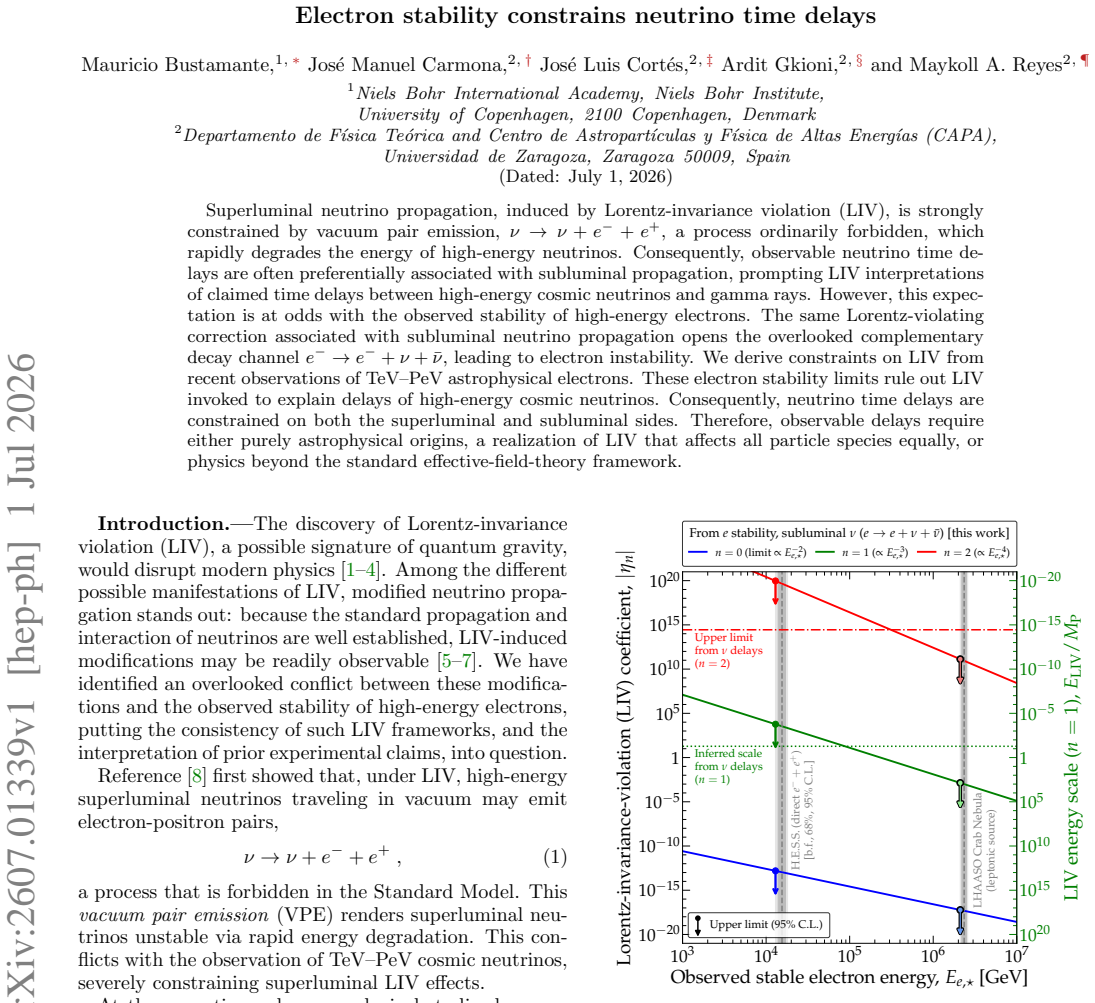
Electron stability rules out LIV explanation for neutrino delays

by Mauricio Bustamante, José Manuel Carmona +3 more

Electron stability constrains neutrino time delays

The violation term slowing neutrinos would also destabilize high-energy electrons, contradicting observations.

Figure from the paper full image
abstract click to expand
Superluminal neutrino propagation, induced by Lorentz-invariance violation (LIV), is strongly constrained by vacuum pair emission, $\nu \to \nu + e^- + e^+$, a process ordinarily forbidden, which rapidly degrades the energy of high-energy neutrinos. Consequently, observable neutrino time delays are often preferentially associated with subluminal propagation, prompting LIV interpretations of claimed time delays between high-energy cosmic neutrinos and gamma rays. However, this expectation is at odds with the observed stability of high-energy electrons. The same Lorentz-violating correction associated with subluminal neutrino propagation opens the overlooked complementary decay channel $e^- \to e^- + \nu + \bar{\nu}$, leading to electron instability. We derive constraints on LIV from recent observations of TeV--PeV astrophysical electrons. These electron stability limits rule out LIV invoked to explain delays of high-energy cosmic neutrinos. Consequently, neutrino time delays are constrained on both the superluminal and subluminal sides. Therefore, observable delays require either purely astrophysical origins, a realization of LIV that affects all particle species equally, or physics beyond the standard effective-field-theory framework.
0
0
astro-ph.HE 2026-07-02

Short GRB 061201 likely from z>2 faint galaxy

by E. Troja, B. O'Connor +5 more

A possible high-redshift origin for the short GRB 061201: implications of a compact binary merger beyond cosmic noon

JWST imaging and afterglow data favor a distant origin over nearby galaxy associations with large offsets.

Figure from the paper full image
abstract click to expand
Short gamma-ray bursts (GRBs) at redshift z>2 remain exceptionally rare, yet they are crucial for tracing compact binary mergers in the early Universe and understanding their role in the production of r-process elements. GRB 061201 is an unusual and still debated event: although its optical afterglow was accurately localized, no secure coincident host galaxy was identified, and the proposed associations with nearby galaxies all require a large separation between the GRB and its birth site. In this work, we revisit GRB 061201 and argue that the observations are more naturally explained if the burst occurred within a faint F322W2~28.4 AB mag galaxy at z>2. By combining constraints from the afterglow and deep near-infrared imaging from JWST, we show that a distant origin provides a coherent explanation of the burst phenomenology. If confirmed, GRB 061201 would represent one of the most distant short GRBs known, extending the observed compact merger population to an epoch when the Universe was only about two billion years old.
0
0
astro-ph.IM 2026-07-02

Instrument reaches 0.15% polarimetry precision with no moving parts

by Alan M. Watson, Noémie Globus

TEQUILA: Mechanism-free polarimetry for astronomy

On-chip micro-polarizer array enables single-exposure Stokes measurements for point-source transients on a 1.3 m telescope.

Figure from the paper full image
abstract click to expand
TEQUILA (Transient Event $Q$, $U$, and $I$ Light Analyzer) is an optical imaging polarimeter developed for the second Nasmyth port of the 1.3-m COLIBR\'I altitude-azimuth telescope at Observatorio Astron\'omico Nacional in San Pedro M\'artir, M\'exico (OAN-SPM). TEQUILA uses a CMOS sensor with an on-chip wire-grid micro-polarizer array to obtain simultaneous, single-exposure measurements of the Stokes parameters $I$, $Q$, and $U$ without moving optical components. This mechanism-free instrument, built entirely from commercial components, delivers seeing-limited imaging in a fixed optical band and is optimized for early-time follow-up of transient sources, including gamma-ray burst afterglows, blazars, and variable young stellar objects. In this paper, we describe the scientific motivation, the instrument design and implementation, the calibration, and initial science results. Sensor characterization reveals a polarimetric structure in the flat field and a low quantum efficiency, which we estimate to be approximately 17%, including losses introduced by the micro-polarizer array. For point sources, TEQUILA achieves absolute polarimetry with RMS uncertainties of 0.15% in pupil-tracking observations and 0.20% in field-tracking observations. In pupil-tracking mode, the observed RMS is fully explained by the measurement and standard-star uncertainties, with no evidence for an additional calibration term. In contrast, field-tracking observations require an additional calibration uncertainty of approximately 0.10%. Calibration for resolved-source polarimetry remains in progress.
0
0
hep-ph 2026-07-02

No evidence for axions in 257 black hole spins

by Orion Ning, Benjamin R. Safdi +1 more

No Evidence for Superradiant Axions in LIGO-Virgo-KAGRA GWTC-5 Binary Black Hole Spins

LIGO-Virgo-KAGRA GWTC-5 data excludes masses 1.7e-14 to 3.3e-12 eV at 95 percent , one of the strongest robust bounds.

Figure from the paper full image
abstract click to expand
The quantum chromodynamics (QCD) axion and axion-like particles may form bound clouds around spinning black holes (BHs) when their Compton wavelength is comparable to the BH gravitational radius, depleting the BH spin through what is known as a $\textit{superradiance}$ instability. Using binary BH (BBH) spin measurements obtained from the LIGO-Virgo-KAGRA GWTC-5 catalog, the most extensive public BBH catalog to date containing $N=257$ mergers with BH masses spanning roughly $5$-$135$ $M_\odot$, we perform a hierarchical Bayesian analysis in the context of a BH spin population model to constrain ultralight axions. The presence of axions at a given mass would imprint a unique signature in the observed mass-spin relation relative to the formation distribution. We find no evidence for axions across more than two decades in mass, excluding axion masses $1.7 \times 10^{-14} \, {\rm eV} \lesssim m_a \lesssim 3.3 \times 10^{-12} \, {\rm eV}$ at 95% confidence. Because prior superradiance bounds in this range derive from X-ray spin measurements with substantial modeling systematics, this result represents one of the strongest robust lower bounds on the QCD axion mass.
0
0
gr-qc 2026-07-02

LISA orbit errors limit response mismatches to below 10^{-7}

by Lorenzo Speri, Olaf Hartwig +6 more

Impact of Spacecraft Orbit Uncertainties and Velocity Mismodeling on the LISA Gravitational-Wave Response

Velocity mismodeling at 10^{-4} Hz produces 10^{-4} mismatches but keeps galactic binary biases under 1 sigma

Figure from the paper full image
abstract click to expand
The Laser Interferometer Space Antenna (LISA) is a space-based gravitational wave observatory that consists of three spacecraft in a near-equilateral triangular formation. The spacecraft orbits are typically assumed to be perfectly known in LISA data analysis studies, but in reality, the orbit determination process introduces uncertainties in the spacecraft positions and velocities. In this work, we investigate how these uncertainties propagate into the LISA detector output and the impact of neglecting the spacecraft velocities. We quantify these errors in the knowledge of the LISA response using mismatches and discuss the implications for gravitational wave data analysis. We find that spacecraft orbit uncertainties impact the LISA response knowledge at high frequencies with worst mismatch below $10^{-7}$. The effect of neglecting the spacecraft velocities is largest at frequencies around $10^{-4}$ Hz with mismatches of order $10^{-4}$. For a galactic binary with frequency $10^{-4}$ Hz and SNR=200 observed for one year, we find that neglecting the spacecraft velocities in the response leads to less than 1-$\sigma$ biases in the parameter estimates. This work provides the first characterization of how errors in the LISA gravitational wave response propagate from gravitational wave strain through detector output to estimated parameters.
0
0
astro-ph.HE 2026-07-02

Beta transport cuts kilonova heating efficiency in inner and outer ejecta

by Zachary L. Andalman, Christopher L. Fryer +3 more

Beta-Particle Transport and Thermalization in Kilonova Ejecta with Detailed Atomic Microphysics

Non-local deposition and escape lower thermalization versus local models; secondary electrons boost ionization and analytic fixes are suppli

Figure from the paper full image
abstract click to expand
When two neutron stars collide, they eject material containing heavy nuclei formed by the rapid neutron capture process ($r$-process). As these nuclei decay, they power a bright optical/near-infrared transient known as a kilonova (KN). Modeling KN emission is a complex problem involving atomic opacities, radiation transport, and heating powered by the thermalization of radioactive decay products like $\gamma$-rays, $\alpha$-particles, and $\beta$-particles. For heating by $\gamma$-rays, many KN modeling codes do full radiation transport calculations. However, heating by $\alpha$- and $\beta$-particles relies on simplified descriptions of collisions and transport, and remains an important source of uncertainty in KN models. In this paper, we study the thermalization and transport of $\beta$-particles. To study thermalization, we use evaluated atomic physics data to estimate per-species contributions to energy deposition, scattering, and electron impact ionization, which we make available online. To include non-local effects, we develop a fully relativistic framework for charged particle transport in a spherically symmetric, homologously expanding ejecta, considering two limiting magnetic-field geometries. Non-local energy deposition and escape reduce thermalization efficiency, especially in the innermost and outermost ejecta, lowering the ejecta temperature and ionization state compared to local deposition models. Coulomb scattering partially offsets these effects by trapping particles at intermediate times. Ionization by secondary electrons significantly enhances the overall ionization rate. We provide analytic prescriptions for the spatially dependent thermalization efficiency for use in future light-curve calculations. Our results demonstrate that evaluated atomic data and charged-particle transport should be incorporated into the next generation of KN models.
0
0
astro-ph.HE 2026-07-02

High-spin black hole masses trace low-spin merger remnants

by Yin-Jie Li, Yuan-Zhu Wang +2 more

Smoking-gun evidence for hierarchical black-hole mergers

Peak-by-peak match in 259 events shows high-spin black holes form via successive mergers rather than isolated processes.

Figure from the paper full image
abstract click to expand
How stellar-mass black holes grow after their birth is a central open question in astrophysics. Gravitational-wave observations have revealed a subpopulation of coalescing black holes with both high masses and high spins, but whether these properties arise from hierarchical mergers in dense stellar environments or from accretion onto isolated black holes has remained unresolved. Here, using a flexible mixture population model applied to the 259 binary black hole mergers in GWTC-5, we show that the mass function of the high-spin subpopulation traces, peak by peak, the predicted remnant-mass distribution of the low-spin, stellar-collapse-origin subpopulation up to $\sim80\,M_\odot$. This morphological match, quantified by a Bhattacharyya coefficient as high as $\sim0.95$, is naturally expected if the high-spin black holes are themselves the products of earlier mergers, whereas any alternative scenario would require fine-tuning, thereby providing smoking-gun evidence for hierarchical mergers. In addition, the sharp upper-mass cutoff of the low-spin subpopulation at $m_{\rm max,1}=54.2^{+7.7}_{-7.2}\,M_\odot$ yields an astrophysical $S$-factor of $S_{300}=151^{+30}_{-26}$~keV~b (68\% credible interval) for the $^{12}{\rm C}(\alpha,\gamma)^{16}{\rm O}$ reaction, in agreement with the benchmark theoretical value. These results establish that the entire observed black-hole population can be accounted for by stellar collapse followed by dynamical hierarchical assembly, without invoking primordial black holes.
0
0
astro-ph.HE 2026-07-02

SVOM begins full characterization of gamma-ray bursts

by F. Daigne, D. Turpin +35 more

First Gamma-Ray Burst Observations with SVOM

Early sample includes prompt emission, afterglows and distances for long, short and X-ray flash events.

abstract click to expand
Following its launch on 22 June 2024, the Space-based multi-band astronomical Variable Objects Monitor (SVOM) successfully completed its flight acceptance, commissioning, and scientific validation phases in early 2025, during which several tens of gamma-ray bursts (GRBs) were detected onboard. Three quarters of these events have also been detected by other satellites, and a quarter are SVOM-only GRBs. In this article, we describe these early GRB observations, with a first description of the SVOM GRB sample that is emerging, and of the level of characterisation already achieved, and with a focus on a few events of particular interest. These early results are very encouraging regarding SVOM's ability to detect and fully characterise (including prompt emission, afterglow and distance) a wide range of GRBs (classical long GRBs, short GRBs, X-Ray Flashes, etc.) and to enable the use of these extreme high-energy transients as probes of the distant Universe.
0
0
astro-ph.HE 2026-07-02

SVOM detects hundreds of X-ray sources beyond its GRB mission

by A. Coleiro, L. Tao +45 more

Early results from the SVOM Observatory Science program

Early observations show the observatory tracking microquasars, blazar flares and stellar activity with its wide-field instruments.

abstract click to expand
We present the organisation and early results from the Observatory Science program of the Space-based multi-band astronomical Variable Objects Monitor (SVOM), based on data collected between July 2024 and December 2025. Although primarily designed for gamma-ray burst studies, SVOM's wide-field, multi-wavelength instruments enable a broad range of high-energy astrophysical investigations. We summarize the execution and performance of the General Program and Target-of-Opportunity observations, and we describe the frameworks used for serendipitous source detection and monitoring with the ECLAIRs coded-mask instrument. Over this period, SVOM carried out more than a thousand pointed observations and detected several hundred non-GRB high-energy sources, mainly X-ray binaries, as well as blazars, stellar flares, magnetars, and unidentified events. We highlight some key results, including the monitoring of the microquasar Cygnus X-1, the detection of burst oscillations from the Low-Mass X-ray Binary 4U 0614+091, the spectral-state monitoring of Aql X-1, the first SVOM detection of an X-ray blazar flare from 1ES 1959+650, and observations of a stellar flare from HD 22468. These results demonstrate SVOM's strong capabilities for time-domain astrophysics beyond its core GRB program.
0
0
astro-ph.HE 2026-07-02

SN 2024jlc bridges SLSNe to stripped-envelope supernovae

by A. Simongini, F. Acero +16 more

Bridging the gap between SLSNe and SE-SNe. Multi-wavelength analysis of the SLSN-Ib SN 2024jlc

Multi-wavelength data and marginal gamma-ray signal suggest the two classes differ mainly in powering mechanism.

Figure from the paper full image
abstract click to expand
The Type I super-luminous supernova SN~2024jlc (ZTF24aapadbb) exploded on the 25th of May 2024 at $z = 0.039$. Being the closest supernova of this class discovered in recent years and one of the closest ever, represented a rare opportunity to study in detail this type of objects. We performed a multi-wavelength analysis, spanning ten orders of magnitude in frequency, including optical/UV photometry and spectroscopy, soft and hard X-rays, and high-energy $\gamma$-rays. We characterized the event as a slow-evolving and He-rich supernova, with one of the lowest peak luminosities reported for a super-luminous event $M_g\sim-19.37$ mag, and a light curve evolution compatible with both circumstellar interaction and magnetar spin-down models, with noticeable contribution from $^{56}$Ni decay. No significant excess was found in the soft and hard X-ray bands, for which we provide upper-limits on the flux. Additionally, we analyzed two years of \textit{Fermi}-LAT data, from which we report an intriguing hint of a $\gamma$-ray signal at the $\sim 3.6 \sigma$ level, although no firm detection can be claimed. The gamma to optical efficiency ratio, $\eta = 0.38$, is suggestive of the presence of a central-engine scenario, similar to SN~2017egm. Our analysis suggests that SN~2024jlc could bridge the gap between SLSNe and classical stripped-envelope supernovae. While still poorly populated, this bridge could consist of all SLSN-Ib supernovae, with the key difference residing in the powering mechanism.
0
0
gr-qc 2026-07-02

Thick disks yield distinct black hole image features

by Bing-Bing Chen, Chen-Yu Yang +2 more

Horizon-scale intensity and polarization images of rotating Konoplya-Zhidenko black holes with thick accretion flows

Intensity and polarization patterns from deformed rotating black holes differ from thin-disk cases and can probe spacetime geometry.

Figure from the paper full image
abstract click to expand
We investigate the shadow and polarization images of a Konoplya-Zhidenko rotating non-Kerr black hole surrounded by a geometrically thick and optically thin accretion flow. The accretion flow is described by an analytical ballistic approximation accretion flow model. The numerical results show that the shadow image exhibits two main features, an outer bright ring and an inner dark region. The former corresponds to higher order images, while the latter is produced by the black hole event horizon. Increasing the deformation parameter $\eta$ does not significantly change the overall shape of the higher order images, but it enlarges their size. Increasing the spin parameter $a$ and the observer inclination angle $\theta_o$ enhances the asymmetry of the higher order images and makes the intensity on the left side much larger than that on the right side. This behavior is associated with frame dragging and the relativistic Doppler effect. In the polarization images, the degree of linear polarization is much smaller in the higher-order image region than in other regions, and the polarization vectors extend over the whole image plane. These results indicate that the thick disk model produces features in both intensity and polarization images that differ markedly from those in thin disk models. Within the framework used in this work, the observed intensity and polarization signatures can serve as effective probes of the underlying spacetime geometry and near horizon accretion dynamics.
0
0
physics.atom-ph 2026-07-02

Oxygen Kα resonance fixed at 554.372 eV with isotope shift resolved

by Jonas Danisch, Marc Botz +16 more

Parts-per-million-accurate determination of the K{α} photoionization resonance of Be-like oxygen with resolution of its ¹⁶O-¹⁸O isotopic shift

Measurement pins inner-shell transition in four-electron oxygen ions and separates the 2.2 meV difference between ¹⁶O and ¹⁸O.

Figure from the paper full image
abstract click to expand
We determine with high accuracy the energy of the inner-shell transition $1s^2 2s^2~{}^1\mathrm{S}_0 \rightarrow 1s~2s^2~2p_{3/2}~{}^1\mathrm{P}_1$ ${}^{16}\mathrm{O}_{K\alpha}^{4+}$ at $554.372(3)~\mathrm{eV}$ ($\lambda$ = $22.36480(12)~\unicode{x212B}$) as well as its small shift of $2.2 \pm 1.3~\mathrm{meV}$ ($\Delta \lambda$ = $0.089(52)~\mathrm{m}\unicode{x212B}$) for the ${}^{18}\mathrm{O}$ isotope. This transition blends with a $K_\alpha$ line of $\mathrm{O}^{5+}$ used in astrophysical diagnostics, potentially affecting its reliability. In contrast to our experimental uncertainty of $\pm 3~\mathrm{meV}$, advanced electronic structure predictions for this four-electron system, including quantum electrodynamic (QED) corrections on the order of $100~\mathrm{meV}$, still scatter by more than $\pm 250~\mathrm{meV}$. Ions generated and stored in an electron beam ion trap were excited at the ELETTRA synchrotron facility with monochromatic soft x rays, with photon energies corrected by an additional spectrometer. Upon resonant excitation of $\mathrm{O}^{4+}$ and subsequent autoionization, we separate the photoions of each isotope by a time-of-flight measurement. This way, we resolve soft x-ray isotopic shifts of a few meV, obtain very accurate data on an essential astrophysical ion, and test calculations down to the level of QED contributions.
0
0
astro-ph.HE 2026-07-02

Mirror dark matter lowers neutron star maximum masses

by Adamu Issifu, Constança Providência +3 more

A self-consistent single-fluid framework for neutron stars admixed with mirror dark matter

Self-consistent model shows interaction softens EOS, raises central densities and shifts cooling onsets depending on symmetry energy.

Figure from the paper full image
abstract click to expand
We develop a self-consistent framework based on a contact vector current-current interaction that couples the chemical potentials of both sectors through mutual mean-field shifts, with the dark matter (DM) fraction $F_D = N_D/N_B$ fixed as a global input parameter. This formulation provides a physically motivated alternative to fixed-density prescriptions, allowing the local DM density to follow the baryonic matter (BM) density throughout the stellar interior. As an application, we consider a mirror-DM scenario with exact symmetry between the dark and visible sectors and investigate NS matter using the NL3$\omega\rho$, FSU2R, NL3, and DDME2 equations of state (EOSs). We find that the DM--BM interaction weakens the binding of dense matter, reduces its incompressibility, and softens the EOS. Consequently, DM increases the central density and compactness of NSs, lowers their maximum masses, and shifts the onset of the direct Urca process to higher stellar densities. As a consequence, the onset of rapid cooling is shifted to more massive stars for models with a stiff symmetry energy and to less massive stars for models with a soft symmetry energy, depending on the extra compactness that results from the DM admixture. These results demonstrate that mirror-DM admixtures modify both the microscopic composition and macroscopic structure of NSs, with potential implications for their thermal evolution and multimessenger observational signatures.
0
0
hep-ph 2026-07-02

DM scattering matches star luminosity near black hole at 10^{-36} cm²

by Stephan A. Meighen-Berger, R. Andrew Gustafson +4 more

Dark matter energy exchange in stars orbiting supermassive black holes

Orbit-averaged exchange in spiked profiles equals stellar output for small cross sections, providing annihilation-free dark star route.

Figure from the paper full image
abstract click to expand
Stars on tight orbits around the supermassive black hole at the Galactic Center pass through regions where the dark matter~(DM) density may be strongly enhanced. We compute the orbit-averaged DM-induced energy exchange for S4714 as an example. It is a star on an exceptionally close and relativistic orbit around Sagittarius~A*. For a spiked dark matter profile, the exchange reaches the stellar luminosity at $\sigma_{\chi p} \sim 10^{-36}~\mathrm{cm}^2$ for MeV-GeV masses and $\sigma_{\chi e} \sim 5\times10^{-38}~\mathrm{cm}^2$ for sub-MeV masses, opening a new annihilation-free route toward dark-star phases. These cross sections lie within the range predicted by freeze-in scenarios and are consistent with cosmic-ray--boosted and solar-reflection dark matter constraints.
0
0
astro-ph.HE 2026-07-02

SKAO surveys to discover thousands of pulsars

by Bhal Chandra Joshi, Aris Karastergiou +1 more

Pulsar Science with the SKAO

High-sensitivity telescopes will support deep observations feeding tests of gravity, nano-Hz waves and nuclear matter.

Figure from the paper full image
abstract click to expand
The large instantaneous sensitivity, wide frequency coverage and flexible observation modes, with large number of beams in the sky, are the main features of the SKA observatory's two telescopes, the SKA-Low and the SKA-Mid. Owing to these capabilities, the SKAO telescopes are going to be a game-changer for radio astronomy in general and pulsar astronomy in particular. Eleven chapters in this book describe their impact on different areas of pulsar science. In this overview article each chapter is briefly summarised and the inter-relationship between different pulsar science use cases are explored: new deep surveys, covering the Galactic field, globular clusters and the Galactic centre, will discover thousands of new pulsars; these will form the backbone for studies of neutron star physics and of their environments. The enhanced understanding provided by these studies will feed into the main contributions to fundamental physics from pulsar astronomy: testing relativistic gravity, studying gravitational waves in the nano-Hz regime and studying the equation of state of nuclear matter. Synergies with other science cases are also highlighted throughout this overview.
0
0
astro-ph.HE 2026-07-02

Spin data split black hole mergers into two populations at 15 solar masses

by Elizabeth Flanagan, Jakob Stegmann +4 more

Distinct spin properties and astrophysical origin of low mass binary black holes in gravitational wave data

Low-mass pairs near 10 solar masses show narrower spins with negative support, unlike higher-mass ones, matching field multiples with large

Figure from the paper full image
abstract click to expand
We analyze the effective-spin distribution of binary black hole mergers in GWTC-5.0 as a function of primary black hole mass using hierarchical Bayesian inference. We model the population as a mixture of two spin components separated by a transition mass scale inferred directly from the data. We find strong evidence for a transition at $\tilde{m} = 15.2^{+4.3}_{-3.6}\, M_\odot$. Mock-catalog analyses show that such a transition is unlikely to arise from finite-sample fluctuations of a mass-independent $\chi_{\rm eff}$ population and the posterior predictive distributions of $\chi_{\rm eff}$ inferred below and above the transition are clearly distinct. Below the transition mass, the effective-spin distribution is narrow, peaks at a small positive value $\chi_{\rm eff}>0$, but also shows significant support for negative $\chi_{\rm eff}$. Above the transition, the distribution is broader and its peak shifts to values consistent with $\chi_{\rm eff}\simeq0$, making its support at both positive and negative $\chi_{\rm eff}$ roughly similar. These findings suggest that the dominant merger population concentrated around $10\,M_{\odot}$ is statistically distinct from the rest and that it arises from a different formation channel. We show that this low-mass population is broadly consistent with formation from massive stellar multiples in the field: it may either arise from isolated binary star evolution but only if black hole natal kicks below $\tilde{m}$ are generally very large ($\gtrsim100\,\rm km/s$) or be caused by the dynamical evolution of hierarchical triples. In contrast, isolated binary evolution with standard fallback kick models cannot reproduce the support for negative $\chi_{\rm eff}$.
0
0
astro-ph.HE 2026-07-02

FRB scattering changes on millisecond scales point to Be star wind

by T. Dial, A. T. Deller +9 more

FRB20250613A: a remarkable repeating FRB with apparent millisecond-timescale scattering variations

Analysis of FRB20250613A shows rapid propagation variations and RM shifts best explained by a nearby turbulent screen from a stellar compani

Figure from the paper full image
abstract click to expand
FRB20250613A is a repeating FRB discovered by the Australian SKA Pathfinder and localised to a low-metallicity dwarf galaxy at a redshift of $z = 0.0987 \pm 0.0001$. FRB 20250613A exhibits a plethora of exotic features that likely overlay the imprint of the circum-burst environment on some intrinsic features of the source. Here we perform a comprehensive analysis of bursts detected by ASKAP, MeerKAT, and the Murriyang Parkes radio telescopes. Bursts during the MeerKAT epoch show a large apparent variance in scattering on timescales of minutes to hours. Polarimetric analysis of the full sample shows spectral depolarisation with variability on timescales of days and changes in rotation measure of $\sim$ 300 rad m$^{-2}$ over days to months. This suggests a highly turbulent magneto-ionised environment. We find significant preference for separations of $\sim$6.8$\pm$0.8 ms in multi-component bursts that we suggest is likely intrinsic to the burst emission mechanism. Finally, we find that a subset of bursts exhibit variations in these propagation effects on burst components separated by just milliseconds, that are difficult to explain by changing sightlines, but plausibly due to non-linear plasma effects in the circum-burst environment caused by the high field strength of the FRB emission. These properties, which demand a nearby turbulent screen of material, are all consistent with the FRB progenitor being embedded in the dense stellar wind of a Be star binary companion, objects which are relatively plentiful in low-mass and low-metallicity galaxies like the FRB20250613A host.
0
0
astro-ph.HE 2026-07-02

SNe Ibn, Icn and FBOTs share CSM interaction parameters

by Kang-Rui Ni, Yu-Hao Zhang +3 more

Mapping the Dense Circumstellar Environments of SNe Ibn, SNe Icn, and Fast Blue Optical Transients

Analysis of 25 light curves shows overlapping ejecta and circumstellar properties, with only the fastest FBOTs falling outside the common mo

Figure from the paper full image
abstract click to expand
SNe Ibn and SNe Icn are stripped-envelope explosions whose optical emission is commonly linked to interaction with H-poor circumstellar material (CSM), whereas fast blue optical transients (FBOTs) form an observational class of rapidly evolving, blue, and luminous events with diverse proposed power sources. We present a uniform comparison of these transients to test whether they are separated in optical light-curve and fitted physical parameter space. We compile multiband optical light curves of 25 SNe Ibn, SNe Icn, and FBOTs, measure same-band observables with Gaussian-process reconstructions, and model the data with the unified \texttt{TransFit-CSM} framework. In the observed (g)-band peak-luminosity--rise-time and decline--rise-time planes, the three classes are not cleanly separated: FBOTs preferentially occupy the luminous and rapidly evolving end of the distribution, but show limited overlap with part of the Ibn/Icn population. Their extinction-corrected peak colors span a broadly overlapping blue region, with FBOTs extending to bluer colors. Unified CSM-interaction fits, including shock heating and an effective inner heating component, yield overlapping CSM and ejecta parameter distributions. These results indicate that the optical light curves of SNe Ibn, SNe Icn, and at least some FBOTs can be compared within a common dense-CSM interaction framework, while the most extreme FBOTs may still require additional power sources or non-thermal components.
0
0
astro-ph.HE 2026-07-02

Heavy-element dust explains late kilonova infrared glow

by Nanae Domoto, Kenta Hotokezaka +1 more

Heavy element dust explains the late-time spectra of kilonovae

Kinetic models show refractory grains from Zr, W and Os produce the emission seen below 1000 K in AT2017gfo and similar events

Figure from the paper full image
abstract click to expand
Neutron star mergers are a leading site of $r$-process, producing radioactively powered optical and infrared transients known as kilonovae. Observations of the kilonovae AT2017gfo, associated with the gravitational-wave event GW170817, and AT2023vfi, associated with GRB 230307A, have enabled measurements of the mass of ejected $r$-process material and the identification of heavy elements in the ejecta. However, late-time observations reveal strong infrared emission with temperature below 1000 K, which is difficult to explain by atomic absorption and emission processes alone. In this paper, we show that kilonova ejecta provide conditions favorable for the formation of dust grains composed of refractory $r$-process elements including Zr, W, and Os. We calculate the kinetic formation of dust grains using reaction rate coefficients of W as a proxy, finding that dust forms efficiently, particularly in slow ejecta. This stands in contrast to a previous study that relied on a classical nucleation framework. By performing radiative transfer simulations that incorporate dust formation, we demonstrate that $r$-process dust naturally explains the observed late-time infrared emission. The formation and abundance of $r$-process dust are highly sensitive to the ejecta mass, composition, and expansion velocity. Infrared emission from $r$-process dust can therefore serve a new probe of heavy-element production in neutron star mergers.
0
0
astro-ph.HE 2026-07-02

Nearly equal-mass black hole pair fits 173-day microlensing in lensed quasar

by Changshuo Yan, Youjun Lu +2 more

An equal mass ratio supermassive binary black holes in Q J0158-4325 with periodic microlensing signature?

Triple-disk model with total mass 10^9.5 solar masses matches both light curve periodicity and UV-optical spectrum of Q J0158-4325.

Figure from the paper full image
abstract click to expand
This study aims to test whether a supermassive binary black hole (SMBBH) system with a triple-disk accretion structure can explain the observed $\sim$173-day periodic microlensing variations and spectral energy distribution (SED) of the gravitationally lensed quasar Q J0158-4325. We construct a triple-disk model for the SMBBH system, incorporating realistic accretion disk structures, orbital motion, and microlensing effects. The model is used to simulate optical and X-ray microlensing light curves and SEDs, which are compared with long-term optical monitoring, X-ray observations, and UV-optical spectra from HST and XSHOOTER. Bayesian analysis and MCMC fitting are applied to constrain model parameters. The model successfully reproduces the periodic microlensing variations. Combined light curve and SED fitting favor a high mass ratio ($q>0.5$) SMBBH system with total mass $\sim 10^{9.5}M_\odot$, and nearly equal-mass binaries ($q\sim1$) provides the best agreement with both the optical/UV spectrum and the microlensing signal. This model predicts larger X-ray microlensing amplitudes than in the optical, but, the available X-ray observations lack the precision needed to place strong constraints. We emphasize the need for future high-cadence monitoring to resolve remaining uncertainties. This study demonstrates the effectiveness of combining multi-wavelength microlensing signatures with spectral modeling to provide robust constraints on SMBBH systems, with the developed framework applicable to other lensed quasars for identifying and characterizing candidate SMBBHs.
0
0
astro-ph.HE 2026-07-02

Companion interaction cannot explain asymmetric SNR expansion rates

by Jingxiao Luo, Gilles Ferrand +3 more

Three-Dimensional Simulations of Type Ia Supernova Remnants I: Effects of a Main-Sequence Companion Star

3D models of Type Ia ejecta colliding with a main-sequence star reproduce some remnant shapes but fall short on the large velocity differenc

abstract click to expand
Type Ia supernovae (SNe Ia) serve as one of cosmic standard candles, but their exact progenitor channel is still an open question. SNe Ia commonly come from binary star evolution. Therefore, one of the major differences among the proposed progenitor channels is whether there is a more-or-less intact companion star remaining at the time of explosion, which causes the SN ejecta to be more asymmetrical. As the SN ejecta evolved into supernovae remnants (SNR), the imprint formed by the companion interaction may affect the morphology of the SNR. In addition, the progenitor systems may have experienced different mass transfer histories and therefore led to formation of different circumstellar material (CSM) environments, which may also affect the early evolution of SNR. In this study, we use GADGET and RAMSES codes to simulate these physical effects and follow the evolution into early-phases of SNRs. In our simulations, we consider different ejecta models and track the element distribution. We compare our simulation with actual observations and conclude that despite some SNRs having morphology resemblance to our simulation results, their highly asymmetric expansion rates are hard to explain by interaction between SN ejecta and a companion star alone.
0
0
astro-ph.HE 2026-07-02

Mass ratio sets period of microlensing fluctuations in binary black holes

by Changshuo Yan, Youjun Lu

Multiwavelength periodic microlensing signatures of macrolensed supermassive binary black holes

Equal-mass pairs vary at half the orbital period while low-mass-ratio pairs follow the full period, with larger amplitudes at shorter wavele

abstract click to expand
The microlensing of lensed quasars presents a promising avenue for understanding the structure of accretion disks around supermassive binary black holes (SMBBHs). We investigated the microlensing signatures in multiband (optical, UV, and X-ray) light curves of active SMBBH systems, focusing on how these signatures depend on the mass ratio, separation, and accretion rate. We analyzed the periodic fluctuations in microlensing light curves induced by the orbital motion of SMBBHs. We examined the relation between the mass ratio and the period of variations in light curves across optical, UV, and X-ray bands. We find that the periodic fluctuations in the light curves depend on the mass ratio of the black holes: for nearly equal masses, variations occur at half the orbital period, whereas for low mass ratios, the period corresponds to the orbital period influenced by the secondary mini-disk. Furthermore, all optical, UV, and X-ray light curves exhibit the same period and phase, but the amplitude of variation is greater in the UV and X-ray bands than in the optical bands. These light curves provide insights into the motion and radiation regions of the disks through wavelength-dependent periodic variations, although they yield limited constraints on the system's black hole mass or Eddington ratio, which can instead be derived from the spectral energy distribution (SED). Integrating microlensing data with SED observations is crucial for accurately constraining the parameters of SMBBH systems.
0
0
astro-ph.HE 2026-07-01

Future UHE data shift preference to hadronic model for HESS J1825-137

by Rubens Costa Jr., R. C. Anjos

Constraining leptonic and hadronic gamma-ray emission from HESS J1825-137 and its environment

Baseline GeV-TeV observations support purely leptonic emission while simulated CTAO and LHAASO points favor adding a proton component.

Figure from the paper full image
abstract click to expand
We present a broadband spectral analysis of the $\gamma$-ray emission from the pulsar wind nebula HESS~J1825$-$137, combining observations from Fermi Large Area Telescope (\textit{Fermi}-LAT), High Energy Stereoscopic System (H.E.S.S.), High-Altitude Water Cherenkov Observatory (HAWC), and Very Energetic Radiation Imaging Telescope Array System (VERITAS) across the $\sim 0.1$~GeV--$160$~TeV energy range. The spectral energy distribution is modelled under purely leptonic, purely hadronic, and lepto-hadronic scenarios using the \textsc{Naima} radiative modeling framework with Markov Chain Monte Carlo parameter estimation. Model comparison via the Bayesian Information Criterion reveals that the baseline GeV--TeV data favour a purely leptonic interpretation, while the inclusion of simulated Cherenkov Telescope Array Observatory (CTAO) observations or Large High Altitude Air Shower Observatory (LHAASO) ultra-high-energy (UHE; $E_{\gamma} \ge 100\,\mathrm{TeV}$) measurements shifts the preference toward models incorporating a hadronic component ($\Delta\mathrm{BIC} = -28.87$ and $-7.89$, respectively). The inferred electron energy budget for the baseline GeV--TeV dataset, $W_e = 4.25 \times 10^{48}$~erg, is consistent with previous estimates reported in the literature. The proton energy budget, $W_p \approx 2.5 \times 10^{48}$~erg, is energetically compatible with $pp$ interactions in the dense molecular environment adjacent to the nebula. These results demonstrate that precise spectral measurements above $\sim 10$~TeV, where Klein--Nishina suppression of inverse Compton emission creates a window for hadronic processes, are essential to establish the dominant emission mechanism in this source.
0
0
astro-ph.IM 2026-07-01

Multimodal inputs raise ZTF transient classification F1 by up to 40%

by Ved G. Shah, Nabeel Rehemtulla +14 more

Leveraging Multimodality for Real-Time Classification of Transients and Variables found by the Zwicky Transient Facility

ORACLE-2 models reach 0.73 macro F1 on real ZTF data and 0.88 on simulations, showing largest gains at early times when light curves are spa

Figure from the paper full image
abstract click to expand
Modern time-domain surveys such as the Zwicky Transient Facility (ZTF) generate hundreds of thousands of alerts each night, making real-time decisions for follow-up observations a central challenge in time-domain astronomy. Robust early classification is crucial for making informed decisions, but is hindered by sparse light curves and degeneracies between classes. In this work, we leverage multimodality to substantially improve real-time classification and demonstrate the practicality of our approach by deploying our model on the ZTF alert stream. Building on the Online Ranked Astrophysical CLass Estimator (ORACLE), we introduce the ORACLE-2 models, which combine light curves, metadata, and images for real-time hierarchical classification. Using both real and simulated datasets, we show that incorporating additional modalities consistently improves classification performance. On observations from ZTF's Bright Transient Survey, our best-performing model, ORACLE-2 Omni, achieves a macro F1 score of 0.73 -- an improvement of up to 11% over models using light curves and metadata alone, and up to 40% over light-curve-only models, with the strongest gains realized at early times. To demonstrate applicability to the Legacy Survey of Space and Time, which will increase alert volume by more than an order of magnitude, we train a light curve + metadata variant on the simulated ELAsTiCC dataset. This model achieves a macro F1 score of 0.88, an improvement of up to 13% over the light-curve-only variant, matching the performance of other state-of-the-art models. Finally, we quantify the trade-offs between performance and throughput, identifying regimes where multimodal approaches offer the greatest benefit. These results show that combining multiple modalities improves early-time classification, enabling more effective triage of high-volume alert streams for current and future time-domain surveys.
0
0
astro-ph.HE 2026-07-01

X-ray spectrum of V4641 Sgr reveals multiphase disk atmosphere

by Zuobin Zhang, Rob Fender +12 more

Dense, multi-phase accretion disk atmosphere in the low-luminosity state of black hole transientV4641 Sgr

Narrow N and O lines require two dense photoionized components extending radially in the accretion flow

Figure from the paper full image
abstract click to expand
We present soft X-ray spectroscopy of the black-hole X-ray binary V4641~Sgr with the \textit{XMM-Newton} Reflection Grating Spectrometer (RGS). The RGS spectrum shows narrow emission features from N\,\textsc{vi--vii} and O\,\textsc{vii--viii} superimposed on a partially covered disk blackbody continuum. A blind Gaussian search confirms the presence of significant lines at the expected rest wavelengths. He-like triplet ratios (high $G$, low $R$) and full photoionization modelling both indicate a dense, photoionized plasma. Small redshifted velocities of $\sim 540$--$720\ \mathrm{km\ s^{-1}}$ are suggested, which are consistent with quasi-static or slowly flowing gas away from the observer after accounting for systematics. Photoionization modelling requires two \textsc{xstar} components with an intermediate ionization parameter ($\log\xi \simeq 3.1$) and a low ionization parameter ($\log\xi \simeq 0.36$), respectively. The simultaneous EPIC-pn spectrum suggests highly ionized Fe emission structures, hinting at an additional, more highly ionized component. These results imply the existence of a radially extended, multiphase, and dense disk atmosphere in the source. We compare the source with other X-ray binaries showing similar emission lines. V4641~Sgr shares a similarly high inclination with other sources; however, the presence of low ionization emission lines distinguishes it from the rest.
0
0
astro-ph.HE 2026-07-01

Double-bump showers constrain cosmic ray masses

by Stijn Buitink, Vital De Henau +29 more

Anomalous Air Showers and What They Reveal About Hadronic Interactions and Cosmic-ray Masses

SKA-Low resolves secondary bumps to test hadronic models and composition in the 10^16-10^18 eV transition.

Figure from the paper full image
abstract click to expand
The identification of the sources and acceleration mechanisms of cosmic rays require precise measurements of their mass composition. Currently, the most reliable method is to measure the atmospheric depth at which cosmic ray air showers in our atmosphere reach their maximum (\Xmax). However, the hadronic interaction properties that govern the longitudinal development of air showers are not precisely known, which is a major source of systematic uncertainty on the mass composition. SKA-Low will observe cosmic rays in the 10$^{16}$ - 10$^{18}$ eV energy range with unprecedented resolution and bandwidth. This allows for a much more detailed reconstruction of the longitudinal shower evolution, which can be used to gain better understanding of the hadronic interactions, as well as the primary mass composition. After the first interaction of the cosmic ray with an atom in an air molecule, the secondary particles still carry a significant fraction of the total energy. When one of these particle travels very far before interacting again, it produces a sub-shower that can be recognized as a secondary bump in the longitudinal profile. Simulations have demonstrated that SKA-Low can resolve such double bump profiles by virtue of its high antenna density and broad bandwidth. In this chapter, we demonstrate how double-bump showers and other anomalous longitudinal developments can be used to constrain hadronic interaction properties, and to determine the mass composition of cosmic rays in the Galactic-to-extragalactic transition region.
0
0
astro-ph.HE 2026-07-01

JWST spectra link calcium-strong supernova to white-dwarf explosion

by Saarah Hall, Lindsey A. Kwok +30 more

JWST Observations of Calcium-Strong Transients: I. Complex Nebular He Emission in SN 2024uj

Early calcium and asymmetric helium lines match thermonuclear models but not core-collapse ones for SN 2024uj.

Figure from the paper full image
abstract click to expand
We present the first JWST observations of a Calcium-Strong Transient (CaST), SN 2024uj, a rare class of supernovae (SNe) with observable properties that are consistent with both thermonuclear explosions of white dwarfs (WDs) and the core collapse of massive stars. SN 2024uj is offset by $\sim6.6$ kpc from its host and exhibits a double-peaked light curve consistent with shock cooling of nearby circumstellar material. At early times, its optical spectra resemble those of normal SNe Ib, but strong [Ca II] $\lambda\lambda$7291, 7324 emission emerges between $+$2 and $+$17 days after maximum light. Radiative-transfer models of a massive stripped He star cannot reproduce this early forbidden Ca emission, even with artificially enhanced surface Ca, whereas it arises naturally in thermonuclear scenarios. The $+$150 d JWST/NIRSpec spectrum reveals highly asymmetric, multicomponent He I at both 1.083 and 2.058 $\mu$m. The He extends to $\gtrsim+$5000 km/s, with a strong, narrow peak at $+$1500 km/s, indicating that He is distributed throughout the ejecta with a concentration offset from center. This He distribution overlaps central [Ca II] and [O I], implying a degree of mixing difficult to produce in a massive star explosion. The He peak might further trace interaction with a shocked, ejected companion in a thermonuclear system. The NIRSpec spectrum also shows molecular CO emission and a rising continuum that, together with a 10 $\mu$m photometric detection, indicates dust emission extending into the mid-infrared. Given the remote environment, early forbidden Ca, mixed He/Ca/O ejecta, and possible companion signature, we favor a thermonuclear origin for SN 2024uj involving at least one low-mass, partially He-rich WD.
0
0
astro-ph.GA 2026-07-01

Eddington ratio alone sets AGN outflow incidence and obscuration

by Carolina Andonie, Andrea Merloni +13 more

AGN radiative feedback as the main regulator of [O III] outflow activity and obscuration in X-ray AGN

Trends with accretion rate survive only when samples are matched on luminosity, pointing to radiation pressure rather than black hole mass.

Figure from the paper full image
abstract click to expand
Large-scale ionised outflows and nuclear obscuration are fundamental manifestations of AGN activity, yet direct observational evidence linking these phenomena remains scarce. We use the eROSITA Final Equatorial Depth Survey, among the largest uniform optical spectroscopic datasets of X-ray AGN, to investigate how AGN accretion rate affects ionised outflow kinematics and X-ray obscuration. Our sample comprises 2.840 AGN at z<0.82 with high-quality SDSS spectra. Through optical spectral fitting, we measure Eddington ratios ($\lambda_{Edd}$) and [O III] emission-line kinematics, tracing ionised outflows. In addition, we use archival eROSITA X-ray spectroscopy with X-ray stacking analyses to constrain the obscuration of the sample, $N_H$. We find that (1) 35% of the entire sample hosts a [O III] outflows ($W_{80}>600$ km/s), with the outflow incidence increasing with the AGN luminosity from 15% at $L_{AGN}<10^{44}$ erg/s up to 60% at $L_{AGN}>10^{46}$ erg/s; (2) the outflow incidence increases with Eddington ratio from 29% at $\log \lambda_{Edd}<-2.3$ to 50% at $\log \lambda_{Edd}>-1.7$; and (3) the AGN obscuration decreases with Eddington ratio, as sources with $\log\lambda_{Edd}>-1.7$ are 5 times less obscured than lower Eddington ratios AGN. In addition, we find that 1% of the sample populates the "forbidden region" of the $N_H-\lambda_{Edd}$ plane, where the outflow incidence peaks at 52%, consistent with a short-lived feedback phase. Notably, when matching the Eddington ratios samples in AGN luminosity, these trends vanish, implying that radiation pressure drives changes in outflow activity and obscuration, while the black hole mass does not play a significant role. Our results are in agreement with AGN radiative feedback scenarios, where the Eddington ratio regulates the AGN environment by driving powerful, galaxy-wide outflows and shaping the amount of circumnuclear material.
0
0
astro-ph.GA 2026-07-01

LRD density drops gently from z~5 peak to z~2

by Shrriya Kapoor, Jorryt Matthee +11 more

Little Red Dots at z~2 in EIGER reveal a gentle decline with respect to their peak number density at z~5

Spectroscopic sample shows they comprise under 3% of AGNs at z=1.9-2.5, milder than photometric surveys reported.

Figure from the paper full image
abstract click to expand
We report the discovery of a sample of little red dots (LRDs) at $z \approx 2$ identified from deep JWST/NIRCam imaging and wide-field slitless spectroscopy over $140$ arcmin$^2$ from the EIGER survey. With an improved blind broad-line identification algorithm, we select 19 sources at spectroscopic redshifts $z = 1.55-3.18$ identified via rest-frame near-infrared lines (Paschen-$\beta$, HeI+Pa$\gamma$ and OI). Based on a range of spectro-photometric criteria, we classify five of these sources as LRDs and the other 14 as classical active galactic nuclei (AGNs). This classification is corroborated by some X-ray detections among the AGNs. Classical AGNs dominate the number counts above optical luminosities M$_{5100}<-22.5$, whereas the LRD fraction among broad-line sources reaches 100 % at M$_{5100}\approx-20$. The LRDs span the range in Balmer break strengths seen in the higher redshift populations. Blue-shifted HeI absorption is detected in the two reddest sources. The HeI/Pa$\gamma$ ratio cleanly separates LRDs from classical AGNs and seems to anti-correlate with Balmer break strength, likely tracing HeI self-absorption at higher gas column densities. Our LRD sample has a similar optical luminosity range as their high-redshift counterparts, corresponding to black hole masses of $\sim10^{6}$ M$_{\odot}$ at the Eddington luminosity. We measure LRD number densities of $\approx 7\times10^{-6}$ cMpc$^{-3}$ at $z = 1.9-2.5$, which indicates that LRDs represent $\lesssim 3$ % of the AGN population at these epochs. Our results confirm the previously reported decline in the LRD number density with respect to $z \approx 5$ based on photometric surveys, although we find the decline to be more gentle than earlier emphasized.
0
0
astro-ph.HE 2026-07-01

ZTF sample pins Type Ia rise at 18.55 days average

by Chang Liu, Adam A. Miller +14 more

Decoding the Early-Time Light Curves of Type Ia Supernovae. II. Population Parameters of One Thousand ZTF Supernovae

972 events show rise-stretch relation splits into two regimes, with high-stretch events tied to outward nickel mixing.

Figure from the paper full image
abstract click to expand
Early-time light curves of Type Ia Supernovae (SNe Ia) encode critical information about their progenitor systems. We characterize the rise of normal SNe Ia using a volume-complete sample of 972 events from the Zwicky Transient Facility Data Release 2, an order of magnitude larger than any previous dataset for similar analyses. Fitting light curves up to $30\%$ of peak flux with a power-law model under a hierarchical Bayesian framework, we provide robust population-level constraints on the rise time ($t_\mathrm{rise}$; $\mu=18.55\pm0.08$ days, $\sigma=1.42\pm0.07$ days), rise index ($\alpha$; $\mu=2.10\pm0.04$, $\sigma=0.48\pm0.03$ in ZTF $r$), and $g-r$ color evolution ($\alpha_g - \alpha_r$; $\mu=0.20\pm0.02$, $\sigma=0.17\pm0.02$). These power-law fits are sensitive to the chosen truncation epoch if data beyond $\sim$$40\%$ of peak flux are included, but generally converge when restricted to earlier epochs. The relation between rise morphology and light-curve width ($\texttt{SALT2}$ $x_1$ stretch) bifurcates into two distinct regimes: high-stretch SNe Ia show clear trends where a higher $x_1$ correlates with shallower rises and more persistent blue colors, whereas low-stretch SNe Ia lack such trends. While rise times correlate positively with $x_1$ overall, this relation flattens significantly within the high-stretch population. Searching for anomalies, we identify several normal SNe Ia with unusually long rise times, which potentially exhibit short-duration ($\lesssim$2 days) flux excesses over a smooth rise. Long-duration ($\sim$5 days) flux excesses appear common within the high-stretch population and are tied to the shallow rises and early blue colors, pointing to widespread outward $^{56}$Ni mixing. Multi-dimensional explosion models with more realistic progenitor setups are needed to fully reproduce the observed dichotomy in rise morphology and stretch.
0
0
astro-ph.HE 2026-07-01

Hierarchical fit reduces bias in supernova population parameters

by Chang Liu, Adam A. Miller

Decoding the Early-Time Light Curves of Type Ia Supernovae. I. A Hierarchical Bayesian Framework for Demographic Inference

Simultaneous Bayesian modeling of many early light curves recovers mean rise time and scatter more accurately than separate fits.

Figure from the paper full image
abstract click to expand
Light curves of Type Ia Supernovae (SNe Ia) in the days following explosion encode the diversity of progenitor systems and explosion physics. We present a hierarchical Bayesian framework to robustly constrain the population-level light-curve morphology of SNe Ia by fitting a large light-curve dataset simultaneously to power-law rises. Using a multivariate Gaussian population prior, this framework automatically down-weights sparsely sampled SNe and noisy measurements in the inference, obviating the need for restrictive quality cuts that introduce selection biases. Validation on simulated power-law light curves demonstrates that the population prior effectively suppresses the volume-projection bias from the asymmetric likelihood: compared to the classic two-step approach of fitting individual SNe and then aggregating the results, the hierarchical approach dramatically reduces the bias on the population-level parameters (mean, scatter, and correlation). When fitting the power-law model to light curves with more realistic morphologies, while the rise time can be mildly underestimated due to model misspecification, the recovered population scatter remains reliable. Furthermore, SNe with early flux excesses can emerge as outliers in the inferred parameter space, offering a potential diagnostic for identifying such events. Finally, we show that the inferred population distribution can also improve individual-event inference. Restricting the population prior to nuisance amplitudes, while preserving the complete correlation structure, regularizes fits to individual SNe without shrinking the physically meaningful rise time and rise index toward their population means.
0
0
astro-ph.HE 2026-07-01

Double polytrope fits neutron star data with max mass 2.45 solar masses

by Tian-Shun Chen, Xiao-Ding Zhou +1 more

An Analytical Toy Equation of State for Neutron Stars Consistent with Current Observations

Analytic models give 11.3 km radius and tidal deformability 485-512 while staying causal.

Figure from the paper full image
abstract click to expand
Fast analytic and semi-analytic studies of neutron stars often require an equation of state that is convenient to evaluate while producing relativistic stellar sequences compatible with current multimessenger constraints. We construct such a benchmark by scanning a smooth double polytropic relation for the energy density as a function of pressure, $\hat\epsilon (\hat p)=a_1\hat p^{\Gamma_1}+a_2\hat p^{\Gamma_2}$. The parameters are selected with filters based on massive pulsars, tidal deformability from the binary-neutron-star event GW170817, and NICER mass-radius measurements. A single polytropic baseline scan finds no model passing all filters, whereas a double-polytrope scan identifies a viable region. A curve-integral score, evaluated against public NICER and GW170817 posterior data sets, is then used to choose benchmark equations of state within this region. The selected representatives support $M_{\max}=2.44$--$2.49\,M_\odot$, with $R_{1.4}\simeq 11.3$ km and $\Lambda_{1.4}=485$--$512$, and remain causal on the stable branch. This compact analytic family provides reference cases for relativistic stellar-structure tests at current observational scales.
0
0
astro-ph.HE 2026-07-01

Pressure-ratio dependent alpha removes disk radiation-pressure instability

by M. H. Naddaf, M. Ghasemnezhad +3 more

Radiation-pressure instability is an artifact of constant-α closure

Requiring single-valued steady solutions in the Mdot-Sigma plane forces alpha to rise with gas-pressure fraction and eliminates the unstable

Figure from the paper full image
abstract click to expand
The standard $\alpha$-disk formalism parametrizes turbulent angular momentum transport through a dimensionless coefficient $\alpha$, assumed to be spatially and thermodynamically invariant. While analytically convenient, this assumption leads to the well-known thermal and viscous instabilities in radiation-pressure dominated (RPD) regions. We show that this instability is not the consequence of radiation pressure, but is due to enforcing a constant $\alpha$ across distinct thermodynamic regimes. Requiring the steady thin-disk (TD) to remain thermally stable and single-valued in the $\dot{M}$--$\Sigma$ plane yields a necessary condition on the stress response, expressed as $\eta_{\rm x} \equiv d\ln\alpha_{\rm x}\,/\,d\ln X > 4/7$, where $X \equiv P_{\rm gas}/P_{\rm rad}$. The resulting viscosity law $\alpha_{\rm x} \equiv \alpha(X)$ emerges directly from the internal consistency of TD equations, without modifying the stress law or invoking any additional physics. $\alpha_{\rm x}$ removes the RPD unstable branch. The disk structure becomes smooth and globally single-valued, with higher $\Sigma$ and $\tau$ in the inner RPD disk, while preserving the standard effective-temperature profile. This increases thermal and inflow timescales, offering a natural route to accretion-state dependent variability without large-amplitude radiation-pressure limit cycles. It also motivates revisiting AGN disk tensions, including microlensing sizes and continuum reverberation lags with improved radiative-transfer modeling. The results show that the RPD instability, and possibly some associated AGN disk tensions, reflect an inconsistent viscosity closure.
1 0
0
astro-ph.HE 2026-07-01

High-luminosity IR TDEs show suppressed rate

by Prajna Nair, Christos Panagiotou +5 more

A Suppressed Volumetric Rate of High-Luminosity Mid-Infrared Selected Tidal Disruption Events

NEOWISE search measures 1.2e-10 per cubic megaparsec per year, below the extrapolation from fainter local events.

Figure from the paper full image
abstract click to expand
Tidal Disruption Events (TDEs) serve as direct probes of the population of supermassive black holes in the center of galaxies and are nowadays regularly detected in optical wide-field time-domain sky surveys. Recent studies have demonstrated that a large fraction of TDEs can be uniquely identified in the infrared (IR) waveband, but these studies have to date been limited to relatively nearby events. In this work, we searched for highly luminous IR-bright TDEs that are rare and thus missed by searches in the local universe. We performed a systematic search of the NEOWISE archive and developed a new selection criterion based on the evolution of the W1-W2 color to select TDE candidates. We identified 10 IR bright TDEs with peak luminosities above $L_{\rm peak\, W2} \simeq 3 \times 10^{43}$ erg s$^{-1}$ and estimated an event rate of $1.2^{+0.5}_{-0.4}\times10^{-10}$ Mpc$^{-3}$year$^{-1}$ for the luminosity range of our sample. Compared to the existing local luminosity function of lower luminosity events, we detect a suppressed rate for these highly luminous events. This turn-over in the luminosity function can be naturally explained by the suppressed amount of TDEs taking place in systems with larger black hole masses, thereby confirming the TDE nature of our sources.
0
0
astro-ph.HE 2026-07-01

FRB 20240114A bursts cut off above 5 GHz

by Param Joshi, Vishal Gajjar +15 more

High Frequency Wideband Study of FRB 20240114A with the Allen Telescope Array

1167-hour wideband campaign shows burst rate changes sharply with frequency and time, confirming chromatic emission.

Figure from the paper full image
abstract click to expand
We present a high-frequency, wideband observing campaign of the hyperactive repeating fast radio burst FRB 20240114A with the Allen Telescope Array. Between 27 January and 29 October 2024, we obtained 1167 hr of on-source observations across 1344 MHz of simultaneous bandwidth covering frequencies from approximately 900 MHz to 7620 MHz. We detected 97 bursts between ~900 MHz and ~5 GHz, including a strong S-band activity episode, while no bursts were detected in the highest-frequency tunings above ~5 GHz despite substantial exposure. This campaign provides one of the very few extended samples of repeating-FRB activity above 3 GHz, a regime that remains sparsely sampled. We find that the burst rate varies strongly with both observing frequency and epoch, confirming that the emission from FRB 20240114A is highly chromatic and band-limited. We measure the spectro-temporal properties of the bursts and their sub-components, confirming that fractional bandwidth remains approximately scale-invariant. Sub-burst durations decrease toward higher frequencies, and the magnitude of the downward drift rate increases with frequency. The cumulative spectral-energy-density distribution above our completeness threshold is well described by a shallow power law, indicating that high-energy bursts contribute substantially to the observed energy output. We also compare our detections with recently proposed long-timescale frequency-modulation models and find that the ATA high-frequency burst storm is not consistent with a strictly phase-coherent modulation inferred from other datasets. Our results demonstrate that incomplete time-frequency coverage can bias interpretations of burst activity and highlight the need for sustained, simultaneous wideband monitoring of hyperactive repeaters.
0
0
astro-ph.HE 2026-07-01

mHz QPOs detected in GX 3+1 at higher luminosity than prior cases

by Malu Sudha, Renee M. Ludlam +3 more

Evidence for Millihertz Oscillations in the bright atoll source GX 3+1

Eight candidates in seven NICER datasets include one that survives global significance tests and show rms-energy pivots near 5 keV.

Figure from the paper full image
abstract click to expand
We report evidence for millihertz (mHz) QPOs in the bright atoll neutron star low-mass X-ray binary (NS LMXB) source GX 3+1 using NICER in the 0.5--10 keV energy band. Across 7 observational datasets obtained over 6 days, we made 8 candidate mHz QPO detections with local significance above 95%, one of which remains above 95% global significance after the trial correction. These mHz QPOs were detected in the 7--15 mHz frequency range and had fractional rms amplitudes ranging from 0.51--1.41%. Our studies indicate no association between the hardness intensity diagram location of the candidate QPOs and their rms amplitudes. There appears to be a monotonous increase in rms with energy, except in some observations where there is a pivot around 3--4 keV or at ~ 5 keV. Previous studies of mHz QPOs in other sources in literature indicate a pivot around 3 keV in the rms-energy relation, but in our study some tentative detections suggest a pivot at around ~ 5 keV, though the large uncertainties in most cases prevent a robust statistical claim. Although properties such as the frequency range of detection and fractional rms amplitudes of the mHz QPOs in our study are well in agreement with that in literature for other NS LMXBs, the luminosity at which these candidate QPOs occur are higher than that of other sources. The rms-energy relation of the candidate mHz QPOs and the luminosity at which they occur challenges some of the existing considerations of mHz QPO origin.
0
0
astro-ph.HE 2026-07-01

Carbon-alpha rate shifts upper black hole mass gap edge by 30 solar masses

by Jeremy Sakstein, Djuna Croon

The location of the upper edge of the pair-instability supernovae black hole mass gap

Simulations identify the 12C(α,γ)16O reaction as the largest source of uncertainty in where pair-instability supernovae cut off black hole f

Figure from the paper full image
abstract click to expand
Gravitational wave observations are beginning to probe the upper edge of the pair-instability supernova (PISN) black hole mass gap, a key prediction of stellar evolution. In this work, we quantify the sensitivity of this boundary to uncertainties in stellar evolution using a suite of simulations that vary inputs including nuclear reaction rates, mixing processes, and stellar winds. We find that the $^{12}{\rm C}(\alpha,\gamma)^{16}{\rm O}$ reaction rate is the dominant source of uncertainty, shifting the upper edge by $\Delta M\sim30\,{\rm M}_\odot$, with the triple-$\alpha$ rate producing a comparable shift of $\sim25\,{\rm M}_\odot$. Notably, $^{16}{\rm O}+^{16}{\rm O}$ reactions shift the upper edge by $\sim15\,{\rm M}_\odot$ while leaving the lower edge unchanged, implying they can widen or narrow the mass gap. Other processes affect the location at the $\lesssim10\,{\rm M}_\odot$ level. In contrast to the lower edge, we find that the upper edge is robust to variations in spatial and temporal resolution, indicating that it is reliably resolved in current simulations. Our results demonstrate that the upper edge carries substantial theoretical uncertainty and, while comparatively less affected by astrophysical contamination than the lower edge, provides a direct probe of the nuclear processes governing pair instability. We discuss the implications for interpreting high-mass black hole detections in gravitational wave data.
0
0
astro-ph.HE 2026-07-01

SKAO to reveal rare transients in extreme physics regimes

by James C.A. Miller-Jones, Kaustubh M. Rajwade +2 more

Unveiling Radio Transients with SKAO Telescopes

Sensitivity, wide field, and survey speed enable discovery of events probing strong gravity and intense magnetic fields.

Figure from the paper full image
abstract click to expand
Transient astrophysics provides a set of unique laboratories for studying fundamental physics. From the launching of powerful relativistic jets to merging neutron stars, highly-magnetised compact objects, or stellar explosions, transients probe the Universe at its most extreme. The SKAO will provide an unrivalled set of capabilities for transient observations on timescales from nanoseconds to decades, opening new discovery space. With its sensitivity, broad spectral coverage, wide field of view, and high survey speed, SKAO will allow us to discover and understand rare events that provide powerful new insights into regimes of high energy density, strong gravity, and intense magnetic fields. Complemented by a suite of multi-wavelength and multi-messenger facilities, and supported by a network of smaller existing radio telescopes and new computational capabilities, SKAO will unveil the most powerful and exotic events in our Universe, addressing some of the key questions in modern astrophysics and cosmology.
0
0
astro-ph.HE 2026-07-01

VLBI cores show magnetic flux decay in some AGN jets

by E.E. Nokhrina, A.P. Lobanov +2 more

Magnetic field and plasma number density from radio and millimeter core measurements in AGN jets

Multifrequency size and brightness data yield B and N versus jet width, pointing to decay and acceleration inside cores of at least some sou

Figure from the paper full image
abstract click to expand
Understanding the mechanism for launching relativistic jets in active galactic nuclei relies upon measuring the magnetic field strength and emitting plasma number density, tracing their evolution along the jet, and determining the relation between their rest frame energy densities. This can be achieved using measurements of the size and brightness temperature of the compact region at the jet base (the ``core'') obtained with very long baseline interferometry (VLBI) across frequencies from 2 to 230~GHz. We develop a framework for independently estimating the magnetic field B* and the emitting plasma number density N* as functions of the jet width $d$, using multifrequency VLBI observations of the core size and brightness temperature. We apply the standard model of self-absorbed synchrotron emission, assuming power-law dependencies of the jet Doppler factor, Lorentz factor, magnetic field strength, and plasma density on the jet width. For an arbitrary jet boundary shape, we derive the dependencies B*(d) and N*(d), and explore a possible relation between the rest frame energy densities of the magnetic field and the emitting plasma. Analysis of core widths and brightness temperatures measured at multiple frequencies points to the possible presence of a magnetic flux decay and effective plasma acceleration within the observed cores at least in some sources of the sample.
0
0
astro-ph.HE 2026-07-01

Isolated black holes emit infrared detectable by WISE from outer disks

by Takumi Koshimizu, Shigeo S. Kimura

Multi-wavelength Emission Modeling from Accretion Flows around Isolated Black Holes Including Magnetic Flux Transport

Magnetic Prandtl number above 1 allows magnetically arrested disks with nonthermal X-rays visible in dense filaments

Figure from the paper full image
abstract click to expand
Isolated stellar-mass black holes (IBHs) are expected to be abundant in the Milky Way, yet their electromagnetic signatures remain largely undetected. We investigate the detectability of IBHs in molecular clouds using a 1D, multi-wavelength emission model that incorporates magnetic flux transport controlled by the magnetic Prandtl number $P_m$. We find that magnetically arrested disks (MADs) form for $P_m\gtrsim 1$, where the magnetic flux threading the black hole is in a saturation value. On the other hand, MAD formation is restricted to a limited parameter range for $P_m<1$, In our model, outer parts of accretion disks, around 100 gravitational radii, efficiently emit infrared photons detectable by WISE. This feature is not captured by the conventional one-zone model. X-ray emission depends strongly on $P_m$; For $P_m=1$ where MAD is formed, X-ray emission is dominated by nonthermal radiation, whereas inverse Compton emission becomes dominant for $P_m=0.5$ where the magnetic field is weaker than the saturation value. X-ray detection is plausible if they are in dense molecular-cloud filaments for $P_m\ge1$, although it is challenging for $P_m< 1$. These results demonstrate that magnetic flux transport plays a key role in shaping the multiwavelength observational signatures of IBHs.
0
0
hep-ph 2026-07-01

Landau-Zener formula fails for axion conversion in neutron stars

by Matti Heikinheimo, Topi Sirkiä +1 more

Landau-Zener formula and resonant axion conversion in neutron star magnetospheres

Resonance width exceeding conversion region size invalidates the formula and revises axion limits from optical searches.

Figure from the paper full image
abstract click to expand
We investigate the Landau-Zener description of resonant axion-photon conversion in neutron star magnetospheres. We find that this picture often fails for axion conversions to millimeter-to-optical band photons due to the characteristic resonance width exceeding the size of the conversion region. This comparison of scales yields a simple criterion for evaluating the validity of the Landau-Zener formula. We verify this criterion numerically, and show that when invalid, the Landau-Zener conversion probability may significantly deviate from the numerical result. In light of these findings, we revise constraints on axions from neutron star optical-band polarization searches.
0
0
astro-ph.HE 2026-07-01

Relativistic motion suppresses radio-wave scattering in magnetars

by Yuanhong Qu, Pawan Kumar

Scattering of Strong Radio Waves by Particles in Strongly Magnetized Plasmas and Implications for Fast Radio Bursts

Cross sections recover linear scalings yet drop far below unity for quasi-parallel propagation, yielding optical depths much less than one.

Figure from the paper full image
abstract click to expand
Fast Radio Bursts (FRBs) are millisecond-duration radio transients that are widely believed to originate within magnetar magnetospheres. Large-amplitude radio waves associated with FRBs propagate through strongly magnetized plasmas, where nonlinear scattering can affect their propagation. By solving the relativistic motion of a single particle interacting with electromagnetic waves of arbitrary polarization and propagation angle $\theta_B$, we compute the scattering cross section and the corresponding optical depth. The scattering cross section of the O-mode can exceed that of the X-mode when $a\sin\theta_B < \omega_B/\omega$, and becomes comparable to that of the X-mode when $a\sin\theta_B > \omega_B/\omega$, where $\theta_B$ is the angle between the wave vector and the background field. In the strongly magnetized and quasi-parallel limits, the cross sections asymptotically recover the linear regime scalings and are strongly suppressed by relativistic particle motion, leading to optical depths well below unity. We also show that curvature radiation losses of O-mode waves are strongly suppressed for quasi-parallel propagation, allowing them to escape from the magnetosphere at moderate multiplicities. We propose that Alfv\'en waves excited by magnetar crust quakes can reach amplitudes comparable to the background magnetic field, thus straightening field lines and reducing $\theta_B$. This geometrical alignment enhances the ability of FRBs to freely propagate through the open field line region. These results suggest that large-amplitude waves propagating quasi-parallel to open magnetic field lines can avoid significant single-particle scattering losses, providing a possible condition for their escape.
0
0
astro-ph.HE 2026-07-01

Black hole spins in low-mass AGNs fall as mass grows

by M.Yu. Piotrovich, S.D. Buliga +1 more

Estimation of black hole spins in low-mass AGNs and comparison with other types of AGNs

Study of 58 sources links the trend to mergers or chaotic accretion and sketches an evolutionary sequence of spin decrease then slow rise.

Figure from the paper full image
abstract click to expand
We estimated the spins of a sample of 58 low-mass AGNs. Analysis of the obtained spins showed that they decrease with increasing SMBH mass, leading us to hypothesize that mergers and/or chaotic accretion are the primary mechanisms for mass growth. In this regard, we proposed a more general hypothesis about the evolution of AGNs. We assume that early low-mass SMBHs have high spins, then, during their evolution, the spins initially decrease and then begin to increase, with the rate of increase gradually slowing.
0
0
physics.space-ph 2026-07-01

Proxy-driven model forecasts galactic cosmic-ray fluxes over decades

by David Pelosi, Fernando Barão +4 more

A new model for long-term forecasting of Galactic cosmic rays

A one-dimensional transport equation with solar-proxy parameters matches existing data and projects intensities for future mission planning.

Figure from the paper full image
abstract click to expand
The modulation of galactic cosmic rays, driven by the evolution of the heliospheric magnetic field, strongly influences the intensity of cosmic rays reaching near-Earth space. Characterizing this process is crucial both for advancing our understanding of cosmic-ray transport and for assessing radiation exposure and related hazards in space environments. Here we present a newly developed forecasting framework built on a numerical description of charged particle transport in the heliosphere and its dependence on solar activity, designed for the long-term forecasting of galactic cosmic-ray fluxes. It solves a one-dimensional, spherically symmetric form of the Parker transport equation, including diffusion, solar-wind advection, and adiabatic energy losses. The model has been validated using multi-species flux measurements from space-based experiments: PAMELA, AMS-02, and ACE. Its strategy is based on Hilbert-Huang transform filtering and cross-correlation between delayed solar proxies and effective model parameters. Our charge-sign- and rigidity-dependent parametric description of the diffusion-advection processes yields good overall agreement with the data, as shown by the reconstruction uncertainty. The robustness of this approach is validated across a broad set of multichannel datasets covering different particle species, energy ranges, and phases of solar activity, supporting its applicability to space radiation monitoring and forecasting. Furthermore, when coupled with solar-proxy forecasting models, it enables decadal-scale predictions of galactic cosmic-ray fluxes, thereby supporting long-term planning and radiation-risk assessment for future space missions.
0
0
astro-ph.SR 2026-07-01

Higher 12C+12C rate boosts heavy elements in supernova ejecta

by L. Roberti, S. Palmerini +11 more

Impact of Sub-2.5 MeV 12C+12CResonances on the Production of Elements from C to Pd in Core-Collapse Supernovae

Extended carbon burning enlarges convective cores and activates the 13C(α,n) source, setting ejecta composition more than explosion details

Figure from the paper full image
abstract click to expand
We explore the impact of a more efficient 12C+12C reaction on the structure and nucleosynthesis of massive stars. We calculate non-rotating stellar models with initial masses of 15, 16, 18, 20, 22, 25, and 40 Msun and solar metallicity by means of the FRANEC code. Furthermore, we simulate the core-collapse supernova of these models with the thermal bomb technique, using two different approaches to inject the thermal energy into the pre-supernova structure. Our results show that a more efficient 12C+12C rate extends the duration of the central carbon burning phase, developing more massive convective cores and leading to a different and less compact pre-supernova structure with respect to models calculated with a standard 12C+12C rate. These structural differences significantly impact nucleosynthesis. In particular, an increased rate enhances the production of elements heavier than Fe, produced by the s-process nucleosynthesis and driven by the more efficient activation of the 13C($\alpha$,n) neutron source in the early carbon burning shells. We find that the differences in the chemical composition of the core-collapse supernova ejecta are primarily determined by these pre-supernova structural changes, which dominate over the effects of different explosion prescriptions.
0
0
nucl-th 2026-07-01

2SC+dd phase makes hybrid stars cool slower than 2SC

by Tsuneo Noda, Akira Dohi +4 more

Cooling of Hybrid Stars with a 2SC+<dd> Phase

Inherited 3P2 superfluidity from hadrons suppresses quark beta decay, yielding hotter stars closer to CFL behavior

abstract click to expand
Recently, Fujimoto, Fukushima & Weise (2019) have proposed a new colour-superconductive state, 2SC+$<dd>$ phase, which can be smoothly connected to the low-density baryon superfluidity in contrast to the 2SC phase. In this scenario, the neutron ${}^3P_2$ superfluidity on the low-density side of the phase transition is inherited by unpaired $d$-quarks in the 2SC phase on the high-density side. Since this could be realized in hybrid stars (neutron stars containing hadronic and quark matter), the 2SC+$<dd>$ phase may change the properties of neutron stars compared to the traditional 2SC phase. In this work, we study the thermal evolution of hybrid stars with the 2SC+$<dd>$ phase for the first time. We find that NSs with the 2SC+$<dd>$ phase become hotter than those with the 2SC phase, and are close to the CFL phase. The ${}^{3}P_2$ superfluidity plays an important role in cooling curves with not the 2SC but 2SC+$<dd>$ phases due to the suppression of quark $\beta$ decay. We therefore point out that, if the scenario of 2SC+$<dd>$ phase is true, it could be specified through low-temperature observations such as Vela, 3C58, Vela Jr., and Vela-like pulsar.
0
0
gr-qc 2026-07-01

GWTC-3 signals match black-hole compactness of 0.5

by Shrobana Ghosh, Charlie Hoy +2 more

Establishing Compactness as a Population Observable in Gravitational-Wave Astronomy

Hierarchical analysis of all high-significance events limits exotic low-compactness mergers to under 0.7 Gpc^{-3} yr^{-1}

Figure from the paper full image
abstract click to expand
Classically, black holes (BHs) are the most compact objects predicted in nature with C=0.5 in the Schwarzschild limit; C is defined as the mass-to-radius ratio in geometric units. In this work we perform a novel measurement on the nature of putative BH mergers in the gravitational wave (GW) data by directly probing the binary's closest approach through an effective compactness parameter. We confidently show all such high-significance signals in GWTC-3 are consistent with the BH hypothesis for the first time. Our hierarchical analysis yields $C_{\rm eff} = 0.5^{+0.3}_{-0.1}$, and we further limit the merger rate of low-compactness exotic binaries to $< 0.7\,{\rm Gpc}^{-3}\,{\rm yr}^{-1}$. This work establishes compactness as a key observable in GW astronomy.
1 0
0
nucl-th 2026-07-01

Kinetic theory yields causal equations for magnetized relativistic plasmas

by Khwahish Kushwah

Relativistic magnetohydrodynamics from kinetic theory

A 14-moment truncation of the Boltzmann-Vlasov equation produces second-order hydrodynamics that include electromagnetic coupling and resist

Figure from the paper full image
abstract click to expand
This thesis develops a kinetic-theory framework for relativistic dissipative magnetohydrodynamics under strong electromagnetic fields, motivated by quark-gluon plasma in heavy-ion collisions. Starting from the relativistic Boltzmann-Vlasov equation and using the method of moments within the 14-moment approximation, it derives causal second-order hydrodynamic equations for relativistic plasmas with increasing generality. The work first review relativistic dissipative hydrodynamics and its kinetic foundations, emphasizing the need for Israel-Stewart-type transient theories to preserve causality and stability. Electromagnetic fields are then introduced at the microscopic level, where the Lorentz force modifies the moment hierarchy and produces anisotropic transport effects absent in field-free fluids. Next, it develops relativistic dissipative magnetohydrodynamics for a non-resistive two-component plasma of oppositely charged particles. Here, the magnetic field couples the dissipative sectors of the two species, generating relative dissipative currents and coupled shear dynamics. For Bjorken expansion, the theory predicts damped oscillations in the transverse shear sector associated with cyclotron motion. Finally, the thesis treats the resistive two-component case, where the electric field evolves dynamically and couples to charge diffusion and shear stress. The resulting theory reveals current-shear feedback, transient electromagnetic generation of momentum anisotropy, and underdamped dissipative oscillations. Applications to homogeneous and Bjorken-expanding plasmas show how resistive and electromagnetic effects modify evolution beyond standard hydrodynamics. Overall, the thesis extends relativistic dissipative hydrodynamics to magnetized and resistive plasmas, providing a microscopic foundation for future studies of strongly magnetized quark-gluon plasma and astrophysical systems.
0
0
gr-qc 2026-07-01

Joint glitch model recovers true GW source parameters

by Charlie Hoy, Ruxandra Bondarescu +2 more

A parametric signal plus noise inference framework for short duration non-Gaussian noise transients

Adding a parametric description of short non-Gaussian transients to the inference allows unbiased recovery of signal properties where standa

Figure from the paper full image
abstract click to expand
Gravitational waves are now routinely detected with ground-based observatories, and, through a process known as Bayesian inference, their source properties are inferred. However, terrestrial noise artifacts, often referred to as glitches, commonly overlap astrophysical signals. This invalidates a fundamental assumption of gravitational wave analyses: the noise is no longer stationary and Gaussian. As a result, traditional techniques can provide biased inferences in realistic data. One method for mitigating the effect of glitches is to jointly analyse both the signal and noise in a single framework. In this work, we introduce bilby-antiglitch to infer the astrophysical signal properties in non-Gaussian noise. By additionally including a quasi-physical glitch model to describe short duration non-Gaussian noise transients, we show that unlike traditional techniques, we infer the true source properties of simulated signals contaminated with loud glitches. We also show that bilby-antiglitch prevents false violation claims of General Relativity, and validates the exceptional nature of gravitational wave signals in spurious data.
0
0
astro-ph.HE 2026-07-01

Insight-HXMT diagrams match RXTE paths for hard states of black hole binaries

by Shao-Feng Liu, Long Ji +1 more

Multi-band power color-color diagrams of three black hole X-ray binaries observed with Insight-HXMT

Three sources show consistent trajectories in hard and hard-intermediate states; very high state appears at similar hue without loop.

Figure from the paper full image
abstract click to expand
Power color-color diagrams (PCCDs) provide a useful diagnostic tool for studying the evolution of outbursts in black hole X-ray binaries. In this paper, we present power color-color diagrams of three sources (MAXI J1348-630, MAXI J1820+070 and Swift J1727.8-1613) observed with Insight-HXMT in a wide energy range of 2-80 keV. We compared the hue regions defined by RXTE, which are associated with different spectral states, with the Insight-HXMT results. We find that, for hard and hard-intermediate states, the trajectories of Insight-HXMT in the power color-color diagrams are generally consistent with those of RXTE. In the soft and soft-intermediate states, weak variability generally prevents robust hue constraints. Nevertheless, a few points in MAXI J1348-630 deviate from the RXTE-defined regions, possibly because of averaged variable power spectra and the presence of a type-A QPO. The trajectories of MAXI J1348-630 and MAXI J1820+070 exhibited roughly consistent patterns over different energy bands, whereas Swift J1727.8-1613 was an exception during its very high state, caused by an additional low-frequency component in the low-energy band. We found that the very high state can be identified through the power color-color diagram, exhibiting a hue similar to that of the hard-intermediate state but not forming a loop pattern. We also investigated the relationship between hue and hardness and found that, although they are generally anti-correlated, they provide consistent timing for the spectral state transitions.
0
0
astro-ph.HE 2026-07-01

Low-mass supernovae make far less CO than massive ones

by K. Medler, T. Mera +29 more

JWST Medium-Resolution Infrared Spectroscopy of SN 2022acko: Tracing Molecule Formation in the Nebular Phase

JWST data on SN 2022acko show CO mass ten times smaller than in SN 2024ggi, pointing to mass-dependent chemistry in supernova ejecta.

Figure from the paper full image
abstract click to expand
The Type II supernova (SN II) SN 2022acko was the first to be spectroscopically observed by the James Webb Space Telescope ($\textit{JWST}$). Here, we analyze SN 2022acko's second and third $\textit{JWST}$ spectra obtained at $+259$ and $+368$ d. We identify strong features associated with hydrogen along with Intermediate-Mass and Iron-Group Elements (IM/IGEs). The medium-resolution mode of $\textit{JWST}$/MIRI uniquely enables the isolation of emission features, allowing us to determine the structure of SN 2022acko, directly coupling the spectroscopic features and the explosion mechanism. We find that IMEs display peak velocities of $~ 300$ km s$^{-1}$, significantly larger than the $~ 100$ km s$^{-1}$ measured for H, He, and IGEs. We suggest a bipolar outflow best explains this ejecta distribution, although Rayleigh-Taylor instabilities may also contribute. Additionally, we find a bulk velocity offset of $~ 97.4^{+86.3}_{-42.3}$ km s$^{-1}$ in the ejecta which we associate with the natal kick of a neutron star. CO emission is also detected while no SiO or dust signatures are observed. We fit the CO first-overtone and fundamental bands with MOFAT and find a clumped distribution is required with a CO mass increasing from $1.55\times10^{-4}$ M$_{\odot}$ at $+259$ to $2.47\times10^{-4}$ M$_{\odot}$ at $+368$ d. This CO mass is approximately an order of magnitude lower than that of SN 2024ggi. As the first $\textit{JWST}$ nebular-phase study of a low-mass SN II, this work shows that such events form substantially less molecules than more massive SNe II, with dust formation likely occurring on longer timescales, if at all.
0
0
astro-ph.HE 2026-07-01

Nebula requires 24 times less ULX power than observed

by Jing Guo, Hua Feng +5 more

Photoionization of the Composite Nebula Surrounding NGC 5408 X-1: Implications for Beamed Emission

Scaled-down EUV/X-ray output plus a blackbody matches both the small He III and large H II regions around NGC 5408 X-1.

Figure from the paper full image
abstract click to expand
NGC 5408 X-1 is one of the best studied ultraluminous X-ray sources (ULXs) and is surrounded by a photoionized nebula. Previous optical spectroscopy established the presence of strong Balmer, [O III], and He II $\lambda4686$ emission from the nebula, but the powering engine remains uncertain. In this work, we present new integral-field observations of NGC 5408 X-1, supplemented by archival long-slit spectroscopy and Hubble Space Telescope (HST) imaging, and confirm the presence of a composite nebula, with a small He III region centered on the ULX and a large, shell-like H II region. We also confirm that the broad He II emission is point-like and most likely associated with the ULX binary system. Photoionization simulations with Cloudy show that the ULX spectral energy distribution (SED), with a total luminosity of $2.4 \times 10^{40}\ {\rm erg\ s^{-1}}$ obtained by fitting the optical/UV/X-ray data, overpredicts both the luminosity and size of the He III region. Instead, adopting the same SED shape with a reduced luminosity of $1.0 \times 10^{39}\ {\rm erg\ s^{-1}}$ together with a blackbody of temperature $30000\ {\rm K}$ and luminosity $1.3 \times 10^{39}\ {\rm erg\ s^{-1}}$ successfully reproduces both the He III and H II regions in terms of their luminosities and sizes. Such a dual-component ionizing spectrum is consistent with HST measurements of the ULX in the optical and UV, while being a factor of 24 lower than the inferred isotropic X-ray luminosity. This implies that the EUV and X-ray emission from the ULX may be mildly beamed toward our line of sight, consistent with the picture of supercritical accretion.
0
0
astro-ph.HE 2026-07-01

Model fits X-ray pulsar spectra and pulses simultaneously

by Ethan J. Gibson, Peter A. Becker

A New Relativistic Model for Spectral Formation in Accretion-Powered X-ray Pulsars: Pulse Profiles and Phase-Averaged Spectra

Using discrete beaming directions in Schwarzschild spacetime to match NuSTAR data on Her X-1.

Figure from the paper full image
abstract click to expand
We develop a new analytical model describing the radiative and dynamical structure of an accretion-powered X-ray pulsar, including relativistic effects and a detailed representation of the rotational and magnetic geometry of the neutron star and the two accretion columns. The model provides for the first time a simultaneous calculation of both the phase-averaged spectrum and the pulse profile for an accretion-powered X-ray pulsar. The X-ray continuum spectrum is calculated using the analytical model of Becker & Wolff (2022), which assumes a conical accretion column geometry. The trajectory of the radiation escaping from the two columns is tracked through the curved spacetime using the Schwarzschild metric. The angular distribution of the radiation escaping from the surfaces of the columns (the beaming pattern) is represented using a set of "laser-like" emission directions, with associated amplitudes, called weight coefficients, that each contribute "sub-profiles" to the observed pulse profile. The sub-profiles provide basis functions that are used to fit the observed pulse profile. This yields a set of weight coefficients that determine the beaming pattern of the emission from the accretion column. We use the new model to analyze NuSTAR data for Her X-1, allowing the determination of the temperature, accretion rate, and magnetic field strength, as well as the rotational inclination angle and the latitudes of the two magnetic poles. The method also yields the beaming pattern of the emission, hence providing for the first time a self-consistent phenomenological description of the physical and radiative structures of the two accretion columns.
0
0
astro-ph.HE 2026-06-30

Type II supernova shows no nebular oxygen lines

by Melissa Rosowsky, Stefano Valenti +22 more

SN 2023rve: A Type II Supernova with No Nebular Oxygen

Low explosion energy and nickel yield suggest partial fallback may have removed oxygen-rich material from view.

Figure from the paper full image
abstract click to expand
We report on multiband photometric and spectroscopic observations of SN 2023rve, a nearby Type II supernova (SN II) discovered in galaxy NGC 1097 (D=$15.4 \pm 3.2$ Mpc). Nearby SNe II provide constraints on late-stage evolution and progenitor mass loss, particularly the role of circumstellar material (CSM) in shaping SN II observables. SN 2023rve peaks with an absolute V-band magnitude of -17.1 and declines at a rate of $0.90 \pm 0.02$ mag/50 days during the plateau. The bolometric light curve implies a $^{56}$Ni mass of 0.0064 $M_\odot$. Using hydrodynamic light-curve modeling, we infer an intermediate-mass progenitor (~14-18 $M_\odot$), a low explosion energy of 0.27 $\times 10^{51}$ ergs, and a dense CSM component with radial extent of 2900 $R_\odot$ and density of $10^{18}$g cm$^{-1}$. This supports growing evidence that enhanced pre-SN mass loss influences the diversity of SNe II. The nebular spectra of SN 2023rve show narrow He I lines and an absence of [O I] lines unprecedented among Type II SNe. Comparison with other SNe II shows that only two other known objects, both with higher velocities, lack oxygen signatures at similar epochs, <10% of the sample. The lack of oxygen emission combined with low explosion energy, a long plateau, and a small synthesized nickel mass may be consistent with partial fallback of material onto the compact remnant. We also discuss alternative explanations for the suppressed oxygen emission, including dust formation, oxygen-calcium mixing, and ongoing CSM interaction.
0
0
astro-ph.HE 2026-06-30

Cygnus X-1 shows no orbital polarization modulation

by Sohee Chun, Bert Vander Meulen +2 more

Energy-Resolved Limits on Orbital X-ray Polarization Modulation in Cygnus X-1

99% upper limits reach 0.47% in soft X-rays after hardness correction, matching the level predicted for companion and wind scattering.

Figure from the paper full image
abstract click to expand
Reflection off the companion star and its focused stellar wind is predicted to modulate the X-ray polarization of black hole X-ray binaries at half the orbital period ($P_{\rm orb}/2$), with an energy-dependent amplitude. We test this prediction against all publicly available IXPE observations of Cygnus X-1, comprising 26 one-day bins from 12 observation IDs spanning 2022-2024. Since the normalized Stokes parameters correlate linearly with the spectral hardness ratio in all three energy bands (2-4, 4-6, and 6-8 keV), we employ a simultaneous harmonic regression that decouples spectral variability from orbital modulation at both $P_{\rm orb}/2$ and $P_{\rm orb}$, complemented by direct fitting of 3D Monte Carlo radiative transfer stellar companion and wind-scattering templates. After removing the spectral hardness trend, neither approach reveals statistically significant orbital modulation: permutation tests yield $p > 0.01$ in all bands, with 99% confidence upper limits of 0.47%, 0.67%, and 1.81% on the $P_{\rm orb}$ amplitude and 0.54%, 0.77%, and 2.13% on the $P_{\rm orb}/2$ amplitude in the 2-4 keV, 4-6 keV, and 6-8 keV bands, respectively. The best-fit stellar companion and wind-scattering amplitude scaling factors in the three bands of $A = $ 0.78$\pm$0.89, 0.96$\pm$0.62, and $-$1.02$\pm$1.11 are consistent with a null result. These non-detections are sensitivity-limited, as the predicted stellar companion and wind-scattering RMS amplitudes in the three bands of $\approx$0.10%, $\approx$0.33%, and $\approx$0.49% are at or below the statistical noise floor of $\sim$0.15%, $\sim$0.31%, and $\sim$0.84%. We quantify the additional exposure required to detect the predicted signal and constrain the wind physics.
0
0
astro-ph.HE 2026-06-30

Offset magnetic field fits pulsar double-peaked profile

by Farhana Taiyebah, Constantinos Kalapotharakos +7 more

Multipolar Magnetic-Field Inference for PSR J0740+6620 with Neural-Network-Accelerated NICER Pulse-Profile Modeling

Neural surrogates enable 11D inference showing zero-offset model is disfavored for PSR J0740+6620 within the vacuum multipolar basis.

Figure from the paper full image
abstract click to expand
We investigate the multipolar surface magnetic-field structure of the high-mass millisecond pulsar PSR J0740+6620 using the 32-bin bolometric NICER pulse profile of Dittmann et al. (2024). Building on the neural-network surrogate framework of Olmschenk et al. (2025), we model the emitting regions as open-field-line footpoints of an offset dipole plus axisymmetric quadrupole static vacuum field, rather than as prescribed geometric hotspots. We fix the stellar mass, radius, observer inclination, and hotspot temperature ratio to the Dittmann et al. (2024) maximum-likelihood values and explore the resulting 11-dimensional magnetic-field space. To make this feasible, we train convolutional neural-network surrogates on $5.12\times10^7$ synthetic bolometric light curves and use them in a parallel ensemble Markov Chain Monte Carlo calculation on 4000 CPU cores, accelerating likelihood evaluations by a factor of $\gtrsim 400$. We perform independent inferences for two calibrated temperature-weight prescriptions, Tw=1.31 and Tw=1.41, encoding the relative bolometric weight associated with the hotspot temperature difference. The posteriors, posterior-predictive light curves, and maximum-likelihood values are very similar, indicating weak sensitivity to this choice. The offset model reproduces the observed double-peaked profile and yields broad, multimodal posteriors, reflecting both the background-dominated data and degeneracies of the multipolar parameterization. The hotspot-density map shows that pulse phases constrain the approximate azimuthal placement of the emission, while latitude, surface extent, and morphology remain weakly constrained. A restricted zero offset run is disfavored within the adopted field basis. This work extends neural-network-accelerated magnetic-field inference to PSR J0740+6620 and motivates future energy-dependent, force-free, and joint X-ray/$\gamma$-ray extensions.
0
0
gr-qc 2026-06-30

Hyperbolic black hole flybys trigger dynamical scalarization

by Frederick C.L. Pardoe, Helvi Witek

Scalarization and descalarization in hyperbolic encounters of black holes

Pairs without static scalar hair can gain it temporarily, while spin shifts from the pass can lock in permanent scalar hair.

Figure from the paper full image
abstract click to expand
We use numerical relativity to study the scalar field evolution sourced by hyperbolic encounters of black holes in quadratic scalar Gauss-Bonnet gravity. In this theory, single black holes are known to acquire a scalar hair through scalarization for certain values of their mass and spin. We work in the decoupling limit and evolve the scalar field on top of a background metric. Seeding binary black holes with an initial scalar field, we find that configurations which initially cannot sustain a scalar hair temporarily scalarize during an encounter and thereby exhibit dynamical scalarization. This is possible for both positive and negative couplings between the scalar field and curvature in black hole binaries with zero and non-zero initial spins, respectively. Furthermore, we find that the change in the spin magnitude of black holes during certain hyperbolic encounters can lead to permanent spin-induced scalarization (or descalarization), which we refer to as spin-up (de)scalarization.
0

browse all of astro-ph.HE → full archive · search · sub-categories