Stark-Broadened Profiles for Ionized Helium Lines Using Computer Simulations
Pith reviewed 2026-07-03 18:30 UTC · model grok-4.3
The pith
Computer simulations replace straight-line paths with hyperbolic trajectories to compute Stark-broadened profiles for ionized helium.
A machine-rendered reading of the paper's core claim, the machinery that carries it, and where it could break.
Core claim
By relaxing the assumption of straight-line trajectories for the perturbing particles and adopting the hyperbolic trajectories appropriate for their interaction with a charged emitter, the computer simulation framework previously developed for neutral helium yields new Stark-broadened profiles for ionized helium that fully account for the dynamical influence of both ions and electrons on the line-broadening process.
What carries the argument
Computer simulation framework that models the dynamical interactions of electrons and ions with the emitting helium ion using hyperbolic trajectories.
If this is right
- The updated profiles incorporate the dynamical effect of charged perturbers on ionized-helium lines.
- The He II 4686 line now has profiles that can be compared directly with those in the existing literature.
- The same simulation approach can in principle be applied to other ionized-helium lines.
- Spectroscopic modeling of DO white dwarfs gains an improved set of theoretical line shapes.
Where Pith is reading between the lines
- The same trajectory change might alter broadening calculations for other charged emitters in stellar plasmas.
- If the profiles differ noticeably from prior work, atmospheric parameter fits for DO white dwarfs could shift.
- Direct tests against observed line wings at high densities would check whether the neutral-helium framework transfers without further adjustment.
Load-bearing premise
The simulation method built for neutral helium stays valid for ionized helium once only the trajectory shape is switched to hyperbolic paths.
What would settle it
High-resolution spectra of the He II 4686 line in DO white dwarfs with independently measured temperature and density would show whether the new profiles match observations more closely than earlier straight-line calculations.
Figures


read the original abstract
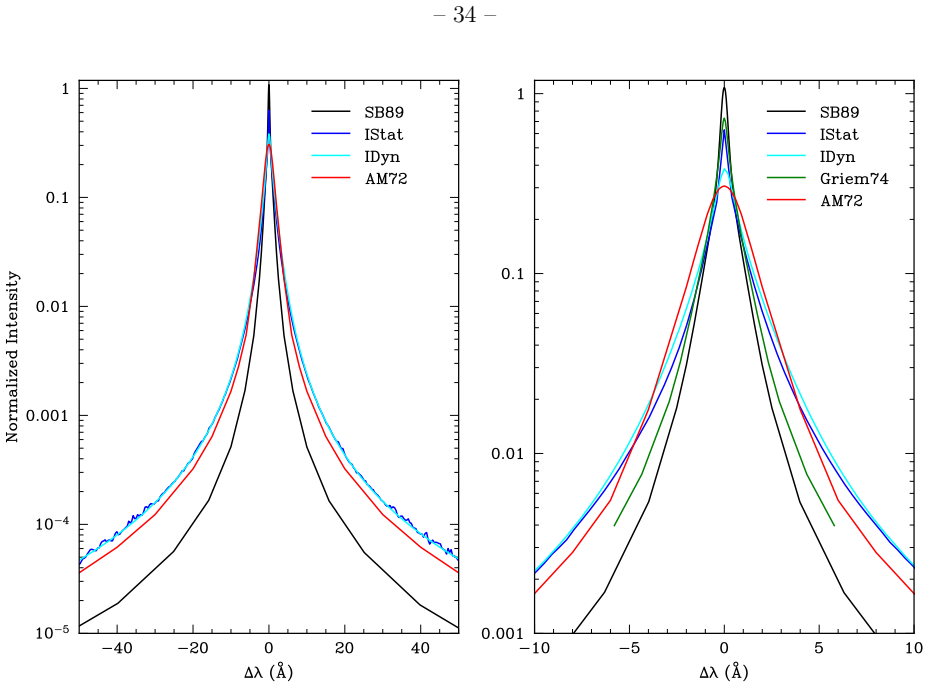
We present new and improved calculations of Stark-broadened profiles for ionized helium, a key ingredient in the spectroscopic analysis of helium-atmosphere DO white dwarfs. Our approach builds upon the computer simulation framework previously developed for neutral helium, which fully accounts for the dynamical interactions of both ions and electrons with the emitting helium atom. We extend this theoretical formalism by relaxing the assumption of straight-line trajectories for the perturbing particles (electrons and ionized helium) and adopting the hyperbolic trajectories appropriate for their interaction with a charged emitter, thereby accounting for their dynamical influence on the line-broadening process. In this exploratory study, we focus on the He II 4686 line, the strongest absorption feature observed in the spectra of DO white dwarfs. We present the resulting Stark profiles and perform a detailed comparison with those available in the literature.
Editorial analysis
A structured set of objections, weighed in public.
Referee Report
Summary. The manuscript presents new Stark-broadened profiles for the He II 4686 line computed via computer simulations. It extends a prior neutral-helium simulation framework by replacing the straight-line trajectory assumption for perturbing electrons and ions with hyperbolic trajectories appropriate to a charged emitter, thereby incorporating dynamical effects in the line-broadening process. The resulting profiles are compared with literature values in an exploratory study aimed at improving spectroscopic analysis of DO white dwarfs.
Significance. Accurate theoretical Stark profiles for He II are important for modeling spectra of helium-atmosphere white dwarfs. If the simulation correctly implements the hyperbolic trajectories and the neutral-helium numerical engine transfers without further modification, the work could supply improved, dynamically consistent profiles. The manuscript does not, however, demonstrate that the central extension is internally validated, which limits the assessed significance.
major comments (2)
- [Abstract] Abstract (paragraph on approach): The central claim requires that the existing computer-simulation code developed for neutral He I transfers to He II once straight-line trajectories are replaced by hyperbolic ones. For a charged emitter the perturber-emitter interaction is Coulombic rather than dipole, altering both the time-dependent microfield experienced by the radiator and the classical trajectory equations themselves; the paper provides no indication that the field-sampling algorithm, impact-parameter handling, or radiator response was re-derived or re-validated for Z=1 emitter charge.
- [Abstract] Abstract (paragraph on approach): The manuscript states that the computer-simulation framework previously developed for neutral helium remains valid when applied to ionized helium once only the trajectory assumption is relaxed; no additional validation or adjustment for the changed charge state of the emitter is described. This premise is load-bearing for the claim that the new profiles constitute an improvement over existing calculations.
Simulated Author's Rebuttal
We thank the referee for their careful review and for identifying points that require clarification in our manuscript. We respond to each major comment below.
read point-by-point responses
-
Referee: [Abstract] Abstract (paragraph on approach): The central claim requires that the existing computer-simulation code developed for neutral He I transfers to He II once straight-line trajectories are replaced by hyperbolic ones. For a charged emitter the perturber-emitter interaction is Coulombic rather than dipole, altering both the time-dependent microfield experienced by the radiator and the classical trajectory equations themselves; the paper provides no indication that the field-sampling algorithm, impact-parameter handling, or radiator response was re-derived or re-validated for Z=1 emitter charge.
Authors: The time-dependent microfield at the emitter is computed from the instantaneous positions of the perturbers via the Coulomb field expression, which is independent of the emitter charge; only the perturber trajectories are affected by the emitter charge. We therefore retain the existing field-sampling algorithm. The trajectory integration is updated to solve the hyperbolic orbit equations under the Coulomb potential, with impact parameters sampled identically but converted to the corresponding hyperbolic parameters. The radiator response for the He II 4686 transition employs the standard hydrogenic Stark matrix elements appropriate to Z=1. We will revise the manuscript to include an explicit description of these points together with a short validation subsection comparing limiting cases. revision: yes
-
Referee: [Abstract] Abstract (paragraph on approach): The manuscript states that the computer-simulation framework previously developed for neutral helium remains valid when applied to ionized helium once only the trajectory assumption is relaxed; no additional validation or adjustment for the changed charge state of the emitter is described. This premise is load-bearing for the claim that the new profiles constitute an improvement over existing calculations.
Authors: The premise rests on the observation that the numerical engine for perturber configuration sampling, field evaluation, and radiator time evolution is formulated in a manner that is independent of emitter charge once the classical trajectories are correctly specified. We will strengthen the manuscript by adding a concise justification of this transferability and by including internal consistency checks (e.g., recovery of straight-line results at high velocities) in a revised version. revision: yes
Circularity Check
Minor self-citation to neutral-helium simulation framework; central extension via hyperbolic trajectories is independent
full rationale
The paper states it builds upon a prior computer-simulation framework for neutral helium and extends it solely by replacing straight-line trajectories with hyperbolic ones. This is a standard self-citation to earlier methodology but does not make the new Stark profiles reduce by construction to quantities fitted from the He II data or to any self-referential definition. No equations are shown that equate a derived profile to an input parameter from the same dataset, and the comparison to literature is presented as external validation. The derivation therefore remains self-contained against external benchmarks, warranting only the lowest non-zero score for routine self-reference.
Axiom & Free-Parameter Ledger
axioms (1)
- domain assumption The simulation framework developed for neutral helium remains applicable to ionized helium after replacing straight-line trajectories with hyperbolic ones.
Reference graph
Works this paper leans on
-
[1]
Auer, L. H. & Mihalas, D. 1972, Astrophys. J. Suppl. Ser., 24, 193
work page 1972
-
[2]
Barnard, A. J., Cooper, J., & Shamey, L. J. 1969, Astron. Astrophys., 1, 28
work page 1969
-
[3]
Beauchamp, A., Wesemael, F., & Bergeron, P. 1997, Astrophys. J. Suppl. Ser., 108, 559 B´ edard, A. 2024, APSS, 369, 43 B´ edard, A., Bergeron, P., & Fontaine, G. 2020, IAU Symposium, 357, 162
work page 1997
-
[4]
Bergeron, P., Wesemael, F., Dufour, P., Beauchamp, A., Hunter, C., Saffer, R. A., Gianninas, A., Ruiz, M. T., Limoges, M. M., Dufour, P., Fontaine, G., & Liebert, J. 2011, Astrophys. J., 737, 28
work page 2011
-
[5]
Hubeny, I., & Winget, D. E. 2022, Astrophys. J., 927, 70
work page 2022
- [6]
-
[7]
Gigosos, M. A. & Carde˜ noso, V. 1996, J. Phys. B: At. Mol. Phys., 29, 4795
work page 1996
-
[8]
Gigosos, M. A. & Cardenoso, V. 1987, J. Phys. B: At. Mol. Phys., 20, 6005
work page 1987
-
[9]
Gigosos, M. A. & Gonz´ alez, M.´A. 2009, Astron. Astrophys., 503, 293
work page 2009
-
[10]
A., Gonz´ alez-Herrero, D., Lara, N., Florido, R., Calisti, A., Ferri, S., & Talin, B
Gigosos, M. A., Gonz´ alez-Herrero, D., Lara, N., Florido, R., Calisti, A., Ferri, S., & Talin, B. 2018, Phys. Rev. E, 98, 033307
work page 2018
-
[11]
Gomez, T. A. 2017, Ph.D. Thesis (University of Texas)
work page 2017
-
[12]
A., Nagayama, T., Kilcrease, D
Gomez, T. A., Nagayama, T., Kilcrease, D. P., Montgomery, M. H., & Winget, D. E. 2016, Phys. Rev. A, 94, 022501
work page 2016
-
[13]
Griem, H. R. 1974, Spectral line broadening by plasmas (Academic Press)
work page 1974
-
[14]
Heber, U., Kufleitner, L., Dorsch, M., Latour, M., Dawson, H., Mattig, F., & Geier, S. 2026, Astron. Astrophys., 708, A115
work page 2026
-
[15]
Hegerfeldt, G. C. & Kesting, V. 1988, Phys. Rev. A, 37, 1488
work page 1988
-
[16]
Hooper, C. F. 1968, Physical Review, 169, 193
work page 1968
-
[17]
Kepple, P. C. 1972, Phys. Rev. A, 6, 1 – 46 –
work page 1972
- [18]
-
[19]
Lara, N., Gonz´ alez, M.´A., & Gigosos, M. A. 2012, Astron. Astrophys., 542, A75
work page 2012
-
[20]
M., Dorsch, M., Van Grootel, V., Chayer, P., Charpinet, S., Heber, U., Randall, S
Latour, M., Green, E. M., Dorsch, M., Van Grootel, V., Chayer, P., Charpinet, S., Heber, U., Randall, S. K., & Ma, X.-Y. 2026, Astron. Astrophys., 705, A248
work page 2026
- [21]
-
[22]
1961, Physical Review, 121, 501 Poqu´ erusse, A., Alexiou, S., & Klodzh, E
Lewis, M. 1961, Physical Review, 121, 501 Poqu´ erusse, A., Alexiou, S., & Klodzh, E. 1996, J. Quant. Spectrosc. Radiat. Transf., 56, 153
work page 1961
-
[23]
Reindl, N., Rauch, T., Werner, K., Kepler, S. O., G¨ ansicke, B. T., & Gentile Fusillo, N. P. 2014, Astron. Astrophys., 572, A117
work page 2014
-
[24]
Rosato, J., Marandet, Y., & Stamm, R. 2020, J. Quant. Spectrosc. Radiat. Transf., 249, 107002
work page 2020
-
[25]
Saumon, D., Blouin, S., & Tremblay, P.-E. 2022, Physics Reports, 988, 1
work page 2022
- [26]
-
[27]
Stambulchik, E. & Maron, Y. 2006, J. Quant. Spectrosc. Radiat. Transf., 99, 730
work page 2006
- [28]
-
[29]
E., Cukanovaite, E., Gentile Fusillo, N
Tremblay, P. E., Cukanovaite, E., Gentile Fusillo, N. P., Cunningham, T., & Hollands, M. A. 2019, Mon. Not. R. Astron. Soc., 482, 5222
work page 2019
-
[30]
Vidal, C. R., Cooper, J., & Smith, E. W. 1970, J. Quant. Spectrosc. Radiat. Transf., 10, 1011
work page 1970
-
[31]
Voss, B., Koester, D., Napiwotzki, R., Christlieb, N., & Reimers, D. 2007, Astron. Astro- phys., 470, 1079 – 47 –
work page 2007
-
[32]
Szapudi, I., Szokoly, G. P., Thakar, A. R., Tremonti, C., Tucker, D. L., Uomoto, A., Vanden Berk, D., Vogeley, M. S., Waddell, P., Wang, S.-i., Watanabe, M., Weinberg, D. H., Yanny, B., Yasuda, N., & SDSS Collaboration. 2000, Astron. J., 120, 1579 This preprint was prepared with the AAS L ATEX macros v5.0
work page 2000
discussion (0)
Sign in with ORCID, Apple, or X to comment. Anyone can read and Pith papers without signing in.