Exploring the Milky Way stellar disk. Carbon, nitrogen, oxygen, sulphur, potassium, and copper abundances for 714 F and G dwarf stars in the solar neighbourhood
Pith reviewed 2026-07-02 08:39 UTC · model grok-4.3
The pith
Abundance ratios relative to oxygen, with stellar ages, reveal Milky Way disk population differences hidden in traditional [X/Fe] trends.
A machine-rendered reading of the paper's core claim, the machinery that carries it, and where it could break.
Core claim
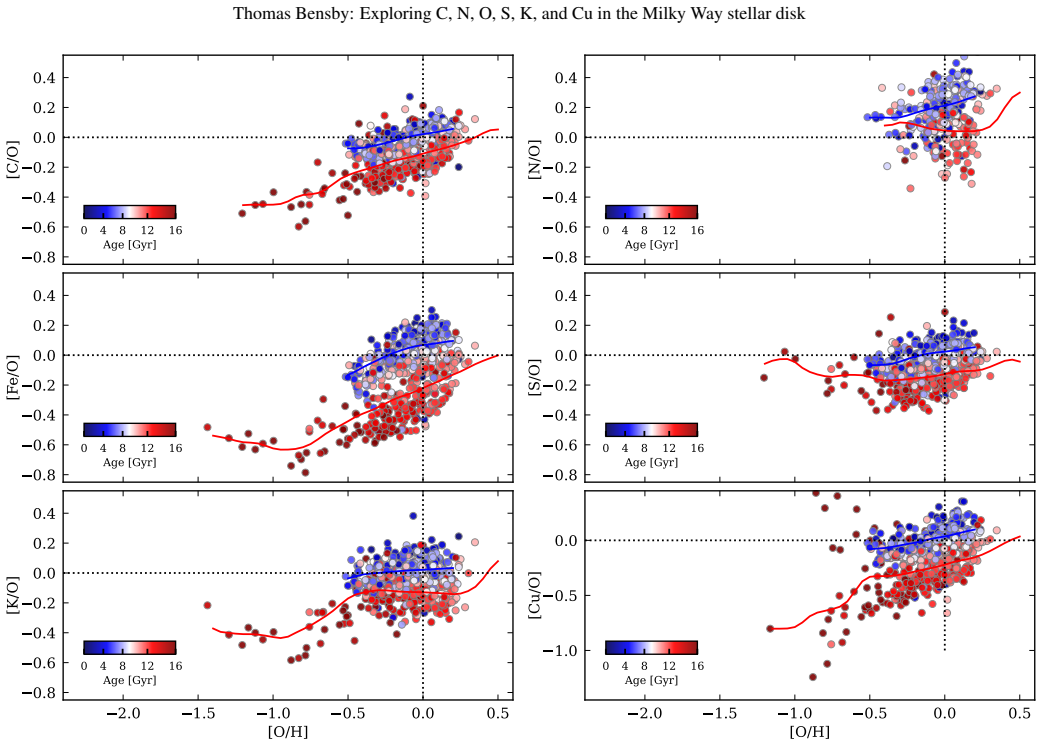
The central claim is that abundance ratios relative to oxygen, together with precise stellar ages, reveal population differences that are partly hidden in traditional [X/Fe] trends. The new measurements for C, N, S, K, Cu and re-derived O confirm alpha-like behavior for oxygen and sulphur, show clearer separations in [X/O] for carbon and nitrogen, and demonstrate that [O/Mg] is not constant. Carbon, oxygen, sulphur, and potassium rank among the most age-sensitive ratios, providing strong discrimination between old and young disk populations.
What carries the argument
Abundance ratios normalized to oxygen ([X/O]) combined with precise stellar ages, used to distinguish thin and thick disk populations in the solar neighbourhood.
If this is right
- The expanded abundance inventory provides a homogeneous reference dataset for Galactic chemical evolution and archaeology studies.
- Sulphur closely follows oxygen while potassium shows broadly alpha-like behaviour with some residual trends relative to oxygen.
- Copper displays a strong metallicity dependence and clear separation between old and young populations when compared to oxygen.
- [O/Mg] is not constant, showing that oxygen and magnesium are complementary rather than interchangeable reference scales.
- Carbon, oxygen, sulphur, and potassium are among the most age-sensitive abundance ratios in the sample.
Where Pith is reading between the lines
- If these [X/O] trends persist in other stellar samples, they could serve as calibrators for chemical tagging in large spectroscopic surveys.
- The variation in [O/Mg] implies that models of nucleosynthesis yields for alpha elements may need to account for separate production channels for oxygen and magnesium.
- Using oxygen as reference could improve the resolution of age-metallicity relations in the Galactic disk beyond what iron-based ratios allow.
Load-bearing premise
The derived abundances have systematic uncertainties from atmospheric parameters, model atmospheres, and non-LTE corrections that are smaller than the observed differences between populations in the [X/O] ratios.
What would settle it
Re-deriving the abundances for the same 714 stars using alternative atmospheric models or without the non-LTE corrections, resulting in the disappearance of the reported [X/O] population separations.
Figures




read the original abstract
[ABRIDGED] We aim to determine abundances of carbon, nitrogen, sulphur, potassium, and copper for 714 nearby F and G dwarf and subgiant stars, and to re-derive oxygen abundances using updated corrections for departures from the assumption of local thermodynamic equilibrium. These elements extend the chemical inventory of our previous studies and provide new constraints on the relative enrichment histories of the Galactic thin and thick disks. The alpha-element behaviour of oxygen is confirmed, with old stars defining an enhanced sequence relative to young stars. Sulphur closely follows oxygen, while potassium shows broadly alpha-like behaviour in [K/Fe] but residual trends relative to oxygen. Carbon and nitrogen show only modest separation in [X/Fe], but much clearer population differences in [X/O]. Copper displays a strong metallicity dependence and clear separation between old and young populations when compared to oxygen. We also find that [O/Mg] is not constant, demonstrating that oxygen and magnesium provide complementary rather than interchangeable reference scales. Quantitative comparisons of all elements analysed in our studies show that carbon, oxygen, sulphur, and potassium rank among the most age-sensitive abundance ratios in the sample and provide strong discrimination between old and young disk populations. The new abundance measurements substantially expand the diagnostic power of this local stellar sample. The results show that abundance ratios relative to oxygen, together with precise stellar ages, reveal population differences that are partly hidden in traditional [X/Fe] trends. The expanded abundance inventory provides a homogeneous reference dataset for studies of Galactic chemical evolution, Galactic archaeology, and large spectroscopic surveys.
Editorial analysis
A structured set of objections, weighed in public.
Referee Report
Summary. The manuscript determines abundances of C, N, S, K and Cu for 714 nearby F/G dwarfs and subgiants, re-derives O abundances with updated non-LTE corrections, and reports that [X/O] ratios (together with precise ages) reveal clearer thin/thick-disk separations than traditional [X/Fe] trends. It further states that [O/Mg] is not constant and that C, O, S and K rank among the most age-sensitive ratios in the sample.
Significance. If the differential systematic uncertainties are demonstrably smaller than the reported population offsets, the expanded homogeneous abundance set would strengthen the diagnostic power of this local sample for Galactic chemical evolution and archaeology studies. The explicit comparison of [X/O] versus [X/Fe] and the non-constancy of [O/Mg] are useful contributions when validated.
major comments (2)
- [Abstract and Results] The central claim that [X/O] provides stronger population discrimination than [X/Fe] (abstract) rests on the premise that systematic errors from the adopted non-LTE corrections and atmospheric parameters are smaller than the observed thin/thick-disk offsets. No quantitative error budget, Monte-Carlo propagation of parameter uncertainties, or external validation against independent non-LTE codes is referenced, leaving the load-bearing assumption untested.
- [Abstract] The statement that [O/Mg] is not constant (abstract) is presented as a key result demonstrating that O and Mg are complementary reference scales, yet the manuscript provides no tabulated [O/Mg] values, trend slopes, or statistical significance test for this non-constancy.
minor comments (1)
- Ensure the full methods section includes the specific non-LTE correction sources and the line lists used for the new elements so that the analysis can be reproduced.
Simulated Author's Rebuttal
We thank the referee for the constructive comments. We address the major points below and agree that the manuscript will benefit from additional quantitative details on error analysis and the [O/Mg] result.
read point-by-point responses
-
Referee: [Abstract and Results] The central claim that [X/O] provides stronger population discrimination than [X/Fe] (abstract) rests on the premise that systematic errors from the adopted non-LTE corrections and atmospheric parameters are smaller than the observed thin/thick-disk offsets. No quantitative error budget, Monte-Carlo propagation of parameter uncertainties, or external validation against independent non-LTE codes is referenced, leaving the load-bearing assumption untested.
Authors: We agree that a quantitative error budget is needed to fully support the claim. In the revised manuscript we will add a dedicated subsection with Monte-Carlo propagation of uncertainties in Teff, log g, [Fe/H] and the non-LTE corrections, together with a comparison against an independent non-LTE code for a subset of stars. This will demonstrate that the differential systematics remain smaller than the reported thin/thick-disk offsets. revision: yes
-
Referee: [Abstract] The statement that [O/Mg] is not constant (abstract) is presented as a key result demonstrating that O and Mg are complementary reference scales, yet the manuscript provides no tabulated [O/Mg] values, trend slopes, or statistical significance test for this non-constancy.
Authors: We acknowledge the need for more quantitative support. Although the trend is visible in the figures, the revised manuscript will include a summary table of [O/Mg] values, the fitted slope and its uncertainty, and a statistical test (linear-regression p-value and Spearman rank correlation) to quantify the departure from constancy. revision: yes
Circularity Check
No circularity: direct spectroscopic abundance measurements with no self-referential derivations
full rationale
The paper reports observational determinations of C, N, S, K, Cu and updated O abundances for 714 stars using standard spectroscopic analysis, model atmospheres and non-LTE corrections. No equations, parameters or population separations are defined in terms of the reported [X/O] or [X/Fe] trends themselves; the results are empirical measurements compared against external literature values on the same sample. No self-citation chains, fitted inputs renamed as predictions, or ansatzes smuggled via prior work appear in the derivation chain. The central claims rest on direct data reduction rather than internal redefinitions, satisfying the self-contained criterion.
Axiom & Free-Parameter Ledger
Reference graph
Works this paper leans on
-
[1]
J., Carigi , L., Nissen , P
Akerman , C. J., Carigi , L., Nissen , P. E., Pettini , M., & Asplund , M. 2004, , 414, 931
2004
-
[2]
Alexeeva , S. A. & Mashonkina , L. I. 2015, , 453, 1619
2015
-
[3]
M., Asplund , M., Collet , R., & Leenaarts , J
Amarsi , A. M., Asplund , M., Collet , R., & Leenaarts , J. 2016, , 455, 3735
2016
-
[4]
M., Grevesse , N., Grumer , J., et al
Amarsi , A. M., Grevesse , N., Grumer , J., et al. 2020 a , , 636, A120
2020
-
[5]
M., Li , W., Grevesse , N., & Jurewicz , A
Amarsi , A. M., Li , W., Grevesse , N., & Jurewicz , A. J. G. 2025, , 703, A35
2025
-
[6]
M., Lind , K., Osorio , Y., et al
Amarsi , A. M., Lind , K., Osorio , Y., et al. 2020 b , , 642, A62
2020
-
[7]
2018, , 473, 3377
Andrievsky , S., Bonifacio , P., Caffau , E., et al. 2018, , 473, 3377
2018
-
[8]
M., Spite , M., Korotin , S
Andrievsky , S. M., Spite , M., Korotin , S. A., et al. 2010, , 509, A88
2010
-
[9]
Ankush , B. K. & Deo , M. N. 2014, , 134, 21
2014
-
[10]
1997, , 318, 521
Asplund , M., Gustafsson , B., Kiselman , D., & Eriksson , K. 1997, , 318, 521
1997
-
[11]
& Bensby , T
Battistini , C. & Bensby , T. 2015, , 577, A9
2015
-
[12]
& Bensby , T
Battistini , C. & Bensby , T. 2016, , 586, A49
2016
-
[13]
W., Koposov , S
Belokurov , V., Erkal , D., Evans , N. W., Koposov , S. E., & Deason , A. J. 2018, , 478, 611
2018
-
[14]
2019, The Messenger, 175, 35
Bensby , T., Bergemann , M., Rybizki , J., et al. 2019, The Messenger, 175, 35
2019
-
[15]
& Feltzing , S
Bensby , T. & Feltzing , S. 2006, , 367, 1181
2006
-
[16]
2004, , 415, 155
Bensby , T., Feltzing , S., & Lundstr \" o m , I. 2004, , 415, 155
2004
-
[17]
Bensby , T., Feltzing , S., & Oey , M. S. 2014, , 562, A71
2014
-
[18]
2021, , 655, A117
Bensby , T., Gould , A., Asplund , M., et al. 2021, , 655, A117
2021
-
[19]
& Lind , K
Bensby , T. & Lind , K. 2018, , 615, A151
2018
-
[20]
2026, , 708, A215
Boin , T., Casamiquela , L., Haywood , M., et al. 2026, , 708, A215
2026
-
[21]
2005, , 441, 533
Caffau , E., Bonifacio , P., Faraggiana , R., et al. 2005, , 441, 533
2005
-
[22]
2009, , 498, 877
Caffau , E., Maiorca , E., Bonifacio , P., et al. 2009, , 498, 877
2009
-
[23]
M., Racca , M., et al
Caliskan , S., Amarsi , A. M., Racca , M., et al. 2025, , 696, A210
2025
-
[24]
2009, , 505, 605
Cescutti , G., Matteucci , F., McWilliam , A., & Chiappini , C. 2009, , 505, 605
2009
-
[25]
Q., Nissen , P
Chen , Y. Q., Nissen , P. E., Zhao , G., & Asplund , M. 2002, , 390, 225
2002
-
[26]
2019, The Messenger, 175, 30
Chiappini , C., Minchev , I., Starkenburg , E., et al. 2019, The Messenger, 175, 30
2019
-
[27]
2003, , 339, 63
Chiappini , C., Romano , D., & Matteucci , F. 2003, , 339, 63
2003
-
[28]
2016, , 823, 102
Choi , J., Dotter , A., Conroy , C., et al. 2016, , 823, 102
2016
-
[29]
R., Delgado Mena , E., & Tsantaki , M
Costa Silva , A. R., Delgado Mena , E., & Tsantaki , M. 2020, , 634, A136
2020
-
[30]
2020, , 493, 5195
Das , P., Hawkins , K., & Jofr \'e , P. 2020, , 493, 5195
2020
-
[31]
M., Freeman , K
De Silva , G. M., Freeman , K. C., Bland-Hawthorn , J., et al. 2015, , 449, 2604
2015
-
[32]
C., et al
Delgado Mena , E., Adibekyan , V., Santos , N. C., et al. 2021, , 655, A99
2021
-
[33]
Z., et al
Delgado Mena , E., Tsantaki , M., Adibekyan , V. Z., et al. 2017, , 606, A94
2017
-
[34]
Demarque , P., Woo , J.-H., Kim , Y.-C., & Yi , S. K. 2004, , 155, 667
2004
-
[35]
2016, , 222, 8
Dotter , A. 2016, , 222, 8
2016
-
[36]
2017, , 604, A128
Duffau , S., Caffau , E., Sbordone , L., et al. 2017, , 604, A128
2017
-
[37]
1993, , 275, 101
Edvardsson , B., Andersen , J., Gustafsson , B., et al. 1993, , 275, 101
1993
-
[38]
Ernandes , H., Barbuy , B., Fria c a , A. C. S., et al. 2020, , 640, A89
2020
-
[39]
S., Carlsson , M., & Kiselman , D
Fabbian , D., Asplund , M., Barklem , P. S., Carlsson , M., & Kiselman , D. 2009 a , , 500, 1221
2009
-
[40]
2006, , 458, 899
Fabbian , D., Asplund , M., Carlsson , M., & Kiselman , D. 2006, , 458, 899
2006
-
[41]
E., Asplund , M., Pettini , M., & Akerman , C
Fabbian , D., Nissen , P. E., Asplund , M., Pettini , M., & Akerman , C. 2009 b , , 500, 1143
2009
-
[42]
K., Feltzing , S., Sahlholdt , C., & Bensby , T
Feuillet , D. K., Feltzing , S., Sahlholdt , C., & Bensby , T. 2022, , 934, 21
2022
-
[43]
2021, , 161, 9
Franchini , M., Morossi , C., Di Marcantonio , P., et al. 2021, , 161, 9
2021
-
[44]
2020, , 888, 55
Franchini , M., Morossi , C., Di Marcantonio , P., et al. 2020, , 888, 55
2020
-
[45]
& Bland-Hawthorn , J
Freeman , K. & Bland-Hawthorn , J. 2002, , 40, 487
2002
-
[46]
Gaia Collaboration , Prusti , T., de Bruijne , J. H. J., et al. 2016, , 595, A1
2016
-
[47]
Gaia Collaboration , Vallenari , A., Brown , A. G. A., et al. 2023, , 674, A1
2023
-
[48]
C., et al
Gilmore , G., Randich , S., Worley , C. C., et al. 2022, , 666, A120
2022
-
[49]
Giribaldi , R. E. & Smiljanic , R. 2023, , 673, A18
2023
-
[50]
Grevesse , N., Asplund , M., & Sauval , A. J. 2007, Space Science Reviews, 130, 105
2007
-
[51]
2021, , 508, 719
Grisoni , V., Matteucci , F., & Romano , D. 2021, , 508, 719
2021
-
[52]
2022, Universe, 8, 409
Gustafsson , B. 2022, Universe, 8, 409
2022
-
[53]
A., Eriksson , K., & Nordlund , A
Gustafsson , B., Bell , R. A., Eriksson , K., & Nordlund , A. 1975, , 42, 407
1975
-
[54]
2008, , 486, 951
Gustafsson , B., Edvardsson , B., Eriksson , K., et al. 2008, , 486, 951
2008
-
[55]
1999, , 342, 426
Gustafsson , B., Karlsson , T., Olsson , E., Edvardsson , B., & Ryde , N. 1999, , 342, 426
1999
-
[56]
2015, , 453, 758
Hawkins , K., Jofr \'e , P., Masseron , T., & Gilmore , G. 2015, , 453, 758
2015
-
[57]
H., et al
Helmi , A., Babusiaux , C., Koppelman , H. H., et al. 2018, , 563, 85
2018
-
[58]
Henry , R. B. C., Edmunds , M. G., & K \"o ppen , J. 2000, , 541, 660
2000
-
[59]
Ho , A. Y. Q., Rix , H.-W., Ness , M. K., et al. 2017, , 841, 40
2017
-
[60]
P., Mackereth , J
Horta , D., Schiavon , R. P., Mackereth , J. T., et al. 2023, , 520, 5671
2023
-
[61]
2004, , 421, 649
Israelian , G., Ecuvillon , A., Rebolo , R., et al. 2004, , 421, 649
2004
-
[62]
& Rebolo , R
Israelian , G. & Rebolo , R. 2001, , 557, L43
2001
-
[63]
2017, , 604, A106
Jean-Baptiste , I., Di Matteo , P., Haywood , M., et al. 2017, , 604, A106
2017
-
[64]
W., Weinberg , D
Johnson , J. W., Weinberg , D. H., Vincenzo , F., Bird , J. C., & Griffith , E. J. 2023, , 520, 782
2023
-
[65]
I., & Lugaro , M
Kobayashi , C., Karakas , A. I., & Lugaro , M. 2020, , 900, 179
2020
-
[66]
A., Andrievsky , S
Korotin , S. A., Andrievsky , S. M., & Zhukova , A. V. 2018, , 480, 965
2018
-
[67]
A., Stempels , H
Kupka , F., Piskunov , N., Ryabchikova , T. A., Stempels , H. C., & Weiss , W. W. 1999, , 138, 119
1999
-
[68]
G., Ryabchikova , T
Kupka , F. G., Ryabchikova , T. A., Piskunov , N. E., Stempels , H. C., & Weiss , W. W. 2000, Baltic Astronomy, 9, 590
2000
-
[69]
2012, , 427, 50
Lind , K., Bergemann , M., & Asplund , M. 2012, , 427, 50
2012
-
[70]
2022, , 657, A29
Lucertini , F., Monaco , L., Caffau , E., Bonifacio , P., & Mucciarelli , A. 2022, , 657, A29
2022
-
[71]
2023, , 671, A137
Lucertini , F., Monaco , L., Caffau , E., et al. 2023, , 671, A137
2023
-
[72]
2017, , 603, A2
Magrini , L., Randich , S., Kordopatis , G., et al. 2017, , 603, A2
2017
-
[73]
2018, , 618, A102
Magrini , L., Vincenzo , F., Randich , S., et al. 2018, , 618, A102
2018
-
[74]
R., Schiavon , R
Majewski , S. R., Schiavon , R. P., Frinchaboy , P. M., et al. 2017, , 154, 94
2017
-
[75]
L., Sharma , S., Buder , S., et al
Martell , S. L., Sharma , S., Buder , S., et al. 2017, , 465, 3203
2017
-
[76]
& Gilmore , G
Masseron , T. & Gilmore , G. 2015, , 453, 1855
2015
-
[77]
Matrozis , E., Ryde , N., & Dupree , A. K. 2013, , 559, A115
2013
-
[78]
2010, , 515, A68
Mattsson , L. 2010, , 515, A68
2010
-
[79]
G., et al
Mel \'e ndez , J., Bergemann , M., Cohen , J. G., et al. 2012, , 543, A29
2012
-
[80]
V., Kovtyukh , V
Mishenina , T. V., Kovtyukh , V. V., Soubiran , C., Travaglio , C., & Busso , M. 2002, , 396, 189
2002
discussion (0)
Sign in with ORCID, Apple, or X to comment. Anyone can read and Pith papers without signing in.