Microscopic universal theory of symmetry-enriched topological quantum spin liquids
Pith reviewed 2026-06-27 18:13 UTC · model grok-4.3
The pith
An explicit bijective map equates the universal data of a TQSL with lattice-plus-internal symmetries to the data for the same group G restricted to internal symmetries alone.
A machine-rendered reading of the paper's core claim, the machinery that carries it, and where it could break.
Core claim
The central claim is that there exists an explicit bijective map between the universal data characterizing a TQSL with a symmetry group G that includes both lattice and internal symmetries and the corresponding universal data for a TQSL with only an internal symmetry group G. The map is obtained from a microscopic theory whose input consists of states with anyons, operators controlling anyon dynamics, and symmetry actions, and whose output is data whose underlying structure generalizes category theory; the same theory also reproduces the Lieb-Schultz-Mattis anomaly matching condition in concrete examples on superconducting, trapped-ion, and Rydberg platforms.
What carries the argument
The explicit bijective map that converts the full universal data set for symmetry group G (lattice plus internal) into the universal data set for the internal-only version of the same group G.
If this is right
- Every universal property of a generic TQSL follows directly from the supplied microscopic states, dynamics operators, and symmetry actions.
- The crystalline equivalence principle holds for unitary and anti-unitary symmetries as well as for continuous symmetries.
- Symmetry-enriched TQSLs realized on quantum processors can be fully characterized and their anomaly matching conditions verified by feeding the microscopic data into the theory.
- The same input-output structure supplies a systematic route to identify and manipulate symmetry-enriched TQSLs for potential use in fault-tolerant quantum computation.
Where Pith is reading between the lines
- Classification tables already computed for internal symmetries can be imported into lattice-symmetry settings without recomputation of the universal data.
- Numerical or experimental searches for new TQSLs can focus on internal-symmetry models and then lift the results to the full symmetry group via the map.
- The same microscopic-input structure may be testable in three-dimensional topological phases if analogous anyon-state and symmetry-action data can be defined.
Load-bearing premise
The chosen microscopic states with anyons, the operators controlling anyon dynamics, and the symmetry actions supplied as input are together sufficient to determine all universal properties without requiring additional unstated assumptions about the underlying Hamiltonian or the completeness of the anyon set.
What would settle it
A concrete counter-example consisting of two TQSLs that share identical microscopic inputs yet differ in at least one measurable universal quantity (such as a braiding phase or a symmetry-fractionalization class) that the claimed bijective map would force to be identical.
Figures





read the original abstract
An ultimate theory of a phase of matter should describe all its universal properties via quantities that are measurable numerically and experimentally. In this work, we present a microscopic universal theory of symmetry-enriched topological quantum spin liquids (TQSLs) in two spatial dimensions, which directly utilizes microscopically measurable quantities to describe the universal properties. This theory applies to generic TQSLs, which can be Abelian or non-Abelian, chiral or non-chiral. The symmetries are also general, which can include both internal and lattice symmetries, unitary and anti-unitary symmetries, and discrete and continuous symmetries. There can be spin-orbit coupling, the microscopic degrees of freedom may transform linearly or projectively under the symmetries, and the symmetries can permute anyons. The input of the theory is some microscopic states with anyons, operators that control the dynamics of anyons, and symmetry actions in the TQSL, and its output is a set of data characterizing the universal properties, whose underlying mathematical structure is a generalization of category theory. Based on this theory, we find an explicit bijective map between the universal data characterizing a TQSL with a symmetry described by a group $G$, where the symmetry actions may include both lattice and internal symmetries, and the corresponding universal data for a TQSL with only an internal symmetry group $G$, and thus establish a precise crystalline equivalence principle. We demonstrate our theory in symmetry-enriched TQSLs realized on quantum processors based on superconducting qubits, trapped ions, and Rydberg atoms, and in each example we verify the Lieb-Schultz-Mattis anomaly matching condition. Our theory provides a solid basis for identifying and manipulating symmetry-enriched TQSLs, which further paves the way for fault-tolerant quantum computation based on these systems.
Editorial analysis
A structured set of objections, weighed in public.
Referee Report
Summary. The manuscript presents a microscopic universal theory for symmetry-enriched topological quantum spin liquids (TQSLs) in two dimensions. Inputs consist of microscopic states containing anyons, operators governing anyon dynamics, and symmetry actions (encompassing lattice and internal symmetries, unitary/anti-unitary, discrete/continuous, with possible spin-orbit coupling and anyon permutation). The output is a set of data characterizing all universal properties, structured as a generalization of category theory. From this, the authors derive an explicit bijective map between the universal data for a symmetry group G that includes both lattice and internal symmetries and the corresponding data for an internal-only symmetry group G, thereby establishing a crystalline equivalence principle. The theory is illustrated with examples on superconducting-qubit, trapped-ion, and Rydberg-atom processors, where the Lieb-Schultz-Mattis anomaly matching condition is verified.
Significance. If the bijective map is derived rigorously from the stated microscopic inputs without hidden assumptions or circularity, the work would supply a unified, numerically and experimentally accessible framework for classifying and manipulating generic (Abelian or non-Abelian, chiral or non-chiral) symmetry-enriched TQSLs that include lattice symmetries. This would strengthen the theoretical basis for fault-tolerant quantum computation using such phases. The direct use of measurable microscopic quantities is a conceptual strength, though no machine-checked proofs, reproducible code, or exhaustive checks against established examples are visible.
major comments (2)
- [Abstract] Abstract: the central claim is an explicit bijective map between universal data for G (lattice+internal) and internal-only G. No derivation, explicit construction, or verification of bijectivity is supplied in the visible text, so it is impossible to confirm that the map follows from the microscopic inputs without post-hoc choices or reduction to a re-labeling of symmetry data.
- [Abstract] Abstract: the weakest assumption states that the supplied anyon states, dynamics operators, and symmetry actions suffice to fix all universal properties. The text does not address how completeness of the anyon set is guaranteed or whether additional unstated Hamiltonian assumptions are required; this assumption is load-bearing for both the output data and the claimed map.
minor comments (2)
- [Abstract] The phrase 'generalization of category theory' is used without indicating the precise mathematical structure or how it reduces to known anyon categories when symmetries are absent.
- [Abstract] The demonstrations on quantum processors are mentioned but no concrete input data, output universal quantities, or explicit LSM-anomaly verification steps are shown.
Simulated Author's Rebuttal
We thank the referee for their careful reading and for highlighting the need for greater clarity on the central claims. We address each major comment point by point below. The full derivations appear in the body of the manuscript; we will revise the abstract and add clarifying text to make the logical structure fully explicit.
read point-by-point responses
-
Referee: [Abstract] Abstract: the central claim is an explicit bijective map between universal data for G (lattice+internal) and internal-only G. No derivation, explicit construction, or verification of bijectivity is supplied in the visible text, so it is impossible to confirm that the map follows from the microscopic inputs without post-hoc choices or reduction to a re-labeling of symmetry data.
Authors: The explicit bijective map is constructed directly from the microscopic inputs (anyon states, dynamics operators, and symmetry actions) in Section 4 of the manuscript. There we define the map on the generalized category data, prove it is invertible by exhibiting the inverse construction, and verify that it preserves all fusion rules, braiding, and symmetry actions without additional choices. The abstract summarizes the result; the full construction and bijectivity proof are in the main text. We will revise the abstract to include a one-sentence pointer to Section 4, ensuring the claim is transparently supported by the microscopic data. revision: yes
-
Referee: [Abstract] Abstract: the weakest assumption states that the supplied anyon states, dynamics operators, and symmetry actions suffice to fix all universal properties. The text does not address how completeness of the anyon set is guaranteed or whether additional unstated Hamiltonian assumptions are required; this assumption is load-bearing for both the output data and the claimed map.
Authors: The completeness of the anyon set is fixed by the input microscopic states themselves: the supplied states are required to contain every anyonic excitation present in the system, so no external completeness check is needed. The theory uses only the given dynamics operators and symmetry actions; no further Hamiltonian details are invoked. We will add a short clarifying paragraph in the introduction (new subsection 1.3) that states this explicitly and explains why the input data suffice to determine the full generalized category without hidden assumptions. revision: yes
Circularity Check
No significant circularity identified
full rationale
The derivation begins from explicitly supplied microscopic inputs (anyon states, dynamics operators, symmetry actions) treated as given, then constructs output universal data whose structure is a generalization of category theory. The claimed bijective map between symmetry-enriched data (lattice+internal G) and internal-only G is presented as following directly from this construction rather than being presupposed or fitted to the same quantities. No equations or steps in the abstract or described chain reduce the output data to the inputs by definition, rename a known result, or rely on self-citation chains for the central claim. The argument is therefore self-contained against the stated inputs.
Axiom & Free-Parameter Ledger
axioms (1)
- domain assumption Microscopic states with anyons, anyon operators, and symmetry actions are together sufficient to determine all universal properties of the TQSL.
invented entities (1)
-
Generalized category-theoretic data structure for symmetry-enriched TQSLs
no independent evidence
Reference graph
Works this paper leans on
-
[1]
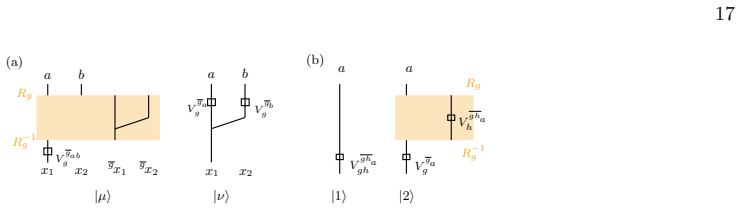
Proof of Eq. (188). We consider the following morphism, c b a d e ν† µ† , which is constructed by picking up a morphism in ⊕eV ab e ⊗V ec d and then composing it with four morphisms |ηa⟩ ∈V ¯aa 0 , |ηb⟩ ∈V ¯bb 0 , |ηc⟩ ∈V ¯cc 0 , and ⟨η ¯d| ∈V 0 d ¯d. These four morphisms are those that we have fixed in defining the map A. Now we notice that we can either...
-
[2]
Proof of Eq. (189). The proof of this equation is similar to the F -A relation Eq. (188). Since the Rab c -symbols can be viewed as basis transformations in V ab c , we can express the map A in two different bases connected by R, as shown in 81 the following diagram. Rabc −1 = ab b a a b a b a ba b a b c c c c ccc µ ν µ† ν† µ′ ν′ Rabc κcAabc κcAbac A A Th...
-
[3]
cohomology invariants
Proof of Eq. (190). The A-symbols also yield certain consistency equations with the U-matrices. As we have mentioned, these U-matrices can be viewed as basis transformation matrices of certain automorphism Φ g, where Φ g might correspond to internal or lattice symmetry in the physical system. Then we notice that the definition of A-matrices yields ab c ga...
-
[4]
Wen,Quantum Field Theory of Many-Body Systems: From the Origin of Sound to an Origin of Light and Electrons, Oxford Graduate Texts (OUP Oxford, 2004)
X.G. Wen,Quantum Field Theory of Many-Body Systems: From the Origin of Sound to an Origin of Light and Electrons, Oxford Graduate Texts (OUP Oxford, 2004)
2004
-
[5]
Fault-tolerant quantum computation by anyons,
A. Yu. Kitaev, “Fault-tolerant quantum computation by anyons,” Annals of Physics303, 2–30 (2003), arXiv:quant- ph/9707021 [quant-ph]
-
[6]
Topological Quantum Computation
Michael H. Freedman, Alexei Kitaev, Michael J. Larsen, and Zhenghan Wang, “Topological quantum computation,” Bulletin of the American Mathematical Society40, 31–38 (2003), arXiv:quant-ph/0101025 [quant-ph]
work page internal anchor Pith review Pith/arXiv arXiv 2003
-
[7]
Non-Abelian Anyons and Topological Quantum Computation
Chetan Nayak, Steven H. Simon, Ady Stern, Michael Freedman, and Sankar Das Sarma, “Non-Abelian anyons and topological quantum computation,” Reviews of Modern Physics80, 1083–1159 (2008), arXiv:0707.1889 [cond-mat.str-el]
work page internal anchor Pith review Pith/arXiv arXiv 2008
-
[8]
C. Broholm, R. J. Cava, S. A. Kivelson, D. G. Nocera, M. R. Norman, and T. Senthil, “Quantum spin liquids,” Science 367, eaay0668 (2020), arXiv:1905.07040 [cond-mat.str-el]
-
[9]
String-net condensation: A physical mechanism for topological phases
Michael A. Levin and Xiao-Gang Wen, “String-net condensation: A physical mechanism for topological phases,” Phys. Rev. B71, 045110 (2005), arXiv:cond-mat/0404617 [cond-mat.str-el]
work page internal anchor Pith review Pith/arXiv arXiv 2005
-
[10]
Anyons in an exactly solved model and beyond,
Alexei Kitaev, “Anyons in an exactly solved model and beyond,” Annals of Physics321, 2–111 (2006), arXiv:cond- mat/0506438 [cond-mat.mes-hall]
-
[11]
Emergent Chiral Spin Liquid: Fractional Quantum Hall Effect in a Kagome Heisenberg Model
Shou-Shu Gong, Wei Zhu, and D. N. Sheng, “Emergent Chiral Spin Liquid: Fractional Quantum Hall Effect in a Kagome Heisenberg Model,” Scientific Reports4, 6317 (2014), arXiv:1312.4519 [cond-mat.str-el]
work page internal anchor Pith review Pith/arXiv arXiv 2014
-
[12]
Global Phase Diagram of Competing Ordered and Quantum Spin Liquid Phases on the Kagom\'e Lattice
Shou-Shu Gong, Wei Zhu, Leon Balents, and D. N. Sheng, “Global phase diagram of competing ordered and quantum spin-liquid phases on the kagome lattice,” Phys. Rev. B91, 075112 (2015), arXiv:1412.1571 [cond-mat.str-el]
work page internal anchor Pith review Pith/arXiv arXiv 2015
-
[13]
Symmetry enriched string-nets: Exactly solvable models for SET phases
Chris Heinrich, Fiona Burnell, Lukasz Fidkowski, and Michael Levin, “Symmetry-enriched string nets: Exactly solvable models for SET phases,” Phys. Rev. B94, 235136 (2016), arXiv:1606.07816 [cond-mat.str-el]
work page internal anchor Pith review Pith/arXiv arXiv 2016
-
[14]
Exactly Solvable Models for Symmetry-Enriched Topological Phases
Meng Cheng, Zheng-Cheng Gu, Shenghan Jiang, and Yang Qi, “Exactly solvable models for symmetry-enriched topological phases,” Phys. Rev. B96, 115107 (2017), arXiv:1606.08482 [cond-mat.str-el]. 96
work page internal anchor Pith review Pith/arXiv arXiv 2017
-
[15]
Global phase diagram and quantum spin liquids in spin-1/2 triangular antiferromagnet
Shou-Shu Gong, W. Zhu, J.-X. Zhu, D. N. Sheng, and Kun Yang, “Global phase diagram and quantum spin liquids in a spin-1/2 triangular antiferromagnet,” Phys. Rev. B96, 075116 (2017), arXiv:1705.00510 [cond-mat.str-el]
work page internal anchor Pith review Pith/arXiv arXiv 2017
-
[16]
Prediction of Toric Code Topological Order from Rydberg Blockade,
Ruben Verresen, Mikhail D. Lukin, and Ashvin Vishwanath, “Prediction of Toric Code Topological Order from Rydberg Blockade,” Physical Review X11, 031005 (2021), arXiv:2011.12310 [cond-mat.str-el]
-
[17]
Coexistence of non-Abelian chiral spin liquid and magnetic order in a spin-1 antiferromagnet,
Yixuan Huang, W. Zhu, Shou-Shu Gong, Hong-Chen Jiang, and D. N. Sheng, “Coexistence of non-Abelian chiral spin liquid and magnetic order in a spin-1 antiferromagnet,” Phys. Rev. B105, 155104 (2022), arXiv:2108.06676 [cond-mat.str-el]
-
[18]
Wei-Wei Luo, Yixuan Huang, D. N. Sheng, and W. Zhu, “Global quantum phase diagram and non-Abelian chiral spin liquid in a spin-3/2 square-lattice antiferromagnet,” Phys. Rev. B108, 035130 (2023), arXiv:2212.14223 [cond-mat.str- el]
-
[19]
Chiral spin liquid and quantum phase diagram of spin-12 J1-J2-J χ model on the square lattice,
Xiao-Tian Zhang, Yixuan Huang, Han-Qing Wu, D. N. Sheng, and Shou-Shu Gong, “Chiral spin liquid and quantum phase diagram of spin-12 J1-J2-J χ model on the square lattice,” Phys. Rev. B109, 125146 (2024), arXiv:2401.07461 [cond-mat.str-el]
-
[20]
Realizing topologically ordered states on a quantum processor,
K. J. Satzinger, Y.-J. Liu, A. Smith, C. Knapp, M. Newman, C. Jones, Z. Chen, C. Quintana, X. Mi, A. Dunsworth, C. Gidney, I. Aleiner, F. Arute, K. Arya, J. Atalaya, R. Babbush, J. C. Bardin, R. Barends, J. Basso, A. Bengtsson, A. Bilmes, M. Broughton, B. B. Buckley, D. A. Buell, B. Burkett, N. Bushnell, B. Chiaro, R. Collins, W. Courtney, S. Demura, A. R...
-
[21]
G. Semeghini, H. Levine, A. Keesling, S. Ebadi, T. T. Wang, D. Bluvstein, R. Verresen, H. Pichler, M. Kalinowski, R. Samajdar, A. Omran, S. Sachdev, A. Vishwanath, M. Greiner, V. Vuleti´ c, and M. D. Lukin, “Probing topological spin liquids on a programmable quantum simulator,” Science374, 1242–1247 (2021), arXiv:2104.04119 [quant-ph]
-
[22]
Topological order from measurements and feed-forward on a trapped ion quantum computer,
Mohsin Iqbal, Nathanan Tantivasadakarn, Thomas M. Gatterman, Justin A. Gerber, Kevin Gilmore, Dan Gresh, Aaron Hankin, Nathan Hewitt, Chandler V. Horst, Mitchell Matheny, Tanner Mengle, Brian Neyenhuis, Ashvin Vishwanath, Michael Foss-Feig, Ruben Verresen, and Henrik Dreyer, “Topological order from measurements and feed-forward on a trapped ion quantum co...
-
[23]
Michael Foss-Feig, Arkin Tikku, Tsung-Cheng Lu, Karl Mayer, Mohsin Iqbal, Thomas M. Gatterman, Justin A. Gerber, Kevin Gilmore, Dan Gresh, Aaron Hankin, Nathan Hewitt, Chandler V. Horst, Mitchell Matheny, Tanner Mengle, Brian Neyenhuis, Henrik Dreyer, David Hayes, Timothy H. Hsieh, and Isaac H. Kim, “Experimental demonstration of the advantage of adaptive...
-
[24]
Non-Abelian topological order and anyons on a trapped-ion processor,
Mohsin Iqbal, Nathanan Tantivasadakarn, Ruben Verresen, Sara L. Campbell, Joan M. Dreiling, Caroline Figgatt, John P. Gaebler, Jacob Johansen, Michael Mills, Steven A. Moses, Juan M. Pino, Anthony Ransford, Mary Rowe, Peter Siegfried, Russell P. Stutz, Michael Foss-Feig, Ashvin Vishwanath, and Henrik Dreyer, “Non-Abelian topological order and anyons on a ...
-
[25]
Symmetry Fractionalization in Two Dimensional Topological Phases
Xie Chen, “Symmetry fractionalization in two dimensional topological phases,” Reviews in Physics2, 3–18 (2017), arXiv:1606.07569 [cond-mat.str-el]
work page internal anchor Pith review Pith/arXiv arXiv 2017
-
[26]
Topological Order with a Twist: Ising Anyons from an Abelian Model
H. Bombin, “Topological Order with a Twist: Ising Anyons from an Abelian Model,” Phys. Rev. Lett.105, 030403 (2010), arXiv:1004.1838 [cond-mat.str-el]
work page internal anchor Pith review Pith/arXiv arXiv 2010
-
[27]
Netanel H. Lindner, Erez Berg, Gil Refael, and Ady Stern, “Fractionalizing Majorana Fermions: Non-Abelian Statistics on the Edges of Abelian Quantum Hall States,” Physical Review X2, 041002 (2012), arXiv:1204.5733 [cond-mat.mes-hall]
work page internal anchor Pith review Pith/arXiv arXiv 2012
-
[28]
Exotic non-Abelian anyons from conventional fractional quantum Hall states
David J. Clarke, Jason Alicea, and Kirill Shtengel, “Exotic non-Abelian anyons from conventional fractional quantum Hall states,” Nature Communications4, 1348 (2013), arXiv:1204.5479 [cond-mat.str-el]
work page internal anchor Pith review Pith/arXiv arXiv 2013
-
[29]
Topological phases with parafermions: theory and blueprints
Jason Alicea and Paul Fendley, “Topological Phases with Parafermions: Theory and Blueprints,” Annual Review of Condensed Matter Physics7, 119–139 (2016), arXiv:1504.02476 [cond-mat.str-el]
work page internal anchor Pith review Pith/arXiv arXiv 2016
-
[30]
Symmetry Fractionalization, Defects, and Gauging of Topological Phases,
Maissam Barkeshli, Parsa Bonderson, Meng Cheng, and Zhenghan Wang, “Symmetry Fractionalization, Defects, and Gauging of Topological Phases,” Phys. Rev. B100, 115147 (2019), arXiv:1410.4540 [cond-mat.str-el]
-
[31]
Symmetry fractionalization and twist defects
Nicolas Tarantino, Netanel H. Lindner, and Lukasz Fidkowski, “Symmetry fractionalization and twist defects,” New Journal of Physics18, 035006 (2016), arXiv:1506.06754 [cond-mat.str-el]
work page internal anchor Pith review Pith/arXiv arXiv 2016
-
[32]
Tian Lan, Gen Yue, and Longye Wang, “Category of SET orders,” Journal of High Energy Physics2024, 111 (2024), arXiv:2312.15958 [cond-mat.str-el]
-
[33]
Classifying fractionalization: symmetry classification of gapped Z2 spin liquids in two dimensions
Andrew M. Essin and Michael Hermele, “Classifying fractionalization: Symmetry classification of gapped Z 2 spin liquids in two dimensions,” Phys. Rev. B87, 104406 (2013), arXiv:1212.0593 [cond-mat.str-el]
work page internal anchor Pith review Pith/arXiv arXiv 2013
-
[34]
Yang Qi and Liang Fu, “Detecting crystal symmetry fractionalization from the ground state: Application to Z 2 spin liquids on the kagome lattice,” Phys. Rev. B91, 100401 (2015), arXiv:1501.00009 [cond-mat.str-el]
work page internal anchor Pith review Pith/arXiv arXiv 2015
-
[35]
Measuring space-group symmetry fractionalization in Z$_2$ spin liquids
Michael P. Zaletel, Yuan-Ming Lu, and Ashvin Vishwanath, “Measuring space-group symmetry fractionalization in 𭟋2 spin liquids,” Phys. Rev. B96, 195164 (2017), arXiv:1501.01395 [cond-mat.str-el]
work page internal anchor Pith review Pith/arXiv arXiv 2017
-
[36]
Maissam Barkeshli, Parsa Bonderson, Meng Cheng, Chao-Ming Jian, and Kevin Walker, “Reflection and Time 97 Reversal Symmetry Enriched Topological Phases of Matter: Path Integrals, Non-orientable Manifolds, and Anomalies,” Communications in Mathematical Physics374, 1021–1124 (2019), arXiv:1612.07792 [cond-mat.str-el]
-
[37]
Folding approach to topological orders enriched by mirror symmetry
Yang Qi, Chao-Ming Jian, and Chenjie Wang, “Folding approach to topological order enriched by mirror symmetry,” Phys. Rev. B99, 085128 (2019), arXiv:1710.09391 [cond-mat.str-el]
work page internal anchor Pith review Pith/arXiv arXiv 2019
-
[38]
Point-group symmetry enriched topological orders,
Zhaoyang Ding and Yang Qi, “Point-group symmetry enriched topological orders,” Phys. Rev. B112, 115102 (2025), arXiv:2502.11106 [cond-mat.str-el]
-
[39]
Microscopic definitions of anyon data,
Kyle Kawagoe and Michael Levin, “Microscopic definitions of anyon data,” Phys. Rev. B101, 115113 (2020), arXiv:1910.11353 [cond-mat.str-el]
-
[40]
Classification of Symmetry-Enriched Topological Quantum Spin Liquids,
Weicheng Ye and Liujun Zou, “Classification of Symmetry-Enriched Topological Quantum Spin Liquids,” Physical Review X14, 021053 (2024), arXiv:2309.15118 [cond-mat.str-el]
-
[41]
Topological phases protected by point group symmetry
Hao Song, Sheng-Jie Huang, Liang Fu, and Michael Hermele, “Topological Phases Protected by Point Group Symmetry,” Physical Review X7, 011020 (2017), arXiv:1604.08151 [cond-mat.str-el]
work page internal anchor Pith review Pith/arXiv arXiv 2017
-
[43]
Lieb-Schultz-Mattis Anomalies and Anomaly Matching
Liujun Zou and Meng Cheng, “Lieb-Schultz-Mattis Anomalies and Anomaly Matching,” arXiv e-prints , arXiv:2604.00347 (2026), arXiv:2604.00347 [cond-mat.str-el]
work page internal anchor Pith review Pith/arXiv arXiv 2026
-
[44]
Weicheng Ye, Meng Guo, Yin-Chen He, Chong Wang, and Liujun Zou, “Topological characterization of Lieb-Schultz- Mattis constraints and applications to symmetry-enriched quantum criticality,” SciPost Physics13, 066 (2022), arXiv:2111.12097 [cond-mat.str-el]
-
[45]
Weicheng Ye and Liujun Zou, “Anomaly of (2+1)-dimensional symmetry-enriched topological order from (3+1)- dimensional topological quantum field theory,” SciPost Physics15, 004 (2023), arXiv:2210.02444 [cond-mat.str-el]
-
[46]
Ruizhi Liu, Jinmin Yi, Shiyu Zhou, and Liujun Zou, “Entanglement area law and Lieb-Schultz-Mattis theorem in long-range interacting systems, and symmetry-enforced long-range entanglement,” Phys. Rev. B112, 214408 (2025), arXiv:2405.14929 [cond-mat.str-el]
-
[47]
Symmetry-enforced minimal entanglement and correlation in quantum spin chains,
Kangle Li and Liujun Zou, “Symmetry-enforced minimal entanglement and correlation in quantum spin chains,” SciPost Physics19, 020 (2025), arXiv:2412.20765 [cond-mat.str-el]
-
[48]
M. B. Hastings and Xiao-Gang Wen, “Quasiadiabatic continuation of quantum states: The stability of topological ground-state degeneracy and emergent gauge invariance,” Phys. Rev. B72, 045141 (2005), arXiv:cond-mat/0503554 [cond-mat.str-el]
work page internal anchor Pith review Pith/arXiv arXiv 2005
-
[49]
M. B. Hastings, “Quasi-adiabatic Continuation for Disordered Systems: Applications to Correlations, Lieb-Schultz- Mattis, and Hall Conductance,” arXiv e-prints , arXiv:1001.5280 (2010), arXiv:1001.5280 [math-ph]
work page internal anchor Pith review Pith/arXiv arXiv 2010
-
[50]
Automorphic Equivalence within Gapped Phases of Quantum Lattice Systems
Sven Bachmann, Spyridon Michalakis, Bruno Nachtergaele, and Robert Sims, “Automorphic Equivalence within Gapped Phases of Quantum Lattice Systems,” Communications in Mathematical Physics309, 835–871 (2012), arXiv:1102.0842 [math-ph]
work page internal anchor Pith review Pith/arXiv arXiv 2012
-
[51]
Local Noether theorem for quantum lattice systems and topological invariants of gapped states,
Anton Kapustin and Nikita Sopenko, “Local Noether theorem for quantum lattice systems and topological invariants of gapped states,” Journal of Mathematical Physics63, 091903 (2022), arXiv:2201.01327 [math-ph]
-
[52]
Fusion rules from entanglement
Bowen Shi, Kohtaro Kato, and Isaac H. Kim, “Fusion rules from entanglement,” Annals of Physics418, 168164 (2020), arXiv:1906.09376 [cond-mat.str-el]
-
[53]
Extracting Wilson loop operators and fractional statistics from a single bulk ground state,
Ze-Pei Cian, Mohammad Hafezi, and Maissam Barkeshli, “Extracting Wilson loop operators and fractional statistics from a single bulk ground state,” arXiv e-prints , arXiv:2209.14302 (2022), arXiv:2209.14302 [cond-mat.str-el]
-
[54]
Relative anomaly in (1 +1 )d rational conformal field theory,
Meng Cheng and Dominic J. Williamson, “Relative anomaly in (1 +1 )d rational conformal field theory,” Physical Review Research2, 043044 (2020), arXiv:2002.02984 [cond-mat.str-el]
-
[55]
Classification of Gapped Symmetric Phases in 1D Spin Systems
Xie Chen, Zheng-Cheng Gu, and Xiao-Gang Wen, “Classification of gapped symmetric phases in one-dimensional spin systems,” Phys. Rev. B83, 035107 (2011), arXiv:1008.3745 [cond-mat.str-el]
work page internal anchor Pith review Pith/arXiv arXiv 2011
-
[56]
Theory of interacting topological crystalline insulators
Hiroki Isobe and Liang Fu, “Theory of interacting topological crystalline insulators,” Phys. Rev. B92, 081304 (2015), arXiv:1502.06962 [cond-mat.str-el]
work page internal anchor Pith review Pith/arXiv arXiv 2015
-
[57]
Building crystalline topological phases from lower-dimensional states
Sheng-Jie Huang, Hao Song, Yi-Ping Huang, and Michael Hermele, “Building crystalline topological phases from lower-dimensional states,” Phys. Rev. B96, 205106 (2017), arXiv:1705.09243 [cond-mat.str-el]
work page internal anchor Pith review Pith/arXiv arXiv 2017
-
[58]
Microscopic Theory of Surface Topological Order for Topological Crystalline Superconductors
Meng Cheng, “Microscopic Theory of Surface Topological Order for Topological Crystalline Superconductors,” Phys. Rev. Lett.120, 036801 (2018), arXiv:1707.02079 [cond-mat.str-el]
work page internal anchor Pith review Pith/arXiv arXiv 2018
-
[59]
Liujun Zou, “Bulk characterization of topological crystalline insulators: Stability under interactions and relations to symmetry enriched U (1) quantum spin liquids,” Phys. Rev. B97, 045130 (2018), arXiv:1711.03090 [cond-mat.str-el]
work page internal anchor Pith review Pith/arXiv arXiv 2018
-
[60]
Crystalline topological phases as defect networks
Dominic V. Else and Ryan Thorngren, “Crystalline topological phases as defect networks,” Phys. Rev. B99, 115116 (2019), arXiv:1810.10539 [cond-mat.str-el]
work page internal anchor Pith review Pith/arXiv arXiv 2019
-
[61]
Gauging spatial symmetries and the classification of topological crystalline phases
Ryan Thorngren and Dominic V. Else, “Gauging spatial symmetries and the classification of topological crystalline phases,” Phys. Rev. X8, arXiv:1612.00846 (2018), arXiv:1612.00846 [cond-mat.str-el]
work page internal anchor Pith review Pith/arXiv arXiv 2018
-
[62]
Topological theory of Lieb-Schultz-Mattis theorems in quantum spin systems,
Dominic V. Else and Ryan Thorngren, “Topological theory of Lieb-Schultz-Mattis theorems in quantum spin systems,” Phys. Rev. B101, 224437 (2020), arXiv:1907.08204 [cond-mat.str-el]
-
[63]
Generalized Lieb-Schultz-Mattis theorem on bosonic symmetry protected topological phases,
Shenghan Jiang, Meng Cheng, Yang Qi, and Yuan-Ming Lu, “Generalized Lieb-Schultz-Mattis theorem on bosonic symmetry protected topological phases,” SciPost Phys.11, 024 (2021), arXiv:1907.08596 [cond-mat.str-el]
-
[64]
Simon,Topological Quantum(Oxford University Press, 2023)
Steven H. Simon,Topological Quantum(Oxford University Press, 2023)
2023
-
[65]
Spectroscopic signatures of crystal momentum fractionalization
Andrew M. Essin and Michael Hermele, “Spectroscopic signatures of crystal momentum fractionalization,” Phys. Rev. B90, 121102 (2014), arXiv:1401.1846 [cond-mat.str-el]
work page internal anchor Pith review Pith/arXiv arXiv 2014
-
[66]
Gauge-Theoretic Origin of Rydberg 98 Quantum Spin Liquids,
P. S. Tarabunga, F. M. Surace, R. Andreoni, A. Angelone, and M. Dalmonte, “Gauge-Theoretic Origin of Rydberg 98 Quantum Spin Liquids,” Phys. Rev. Lett.129, 195301 (2022), arXiv:2205.13000 [cond-mat.str-el]
-
[67]
Emergent Z 2 Gauge Theories and Topological Excitations in Rydberg Atom Arrays,
Rhine Samajdar, Darshan G. Joshi, Yanting Teng, and Subir Sachdev, “Emergent Z 2 Gauge Theories and Topological Excitations in Rydberg Atom Arrays,” Phys. Rev. Lett.130, 043601 (2023), arXiv:2204.00632 [cond-mat.quant-gas]
-
[68]
Unifying Kitaev Magnets, Kagom´ e Dimer Models, and Ruby Rydberg Spin Liquids,
Ruben Verresen and Ashvin Vishwanath, “Unifying Kitaev Magnets, Kagom´ e Dimer Models, and Ruby Rydberg Spin Liquids,” Physical Review X12, 041029 (2022), arXiv:2205.15302 [cond-mat.str-el]
-
[69]
On the Stability of Charges in Infinite Quantum Spin Systems,
Matthew Cha, Pieter Naaijkens, and Bruno Nachtergaele, “On the Stability of Charges in Infinite Quantum Spin Systems,” Communications in Mathematical Physics373, 219–264 (2019), arXiv:1804.03203 [math-ph]
-
[70]
Yoshiko Ogata, “A derivation of braided C ∗-tensor categories from gapped ground states satisfying the approximate Haag duality,” arXiv e-prints , arXiv:2106.15741 (2021), arXiv:2106.15741 [math-ph]
-
[71]
An operator algebraic approach to symmetry defects and fractionalization
Kyle Kawagoe, Siddharth Vadnerkar, and Daniel Wallick, “An operator algebraic approach to symmetry defects and fractionalization,” arXiv e-prints , arXiv:2410.23380 (2024), arXiv:2410.23380 [math-ph]
work page internal anchor Pith review Pith/arXiv arXiv 2024
-
[72]
Statistics of fractionalized excitations through threshold spectroscopy
Siddhardh C. Morampudi, Ari M. Turner, Frank Pollmann, and Frank Wilczek, “Statistics of Fractionalized Excitations through Threshold Spectroscopy,” Phys. Rev. Lett.118, 227201 (2017), arXiv:1608.05700 [cond-mat.str-el]
work page internal anchor Pith review Pith/arXiv arXiv 2017
-
[73]
Measuring Anyonic Exchange Phases Using Two-Dimensional Coherent Spectroscopy,
Nico Kirchner, Wonjune Choi, and Frank Pollmann, “Measuring Anyonic Exchange Phases Using Two-Dimensional Coherent Spectroscopy,” arXiv e-prints , arXiv:2511.17420 (2025), arXiv:2511.17420 [cond-mat.str-el]
-
[74]
The fractional quantum hall effect,
Horst L. Stormer, Daniel C. Tsui, and Arthur C. Gossard, “The fractional quantum hall effect,” Rev. Mod. Phys.71, S298–S305 (1999)
1999
-
[75]
Characterization and Classification of Fermionic Symmetry Enriched Topological Phases,
David Aasen, Parsa Bonderson, and Christina Knapp, “Characterization and Classification of Fermionic Symmetry Enriched Topological Phases,” arXiv e-prints , arXiv:2109.10911 (2021), arXiv:2109.10911 [cond-mat.str-el]
-
[76]
Fermionic symmetry fractionalization in (2+1) dimensions,
Daniel Bulmash and Maissam Barkeshli, “Fermionic symmetry fractionalization in (2+1) dimensions,” Phys. Rev. B 105, 125114 (2022), arXiv:2109.10913 [cond-mat.str-el]
-
[77]
Anomaly cascade in (2+1)-dimensional fermionic topological phases,
Daniel Bulmash and Maissam Barkeshli, “Anomaly cascade in (2+1)-dimensional fermionic topological phases,” Phys. Rev. B105, 155126 (2022), arXiv:2109.10922 [cond-mat.str-el]
-
[78]
Classification of (2 +1 )D invertible fermionic topological phases with symmetry,
Maissam Barkeshli, Yu-An Chen, Po-Shen Hsin, and Naren Manjunath, “Classification of (2 +1 )D invertible fermionic topological phases with symmetry,” Phys. Rev. B105, 235143 (2022), arXiv:2109.11039 [cond-mat.str-el]
-
[79]
Quantum orders and symmetric spin liquids,
Xiao-Gang Wen, “Quantum orders and symmetric spin liquids,” Phys. Rev. B65, 165113 (2002), arXiv:cond- mat/0107071 [cond-mat.str-el]
-
[80]
Average Symmetry-Protected Topological Phases,
Ruochen Ma and Chong Wang, “Average Symmetry-Protected Topological Phases,” Physical Review X13, 031016 (2023), arXiv:2209.02723 [cond-mat.str-el]
-
[81]
Topological Phases with Average Symmetries: The Decohered, the Disordered, and the Intrinsic,
Ruochen Ma, Jian-Hao Zhang, Zhen Bi, Meng Cheng, and Chong Wang, “Topological Phases with Average Symmetries: The Decohered, the Disordered, and the Intrinsic,” Physical Review X15, 021062 (2025), arXiv:2305.16399 [cond- mat.str-el]
discussion (0)
Sign in with ORCID, Apple, or X to comment. Anyone can read and Pith papers without signing in.