Beyond Continuity: Simulation-free Reconstruction of Discrete Branching Dynamics from Single-cell Snapshots
Pith reviewed 2026-07-01 07:58 UTC · model grok-4.3
The pith
USB reconstructs cell trajectories from snapshots by modeling birth and death as discrete single-cell jumps rather than continuous mass flow.
A machine-rendered reading of the paper's core claim, the machinery that carries it, and where it could break.
Core claim
USB provides a tractable solution to the Branching Schrödinger Bridge (BSB) problem, offering a rigorous microscopic interpretation where individual cells undergo both Brownian motion and discrete birth-death jumps. It implements this via an efficient, simulation-free training objective that scales to high-dimensional omics data, enabling trajectory reconstruction and discrete simulation of birth-death dynamics at single-cell resolution.
What carries the argument
The Unbalanced Schrödinger Bridge (USB) framework, which solves the Branching Schrödinger Bridge problem by combining stochastic diffusion with discrete birth-death jumps.
If this is right
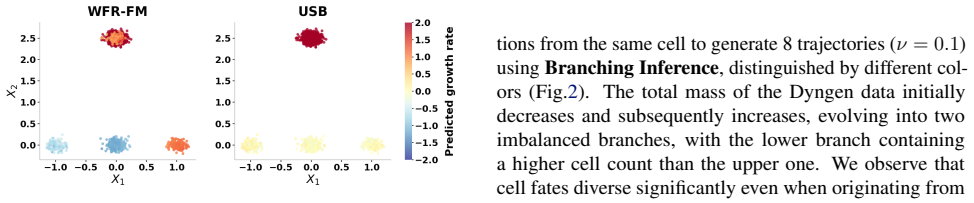
- Trajectory reconstruction achieves performance better than or comparable to deterministic baselines on both simulated and real-world datasets.
- The approach uniquely enables realistic discrete simulation of birth-death dynamics at single-cell resolution.
- Stochastic and unbalanced effects are integrated into a single dynamics learning framework.
- The simulation-free objective scales the method to high-dimensional omics data.
Where Pith is reading between the lines
- The discrete-jump formulation could be tested on non-biological branching systems such as particle coalescence or population models with explicit birth-death rules.
- If the microscopic interpretation holds, it would allow finer resolution of cell-fate decision points by tracking individual event probabilities rather than aggregate flows.
- The method opens the possibility of coupling USB outputs directly to downstream models that require explicit lineage trees instead of density estimates.
Load-bearing premise
A simulation-free training objective can be derived that correctly captures the discrete jump-like birth-death events at single-cell resolution while scaling to high-dimensional omics data.
What would settle it
Running the model on a dataset with independent lineage-tracing ground truth and checking whether the frequency and timing of simulated discrete birth-death events match the observed single-cell event counts.
Figures



read the original abstract
Inferring cellular trajectories from destructive snapshots is complicated by the challenges of stochasticity and non-conservative mass dynamics such as cell proliferation and apoptosis. Existing unbalanced Optimal Transport (OT) methods treat mass as a continuous fluid, performing inference at the population level. However, this macroscopic view often fails to capture the discrete, jump-like nature of birth-death events at single-cell resolution, which is essential for understanding lineage branching and fate decisions. We present Unbalanced Schr\"odinger Bridge (USB), a simulation-free framework for learning underlying dynamics that effectively integrates both stochastic and unbalanced effects which also models the discrete, jump-like birth-death dynamics at single-cell resolution. Theoretically, USB provides a tractable solution to the Branching Schr\"odinger Bridge (BSB) problem, offering a rigorous microscopic interpretation where individual cells undergo both Brownian motion and discrete birth-death jumps. Technically, the method implements an efficient solver by introducing a simulation-free training objective that effectively scales to high-dimensional omics data. Empirically, we demonstrate on both simulated and real-world datasets that USB not only achieves trajectory reconstruction performance better than or comparable to deterministic baselines but also uniquely enables realistic discrete simulation of birth-death dynamics at single-cell resolution.
Editorial analysis
A structured set of objections, weighed in public.
Referee Report
Summary. The paper introduces Unbalanced Schrödinger Bridge (USB), a simulation-free solver for the Branching Schrödinger Bridge (BSB) problem. It claims to reconstruct cellular trajectories from single-cell snapshots by modeling both continuous Brownian motion and discrete birth-death jumps at the individual-cell level, outperforming or matching deterministic baselines on simulated and real omics data while enabling realistic discrete simulations.
Significance. If the simulation-free objective rigorously captures exact microscopic jump statistics without hidden continuous approximations, the result would meaningfully advance single-cell dynamics inference beyond population-level unbalanced OT. The explicit microscopic interpretation and scaling claim to high-dimensional data are the primary contributions.
major comments (2)
- [Abstract, §3] Abstract and §3 (method): the central claim that the USB training objective 'effectively captures the discrete, jump-like birth-death dynamics at single-cell resolution' is load-bearing for the BSB solution. The skeptic concern is valid here: without an explicit derivation showing that the objective preserves the exact jump measure (rather than weak/population convergence), it is unclear whether the method avoids the continuous-path approximations typical of standard SB extensions. A concrete counter-example or theorem bounding the total variation distance on jump counts would be required.
- [§4] §4 (experiments): the performance claims ('better than or comparable to deterministic baselines' and 'uniquely enables realistic discrete simulation') are stated without reported error bars, dataset sizes, or ablation on the discrete-jump component. If the simulation results only match marginal distributions, this does not substantiate the microscopic interpretation.
minor comments (2)
- [§2] Notation for the birth-death intensity and the precise form of the simulation-free loss should be introduced earlier and kept consistent across equations.
- [Figures] Figure captions should explicitly state whether the visualized trajectories are sampled from the learned USB process or from a post-hoc simulation.
Simulated Author's Rebuttal
We thank the referee for their thoughtful review and constructive feedback on our manuscript. We address the major comments point by point below and outline the revisions we plan to make.
read point-by-point responses
-
Referee: [Abstract, §3] Abstract and §3 (method): the central claim that the USB training objective 'effectively captures the discrete, jump-like birth-death dynamics at single-cell resolution' is load-bearing for the BSB solution. The skeptic concern is valid here: without an explicit derivation showing that the objective preserves the exact jump measure (rather than weak/population convergence), it is unclear whether the method avoids the continuous-path approximations typical of standard SB extensions. A concrete counter-example or theorem bounding the total variation distance on jump counts would be required.
Authors: We appreciate this concern regarding the exact preservation of jump statistics. The Branching Schrödinger Bridge is formulated at the microscopic level, where each cell's trajectory includes both continuous diffusion and discrete birth-death events. The USB objective is derived directly from this BSB formulation in §3, ensuring that the learned dynamics correspond to the individual-level process rather than a population approximation. While an explicit total variation bound on jump counts is not derived in the current manuscript, the equivalence to the BSB problem provides the rigorous microscopic interpretation. We will add a clarifying remark in §3 to emphasize this distinction from continuous approximations. revision: partial
-
Referee: [§4] §4 (experiments): the performance claims ('better than or comparable to deterministic baselines' and 'uniquely enables realistic discrete simulation') are stated without reported error bars, dataset sizes, or ablation on the discrete-jump component. If the simulation results only match marginal distributions, this does not substantiate the microscopic interpretation.
Authors: We agree that additional details are needed to strengthen the experimental claims. In the revised manuscript, we will report error bars across multiple runs, specify the sizes of all datasets used, and include an ablation study isolating the contribution of the discrete-jump modeling component. This will help demonstrate that the performance gains are attributable to the microscopic discrete dynamics rather than marginal matching alone. revision: yes
Circularity Check
No circularity detected; derivation self-contained
full rationale
The abstract and context present USB as a new simulation-free solver for the BSB problem without exhibiting any equations, self-definitions, fitted inputs renamed as predictions, or load-bearing self-citations. No derivation chain is shown that reduces to its inputs by construction. The central claim of a tractable microscopic interpretation for discrete jumps is stated as a technical contribution rather than derived from prior fitted quantities or author-specific uniqueness theorems. This is the expected honest non-finding when no load-bearing steps are visible for inspection.
Axiom & Free-Parameter Ledger
Reference graph
Works this paper leans on
-
[1]
PMLR, 25–27 Apr 2023a. Bunne, C., Stark, S. G., Gut, G., et al. Learning single- cell perturbation responses using neural optimal transport. Nature methods, 20:1759–1768, 2023b. Cannoodt, R., Saelens, W., Deconinck, L., and Saeys, Y . Spearheading future omics analyses using dyngen, a multi-modal simulator of single cells.Nature commu- nications, 12:3942,...
-
[2]
Curran Associates, Inc., 2020. Huguet, G., Magruder, D. S., Tong, A., Fasina, O., Kuchroo, M., Wolf, G., and Krishnaswamy, S. Manifold interpo- lating optimal-transport flows for trajectory inference. In Koyejo, S., Mohamed, S., Agarwal, A., Belgrave, D., Cho, K., and Oh, A. (eds.),Advances in Neural Informa- tion Processing Systems, volume 35, pp. 29705–...
-
[3]
For branchSBM (Tang et al., 2025), we follow the hyperparameter settings in Table 9 of their paper
and VGFM (Wang et al., 2025), we used their default hyperparameter settings, since the datasets evaluated in our work are also used in their work, and our model sizes are consistent. For branchSBM (Tang et al., 2025), we follow the hyperparameter settings in Table 9 of their paper. For other simulation-free methods (MMFM (Rohbeck et al., 2025), Metric FM ...
-
[4]
We applied USB on the reduced 10D EMT data
reduced the dimension to 10 by an autoencoder. We applied USB on the reduced 10D EMT data. As shown in Table 7, USB achieves the best performance at most time points with growth penalty δ= 14 , and diffusion parameter ν= 0.001 . We plotted the learned growth rate in Figure 6. As shown, USB predicts higher growth rate in initial and intermediate stages, wh...
discussion (0)
Sign in with ORCID, Apple, or X to comment. Anyone can read and Pith papers without signing in.