Reasoning LLM Improves Speaker Recognition in Long-form TV Dramas
Pith reviewed 2026-07-03 14:12 UTC · model grok-4.3
The pith
A large reasoning model using multimodal tool-use achieves superior speaker recognition in long-form TV dramas, especially for short utterances.
A machine-rendered reading of the paper's core claim, the machinery that carries it, and where it could break.
Core claim
DramaSR-LRM, built upon a large reasoning model, autonomously aggregates contextual evidence via multimodal tool-use to synthesize diverse inputs and achieve high-fidelity speaker attribution in TV dramas, significantly outperforming existing baselines particularly on short utterances where acoustic biometrics are inherently unreliable.
What carries the argument
DramaSR-LRM, the approach that uses a large reasoning model to autonomously aggregate contextual evidence via multimodal tool-use for speaker attribution.
If this is right
- Speaker attribution accuracy rises especially when acoustic cues are weak or absent.
- The DramaSR-532K benchmark enables systematic testing of methods that integrate auditory, linguistic, and visual signals.
- Improved speaker recognition supports more reliable extraction of storylines from long-form video.
- The multimodal tool-use strategy demonstrates how reasoning models can handle cases where individual modalities fail.
Where Pith is reading between the lines
- The same aggregation technique could be tested on other long-form video domains such as documentaries or live events.
- If tool errors remain low, the approach might scale to real-time applications like meeting transcription.
- A controlled ablation that removes one modality at a time would isolate which cue types drive the reported gains.
Load-bearing premise
The large reasoning model can autonomously aggregate contextual evidence via multimodal tool-use to achieve high-fidelity speaker attribution without errors from tool inaccuracies or flawed context synthesis.
What would settle it
Running DramaSR-LRM on a fresh collection of TV dramas with independently verified speaker labels and observing no statistically significant gains over baselines on short utterances would falsify the performance claim.
Figures






read the original abstract
Long-form TV dramas present a formidable challenge for comprehensive video understanding, where deciphering complex storyline often relies on \textbf{speaker recognition}, the task of accurately attributing each spoken utterance to its respective character. In this paper, we advance this field through two primary contributions. (1) We introduce \textbf{DramaSR-532K}, a large-scale benchmark comprising 532K annotated dialogue lines across more than 900 unique characters, necessitating the integration of auditory, linguistic, and visual cues for speaker recognition. (2) We propose \textbf{DramaSR-LRM}, a robust approach built upon a large reasoning model (LRM). DramaSR-LRM is designed to autonomously aggregate contextual evidence via multimodal tool-use, synthesizing diverse inputs to achieve high-fidelity attribution. Experimental results demonstrate that DramaSR-LRM significantly outperforms existing baselines, particularly on short utterances where acoustic biometrics are inherently unreliable. \textit{All the data and code will be made publicly available at the project page: https://www.github.com/198808xc/DramaSR-LRM.}
Editorial analysis
A structured set of objections, weighed in public.
Referee Report
Summary. The manuscript introduces DramaSR-532K, a large-scale benchmark with 532K annotated dialogue lines across more than 900 characters from long-form TV dramas, and proposes DramaSR-LRM, an approach that uses a large reasoning model to autonomously aggregate auditory, linguistic, and visual cues via multimodal tool-use for speaker recognition. It claims that DramaSR-LRM significantly outperforms existing baselines, especially on short utterances where acoustic biometrics are unreliable. The work commits to releasing all data and code publicly.
Significance. If the results hold after proper validation, the benchmark would be a substantial contribution to multimodal video understanding, and the LRM-based approach could illustrate how reasoning models synthesize contextual evidence beyond pure acoustic features. The explicit commitment to public data and code release is a clear strength that supports reproducibility and follow-on work.
major comments (2)
- [Abstract] Abstract: the central claim that DramaSR-LRM 'significantly outperforms existing baselines, particularly on short utterances' is asserted without any quantitative metrics, baseline descriptions, experimental setup details, or error analysis, preventing verification of the claimed gains.
- [DramaSR-LRM description and experimental evaluation] DramaSR-LRM description and experimental evaluation: the claim that performance gains arise from autonomous context aggregation via multimodal tool-use holds only if tool outputs have low error and synthesis does not amplify mistakes. No tool-level precision/recall, ablation studies removing or noising individual tools, or analysis of how tool errors propagate to final attributions are reported, so observed improvements could originate from benchmark artifacts or unmeasured tool quality rather than the reasoning component.
Simulated Author's Rebuttal
We thank the referee for the constructive feedback on our manuscript. We address each major comment below, indicating planned revisions where appropriate to strengthen the presentation of results and analysis.
read point-by-point responses
-
Referee: [Abstract] Abstract: the central claim that DramaSR-LRM 'significantly outperforms existing baselines, particularly on short utterances' is asserted without any quantitative metrics, baseline descriptions, experimental setup details, or error analysis, preventing verification of the claimed gains.
Authors: We agree that the abstract would be strengthened by including key quantitative results. In the revised manuscript we will expand the abstract to report specific metrics (e.g., absolute accuracy gains on short utterances versus the strongest baseline), name the primary baselines, and briefly note the evaluation protocol. This change will make the central claim verifiable from the abstract alone. revision: yes
-
Referee: [DramaSR-LRM description and experimental evaluation] DramaSR-LRM description and experimental evaluation: the claim that performance gains arise from autonomous context aggregation via multimodal tool-use holds only if tool outputs have low error and synthesis does not amplify mistakes. No tool-level precision/recall, ablation studies removing or noising individual tools, or analysis of how tool errors propagate to final attributions are reported, so observed improvements could originate from benchmark artifacts or unmeasured tool quality rather than the reasoning component.
Authors: This is a fair observation. The current experiments focus on end-to-end attribution accuracy rather than component-wise tool diagnostics. We will add a new subsection that reports per-tool precision/recall on a held-out validation set and includes an ablation that systematically degrades individual tool outputs. A brief error-propagation discussion will also be included. Full Monte-Carlo propagation studies remain computationally expensive and will be noted as future work rather than claimed as completed. revision: partial
Circularity Check
No circularity; empirical claims rest on new dataset and external baselines
full rationale
The paper introduces DramaSR-532K as a new benchmark and DramaSR-LRM as an LRM-based method using multimodal tool-use for speaker attribution. Performance is reported via comparison to existing baselines on this dataset, with emphasis on short utterances. No equations, derivations, fitted parameters renamed as predictions, or self-citation chains appear in the abstract or description. The derivation chain is self-contained against external benchmarks and does not reduce to its own inputs by construction.
Axiom & Free-Parameter Ledger
Reference graph
Works this paper leans on
-
[1]
Do not refer to the first/last frame of any individual clip as that of the entire video
Since clip descriptions are provided in chronological order, ensure the description is coherent and follows the same sequence. Do not refer to the first/last frame of any individual clip as that of the entire video
-
[2]
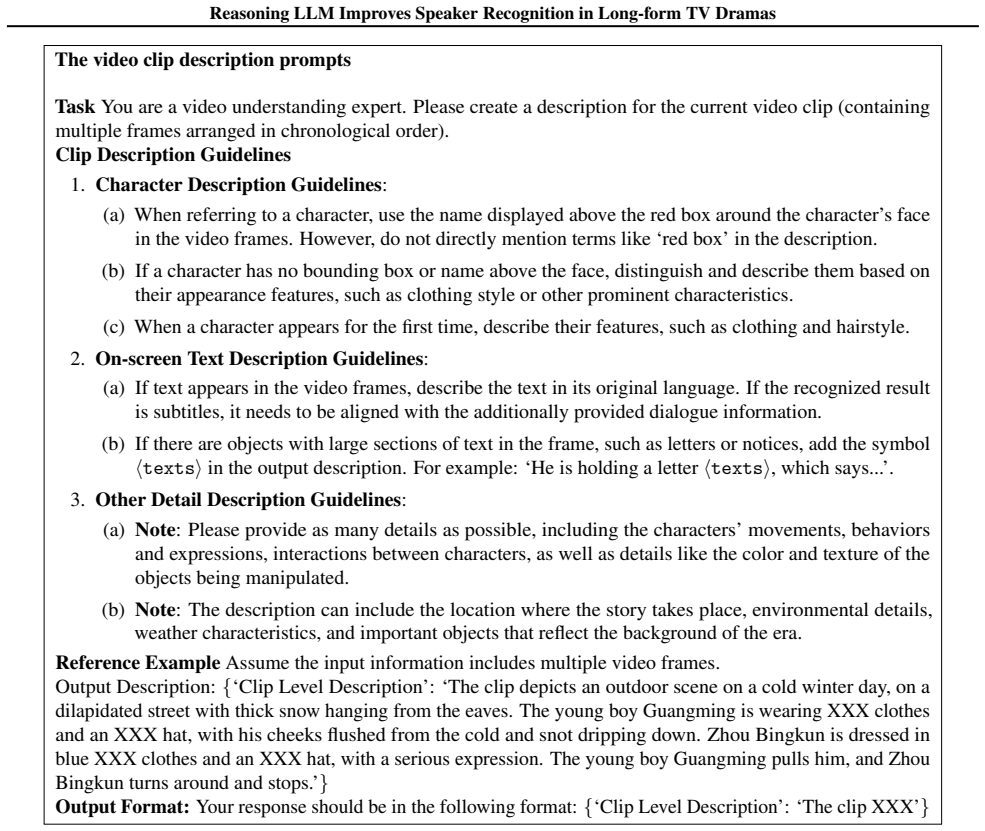
The clips are continuous; pay attention to maintaining logical coherence when summarizing
-
[3]
Avoid frequent use of expressions like ‘XXX said: ‘...’; instead, prefer ‘XXX did something and expressed XXX meaning’
Note:Present text and dialogue from the clips in a paraphrased summary form. Avoid frequent use of expressions like ‘XXX said: ‘...’; instead, prefer ‘XXX did something and expressed XXX meaning’
-
[4]
Note:Due to clip segmentation, errors may exist. Correct such errors when merging clip descriptions, ensuring smooth narration at the junctions—for example, merge statements from the same person or descriptions of the same person/object. If subtitles for the entire section are provided, use their context to make judgments; only correct errors when confide...
-
[5]
Merge duplicated dialogue only if it is described twice for the same clip (not if the character actually spoke twice)
Note:Merge repeated descriptions of a character’s expressions, appearance, or state (e.g., ‘appearing helpless and powerless’, ‘wearing a blue coat with a red badge on the chest’, ‘continuing to wash dishes on the other side of the room without participating in the conversation’) to avoid redundancy. Merge duplicated dialogue only if it is described twice...
-
[6]
Note:The tone of the video description should mimic direct narration of a video, not a summary of information from multiple clips. Thus, avoid expressions from the reference clip descriptions such as ‘this clip begins...’, ‘as the clip progresses...’, ‘this clip ends’, ‘the final/initial frame’, ‘the second clip starts with...’, ‘the last few frames of this part’
-
[7]
Try to understand the video’s theme and provide a coherent narrative that connects all clips
Note:Incorporate all details from the given clip descriptions, but avoid repeating descriptions of the same shot. Try to understand the video’s theme and provide a coherent narrative that connects all clips
-
[8]
Note:If subtitles or character relationships for these clips are provided, use them to aid understanding and correct errors
-
[9]
Retain as much information as possible while reducing detailed descriptions
Note:Since the duration of each clip varies, the length of the concise description must meet the specific word count requirement for each case. Retain as much information as possible while reducing detailed descriptions. Output Format:Your response must follow the following structure: {‘Section Detailed Description’: ‘The section ......’} Figure 6.Video s...
-
[10]
The concise description is a summary of the detailed description
-
[11]
Retain information useful for understanding the plot, but omit excessive detailed descriptions
It must include key elements such as people/objects involved, actions performed, locations, and core events. Retain information useful for understanding the plot, but omit excessive detailed descriptions
-
[12]
It should contain distinguishing features of the scene, such as the story’s setting, unique plot points, or main character relationships
-
[13]
5.Note:Retain as much key information as possible while minimizing redundant details
If subtitles or character relationships of the video are provided, use them to check and correct any errors. 5.Note:Retain as much key information as possible while minimizing redundant details. Guidelines for Title
-
[14]
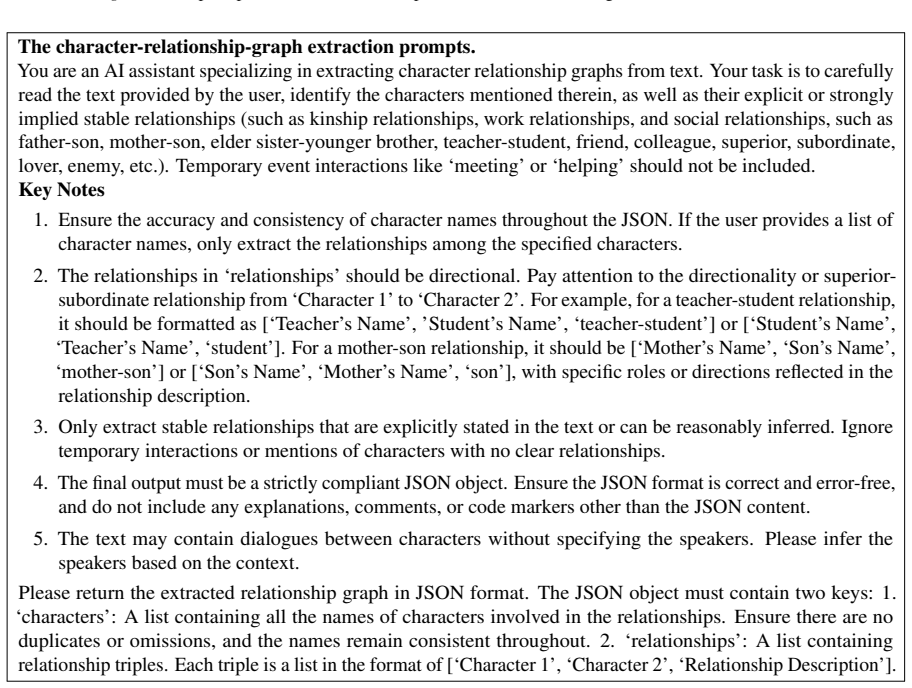
The title should be in the form of a phrase, concisely capturing the core event of the video. Output Format:Your response must follow the following structure: {‘Section Brief Description’: ‘The section XXXX’, ‘Title’: ‘XXX’} Figure 7.The prompt to condense the description of the entire video segment into a concise version. The character-relationship-graph...
-
[15]
If the user provides a list of character names, only extract the relationships among the specified characters
Ensure the accuracy and consistency of character names throughout the JSON. If the user provides a list of character names, only extract the relationships among the specified characters
-
[16]
Pay attention to the directionality or superior- subordinate relationship from ‘Character 1’ to ‘Character 2’
The relationships in ‘relationships’ should be directional. Pay attention to the directionality or superior- subordinate relationship from ‘Character 1’ to ‘Character 2’. For example, for a teacher-student relationship, it should be formatted as [‘Teacher’s Name’, ’Student’s Name’, ‘teacher-student’] or [‘Student’s Name’, ‘Teacher’s Name’, ‘student’]. For...
-
[17]
Ignore temporary interactions or mentions of characters with no clear relationships
Only extract stable relationships that are explicitly stated in the text or can be reasonably inferred. Ignore temporary interactions or mentions of characters with no clear relationships
-
[18]
Ensure the JSON format is correct and error-free, and do not include any explanations, comments, or code markers other than the JSON content
The final output must be a strictly compliant JSON object. Ensure the JSON format is correct and error-free, and do not include any explanations, comments, or code markers other than the JSON content
-
[19]
Please infer the speakers based on the context
The text may contain dialogues between characters without specifying the speakers. Please infer the speakers based on the context. Please return the extracted relationship graph in JSON format. The JSON object must contain two keys: 1. ‘characters’: A list containing all the names of characters involved in the relationships. Ensure there are no duplicates...
2023
-
[20]
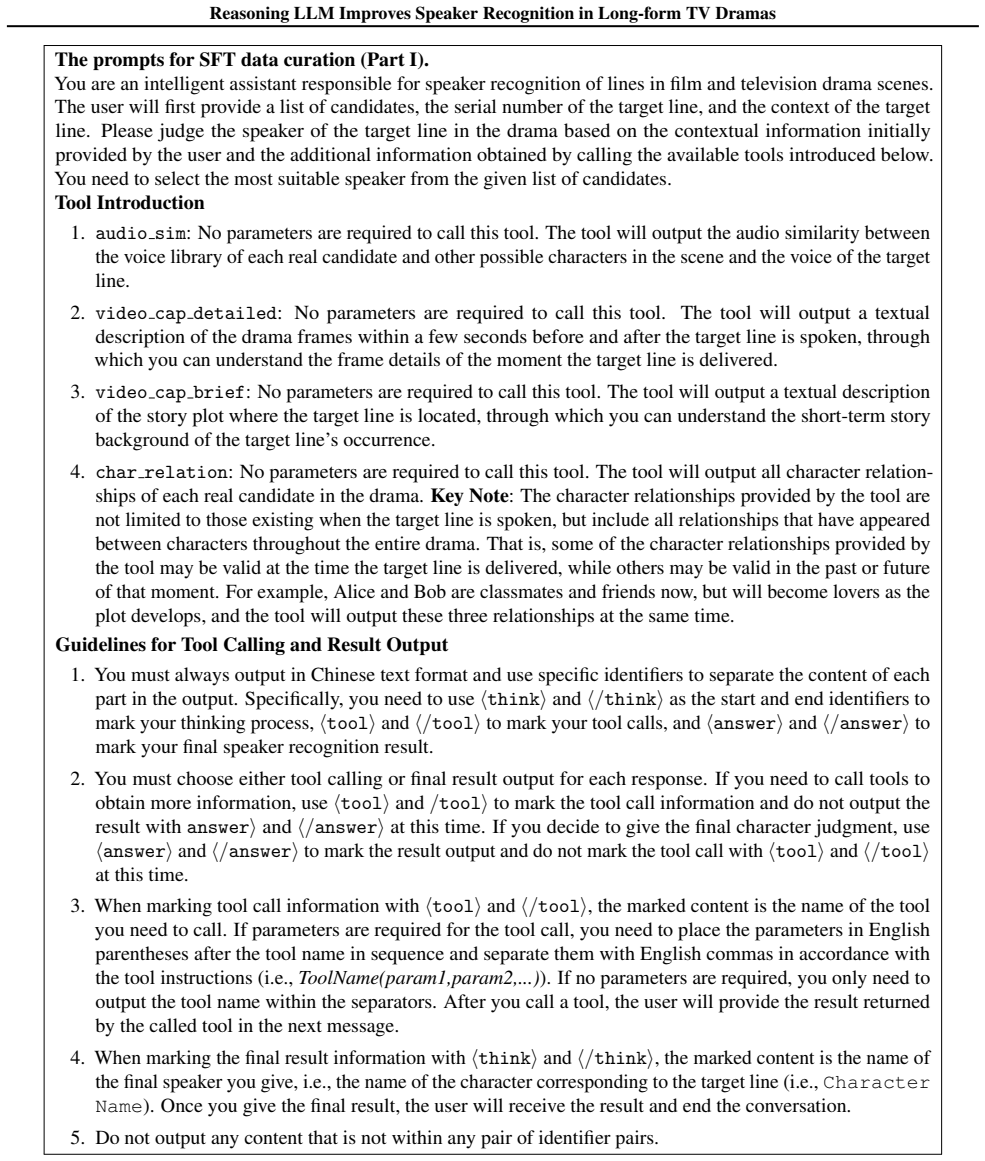
You must always output in Chinese text format and use specific identifiers to separate the content of each part in the output. Specifically, you need to use ⟨think⟩ and ⟨/think⟩ as the start and end identifiers to mark your thinking process, ⟨tool⟩ and ⟨/tool⟩ to mark your tool calls, and ⟨answer⟩ and ⟨/answer⟩ to mark your final speaker recognition result
-
[21]
If you need to call tools to obtain more information, use ⟨tool⟩ and /tool⟩ to mark the tool call information and do not output the result with answer⟩ and ⟨/answer⟩ at this time
You must choose either tool calling or final result output for each response. If you need to call tools to obtain more information, use ⟨tool⟩ and /tool⟩ to mark the tool call information and do not output the result with answer⟩ and ⟨/answer⟩ at this time. If you decide to give the final character judgment, use ⟨answer⟩ and ⟨/answer⟩ to mark the result o...
-
[22]
When marking tool call information with ⟨tool⟩ and ⟨/tool⟩, the marked content is the name of the tool you need to call. If parameters are required for the tool call, you need to place the parameters in English parentheses after the tool name in sequence and separate them with English commas in accordance with the tool instructions (i.e.,ToolName(param1,p...
-
[23]
Once you give the final result, the user will receive the result and end the conversation
When marking the final result information with ⟨think⟩ and ⟨/think⟩, the marked content is the name of the final speaker you give, i.e., the name of the character corresponding to the target line (i.e.,Character Name). Once you give the final result, the user will receive the result and end the conversation
-
[24]
Figure 9.The prompt to identify the speaker of the target line based on contextual information and multi-tool invocation
Do not output any content that is not within any pair of identifier pairs. Figure 9.The prompt to identify the speaker of the target line based on contextual information and multi-tool invocation. initialized with the user prompt described in Figure 11, which incorporates the initial speaker labels. To ensure high-quality reasoning, we implement a two-pas...
-
[25]
In addition, the provided lines do not exactly constitute the complete story corresponding to video cap brief, and there may be differences in their context ranges
Lines with consecutive IDs are also consecutive in the drama plot, and the provided lines are excerpted from the drama, so the provided lines may not represent a complete dialogue scene. In addition, the provided lines do not exactly constitute the complete story corresponding to video cap brief, and there may be differences in their context ranges. You c...
-
[26]
If there are address terms in the target line or the contextual lines that form a dialogue relationship with the target line, or the expression of the target line and its context implies the relationships between characters in the scene, you can actively try to call the char relation tool (Tool 4) to obtain relevant relationship information
-
[27]
Please fully invoke the tools before outputting the answer, and try not to give the answer directly in the first response
-
[28]
Only one tool can be invoked per output
-
[29]
Please ensure that your thinking process marked with ⟨think⟩ and ⟨/think⟩ is included in every output. (This requirement is emphasized three times: ensure the thinking process is included in every output; ensure the thinking process is included in every output; ensure the thinking process is included in every output.) Figure 10.(Continuing Figure 9) The p...
-
[30]
List of Speaker Candidates is as follows: ———————– {candidate str} ———————– Note: Among the candidates, ‘Others’ indicates that the speaker is a role other than the above-listed candidates. This usually means the speaker is a temporary character in the film and television drama (e.g., announcer, police officer, passerby, staff member, etc.) or a main char...
-
[31]
For example, ‘[1] Alice: Hello’
Contextual lines have been organized into text format, where each line represents a single line of dialogue with the structure: ‘[Serial Number] Speaker: Dialogue Line’. For example, ‘[1] Alice: Hello’. If the speaker is marked as ‘Unknown’, it means the speaker’s identity is undetermined for the time being; the label ‘Others’ has the same meaning as defi...
-
[32]
The serial number of the target line you need to judge is{j}. The speaker recognition cheat prompts. The actual speaker of the target line is ⟨the true role⟩. Please provide a reasonable tool calling process and analytical reasoning based on the known answer, and finally present the conclusion. Note that you must pretend to be unaware of the answer when g...
discussion (0)
Sign in with ORCID, Apple, or X to comment. Anyone can read and Pith papers without signing in.