Towards a Floer theory for Mars I -- Twisted Zeeman systems
Pith reviewed 2026-06-28 12:07 UTC · model grok-4.3
The pith
Periodic collisional solutions of twisted Zeeman systems can be detected variationally after regularizing collisions in non-local Lagrangian and Hamiltonian setups.
A machine-rendered reading of the paper's core claim, the machinery that carries it, and where it could break.
Core claim
In this singular Euler-Hamilton system with time-periodic forces, the collision singularity can be regularized such that periodic collisional solutions are detectable as critical points of action functionals in both a non-local Lagrangian setup and a non-local Hamiltonian setup.
What carries the argument
Regularization of the collision singularity that preserves the variational structure for non-local action functionals.
If this is right
- Periodic collisional solutions exist and can be found variationally in the regularized non-local setups.
- The method applies to models of the elliptic restricted three-body problem via the correspondence with Lorentz and gravitational forces.
- This provides a foundation for developing a Floer theory for these systems.
- Similar regularization techniques may detect periodic orbits in other singular time-periodic Hamiltonian systems.
Where Pith is reading between the lines
- This approach could be extended to compute explicit orbits in specific force configurations using numerical minimization of the action.
- Connections to the original three-body problem suggest possible new proofs of periodic solutions in celestial mechanics.
- If the non-local setups admit a Floer homology, it would give invariants for classifying these orbits.
Load-bearing premise
The regularization of the collision singularity must preserve enough of the variational structure so that the non-local action functionals still detect the periodic solutions.
What would settle it
Finding a specific time-periodic force configuration where a known periodic collisional orbit exists, but the regularized variational problem has no corresponding critical point, would show the method fails.
Figures


read the original abstract
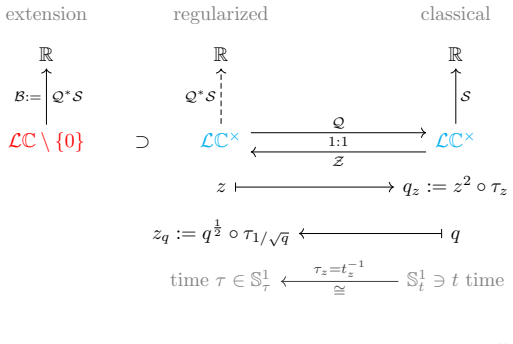
In this article we study periodic orbits of an electron attracted by a proton subject to Lorentz, electric, and Euler forces where each of them is allowed to depend periodically on time. This setup is motivated by the elliptic restricted three-body-problem where the Lorentz force corresponds to Coriolis force, the Coulomb force is replaced by the gravitational force, and the electric force of an external source is a combination of centrifugal forces and gravitational forces of other bodies. This is a singular version of a Euler-Hamilton system as discussed in [FW26b]. The singularity is due to collisions of the electron with the proton, respectively of two masses. Due to the possibility of collisions this problem has to be regularized. We show how periodic collisional solutions of this problem can be detected variationally in a non-local Lagrangian setup as well as in a non-local Hamiltonian setup.
Editorial analysis
A structured set of objections, weighed in public.
Referee Report
Summary. The manuscript studies periodic orbits in a time-periodic singular Euler-Hamilton system modeling an electron attracted to a proton under Lorentz, electric, and Euler forces (motivated by the elliptic restricted three-body problem). It regularizes the collision singularity and claims to detect periodic collisional solutions variationally in both a non-local Lagrangian setup and a non-local Hamiltonian setup.
Significance. If the regularization is shown to preserve the variational structure so that collisional periodic orbits remain detectable as critical points, the work would provide a concrete step toward Floer-theoretic methods for singular systems with collisions. The abstract, however, states the result without derivation, regularization details, or verification, so the significance cannot be assessed from the available text.
major comments (1)
- Abstract: the central claim that periodic collisional solutions can be detected variationally after regularization is asserted without any derivation, explicit regularization map, or verification that the non-local Lagrangian/Hamiltonian structure is preserved. This step is load-bearing for the detection result and cannot be evaluated from the given material.
Simulated Author's Rebuttal
We thank the referee for their report. The single major comment concerns the level of detail provided in the abstract regarding regularization and preservation of variational structure. We address this below and note that the full derivations appear in the body of the manuscript.
read point-by-point responses
-
Referee: [—] Abstract: the central claim that periodic collisional solutions can be detected variationally after regularization is asserted without any derivation, explicit regularization map, or verification that the non-local Lagrangian/Hamiltonian structure is preserved. This step is load-bearing for the detection result and cannot be evaluated from the given material.
Authors: The abstract is intended as a concise summary. The explicit regularization (via a time-dependent Levi-Civita-type transformation adapted to the twisted Zeeman potential) is constructed in Section 2. Preservation of the non-local Lagrangian and Hamiltonian structures under this regularization is verified in Propositions 3.2 and 5.1, respectively. The variational detection of periodic collisional solutions as critical points of the regularized action functionals is then carried out in Theorems 4.3 (Lagrangian) and 6.4 (Hamiltonian). If the referee finds the abstract too terse, we are willing to add a single sentence referencing the regularization map and the relevant propositions. revision: partial
Circularity Check
No significant circularity identified
full rationale
The provided abstract and context reference prior work [FW26b] for the non-singular Euler-Hamilton system but present the current paper as an extension to the singular collisional case through regularization that preserves variational structure for detection of periodic orbits in non-local Lagrangian and Hamiltonian setups. No equations, self-definitional constructions, fitted inputs renamed as predictions, or load-bearing self-citations that reduce the central claim to its own inputs by construction are visible. The derivation chain builds on the regularization step as an independent construction without reducing to self-referential inputs or ansatzes smuggled via citation.
Axiom & Free-Parameter Ledger
Reference graph
Works this paper leans on
-
[1]
The role of the L egendre transform in the study of the F loer complex of cotangent bundles
Alberto Abbondandolo and Matthias Schwarz. The role of the L egendre transform in the study of the F loer complex of cotangent bundles. Comm. Pure Appl. Math. , 68(11):1885--1945, 2015
1945
-
[2]
Regularized variational principles for the perturbed K epler problem
Vivina Barutello, Rafael Ortega, and Gianmaria Verzini. Regularized variational principles for the perturbed K epler problem. Adv. Math. , 383:Paper No. 107694, 64, 2021. arXiv:2003.09383 https://arxiv.org/abs/2003.09383
-
[3]
A variational approach to frozen planet orbits in helium
Kai Cieliebak, Urs Frauenfelder, and Evgeny Volkov. A variational approach to frozen planet orbits in helium. Ann. Inst. H. Poincar\' e C Anal. Non Lin\' e aire , 40(2):379--455, 2023
2023
-
[4]
Periodic orbits in the restricted three-body problem and A rnold's J^+ -invariant
Kai Cieliebak, Urs Frauenfelder, and Otto van Koert. Periodic orbits in the restricted three-body problem and A rnold's J^+ -invariant. Regul. Chaotic Dyn. , 22(4):408--434, 2017
2017
-
[5]
Analysis
Otto Forster. Analysis. 1 . Grundkurs Mathematik. Vieweg + Teubner, Wiesbaden, expanded edition, 2011. Differential- und Integralrechnung einer Ver\"anderlichen
2011
-
[6]
Periodic orbits in time-dependent planar Stark-Zeeman systems
Urs Frauenfelder . Periodic orbits in time-dependent planar Stark-Zeeman systems . arXiv e-prints , page arXiv:2503.09209 https://arxiv.org/abs/2503.09209, March 2025. Accepted for publication in Kyoto J. Math
-
[7]
The regularized free fall I -- Index computations
Urs Frauenfelder and Joa Weber . The regularized free fall I -- Index computations . Russian Journal of Mathematical Physics , 28(4):464--487, 2021. SharedIt https://rdcu.be/cCJqj
2021
-
[8]
Loop space blow-up and scale calculus
Urs Frauenfelder and Joa Weber. Loop space blow-up and scale calculus . Arch. Math. (Basel) , 126:335--342, 2026. Open access https://rdcu.be/eZpmp
2026
-
[9]
Merry-go-round and time-dependent symplectic forms
Urs Frauenfelder and Joa Weber . Merry-go-round and time-dependent symplectic forms . viXra e-prints https://vixra.org/author/joa_weber science, freedom, dignity , pages 1--18, January 2026. viXra: 2601.0019 https://vixra.org/abs/2601.0019
-
[10]
The linearized Floer equation in a chart
Urs Frauenfelder and Joa Weber . The linearized Floer equation in a chart . SIGMA , 22(032):38 pages, 2026. Special Issue https://sigma-journal.com/Merry.html on Geometry and Dynamics in memory of Will Merry. Open access https://doi.org/10.3842/SIGMA.2026.032
-
[11]
Towards a Floer theory for Mars II -- Floer Hessian field almost extends
Urs Frauenfelder and Joa Weber . Towards a Floer theory for Mars II -- Floer Hessian field almost extends . viXra e-prints https://vixra.org/author/joa_weber science, freedom, dignity , 2026. In preparation
2026
-
[12]
Johannes Kepler. Astronomia Nova . Heidelberg: G. Voegelinus, 1609. Online: archive https://archive.org/details/Astronomianovaa00Kepl or ETH Z\"urich https://www.e-rara.ch/zut/doi/10.3931/e-rara-558
-
[13]
Johannes Kepler. Gesammelte Werke. Astronomia nova , volume 3 of Kepler. Gesammelte Werke . Max Caspar [Hg./Red.], Walther von Dyck [Hg./Red.], M \"u nchen, 1937. Online: vol 3 https://publikationen.badw.de/de/002334739 and BAdW https://kepler.badw.de/die-edition.html
-
[14]
New Astronomy, translated by William H
Johannes Kepler. New Astronomy, translated by William H. Donahue . Cambridge Univ. Press, Cambridge, 1992. Link: New Revised Edition, 2015 https://www.greenlion.com/books/astronomianova.html
1992
-
[15]
Fundamentals of differential geometry
Serge Lang . Fundamentals of differential geometry . Springer-Verlag, New York, corr. printing 2nd edition, 2001
2001
-
[16]
Ordinary differential equations and dynamical systems , volume 140 of Graduate Studies in Mathematics
Gerald Teschl. Ordinary differential equations and dynamical systems , volume 140 of Graduate Studies in Mathematics . Online edition http://www.mat.univie.ac.at/ gerald/ftp/book-ode/index.html, authorized by American Mathematical Society, Providence, RI, 2012
2012
-
[17]
Topological methods in the quest for periodic orbits
Joa Weber. Topological methods in the quest for periodic orbits . Publica c \ oes Matem\'aticas. Instituto Nacional de Matem\'atica Pura e Aplicada (IMPA), Rio de Janeiro, 2017. 31 ^ o Col\'oquio Brasileiro de Matem\'atica. Access book http://www.math.stonybrook.edu/ joa/PUBLICATIONS/CBM31-TOPMETDYN.pdf
2017
discussion (0)
Sign in with ORCID, Apple, or X to comment. Anyone can read and Pith papers without signing in.