The Human Creativity Benchmark
Pith reviewed 2026-06-30 05:51 UTC · model grok-4.3
The pith
Evaluating creative AI requires separating where professionals agree on standards from where their tastes legitimately differ.
A machine-rendered reading of the paper's core claim, the machinery that carries it, and where it could break.
Core claim
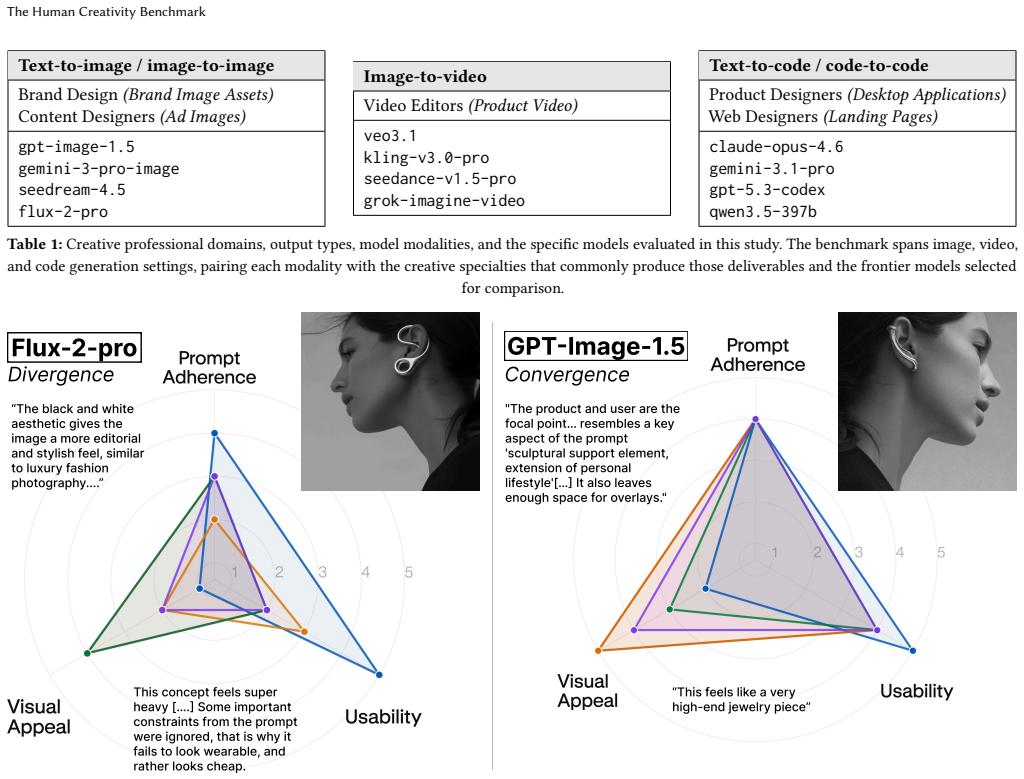
The paper claims that creative AI evaluation must preserve two distinct signals: convergence, where professionals align around shared best practices, and divergence, where individual taste legitimately varies. The Human Creativity Benchmark operationalizes this separation by collecting pairwise preferences, scalar ratings on prompt adherence, usability, and visual appeal, and qualitative rationales from domain professionals. Across 15,000 professional judgments spanning five creative domains and three workflow phases, convergence concentrates on verifiable dimensions like technical correctness and visual hierarchy, while divergence concentrates on taste-driven dimensions like aesthetic direc
What carries the argument
The Human Creativity Benchmark, which partitions expert judgments into convergence and divergence categories to preserve distinct signals instead of averaging them.
If this is right
- Models can be assessed for reliability on dimensions where convergence occurs and for adaptability on dimensions where divergence occurs.
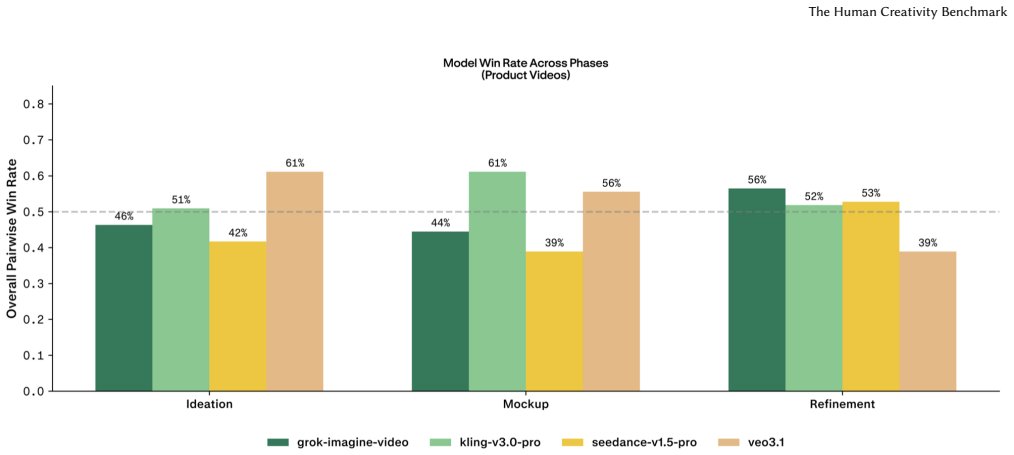
- Evaluation must be performed separately for each workflow phase because performance patterns differ across ideation, mockup, and refinement.
- Single quality metrics lose the information needed to decide where models should match shared standards and where they should support variation.
- Benchmark results can guide targeted improvements by identifying specific dimensions and phases where steerability is preferred over correctness.
Where Pith is reading between the lines
- The same separation of signals could be applied to other subjective domains such as text generation or music composition to distinguish objective constraints from stylistic choice.
- Developers could use divergence data to train models that produce varied outputs rather than converging toward averaged preferences.
Load-bearing premise
The collected pairwise preferences, scalar ratings, and rationales from domain professionals can be partitioned into convergence and divergence categories in a way that reflects genuine taste variation rather than prompt-specific artifacts, domain selection, or rater pool composition.
What would settle it
If re-running the same collection process with altered prompts or a different rater pool produces convergence and divergence partitions that no longer align with the original patterns on verifiable versus taste-driven dimensions, the separation would not hold.
Figures







read the original abstract
Modern AI evaluation frameworks treat evaluator disagreement as noise to be resolved. In creative domains, professional disagreement reflects genuine differences in taste, not measurement error. We argue that evaluating creative AI requires preserving two distinct signals: convergence, where professionals align around shared best practices, and divergence, where individual taste legitimately varies. We present the Human Creativity Benchmark (HCB), a benchmark that operationalizes this separation by collecting pairwise preferences, scalar ratings on prompt adherence, usability, and visual appeal, and qualitative rationale from domain professionals. Across 15,000 professional judgments spanning five creative domains and three workflow phases (ideation, mockup, refinement), we find that convergence concentrates on verifiable dimensions like technical correctness and visual hierarchy, while divergence concentrates on taste-driven dimensions like aesthetic direction and conceptual risk. No model excels uniformly across all phases. Collapsing these signals into a single quality metric discards the most actionable information: where models must be correct versus where they should remain steerable.
Editorial analysis
A structured set of objections, weighed in public.
Referee Report
Summary. The paper argues that creative AI evaluation should preserve two signals—convergence on verifiable dimensions (e.g., technical correctness) and divergence on taste-driven dimensions (e.g., aesthetic direction)—rather than treating professional disagreement as noise to be aggregated into a single metric. It introduces the Human Creativity Benchmark (HCB) operationalized via 15,000 pairwise preferences, scalar ratings (prompt adherence, usability, visual appeal), and rationales collected from domain professionals across five creative domains and three workflow phases (ideation, mockup, refinement). The central empirical claim is that convergence concentrates on verifiable aspects while divergence concentrates on taste aspects, with no model excelling uniformly, implying that single-metric collapse discards actionable information about where models must be correct versus remain steerable.
Significance. If the reported partition between convergence and divergence proves robust, the work supplies a concrete, multi-dimensional evaluation framework that directly addresses a recognized limitation in current creative-AI benchmarks. The emphasis on preserving steerability information rather than forcing consensus is a substantive contribution to evaluation methodology in generative AI.
major comments (2)
- [Abstract] Abstract: The manuscript states findings from 15,000 professional judgments yet supplies no methods detail on sampling, exclusion criteria, inter-rater reliability statistics, or raw-data summary. Without these, the claim that convergence concentrates on verifiable dimensions cannot be assessed for robustness or post-hoc selection.
- [Abstract] Abstract: The operationalization of partitioning judgments into convergence versus divergence categories is presented without any validation that the observed patterns reflect genuine taste variation rather than prompt artifacts, domain selection, or rater-pool composition; this partition is load-bearing for the central claim that single-metric aggregation discards actionable information.
Simulated Author's Rebuttal
We thank the referee for the constructive comments highlighting the need for greater methodological transparency in the abstract and explicit validation of the convergence-divergence partition. We address each point below and will revise the manuscript accordingly to strengthen the presentation of the Human Creativity Benchmark.
read point-by-point responses
-
Referee: [Abstract] Abstract: The manuscript states findings from 15,000 professional judgments yet supplies no methods detail on sampling, exclusion criteria, inter-rater reliability statistics, or raw-data summary. Without these, the claim that convergence concentrates on verifiable dimensions cannot be assessed for robustness or post-hoc selection.
Authors: We agree that the abstract omits these details. The full manuscript contains a Methods section specifying rater recruitment (domain professionals with minimum experience thresholds recruited through professional networks), exclusion criteria (failed attention checks and insufficient domain expertise), inter-rater reliability (Krippendorff's alpha computed separately for pairwise preferences and scalar ratings), and raw-data summaries (distribution of judgments across domains and phases). To address the concern directly, we will revise the abstract to include a concise methods overview so readers can evaluate robustness without needing the full text. revision: yes
-
Referee: [Abstract] Abstract: The operationalization of partitioning judgments into convergence versus divergence categories is presented without any validation that the observed patterns reflect genuine taste variation rather than prompt artifacts, domain selection, or rater-pool composition; this partition is load-bearing for the central claim that single-metric aggregation discards actionable information.
Authors: The partition is operationalized by first identifying dimensions via rater rationales and then measuring agreement: high consensus on verifiable aspects (prompt adherence, technical correctness, visual hierarchy) versus persistent divergence on taste aspects (aesthetic direction, conceptual risk). The multi-domain and multi-phase design provides initial safeguards against single-prompt or single-domain artifacts. We acknowledge that the current manuscript does not include dedicated robustness checks (e.g., prompt perturbation tests or rater demographic subgroup analyses). We will add these validation analyses in a new subsection to confirm the patterns are not artifacts of the experimental setup. revision: yes
Circularity Check
No significant circularity
full rationale
The paper defines the Human Creativity Benchmark through fresh collection of 15,000 professional pairwise preferences, scalar ratings, and rationales across five domains and three workflow phases. No equations, fitted parameters, predictions, or self-citation chains appear in the supplied text; the separation into convergence (verifiable dimensions) versus divergence (taste dimensions) is an empirical partition of the newly gathered data rather than a reduction to prior inputs by construction. The claim that single-metric aggregation loses actionable information follows directly from the operationalization once the data partition is performed.
Axiom & Free-Parameter Ledger
Reference graph
Works this paper leans on
-
[1]
Langley , title =
P. Langley , title =. Proceedings of the 17th International Conference on Machine Learning (ICML 2000) , address =. 2000 , pages =
2000
-
[2]
T. M. Mitchell. The Need for Biases in Learning Generalizations. 1980
1980
-
[3]
M. J. Kearns , title =
-
[4]
Machine Learning: An Artificial Intelligence Approach, Vol. I. 1983
1983
-
[5]
R. O. Duda and P. E. Hart and D. G. Stork. Pattern Classification. 2000
2000
-
[6]
Suppressed for Anonymity , author=
-
[7]
Newell and P
A. Newell and P. S. Rosenbloom. Mechanisms of Skill Acquisition and the Law of Practice. Cognitive Skills and Their Acquisition. 1981
1981
-
[8]
A. L. Samuel. Some Studies in Machine Learning Using the Game of Checkers. IBM Journal of Research and Development. 1959
1959
-
[9]
Proceedings of the 1st Workshop on Evaluation and Comparison of
We Need to Consider Disagreement in Evaluation , author =. Proceedings of the 1st Workshop on Evaluation and Comparison of
-
[10]
Advances in Neural Information Processing Systems , volume =
Picking on the Same Person: Does Algorithmic Monoculture Lead to Outcome Homogenization? , author =. Advances in Neural Information Processing Systems , volume =
-
[11]
Sociology , volume =
Sociology and the Cultural and Creative Industries , author =. Sociology , volume =
-
[12]
Philip and Skene, Allan M
Dawid, A. Philip and Skene, Allan M. , journal =. Maximum Likelihood Estimation of Observer Error-Rates Using the
-
[13]
Inel, Oana and Khamkham, Khalifeh and Cristea, Tatiana and Dumitrache, Anca and Rutjes, Heine and Ploeg, Jelle and Romaszko, Lukasz and Aroyo, Lora and Sips, Robert-Jan , booktitle =
-
[14]
Intergovernmental Committee for the Protection and Promotion of the Diversity of Cultural Expressions , year =
Culture, Platforms and Machines: The Impact of Artificial Intelligence on the Diversity of Cultural Expressions , author =. Intergovernmental Committee for the Protection and Promotion of the Diversity of Cultural Expressions , year =
-
[15]
Rethinking Creativity: Creative Industries,
Lee, Hye-Kyung , journal =. Rethinking Creativity: Creative Industries,
-
[16]
Journal of Creativity , volume =
Extending Human Creativity with. Journal of Creativity , volume =
-
[17]
Catastrophic Forgetting and Mode Collapse in
Thanh-Tung, Hoang and Tran, Thanh , booktitle =. Catastrophic Forgetting and Mode Collapse in
-
[18]
2024 , howpublished =
Stitch , author =. 2024 , howpublished =
2024
-
[19]
Why Good Thoughts Block Better Ones: The Mechanism of the Pernicious
Bilali\'c, Merim and McLeod, Peter and Gobet, Fernand , journal =. Why Good Thoughts Block Better Ones: The Mechanism of the Pernicious
-
[20]
Advances in Neural Information Processing Systems , volume =
Auditing for Human Expertise , author =. Advances in Neural Information Processing Systems , volume =
-
[21]
Advances in Neural Information Processing Systems , volume =
Human Expertise in Algorithmic Prediction , author =. Advances in Neural Information Processing Systems , volume =
-
[22]
Human Computation , volume =
Framing is Mightier than the Sword: Detection of Episodic and Thematic Framing in News Media , author =. Human Computation , volume =. 2024 , doi =
2024
-
[23]
The Journal of Creative Behavior , volume =
Needed Research on the Measurement of Creativity , author =. The Journal of Creative Behavior , volume =
-
[24]
We need to consider disagreement in evaluation
Valerio Basile, Michael Fell, Tommaso Fornaciari, Dirk Hovy, Silviu Paun, Barbara Plank, Massimo Poesio, and Anca Uma. We need to consider disagreement in evaluation. In Proceedings of the 1st Workshop on Evaluation and Comparison of NLP Systems , pages 15--21, 2021
2021
-
[25]
Creel, Arvind Kumar, Dan Jurafsky, and Percy Liang
Rishi Bommasani, Kathleen A. Creel, Arvind Kumar, Dan Jurafsky, and Percy Liang. Picking on the same person: Does algorithmic monoculture lead to outcome homogenization? In Advances in Neural Information Processing Systems, volume 35, pages 3663--3678, 2022
2022
-
[26]
Philip Dawid and Allan M
A. Philip Dawid and Allan M. Skene. Maximum likelihood estimation of observer error-rates using the EM algorithm. Journal of the Royal Statistical Society: Series C (Applied Statistics), 28 0 (1): 0 20--28, 1979
1979
-
[27]
CrowdTruth : Machine-human computation framework for harnessing disagreement in gathering annotated data
Oana Inel, Khalifeh Khamkham, Tatiana Cristea, Anca Dumitrache, Heine Rutjes, Jelle Ploeg, Lukasz Romaszko, Lora Aroyo, and Robert-Jan Sips. CrowdTruth : Machine-human computation framework for harnessing disagreement in gathering annotated data. In The Semantic Web -- ISWC 2014 , volume 8797 of Lecture Notes in Computer Science, pages 486--504. Springer, 2014
2014
-
[28]
Rethinking creativity: Creative industries, AI and everyday creativity
Hye-Kyung Lee. Rethinking creativity: Creative industries, AI and everyday creativity. Media, Culture & Society, 44 0 (3): 0 601--612, 2022
2022
-
[29]
Catastrophic forgetting and mode collapse in GANs
Hoang Thanh-Tung and Thanh Tran. Catastrophic forgetting and mode collapse in GANs . In 2020 International Joint Conference on Neural Networks ( IJCNN ) , pages 1--10. IEEE, 2020
2020
-
[30]
Treffinger and John P
Donald J. Treffinger and John P. Poggio. Needed research on the measurement of creativity. The Journal of Creative Behavior, 6 0 (4): 0 263--267, 1972
1972
discussion (0)
Sign in with ORCID, Apple, or X to comment. Anyone can read and Pith papers without signing in.