Madelung hydrodynamics and Poisson geometry of wave functions
Pith reviewed 2026-07-02 05:59 UTC · model grok-4.3
The pith
The Madelung transform, regarded as a momentum map, defines prequantum bundles for coadjoint orbits of semidirect extensions of diffeomorphism groups on arbitrary oriented manifolds.
A machine-rendered reading of the paper's core claim, the machinery that carries it, and where it could break.
Core claim
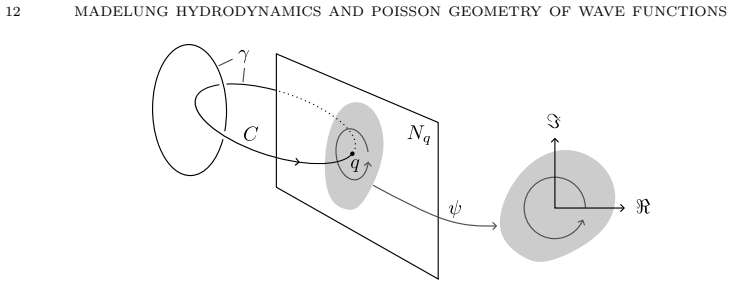
For arbitrary oriented manifolds the Madelung transform, regarded as a momentum map, naturally defines prequantum bundles for coadjoint orbits of semidirect extensions of diffeomorphism groups. For wave functions without zeros the transform supplies a Kähler map between the infinite-dimensional Fubini-Study and Fisher-Rao geometries. For wave functions with noncritical zeros the transform is a symplectomorphism onto coadjoint orbits carrying Morse-Bott densities, thereby furnishing a momentum-map account of the Wallstrom quantization condition.
What carries the argument
The Madelung transform viewed as a momentum map in the Poisson geometry of the diffeomorphism group and its semidirect product extensions.
If this is right
- The construction supplies an infinite-dimensional version of convexity results for Hamiltonian torus actions, giving a partial answer to Atiyah's question.
- It extends the Kähler isomorphism between Fubini-Study and Fisher-Rao geometries from simply-connected to non-simply-connected manifolds.
- It yields a momentum-map perspective on the Wallstrom quantization condition for the hydrodynamical form of quantum mechanics.
- It relates the Madelung setting to the Marsden-Weinstein symplectic structures on knots and membranes.
Where Pith is reading between the lines
- The prequantum-bundle construction could be used to import finite-dimensional geometric quantization techniques directly into the hydrodynamical formulation of quantum mechanics.
- The result suggests that topological features of the base manifold (fundamental group, orientability) control which coadjoint orbits can be prequantized via wave functions.
- One could test whether the same momentum-map property persists when the underlying manifold is allowed to have boundary or is taken to be non-orientable.
Load-bearing premise
Wave functions are generic (no zeros or only noncritical zeros) on an oriented manifold and the Madelung map is a momentum map in the infinite-dimensional Poisson geometry.
What would settle it
A concrete wave function with a critical zero on the circle whose image under the Madelung map fails to be a symplectomorphism onto the corresponding coadjoint orbit with Morse-Bott density.
Figures


read the original abstract
We describe the Poisson geometry of the Madelung transform between quantum mechanics and hydrodynamics for generic wave functions. We prove that for arbitrary oriented manifolds this transform, being regarded as a momentum map, naturally defines prequantum bundles for coadjoint orbits of semidirect extensions of diffeomorphism groups. Furthermore, we show that the Madelung framework provides a natural infinite-dimensional version of the convexity results for Hamiltonian torus actions, thus giving a partial answer to Atiyah's question. In particular, for wave functions without zeros our results provide a K\"ahler map between the infinite-dimensional Fubini--Study and Fisher--Rao geometries, thus extending previous results to non-simply-connected manifolds. Furthermore, for wave functions with noncritical zeros, the Madelung transform is shown to be a symplectomorphism to the coadjoint orbits with Morse--Bott densities. The latter, in turn, furnishes a novel momentum map point of view on the Wallstrom quantization condition for the hydrodynamical form of quantum mechanics. We also comment on the relation between the Madelung setting and the Marsden--Weinstein symplectic structures on knots and membranes.
Editorial analysis
A structured set of objections, weighed in public.
Referee Report
Summary. The manuscript claims that the Madelung transform, regarded as a momentum map, defines prequantum bundles for coadjoint orbits of semidirect extensions of diffeomorphism groups on arbitrary oriented manifolds. For wave functions without zeros it induces a Kähler map between the infinite-dimensional Fubini–Study and Fisher–Rao geometries; for wave functions with noncritical zeros it is a symplectomorphism onto coadjoint orbits carrying Morse–Bott densities, thereby furnishing a momentum-map interpretation of the Wallstrom quantization condition. The work also supplies an infinite-dimensional version of convexity results for Hamiltonian torus actions, partially answering Atiyah’s question, and comments on relations to Marsden–Weinstein structures on knots and membranes.
Significance. If the central identifications hold, the paper would provide a coherent Poisson-geometric bridge between quantum mechanics and hydrodynamics on general oriented manifolds, extending known finite-dimensional convexity and Kähler correspondences to the infinite-dimensional setting. The momentum-map treatment of the Wallstrom condition and the explicit construction of prequantum bundles constitute concrete technical contributions that could be useful for geometric quantization of fluid systems.
major comments (3)
- [Main theorem on prequantum bundles] The assertion that the Madelung map ρ: Ψ ↦ (density, velocity) is a momentum map for the coadjoint action of Diff(M) ⋉ C^∞(M) is load-bearing for every subsequent theorem on prequantum bundles and Kähler structures. The manuscript does not specify the precise infinite-dimensional manifold structure (Fréchet, Sobolev H^s for s > dim(M)/2 + 1, etc.) placed on the space of sections or on the diffeomorphism group. Without this choice the smoothness of the coadjoint action, the embeddedness of the orbit, and the identification of the pulled-back symplectic form with the Fubini–Study form cannot be verified. (Main theorem on prequantum bundles and the paragraph immediately following the definition of ρ.)
- [Section on the Kähler correspondence] The claim that the Madelung transform supplies a Kähler map between Fubini–Study and Fisher–Rao geometries for zero-free wave functions on non-simply-connected manifolds rests on the pull-back of the complex structure being well-defined and integrable. The argument must explicitly check that the almost-complex structure induced by the momentum map commutes with the coadjoint action; the current exposition leaves this verification implicit. (Section on the Kähler correspondence and the statement of the relevant theorem.)
- [Paragraph discussing the infinite-dimensional convexity result] The partial answer to Atiyah’s convexity question for infinite-dimensional torus actions is presented as a consequence of the Madelung momentum map. The convexity statement requires a precise definition of the moment map image and a compactness or properness hypothesis on the torus action; neither is stated explicitly, making it impossible to assess whether the infinite-dimensional case reduces to the finite-dimensional convexity theorem or requires additional hypotheses. (Paragraph discussing the infinite-dimensional convexity result.)
minor comments (2)
- [Introduction] The notation for the semidirect product group and its Lie algebra should be introduced once in the introduction and used consistently thereafter.
- [Discussion of related work] Several references to infinite-dimensional symplectic geometry (e.g., works on ideal fluids) are cited but the precise relation of the present construction to those results is not spelled out.
Simulated Author's Rebuttal
We thank the referee for the careful reading and constructive comments. We address each major point below and will revise the manuscript to incorporate the requested clarifications on the infinite-dimensional setting.
read point-by-point responses
-
Referee: The assertion that the Madelung map ρ: Ψ ↦ (density, velocity) is a momentum map for the coadjoint action of Diff(M) ⋉ C^∞(M) is load-bearing for every subsequent theorem on prequantum bundles and Kähler structures. The manuscript does not specify the precise infinite-dimensional manifold structure (Fréchet, Sobolev H^s for s > dim(M)/2 + 1, etc.) placed on the space of sections or on the diffeomorphism group. Without this choice the smoothness of the coadjoint action, the embeddedness of the orbit, and the identification of the pulled-back symplectic form with the Fubini–Study form cannot be verified. (Main theorem on prequantum bundles and the paragraph immediately following the definition of ρ.)
Authors: We agree that an explicit choice of manifold structure is required for rigor. In the revised manuscript we will specify that the space of wave functions is an open subset of the Sobolev Hilbert manifold H^s(M,ℂ) with s > dim(M)/2 + 1 and that Diff(M) ⋉ C^∞(M) is equipped with the corresponding Sobolev topology. With this structure the coadjoint action is smooth, orbits are embedded submanifolds, and the pull-back of the symplectic form coincides with the Fubini–Study form; we will add the corresponding verification to the proof of the main theorem. revision: yes
-
Referee: The claim that the Madelung transform supplies a Kähler map between Fubini–Study and Fisher–Rao geometries for zero-free wave functions on non-simply-connected manifolds rests on the pull-back of the complex structure being well-defined and integrable. The argument must explicitly check that the almost-complex structure induced by the momentum map commutes with the coadjoint action; the current exposition leaves this verification implicit. (Section on the Kähler correspondence and the statement of the relevant theorem.)
Authors: We will make the verification explicit. We will insert a short lemma showing that the almost-complex structure J pulled back by the momentum map is invariant under the coadjoint action: for any fundamental vector field X_M generated by the group action one has ℒ_{X_M} J = 0, which follows directly from the equivariance of the momentum map. This establishes that J is integrable and that the Madelung map is Kähler on the zero-free locus. revision: yes
-
Referee: The partial answer to Atiyah’s convexity question for infinite-dimensional torus actions is presented as a consequence of the Madelung momentum map. The convexity statement requires a precise definition of the moment map image and a compactness or properness hypothesis on the torus action; neither is stated explicitly, making it impossible to assess whether the infinite-dimensional case reduces to the finite-dimensional convexity theorem or requires additional hypotheses. (Paragraph discussing the infinite-dimensional convexity result.)
Authors: We will revise the paragraph to state explicitly that the image of the moment map consists of those coadjoint orbits whose densities have fixed total mass and whose velocities satisfy the appropriate integrability conditions, and that the torus action is assumed proper in the H^s topology. Under these hypotheses the convexity statement follows from the classical Atiyah–Guillemin–Sternberg theorem applied after reduction or by a direct argument using the momentum-map property; the revised text will make this reduction clear. revision: yes
Circularity Check
No circularity: derivation self-contained in standard Poisson geometry
full rationale
The paper proves that the Madelung transform is a momentum map for semidirect extensions of Diff(M), yielding prequantum bundles and a Kähler correspondence between Fubini-Study and Fisher-Rao geometries on generic wave functions. No quoted step reduces by the paper's own equations to a fitted input, self-definition, or load-bearing self-citation chain; the claims extend prior results via explicit constructions on oriented manifolds without invoking uniqueness theorems or ansatzes from the authors' own prior work as the sole justification. The derivation therefore remains independent of its inputs.
Axiom & Free-Parameter Ledger
axioms (2)
- standard math Standard results on momentum maps for diffeomorphism groups and their semidirect extensions.
- standard math Existence of prequantum bundles over the relevant coadjoint orbits.
Reference graph
Works this paper leans on
-
[1]
V. I. Arnold,Mathematical Methods of Classical Mechanics, vol. 60 ofGraduate Texts in Mathematics, Second ed., Springer-Verlag, New York, 1989
1989
-
[2]
Atiyah, Circular symmetry and stationary-phase approximations,Colloque en l’honneur de Laurent Schwartz, Volume 1 (Palaiseau, 1983), vol
M. Atiyah, Circular symmetry and stationary-phase approximations,Colloque en l’honneur de Laurent Schwartz, Volume 1 (Palaiseau, 1983), vol. 131 ofAst´ erisque, pp. 43–59, Soci´ et´ e Math´ ematique de France, Paris, 1985
1983
-
[3]
Bao and T
D. Bao and T. S. Ratiu, On a maximal torus in the volume-preserving diffeomorphism group of the finite cylinder,Differential Geometry and its Applications7(1997), 193– 210
1997
-
[4]
A. M. Bloch, H. Flaschka, and T. S. Ratiu, A Schur-Horn-Kostant convexity theorem for the diffeomorphism group of the annulus,Inventiones mathematicae113(1993), 511–529
1993
-
[5]
D. C. Brody and L. P. Hughston, Geometric quantum mechanics,J. Geom. Phys.38 (2001), 19 – 53
2001
-
[6]
Brylinski,Loop Spaces, Characteristic Classes, and Geometric Quantization, vol
J.-L. Brylinski,Loop Spaces, Characteristic Classes, and Geometric Quantization, vol. 107 ofProgress in Mathematics, Birkh¨ auser, Boston, 1993
1993
-
[7]
Implicit representations of codimension-2 submanifolds and their prequantum structure
A. Chern and S. Ishida, Implicit representations of codimension-2 submanifolds and their prequantum structure, 2025,arXiv:2507.11727
work page internal anchor Pith review Pith/arXiv arXiv 2025
-
[8]
D. G. Ebin and J. E. Marsden, Groups of diffeomorphisms and the notion of an incom- pressible fluid.,Ann. of Math.92(1970), 102–163
1970
-
[9]
El Hadrami,Poisson algebras and convexity, Ph.D
M. El Hadrami,Poisson algebras and convexity, Ph.D. thesis, The University of Ari- zona, Tucson, AZ, 1996
1996
-
[10]
Fusca, The Madelung transform as a momentum map,J
D. Fusca, The Madelung transform as a momentum map,J. Geom. Mech.9(2017), 157–165
2017
-
[11]
R. S. Hamilton, The inverse function theorem of Nash and Moser,Bull. Amer. Math. Soc. (N.S.)7(1982), 65–222
1982
-
[12]
Khesin, G
B. Khesin, G. Misio lek, and K. Modin, Geometry of the Madelung transform,Arch. Rational Mech. Anal.234(2019), 549–573
2019
-
[13]
Khesin and L
B. Khesin and L. Volk, Morse-Bott volume forms,Arnold Math. J.12(2026), 141–159
2026
-
[14]
T. W. B. Kibble, Geometrization of quantum mechanics,Comm. Math. Phys.65(1979), 189–201
1979
-
[15]
Madelung, Quantentheorie in hydrodynamischer Form,Zeitschrift f¨ ur Physik40 (1927), 322–326
E. Madelung, Quantentheorie in hydrodynamischer Form,Zeitschrift f¨ ur Physik40 (1927), 322–326
1927
-
[16]
Marsden and A
J. Marsden and A. Weinstein, Coadjoint orbits, vortices, and Clebsch variables for incompressible fluids,Physica D: Nonlinear Phenomena7(1983), 305–323
1983
-
[17]
S. M. Mousavi and M. Pinsonnault, A convexity theorem for symplectomorphism groups of toric manifolds,in preparation(2026)
2026
-
[18]
Reddiger and B
M. Reddiger and B. Poirier, Towards a mathematical theory of the Madelung equations: Takabayasi’s quantization condition, quantum quasi-irrotationality, weak formulations, and the Wallstrom phenomenon,J. Phys. A56(2023), 193001
2023
-
[19]
Takabayasi, On the formulation of quantum mechanics associated with classical pictures,Prog
T. Takabayasi, On the formulation of quantum mechanics associated with classical pictures,Prog. Theor. Phys.8(1952), 143–182
1952
-
[20]
T. C. Wallstrom, Inequivalence between the Schr¨ odinger equation and the Madelung hydrodynamic equations,Phys. Rev. A49(1994), 1613–1617
1994
-
[21]
T. C. Wallstrom, On the initial-value problem for the Madelung hydrodynamic equa- tions,Phys. Lett. A184(1994), 229–233
1994
discussion (0)
Sign in with ORCID, Apple, or X to comment. Anyone can read and Pith papers without signing in.