A transition-metal qubit in diamond with all-optical control and millisecond quantum memory
Pith reviewed 2026-07-03 12:12 UTC · model grok-4.3
The pith
A nickel-vacancy center in diamond functions as an all-optically controlled spin qubit with coherence above one millisecond at 1.65 K.
A machine-rendered reading of the paper's core claim, the machinery that carries it, and where it could break.
Core claim
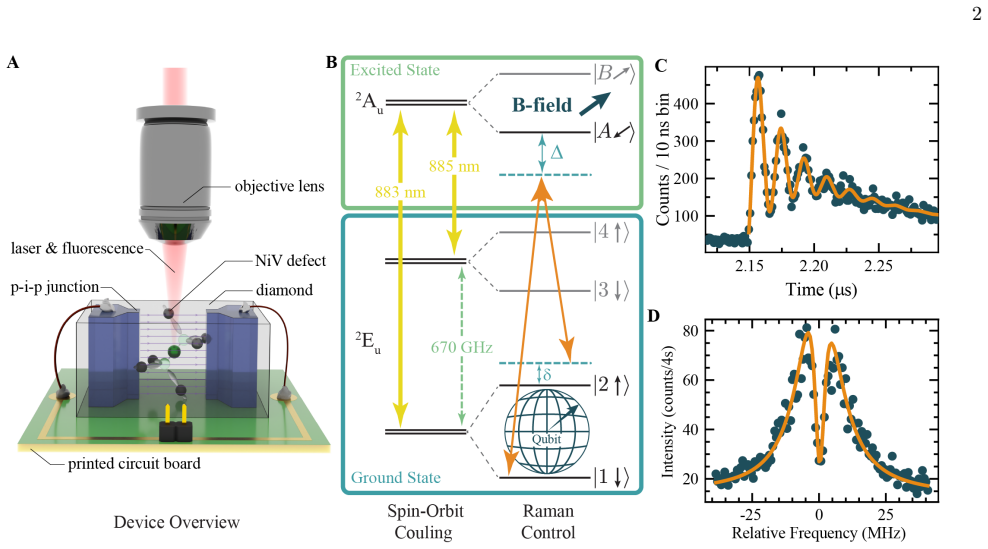
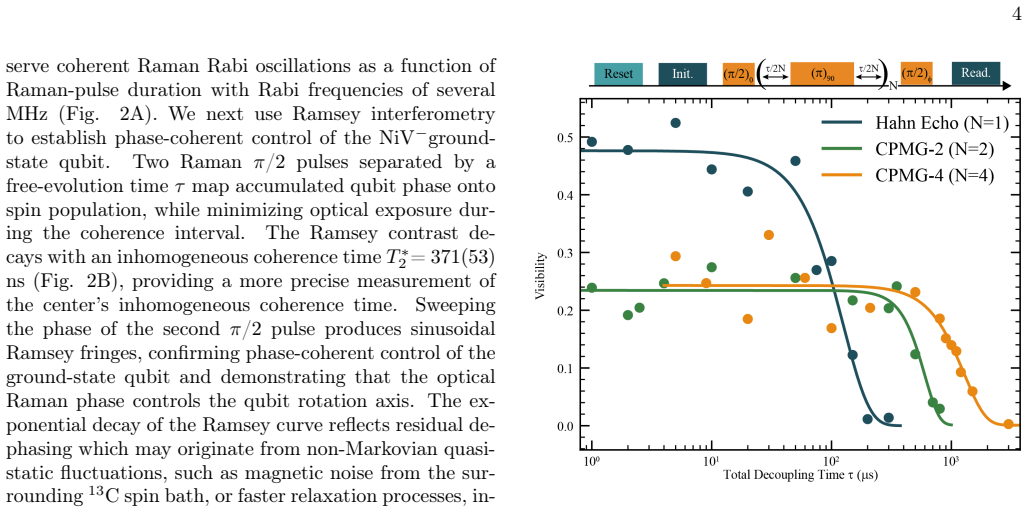
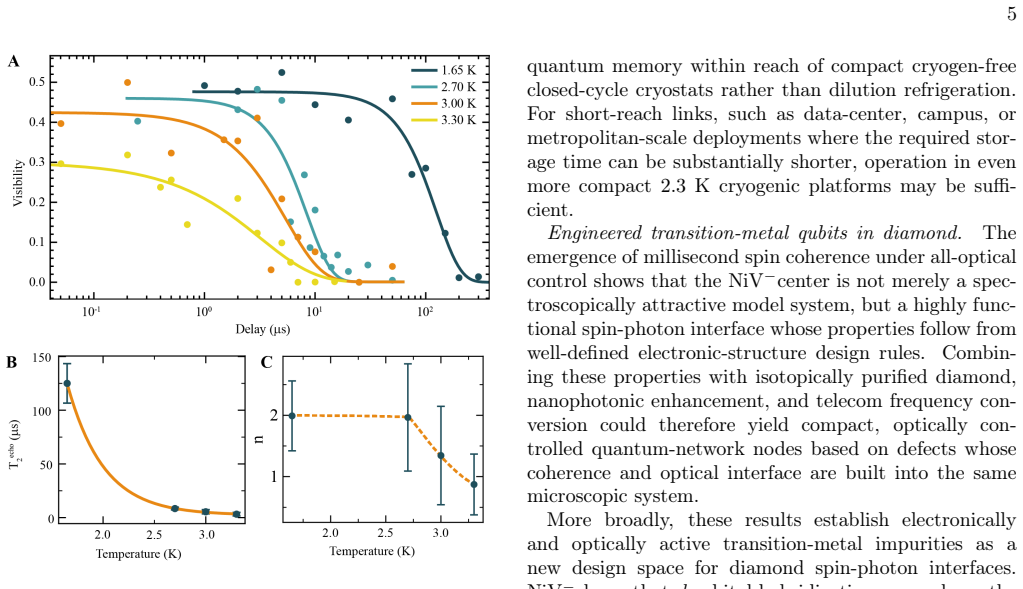
Using a single NiV- defect, the authors implement all-optical Raman control of the spin qubit and apply CPMG-4 dynamical decoupling to reach a coherence time of 1.27 ms at 1.65 K, while the ground-state spin-orbit protection is identified as the mechanism that suppresses decoherence channels under optical driving.
What carries the argument
The NiV- defect, whose spin-orbit-protected ground state supports Raman transitions for fully optical spin manipulation without microwave fields.
If this is right
- The qubit operates at temperatures compatible with compact closed-cycle cryogenics, removing the need for dilution refrigerators.
- All-optical control enables integration with photonic circuits without microwave delivery lines.
- Near-infrared emission allows direct coupling to telecom-band fibers after frequency conversion.
- The demonstrated 1.27 ms coherence sets a new benchmark for diamond spin-photon interfaces at accessible temperatures.
Where Pith is reading between the lines
- Similar transition-metal centers may extend the approach to other diamond hosts or to silicon carbide, broadening the material choices for optically addressable long-lived spins.
- The millisecond coherence window could support entanglement distribution over tens of kilometers if paired with efficient photon collection and frequency conversion.
- All-optical dynamical decoupling sequences may be adapted to other color centers whose optical transitions currently introduce excess decoherence.
Load-bearing premise
The measured coherence gain arises solely from intrinsic spin-orbit protection in the NiV- ground state and is not limited by uncontrolled effects from the optical pulses themselves.
What would settle it
A direct measurement showing that the coherence time under optical driving remains below 400 ns even after CPMG-4 decoupling, or an observed increase in decoherence rate proportional to optical pulse intensity.
Figures
read the original abstract
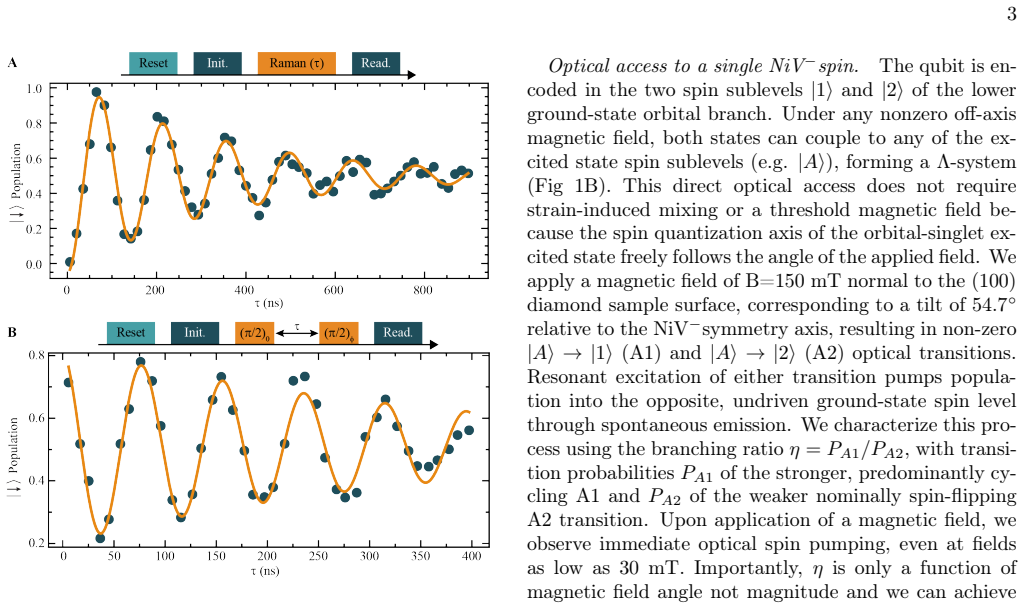
Quantum networks require qubits that combine efficient optical access, coherent control, and long-lived quantum memory, but realizing all three in one scalable platform remains a central bottleneck. Diamond color centers are leading candidates, yet widely studied defects retain tradeoffs among these capabilities. Here, we show that transition-metal defects in diamond provide a distinct route beyond these platforms by combining spin-orbit protected ground-state coherence, all-optical control, and near-infrared emission. Using a single nickel-vacancy (NiV$^-$), we demonstrate an all-optically controlled diamond spin qubit with coherence exceeding one millisecond at 1.65 K, compatible with compact closed-cycle cryogenics. We implement Raman Rabi oscillations and Ramsey interferometry and use all-optical dynamical decoupling to extend coherence from $T_2^*$ = 371 ns to $T_2^{CPMG-4}$ = 1.27 ms, establishing NiV$^-$ as a deployable diamond spin-photon interface.
Editorial analysis
A structured set of objections, weighed in public.
Referee Report
Summary. The manuscript claims to demonstrate a nickel-vacancy (NiV-) defect in diamond as a spin qubit that combines all-optical Raman control, spin-orbit-protected ground-state coherence, and near-infrared emission. Using a single NiV- center at 1.65 K, it reports Ramsey interferometry and all-optical CPMG-4 dynamical decoupling that extends coherence from T2* = 371 ns to T2^CPMG-4 = 1.27 ms, positioning the defect as a deployable spin-photon interface for quantum networks compatible with closed-cycle cryogenics.
Significance. If the experimental claims are substantiated with full data and controls, the work would establish transition-metal defects as a distinct platform that simultaneously satisfies efficient optical access, coherent all-optical control, and millisecond-scale memory, addressing longstanding tradeoffs in diamond color-center qubits. The compatibility with compact cryogenics and the use of spin-orbit protection constitute concrete strengths for scalable quantum networking.
major comments (2)
- [Abstract / coherence results] Abstract and results on coherence measurements: the attribution of the T2 extension from 371 ns to 1.27 ms to intrinsic spin-orbit protection in the NiV- ground state is load-bearing for the central claim, yet the manuscript provides no quantitative bounds on pulse-induced heating, spectral diffusion from the Raman drive, or deviation from ideal CPMG scaling. Without these diagnostics the possibility that pulse errors or local heating dominate the observed extension cannot be ruled out.
- [Methods / data tables] Experimental methods and data presentation: the abstract states specific numerical outcomes (T2* = 371 ns, T2^CPMG-4 = 1.27 ms) but the manuscript text supplies neither raw data tables, error bars on the reported times, nor full pulse-sequence parameters, preventing independent verification of the coherence claims.
minor comments (1)
- [Abstract] The superscript notation T2^{CPMG-4} is used without an explicit definition of the sequence parameters (pulse spacing, number of pulses) in the abstract; a brief parenthetical clarification would improve readability.
Simulated Author's Rebuttal
We thank the referee for their careful and constructive review. The comments highlight important points on the robustness of the coherence attribution and on data transparency. We address each below and indicate the revisions that will be incorporated.
read point-by-point responses
-
Referee: [Abstract / coherence results] Abstract and results on coherence measurements: the attribution of the T2 extension from 371 ns to 1.27 ms to intrinsic spin-orbit protection in the NiV- ground state is load-bearing for the central claim, yet the manuscript provides no quantitative bounds on pulse-induced heating, spectral diffusion from the Raman drive, or deviation from ideal CPMG scaling. Without these diagnostics the possibility that pulse errors or local heating dominate the observed extension cannot be ruled out.
Authors: We agree that explicit quantitative bounds on potential systematics would strengthen the attribution to spin-orbit protection. In the revised manuscript we will add a dedicated supplementary section containing (i) in-situ temperature monitoring during the Raman and CPMG sequences to bound heating, (ii) repeated Ramsey measurements to quantify any spectral diffusion induced by the drive, and (iii) an analysis of coherence versus number of CPMG pulses to test consistency with ideal dynamical-decoupling scaling. These controls were performed but not reported in the original submission; their inclusion will allow readers to assess the contribution of pulse errors or heating. revision: yes
-
Referee: [Methods / data tables] Experimental methods and data presentation: the abstract states specific numerical outcomes (T2* = 371 ns, T2^CPMG-4 = 1.27 ms) but the manuscript text supplies neither raw data tables, error bars on the reported times, nor full pulse-sequence parameters, preventing independent verification of the coherence claims.
Authors: We accept that the absence of error bars, raw data, and complete pulse parameters limits independent verification. The revised manuscript will include error bars derived from the fits on all reported T2 values, a supplementary table listing the raw coherence data points (or a link to a public data repository), and a detailed table of Raman pulse amplitudes, durations, detunings, and CPMG timing parameters in the Methods section. revision: yes
Circularity Check
No circularity: purely experimental demonstration with no derivations or fitted predictions
full rationale
The paper reports direct experimental measurements on a single NiV- defect, including observed coherence times (T2* = 371 ns to T2^CPMG-4 = 1.27 ms) and all-optical control via Raman Rabi oscillations and Ramsey interferometry. No equations, derivations, or parameter-fitting steps are present that could reduce to self-definition or fitted inputs called predictions. The central claims rest on measured data rather than any chain that loops back to its own assumptions by construction. Attribution of coherence extension to spin-orbit protection is an interpretation of results, not a mathematical reduction. No self-citation load-bearing or ansatz smuggling is identifiable from the provided text.
Axiom & Free-Parameter Ledger
Reference graph
Works this paper leans on
-
[1]
H. J. Kimble, The quantum internet.Nature.453, 1023– 1030 (2008)
2008
-
[2]
S. Wehner, D. Elkouss, R. Hanson, Quantum inter- net: A vision for the road ahead.Science.362(2018), doi:10.1126/science.aam9288
-
[3]
A. K. Ekert, Quantum cryptography based on Bell’s the- orem.Physical review letters.67, 661 (1991)
1991
-
[4]
Gisin, G
N. Gisin, G. Ribordy, W. Tittel, H. Zbinden, Quantum cryptography.Rev. Mod. Phys.74, 145–195 (2002)
2002
-
[5]
Monroe, R
C. Monroe, R. Raussendorf, A. Ruthven, K. R. Brown, P. Maunz, L. M. Duan, J. Kim, Large-scale modu- lar quantum-computer architecture with atomic memory and photonic interconnects.Phys. Rev. A.89, 022317 (2014)
2014
-
[6]
N. H. Nickerson, J. F. Fitzsimons, S. C. Benjamin, Freely scalable quantum technologies using cells of 5-to- 50 qubits with very lossy and noisy photonic links.Phys- ical Review X.4, 041041 (2014)
2014
-
[7]
Gottesman, T
D. Gottesman, T. Jennewein, S. Croke, Longer-baseline telescopes using quantum repeaters.Phys. Rev. Lett. 109, 070503 (2012)
2012
-
[8]
Kómár, E
P. Kómár, E. M. Kessler, M. Bishof, L. Jiang, A. S. Sørensen, J. Ye, M. D. Lukin, A quantum network of clocks.Nat. Phys.10, 582–587 (2014)
2014
-
[9]
M. Ruf, N. H. Wan, H. Choi, D. Englund, R. Hanson, Quantum networks based on color centers in diamond.J. Appl. Phys.130, 070901 (2021)
2021
-
[10]
Togan, Y
E. Togan, Y. Chu, A. S. Trifonov, L. Jiang, J. Maze, L. Childress, M. V. G. Dutt, A. S. Sørensen, P. R. Hem- mer, A. S. Zibrov, M. D. Lukin, Quantum entanglement between an optical photon and a solid-state spin qubit. Nature.466, 730–734 (2010)
2010
-
[11]
B.Hensen, H.Bernien, A.E.Dréau, A.Reiserer, N.Kalb, M. S. Blok, J. Ruitenberg, R. F. L. Vermeulen, R. N. Schouten, C. Abellán, W. Amaya, V. Pruneri, M. W. Mitchell, M. Markham, D. J. Twitchen, D. Elkouss, S. Wehner, T. H. Taminiau, R. Hanson, Loophole-free Bell inequality violation using electron spins separated by 1.3 kilometres.Nature.526, 682–686 (2015)
2015
-
[12]
M.Pompili, S.L.N.Hermans, S.Baier, H.K.C.Beukers, P. C. Humphreys, R. N. Schouten, R. F. L. Vermeulen, M. J. Tiggelman, L. Dos Santos Martins, B. Dirkse, S. Wehner, R. Hanson, Realization of a multinode quantum network of remote solid-state qubits.Science.372, 259– 264 (2021)
2021
-
[13]
A. J. Stolk, K. L. van der Enden, M.-C. Slater, I. Te Raa- Derckx, P. Botma, J. van Rantwijk, J. J. B. Biemond, R. A. J. Hagen, R. W. Herfst, W. D. Koek, A. J. H. Meskers, R. Vollmer, E. J. van Zwet, M. Markham, A. M. Ed- monds, J. F. Geus, F. Elsen, B. Jungbluth, C. Haefner, C. Tresp, J. Stuhler, S. Ritter, R. Hanson, Metropolitan- scale heralded entangl...
2024
-
[14]
Childress, R
L. Childress, R. Hanson, Diamond NV centers for quan- tum computing and quantum networks.MRS Bull.38, 134–138 (2013)
2013
-
[15]
Riedel, I
D. Riedel, I. Söllner, B. J. Shields, S. Starosielec, P. Ap- pel, E. Neu, P. Maletinsky, R. J. Warburton, Determin- istic Enhancement of Coherent Photon Generation from a Nitrogen-Vacancy Center in Ultrapure Diamond.Phys. Rev. X.7, 031040 (2017)
2017
-
[16]
Tamarat, T
P. Tamarat, T. Gaebel, J. R. Rabeau, M. Khan, A. D. Greentree, H. Wilson, L. C. L. Hollenberg, S. Prawer, P. Hemmer, F. Jelezko, J. Wrachtrup, Stark shift control of single optical centers in diamond.Phys. Rev. Lett.97, 083002 (2006)
2006
-
[17]
Batalov, C
A. Batalov, C. Zierl, T. Gaebel, P. Neumann, I. Y. Chan, G. Balasubramanian, P. R. Hemmer, F. Jelezko, J. Wrachtrup, Temporal coherence of photons emitted by single nitrogen-vacancy defect centers in diamond using optical Rabi-oscillations.Phys. Rev. Lett.100, 077401 (2008)
2008
-
[18]
Bernien, B
H. Bernien, B. Hensen, W. Pfaff, G. Koolstra, M. S. Blok, L. Robledo, T. H. Taminiau, M. Markham, D. J. Twitchen, L. Childress, R. Hanson, Heralded entangle- ment between solid-state qubits separated by three me- tres.Nature.497, 86–90 (2013)
2013
-
[19]
E. Neu, M. Agio, C. Becher, Photophysics of single sili- con vacancy centers in diamond: implications for single photon emission.Opt. Express.20, 19956–19971 (2012)
2012
-
[20]
C. Hepp, Electronic structure of the silicon vacancy color center in diamond.Universität des Saarlandes(2014), doi:10.22028/d291-23020
-
[21]
L. J. Rogers, K. D. Jahnke, M. H. Metsch, A. Sipahigil, J. M. Binder, T. Teraji, H. Sumiya, J. Isoya, M. D. Lukin, P.Hemmer, F.Jelezko, All-opticalinitialization, readout, and coherent preparation of single silicon-vacancy spins in diamond.Phys. Rev. Lett.113, 263602 (2014)
2014
-
[22]
Sipahigil, K
A. Sipahigil, K. D. Jahnke, L. J. Rogers, T. Teraji, J. Isoya, A. S. Zibrov, F. Jelezko, M. D. Lukin, Indistin- guishable photons from separated silicon-vacancy centers in diamond.Phys. Rev. Lett.113, 113602 (2014)
2014
-
[23]
C. Hepp, T. Müller, V. Waselowski, J. N. Becker, B. Pingault, H. Sternschulte, D. Steinmüller-Nethl, A. Gali, J. R. Maze, M. Atatüre, C. Becher, Electronic structure of the silicon vacancy color center in diamond.Phys. Rev. Lett.112, 036405 (2014)
2014
-
[24]
Faraon, C
A. Faraon, C. Santori, Z. Huang, V. M. Acosta, R. G. Beausoleil, Coupling of nitrogen-vacancy centers to pho- tonic crystal cavities in monocrystalline diamond.Phys. Rev. Lett.109, 033604 (2012)
2012
-
[25]
Siyushev, H
P. Siyushev, H. Pinto, M. Vörös, A. Gali, F. Jelezko, J. Wrachtrup, Optically controlled switching of the charge state of a single nitrogen-vacancy center in diamond at cryogenic temperatures.Phys. Rev. Lett.110, 167402 (2013)
2013
-
[26]
Pingault, J
B. Pingault, J. N. Becker, C. H. H. Schulte, C. Arend, C. Hepp, T. Godde, A. I. Tartakovskii, M. Markham, C. Becher, M. Atatüre, All-optical formation of coherent dark states of silicon-vacancy spins in diamond.Phys. Rev. Lett.113, 263601 (2014)
2014
-
[27]
K. D. Jahnke, A. Sipahigil, J. M. Binder, M. W. Doherty, M. Metsch, L. J. Rogers, N. B. Manson, M. D. Lukin, F. Jelezko, Electron–phonon processes of the silicon- vacancy centre in diamond.New J. Phys.17, 043011 (2015)
2015
-
[28]
J. N. Becker, B. Pingault, D. Groß, M. Gündoğan, N. Kukharchyk, M. Markham, A. Edmonds, M. Atatüre, P. 7 Bushev, C. Becher, All-Optical Control of the Silicon- Vacancy Spin in Diamond at Millikelvin Temperatures. Phys. Rev. Lett.120, 053603 (2018)
2018
-
[29]
D. D. Sukachev, A. Sipahigil, C. T. Nguyen, M. K. Bhaskar, R. E. Evans, F. Jelezko, M. D. Lukin, Silicon- Vacancy Spin Qubit in Diamond: A Quantum Memory Exceeding 10 ms with Single-Shot State Readout.Phys. Rev. Lett.119, 223602 (2017)
2017
-
[30]
Meesala, Y.-I
S. Meesala, Y.-I. Sohn, B. Pingault, L. Shao, H. A. Atikian, J. Holzgrafe, M. Gündoğan, C. Stavrakas, A. Sipahigil, C. Chia, R. Evans, M. J. Burek, M. Zhang, L. Wu, J. L. Pacheco, J. Abraham, E. Bielejec, M. D. Lukin, M. Atatüre, M. Lončar, Strain engineering of the silicon- vacancy center in diamond.Phys. Rev. B.97, 205444 (2018)
2018
-
[31]
Bersin, M
E. Bersin, M. Sutula, Y. Q. Huan, A. Suleymanzade, D. R. Assumpcao, Y.-C. Wei, P.-J. Stas, C. M. Knaut, E. N. Knall, C. Langrock, N. Sinclair, R. Murphy, R. Riedinger, M. Yeh, C. J. Xin, S. Bandyopadhyay, D. D. Sukachev, B. Machielse, D. S. Levonian, M. K. Bhaskar, S. Hamilton, H. Park, M. Lončar, M. M. Fejer, P. B. Dixon, D. R. Englund, M. D. Lukin, Tele...
2024
-
[32]
B. C. Rose, D. Huang, Z.-H. Zhang, P. Stevenson, A. M. Tyryshkin, S. Sangtawesin, S. Srinivasan, L. Loudin, M. L. Markham, A. M. Edmonds, D. J. Twitchen, S. A. Lyon, N. P. de Leon, Observation of an environmentally insensitive solid-state spin defect in diamond.Science. 361, 60–63 (2018)
2018
-
[33]
Zhang, J
Z.-H. Zhang, J. A. Zuber, L. V. H. Rodgers, X. Gui, P. Stevenson, M. Li, M. Batzer, M. L. Grimau Puigibert, B. J. Shields, A. M. Edmonds, N. Palmer, M. L. Markham, R. J. Cava, P. Maletinsky, N. P. de Leon, Neutral silicon vacancy centers in undoped diamond via surface control. Phys. Rev. Lett.130, 166902 (2023)
2023
-
[34]
B. L. Green, S. Mottishaw, B. G. Breeze, A. M. Ed- monds, U. F. S. D’Haenens-Johansson, M. W. Doherty, S. D. Williams, D. J. Twitchen, M. E. Newton, Neutral Silicon-Vacancy Center in Diamond: Spin Polarization and Lifetimes.Phys. Rev. Lett.119, 096402 (2017)
2017
-
[35]
Iwasaki, F
T. Iwasaki, F. Ishibashi, Y. Miyamoto, Y. Doi, S. Kobayashi, T. Miyazaki, K. Tahara, K. D. Jahnke, L. J. Rogers, B. Naydenov, F. Jelezko, S. Yamasaki, S. Nagamachi, T. Inubushi, N. Mizuochi, M. Hatano, Germanium-Vacancy Single Color Centers in Diamond. Sci. Rep.5, 12882 (2015)
2015
-
[36]
Iwasaki, Y
T. Iwasaki, Y. Miyamoto, T. Taniguchi, P. Siyushev, M. H. Metsch, F. Jelezko, M. Hatano, Tin-Vacancy Quan- tum Emitters in Diamond.Phys. Rev. Lett.119, 253601 (2017)
2017
-
[37]
M. E. Trusheim, N. H. Wan, K. C. Chen, C. J. Ciccarino, J. Flick, R. Sundararaman, G. Malladi, E. Bersin, M. Walsh, B. Lienhard, H. Bakhru, P. Narang, D. Englund, Lead-related quantum emitters in diamond.Phys. Rev. B.99, 075430 (2019)
2019
-
[38]
Thiering, A
G. Thiering, A. Gali,Ab InitioMagneto-Optical Spec- trum of Group-IV Vacancy Color Centers in Diamond. Phys. Rev. X.8, 021063 (2018)
2018
-
[39]
Debroux, C
R. Debroux, C. P. Michaels, C. M. Purser, N. Wan, M. E. Trusheim, J. Arjona Martínez, R. A. Parker, A. M. Stramma, K. C. Chen, L. de Santis, E. M. Alexeev, A. C. Ferrari, D. Englund, D. A. Gangloff, M. Atatüre, Quan- tum Control of the Tin-Vacancy Spin Qubit in Diamond. Phys. Rev. X.11, 041041 (2021)
2021
-
[40]
E. I. Rosenthal, C. P. Anderson, H. C. Kleidermacher, A. J. Stein, H. Lee, J. Grzesik, G. Scuri, A. E. Rugar, D. Riedel, S. Aghaeimeibodi, G. H. Ahn, K. Van Gasse, J. Vučković, Microwave Spin Control of a Tin-Vacancy Qubit in Diamond.Phys. Rev. X.13, 031022 (2023)
2023
-
[41]
Karapatzakis, J
I. Karapatzakis, J. Resch, M. Schrodin, P. Fuchs, M. Kieschnick, J. Heupel, L. Kussi, C. Sürgers, C. Popov, J. Meijer, C. Becher, W. Wernsdorfer, D. Hunger, Mi- crowave Control of the Tin-Vacancy Spin Qubit in Dia- mond with a Superconducting Waveguide.Phys. Rev. X. 14, 031036 (2024)
2024
-
[42]
I. M. Morris, T. Lühmann, K. Klink, L. Crooks, D. Hardeman, D. J. Twitchen, S. Pezzagna, J. Meijer, S. S. Nicley, J.N.Becker, Lifetime-Limitedand TunableEmis- sion from Single Charge-Stabilized Nickel Vacancy Cen- ters in Diamond.Phys. Rev. Lett.135, 043602 (2025)
2025
-
[43]
Thiering, A
G. Thiering, A. Gali, Magneto-optical spectra of the split nickel-vacancy defect in diamond.Phys. Rev. Research. 3, 043052 (2021)
2021
-
[44]
E. L. Hahn, Spin Echoes.Phys. Rev.80, 580–594 (1950)
1950
-
[45]
Cywinski, R
U. Cywinski, R. M. Lutchyn, C. P. Nave, S. Das Sarma, How to enhance dephasing time in superconducting qubits.Physical Review B—Condensed Matter and Ma- terials Physics.77, 174509 (2008)
2008
-
[46]
J. R. Maze, P. L. Stanwix, J. S. Hodges, S. Hong, J. M. Taylor, P. Cappellaro, L. Jiang, M. V. G. Dutt, E. Togan, A. S. Zibrov, A. Yacoby, R. L. Walsworth, M. D. Lukin, Nanoscale magnetic sensing with an individual electronic spin in diamond.Nature.455, 644–647 (2008)
2008
-
[47]
de Lange, Z
G. de Lange, Z. H. Wang, D. Ristè, V. V. Dobrovitski, R. Hanson, Universal dynamical decoupling of a single solid-state spin from a spin bath.Science.330, 60–63 (2010)
2010
-
[48]
H. Y. Carr, E. M. Purcell, Effects of Diffusion on Free Precession in Nuclear Magnetic Resonance Experiments. Phys. Rev.94, 630–638 (1954)
1954
-
[49]
Meiboom, D
S. Meiboom, D. Gill, Modified Spin-Echo Method for Measuring Nuclear Relaxation Times.Rev. Sci. Instrum. 29, 688 (1958)
1958
-
[50]
C. J. Foot,Atomic physics(Oxford university press, 2005), vol. 7. 8 Supplemental Material A transition-metal qubit in diamond with all-optical control and millisecond quantum memory MA TERIALS AND METHODS Sample and cryogenic optical setup Measurements were performed on a single negatively charged nickel-vacancy center, NiV−, in an electrically con- tacte...
2005
discussion (0)
Sign in with ORCID, Apple, or X to comment. Anyone can read and Pith papers without signing in.