Resolving superposition in AI for interpretability and cross-modal alignment in patient-neuronal images
Pith reviewed 2026-07-03 22:09 UTC · model grok-4.3
The pith
Sparse autoencoders resolve superposition to recover geometric fidelity in neuron image representations, enabling adaptation of single-cell RNA methods and de novo cross-modal alignment.
A machine-rendered reading of the paper's core claim, the machinery that carries it, and where it could break.
Core claim
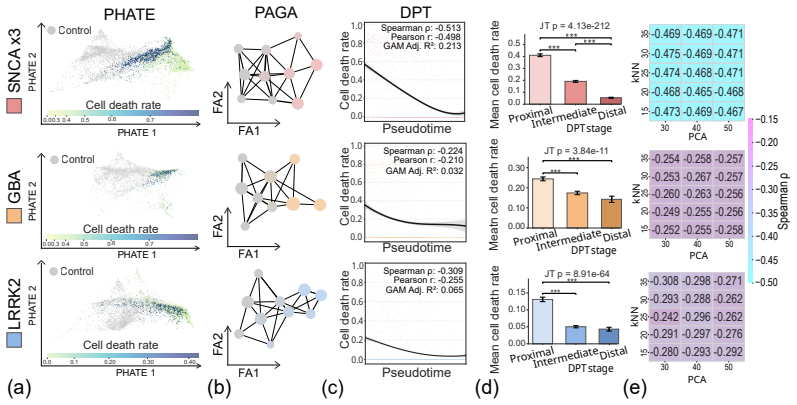
We theoretically and empirically demonstrate that superposition contaminates representational metric spaces, and thereby SAEs successfully recover geometric fidelity. By treating these geometrically purified representations as single-cell state vectors, we adapted single-cell RNA sequencing (scRNA-seq) data analysis methodologies directly to the image domain. Finally, we introduce GW-map, utilizing Gromov-Wasserstein optimal transport to align these image representations with authentic scRNA-seq data de novo. This coupling reconstructs hierarchical neuronal pathology pathways such as Calcium-AIS scaffold, without reference spatial transcriptomics.
What carries the argument
Sparse autoencoders (SAEs) that resolve superposition to purify geometric representations in latent spaces, combined with Gromov-Wasserstein optimal transport (GW-map) for cross-modal alignment between image-derived state vectors and scRNA-seq profiles.
If this is right
- SAEs recover geometric fidelity in representational metric spaces contaminated by superposition.
- Geometrically purified image representations can be treated as single-cell state vectors.
- scRNA-seq data analysis methodologies can be adapted directly to the image domain.
- GW-map enables de novo alignment of image representations with authentic scRNA-seq data.
- Hierarchical neuronal pathology pathways such as Calcium-AIS scaffold can be reconstructed without reference spatial transcriptomics.
Where Pith is reading between the lines
- The method could extend to other high-dimensional biological imaging datasets by using SAEs to enable similar cross-modal alignments.
- Success would reduce dependence on spatial transcriptomics for pathway discovery in spatial biology.
- Focusing on geometric fidelity rather than feature attribution may offer a general route to interpretability in other superposition-heavy AI applications.
- Testing the approach on larger cohorts or different neurological conditions would check whether the single-cell vector analogy holds broadly.
Load-bearing premise
The multiplexed patient-derived neuron images contain sufficient information to treat the SAE-derived representations as directly comparable single-cell state vectors to scRNA-seq profiles.
What would settle it
If applying scRNA-seq analysis methods to the SAE-purified image representations fails to produce biologically meaningful clusters or if the GW-map alignment does not reconstruct the Calcium-AIS scaffold pathway consistent with independent validations, the claims would be falsified.
Figures




read the original abstract
Artificial intelligence is transforming our capability to solve biological challenges. In dimensionality bottleneck regimes exacerbated by high-dimensional biological data, neural networks force distinct concepts into the lower dimensions known as superposition. Although this superposition is widely known to hinder interpretability, its impact on corrupting the geometry of latent spaces remains critically overlooked. Here, we utilized sparse autoencoders (SAEs) trained on over 100,000 multiplexed images of patient-derived Parkinson's disease and healthy neurons to resolve superposition. This approach bypasses the mathematical non-uniqueness of feature attribution by shifting to interpretable latent representation analysis. We theoretically and empirically demonstrate that superposition contaminates representational metric spaces, and thereby SAEs successfully recover geometric fidelity. By treating these geometrically purified representations as single-cell state vectors, we adapted single-cell RNA sequencing (scRNA-seq) data analysis methodologies directly to the image domain. Finally, we introduce GW-map, utilizing Gromov-Wasserstein optimal transport to align these image representations with authentic scRNA-seq data de novo. This coupling reconstructs hierarchical neuronal pathology pathways such as Calcium-AIS scaffold, without reference spatial transcriptomics, establishing a scalable foundation for spatial biology. Code is available at https://github.com/jijihihi/Bio\_superposition
Editorial analysis
A structured set of objections, weighed in public.
Referee Report
Summary. The manuscript claims that superposition in neural network representations contaminates metric spaces in high-dimensional biological data, and that sparse autoencoders (SAEs) trained on over 100,000 multiplexed images of patient-derived Parkinson's disease and healthy neurons can resolve this to recover geometric fidelity. It adapts scRNA-seq analysis methodologies to the image domain by treating the purified SAE latents as single-cell state vectors, and introduces GW-map using Gromov-Wasserstein optimal transport to align these image representations with scRNA-seq data de novo, thereby reconstructing hierarchical neuronal pathology pathways such as the Calcium-AIS scaffold without reference spatial transcriptomics. Code is made available.
Significance. If the claims regarding geometric fidelity recovery and valid cross-modal transfer are substantiated, the work could offer a scalable approach for integrating imaging and transcriptomic data in spatial biology and neuroscience. The code availability supports reproducibility. However, the abstract supplies no equations, dataset details, error bars, or validation metrics, so the significance cannot be fully assessed from the provided information.
major comments (3)
- [Abstract] Abstract: the theoretical demonstration that superposition contaminates representational metric spaces is asserted without any equations, derivations, or formal arguments, which is load-bearing for the central claim of contamination and recovery.
- [Abstract] Abstract: the empirical demonstration of contamination and recovery by SAEs supplies no dataset details, exclusion criteria, error bars, or quantitative metrics, preventing verification of the geometric fidelity recovery that underpins the subsequent scRNA-seq adaptation and GW-map alignment.
- [Abstract] Abstract: the adaptation of scRNA-seq tools (trajectory inference, differential expression analogs) to SAE-derived image latents and the de novo GW alignment assumes these latents encode state information with statistical properties analogous to transcriptomic profiles, but no matched perturbation experiments, orthogonal validation against known PD markers, or controls falsifying the analogy are described.
minor comments (1)
- The GitHub URL contains an escaped underscore (Bio\_superposition) that may hinder direct access.
Simulated Author's Rebuttal
We thank the referee for their constructive comments on our manuscript. We have carefully considered each point and provide point-by-point responses below. Where appropriate, we have revised the abstract to address the concerns about missing details.
read point-by-point responses
-
Referee: [Abstract] Abstract: the theoretical demonstration that superposition contaminates representational metric spaces is asserted without any equations, derivations, or formal arguments, which is load-bearing for the central claim of contamination and recovery.
Authors: We acknowledge that the abstract does not include the equations. The full paper includes a theoretical analysis in the Methods and Results sections with formal arguments and derivations showing how superposition leads to metric space contamination. We will update the abstract to briefly summarize the key theoretical insight and reference the relevant section. revision: yes
-
Referee: [Abstract] Abstract: the empirical demonstration of contamination and recovery by SAEs supplies no dataset details, exclusion criteria, error bars, or quantitative metrics, preventing verification of the geometric fidelity recovery that underpins the subsequent scRNA-seq adaptation and GW-map alignment.
Authors: The abstract is space-constrained, but the manuscript provides extensive details on the dataset (>100,000 images), exclusion criteria in the Methods, and quantitative metrics with error bars in the Results (e.g., fidelity recovery metrics in Figure 2). We will add key quantitative highlights and dataset summary to the abstract in the revision. revision: yes
-
Referee: [Abstract] Abstract: the adaptation of scRNA-seq tools (trajectory inference, differential expression analogs) to SAE-derived image latents and the de novo GW alignment assumes these latents encode state information with statistical properties analogous to transcriptomic profiles, but no matched perturbation experiments, orthogonal validation against known PD markers, or controls falsifying the analogy are described.
Authors: The paper validates the approach by reconstructing known pathology pathways like the Calcium-AIS scaffold, which serves as orthogonal validation against PD markers from literature. While matched perturbation experiments are not included in this study (as it uses existing patient data), we will expand the discussion to address the assumptions and include controls where possible in the revision. revision: partial
Circularity Check
No circularity: derivation relies on standard SAE properties and external OT methods without self-referential reduction
full rationale
The paper asserts a theoretical demonstration that superposition contaminates metric spaces and that SAEs recover fidelity, then adapts scRNA-seq tools and applies Gromov-Wasserstein alignment to image latents. No equations or steps in the visible text reduce a claimed prediction or uniqueness result to a fitted parameter or self-citation by construction. The cross-modal analogy is asserted rather than derived from prior self-work, and no renaming of known results or ansatz smuggling appears. The chain remains self-contained against external benchmarks such as standard SAE literature and OT algorithms.
Axiom & Free-Parameter Ledger
free parameters (1)
- SAE sparsity level
axioms (1)
- standard math Gromov-Wasserstein distance satisfies the properties of an optimal transport metric between metric spaces
invented entities (1)
-
GW-map
no independent evidence
Reference graph
Works this paper leans on
-
[1]
Grad-cam: Visual explanations from deep networks via gradient-based localization
Ramprasaath R Selvaraju, Michael Cogswell, Abhishek Das, Ramakrishna Vedantam, Devi Parikh, and Dhruv Batra. Grad-cam: Visual explanations from deep networks via gradient-based localization. InProceedings of the IEEE International Conference on Computer Vision (ICCV), pages 618–626, 2017
work page 2017
-
[2]
A Unified Approach to Interpreting Model Predictions
Scott M Lundberg and Su-In Lee. A Unified Approach to Interpreting Model Predictions. In Advances in Neural Information Processing Systems, volume 30. Curran Associates, Inc., 2017. URL
work page 2017
-
[3]
Apoorva Aravindkumar, Marimuthu Ramadoss, Saqhibuddeen Ahmed Fakhruddin Ahmed, Vidhya Sampath, and Kishor Lakshminarayanan. Explainable AI in healthcare: a systematic review of XAI use cases in imaging, diagnostics, and rehabilitation.Frontiers in Artificial Intelligence, 9, April 2026. ISSN 2624-8212. doi: 10.3389/frai.2026.1749527. URL
-
[4]
Zhongliang Zhou, Mengxuan Hu, Mariah Salcedo, Nathan Gravel, Wayland Yeung, Aarya Venkat, Dongliang Guo, Jielu Zhang, Natarajan Kannan, and Sheng Li. XAI meets Biology: A Comprehensive Review of Explainable AI in Bioinformatics Applications, December 2023. URL . arXiv:2312.06082 [cs]
-
[5]
The Many Shapley Values for Model Explanation
Mukund Sundararajan and Amir Najmi. The Many Shapley Values for Model Explanation. InProceedings of the 37th International Conference on Machine Learning, pages 9269–9278. PMLR, November 2020. URL
work page 2020
-
[6]
Asymmetric Shapley values: incorporating causal knowledge into model-agnostic explainability
Christopher Frye, Colin Rowat, and Ilya Feige. Asymmetric Shapley values: incorporating causal knowledge into model-agnostic explainability. InAdvances in Neural Information Processing Systems, volume 33, pages 1229–1239. Curran Associates, Inc., 2020. URL
work page 2020
-
[7]
Fairwashing explanations with off-manifold detergent
Christopher Anders, Plamen Pasliev, Ann-Kathrin Dombrowski, Klaus-Robert Müller, and Pan Kessel. Fairwashing explanations with off-manifold detergent. InProceedings of the 37th International Conference on Machine Learning, pages 314–323. PMLR, November 2020. URL
work page 2020
-
[8]
The Disagreement Problem in Explainable Machine Learning: A Practitioner’s Perspective
Satyapriya Krishna, Tessa Han, Alex Gu, Steven Wu, Shahin Jabbari, and Himabindu Lakkaraju. The Disagreement Problem in Explainable Machine Learning: A Practitioner’s Perspective. Transactions on Machine Learning Research, 2024. ISSN 2835-8856. URL
work page 2024
-
[9]
Blair Bilodeau, Natasha Jaques, Pang Wei Koh, and Been Kim. Impossibility theorems for feature attribution.Proceedings of the National Academy of Sciences, 121(2):e2304406120, January 2024. doi: 10.1073/pnas.2304406120. URL . 11
-
[10]
On the failings of Shapley values for explainability
Xuanxiang Huang and Joao Marques-Silva. On the failings of Shapley values for explainability. International Journal of Approximate Reasoning, 171:109112, August 2024. ISSN 0888-613X. doi: 10.1016/j.ijar.2023.109112. URL
-
[11]
A Mathematical Framework for Transformer Circuits.Trans- former Circuits Thread, 2021
Nelson Elhage, Neel Nanda, Catherine Olsson, Tom Henighan, Nicholas Joseph, Ben Mann, Amanda Askell, and Yuntao Bai. A Mathematical Framework for Transformer Circuits.Trans- former Circuits Thread, 2021. URL
work page 2021
-
[12]
Toy Models of Superposition.Transformer Circuits Thread, 2022
Nelson Elhage, Tristan Hume, Catherine Olsson, Nicholas Schiefer, Tom Henighan, and Shauna Kravec. Toy Models of Superposition.Transformer Circuits Thread, 2022. URL
work page 2022
-
[13]
Trenton Bricken, Adly Templeton, Joshua Batson, Brian Chen, Adam Jermyn, Tom Conerly, and Nicholas L Turner. Towards Monosemanticity: Decomposing Language Models With Dictionary Learning.Transformer Circuits Thread, 2023. URL
work page 2023
-
[14]
Scaling Monosemanticity: Extracting Interpretable Features from Claude 3 Sonnet
Adly Templeton, Tom Conerly, Jonathan Marcus, Jack Lindsey, Trenton Bricken, and Brian Chen. Scaling Monosemanticity: Extracting Interpretable Features from Claude 3 Sonnet. Transformer Circuits Thread, 2024. URL
work page 2024
-
[15]
This Looks Like That: Deep Learning for Interpretable Image Recognition
Chaofan Chen, Oscar Li, Daniel Tao, Alina Barnett, Cynthia Rudin, and Jonathan K Su. This Looks Like That: Deep Learning for Interpretable Image Recognition. InAdvances in Neural Information Processing Systems, volume 32. Curran Associates, Inc., 2019. URL
work page 2019
-
[16]
Pang Wei Koh, Thao Nguyen, Yew Siang Tang, Stephen Mussmann, Emma Pierson, Been Kim, and Percy Liang. Concept Bottleneck Models. InProceedings of the 37th International Conference on Machine Learning, pages 5338–5348. PMLR, November 2020. URL
work page 2020
-
[17]
Been Kim, Martin Wattenberg, Justin Gilmer, Carrie Cai, James Wexler, Fernanda Viegas, and Rory Sayres. Interpretability Beyond Feature Attribution: Quantitative Testing with Concept Activation Vectors (TCA V). InProceedings of the 35th International Conference on Machine Learning, pages 2668–2677. PMLR, July 2018. URL
work page 2018
-
[18]
Bridging the Black Box: A Survey on Mechanistic Interpretability in AI.ACM Comput
Shriyank Somvanshi, Md Monzurul Islam, Amir Rafe, Anannya Ghosh Tusti, Arka Chakraborty, Anika Baitullah, Tausif Islam Chowdhury, Nawaf Alnawmasi, Anandi Dutta, and Subasish Das. Bridging the Black Box: A Survey on Mechanistic Interpretability in AI.ACM Comput. Surv., 58(8):210:1–210:35, February 2026. ISSN 0360-0300. doi: 10.1145/3787104. URL
-
[19]
Superposition disentanglement of neural representations reveals hidden alignment
André Longon, David Klindt, and Meenakshi Khosla. Superposition disentanglement of neural representations reveals hidden alignment. InProceedings of UniReps: the Third Edition of the Workshop on Unifying Representations in Neural Models, pages 342–359. PMLR, February
-
[20]
The linear representation hypothesis and the geometry of large language models
Kiho Park, Yo Joong Choe, and Victor Veitch. The linear representation hypothesis and the geometry of large language models. InProceedings of the International Conference on Machine Learning, volume 235 ofICML’24, pages 39643–39666, Vienna, Austria, July 2024. JMLR.org
work page 2024
-
[21]
Ruochen Jiang, Tianyi Sun, Dongyuan Song, and Jingyi Jessica Li. Statistics or biology: the zero-inflation controversy about scRNA-seq data.Genome Biology, 23(1):31, January 2022. ISSN 1474-760X. doi: 10.1186/s13059-022-02601-5. URL
-
[22]
Binghao Chai, Christoforos Efstathiou, Haoran Yue, and Viji M. Draviam. Opportunities and challenges for deep learning in cell dynamics research.Trends in Cell Biology, 34(11):955–967, November 2024. ISSN 0962-8924, 1879-3088. doi: 10.1016/j.tcb.2023.10.010. URL
-
[23]
Caicedo, Claire McQuin, Allen Goodman, Shantanu Singh, and Anne E
Juan C. Caicedo, Claire McQuin, Allen Goodman, Shantanu Singh, and Anne E. Carpenter. Weakly Supervised Learning of Single-Cell Feature Embeddings.Proceedings. IEEE Computer Society Conference on Computer Vision and Pattern Recognition, 2018:9309–9318, June 2018. ISSN 1063-6919. doi: 10.1109/CVPR.2018.00970
-
[24]
Gabriel Peyré and Marco Cuturi.Computational Optimal Transport: With Applications to Data Science, volume 11. Now Publishers, February 2019. doi: 10.1561/2200000073. URL
-
[25]
Gromov–Wasserstein Distances and the Metric Approach to Object Matching
Facundo Mémoli. Gromov–Wasserstein Distances and the Metric Approach to Object Matching. Foundations of Computational Mathematics, 11(4):417–487, August 2011. ISSN 1615-3375, 1615-3383. doi: 10.1007/s10208-011-9093-5. URL
-
[26]
Pinar Demetci, Rebecca Santorella, Björn Sandstede, William Stafford Noble, and Ritambhara Singh. SCOT: Single-Cell Multi-Omics Alignment with Optimal Transport.Journal of Com- putational Biology: A Journal of Computational Molecular Cell Biology, 29(1):3–18, January
-
[27]
ISSN 1557-8666. doi: 10.1089/cmb.2021.0446. 12
-
[28]
Boyi Guo, Wodan Ling, Sang Ho Kwon, Pratibha Panwar, Shila Ghazanfar, Keri Mar- tinowich, and Stephanie C. Hicks. Integrating Spatially-Resolved Transcriptomics Data Across Tissues and Individuals: Challenges and Opportunities.Small Methods, 9(5): 2401194, 2025. ISSN 2366-9608. doi: 10.1002/smtd.202401194. URL . _eprint: https://onlinelibrary.wiley.com/do...
-
[29]
Muiz Khan, Suzan Arslanturk, and Sorin Draghici. A comprehensive review of spatial tran- scriptomics data alignment and integration.Nucleic Acids Research, 53(12):gkaf536, June 2025. ISSN 1362-4962. doi: 10.1093/nar/gkaf536
-
[30]
Karishma D’Sa, James R. Evans, Gurvir S. Virdi, Giulia Vecchi, Alexander Adam, Ottavia Bertolli, James Fleming, Hojong Chang, Craig Leighton, Mathew H. Horrocks, Dilan Athauda, Minee L. Choi, and Sonia Gandhi. Prediction of mechanistic subtypes of Parkinson’s using patient-derived stem cell models.Nature Machine Intelligence, 5(8):933–946, August 2023. IS...
-
[31]
Y . Lecun, L. Bottou, Y . Bengio, and P. Haffner. Gradient-based learning applied to document recognition.Proceedings of the IEEE, 86(11):2278–2324, January 1998. ISSN 1558-2256. doi: 10.1109/5.726791. URL
-
[32]
Chris Olah, Nick Cammarata, Ludwig Schubert, Gabriel Goh, Michael Petrov, and Shan Carter. Zoom In: An Introduction to Circuits.Distill, 5(3):10.23915/distill.00024.001, March 2020. ISSN 2476-0757. doi: 10.23915/distill.00024.001. URL
-
[33]
Metamorphictestingoflarge languagemodelsfornaturallanguageprocessing.doi:10.48550/arXiv
Tom Burgert, Oliver Stoll, Paolo Rota, and Begüm Demir. ImageNet-trained CNNs are not biased towards texture: Revisiting feature reliance through controlled suppression. InAdvances in Neural Information Processing Systems, volume 38, 2025. doi: 10.48550/ARXIV .2509.20234. URL . Version Number: 5
work page internal anchor Pith review doi:10.48550/arxiv 2025
-
[34]
Approximating CNNs with Bag-of-local-Features models works surprisingly well on ImageNet
Wieland Brendel and Matthias Bethge. Approximating CNNs with Bag-of-local-Features models works surprisingly well on ImageNet. InInternational Conference on Learning Repre- sentations, New Orleans, 2019. URL
work page 2019
-
[35]
An Image is Worth 16x16 Words: Transformers for Image Recognition at Scale
Alexey Dosovitskiy, Lucas Beyer, Alexander Kolesnikov, Dirk Weissenborn, Xiaohua Zhai, Thomas Unterthiner, Mostafa Dehghani, Matthias Minderer, Georg Heigold, Sylvain Gelly, Jakob Uszkoreit, and Neil Houlsby. An Image is Worth 16x16 Words: Transformers for Image Recognition at Scale. In9th International Conference on Learning Representations, ICLR 2021, V...
work page 2021
-
[36]
Maithra Raghu, Thomas Unterthiner, Simon Kornblith, Chiyuan Zhang, and Alexey Dosovitskiy. Do Vision Transformers See Like Convolutional Neural Networks? InAdvances in Neural Information Processing Systems, volume 34, pages 12116–12128. Curran Associates, Inc., 2021. URL
work page 2021
-
[37]
Supervised Contrastive Learning
Prannay Khosla, Piotr Teterwak, Chen Wang, Aaron Sarna, Yonglong Tian, Phillip Isola, Aaron Maschinot, Ce Liu, and Dilip Krishnan. Supervised Contrastive Learning. InAdvances in Neural Information Processing Systems, volume 33, pages 18661–18673. Curran Associates, Inc., 2020. URL
work page 2020
-
[38]
Momentum Contrast for Unsupervised Visual Representation Learning
Kaiming He, Haoqi Fan, Yuxin Wu, Saining Xie, and Ross Girshick. Momentum Contrast for Unsupervised Visual Representation Learning. InProceedings of the IEEE/CVF Conference on Computer Vision and Pattern Recognition, pages 9729–9738, 2020. doi: 10.1109/CVPR42600. 2020.00975. URL
-
[39]
Senthooran Rajamanoharan, Arthur Conmy, Lewis Smith, Tom Lieberum, Vikrant Varma, János Kramár, Rohin Shah, and Neel Nanda. Improving Sparse Decomposition of Language Model Activations with Gated Sparse Autoencoders.Advances in Neural Information Processing Systems, 37:775–818, December 2024. doi: 10.52202/079017-0024. URL
-
[40]
Laleh Haghverdi, Maren Büttner, F Alexander Wolf, Florian Buettner, and Fabian J Theis. Diffusion pseudotime robustly reconstructs lineage branching.Nature Methods, 13(10):845– 848, October 2016. ISSN 1548-7091, 1548-7105. doi: 10.1038/nmeth.3971. URL
-
[41]
Moon, David van Dijk, Zheng Wang, Scott Gigante, Daniel B
Kevin R. Moon, David van Dijk, Zheng Wang, Scott Gigante, Daniel B. Burkhardt, William S. Chen, Kristina Yim, Antonia van den Elzen, Matthew J. Hirn, Ronald R. Coifman, Natalia B. Ivanova, Guy Wolf, and Smita Krishnaswamy. Visualizing structure and transitions in high- dimensional biological data.Nature Biotechnology, 37(12):1482–1492, December 2019. ISSN...
-
[42]
F. Alexander Wolf, Fiona K. Hamey, Mireya Plass, Jordi Solana, Joakim S. Dahlin, Berthold Göttgens, Nikolaus Rajewsky, Lukas Simon, and Fabian J. Theis. PAGA: graph abstraction reconciles clustering with trajectory inference through a topology preserving map of single cells. Genome Biology, 20(1):59, March 2019. ISSN 1474-760X. doi: 10.1186/s13059-019-1663-x. URL
-
[43]
Ikezu, Justin O’Leary, Manikandan Selvaraj, Yiyang Zhu, Yuka A
Yunjung Jin, Fuyao Li, Zonghua Li, Tadafumi C. Ikezu, Justin O’Leary, Manikandan Selvaraj, Yiyang Zhu, Yuka A. Martens, Shunsuke Koga, Hannah Santhakumar, Yonghe Li, Wenyan Lu, Yang You, Kiara Lolo, Michael DeTure, Alexandra I. Beasley, Mary D. Davis, Pamela J. McLean, Owen A. Ross, Takahisa Kanekiyo, Tsuneya Ikezu, Thomas Caulfield, Jonathan Carr, Zbigni...
work page 2024
-
[44]
Romain Lopez, Jeffrey Regier, Michael B. Cole, Michael I. Jordan, and Nir Yosef. Deep generative modeling for single-cell transcriptomics.Nature Methods, 15(12):1053–1058, December 2018. ISSN 1548-7105. doi: 10.1038/s41592-018-0229-2. URL
-
[45]
Similarity of Neural Network Representations Revisited
Simon Kornblith, Mohammad Norouzi, Honglak Lee, and Geoffrey Hinton. Similarity of Neural Network Representations Revisited. InProceedings of the 36th International Conference on Machine Learning, pages 3519–3529. PMLR, May 2019. URL
work page 2019
-
[46]
Thao Nguyen, Maithra Raghu, and Simon Kornblith. Do wide and deep networks learn the same things? Uncovering how neural network representations vary with width and depth. In International Conference on Learning Representations, 2021. arXiv:2010.15327 [cs.LG]
-
[47]
Alex Murphy, Joel Zylberberg, and Alona Fyshe. Correcting biased centered kernel alignment measures in biological and artificial neural networks, 2024. URL . arXiv:2405.01012 [q- bio.NC]
-
[48]
Tianqi Chen and Carlos Guestrin. XGBoost: A Scalable Tree Boosting System.Proceedings of the 22nd ACM SIGKDD International Conference on Knowledge Discovery and Data Mining,
-
[49]
Vardan Papyan, X. Y . Han, and David L. Donoho. Prevalence of neural collapse during the terminal phase of deep learning training.Proceedings of the National Academy of Sciences, 117 (40):24652–24663, October 2020. ISSN 0027-8424, 1091-6490. doi: 10.1073/pnas.2015509117. URL
-
[50]
The effective rank: A measure of effective dimensionality
Olivier Roy and Martin Vetterli. The effective rank: A measure of effective dimensionality. In 2007 15th European Signal Processing Conference, pages 606–610, September 2007. URL
work page 2007
-
[51]
A. B. Singleton, M. Farrer, J. Johnson, A. Singleton, S. Hague, J. Kachergus, M. Hulihan, T. Peuralinna, A. Dutra, R. Nussbaum, S. Lincoln, A. Crawley, M. Hanson, D. Maraganore, C. Adler, M. R. Cookson, M. Muenter, M. Baptista, D. Miller, J. Blancato, J. Hardy, and K. Gwinn-Hardy. alpha-Synuclein locus triplication causes Parkinson’s disease.Science, 302 ...
-
[52]
Marie-Christine Chartier-Harlin, Jennifer Kachergus, Christophe Roumier, Vincent Mouroux, Xavier Douay, Sarah Lincoln, Clotilde Levecque, Lydie Larvor, Joris Andrieux, Mary Hulihan, Nawal Waucquier, Luc Defebvre, Philippe Amouyel, Matthew Farrer, and Alain Destée. Alpha- synuclein locus duplication as a cause of familial Parkinson’s disease.Lancet, 364(94...
-
[53]
Marthe H. R. Ludtmann, Plamena R. Angelova, Mathew H. Horrocks, Minee L. Choi, Mar- garida Rodrigues, Artyom Y . Baev, Alexey V . Berezhnov, Zhi Yao, Daniel Little, Blerida Banushi, Afnan Saleh Al-Menhali, Rohan T. Ranasinghe, Daniel R. Whiten, Ratsuda Yapom, Karamjit Singh Dolt, Michael J. Devine, Paul Gissen, Tilo Kunath, Morana Jaganjac, Evgeny V . Pav...
-
[54]
Towards better understanding of gradient-based attribution methods for deep neural networks
Marco Ancona, Enea Ceolini, Cengiz Öztireli, and Markus Gross. Towards better understanding of gradient-based attribution methods for deep neural networks. InInternational Conference on Learning Representations (ICLR), Vancouver, Canada, 2018. 14
work page 2018
-
[55]
J.A. Tropp. Greed is good: algorithmic results for sparse approximation.IEEE Transactions on Information Theory, 50(10):2231–2242, October 2004. ISSN 1557-9654. doi: 10.1109/TIT. 2004.834793. URL
work page doi:10.1109/tit 2004
-
[56]
Jesse A. Livezey, Alejandro F. Bujan, and Friedrich T. Sommer. Learning Overcomplete, Low Coherence Dictionaries with Linear Inference.Journal of Machine Learning Research, 20(174): 1–42, 2019. ISSN 1533-7928. URL
work page 2019
-
[57]
L. Welch. Lower bounds on the maximum cross correlation of signals (Corresp.).IEEE Transactions on Information Theory, 20(3):397–399, May 1974. ISSN 1557-9654. doi: 10.1109/TIT.1974.1055219. URL
- [58]
-
[59]
Mixon, Chong You, and Zhihui Zhu
Jiachen Jiang, Jinxin Zhou, Peng Wang, Qing Qu, Dustin G. Mixon, Chong You, and Zhihui Zhu. Generalized neural collapse for a large number of classes. InProceedings of the 41st International Conference on Machine Learning, volume 235 ofICML’24, pages 22010–22041, Vienna, Austria, July 2024. JMLR.org
work page 2024
-
[60]
Ciara H. O’Flanagan, Kieran R. Campbell, Allen W. Zhang, Farhia Kabeer, Jamie L. P. Lim, Justina Biele, Peter Eirew, Daniel Lai, Andrew McPherson, Esther Kong, Cherie Bates, Kelly Borkowski, Matt Wiens, Brittany Hewitson, James Hopkins, Jenifer Pham, Nicholas Ceglia, Richard Moore, Andrew J. Mungall, Jessica N. McAlpine, Sohrab P. Shah, and Samuel Aparici...
-
[61]
Irina V . Kopylova, Artem B. Ivanov, Lev R. Eidelman, Ekaterina N. Zaitseva, Ekaterina D. Kulikova, Dmitriy A. Grehnyov, Alexandra N. Bogomazova, Vladimir A. Vigont, Elena V . Kaznacheyeva, Maria A. Lagarkova, Olga S. Lebedeva, and Evgenii I. Olekhnovich. Convergent transcriptomic signature in iPSC-dopaminergic neurons of hereditary Parkinson’s disease.Li...
-
[62]
Oliver Stegle, Sarah A. Teichmann, and John C. Marioni. Computational and analytical challenges in single-cell transcriptomics.Nature Reviews Genetics, 16(3):133–145, March 2015. ISSN 1471-0064. doi: 10.1038/nrg3833. URL
-
[63]
Stephanie C Hicks, F William Townes, Mingxiang Teng, and Rafael A Irizarry. Missing data and technical variability in single-cell RNA-sequencing experiments.Biostatistics, 19(4):562–578, October 2018. ISSN 1465-4644. doi: 10.1093/biostatistics/kxx053. URL
-
[64]
Wolock, Romain Lopez, and Allon M
Samuel L. Wolock, Romain Lopez, and Allon M. Klein. Scrublet: Computational Identification of Cell Doublets in Single-Cell Transcriptomic Data.Cell Systems, 8(4):281–291.e9, April
-
[65]
doi: 10.1016/j.cels.2018.11.005
ISSN 2405-4720. doi: 10.1016/j.cels.2018.11.005
-
[66]
van den Brink, Fanny Sage, Ábel Vértesy, Bastiaan Spanjaard, Josi Peterson-Maduro, Chloé S
Susanne C. van den Brink, Fanny Sage, Ábel Vértesy, Bastiaan Spanjaard, Josi Peterson-Maduro, Chloé S. Baron, Catherine Robin, and Alexander van Oudenaarden. Single-cell sequencing reveals dissociation-induced gene expression in tissue subpopulations.Nature Methods, 14(10): 935–936, October 2017. ISSN 1548-7105. doi: 10.1038/nmeth.4437. URL
-
[67]
Dijkstra, Angela Ingrassia, Renee X
Anke A. Dijkstra, Angela Ingrassia, Renee X. de Menezes, Ronald E. van Kesteren, Annemieke J. M. Rozemuller, Peter Heutink, and Wilma D. J. van de Berg. Evidence for Immune Response, Axonal Dysfunction and Reduced Endocytosis in the Substantia Nigra in Early Stage Parkinson’s Disease.PLOS ONE, 10(6):e0128651, 2015. ISSN 1932-6203. doi: 10.1371/journal.pon...
-
[68]
David L. Donoho and Michael Elad. Optimally sparse representation in general (nonorthogonal) dictionaries via ℓ1 minimization.Proceedings of the National Academy of Sciences, 100(5): 2197–2202, March 2003. ISSN 0027-8424, 1091-6490. doi: 10.1073/pnas.0437847100. URL
-
[69]
D.L. Donoho. Compressed sensing.IEEE Transactions on Information Theory, 52(4):1289– 1306, April 2006. ISSN 0018-9448. doi: 10.1109/TIT.2006.871582. URL
-
[70]
Gabriele Gut, Michelle D Tadmor, Dana Pe’er, Lucas Pelkmans, and Prisca Liberali. Trajectories of cell-cycle progression from fixed cell populations.Nature Methods, 12(10):951–954, October
-
[71]
ISSN 1548-7091, 1548-7105. doi: 10.1038/nmeth.3545. URL . 15
-
[72]
Bryan He, Ludvig Bergenstråhle, Linnea Stenbeck, Abubakar Abid, Alma Andersson, Åke Borg, Jonas Maaskola, Joakim Lundeberg, and James Zou. Integrating spatial gene expression and breast tumour morphology via deep learning.Nature Biomedical Engineering, 4(8):827–834, August 2020. ISSN 2157-846X. doi: 10.1038/s41551-020-0578-x. URL
-
[73]
Ronald Xie, Kuan Pang, Sai Chung, Catia Perciani, Sonya MacParland, Bo Wang, and Gary Bader. Spatially Resolved Gene Expression Prediction from Histology Images via Bi-modal Contrastive Learning.Advances in Neural Information Processing Systems, 36:70626–70637, December 2023. URL
work page 2023
-
[74]
Shuailin Xue, Fangfang Zhu, Jinyu Chen, and Wenwen Min. Inferring single-cell resolution spatial gene expression via fusing spot-based spatial transcriptomics, location, and histology using GCN.Briefings in Bioinformatics, 26(1):bbae630, January 2025. ISSN 1477-4054. doi: 10.1093/bib/bbae630. URL
-
[75]
Way, Ted Natoli, Adeniyi Adeboye, Lev Litichevskiy, Andrew Yang, Xiaodong Lu, Juan C
Gregory P. Way, Ted Natoli, Adeniyi Adeboye, Lev Litichevskiy, Andrew Yang, Xiaodong Lu, Juan C. Caicedo, Beth A. Cimini, Kyle Karhohs, David J. Logan, Mohammad H. Rohban, Maria Kost-Alimova, Kate Hartland, Michael Bornholdt, Srinivas Niranj Chandrasekaran, Marzieh Haghighi, Erin Weisbart, Shantanu Singh, Aravind Subramanian, and Anne E. Carpenter. Morpho...
-
[76]
Tommaso Schirinzi, Graziella Madeo, Giuseppina Martella, Marta Maltese, Barbara Picconi, Paolo Calabresi, and Antonio Pisani. Early synaptic dysfunction in Parkinson’s disease: Insights from animal models.Movement Disorders: Official Journal of the Movement Disorder Society, 31(6):802–813, June 2016. ISSN 1531-8257. doi: 10.1002/mds.26620
-
[77]
Seong Su Kang, Zhentao Zhang, Xia Liu, Fredric P. Manfredsson, Matthew J. Benskey, Xuebing Cao, Jun Xu, Yi E. Sun, and Keqiang Ye. TrkB neurotrophic activities are blocked by α- synuclein, triggering dopaminergic cell death in Parkinson’s disease.Proceedings of the National Academy of Sciences of the United States of America, 114(40):10773–10778, October
-
[78]
ISSN 1091-6490. doi: 10.1073/pnas.1713969114
-
[79]
Yaping Chu, Gerardo A. Morfini, Lori B. Langhamer, Yinzhen He, Scott T. Brady, and Jef- frey H. Kordower. Alterations in axonal transport motor proteins in sporadic and experimental Parkinson’s disease.Brain: A Journal of Neurology, 135(Pt 7):2058–2073, July 2012. ISSN 1460-2156. doi: 10.1093/brain/aws133
-
[80]
Christophe Leterrier. The Axon Initial Segment: An Updated Viewpoint.The Journal of Neuroscience: The Official Journal of the Society for Neuroscience, 38(9):2135–2145, February
discussion (0)
Sign in with ORCID, Apple, or X to comment. Anyone can read and Pith papers without signing in.