DPLAN: Minimal Connectivity to Floorplan Generation
Pith reviewed 2026-06-26 12:59 UTC · model grok-4.3
The pith
DPLAN generates valid rectangular or orthogonal floor plans from door connections and non-adjacency constraints by minimally connecting the graph and removing separating triangles from a bi-connected plane triangulation.
A machine-rendered reading of the paper's core claim, the machinery that carries it, and where it could break.
Core claim
Any set of door and non-adjacency constraints can be realized as a non-overlapping floor plan: augment the constraint graph minimally to restore connectivity, form a bi-connected plane triangulation, then delete separating triangles by edge modification (for rectangular floor plans) or by vertex insertion (for orthogonal floor plans) while leaving the original constraints intact.
What carries the argument
The bi-connected plane triangulation of the minimally augmented constraint graph, followed by controlled removal of separating triangles to obtain either a rectangular or orthogonal floor plan.
If this is right
- All user-specified door connections appear as shared walls and all forbidden adjacencies are prevented.
- Rectangular floor plans contain no extra rooms or unused spaces.
- Orthogonal floor plans can accommodate rectilinear room shapes through the added vertices.
- The same constraint set can produce either a rectangular or an orthogonal layout depending on the chosen triangle-removal rule.
- The output layouts can be rendered directly from the final graph in an interactive Python tool.
Where Pith is reading between the lines
- The same augmentation-plus-triangulation pipeline could be reused for other adjacency-constrained layout problems such as circuit placement or facility design.
- Room dimensions and area requirements could be assigned after the topology is fixed, turning the current method into the first stage of a two-stage pipeline.
- Non-rectangular plot boundaries would require a modified triangulation step that respects the outer polygon rather than assuming a rectangle.
- Circulation paths could be enforced by adding extra edges that represent mandatory corridors before the triangulation stage.
Load-bearing premise
A bi-connected plane triangulation of the minimally augmented graph can always be converted into a valid non-overlapping floor plan that keeps every original door requirement and every non-adjacency while introducing neither extra rooms nor empty spaces.
What would settle it
A concrete list of rooms, required doors, and forbidden adjacencies for which the DPLAN procedure either outputs an overlapping layout, creates an extra room, or violates a non-adjacency, yet a valid floor plan is known to exist.
Figures


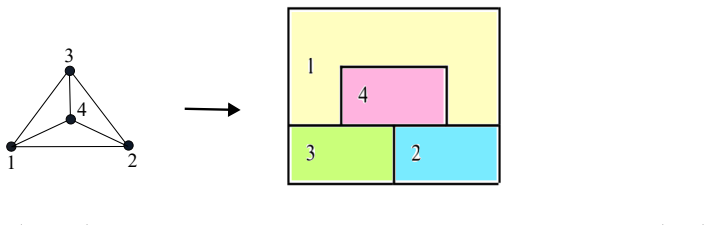


read the original abstract
Automated floor plan generation is an important problem in computational architectural design. The goal is to construct a floor plan from user-defined room numbers and door requirements. The user specifies which rooms must share a door and which rooms must not be adjacent. However, these requirements do not determine the exact placement or shape of the rooms. The task is therefore to arrange the rooms in a single floor plan so that all required door connections are satisfied and no rooms overlap. To address this problem, we propose DPLAN (Door Connectivity to Floor Plan Generation), a graph-based prototype that generates floor plans from door and non-adjacency constraints. The framework operates in three stages. First, the user-defined graph is examined and, if disconnected, additional edges are added to connect its components. Second, a bi-connected plane triangulation is constructed to ensure the existence of a floor plan without overlapping rooms or empty spaces. Third, the triangulated graph is transformed into floor plans. For rectangular floor plans (RFPs), separating triangles are removed by modifying edges without adding new vertices, thereby avoiding the creation of extra rooms. For orthogonal floor plans (OFPs), separating triangles are removed by introducing additional vertices, allowing rectilinear room shapes. By enforcing both door and non-adjacency requirements, the framework generates floor plans that satisfy the given constraints. The method is implemented in Python and includes a prototype for interactive constraint specification and floor plan visualization. Currently, the framework supports rectangular plot boundaries. Future work includes support for non-rectangular plots, dimension-based scaling, and circulation modeling.
Editorial analysis
A structured set of objections, weighed in public.
Referee Report
Summary. The paper proposes DPLAN, a three-stage graph-based prototype for automated floorplan generation. It takes user-specified room counts with door (adjacency) and non-adjacency constraints, augments disconnected graphs by adding edges, constructs a bi-connected plane triangulation, and transforms the result into rectangular floor plans (RFPs) via edge modification or orthogonal floor plans (OFPs) via vertex insertion to eliminate separating triangles, claiming the output satisfies all constraints without overlaps or extra rooms.
Significance. If the transformation from bi-connected plane triangulation to RFP/OFP can be shown to preserve exactly the input adjacencies and non-adjacencies, the work would supply a constructive graph algorithm for a classic problem in computational geometry and architectural design automation. The Python implementation with interactive visualization is noted as a practical contribution, but the absence of any validation, examples, or proofs in the manuscript prevents assessing whether the result holds.
major comments (2)
- [Abstract] Abstract, third-stage description: the central claim that removing separating triangles (edge modification for RFPs, vertex insertion for OFPs) from the bi-connected plane triangulation always yields valid non-overlapping floor plans that preserve all original door connections and exclude all forbidden non-adjacencies is unsupported; no algorithm, invariant, or counterexample discussion is supplied to establish that the step does not introduce new adjacencies or extra rooms.
- No validation section or results: the manuscript states that the framework 'generates floor plans that satisfy the given constraints' and mentions a Python implementation, yet provides no worked examples, failure cases, metrics (e.g., constraint satisfaction rate), or comparison against existing floorplan generators, leaving the soundness of the pipeline unverified.
minor comments (2)
- [Abstract] The abstract lists future work (non-rectangular plots, dimension scaling, circulation) but does not discuss current limitations such as restriction to rectangular boundaries or handling of degenerate graphs.
- Notation for the input graph (vertices as rooms, edges as doors) is introduced informally; a formal definition in an early section would improve clarity.
Simulated Author's Rebuttal
We thank the referee for the constructive report. We address the two major comments point by point below and commit to revisions that strengthen the manuscript without altering its core claims.
read point-by-point responses
-
Referee: [Abstract] Abstract, third-stage description: the central claim that removing separating triangles (edge modification for RFPs, vertex insertion for OFPs) from the bi-connected plane triangulation always yields valid non-overlapping floor plans that preserve all original door connections and exclude all forbidden non-adjacencies is unsupported; no algorithm, invariant, or counterexample discussion is supplied to establish that the step does not introduce new adjacencies or extra rooms.
Authors: We acknowledge that the current manuscript presents the third stage at a high level and does not supply explicit invariants, a formal algorithm description, or counterexample analysis for the separating-triangle removal step. The operations are intended to maintain the input adjacencies by construction (edge modification for RFPs avoids new rooms; vertex insertion for OFPs adds only auxiliary vertices), yet this is not demonstrated in the text. In the revision we will add a dedicated subsection detailing the local modifications, the preserved adjacency relation, and a brief argument that no forbidden adjacencies are created. revision: yes
-
Referee: [—] No validation section or results: the manuscript states that the framework 'generates floor plans that satisfy the given constraints' and mentions a Python implementation, yet provides no worked examples, failure cases, metrics (e.g., constraint satisfaction rate), or comparison against existing floorplan generators, leaving the soundness of the pipeline unverified.
Authors: The manuscript indeed contains no empirical validation, worked examples, or quantitative metrics; it is presented as a graph-theoretic prototype. We agree that this omission makes it difficult to assess correctness in practice. The revision will incorporate a new section with at least two concrete input graphs, the generated floor plans, and a discussion of constraint preservation, together with a short note on known limitations. revision: yes
Circularity Check
No circularity; constructive graph algorithm is self-contained
full rationale
The paper presents a three-stage algorithmic procedure (graph augmentation for connectivity, bi-connected plane triangulation, then separating-triangle removal to produce RFPs/OFPs) without equations, fitted parameters, or any self-citation. No step reduces the claimed output to the input by definition or construction; the transformation is asserted as a graph-theoretic construction rather than a renaming or self-referential fit. This matches the reader's assessment that the method is a constructive algorithm with no evident reduction.
Axiom & Free-Parameter Ledger
axioms (2)
- domain assumption A bi-connected plane triangulation of the augmented graph guarantees a floor plan without overlaps or empty spaces.
- domain assumption Added connecting edges do not violate any user-specified non-adjacency constraints.
Reference graph
Works this paper leans on
-
[1]
Rectangular duals of planar graphs
Krzysztof Ko´ zmi´ nski and Edwin Kinnen. Rectangular duals of planar graphs. Networks, 15(2):145–157, 1985
1985
-
[2]
Existence theorems for floorplans
Ingrid Rinsma. Existence theorems for floorplans. Bulletin of the Australian Mathematical Society , 37(3):473–475, 1988
1988
-
[3]
A linear time algorithm to check for the existence of a rectangular dual of a planar triangulated graph
Jayaram Bhasker and Sartaj Sahni. A linear time algorithm to check for the existence of a rectangular dual of a planar triangulated graph. Networks, 17(3):307–317, 1987
1987
-
[4]
Rectangular and orthogonal floorplans wit h required room areas and tree adjacency
Ingrid Rinsma. Rectangular and orthogonal floorplans wit h required room areas and tree adjacency. Environment and Planning B: Planning and Design , 15(1):111–118, 1988. b c ef g h i j k l m k ei l k p f i q s t q u g c f e : m k v f q p w c s q x m k e i l k p f i q s t q u g c f ey z i p i h q s m g g h e q l { q v k p v y: (4) (3) | } } ~ } ...
1988
-
[5]
Algorithms for floorplan d esign via rectangular dualization
Yen-Tai Lai and Sany M Leinwand. Algorithms for floorplan d esign via rectangular dualization. IEEE transactions on computer-aided design of integrated circuits and systems , 7(12):1278–1289, 1988
1988
-
[6]
Simple and efficient floor-planning
Maciej Kurowski. Simple and efficient floor-planning. Information processing letters , 86(3):113–119, 2003
2003
-
[7]
Compact flo or-planning via orderly spanning trees
Chien-Chih Liao, Hsueh-I Lu, and Hsu-Chun Yen. Compact flo or-planning via orderly spanning trees. Journal of Algo- rithms, 48(2):441–451, 2003
2003
-
[8]
Automatic real-t ime generation of floor plans based on squarified treemaps algorithm
Fernando Marson and Soraia Raupp Musse. Automatic real-t ime generation of floor plans based on squarified treemaps algorithm. International Journal of Computer Games Technology , 2010(1):624817, 2010
2010
-
[9]
Improved floor-plann ing of graphs via adjacency-preserving transformations
Huaming Zhang and Sadish Sadasivam. Improved floor-plann ing of graphs via adjacency-preserving transformations. Journal of combinatorial optimization , 22(4):726–746, 2011
2011
-
[10]
A Novel Algorithm for Real-time Procedural Generation of Building Floor Plans
Maysam Mirahmadi and Abdallah Shami. A novel algorithm f or real-time procedural generation of building floor plans. arXiv preprint arXiv:1211.5842 , 2012
work page internal anchor Pith review Pith/arXiv arXiv 2012
-
[11]
Irregular architectural layout synthesis with graphical inputs
Hao Hua. Irregular architectural layout synthesis with graphical inputs. Automation in construction , 72:388–396, 2016
2016
-
[12]
Customization an d generation of floor plans based on graph transformations
Xiao-Yu Wang, Yin Yang, and Kang Zhang. Customization an d generation of floor plans based on graph transformations. Automation in Construction , 94:405–416, 2018
2018
-
[13]
Automated generation of dimensioned rectangular floor- plans
Nitant Upasani, Krishnendra Shekhawat, and Garv Sachde va. Automated generation of dimensioned rectangular floor- plans. Automation in Construction , 113:103149, 2020
2020
-
[14]
A tool for computer-generated dimensioned floorplans based on given adjacencies
Krishnendra Shekhawat, Nitant Upasani, Sumit Bisht, an d Rahil N Jain. A tool for computer-generated dimensioned floorplans based on given adjacencies. Automation in Construction , 127:103718, 2021
2021
-
[15]
Automated generation of floorplans with non-rectangular rooms
Krishnendra Shekhawat, Rohit Lohani, Chirag Dasannach arya, Sumit Bisht, and Sujay Rastogi. Automated generation of floorplans with non-rectangular rooms. Graphical Models, 127:101175, 2023
2023
-
[16]
Jain, Riddhesh Jayesh Tiwaskar, and Chinmay Hebbar
Sumit Bisht, Krishnendra Shekhawat, Nitant Upasani, Ra hil N. Jain, Riddhesh Jayesh Tiwaskar, and Chinmay Hebbar. Transforming an adjacency graph into dimensioned floorplan layouts. Computer Graphics Forum , 41(6):5–22, 2022
2022
-
[17]
Automated generation of housing layouts using graph-rules
Shiksha, Rohit Lohani, Krishnendra Shekhawat, Arsh Sin gh, and Karan Agrawal. Automated generation of housing layouts using graph-rules. Computers & Graphics , 134:104506, 2026
2026
-
[18]
Floornet: A un ified framework for floorplan reconstruction from 3d scans
Chen Liu, Jiaye Wu, and Yasutaka Furukawa. Floornet: A un ified framework for floorplan reconstruction from 3d scans. In Proceedings of the European conference on computer vision ( ECCV), pages 201–217, 2018
2018
-
[19]
Data-driven interior plan generation for residential buildings
Wenming Wu, Xiao-Ming Fu, Rui Tang, Yuhan Wang, Yu-Hao Qi , and Ligang Liu. Data-driven interior plan generation for residential buildings. ACM Transactions on Graphics (TOG) , 38(6):1–12, 2019
2019
-
[20]
Floor-sp: Inverse cad for floorplans by sequential room-wi se shortest path
Jiacheng Chen, Chen Liu, Jiaye Wu, and Yasutaka Furukawa . Floor-sp: Inverse cad for floorplans by sequential room-wi se shortest path. In Proceedings of the IEEE/CVF International Conference on Co mputer Vision (ICCV) , October 2019
2019
-
[21]
Graph2plan: learning floorplan generation from layout graphs
Ruizhen Hu, Zeyu Huang, Yuhan Tang, Oliver Van Kaick, Hao Zhang, and Hui Huang. Graph2plan: learning floorplan generation from layout graphs. ACM Trans. Graph. , 39(4), August 2020
2020
-
[22]
House-gan: Relational generative adversarial networks for graph-constrained house layout g eneration
Nelson Nauata, Kai-Hung Chang, Chin-Yi Cheng, Greg Mori , and Yasutaka Furukawa. House-gan: Relational generative adversarial networks for graph-constrained house layout g eneration. In European Conference on Computer Vision , pages 162–177. Springer, 2020
2020
-
[23]
House- gan++: Generative adversarial layout refinement network to wards intelligent computational agent for professional ar chi- tects
Nelson Nauata, Sepidehsadat Hosseini, Kai-Hung Chang, Hang Chu, Chin-Yi Cheng, and Yasutaka Furukawa. House- gan++: Generative adversarial layout refinement network to wards intelligent computational agent for professional ar chi- tects. In Proceedings of the IEEE/CVF Conference on Computer Vision a nd Pattern Recognition , pages 13632–13641, 2021
2021
-
[24]
Actfloor-gan: activity-guided adversarial networks for human-centric floorplan design
Shidong Wang, Wei Zeng, Xi Chen, Yu Ye, Yu Qiao, and Chi-Wi ng Fu. Actfloor-gan: activity-guided adversarial networks for human-centric floorplan design. IEEE Transactions on Visualization and Computer Graphics , 29(3):1610–1624, 2021
2021
-
[25]
Wallplan: synthesizing floorplans by learning to generate wall graphs
Jiahui Sun, Wenming Wu, Ligang Liu, Wenjie Min, Gaofeng Z hang, and Liping Zheng. Wallplan: synthesizing floorplans by learning to generate wall graphs. ACM Transactions on Graphics (TOG) , 41(4):1–14, 2022
2022
-
[26]
Housediffusion: Vector floorplan generation via a diffusion model with discrete and continuous denoising
Safa Shabani, Mohammad Fekri, Mohammad Ali Sadeghi, and Peter Wonka. Housediffusion: Vector floorplan generation via a diffusion model with discrete and continuous denoising . Computer Graphics Forum , 42(7):e14916, 2023
2023
-
[27]
Graph2p ix: A generative model for converting room adjacency relationships into layout images
ZHEN HAN, XIAOQIAN LI, YE YUAN, and RUDI STOUFFS. Graph2p ix: A generative model for converting room adjacency relationships into layout images. In Proceedings of the 29th International Conference of the Ass ociation for Computer-Aided Architectural Design Research in Asia (CAA DRIA) 2024 , pages 139–148, 2024
2024
-
[28]
Deep learning for automated 3d floor plan gene ration
Chau Ma Thi. Deep learning for automated 3d floor plan gene ration. VNU JOURNAL OF SCIENCE: COMPUTER SCIENCE AND COMMUNICATION ENGINEERING: Vietnam National U niversity Journal of Science , 2024
2024
-
[29]
Mas kplan: Masked generative layout planning from partial inpu t
Hang Zhang, Anton Savov, and Benjamin Dillenburger. Mas kplan: Masked generative layout planning from partial inpu t. In Proceedings of the IEEE/CVF Conference on Computer Vision a nd Pattern Recognition , pages 8964–8973, 2024
2024
-
[30]
Cons2plan: Vector floorplan gener- ation from various conditions via a learning framework base d on conditional diffusion models
Shibo Hong, Xuhong Zhang, Tianyu Du, Sheng Cheng, Xun Wan g, and Jianwei Yin. Cons2plan: Vector floorplan gener- ation from various conditions via a learning framework base d on conditional diffusion models. In Proceedings of the 32nd ACM International Conference on Multimedia , pages 3248–3256, 2024
2024
-
[31]
R esidential floor plans: Multi-conditional automatic generation using diffusion models
Pengyu Zeng, Wen Gao, Jun Yin, Pengjian Xu, and Shuai Lu. R esidential floor plans: Multi-conditional automatic generation using diffusion models. Automation in Construction , 162:105374, 2024
2024
-
[32]
Gflan: Generative functional layouts
Mohamed Abouagour and Eleftherios Garyfallidis. Gflan: Generative functional layouts. arXiv preprint arXiv:2512.16275 , 2025
-
[33]
Turning a graph into a rectangular floor plan
J Roth, R Hashimshony, and A Wachman. Turning a graph into a rectangular floor plan. Building and Environment , 17(3):163–173, 1982
1982
-
[34]
Depth-first search and linear graph algor ithms
Robert Tarjan. Depth-first search and linear graph algor ithms. SIAM journal on computing , 1(2):146–160, 1972
1972
-
[35]
Ear-clipping b ased algorithms of generating high-quality polygon tri- angulation
Gang Mei, John C Tipper, and Nengxiong Xu. Ear-clipping b ased algorithms of generating high-quality polygon tri- angulation. In Proceedings of the 2012 International Conference on Inform ation Technology and Software Engineering: Software Engineering & Digital Media Technology , pages 979–988. Springer, 2012
2012
-
[36]
Existence theorems for floor-plans
I Rinsma. Existence theorems for floor-plans. Bulletin of the Australian Mathematical Society , 37(3):473–475, 1988
1988
-
[37]
Finding all the elementary circuits of a directed graph
Donald B Johnson. Finding all the elementary circuits of a directed graph. SIAM Journal on Computing , 4(1):77–84, 1975
1975
-
[38]
Regular edge labeling of 4-connecte d plane graphs and its applications in graph drawing problem s
Goos Kant and Xin He. Regular edge labeling of 4-connecte d plane graphs and its applications in graph drawing problem s. Theoretical Computer Science , 172(1-2):175–193, 1997
1997
-
[39]
Dfs tree construction: A lgorithms and characterizations: Preliminary version
Ephraim Korach and Zvi Ostfeld. Dfs tree construction: A lgorithms and characterizations: Preliminary version. In International Workshop on Graph-Theoretic Concepts in Com puter Science , pages 87–106. Springer, 1988
1988
-
[40]
Efficiency of a good but not linear set union algorithm
Robert Endre Tarjan. Efficiency of a good but not linear set union algorithm. Journal of the ACM (JACM) , 22(2):215–225, 1975
1975
-
[41]
On floor-plan of plane graphs
Xin He. On floor-plan of plane graphs. SIAM Journal on Computing , 28(6):2150–2167, 1999
1999
-
[42]
Ad dressing adjacency constraints in rectangular floor plans using monte-carlo tree search
Feng Shi, Ranjith K Soman, Ji Han, and Jennifer K Whyte. Ad dressing adjacency constraints in rectangular floor plans using monte-carlo tree search. Automation in Construction , 115:103187, 2020. 12 Appendix 12.1 Analysis of Performance This section explains the computational performance of our propo sed pipeline and compares it with existing graph- based ...
2020
-
[43]
Algorithm 1 ensures connectivity while respecting non-adjacenc y constraints, producing the graph GC
-
[44]
Algorithm 2 augments the graph to achieve bi-connectivity, prod ucing GB
-
[45]
Algorithm 3 performs constrained triangulation to obtain GT
-
[46]
All four procedures operate directly on a fixed plane embedding of t he graph
Algorithm 4 removes separating triangles (when required), resu lting in the final graph GF , particularly when each module must correspond to a rectangular region. All four procedures operate directly on a fixed plane embedding of t he graph. At every step, adjacency relations are modified only when necessary and in a clearly defined manner. The pipeline does...
-
[47]
The number of added edges satisfies |A|≤ k− 1, and if Algorithm 1 succeeds in merging all components, then |A| = k− 1 (hence the augmentation is minimum in cardinality among all augmentations that connect these k components). Proof. Case 1 : Suppose there exists a set of edges whose insertion into G produces the graph GC , and none of these added edges bel...
2010
-
[48]
Every edge added during the constrained phase satisfies th e non-adjacency constraints, i.e., is not in N
-
[49]
If for every articulation point v there exists a set of allowed edges (not in N ) that connects the blocks of GC−{ v}, then the output GB is biconnected. Proof. (1) Connectivity . Algorithm 2 only adds edges to GC (Steps 7–9) and never deletes vertices; adding edges cannot destroy connectivity, hence GB remains connected. (2) Non-adjacency preservation (c...
-
[50]
GT is planar and contains GB as a spanning subgraph
-
[51]
Every diagonal added by Algorithm 3 respects the non-adja cency constraints (i.e., is not in N )
-
[52]
Every bounded face of GT is a triangle; hence GT is a plane triangulated graph. Proof. Algorithm 3 only adds edges, so GB remains a spanning subgraph of the result. By Lemma 4, every acce pted diagonal is non-crossing and lies inside the target face, so planarity is preserved throughout; this proves (1). The same lemma gives (2). For (3), Algorithm 3 iter...
-
[53]
GF contains no separating triangles, i.e., ST(GF ) =∅
-
[54]
During the constrained replacement stage, every added ed ge (r, d ) satisfies (r, d ) /∈N
-
[55]
If the constrained stage cannot reduce m further, the fallback stage (which drops the non-adjacency filter) guar- antees that the algorithm can still reduce m and thus reach ST(G) =∅. Proof. Algorithm 4 begins by computing T = ST(GT ) and m =|T|(Steps 1–4), and then calls RemoveSTEdgeR- emoval to iteratively modify GT until separating triangles disappear, ...
discussion (0)
Sign in with ORCID, Apple, or X to comment. Anyone can read and Pith papers without signing in.