DVD: Discrete Voxel Diffusion for 3D Generation and Editing
Pith reviewed 2026-06-30 23:05 UTC · model grok-4.3
The pith
Discrete diffusion treats voxel occupancy as a native categorical variable to generate, assess, and edit sparse 3D voxels directly.
A machine-rendered reading of the paper's core claim, the machinery that carries it, and where it could break.
Core claim
DVD is a discrete diffusion framework that treats voxel occupancy as a native discrete variable, enabling direct sampling of sparse voxel configurations, uncertainty estimation through predictive entropy, and single-round inpainting or editing after block-structured fine-tuning, all as the initial prior stage for SLat-based 3D pipelines.
What carries the argument
Categorical diffusion process defined directly on voxel occupancy states, which samples valid discrete configurations without continuous intermediates.
If this is right
- Voxel generation proceeds as direct categorical sampling without post-hoc discretization.
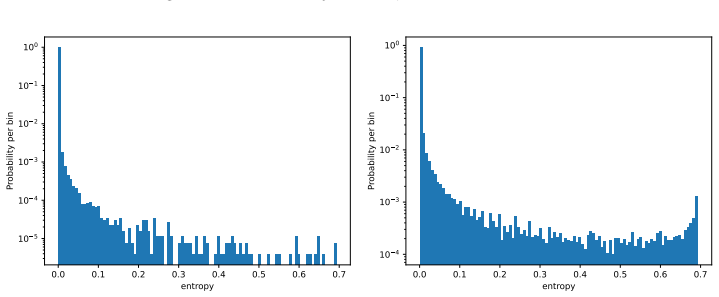
- Predictive entropy identifies ambiguous regions and difficult samples for filtering or quality checks.
- A single fine-tuned model performs both unconditional generation and block-wise editing or inpainting.
- Generation steps become more interpretable because each step operates on explicit occupancy categories.
Where Pith is reading between the lines
- The same categorical modeling could be tested on other grid-based 3D representations that currently rely on continuous diffusion.
- Entropy-based filtering might be applied upstream to curate training sets for later stages of 3D pipelines.
- Single-round editing capability could support interactive tools where users modify only selected voxel blocks.
Load-bearing premise
Discrete diffusion serves as an effective first-stage prior for sparse voxel scaffolds inside SLat-based 3D generative pipelines.
What would settle it
If a continuous diffusion model followed by thresholding produces voxel scaffolds with measurably higher fidelity or lower failure rate on the same downstream 3D tasks, the claimed advantage of native discrete modeling would not hold.
Figures






read the original abstract
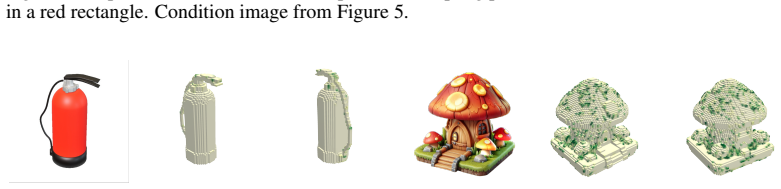
We introduce Discrete Voxel Diffusion (DVD), a discrete diffusion framework to generate, assess, and edit sparse voxels for SLat (Structured LATent) based 3D generative pipelines. Although discrete diffusion has not generally displaced continuous diffusion in image-like generation, we show that it can be an effective first-stage prior for sparse voxel scaffolds. By treating voxel occupancy as a native discrete variable, DVD avoids continuous-to-discrete thresholding and provides a simple framework for voxel generation, uncertainty estimation, and editing. Beyond quality gains, DVD provides more interpretable generation dynamics through explicit categorical modeling. Furthermore, we leverage the predictive entropy as a robust uncertainty metric to identify ambiguous voxel regions and complicated samples, facilitating tasks such as data filtering and quality assessment. Finally, we propose a lightweight fine-tuning strategy using block-structured perturbation patterns. This approach empowers the model to inpaint and edit voxels within a single sampling round, requiring negligible auxiliary computation and no additional model evaluations. Code is available at https://github.com/TeCai/DVD.
Editorial analysis
A structured set of objections, weighed in public.
Referee Report
Summary. The paper introduces Discrete Voxel Diffusion (DVD), a discrete diffusion framework for generating, assessing, and editing sparse voxels as a first-stage prior in SLat-based 3D generative pipelines. By modeling voxel occupancy directly as a categorical variable, DVD avoids continuous-to-discrete thresholding, supplies predictive entropy as an uncertainty metric for ambiguous regions and data filtering, and uses block-structured perturbation fine-tuning to enable single-round inpainting and editing with negligible extra cost. The abstract emphasizes interpretable generation dynamics via explicit categorical modeling and reports quality gains over continuous alternatives.
Significance. If the empirical results hold, the approach supplies a native discrete prior that simplifies uncertainty quantification and editing in sparse voxel scaffolds, with explicit categorical modeling offering more interpretable dynamics than continuous diffusion. The open-sourced code at the cited GitHub repository is a clear strength for reproducibility. The framing as an empirical modeling choice rather than a derived identity avoids circularity risks.
minor comments (2)
- [Abstract] Abstract states 'quality gains' and 'robust uncertainty metric' without naming the specific metrics, baselines, or datasets; the main text should include these details with quantitative tables to support the claims.
- The lightweight fine-tuning strategy is described at a high level; a dedicated methods subsection with the exact perturbation pattern definition and training objective would improve clarity.
Simulated Author's Rebuttal
We thank the referee for their review of our manuscript and for the positive summary of DVD's contributions as a discrete prior for sparse voxel scaffolds in SLat-based pipelines. We appreciate the recognition of the open-sourced code and the framing as an empirical modeling choice. No major comments were listed in the report, so we provide no point-by-point responses below. We remain available to supply further empirical details or clarifications if needed to resolve the uncertain recommendation.
Circularity Check
No significant circularity identified
full rationale
The paper presents DVD as a proposed discrete diffusion modeling choice for voxel occupancy in SLat pipelines, motivated directly in the abstract as an effective first-stage prior. No equations, predictions, or derivations are shown that reduce by construction to fitted inputs, self-definitions, or self-citation chains. The central claims rest on empirical quality gains and interpretability rather than any load-bearing logical reduction to prior author work or renamed known results. This is a standard non-circular modeling paper.
Axiom & Free-Parameter Ledger
axioms (1)
- domain assumption Voxel occupancy is best modeled as a native discrete categorical variable rather than a continuous approximation.
Reference graph
Works this paper leans on
-
[1]
3d gaussian splatting for real-time radiance field rendering.ACM Trans
Bernhard Kerbl, Georgios Kopanas, Thomas Leimkühler, and George Drettakis. 3d gaussian splatting for real-time radiance field rendering.ACM Trans. Graph., 42(4):139–1, 2023
2023
-
[2]
3dshape2vecset: A 3d shape representation for neural fields and generative diffusion models.ACM Transactions On Graphics (TOG), 42(4):1–16, 2023
Biao Zhang, Jiapeng Tang, Matthias Niessner, and Peter Wonka. 3dshape2vecset: A 3d shape representation for neural fields and generative diffusion models.ACM Transactions On Graphics (TOG), 42(4):1–16, 2023
2023
-
[3]
Direct3d: Scalable image-to-3d generation via 3d latent diffusion transformer.Advances in Neural Information Processing Systems, 37:121859–121881, 2024
Shuang Wu, Youtian Lin, Feihu Zhang, Yifei Zeng, Jingxi Xu, Philip Torr, Xun Cao, and Yao Yao. Direct3d: Scalable image-to-3d generation via 3d latent diffusion transformer.Advances in Neural Information Processing Systems, 37:121859–121881, 2024
2024
-
[4]
Xianghui Yang, Huiwen Shi, Bowen Zhang, Fan Yang, Jiacheng Wang, Hongxu Zhao, Xinhai Liu, Xinzhou Wang, Qingxiang Lin, Jiaao Yu, Lifu Wang, Jing Xu, Zebin He, Zhuo Chen, Sicong Liu, Junta Wu, Yihang Lian, Shaoxiong Yang, Yuhong Liu, Yong Yang, Di Wang, Jie Jiang, and Chunchao Guo. Hunyuan3d 1.0: A unified framework for text-to-3d and image-to-3d generatio...
-
[5]
Hunyuan3D 2.0: Scaling Diffusion Models for High Resolution Textured 3D Assets Generation
Zibo Zhao, Zeqiang Lai, Qingxiang Lin, Yunfei Zhao, Haolin Liu, Shuhui Yang, Yifei Feng, Mingxin Yang, Sheng Zhang, Xianghui Yang, Huiwen Shi, Sicong Liu, Junta Wu, Yihang Lian, Fan Yang, Ruining Tang, Zebin He, Xinzhou Wang, Jian Liu, Xuhui Zuo, Zhuo Chen, Biwen Lei, Haohan Weng, Jing Xu, Yiling Zhu, Xinhai Liu, Lixin Xu, Changrong Hu, Shaoxiong Yang, So...
work page internal anchor Pith review Pith/arXiv arXiv 2025
-
[6]
Hunyuan3D 2.5: Towards High-Fidelity 3D Assets Generation with Ultimate Details
Zeqiang Lai, Yunfei Zhao, Haolin Liu, Zibo Zhao, Qingxiang Lin, Huiwen Shi, Xianghui Yang, Mingxin Yang, Shuhui Yang, Yifei Feng, Sheng Zhang, Xin Huang, Di Luo, Fan Yang, Fang Yang, Lifu Wang, Sicong Liu, Yixuan Tang, Yulin Cai, Zebin He, Tian Liu, Yuhong Liu, Jie Jiang, Linus, Jingwei Huang, and Chunchao Guo. Hunyuan3d 2.5: Towards high-fidelity 3d asse...
work page internal anchor Pith review Pith/arXiv arXiv 2025
-
[7]
Clay: A controllable large-scale generative model for creating high-quality 3d assets.ACM Transactions on Graphics (TOG), 43(4):1–20, 2024
Longwen Zhang, Ziyu Wang, Qixuan Zhang, Qiwei Qiu, Anqi Pang, Haoran Jiang, Wei Yang, Lan Xu, and Jingyi Yu. Clay: A controllable large-scale generative model for creating high-quality 3d assets.ACM Transactions on Graphics (TOG), 43(4):1–20, 2024
2024
-
[8]
Bang: Dividing 3d assets via generative exploded dynamics.ACM Transactions on Graphics (TOG), 44(4):1–21, 2025
Longwen Zhang, Qixuan Zhang, Haoran Jiang, Yinuo Bai, Wei Yang, Lan Xu, and Jingyi Yu. Bang: Dividing 3d assets via generative exploded dynamics.ACM Transactions on Graphics (TOG), 44(4):1–21, 2025
2025
-
[9]
TripoSG: High-Fidelity 3D Shape Synthesis using Large-Scale Rectified Flow Models
Yangguang Li, Zi-Xin Zou, Zexiang Liu, Dehu Wang, Yuan Liang, Zhipeng Yu, Xingchao Liu, Yuan-Chen Guo, Ding Liang, Wanli Ouyang, et al. Triposg: High-fidelity 3d shape synthesis using large-scale rectified flow models.arXiv preprint arXiv:2502.06608, 2025
work page internal anchor Pith review Pith/arXiv arXiv 2025
-
[10]
Structured 3d latents for scalable and versatile 3d generation
Jianfeng Xiang, Zelong Lv, Sicheng Xu, Yu Deng, Ruicheng Wang, Bowen Zhang, Dong Chen, Xin Tong, and Jiaolong Yang. Structured 3d latents for scalable and versatile 3d generation. In Proceedings of the Computer Vision and Pattern Recognition Conference, pages 21469–21480, 2025
2025
-
[11]
arXiv preprint arXiv:2510.23306 (2025)
Jiahao Chang, Chongjie Ye, Yushuang Wu, Yuantao Chen, Yidan Zhang, Zhongjin Luo, Chenghong Li, Yihao Zhi, and Xiaoguang Han. Reconviagen: Towards accurate multi-view 3d object reconstruction via generation, 2025. URLhttps://arxiv.org/abs/2510.23306
-
[12]
arXiv preprint arXiv:2505.14521 (2025)
Zhihao Li, Yufei Wang, Heliang Zheng, Yihao Luo, and Bihan Wen. Sparc3d: Sparse rep- resentation and construction for high-resolution 3d shapes modeling, 2025. URL https: //arxiv.org/abs/2505.14521. 10
-
[13]
arXiv preprint arXiv:2512.03052 (2025)
Zeqiang Lai, Yunfei Zhao, Zibo Zhao, Haolin Liu, Qingxiang Lin, Jingwei Huang, Chunchao Guo, and Xiangyu Yue. Lattice: Democratize high-fidelity 3d generation at scale, 2025. URL https://arxiv.org/abs/2512.03052
-
[14]
Tanghui Jia, Dongyu Yan, Dehao Hao, Yang Li, Kaiyi Zhang, Xianyi He, Lanjiong Li, Jinnan Chen, Lutao Jiang, Qishen Yin, et al. Ultrashape 1.0: High-fidelity 3d shape generation via scalable geometric refinement.arXiv preprint arXiv:2512.21185, 2025
-
[15]
arXiv preprint arXiv:2505.17412 (2025)
Shuang Wu, Youtian Lin, Feihu Zhang, Yifei Zeng, Yikang Yang, Yajie Bao, Jiachen Qian, Siyu Zhu, Xun Cao, Philip Torr, et al. Direct3d-s2: Gigascale 3d generation made easy with spatial sparse attention.arXiv preprint arXiv:2505.17412, 2025
-
[16]
Native and Compact Structured Latents for 3D Generation
Jianfeng Xiang, Xiaoxue Chen, Sicheng Xu, Ruicheng Wang, Zelong Lv, Yu Deng, Hongyuan Zhu, Yue Dong, Hao Zhao, Nicholas Jing Yuan, et al. Native and compact structured latents for 3d generation.arXiv preprint arXiv:2512.14692, 2025
work page internal anchor Pith review Pith/arXiv arXiv 2025
-
[17]
Auto-Encoding Variational Bayes
Diederik P Kingma and Max Welling. Auto-encoding variational bayes.arXiv preprint arXiv:1312.6114, 2013
work page internal anchor Pith review Pith/arXiv arXiv 2013
-
[18]
Denoising diffusion probabilistic models.Advances in neural information processing systems, 33:6840–6851, 2020
Jonathan Ho, Ajay Jain, and Pieter Abbeel. Denoising diffusion probabilistic models.Advances in neural information processing systems, 33:6840–6851, 2020
2020
-
[19]
arXiv preprint arXiv:2506.10892 , year=
Subham Sekhar Sahoo, Justin Deschenaux, Aaron Gokaslan, Guanghan Wang, Justin Chiu, and V olodymyr Kuleshov. The diffusion duality.arXiv preprint arXiv:2506.10892, 2025
-
[20]
Johnson, Jonathan Ho, Daniel Tarlow, and Rianne van den Berg
Jacob Austin, Daniel D. Johnson, Jonathan Ho, Daniel Tarlow, and Rianne van den Berg. Structured denoising diffusion models in discrete state-spaces. In M. Ranzato, A. Beygelzimer, Y . Dauphin, P.S. Liang, and J. Wortman Vaughan, editors,Advances in Neural Information Processing Systems, volume 34, pages 17981–17993. Curran Associates, Inc., 2021. URL htt...
2021
-
[21]
Xcube: Large-scale 3d generative modeling using sparse voxel hierarchies
Xuanchi Ren, Jiahui Huang, Xiaohui Zeng, Ken Museth, Sanja Fidler, and Francis Williams. Xcube: Large-scale 3d generative modeling using sparse voxel hierarchies. InProceedings of the IEEE/CVF conference on computer vision and pattern recognition, pages 4209–4219, 2024
2024
-
[22]
A continuous time framework for discrete denoising models.Advances in Neural Information Processing Systems, 35:28266–28279, 2022
Andrew Campbell, Joe Benton, Valentin De Bortoli, Thomas Rainforth, George Deligiannidis, and Arnaud Doucet. A continuous time framework for discrete denoising models.Advances in Neural Information Processing Systems, 35:28266–28279, 2022
2022
-
[23]
Discrete flow matching.Advances in Neural Information Processing Systems, 37:133345–133385, 2024
Itai Gat, Tal Remez, Neta Shaul, Felix Kreuk, Ricky TQ Chen, Gabriel Synnaeve, Yossi Adi, and Yaron Lipman. Discrete flow matching.Advances in Neural Information Processing Systems, 37:133345–133385, 2024
2024
-
[24]
Gener- ative flows on discrete state-spaces: Enabling multimodal flows with applications to protein co-design
Andrew Campbell, Jason Yim, Regina Barzilay, Tom Rainforth, and Tommi Jaakkola. Gener- ative flows on discrete state-spaces: Enabling multimodal flows with applications to protein co-design. InInternational Conference on Machine Learning, pages 5453–5512. PMLR, 2024
2024
-
[25]
Simplified and generalized masked diffusion for discrete data.Advances in neural information processing systems, 37:103131–103167, 2024
Jiaxin Shi, Kehang Han, Zhe Wang, Arnaud Doucet, and Michalis Titsias. Simplified and generalized masked diffusion for discrete data.Advances in neural information processing systems, 37:103131–103167, 2024
2024
-
[26]
Simple and effective masked diffusion language models.Advances in Neural Information Processing Systems, 37:130136–130184, 2024
Subham Sahoo, Marianne Arriola, Yair Schiff, Aaron Gokaslan, Edgar Marroquin, Justin Chiu, Alexander Rush, and V olodymyr Kuleshov. Simple and effective masked diffusion language models.Advances in Neural Information Processing Systems, 37:130136–130184, 2024
2024
-
[27]
Effective and efficient masked image generation models, 2025
Zebin You, Jingyang Ou, Xiaolu Zhang, Jun Hu, Jun Zhou, and Chongxuan Li. Effective and efficient masked image generation models, 2025. URL https://arxiv.org/abs/2503. 07197
2025
-
[28]
arXiv preprint arXiv:2503.20853 (2025) 4
Alexander Swerdlow, Mihir Prabhudesai, Siddharth Gandhi, Deepak Pathak, and Katerina Fragkiadaki. Unified multimodal discrete diffusion.arXiv preprint arXiv:2503.20853, 2025. 11
-
[29]
Weiquan Wang, Jun Xiao, Chunping Wang, Wei Liu, Zhao Wang, and Long Chen.Di2Pose: Dis- crete diffusion model for occluded 3d human pose estimation.Advances in Neural Information Processing Systems, 37:98717–98741, 2024
2024
-
[30]
Jianlin Su, Murtadha Ahmed, Yu Lu, Shengfeng Pan, Wen Bo, and Yunfeng Liu
Kaiyu Song, Hanjiang Lai, Yaqing Zhang, Chuangjian Cai, Yan Pan Kun Yue, and Jian Yin. Topology sculptor, shape refiner: Discrete diffusion model for high-fidelity 3d meshes genera- tion, 2025. URLhttps://arxiv.org/abs/2510.21264
-
[31]
Td3d: Tensor-based discrete diffusion process for 3d shape generation
Jinglin Zhao, Debin Liu, Laurence T Yang, Ruonan Zhao, Zheng Wang, and Zhe Li. Td3d: Tensor-based discrete diffusion process for 3d shape generation. In2024 IEEE International Conference on Multimedia and Expo (ICME), pages 1–6. IEEE, 2024
2024
-
[32]
Justin Jung. Scaffold diffusion: Sparse multi-category voxel structure generation with discrete diffusion.arXiv preprint arXiv:2509.00062, 2025
-
[33]
Large scene generation with cube-absorb discrete diffusion
Qianjiang Hu and Wei Hu. Large scene generation with cube-absorb discrete diffusion. In Proceedings of the IEEE/CVF International Conference on Computer Vision, pages 25186– 25196, 2025
2025
-
[34]
Pyramid diffusion for fine 3d large scene generation, 2024
Yuheng Liu, Xinke Li, Xueting Li, Lu Qi, Chongshou Li, and Ming-Hsuan Yang. Pyramid diffusion for fine 3d large scene generation, 2024. URL https://arxiv.org/abs/2311. 12085
2024
-
[35]
Repaint: Inpainting using denoising diffusion probabilistic models
Andreas Lugmayr, Martin Danelljan, Andres Romero, Fisher Yu, Radu Timofte, and Luc Van Gool. Repaint: Inpainting using denoising diffusion probabilistic models. InProceedings of the IEEE/CVF conference on computer vision and pattern recognition, pages 11461–11471, 2022
2022
-
[36]
Denoising diffusion restoration models.Advances in neural information processing systems, 35:23593–23606, 2022
Bahjat Kawar, Michael Elad, Stefano Ermon, and Jiaming Song. Denoising diffusion restoration models.Advances in neural information processing systems, 35:23593–23606, 2022
2022
-
[37]
A Survey on Diffusion Models for Inverse Problems
Giannis Daras, Hyungjin Chung, Chieh-Hsin Lai, Yuki Mitsufuji, Jong Chul Ye, Peyman Milanfar, Alexandros G Dimakis, and Mauricio Delbracio. A survey on diffusion models for inverse problems.arXiv preprint arXiv:2410.00083, 2024
work page internal anchor Pith review Pith/arXiv arXiv 2024
-
[38]
Your absorbing discrete diffusion secretly models the conditional distributions of clean data
Jingyang Ou, Shen Nie, Kaiwen Xue, Fengqi Zhu, Jiacheng Sun, Zhenguo Li, and Chongxuan Li. Your absorbing discrete diffusion secretly models the conditional distributions of clean data. InThe Thirteenth International Conference on Learning Representations, 2025. URL https://openreview.net/forum?id=sMyXP8Tanm
2025
-
[39]
Palette: Image-to-image diffusion models
Chitwan Saharia, William Chan, Huiwen Chang, Chris Lee, Jonathan Ho, Tim Salimans, David Fleet, and Mohammad Norouzi. Palette: Image-to-image diffusion models. InACM SIGGRAPH 2022 conference proceedings, pages 1–10, 2022
2022
-
[40]
Simple guidance mechanisms for discrete diffusion models.arXiv preprint arXiv:2412.10193, 2024
Yair Schiff, Subham Sekhar Sahoo, Hao Phung, Guanghan Wang, Sam Boshar, Hugo Dalla- torre, Bernardo P de Almeida, Alexander Rush, Thomas Pierrot, and V olodymyr Kuleshov. Simple guidance mechanisms for discrete diffusion models.arXiv preprint arXiv:2412.10193, 2024
-
[41]
Using shape to categorize: Low-shot learning with an explicit shape bias
Stefan Stojanov, Anh Thai, and James M Rehg. Using shape to categorize: Low-shot learning with an explicit shape bias. InProceedings of the IEEE/CVF conference on computer vision and pattern recognition, pages 1798–1808, 2021
2021
-
[42]
Classifier-Free Diffusion Guidance
Jonathan Ho and Tim Salimans. Classifier-free diffusion guidance, 2022. URL https:// arxiv.org/abs/2207.12598
work page internal anchor Pith review Pith/arXiv arXiv 2022
-
[43]
Unlocking guidance for discrete state-space diffusion and flow models
Hunter Nisonoff, Junhao Xiong, Stephan Allenspach, and Jennifer Listgarten. Unlocking guidance for discrete state-space diffusion and flow models. InThe Thirteenth International Conference on Learning Representations, 2025. URL https://openreview.net/forum? id=XsgHl54yO7
2025
-
[44]
Decoupled Weight Decay Regularization
Ilya Loshchilov and Frank Hutter. Decoupled weight decay regularization.arXiv preprint arXiv:1711.05101, 2017. 12
work page internal anchor Pith review Pith/arXiv arXiv 2017
-
[45]
Gans trained by a two time-scale update rule converge to a local nash equilibrium.Advances in neural information processing systems, 30, 2017
Martin Heusel, Hubert Ramsauer, Thomas Unterthiner, Bernhard Nessler, and Sepp Hochreiter. Gans trained by a two time-scale update rule converge to a local nash equilibrium.Advances in neural information processing systems, 30, 2017
2017
-
[46]
Dinov2: Learning robust visual features without supervision.Transactions on Machine Learning Research Journal, 2024
Maxime Oquab, Timothée Darcet, Théo Moutakanni, Huy V o, Marc Szafraniec, Vasil Khalidov, Pierre Fernandez, Daniel Haziza, Francisco Massa, Alaaeldin El-Nouby, et al. Dinov2: Learning robust visual features without supervision.Transactions on Machine Learning Research Journal, 2024
2024
-
[47]
Pointnet++: Deep hierarchical feature learning on point sets in a metric space.Advances in neural information processing systems, 30, 2017
Charles Ruizhongtai Qi, Li Yi, Hao Su, and Leonidas J Guibas. Pointnet++: Deep hierarchical feature learning on point sets in a metric space.Advances in neural information processing systems, 30, 2017
2017
-
[48]
Learning transferable visual models from natural language supervision
Alec Radford, Jong Wook Kim, Chris Hallacy, Aditya Ramesh, Gabriel Goh, Sandhini Agarwal, Girish Sastry, Amanda Askell, Pamela Mishkin, Jack Clark, et al. Learning transferable visual models from natural language supervision. InInternational conference on machine learning, pages 8748–8763. PmLR, 2021
2021
-
[49]
Dora: Sampling and benchmarking for 3d shape variational auto-encoders
Rui Chen, Jianfeng Zhang, Yixun Liang, Guan Luo, Weiyu Li, Jiarui Liu, Xiu Li, Xiaoxiao Long, Jiashi Feng, and Ping Tan. Dora: Sampling and benchmarking for 3d shape variational auto-encoders. InProceedings of the Computer Vision and Pattern Recognition Conference, pages 16251–16261, 2025
2025
-
[50]
Objaverse++: Curated 3d object dataset with quality annotations
Chendi Lin, Heshan Liu, Qunshu Lin, Zachary Bright, Shitao Tang, Yihui He, Minghao Liu, Ling Zhu, and Cindy Le. Objaverse++: Curated 3d object dataset with quality annotations. arXiv preprint arXiv:2504.07334, 2025
-
[51]
Objaverse: A universe of annotated 3d objects
Matt Deitke, Dustin Schwenk, Jordi Salvador, Luca Weihs, Oscar Michel, Eli VanderBilt, Ludwig Schmidt, Kiana Ehsani, Aniruddha Kembhavi, and Ali Farhadi. Objaverse: A universe of annotated 3d objects. InProceedings of the IEEE/CVF conference on computer vision and pattern recognition, pages 13142–13153, 2023
2023
-
[52]
Guanghan Wang, Yair Schiff, Subham Sekhar Sahoo, and V olodymyr Kuleshov. Remasking discrete diffusion models with inference-time scaling, 2025. URL https://arxiv.org/abs/ 2503.00307
-
[53]
Jaeyeon Kim, Kulin Shah, Vasilis Kontonis, Sham Kakade, and Sitan Chen. Train for the worst, plan for the best: Understanding token ordering in masked diffusions.arXiv preprint arXiv:2502.06768, 2025
-
[54]
On powerful ways to generate: Autoregression, diffusion, and beyond, 2025
Chenxiao Yang, Cai Zhou, David Wipf, and Zhiyuan Li. On powerful ways to generate: Autoregression, diffusion, and beyond, 2025. URLhttps://arxiv.org/abs/2510.06190
-
[55]
Li Deng. The mnist database of handwritten digit images for machine learning research [best of the web].IEEE Signal Processing Magazine, 29(6):141–142, 2012. doi: 10.1109/MSP.2012. 2211477
-
[56]
Jianlin Su, Murtadha Ahmed, Yu Lu, Shengfeng Pan, Wen Bo, and Yunfeng Liu. Roformer: Enhanced transformer with rotary position embedding.Neurocomputing, 568:127063, 2024. ISSN 0925-2312. doi: https://doi.org/10.1016/j.neucom.2023.127063. URL https://www. sciencedirect.com/science/article/pii/S0925231223011864
-
[57]
Large Language Diffusion Models
Shen Nie, Fengqi Zhu, Zebin You, Xiaolu Zhang, Jingyang Ou, Jun Hu, Jun Zhou, Yankai Lin, Ji-Rong Wen, and Chongxuan Li. Large language diffusion models, 2025. URL https: //arxiv.org/abs/2502.09992
work page internal anchor Pith review Pith/arXiv arXiv 2025
-
[58]
Qiao Sun, Zhicheng Jiang, Hanhong Zhao, and Kaiming He. Is noise conditioning necessary for denoising generative models?arXiv preprint arXiv:2502.13129, 2025
-
[59]
(2025).Equilibrium Matching: generative modeling with implicit energy- based models.arXiv:2510.02300
Runqian Wang and Yilun Du. Equilibrium matching: Generative modeling with implicit energy-based models, 2025. URLhttps://arxiv.org/abs/2510.02300. 13
-
[60]
Thomas Wolf, Lysandre Debut, Victor Sanh, Julien Chaumond, Clement Delangue, Anthony Moi, Pierric Cistac, Tim Rault, Rémi Louf, Morgan Funtowicz, Joe Davison, Sam Shleifer, Patrick von Platen, Clara Ma, Yacine Jernite, Julien Plu, Canwen Xu, Teven Le Scao, Sylvain Gugger, Mariama Drame, Quentin Lhoest, and Alexander M. Rush. Transformers: State-of-the- ar...
2020
-
[61]
Hunyuan3D 2.1: From Images to High-Fidelity 3D Assets with Production-Ready PBR Material
Team Hunyuan3D, Shuhui Yang, Mingxin Yang, Yifei Feng, Xin Huang, Sheng Zhang, Zebin He, Di Luo, Haolin Liu, Yunfei Zhao, Qingxiang Lin, Zeqiang Lai, Xianghui Yang, Huiwen Shi, Zibo Zhao, Bowen Zhang, Hongyu Yan, Lifu Wang, Sicong Liu, Jihong Zhang, Meng Chen, Liang Dong, Yiwen Jia, Yulin Cai, Jiaao Yu, Yixuan Tang, Dongyuan Guo, Junlin Yu, Hao Zhang, Zhe...
work page internal anchor Pith review Pith/arXiv arXiv 2025
-
[62]
We sample 4000 points from each mesh and compute the P-FID, denoted as FIDPC
The point cloud FID following PointNet++ [47]. We sample 4000 points from each mesh and compute the P-FID, denoted as FIDPC. For the FID of V oxels, we sample 4000 points from the cubified mesh of the GT voxel and the generated voxels. For computing the chamfer (CD), we sample 10000 points from each mesh. For computing the chamfer distance of voxels (CDV)...
-
[63]
Totally, there are 15000 images in the training subset and 6000 images in the Toys4k evaluation set
The FID under DINOv2 [46] feature spaces, where we render 6 images per asset with yaw angles at every 60 degrees, a pitch angle of 30 degrees, and a radius of 2.5. Totally, there are 15000 images in the training subset and 6000 images in the Toys4k evaluation set
-
[64]
We also compute the CLIP score of rendered results and the GT rendering image set. We render 6 images per generated asset with yaw angles at every 60 degrees, a pitch angle of 30 degrees, and a radius of 2.5, and calculate the maximal CLIP score across these 6 images per asset, then report the averaged CLIP score across all assets. Uncertainty scoresThe d...
-
[65]
We also discussed the reason for conducting the inpainting experiment with generated voxels (instead of GT) in Appendix F.2. F Additional Ablation Study F.1 Ablation on Sampling Steps We studied the influence of the sampling step for both continuous and discrete stage 1 on the Toys4k dataset. Table 8: Generation result on Toys4K with different NFEs. Metho...
discussion (0)
Sign in with ORCID, Apple, or X to comment. Anyone can read and Pith papers without signing in.