Driver-WM: A Driver-Centric Traffic-Conditioned Latent World Model for In-Cabin Dynamics Rollout
Pith reviewed 2026-06-30 23:30 UTC · model grok-4.3
The pith
Driver-WM forecasts in-cabin driver dynamics causally conditioned on out-cabin traffic.
A machine-rendered reading of the paper's core claim, the machinery that carries it, and where it could break.
Core claim
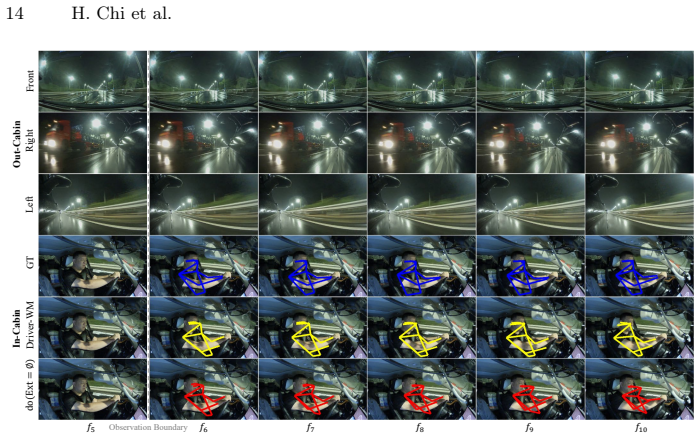
Driver-WM is a driver-centric latent world model that rolls out in-cabin dynamics causally conditioned on out-cabin traffic context. This formulation unifies physical kinematics forecasting with auxiliary behavioral and emotional semantic recognition. Operating in a compact latent space constructed from frozen vision-language features, it adopts a dual-stream architecture to separately encode external traffic and internal driver states, directionally coupled via a gated causal injection mechanism using a learned vector gate to modulate external contextual perturbations while strictly enforcing temporal causality.
What carries the argument
Gated causal injection mechanism that couples dual streams for external traffic and internal driver states using a learned vector gate.
Load-bearing premise
The learned vector gate can modulate external perturbations while enforcing temporal causality when coupling the dual streams.
What would settle it
If experiments on the AIDE dataset show that a model without the gated causal injection achieves similar performance in long-horizon forecasting and semantic alignment, the value of the proposed mechanism would be questioned.
Figures



read the original abstract
Safe L2/L3 driving automation requires anticipating human-in-the-loop reactions during shared-control transitions. While most driving world models forecast the external environment, in-cabin intelligence remains strictly recognition-oriented and lacks multi-step rollout capabilities for driver dynamics. We introduce Driver-WM, a driver-centric latent world model that rolls out in-cabin dynamics causally conditioned on out-cabin traffic context. This formulation unifies physical kinematics forecasting with auxiliary behavioral and emotional semantic recognition. Operating in a compact latent space constructed from frozen vision-language features, Driver-WM adopts a dual-stream architecture to separately encode external traffic and internal driver states. These streams are directionally coupled via a gated causal injection mechanism, which uses a learned vector gate to modulate external contextual perturbations while strictly enforcing temporal causality. Experiments on AIDE show robust long-horizon forecasting on reactive high-motion clips, improved driver/traffic semantic alignment, and controlled interventions that expose the external-to-internal mechanism.
Editorial analysis
A structured set of objections, weighed in public.
Referee Report
Summary. The manuscript introduces Driver-WM, a driver-centric latent world model for multi-step rollout of in-cabin driver dynamics causally conditioned on out-cabin traffic context. It uses a dual-stream architecture operating in a compact latent space from frozen vision-language features, with the streams directionally coupled via a gated causal injection mechanism employing a learned vector gate. The model unifies physical kinematics forecasting with auxiliary behavioral and emotional semantic recognition. Experiments on the AIDE dataset are reported to demonstrate robust long-horizon forecasting on reactive high-motion clips, improved driver/traffic semantic alignment, and results from controlled interventions exposing the external-to-internal mechanism.
Significance. If the causal conditioning holds without leakage and the long-horizon forecasts are accurate, the work could meaningfully advance in-cabin intelligence for L2/L3 shared-control automation by enabling predictive modeling of driver reactions to external traffic. The unification of kinematics rollout with semantic recognition tasks and the use of controlled interventions for mechanism analysis represent constructive elements.
major comments (1)
- [Abstract] Abstract (gated causal injection mechanism): the claim that the learned vector gate 'modulate[s] external contextual perturbations while strictly enforcing temporal causality' when coupling the dual streams is load-bearing for the central claim of causally conditioned rollout. A learned vector gate (typically a sigmoid or softmax modulator) applied to concatenated or cross-attended latents does not by itself prevent non-causal flow from future external frames during multi-step rollout, unless the implementation includes explicit autoregressive masking, causal attention masks, or future-state blocking. The manuscript must provide the precise coupling equations, pseudocode, or architectural diagram to substantiate the strict enforcement.
Simulated Author's Rebuttal
We thank the referee for the constructive feedback and positive evaluation of the work's significance for L2/L3 automation. We address the single major comment below regarding the need to substantiate the causal enforcement claim.
read point-by-point responses
-
Referee: [Abstract] Abstract (gated causal injection mechanism): the claim that the learned vector gate 'modulate[s] external contextual perturbations while strictly enforcing temporal causality' when coupling the dual streams is load-bearing for the central claim of causally conditioned rollout. A learned vector gate (typically a sigmoid or softmax modulator) applied to concatenated or cross-attended latents does not by itself prevent non-causal flow from future external frames during multi-step rollout, unless the implementation includes explicit autoregressive masking, causal attention masks, or future-state blocking. The manuscript must provide the precise coupling equations, pseudocode, or architectural diagram to substantiate the strict enforcement.
Authors: We agree that the abstract's phrasing is high-level and that the manuscript requires explicit details to substantiate the strict causality claim. The dual-stream coupling does employ autoregressive masking and future-state blocking in the gated injection (applied only to past and current external latents), but these elements are described at a high level in Section 3.2 without the requested equations or diagram. In the revision we will add the precise coupling equations (showing the learned gate applied after causal masking), pseudocode for the multi-step rollout procedure, and an updated Figure 2 that explicitly annotates the masking and blocking mechanisms. revision: yes
Circularity Check
No circularity detected; derivation self-contained
full rationale
The provided abstract and description contain no equations, fitted parameters presented as predictions, self-citations, uniqueness theorems, or ansatzes that reduce any claimed result to its inputs by construction. The gated causal injection is described as a design mechanism without any derivation chain shown that would qualify under the enumerated patterns. No load-bearing steps reduce to prior fitted quantities or self-referential definitions. The paper's claims about latent space construction and rollout remain independent of the circularity criteria.
Axiom & Free-Parameter Ledger
free parameters (1)
- learned vector gate
axioms (2)
- domain assumption Frozen vision-language features provide a compact latent space sufficient for encoding both external traffic and internal driver states.
- domain assumption Temporal causality can be strictly enforced via directional coupling in the dual-stream architecture.
Forward citations
Cited by 1 Pith paper
-
Risk-Aware Selective Multimodal Driver Monitoring with Driver-State World Modeling
A cost-aware selective inference framework combines a lightweight multimodal student model and driver-state world modeling to reduce unsafe false negatives in driver monitoring while keeping low latency.
Reference graph
Works this paper leans on
-
[1]
In: 2021 IEEE/CVF International Conference on Computer Vision (ICCV)
Adeli, V., Ehsanpour, M., Reid, I., Niebles, J.C., Savarese, S., Adeli, E., Rezatofighi, H.: TRiPOD: Human Trajectory and Pose Dynamics Forecasting in the Wild . In: 2021 IEEE/CVF International Conference on Computer Vision (ICCV). pp. 13370– 13380. IEEE Computer Society, Los Alamitos, CA, USA (Oct 2021).https://doi. org/10.1109/ICCV48922.2021.01314, http...
-
[2]
Bai, J., Bai, S., Yang, S., Wang, S., Tan, S., Wang, P., Lin, J., Zhou, C., Zhou, J.: Qwen-VL: A versatile vision-language model for understanding, localization, text reading, and beyond (2024),https://openreview.net/forum?id=qrGjFJVl3m
2024
-
[3]
Bai, S., Cai, Y., Chen, R., Chen, K., Chen, X., Cheng, Z., Deng, L., Ding, W., Gao, C., Ge, C., Ge, W., Guo, Z., Huang, Q., Huang, J., Huang, F., Hui, B., Jiang, S., Li, Z., Li, M., Li, M., Li, K., Lin, Z., Lin, J., Liu, X., Liu, J., Liu, C., Liu, Y., Liu, D., Liu, S., Lu, D., Luo, R., Lv, C., Men, R., Meng, L., Ren, X., Ren, X., Song, S., Sun, Y., Tang, ...
2025
-
[4]
Chen, L., Wu, P., Chitta, K., Jaeger, B., Geiger, A., Li, H.: End-to-end autonomous driving: Challenges and frontiers. IEEE Trans. Pattern Anal. Mach. Intell.46(12), 10164–10183 (Dec 2024).https://doi.org/10.1109/TPAMI.2024.3435937, https: //doi.org/10.1109/TPAMI.2024.3435937
-
[5]
IEEE Transactions on Intelligent Vehicles10(4), 2905–2914 (2025).https://doi.org/10.1109/TIV
Chen, L., Li, Y., Huang, C., Li, B., Xing, Y., Tian, D., Li, L., Hu, Z., Na, X., Li, Z., Teng, S., Lv, C., Wang, J., Cao, D., Zheng, N., Wang, F.Y.: Milestones in autonomous driving and intelligent vehicles: Survey of surveys. IEEE Transactions on Intelligent Vehicles8(2), 1046–1056 (2023).https://doi.org/10.1109/TIV. 2022.3223131
work page doi:10.1109/tiv 2023
-
[6]
In: 2025 IEEE Intelligent Vehicles Sym- posium (IV)
Chi, H., Yang, H., Yang, L., Lv, C.: Vlm-dm: Visual language models for multitask domain adaptation in driver monitoring. In: 2025 IEEE Intelligent Vehicles Sym- posium (IV). pp. 1280–1285 (2025).https://doi.org/10.1109/IV64158.2025. 11097620
-
[7]
In: Proceedings of the 40th International Conference on Machine Learning
Driess, D., Xia, F., Sajjadi, M.S.M., Lynch, C., Chowdhery, A., Ichter, B., Wahid, A., Tompson, J., Vuong, Q., Yu, T., Huang, W., Chebotar, Y., Sermanet, P., Duckworth, D., Levine, S., Vanhoucke, V., Hausman, K., Toussaint, M., Greff, K., Zeng, A., Mordatch, I., Florence, P.: Palm-e: an embodied multimodal language model. In: Proceedings of the 40th Inter...
2023
-
[8]
In: Globerson, A., Mackey, L., Belgrave, D., Fan, A., Paquet, U., Tomczak, J., Zhang, C
Gao, S., Yang, J., Chen, L., Chitta, K., Qiu, Y., Geiger, A., Zhang, J., Li, H.: Vista: A generalizable driving world model with high fidelity and versatile con- trollability. In: Globerson, A., Mackey, L., Belgrave, D., Fan, A., Paquet, U., Tomczak, J., Zhang, C. (eds.) Advances in Neural Information Processing Sys- tems. vol. 37, pp. 91560–91596. Curran...
-
[9]
Guo, W., Du, Y., Shen, X., Lepetit, V., Alameda-Pineda, X., Moreno-Noguer, F.: Back to mlp: A simple baseline for human motion prediction. In: 2023 IEEE/CVF Winter Conference on Applications of Computer Vision (WACV). pp. 4798–4808 (2023).https://doi.org/10.1109/WACV56688.2023.00479
-
[10]
GAIA-1: A Generative World Model for Autonomous Driving
Hu, A., Russell, L., Yeo, H., Murez, Z., Fedoseev, G., Kendall, A., Shotton, J., Corrado, G.: GAIA-1: A Generative World Model for Autonomous Driving. arXiv e-prints arXiv:2309.17080 (Sep 2023).https://doi.org/10.48550/arXiv.2309. 17080
work page internal anchor Pith review Pith/arXiv arXiv doi:10.48550/arxiv.2309 2023
-
[11]
In: Proceedings of the IEEE/CVF Conference on Computer Vision and Pattern Recognition (CVPR)
Hu, Y., Yang, J., Chen, L., Li, K., Sima, C., Zhu, X., Chai, S., Du, S., Lin, T., Wang, W., Lu, L., Jia, X., Liu, Q., Dai, J., Qiao, Y., Li, H.: Planning-oriented autonomous driving. In: Proceedings of the IEEE/CVF Conference on Computer Vision and Pattern Recognition (CVPR). pp. 17853–17862 (June 2023)
2023
-
[12]
Jain, A., Koppula, H.S., Soh, S., Raghavan, B., Singh, A., Saxena, A.: Brain4cars: Car that knows before you do via sensory-fusion deep learning architecture (2016), https://arxiv.org/abs/1601.00740
work page internal anchor Pith review Pith/arXiv arXiv 2016
-
[13]
DOLCE: A model-based probabilistic diffusion framework for limited-angle CT reconstruction,
Jiang, B., Chen, S., Xu, Q., Liao, B., Chen, J., Zhou, H., Zhang, Q., Liu, W., Huang, C., Wang, X.: Vad: Vectorized scene representation for efficient autonomous driving. In: 2023 IEEE/CVF International Conference on Computer Vision (ICCV). pp. 8306–8316 (2023).https://doi.org/10.1109/ICCV51070.2023.00766
-
[14]
2025.3D and 4D world modeling: a survey
Kong, L., Yang, W., Mei, J., Liu, Y., Liang, A., Zhu, D., Lu, D., Yin, W., Hu, X., Jia, M., Deng, J., Zhang, K., Wu, Y., Yan, T., Gao, S., Wang, S., Li, L., Pan, L., Liu, Y., Zhu, J., Tsang Ooi, W., Hoi, S.C.H., Liu, Z.: 3D and 4D World Modeling: A Survey. arXiv e-prints arXiv:2509.07996 (Sep 2025).https://doi.org/10.48550/ arXiv.2509.07996
-
[15]
In: Proceedings of the 40th International Conference on Machine Learning
Li, J., Li, D., Savarese, S., Hoi, S.: Blip-2: bootstrapping language-image pre-training with frozen image encoders and large language models. In: Proceedings of the 40th International Conference on Machine Learning. ICML’23, JMLR.org (2023)
2023
-
[16]
Enhancing End-to-End Autonomous Driving with Latent World Model
Li, Y., Fan, L., He, J., Wang, Y., Chen, Y., Zhang, Z., Tan, T.: Enhancing End-to- End Autonomous Driving with Latent World Model. arXiv e-prints arXiv:2406.08481 (Jun 2024).https://doi.org/10.48550/arXiv.2406.08481
work page internal anchor Pith review Pith/arXiv arXiv doi:10.48550/arxiv.2406.08481 2024
-
[17]
Liu, H., Huang, Z., Huang, W., Yang, H., Mo, X., Lv, C.: Hybrid-prediction integrated planning for autonomous driving. IEEE Transactions on Pattern Analysis and Machine Intelligence47(4), 2597–2614 (2025).https://doi.org/10.1109/ TPAMI.2025.3526936
-
[18]
In: Proceedings of the 37th International Conference on Neural Information Processing Systems
Liu, H., Li, C., Wu, Q., Lee, Y.J.: Visual instruction tuning. In: Proceedings of the 37th International Conference on Neural Information Processing Systems. NIPS ’23, Curran Associates Inc., Red Hook, NY, USA (2023)
2023
- [19]
-
[20]
Liu, W., Qiao, Y., Wang, Z., Guo, Q., Chen, Z., Zhou, M., Li, X., Wang, L., Li, Z., Liu, H., Wang, W.: Tem3-learning: Time-efficient multimodal multi-task Driver-WM 17 learning for advanced assistive driving. In: Laugier, C., Renzaglia, A., Atanasov, N., Birchfield, S., Cielniak, G., {De Mattos}, L., Fiorini, L., Giguere, P., Hashimoto, K., Ibanez-Guzman,...
-
[21]
In: Computer Vision and Pattern Recognition
Liu, W., Wang, W., Qiao, Y., Guo, Q., Zhu, J., Li, P., Chen, Z., Yang, H., Li, Z., Wang, L., Tan, T., Liu, H.: MMTL-UniAD: A Unified Framework for Multimodal and Multi-Task Learning in Assistive Driving Perception . In: 2025 IEEE/CVF Conference on Computer Vision and Pattern Recognition (CVPR). pp. 6864–6874. IEEE Computer Society, Los Alamitos, CA, USA (...
-
[22]
In: 2019 IEEE/CVF International Conference on Computer Vision (ICCV)
Martin, M., Roitberg, A., Haurilet, M., Horne, M., Reiß, S., Voit, M., Stiefelhagen, R.: Drive&act: A multi-modal dataset for fine-grained driver behavior recognition in autonomous vehicles. In: 2019 IEEE/CVF International Conference on Computer Vision (ICCV). pp. 2801–2810 (2019).https://doi.org/10.1109/ICCV.2019. 00289
-
[23]
In: 2017 IEEE Conference on Computer Vision and Pattern Recognition (CVPR)
Martinez, J., Black, M.J., Romero, J.: On Human Motion Prediction Using Recurrent Neural Networks . In: 2017 IEEE Conference on Computer Vision and Pattern Recognition (CVPR). pp. 4674–4683. IEEE Computer Society, Los Alamitos, CA, USA (Jul 2017).https://doi.org/10.1109/CVPR.2017.497, https: //doi.ieeecomputersociety.org/10.1109/CVPR.2017.497
-
[24]
Rahimi, A., Gerard, V., Zablocki, E., Cord, M., Alahi, A.: Mad: Motion appearance decoupling for efficient driving world models (2026),https://arxiv.org/abs/2601. 09452
2026
-
[25]
SAE On-Road Automated Vehicle Standards Committee: Taxonomy and definitions fortermsrelated toon-roadmotorvehicle automated drivingsystems.SAE Standard J3016 (2014)
2014
-
[26]
Sima, C., Renz, K., Chitta, K., Chen, L., Zhang, H., Xie, C., Beißwenger, J., Luo, P., Geiger, A., Li, H.: Drivelm: Driving with graph visual question answering. In: Computer Vision – ECCV 2024: 18th European Conference, Milan, Italy, September 29–October 4, 2024, Proceedings, Part LII. p. 256–274. Springer-Verlag, Berlin, Heidelberg (2024). https://doi.o...
-
[27]
Wang, P., Bai, S., Tan, S., Wang, S., Fan, Z., Bai, J., Chen, K., Liu, X., Wang, J., Ge, W., Fan, Y., Dang, K., Du, M., Ren, X., Men, R., Liu, D., Zhou, C., Zhou, J., Lin, J.: Qwen2-vl: Enhancing vision-language model’s perception of the world at any resolution (2024),https://arxiv.org/abs/2409.12191
work page internal anchor Pith review Pith/arXiv arXiv 2024
-
[28]
Wang, W., Wang, L., Zhang, C., Liu, C., Sun, L.: Social interactions for au- tonomous driving: A review and perspectives. Found. Trends Robot10(3–4), 198–376 (Nov 2022).https://doi.org/10.1561/2300000078, https://doi.org/ 10.1561/2300000078 18 H. Chi et al
-
[29]
Wang, X., Zhu, Z., Huang, G., Chen, X., Zhu, J., Lu, J.: Drivedreamer: Towards real- world-drive world models for autonomous driving. In: Computer Vision – ECCV 2024: 18th European Conference, Milan, Italy, September 29–October 4, 2024, Proceedings, Part XLVIII. p. 55–72. Springer-Verlag, Berlin, Heidelberg (2024). https://doi.org/10.1007/978-3-031-73195-...
-
[30]
Human Factors64(7), 1227– 1260 (2022)
Weaver, B.W., DeLucia, P.R.: A systematic review and meta-analysis of takeover performance during conditionally automated driving. Human Factors64(7), 1227– 1260 (2022)
2022
-
[31]
Xing,Y.,Lv,C.,Cao,D.,Hang,P.:Towardhuman-vehiclecollaboration:Reviewand perspectives on human-centered collaborative automated driving. Transportation Research Part C: Emerging Technologies128, 103199 (2021).https://doi.org/ https://doi.org/10.1016/j.trc.2021.103199
-
[32]
IEEE Transactions on Vehicular Technology68(6), 5379–5390 (2019).https://doi.org/10.1109/TVT
Xing, Y., Lv, C., Wang, H., Cao, D., Velenis, E., Wang, F.Y.: Driver activity recognition for intelligent vehicles: A deep learning approach. IEEE Transactions on Vehicular Technology68(6), 5379–5390 (2019).https://doi.org/10.1109/TVT. 2019.2908425
work page doi:10.1109/tvt 2019
-
[33]
Yan, S., Xiong, Y., Lin, D.: Spatial temporal graph convolutional networks for skeleton-based action recognition. In: Proceedings of the Thirty-Second AAAI Conference on Artificial Intelligence and Thirtieth Innovative Applications of Artificial Intelligence Conference and Eighth AAAI Symposium on Educational Advances in Artificial Intelligence. AAAI’18/I...
2018
-
[34]
DOLCE: A model-based probabilistic diffusion framework for limited-angle CT reconstruction,
Yang, D., Huang, S., Xu, Z., Li, Z., Wang, S., Li, M., Wang, Y., Liu, Y., Yang, K., Chen, Z., Wang, Y., Liu, J., Zhang, P., Zhai, P., Zhang, L.: Aide: A vision-driven multi-view, multi-modal, multi-tasking dataset for assistive driving perception. In: 2023 IEEE/CVF International Conference on Computer Vision (ICCV). pp. 20402–20413 (2023).https://doi.org/...
-
[35]
IEEE Transactions on Intelligent Transportation Systems25(2), 2034–2045 (2024)
Yang, H., Liu, H., Hu, Z., Nguyen, A.T., Guerra, T.M., Lv, C.: Quantitative identi- fication of driver distraction: A weakly supervised contrastive learning approach. IEEE Transactions on Intelligent Transportation Systems25(2), 2034–2045 (2024). https://doi.org/10.1109/TITS.2023.3316203
-
[36]
In: Proceedings of the IEEE/CVF Conference on Computer Vision and Pattern Recognition (CVPR)
Zhao, G., Ni, C., Wang, X., Zhu, Z., Zhang, X., Wang, Y., Huang, G., Chen, X., Wang, B., Zhang, Y., Mei, W., Wang, X.: Drivedreamer4d: World models are effective data machines for 4d driving scene representation. In: Proceedings of the IEEE/CVF Conference on Computer Vision and Pattern Recognition (CVPR). pp. 12015–12026 (June 2025)
2025
- [37]
-
[38]
In: Proceedings of the IEEE/CVF International Conference on Computer Vision (ICCV)
Zheng, Y., Yang, P., Xing, Z., Zhang, Q., Zheng, Y., Gao, Y., Li, P., Zhang, T., Xia, Z., Jia, P., Lang, X., Zhao, D.: World4drive: End-to-end autonomous driving via intention-aware physical latent world model. In: Proceedings of the IEEE/CVF International Conference on Computer Vision (ICCV). pp. 28632–28642 (October 2025)
2025
-
[39]
In: Proceedings of the 33rd ACM International Conference on Multimedia
Zhu, G., Fan, S., Dai, H., Ho, E.S.L.: Waymo-3dskelmo: A multi-agent 3d skele- tal motion dataset for pedestrian interaction modeling in autonomous driving. In: Proceedings of the 33rd ACM International Conference on Multimedia. p. 13184–13190. MM ’25, Association for Computing Machinery, New York, NY, USA (2025). https://doi.org/10.1145/3746027.3758273, ...
-
[40]
DOLCE: A model-based probabilistic diffusion framework for limited-angle CT reconstruction,
Zhu, W., Ma, X., Liu, Z., Liu, L., Wu, W., Wang, Y.: MotionBERT: A Unified Perspective on Learning Human Motion Representations . In: 2023 IEEE/CVF International Conference on Computer Vision (ICCV). pp. 15039–15053. IEEE Computer Society, Los Alamitos, CA, USA (Oct 2023).https://doi.org/10. 1109/ICCV51070.2023.01385, https://doi.ieeecomputersociety.org/1...
-
[41]
maximal injection step
Zitkovich, B., Yu, T., Xu, S., Xu, P., Xiao, T., Xia, F., Wu, J., Wohlhart, P., Welker, S., Wahid, A., Vuong, Q., Vanhoucke, V., Tran, H., Soricut, R., Singh, A., Singh, J., Sermanet, P., Sanketi, P.R., Salazar, G., Ryoo, M.S., Reymann, K., Rao, K., Pertsch, K., Mordatch, I., Michalewski, H., Lu, Y., Levine, S., Lee, L., Lee, T.W.E., Leal, I., Kuang, Y., ...
2023
discussion (0)
Sign in with ORCID, Apple, or X to comment. Anyone can read and Pith papers without signing in.