From Bloch to N\'eel: Anisotropy-dependent Domain-Wall Character in FePd Thin Films
Pith reviewed 2026-07-03 09:22 UTC · model grok-4.3
The pith
FePd thin films with high perpendicular anisotropy exhibit a depth-dependent change in domain wall character from hybrid Bloch-Néel to purely Néel.
A machine-rendered reading of the paper's core claim, the machinery that carries it, and where it could break.
Core claim
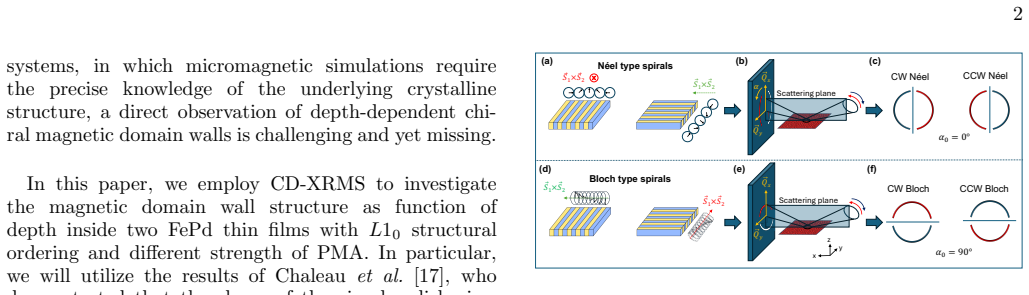
Angular-dependent CD-XRMS directly reveals a smooth transition from a hybrid Bloch-Néel chirality within the upper FePd layer towards a purely Néel-type structure at the lower FePd interface in the Q_PMA=1.8 sample, while the Q_PMA=1.45 sample shows purely Néel walls throughout, linked to differences in long-range L10 structural order.
What carries the argument
Angular-dependent circular dichroism X-ray resonant magnetic scattering, which supplies a depth profile of domain-wall chirality through variation of the incident angle.
If this is right
- Long-range L10 structural order, not anisotropy strength alone, controls whether domain walls remain purely Néel or develop a Bloch component.
- Even films with Q_PMA above 1.4 can host hybrid walls when structural order is high.
- Pure Néel walls can appear throughout a film at moderate anisotropy when long-range order is reduced.
- Combining angular CD-XRMS with STXM and ptychography connects magnetic depth profiles to structural characterization.
Where Pith is reading between the lines
- Growth conditions that tune L10 order could be used to engineer intentional chirality gradients along the film thickness for device applications.
- The same angular-scattering approach may uncover similar hidden depth transitions in other perpendicular-anisotropy materials.
- Micromagnetic models of these films would need to incorporate position-dependent anisotropy or exchange parameters to reproduce the observed wall evolution.
Load-bearing premise
The angular dependence of the CD-XRMS signal can be read as a direct depth profile of domain-wall chirality without significant contributions from surface morphology or interface roughness.
What would settle it
An independent layer-resolved measurement such as polarized neutron reflectometry on the same samples that fails to show the reported chirality transition would falsify the depth interpretation.
Figures


read the original abstract
We report an experimental investigation of the depth-dependent domain wall formation in L1$_0$-FePd thin films with high perpendicular magnetic anisotropy. Using circular dichroism X-ray resonant magnetic scattering (CD-XRMS) as a function of the incident X-ray angle, we explore the depth evolution of chiral spin textures in two samples with different strengths of magnetocrystalline anisotropy. Combined with CD-STXM, CD-ptychography, and macroscopic characterization of the structural order, magnetic properties, and surface morphology, we relate these observations to differences in the long-range order of the L1$_0$ phase of FePd. One FePd thin film with very high magnetocrystalline anisotropy, characterized by $Q_{PMA}=1.8$, exhibits an unexpectedly large N\'eel contribution. Angular-dependent CD-XRMS directly reveals a smooth transition from a hybrid Bloch-N\'eel chirality within the upper FePd layer towards a purely N\'eel-type structure at the lower FePd interface. In the second FePd sample, despite a still relatively large $Q_{PMA}=1.45$, the domain walls were found to be purely N\'eel type. These results indicate a crucial role of the long-range structural order in determining the formation of the magnetic structure.
Editorial analysis
A structured set of objections, weighed in public.
Referee Report
Summary. The manuscript reports an experimental study of depth-dependent domain-wall chirality in L1₀-FePd thin films with perpendicular magnetic anisotropy. Using angle-dependent circular dichroism X-ray resonant magnetic scattering (CD-XRMS) together with CD-STXM, CD-ptychography, and macroscopic structural/magnetic characterization, the authors claim that the Q_PMA=1.8 sample exhibits a smooth transition from hybrid Bloch-Néel chirality in the upper layer to purely Néel-type walls at the lower interface, while the Q_PMA=1.45 sample shows purely Néel walls throughout; these differences are attributed to variations in long-range L1₀ structural order.
Significance. If the angular CD-XRMS data can be shown to isolate magnetic depth profiles without significant non-magnetic artifacts, the work would provide direct experimental evidence connecting long-range chemical order to domain-wall character in high-PMA materials. Such a link is relevant for spintronic applications where wall type influences dynamics, pinning, and stability. The multi-technique approach is a strength, but the central depth-resolved claim requires further validation.
major comments (2)
- [CD-XRMS analysis and discussion of angular dependence] The central claim that angular-dependent CD-XRMS directly maps a depth-resolved transition from hybrid Bloch-Néel to pure Néel walls (abstract; results on CD-XRMS angle dependence) rests on the assumption that the observed angular variation arises solely from the magnetic structure factor. The manuscript does not report quantitative forward modeling (DWBA or Born-approximation simulations) that incorporates the measured surface morphology and roughness parameters to isolate the magnetic contribution and test robustness against possible charge-scattering artifacts.
- [Discussion] The attribution of the difference in wall character between the two samples to long-range L1₀ order (discussion section) is based on samples that also differ in Q_PMA; without additional control samples or a quantitative correlation between order parameter and wall type across a series, the causal link remains suggestive rather than definitive.
minor comments (2)
- [Figure captions] Figure captions for the CD-XRMS angular scans should explicitly state the fitting model or simulation used to extract the depth profile.
- [Methods or CD-XRMS section] The manuscript would benefit from a brief statement of the penetration-depth calculation or effective probing depth as a function of incidence angle.
Simulated Author's Rebuttal
We thank the referee for the careful and constructive review. The comments highlight important aspects of the CD-XRMS interpretation and the attribution of domain-wall character to structural order. We address each point below and indicate where revisions will be made to strengthen the manuscript.
read point-by-point responses
-
Referee: [CD-XRMS analysis and discussion of angular dependence] The central claim that angular-dependent CD-XRMS directly maps a depth-resolved transition from hybrid Bloch-Néel to pure Néel walls (abstract; results on CD-XRMS angle dependence) rests on the assumption that the observed angular variation arises solely from the magnetic structure factor. The manuscript does not report quantitative forward modeling (DWBA or Born-approximation simulations) that incorporates the measured surface morphology and roughness parameters to isolate the magnetic contribution and test robustness against possible charge-scattering artifacts.
Authors: We agree that explicit DWBA or Born-approximation simulations incorporating the AFM-measured roughness would provide additional rigor in separating magnetic and charge contributions. The original analysis relied on the resonant enhancement at the Fe L3 edge, the known penetration depth variation with angle, and consistency with CD-STXM and ptychography results obtained at different depths. In the revised manuscript we will add quantitative forward modeling using the measured surface morphology parameters to confirm that charge-scattering artifacts do not account for the observed angular dependence. revision: yes
-
Referee: [Discussion] The attribution of the difference in wall character between the two samples to long-range L1₀ order (discussion section) is based on samples that also differ in Q_PMA; without additional control samples or a quantitative correlation between order parameter and wall type across a series, the causal link remains suggestive rather than definitive.
Authors: We acknowledge that the two samples differ in both Q_PMA and the L1₀ order parameter, and that a larger series with independent variation of order at fixed Q_PMA would be ideal. Q_PMA itself is determined by the magnetocrystalline anisotropy, which scales directly with the long-range chemical order in L1₀-FePd; the structural characterization (XRD order parameter, lattice parameters) shows a clear correlation between higher order and higher Q_PMA. The discussion will be revised to present the link as correlative rather than strictly causal and to note the limitation of having only two samples. revision: partial
Circularity Check
No circularity: purely experimental observations with no derivation chain
full rationale
The paper reports experimental measurements using angular-dependent CD-XRMS, CD-STXM, CD-ptychography and structural/magnetic characterization on two FePd samples. No equations, parameter fitting, predictions, or self-referential derivations appear in the abstract or described content. The central claim is an observational link between Q_PMA, L1₀ order and domain-wall character extracted directly from angle-dependent dichroic signals. This is self-contained against external benchmarks (measured roughness, order parameters) and carries no load-bearing self-citation or ansatz. Score 0 is the expected outcome for such work.
Axiom & Free-Parameter Ledger
axioms (1)
- domain assumption Standard assumptions in X-ray resonant magnetic scattering allow circular dichroism signals to be interpreted as magnetic chirality and depth profiles via angular variation.
Reference graph
Works this paper leans on
-
[1]
Growth of FePd thin films L10-ordered FePd thin films with point group sym- metry P4/mmm were grown following the proto- col described in Ref.[21–23]. Two samples,F ePd- highandF ePd-midwith different magnetocrystalline anisotropies, controlled by different FePd growth modes and thicknesses, were prepared using a state-of-the-art molecular beam epitaxy sy...
-
[2]
Figure 2(e) shows XRD mea- surements of the FePd (001) and (002) Bragg peaks with θ2(FePd-high)=49.8◦ andθ 2(FePd-mid)=49.25◦
X-ray diffraction The structural quality of grown thin films was veri- fied with X-ray diffraction measurements using a Bruker AXS D8 Advance system. Figure 2(e) shows XRD mea- surements of the FePd (001) and (002) Bragg peaks with θ2(FePd-high)=49.8◦ andθ 2(FePd-mid)=49.25◦. These (002) Bragg peak positions correspond to out-of-plane lattice constants of...
-
[3]
Magnetization measurements TABLE I.Magnetic and structural parameters of FePd-high and FePd-mid. Ku(M erg cm3 )Q P M A D(nm)S c ⊥ F ePd-high14.43±0.05 1.8±0.05 70±2 0.63±0.02 3.66 ˚A F ePd-mid12.77±0.05 1.45±0.03 58±2 0.31±0.04 3.7 ˚A L10-FePd[21] 10.3 1.55≈60 0.79 3.714 ˚A[25] disordered[21] 0.7 0.11 — 0 3.807 ˚A[25] FePd AFMMFM (FePd-mid) xy MFM (FePd-h...
-
[4]
in Germany. Figure 1 (a,b) shows the magnetization curves measured at room temperature applied in the di- rections along (Hext,||) and perpendicular (Hext,⊥) to the thin film surface. By the ratio of integratedM(H ext,⊥) andM(H ext,||) hysteresis loops, the magnetocrystalline anisotropy constantK u can be extracted following equa- tion 1, based on [22]: Z...
-
[5]
Foerster, O
M. Foerster, O. Boulle, S. Esefelder, R. Mattheis, and M. Kl¨ aui, Domain wall memory device, inHandbook of Spintronics, edited by Y. Xu, D. D. Awschalom, and J. Nitta (Springer Netherlands, Dordrecht, 2016) pp. 1387–1441
2016
-
[6]
Yang, Applied Physics Letters116, 120502 (2020)
S.-H. Yang, Applied Physics Letters116, 120502 (2020)
2020
-
[7]
Navas, C
D. Navas, C. Redondo, G. A. Badini Confalonieri, F. Batallan, A. Devishvili, O. Iglesias-Freire, A. Asenjo, C. A. Ross, and B. P. Toperverg, Phys. Rev. B90, 054425 (2014)
2014
-
[8]
Emori, U
S. Emori, U. Bauer, S.-M. Ahn, E. Martinez, and G. S. D. Beach, Nature Mater12, 611 (2013)
2013
-
[9]
Grytsiuk, J
S. Grytsiuk, J. P. Hanke, M. Hoffmann, J. Bouaziz, O. Gomonay, G. Bihlmayer, S. Lounis, Y. Mokrousov, and S. Bl¨ ugel, Nature Communications11, 511 (2020)
2020
-
[10]
Skoropata, J
E. Skoropata, J. Nichols, J. M. Ok, R. V. Chopdekar, E. S. Choi, A. Rastogi, C. Sohn, X. Gao, S. Yoon, T. Farmer, R. D. Desautels, Y. Choi, D. Haskel, J. W. Freeland, S. Okamoto, M. Brahlek, and H. N. Lee, Sci- ence Advances6, eaaz3902 (2020)
2020
-
[11]
J. W. A. Robinson, J. D. S. Witt, and M. G. Blamire, Science329, 59 (2010)
2010
-
[12]
Jiang, G
W. Jiang, G. Chen, K. Liu, J. Zang, S. G. te Velthuis, and A. Hoffmann, Physics Reports704, 1 (2017)
2017
-
[13]
Blundell,Magnetism in Condensed Matter(Oxford University Press, 2001)
S. Blundell,Magnetism in Condensed Matter(Oxford University Press, 2001)
2001
-
[14]
A. V. Davydenko, A. G. Kozlov, N. N. Chernousov, A. A. Turpak, A. S. Pashenko, V. A. Antonov, M. V. Rautskii, A. S. Tarasov, A. V. Ognev, C. H. Wan, X. F. Han, and A. S. Samardak, Phys. Rev. B112, 224402 (2025)
2025
-
[15]
A. K. S. Kevin J. A. Franke, Colin Ophus and C. H. Marrows, PHYSICAL REVIEW LETTERS127, 10.1103/PhysRevLett.127.127203 (2021)
-
[16]
Kittel, Phys
C. Kittel, Phys. Rev.70, 965 (1946)
1946
-
[17]
H. A. D¨ urr, E. Dudzik, S. S. Dhesi, J. B. Goed- koop, G. van der Laan, M. Belakhovsky, C. Mocuta, A. Marty, and Y. Samson, Science284, 2166 (1999), [DOI: 10.1126/science.284.5423.2166]
-
[18]
Legrand, J.-Y
W. Legrand, J.-Y. Chauleau, D. Maccariello, N. Reyren, S. Collin, K. Bouzehouane, N. Jaouen, V. Cros, and A. Fert, Science Advances4, eaat0415 (2018)
2018
-
[19]
P. C. Carvalho, I. P. Miranda, J. Brand˜ ao, A. Bergman, J. C. Cezar, A. B. Klautau, and H. M. Petrilli, Nano Letters23, 4854 (2023)
2023
-
[20]
A. Stellhorn, J. G. C. Palma, A. Backs, A. Bergman, A. B. Klautau, E. Kentzinger, C. Bednarski-Meinke, S. Tober, E. Blackburn, J. Barthel, H. M. Petrilli, and I. P. Miranda, arXiv preprint arXiv:2604.02824 (2026)
work page internal anchor Pith review Pith/arXiv arXiv 2026
-
[21]
Chauleau, W
J.-Y. Chauleau, W. Legrand, N. Reyren, D. Mac- cariello, S. Collin, H. Popescu, K. Bouzehouane, V. Cros, N. Jaouen, and A. Fert, Phys. Rev. Lett.120, 037202 (2018)
2018
-
[22]
D. E. Laughlin, K. Srinivasan, M. Tanase, and L. Wang, Scripta Materialia53, 383 (2005)
2005
-
[23]
van der Laan, K
G. van der Laan, K. Chesnel, M. Belakhovsky, A. Marty, F. Livet, S. Collins, E. Dudzik, A. Haznar, and J. Attan´ e, Superlattices and Microstructures34, 107 (2003)
2003
-
[24]
Dudzik, S
E. Dudzik, S. S. Dhesi, H. A. D¨ urr, S. P. Collins, M. D. Roper, G. van der Laan, K. Chesnel, M. Belakhovsky, A. Marty, and Y. Samson, Phys. Rev. B62, 5779 (2000)
2000
-
[25]
Gehanno,Perpendicular magnetic anisotropy of epi- taxial thin films ofFePd ordered alloys, Ph.D
V. Gehanno,Perpendicular magnetic anisotropy of epi- taxial thin films ofFePd ordered alloys, Ph.D. thesis, Uni- versit´ e JoSeph-Fourier - Grenoble I (1997)
1997
-
[26]
Gehanno, A
V. Gehanno, A. Marty, B. Gilles, and Y. Samson, Phys- ical Review B55, 12552 (1997)
1997
-
[27]
Gehanno, R
V. Gehanno, R. Hoffmann, Y. Samsona, A. Marty, and S. Auffret, Eur. Phys. J. B10, 457 (1999)
1999
-
[28]
Stellhorn, A
A. Stellhorn, A. Sarkar, E. Kentzinger, M. Waschk, P. Sch¨ offmann, S. Schr¨ oder, G. Abuladze, Z. Fu, V. Pipich, and T. Br¨ uckel, Journal of Magnetism and Magnetic Materials476, 483 (2019)
2019
-
[29]
Ichitsubo and K
T. Ichitsubo and K. Tanaka, Journal of Applied Physics 96, 6220 (2004)
2004
-
[30]
B. E. Warren, X-ray diffraction (Addison-Wesley Pub. Co., 1969)
1969
-
[31]
J. M. D. Coey,Magnetism and Magnetic Materials(Cam- bridge University Press, 2010)
2010
-
[32]
Thibault and M
P. Thibault and M. Guizar-Sicairos, New Journal of Physics14, 063004 (2012)
2012
-
[33]
Enders and P
B. Enders and P. Thibault, Proc. A472 (2196), 20160640 (2016)
2016
-
[34]
Barla, J
A. Barla, J. Nicol´ as, D. Cocco, S. M. Valvidares, J. Herrero-Mart´ ın, P. Gargiani, J. Moldes, C. Ruget, E. Pellegrin, and S. Ferrer, Journal of Synchrotron Radi- ation23, 1507 (2016)
2016
-
[35]
E. G. B.L. Henke and J. Davis, Atomic Data and Nuclear Data Tables54, 181 (1993). 10
1993
-
[36]
J. P. Hill and D. F. McMorrow, Acta Crystallographica A52, 236 (1996)
1996
-
[37]
J. P. Hannon, G. T. Trammell, M. Blume, and D. Gibbs, Phys. Rev. Lett.61, 1245 (1988)
1988
-
[38]
S. L. Zhang, G. van der Laan, W. W. Wang, A. A. Haghighirad, and T. Hesjedal, Phys. Rev. Lett.120, 227202 (2018)
2018
-
[39]
Halley, Y
D. Halley, Y. Samson, A. Marty, P. Bayle-Guillemaud, C. Beign´ e, B. Gilles, and J. E. Mazille, Phys. Rev. B65, 205408 (2002)
2002
discussion (0)
Sign in with ORCID, Apple, or X to comment. Anyone can read and Pith papers without signing in.